Key Takeaways
- Growth in a fractional real estate investment platform depends on balancing quality property supply with steady investor demand.
- Adding more properties alone does not create sustainable growth unless the listings match investor preferences, risk expectations and ticket sizes.
- Investor acquisition works best when the platform clearly explains property economics, ownership structure, expected returns and associated risks.
- Repeat investing becomes an important growth signal because returning investors reduce dependence on continuously acquiring first-time users.
Property Supply and Investor Acquisition
- Property sourcing should focus on assets that meet defined criteria for location, financial performance, documentation and investment suitability.
- A consistent pipeline of eligible properties helps prevent investors from arriving on the platform without enough relevant opportunities to evaluate.
- Investor acquisition can combine educational content, referral programs, targeted campaigns and transparent property information to build confidence before registration.
- Platforms should measure which properties, channels and investor segments produce completed investments rather than focusing only on traffic or account creation.
Repeat Investing and Growth Insights
- Returning investors are more likely to invest again when dashboards clearly show ownership, distributions, property updates and portfolio performance.
- Relevant property alerts and personalized opportunity recommendations can help reconnect investors when suitable new assets become available.
- Repeat investment rates should be analyzed alongside property quality, investor satisfaction, holding periods and payout consistency.
- Sustainable platform growth comes from creating a cycle where strong property supply attracts investors, positive investment experiences support retention, and retained investors fund future opportunities.
Launching a fractional real estate investment platform is not only a technology decision. The platform may have property listings, investor onboarding, wallet flows, ownership records, and distribution workflows, but growth depends on whether the business can keep three engines moving together: property supply, investor acquisition, and repeat investing.
A founder can build a beautiful investment app and still struggle if there are not enough credible properties. A real estate operator can source strong assets and still struggle if investors do not trust the platform. An investor may complete one transaction and never return if the product does not show performance, liquidity options, or new opportunities clearly.
That is why growth strategy matters before and after launch. A fractional property platform is a marketplace, a financial product experience, and a trust-driven real estate operation at the same time. The companies that grow well usually do not treat marketing, property sourcing, and investor retention as separate departments. They connect them through data, content, onboarding, transparency, and platform design.
This guide explains how founders and operators can grow a fractional real estate platform by building reliable property supply, acquiring the right investors, and creating repeat investment behavior.
Why Growth Is Harder in Fractional Real Estate Than in Normal Marketplaces
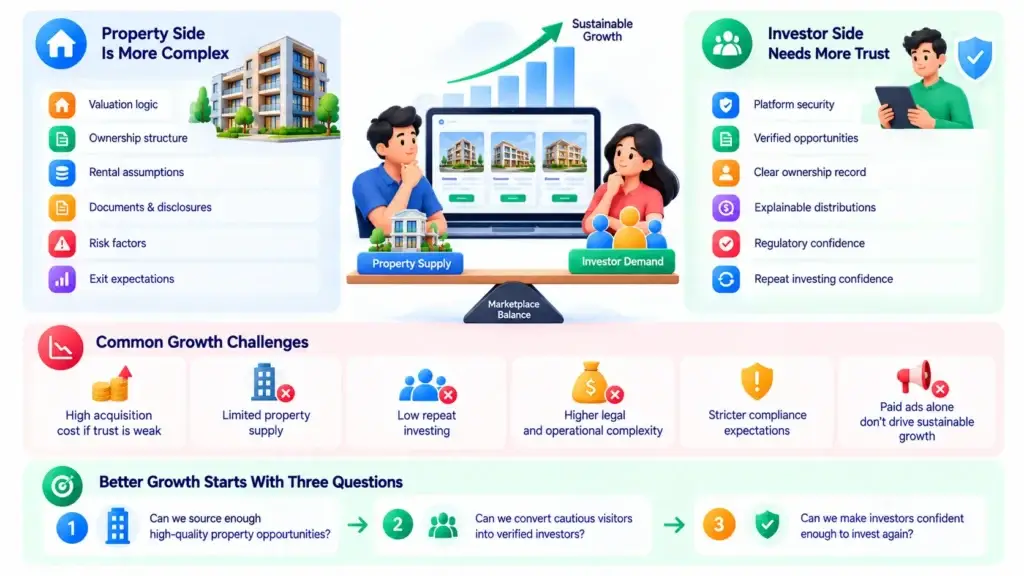
A normal marketplace grows by increasing buyers and sellers. A fractional real estate platform has a more complex challenge because every side of the marketplace carries financial, legal, operational, and trust expectations.
The property side is not just “supply.” Each asset needs valuation logic, ownership structure, rental assumptions, documents, risk disclosures, and exit expectations. The investor side is not just “demand.” Investors need confidence that the opportunity is real, the platform is secure, the ownership record is clear, and distributions can be explained.
This means growth cannot rely only on paid ads or property volume. If investor trust is weak, acquisition spend becomes expensive. If property supply is weak, investors have nothing meaningful to compare. If repeat investing is weak, the platform constantly needs new users to replace inactive ones.
A better growth strategy starts with three questions:
- Can we source enough high-quality property opportunities?
- Can we convert cautious visitors into verified investors?
- Can we make investors confident enough to invest again?
When these three questions are answered together, the platform has a stronger chance of growing sustainably.
The Three Growth Engines of a Fractional Property Investment Platform
A fractional real estate platform grows through three connected engines.
| Growth Engine | What It Means | Why It Matters |
|---|---|---|
| Property supply | Sourcing, underwriting, and publishing credible investment opportunities | Investors need enough quality assets to compare and trust |
| Investor acquisition | Bringing qualified investors into the platform and helping them complete their first investment | The platform needs demand that understands the product |
| Repeat investing | Encouraging existing investors to fund more properties over time | Retention improves lifetime value and reduces acquisition pressure |
The mistake many founders make is overinvesting in one engine while ignoring the others. For example, a platform may run strong acquisition campaigns before it has enough properties. Another may source strong deals but fail to explain them clearly to first-time investors. Another may get early investors but not build the product loops that bring them back.
These three engines also shape the wider fractional real estate platform business model, because revenue growth depends on how property supply, investor acquisition, distributions, platform fees, and repeat investment behavior work together.
The strongest approach is to design property supply, investor acquisition, and repeat investing as one operating system.
Build Property Supply Before You Scale Investor Demand
Property supply is the foundation of a fractional real estate platform. But supply should not mean uploading every available property. Investors are not browsing casually; they are evaluating whether an asset deserves capital.
A strong supply strategy starts with a clear acquisition thesis. The platform should know what types of properties it wants to offer, what investor profile it serves, what ticket size makes sense, and what risks it is willing to explain.
For example, one platform may focus on income-generating residential properties in established neighborhoods. Another may focus on commercial assets with predictable lease terms. Another may focus on developer-led opportunities where the upside is higher but the risk profile needs clearer explanation.
The founder’s job is not simply to “add listings.” It is to create a repeatable property pipeline.
Property Supply Sources to Prioritize
A platform can build supply through several channels:
- Property developers with upcoming or completed inventory
- Real estate brokers with access to off-market opportunities
- Asset managers managing income-producing properties
- Family offices or syndicators digitizing private investment access
- Real estate agencies that want to create investment products
- Existing landlords looking for partial liquidity or structured exits
Each source has a different operating requirement. Developers may want speed and capital access. Brokers may want placement fees or deal visibility. Asset managers may want investor reporting. Family offices may want controlled access rather than public distribution.
A platform should document these differences because the partner pipeline affects both product workflow and sales strategy.
Define Property Selection Criteria Investors Can Understand
Investor trust improves when property selection feels disciplined. If every listing appears random, investors have to do too much work on their own. If the platform explains why each property fits the investment thesis, the user journey becomes easier.
Property selection criteria may include:
- Location quality and demand drivers
- Rental yield assumptions
- Occupancy history or projected lease-up timeline
- Property condition and maintenance expectations
- Developer or seller track record
- Legal documentation readiness
- Exit assumptions and liquidity expectations
- Currency, country, and investor eligibility rules
- Minimum investment amount and target investor profile
The goal is not to remove risk. Real estate investment always carries risk. The goal is to make the decision framework visible so investors understand how opportunities are reviewed.
A platform that explains its property thesis clearly can use that same logic across landing pages, investment memos, email campaigns, webinar content, and in-app property detail pages.
Turn Underwriting Into a Growth Asset
Many founders treat underwriting as a back-office process. In fractional real estate, underwriting can become a growth asset because it gives investors reasons to trust the platform.
A strong underwriting workflow should not stay hidden inside spreadsheets. The platform should translate the important parts into investor-facing education:
- Why this location matters
- What rental assumptions are being used
- What costs or reserves are considered
- What documents are available for review
- What the investment structure means
- What could affect distributions
- What exit options may or may not exist
This does not mean overwhelming users with technical detail. It means creating layered transparency. A beginner should understand the opportunity quickly, while a more serious investor should be able to go deeper.
This is where product structure matters. Property records, document storage, investment calculators, ownership registers, wallet flows, and distribution histories should support the same story. When the back office and investor experience operate from the same data, the platform becomes easier to trust.
A strong fractional real estate investment platform architecture connects these workflows behind the scenes, so investor-facing property data, finance records, document access, ownership entries, and reporting modules stay aligned as the platform grows.
Acquire Investors Through Education Before Conversion
Investor acquisition in fractional real estate should not begin with “Invest now.” Most users need education before they are ready to fund a property. They may understand real estate, but not fractional ownership. They may understand investing, but not SPV-based property investment structures. They may like the property, but still wonder how rental income, exits, investor eligibility, and ownership records work.
That is why educational acquisition works well for this category.
Useful acquisition content includes:
- “How fractional property investing works”
- “How rental distributions are calculated”
- “What investors should check before funding a property”
- “How property-backed investment platforms manage ownership records”
- “How secondary market exits may work in fractional property investing”
- “How to compare two real estate investment opportunities”
For founders building an investor education funnel, a real estate crowdfunding platform can support property discovery, investor onboarding, campaign-style funding workflows, document access, and structured capital participation without making the user journey feel overly complex.
These topics attract users who are problem-aware but not yet vendor-ready. Once they understand the model, they are more likely to explore the platform.
A founder should treat education as part of the conversion funnel, not just blog traffic. Educational content can feed email sequences, webinars, calculators, onboarding screens, investment memo templates, and investor support conversations.
Reduce First-Investment Friction With Better Onboarding
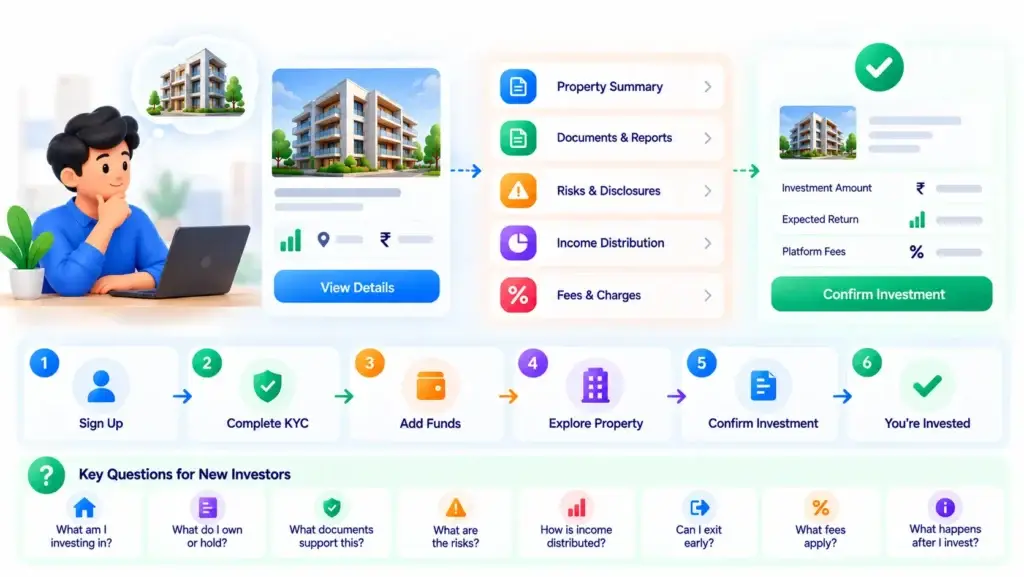
The first investment is the hardest conversion. A new investor has to trust the platform, understand the property, complete onboarding, pass verification where required, fund a wallet or payment method, review documents, and confirm the subscription.
Every unclear step creates drop-off.
A strong first-investment journey should answer:
- What am I investing in?
- What do I own or hold?
- What documents support this opportunity?
- What are the risks?
- How is income distributed?
- Can I exit before the property is sold?
- What fees apply?
- What happens after I invest?
The platform should not hide these answers deep in legal documents. It should bring them into the investor experience through tooltips, summaries, FAQs, property memos, order summaries, and confirmation screens.
A first-time investor is not only buying a share in a property. They are deciding whether the platform deserves ongoing trust.
This is why core fractional property investment platform features should support the full investor journey, including property discovery, verification, wallet funding, document access, portfolio tracking, ownership visibility, distribution updates, and admin-side investor management.
Use Investor Segmentation Instead of One Generic Funnel
Not all investors behave the same way. A fractional property platform may attract beginners, experienced real estate investors, expatriates, high-income professionals, family-office clients, or existing private investors moving from offline deals to digital access.
Each segment needs different messaging.
| Investor Segment | What They Care About | Best Growth Angle |
|---|---|---|
| First-time real estate investors | Simplicity, education, low confusion | Explain the model clearly and reduce jargon |
| Experienced investors | Yield assumptions, documents, risk details | Provide deeper property data and comparison tools |
| Expatriate investors | Currency, access, remote investing, reporting | Highlight multi-currency and cross-border clarity |
| Existing private investors | Trust, reporting, transparency, records | Show portfolio visibility and distribution history |
| Wealth managers or advisors | Controls, documentation, credibility | Provide structured reporting and audit-ready workflows |
Segmentation affects landing pages, email campaigns, webinars, property recommendations, investor dashboards, and customer support. The more relevant the message, the lower the acquisition friction.
Make Repeat Investing a Product Loop, Not Just a Marketing Campaign
Repeat investing happens when users feel confident after the first transaction. That confidence comes from platform behavior over time.
An investor is more likely to invest again when they can see:
- Their portfolio clearly
- Their ownership records
- Property updates
- Rental distribution history
- Upcoming opportunities
- Comparable assets
- Exit options or secondary market activity
- Clear support responses
- Transparent fee and performance information
This means repeat investing is not only an email campaign. It is a product loop.
The investor dashboard should make progress visible. The platform should remind users when new opportunities match their interests. Property updates should make investors feel informed. Distribution events should reinforce trust. Secondary market activity should show that liquidity planning exists, even if exits are not guaranteed.
A platform that only contacts investors when asking for more money will struggle. A platform that keeps investors informed between investments builds a stronger retention base.
Build Trust Through Distribution and Reporting Discipline
In fractional real estate, the post-investment experience is just as important as the pre-investment pitch. Investors want to know what happened after funding.
Even when distributions are not immediate or guaranteed, communication must be clear. Silence creates doubt. Confusing reporting creates support tickets. Poor visibility reduces repeat investment.
Useful reporting workflows include:
- Property performance updates
- Rent collection updates where relevant
- Expense and reserve explanations
- Distribution announcements
- Portfolio summaries
- Tax or document availability notices where applicable
- Ownership certificate access
- Activity history and audit trails
The goal is to reduce uncertainty. Investors should not have to ask basic questions about what they own, what changed, or when the next update is expected.
This is one reason founders should think carefully about the admin and finance layer of the platform. Growth is not only driven by what users see on the homepage. It is also driven by how accurately the platform records ownership, money movement, documents, and communication.
Use Liquidity Carefully as a Growth Lever
Liquidity is attractive in fractional real estate, but it must be positioned carefully. A secondary marketplace or exit workflow can improve investor confidence because users feel there may be a path out before the full property sale. But liquidity should not be oversold.
A responsible platform should explain:
- Whether secondary transfers are supported
- Whether buyers must be eligible or verified
- Whether platform approval is needed
- How pricing is determined
- Whether exit windows exist
- Whether liquidity depends on buyer demand
- What fees apply to secondary transactions
When explained honestly, liquidity can support growth. It reduces the psychological barrier for new investors and can encourage repeat investing. But unrealistic liquidity promises can damage trust.
The stronger positioning is simple: provide structured exit workflows where possible, but never imply guaranteed resale demand.
Growth Metrics Founders Should Track
A fractional property platform should track more than website traffic and signups. The most useful metrics connect property supply, investor behavior, and repeat investment.
| Growth Area | Metrics to Track | Why It Matters |
|---|---|---|
| Property supply | Deals sourced, deals approved, time to publish, document readiness | Shows whether the platform has investable inventory |
| Investor acquisition | Visitor-to-signup rate, KYC completion, first funding rate | Shows whether users trust the platform enough to start |
| First investment | Property-page conversion, wallet funding, subscription completion | Shows where investment friction exists |
| Retention | Repeat investment rate, portfolio login frequency, update engagement | Shows whether investors stay active |
| Liquidity | Secondary listing activity, buyer interest, completed transfers | Shows whether exit workflows are useful |
| Trust | Support tickets, document views, failed verification, refund requests | Shows where confidence breaks down |
These metrics help founders avoid vanity growth. A platform with many signups but few funded investors may have an education or trust issue. A platform with strong investor interest but limited assets may have a supply problem. A platform with first-time investments but no repeat activity may have a reporting or retention problem.
Where Miracuves Fits Into the Growth Journey
Growth strategy becomes easier when the platform foundation already supports the core workflows. Founders should not have to manually stitch together investor onboarding, property records, wallet flows, ownership registers, distribution workflows, and operator controls after launch.
Miracuves helps founders build ready-made and white-label app platforms with source-code ownership, branded design, admin control, and faster deployment. For fractional property operators, a launch-ready platform foundation can reduce the time spent building basic flows and allow the team to focus earlier on property supply, investor education, market positioning, and retention.
A white-label fractional real estate platform is especially useful when founders want branded investor experiences, property listing workflows, wallet logic, portfolio dashboards, and operator controls without starting every core module from zero.
Where the ready-made scope fits, Miracuves’ 6-day delivery timeline can help founders move faster from planning to a working platform experience. Final readiness for real investors still depends on live provider setup, security hardening, jurisdiction-specific legal review, and the operator’s own permission to conduct investment activity.
For teams comparing ready-made deployment with a longer custom build, the fractional real estate platform development cost should be evaluated around feature scope, investor workflows, payment integrations, localization needs, compliance-support modules, and post-launch customization.
If you are planning a property-backed investment platform and want to evaluate the technology foundation, you can explore Miracuves’ launch-ready fractional property investment platform</a> to see how investor, operator, finance, and partner workflows can be structured under one system.
Common Growth Mistakes to Avoid
Mistake 1: Launching Investor Campaigns Before Property Supply Is Ready
Paid traffic cannot fix weak inventory. If users arrive and find too few credible opportunities, they may not return. Build enough property depth before scaling acquisition.
Mistake 2: Treating Compliance and Trust as Footer Content
In property investment, trust is part of the product. Eligibility, documentation, agreements, risk explanations, and operator controls should appear throughout the investor journey.
Mistake 3: Overpromising Liquidity
A secondary market can support confidence, but it should not be sold as guaranteed exit. Be clear about demand, approval, pricing, and transfer conditions.
Mistake 4: Ignoring Post-Investment Communication
Investors who receive no updates after funding may not invest again. Reporting, distributions, portfolio visibility, and property updates support retention.
Mistake 5: Measuring Growth Only by Signups
Signups are not enough. Track verified investors, funded wallets, first investments, repeat investments, property views, document engagement, and distribution engagement.
Final Thoughts
A fractional real estate platform does not grow because it has a property listing page. It grows when credible supply, educated investors, and repeat investment loops work together.
The strongest operators build trust before asking for capital. They source properties with a clear thesis, explain investment opportunities transparently, reduce onboarding friction, communicate after investment, and keep investors engaged with new opportunities and portfolio visibility.
For founders, the real question is not only “Can we launch the platform?” It is “Can we build a system where property supply, investor demand, and repeat investing reinforce each other?”
A strong technology foundation helps, but growth comes from disciplined execution. When the product, operations, and investor journey are aligned, a fractional property platform has a better chance of becoming a durable investment ecosystem rather than a one-time launch.
A strong technology foundation helps, but growth comes from disciplined execution. When the product, operations, and investor journey are aligned, a fractional property platform has a better chance of becoming a durable investment ecosystem rather than a one-time launch. For founders who need implementation support, working with a fractional real estate platform development company can help connect product strategy, investor workflows, admin control, and branded deployment more efficiently.
FAQs
What is the best growth strategy for a fractional real estate platform?
The best strategy is to balance property supply, investor acquisition, and repeat investing. A platform needs credible investment opportunities, educational acquisition funnels, smooth onboarding, transparent reporting, and product loops that bring investors back after their first investment.
How do fractional real estate platforms attract investors?
They attract investors through education, transparent property information, clear risk explanation, strong onboarding, trust signals, referral programs, webinars, performance updates, and content that explains how property-backed investing works.
Why is property supply important for fractional real estate growth?
Property supply determines whether investors have enough credible opportunities to compare and fund. Weak supply reduces trust and makes acquisition less efficient, while disciplined property sourcing improves investor confidence.
How can a property investment platform encourage repeat investing?
Repeat investing improves when investors can see portfolio performance, receive property updates, access distribution history, discover relevant new deals, and understand exit options. Retention depends on confidence after the first investment.
What role does a secondary marketplace play in platform growth?
A secondary marketplace can reduce investor hesitation by offering a structured potential exit path. However, platforms should explain that liquidity depends on buyer demand, eligibility, pricing, and approval workflows.
What metrics should founders track after launching a fractional property platform?
Important metrics include property approval rate, investor signup rate, KYC completion, wallet funding, first investment conversion, repeat investment rate, property update engagement, distribution engagement, and secondary market activity.
Can Miracuves help launch a fractional property investment platform quickly?
Yes. Miracuves offers ready-made and white-label app foundations with source-code ownership, admin control, and a 6-day delivery timeline where the ready-made scope fits. Final real-investor readiness depends on provider integrations, security hardening, legal review, and operating permissions.
Miracuves is an independent software development company. We are not affiliated with, connected to, sponsored by, or endorsed by any company or product named in this article.
Terms such as “X Clone” are used descriptively. It is how the software industry refers to building a platform with functionality comparable to a known service, and how clients search for it.
The entire design and codebase of our products is built by our own team. Our products contain no code, design, graphics, or content originating from any third-party website or applications.
All third-party names and marks referenced in this article are the property of their respective owners, referenced solely to identify the services discussed.