Key Takeaways
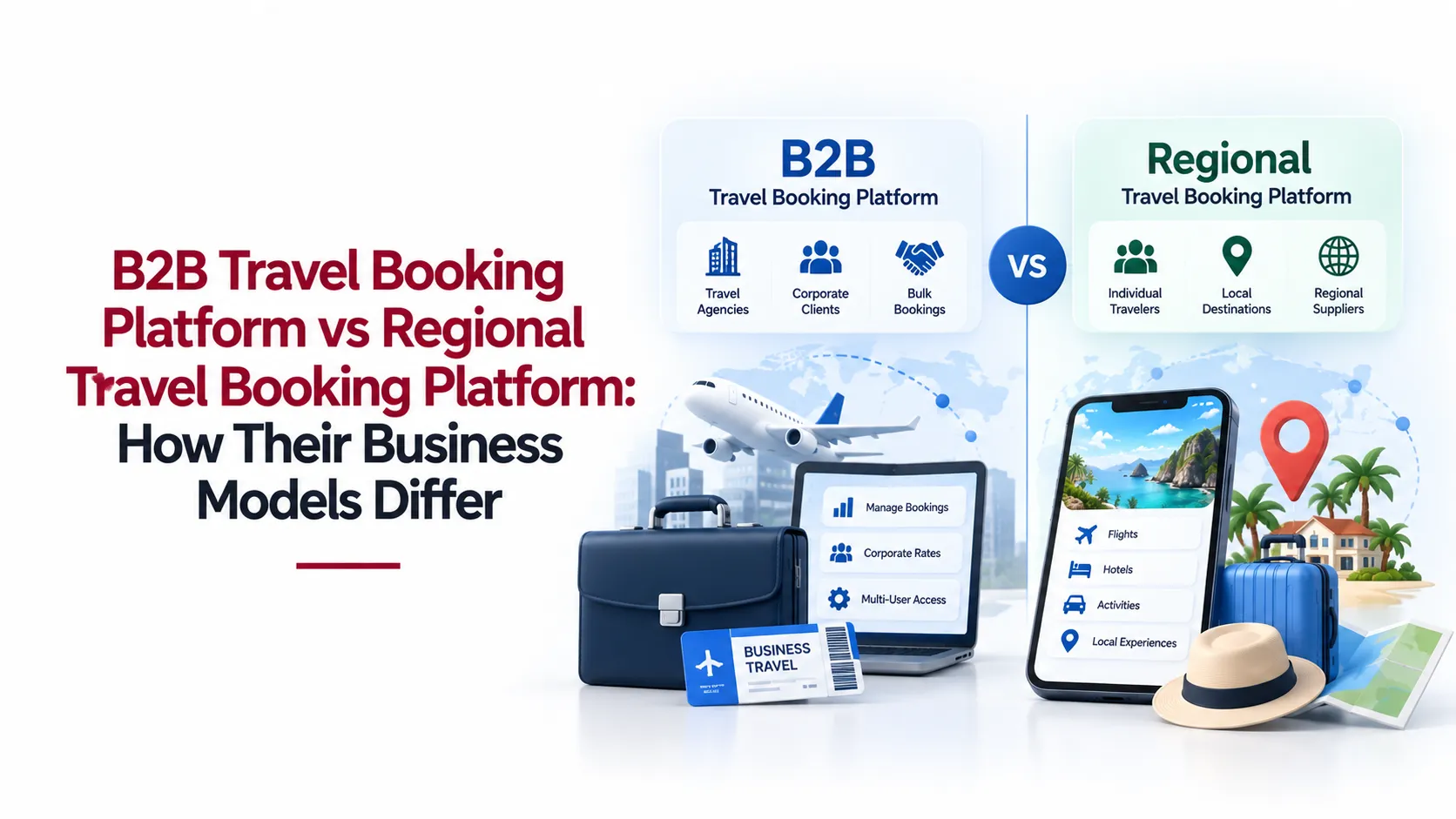
- B2B vs regional travel booking platforms differs mainly in target users, inventory distribution, pricing logic, commissions, booking workflows, and customer relationships.
- B2B travel platforms primarily serve agents, agencies, resellers, and corporate partners, while regional platforms can connect travelers directly with local hotels, suppliers, activities, and transportation services.
- Both models require supplier APIs, inventory management, reservations, payments, cancellations, reporting, and settlements, but the commercial and operational workflows are structured differently.
Business Model Comparison Signals
- B2B platforms focus on negotiated rates, agent markups, credit limits, wallets, sub-agent accounts, commission structures, bulk bookings, vouchers, and reseller reporting.
- Regional travel platforms focus more on destination discovery, local inventory, traveler search, direct checkout, supplier visibility, regional packages, reviews, and customer support.
- B2B revenue can come from markups, commissions, subscription plans, and transaction fees, while regional marketplaces can combine booking commissions, supplier fees, service charges, promoted listings, and travel packages.
Founder Decision Insights
- Founders targeting agencies and resellers should prioritize agent onboarding, negotiated inventory, markup controls, credit management, commissions, booking statements, and partner settlements.
- Founders targeting regional travelers should prioritize local supplier acquisition, destination search, availability, transparent pricing, secure payments, booking management, and localized travel experiences.
- Miracuves develops customizable B2B and regional travel booking platforms with supplier integrations, inventory, agent management, traveler workflows, payments, commissions, settlements, analytics, and admin controls.
Travel startups often begin with one big question: should the business serve travelers directly, or should it serve agents, corporates, suppliers, and travel resellers?
That question decides the business model.
A B2B travel booking platform is built around partners. It helps travel agents, corporate travel desks, resellers, franchise partners, and business clients access inventory, manage bookings, apply markups, track commissions, issue invoices, and serve their own customers.
A regional travel booking platform is built around traveler demand. It helps users search and book flights, hotels, buses, cabs, packages, activities, local experiences, or stays in a specific region, destination, or market.
Both models can work. But they require different revenue logic, product workflows, marketing channels, supplier relationships, and operational controls.
The smartest startup decision is not choosing the bigger-looking model. It is choosing the model your market, team, supplier access, and budget can operate well.
What Is a B2B Travel Booking Platform?
A B2B travel booking platform helps businesses sell or manage travel.
The end traveler may still exist, but the direct customer of the platform is usually an agent, corporate desk, reseller, franchise partner, tour operator, or travel business.
A B2B travel platform may support:
- Travel agent login
- Corporate travel dashboard
- Sub-agent accounts
- Reseller pricing
- Markup control
- Credit limits
- Wallet or deposit balance
- Booking on behalf of customers
- Agent commissions
- Corporate travel approvals
- Invoice generation
- Settlement reports
- Supplier inventory access
- Group bookings
- Offline-to-online travel workflows
In this model, the platform creates value by helping travel businesses sell faster, manage records better, and access inventory from one controlled system.
The revenue is often relationship-led. Instead of depending only on millions of consumer app downloads, the platform grows through agents, corporate accounts, resellers, and managed travel partners.
What Is a Regional Travel Booking Platform?
A regional travel booking platform is built for traveler demand in a defined market.
It may focus on one country, one state, one tourism region, one destination cluster, or one type of traveler.
A regional travel platform may support:
- Destination search
- Hotel and stay booking
- Bus, cab, or local transport booking
- Flights where supplier access is available
- Holiday packages
- Local activities
- Homestays
- Tour operators
- Wallet and loyalty
- Coupons and offers
- Reviews and ratings
- Cancellations and refunds
- Traveler support
- Supplier payouts
In this model, the platform creates value by helping travelers discover, compare, book, pay, and manage trips in one place.
Revenue usually depends on booking volume, supplier partnerships, margins, service fees, add-ons, repeat usage, and marketplace trust.
The Core Difference: Partner-Led vs Traveler-Led Growth
The biggest difference is how the platform grows.
A B2B travel booking platform grows through partner networks. One agent can bring many customers. One corporate account can generate repeated bookings. One reseller network can expand distribution without every customer coming directly through paid ads.
A regional travel booking platform grows through traveler demand. It needs strong search visibility, destination content, app engagement, offers, reviews, supplier quality, and trust-building.
B2B Travel Booking Platform vs Regional Travel Booking Platform
| Comparison Area | B2B Travel Booking Platform | Regional Travel Booking Platform |
|---|---|---|
| Primary users | Agents, sub-agents, resellers, corporate travel desks, tour operators, and travel businesses. | Travelers, families, groups, local tourists, destination visitors, and direct consumers. |
| Growth model | Partner-led distribution through agents, corporate accounts, and managed reseller networks. | Traveler-led demand through search, content, offers, loyalty, reviews, and repeat bookings. |
| Revenue logic | Agent markup, commission split, subscription, credit limits, service fees, corporate plans, and inventory access. | Supplier commission, service fees, package margins, featured listings, add-ons, wallet, loyalty, and repeat bookings. |
| Operational focus | Approvals, invoices, statements, credit control, agent roles, corporate policies, and settlement reports. | Search quality, supplier availability, checkout, refunds, reviews, local inventory, and customer support. |
| Best startup fit | Founders with travel agency networks, corporate contacts, negotiated inventory, or reseller relationships. | Founders with regional destination knowledge, supplier access, local brand trust, and consumer marketing capability. |
Revenue Model Difference
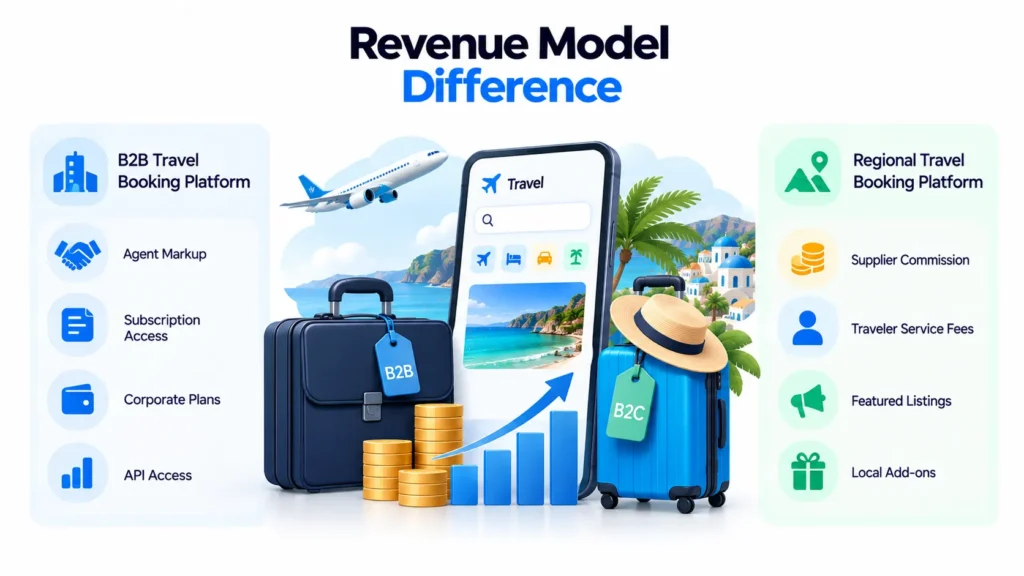
The B2B model and the regional model both earn from bookings, but the revenue structure is different.
A B2B travel booking platform usually earns through controlled partner relationships.
Common B2B revenue streams include:
- Agent markup
- Commission split
- Corporate travel plans
- Subscription access
- Wallet deposits
- Credit limit fees
- Booking service charges
- API access
- White-label reseller accounts
- Reporting and invoice tools
- Supplier margin sharing
A regional travel booking platform usually earns through consumer and supplier transactions.
Common regional platform revenue streams include:
- Supplier commission
- Traveler service fees
- Package margins
- Featured listings
- Sponsored placements
- Local activity add-ons
- Transport add-ons
- Wallet and loyalty activity
- Cancellation or convenience fees where appropriate
- Seasonal campaign partnerships
Neither model is automatically better. A B2B model may bring higher relationship value per account, while a regional model may build a stronger direct consumer brand.
The right model depends on how your startup can acquire demand, control supply, and manage operations.
Cost Structure Difference
The cost structure also differs.
A B2B travel platform may spend more on:
- Sales teams
- Agent onboarding
- Corporate account management
- Partner training
- Settlement operations
- Credit control
- Invoice management
- Custom reports
- Relationship support
- Supplier negotiation
A regional travel platform may spend more on:
- Consumer marketing
- SEO and destination content
- App campaigns
- Coupon campaigns
- Customer support
- Local supplier onboarding
- Brand trust
- Reviews and ratings
- Refund handling
- Loyalty programs
B2B costs are usually more sales-led. Regional platform costs are usually more marketing-led.
For a startup, this distinction matters. If the founder already has agent relationships or corporate buyers, a B2B model may reduce early customer-acquisition pressure. If the founder has strong local destination knowledge and consumer reach, a regional model may create better brand value.
Product Workflow Difference
A B2B travel booking platform needs workflows that help partners sell and manage bookings.
Important B2B workflows include:
- Agent login
- Sub-agent management
- Customer booking on behalf of travelers
- Markup control
- Wallet or credit balance
- Booking statements
- Commission tracking
- Corporate approvals
- Travel policy rules
- Invoice generation
- Department-wise reports
- Settlement records
A regional travel booking platform needs workflows that help travelers search, compare, trust, book, and return.
Important regional platform workflows include:
- Destination search
- Category filters
- Supplier listings
- Availability display
- Price comparison
- Secure checkout
- Booking confirmation
- Cancellation request
- Refund tracking
- Reviews and ratings
- Loyalty points
- Saved traveler profiles
- Customer support
Founders should avoid mixing both models too early. A platform can support both eventually, but the launch experience should prioritize the model that creates the fastest path to real bookings.
Supplier Strategy Difference
Travel platforms depend on supply. The difference is how that supply is used.
In a B2B model, suppliers are usually connected to help agents or corporate buyers access bookable inventory. The focus is on reliability, negotiated rates, markups, credit terms, invoices, and settlement.
In a regional model, suppliers are part of the traveler-facing experience. Listings, photos, descriptions, amenities, availability, reviews, pricing, and cancellation policies directly affect conversion.
A B2B platform needs supplier depth that partners can sell confidently. A regional platform needs supplier quality that travelers can trust.
Supplier strategy may include:
- Hotels
- Homestays
- Bus operators
- Cab providers
- Activity operators
- Tour package suppliers
- Destination partners
- Insurance partners
- Payment partners
- Local travel operators
The platform should make supplier onboarding and inventory control simple enough for real-world use.
Booking Operations Difference
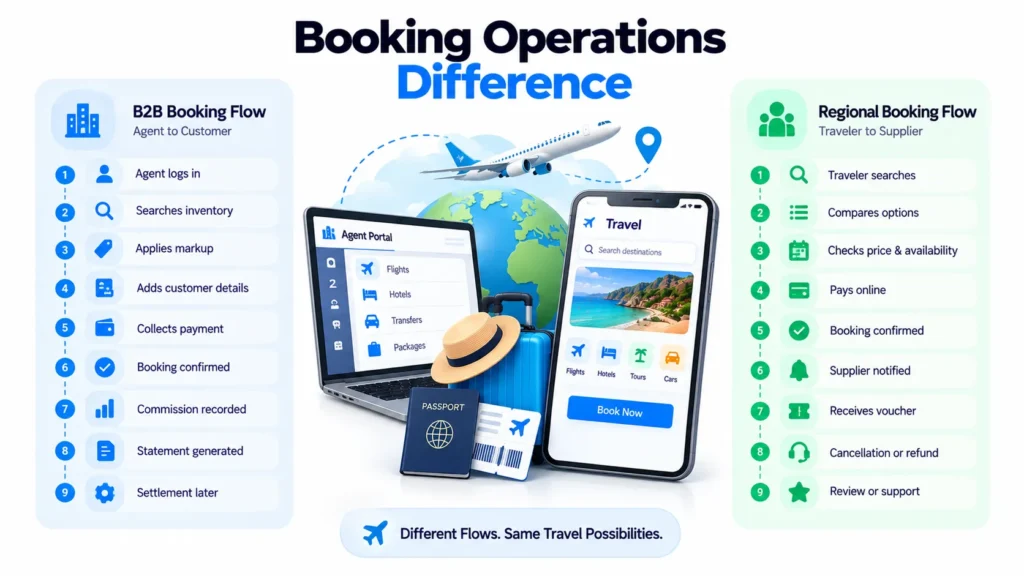
Booking operations are where the business model becomes real.
A B2B booking flow may look like this:
- Agent logs in.
- Agent searches inventory for a customer.
- Agent applies markup.
- Customer details are added.
- Payment is collected through wallet, credit, or external method.
- Booking is confirmed.
- Commission is recorded.
- Statement is generated.
- Settlement is handled later.
A regional traveler-facing booking flow may look like this:
- Traveler searches destination or category.
- Traveler compares options.
- Traveler checks price, availability, and rules.
- Traveler pays online.
- Booking is confirmed.
- Supplier is notified.
- Traveler receives voucher or itinerary.
- Cancellation, refund, review, or support workflow may follow.
The first flow is partner-operations heavy. The second flow is user-experience heavy.
A strong travel business may eventually need both. But early-stage startups should avoid building every workflow before validating which side creates demand.
Margin and Commission Control
Margin control is critical in both models.
In a B2B travel booking platform, the operator may need to configure:
- Agent markup
- Sub-agent markup
- Commission percentage
- Credit limits
- Corporate pricing
- Supplier rates
- Service fees
- Settlement terms
- Custom pricing by partner
In a regional travel booking platform, the operator may need to configure:
- Category commission
- Supplier commission
- Package margin
- Coupon rules
- Featured listing price
- Seasonal discount
- Service fee
- Wallet credit
- Loyalty reward value
- Refund fee rules
The admin dashboard should allow operators to adjust margins without needing developers for every change.
For founders comparing commissions, margins, agents, supplier revenue, corporate plans, wallet activity, and category-level monetization, this travel booking platform business model guide can support deeper planning.
Technology and Platform Requirements
The two business models need overlapping technology, but some priorities differ.
A B2B platform should prioritize:
- Agent portal
- Corporate dashboard
- Role-based access
- Credit limits
- Wallet balance
- Commission reports
- Invoice generation
- Approval workflows
- Settlement records
- Partner-specific pricing
A regional platform should prioritize:
- Fast search
- Mobile-first booking
- Supplier listing pages
- Availability checks
- Secure checkout
- Coupons and offers
- Reviews and ratings
- Loyalty system
- Refund tracking
- Traveler support
A complete travel platform may include both. But the launch roadmap should not become overloaded.
For readers who need a simpler product-flow explanation before deeper model planning, this guide explains how a travel booking platform works from search and availability to checkout, confirmation, refunds, and admin control.
Founders planning user roles, agent workflows, supplier dashboards, booking states, checkout, wallet, loyalty, refunds, and admin control can also review the travel booking platform features needed to operate a scalable travel marketplace.
Which Model Fits Startups Better?
The answer depends on the founder’s advantage.
A B2B travel booking platform may fit better when:
- You already know agents or corporate buyers.
- You can negotiate supplier inventory.
- Your market still depends on assisted travel booking.
- You want lower consumer marketing dependency.
- You can manage settlement, invoices, and partner support.
- You want relationship-led growth.
A regional travel booking platform may fit better when:
- You understand a specific destination or region deeply.
- You can onboard local suppliers.
- Travelers are searching for better local booking options.
- You can invest in SEO, content, app marketing, and offers.
- You want to build direct consumer brand value.
- You can manage reviews, refunds, loyalty, and support.
A hybrid model may fit later when the platform has enough operational maturity to support both traveler demand and partner-led distribution.
Founder Decision Signals
Distribution Advantage
Choose B2B if you already have agent, reseller, corporate, or travel partner relationships. Choose regional if you can attract travelers directly through search, content, offers, and local trust.
Supplier Control
Choose B2B if negotiated rates and partner access matter most. Choose regional if local inventory quality, listing trust, reviews, and direct booking experience matter most.
Revenue Path
B2B platforms often monetize through markups, commissions, subscriptions, corporate plans, and settlement workflows. Regional platforms often monetize through commissions, service fees, package margins, add-ons, and loyalty.
Operational Readiness
B2B needs strong partner management and finance workflows. Regional platforms need stronger customer support, supplier quality control, refunds, reviews, and consumer retention.
Can One Platform Support Both Models?
Yes, but founders should phase the rollout carefully.
A platform may start as a regional traveler-facing marketplace, then add agent access after supplier depth improves. Another platform may begin as a B2B travel portal, then add a consumer booking app later.
A phased model may look like this:
Phased Growth Path for Travel Booking Startups
| Stage | B2B Priority | Regional Priority |
|---|---|---|
| Launch | Agent portal, supplier inventory, markup, wallet, commission, and statements. | Destination search, supplier listings, checkout, booking confirmation, refunds, and support. |
| Early Traction | Add sub-agents, credit limits, corporate accounts, invoices, and partner reports. | Add reviews, loyalty, coupons, local packages, activities, and seasonal offers. |
| Scale | Add API access, reseller portals, corporate policies, settlement automation, and advanced reports. | Add more regions, categories, supplier tools, app campaigns, personalization, and retention loops. |
Startup Checklist: Choosing the Right Travel Booking Model
Before choosing a B2B or regional travel booking model, founders should confirm:
- Who is the first paying customer?
- Is demand partner-led or traveler-led?
- Which travel categories are needed first?
- Which suppliers are already available?
- Are agents or corporate buyers part of the launch plan?
- Will the platform need credit limits or wallet deposits?
- How will commissions and markups be managed?
- How will refunds and cancellations be handled?
- Does the platform need loyalty and coupons from day one?
- Which admin roles are required?
- Who manages customer support?
- Who manages supplier support?
- How will revenue be tracked?
- How will settlements be reconciled?
- Which model can be validated fastest?
If you are comparing launch-ready options, this guide on ready-made travel booking platform options explains how scripts, features, pricing, and rollout scope should be evaluated before development.
Common Mistakes Founders Should Avoid
Choosing B2B Without Partner Relationships
A B2B model depends on agents, resellers, corporate buyers, or business travel partners. Without relationships, sales cycles can become slow.
Choosing Regional Without Supplier Depth
A regional travel platform needs reliable hotels, stays, transport, activities, or packages. Without strong supply, traveler acquisition becomes expensive.
Mixing Both Models Too Early
Agent portals, corporate dashboards, consumer booking apps, loyalty, suppliers, refunds, and settlements can overload an early startup if launched together without focus.
Ignoring Finance Operations
Both models need clear records for payments, refunds, commissions, markups, wallet balances, supplier payouts, and reconciliation.
Founders should also plan how they will attract travelers, agents, suppliers, and early bookings after the platform is ready. This guide on travel booking platform launch marketing explains what to prioritize before and after going live.
How Miracuves Helps Founders Launch Travel Booking Platforms
Miracuves helps founders, travel agencies, tour operators, regional travel businesses, and B2B travel operators launch ready-made and white-label booking platforms with branded design, source-code ownership, supplier workflows, payment integrations, agent portals, corporate travel workflows, and admin control.
Businesses exploring broader travel and hospitality launch paths can also review Miracuves’ travel booking solutions for related platform models.
For founders evaluating a launch-ready product foundation, Miracuves’travel booking platform foundation can help review traveler flows, supplier connections, booking categories, payments, margins, agent workflows, corporate travel, loyalty, and operator controls.
If you are comparing budget and rollout scope, review Miracuves’ guide on travel booking platform development cost.
For vendor evaluation, this page on choosing a travel booking development partner can help you understand what to check before selecting a team.
When the ready-made scope fits the rollout requirement, Miracuves can support 6-day solution delivery, helping founders move faster without building every traveler, supplier, agent, corporate, payment, margin, refund, loyalty, and admin workflow from zero.
Final Thoughts: Choose the Model Your Startup Can Operate Best
A B2B travel booking platform and a regional travel booking platform are both valid startup models, but they are built for different strengths.
Choose a B2B model when your advantage is relationships: agents, corporates, suppliers, resellers, negotiated rates, and managed travel operations.
Choose a regional model when your advantage is destination focus: local supply, traveler trust, search visibility, packages, experiences, and repeat consumer bookings.
The best model is not the one with the longest feature list. It is the one your startup can sell, operate, support, and improve consistently.
Start focused, validate the revenue engine, build operational control, and expand only when the platform has enough data and process maturity to support the next layer.
FAQs
What is the difference between a B2B travel booking platform and a regional travel booking platform?
A B2B travel booking platform serves agents, corporates, resellers, and travel businesses. A regional travel booking platform serves travelers directly in a specific destination, region, or travel category.
How does a B2B travel booking platform make money?
A B2B travel booking platform can earn through agent markups, commission splits, subscription access, corporate travel plans, wallet deposits, credit limits, API access, service fees, and settlement-based workflows.
How does a regional travel booking platform make money?
A regional travel booking platform can earn through supplier commissions, traveler service fees, package margins, featured listings, local activity add-ons, transport add-ons, coupons, wallet activity, loyalty, and seasonal campaigns.
Which travel booking model is better for startups?
The better model depends on the founder’s advantage. B2B may fit founders with agent or corporate relationships. Regional booking may fit founders with destination knowledge, supplier access, and consumer marketing strength.
Can one travel platform support both B2B and regional booking?
Yes. A platform can support both over time, but founders should usually validate one model first. Adding agents, corporates, suppliers, consumers, loyalty, refunds, and settlements all at once can create operational complexity.
What features are important in a B2B travel booking platform?
Important features include agent login, sub-agent accounts, markup control, wallet balance, credit limits, commission tracking, invoice generation, corporate approvals, statements, settlement records, and admin reports.
What features are important in a regional travel booking platform?
Important features include destination search, listings, filters, availability, pricing, secure checkout, booking confirmation, cancellation and refund workflows, reviews, loyalty, offers, support, supplier dashboards, and admin control.
Can Miracuves help launch a B2B or regional travel booking platform?
Yes. Miracuves helps founders launch ready-made and white-label travel booking platforms with branded design, supplier workflows, payment integrations, agent portals, corporate travel workflows, admin dashboards, source-code ownership, and customization support. A 6-day launch may apply when the ready-made scope matches the rollout requirement.
Miracuves is an independent software development company. We are not affiliated with, connected to, sponsored by, or endorsed by any company or product named in this article.
Terms such as “X Clone” are used descriptively. It is how the software industry refers to building a platform with functionality comparable to a known service, and how clients search for it.
The entire design and codebase of our products is built by our own team. Our products contain no code, design, graphics, or content originating from any third-party website or applications.
All third-party names and marks referenced in this article are the property of their respective owners, referenced solely to identify the services discussed.