Key Takeaways
- A regional travel booking platform should combine flights, hotels, car rentals, tours, payments, traveler accounts, supplier inventory, booking management, and admin operations.
- Travelers need unified search, filters, availability, price comparison, booking confirmation, itinerary management, cancellations, refunds, notifications, and customer support across every travel category.
- Regional relevance depends on local currencies, languages, payment methods, taxes, destination content, supplier partnerships, cancellation rules, and market-specific traveler preferences.
Multi-Service Booking Signals
- Flight and hotel modules can support destination search, dates, fare or room comparison, filters, real-time availability, traveler details, add-ons, booking policies, and confirmations.
- Car rental workflows may include pickup and drop-off locations, vehicle types, pricing, availability, deposits, insurance options, driver requirements, extras, and reservation modifications.
- Tour and activity features can cover destination discovery, schedules, ticket types, participant limits, pickup details, packages, vouchers, reviews, cancellation rules, and booking management.
Regional Operations Insights
- Supplier integrations should synchronize inventory, rates, availability, booking status, confirmations, cancellations, commissions, and settlement data across travel providers.
- Operators should manage multi-currency payments, local gateways, promotions, refunds, supplier payouts, taxes, localization, analytics, customer support, and role-based admin controls.
- Miracuves develops customizable regional travel booking platforms with flights, hotels, cars, tours, supplier integrations, payments, itinerary management, localization, analytics, and admin controls.
A regional travel booking platform is not just a website where users search for tickets and rooms. It is a complete travel commerce system that connects travelers, suppliers, local operators, payment systems, support teams, and business owners through one controlled digital platform.
For founders, travel agencies, tourism brands, and regional operators, the real question is not simply, “Can users book travel online?” The better question is, “Can the platform handle flights, hotels, cars, and tours in a way that feels simple for travelers and manageable for the business?”
That is where feature planning becomes important. A travel booking platform must make discovery easy, pricing transparent, payments secure, bookings manageable, and operations scalable. It also needs enough admin control so the platform owner can manage suppliers, commissions, cancellations, offers, refunds, and support without depending on developers for every small change.
This guide explains the must-have features a regional travel booking platform should include, why each feature matters, and how founders can think about building a travel product that supports both customer convenience and long-term business growth.
Why Regional Travel Booking Platforms Need a Different Feature Strategy
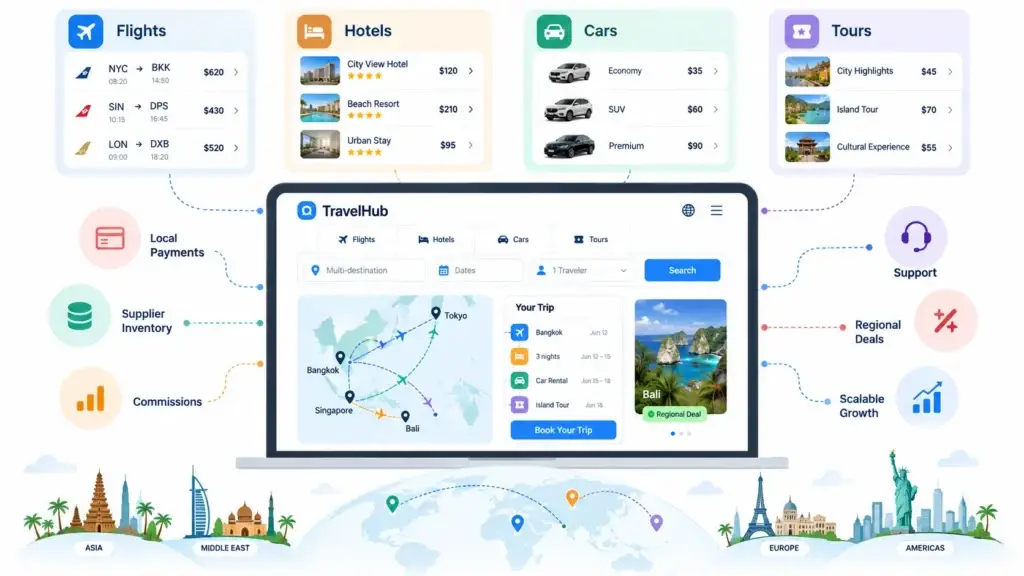
A regional travel booking platform has a different job from a generic global travel portal. It must reflect how people actually travel in a specific market.
In some regions, users may combine flights with local cabs, guided tours, local stays, weekend packages, or regional transport options. In others, travelers may care more about local payment methods, domestic routes, language support, travel agent assistance, or package deals for families and groups.
That means the feature list should not be copied blindly from large travel businesses. It should be built around local behavior.
A regional travel platform usually needs to answer these questions:
- Can users search and compare travel options quickly?
- Can the platform combine flights, hotels, cars, and tours into one trip flow?
- Can suppliers manage their own inventory?
- Can the business owner control commissions and markups by category?
- Can users cancel, reschedule, or request support without confusion?
- Can the platform promote regional destinations, seasonal deals, and local packages?
- Can the system scale from one region to multiple cities, destinations, or countries?
The goal is not to overload the product with every possible feature. The goal is to include the right features that make booking easier for travelers and operations smoother for the platform owner.
Core User Features Every Regional Travel Booking Platform Should Include
The user side of a travel booking platform must feel simple, fast, and trustworthy. Travelers are usually comparing multiple options, checking dates, reviewing prices, and making decisions that involve money, time, and personal plans.
If the user flow is confusing, they leave. If pricing is unclear, they hesitate. If confirmation is delayed, they lose trust.
Here are the core user-facing features a regional travel booking platform should include. For a deeper module-by-module breakdown, founders can also review this travel booking platform feature set before finalizing their build scope.
Easy Sign-Up and User Profiles
Users should be able to register through email, phone number, one-time password, or social login depending on the target market. Once registered, they should have a profile where they can manage personal details, saved travelers, payment preferences, loyalty rewards, support requests, and past bookings.
For regional travel platforms, saved traveler details are especially useful because many users book for family members, colleagues, or groups. A simple profile system reduces repeat data entry and speeds up future bookings.
Smart Search Across Flights, Hotels, Cars, and Tours
Search is the heart of any travel booking platform. Users should be able to search by destination, date, category, budget, travel type, and availability.
A strong regional travel search experience should include:
- Flight search by route, date, fare class, stops, and timing
- Hotel search by destination, date, rating, amenities, and price
- Car search by pickup location, drop location, vehicle type, and rental duration
- Tour search by destination, activity type, group size, language, and schedule
The key is not just to show results. The platform should help users compare options clearly.
Filters, Sorting, and Personalized Recommendations
Travelers rarely book the first option they see. They filter, compare, and shortlist.
Useful filters include price range, rating, distance, amenities, cancellation policy, duration, pickup location, package type, and availability. Sorting options should include price, popularity, customer rating, earliest departure, shortest duration, and recommended deals.
For regional travel platforms, personalized recommendations can also highlight local experiences, weekend packages, seasonal routes, nearby stays, or curated tour bundles.
Transparent Pricing and Fare Breakdown
Travel pricing can become confusing if base price, taxes, convenience fees, add-ons, discounts, and cancellation rules are not shown clearly.
A regional travel booking platform should show the full price breakdown before payment. This includes supplier price, platform markup, service fee, taxes, discounts, add-ons, and refund rules where applicable.
Transparent pricing reduces support tickets and improves booking confidence.
Saved Trips, Wishlist, and Itinerary Planning
Many travelers research before they book. A wishlist or saved trip feature allows users to save hotels, tours, cars, and routes for later comparison.
An itinerary planner can help users combine flights, hotel stays, car rentals, and tours into one organized trip view. This is especially useful for regional tourism platforms, destination marketplaces, and travel agencies moving online.
Secure Payments and Multiple Payment Options
Payment flexibility matters because regional markets often have different preferred payment methods. A strong travel platform should support cards, wallets, local payment gateways, promo codes, partial payments where relevant, and invoice-based payments for business users if needed.
The payment flow should be secure, mobile-friendly, and connected to booking confirmation. The user should know exactly when a booking is confirmed, pending, cancelled, or refunded.
Booking History and Trip Management
Users should be able to view all confirmed, pending, completed, cancelled, and refunded bookings from one dashboard.
Trip management should include:
- Tickets and vouchers
- Hotel confirmations
- Car booking details
- Tour schedules
- Cancellation options
- Refund status
- Support tickets
- Invoice downloads
- Traveler details
This feature becomes more important as the platform expands across multiple booking categories.
Reviews, Ratings, and Trust Signals
Reviews help users make decisions, especially for hotels, tours, local operators, and car rentals.
A regional travel platform should allow verified reviews after completed bookings. It should also support ratings for cleanliness, punctuality, service quality, location, value, and overall experience depending on the category.
For the platform owner, review moderation is equally important. Admin teams should be able to detect spam, remove abusive content, and respond to disputes.
Core Feature Areas and Their Business Value
| Feature Area | Business Value | Founder Impact |
|---|---|---|
| Smart Search | Helps travelers discover flights, hotels, cars, and tours faster. | Improves conversion by reducing search friction. |
| Transparent Pricing | Shows fees, taxes, discounts, and add-ons before checkout. | Reduces abandoned bookings and payment disputes. |
| Supplier Integration | Connects live inventory from travel suppliers and local partners. | Allows the platform to scale inventory without manual updates. |
| Admin Dashboard | Controls users, suppliers, commissions, bookings, refunds, and offers. | Gives founders operational control after launch. |
| Cancellation and Refund Flow | Helps users manage booking changes clearly. | Builds trust and reduces support workload. |
Flight Booking Features for a Regional Travel Platform
Flight booking is often the highest-intent feature in a travel platform because users expect fast search, real-time availability, and reliable confirmation.
A flight booking module should include one-way, round-trip, and multi-city search. It should support filters for airlines, stops, departure time, arrival time, baggage, fare rules, duration, and refundability.
For a regional platform, domestic routes, regional airports, local fare classes, and preferred payment options may matter more than global complexity.
Important flight booking features include:
- Route-based flight search
- Passenger count and class selection
- Fare comparison
- Baggage information
- Seat selection where supported
- Fare rules and cancellation terms
- Booking confirmation
- E-ticket generation
- Refund and rescheduling workflow
- Admin control over markup and service fees
The business layer matters as much as the user interface. The platform owner should be able to set category-specific margins, apply service fees, manage promotional discounts, and track confirmed versus failed bookings.
Without backend control, flight booking becomes difficult to operate profitably.
Hotel Booking Features That Improve Trust and Conversion
Hotels are decision-heavy. Users compare photos, price, location, amenities, room types, meal plans, cancellation policies, and reviews before booking.
A hotel booking module should make that comparison easy.
Key hotel booking features include:
- Destination and date-based hotel search
- Room availability
- Room type selection
- Meal plan display
- Photo gallery
- Amenities list
- Map-based location view
- Guest ratings and verified reviews
- Cancellation policy
- Pay-now or pay-later options where relevant
- Booking voucher generation
For regional travel businesses, direct hotel onboarding can be a major advantage. Many local hotels, homestays, boutique stays, and guesthouses may not be deeply represented on large global platforms. A regional booking platform can differentiate itself by adding local inventory, negotiated packages, and destination-specific offers.
The supplier side should also allow hotels to manage room availability, rates, images, booking policies, and payout details.
Car Booking Features for Local Mobility and Trip Completion
Cars, cabs, and transfers help complete the travel experience. A traveler who books a flight and hotel may also need airport pickup, city transfer, rental car, chauffeur service, or intercity ride.
A regional travel booking platform should include car booking features if the business wants to serve the full trip journey.
Useful car booking features include:
- Pickup and drop location
- One-way and round-trip transfer options
- Vehicle category selection
- Hourly rental or daily rental options
- Driver details where applicable
- Fare estimate
- Add-on options such as extra luggage or child seat
- Real-time booking status
- Cancellation rules
- Admin commission and vendor payout tracking
For founders, car booking is not only an extra feature. It can become an additional revenue stream and improve customer retention by keeping more of the trip inside one platform.
Tours and Activities Features for Regional Differentiation
Tours and activities can give a regional travel platform its strongest local identity. Flights and hotels are often functional, but tours create discovery, emotional value, and destination-level differentiation.
A tours module should allow users to browse experiences by location, category, date, duration, price, group size, and language.
Important tour booking features include:
- Activity listing pages
- Tour schedules
- Availability calendar
- Group size selection
- Duration and itinerary details
- Local guide information
- Pickup point details
- Inclusions and exclusions
- Cancellation terms
- Instant or request-based booking
- Voucher generation
For regional tourism businesses, tours can include city walks, adventure activities, cultural experiences, food tours, pilgrimage routes, local events, nature trips, and curated holiday packages.
This module also gives the platform owner more flexibility because many local tour operators can be onboarded directly through supplier dashboards.
Supplier and Vendor Features for Inventory Control
A travel platform cannot scale if every booking, rate update, image change, or availability update depends on the admin team.
Supplier dashboards are important because hotels, car providers, tour operators, and local partners need a way to manage their own inventory.
A supplier dashboard should allow partners to:
- Add and update listings
- Manage availability
- Upload photos
- Set pricing
- Define cancellation rules
- View bookings
- Accept or reject requests where needed
- Track payouts
- Respond to support issues
- Update business profile details
For founders, supplier dashboards reduce manual operations and make the platform more scalable. They also improve partner relationships because suppliers can control their own information and respond faster.
Admin Dashboard Features Every Founder Should Prioritize
The admin dashboard is the control center of the travel booking business. It decides whether the platform can be managed professionally after launch.
A strong admin dashboard should not only display data. It should help the platform owner take action.
Important admin features include:
- User management
- Supplier management
- Booking management
- Category management
- Commission and markup settings
- Payment tracking
- Refund management
- Promo code management
- Loyalty program control
- Support ticket management
- Role-based staff access
- Reports and analytics
- Content and banner management
- Notification management
- Review moderation
For regional platforms, category-level control is especially important. Flights, hotels, cars, and tours do not always follow the same commission logic. The platform owner may need different margins, refund rules, supplier agreements, and promotion strategies for each category.
A ready-made travel booking foundation from Miracuves’ regional travel solution can help founders start with these operational layers already structured, instead of building each control panel from zero.
Founder Decision Signals
Speed
If your market opportunity depends on launching before a peak travel season, a ready-made travel booking platform can reduce the time spent building core booking flows from scratch.
Cost
Cost is not only development expense. Founders should also consider missed bookings, supplier onboarding delays, and operational inefficiency caused by weak backend control.
Scalability
A regional platform should support more cities, suppliers, travel categories, and payment methods as the business grows.
Market Fit
The platform should reflect local travel behavior, local inventory, local payment choices, and the booking habits of the target audience.
Payment, Wallet, Refund, and Cancellation Features
Travel bookings involve payment risk because inventory can change, suppliers may fail to confirm, users may cancel, and refunds may depend on category-specific rules.
That is why payment and refund logic must be planned carefully.
A travel booking platform should include:
- Secure payment gateway integration
- Payment status tracking
- Booking status sync
- Refund workflow
- Cancellation policy display
- Wallet or credit balance where relevant
- Promo code support
- Gift card or voucher support if needed
- Failed payment handling
- Payment reports for admin teams
The user should never be confused about what happened after payment. If a booking is confirmed, they should receive a confirmation. If it is pending, the status should be visible. If it fails, the refund path should be clear.
For founders, this is a trust issue. Payment confusion creates support pressure and damages repeat booking potential.
This is also where monetization planning becomes important. A platform owner should understand how commissions, service fees, markups, add-ons, supplier payouts, and refunds affect the overall travel booking platform business model before setting category-wise pricing rules.
Offers, Loyalty, and Retention Features
Travel platforms should not depend only on first-time users. Repeat bookings, seasonal campaigns, and loyalty programs can improve long-term growth.
Useful retention features include:
- Promo codes
- First-booking discounts
- Referral rewards
- Wallet cashback
- Loyalty tiers
- Seasonal deals
- Destination-specific offers
- Package discounts
- Email and push notification campaigns
- Abandoned search reminders
Regional platforms can use offers strategically around festivals, holidays, local events, weekend travel, school vacations, pilgrimage routes, or destination campaigns.
The admin dashboard should allow non-technical teams to create and manage these campaigns.
Localization Features for Regional Travel Markets
A regional travel booking platform should feel local, not generic.
Localization may include:
- Local language support
- Local currency
- Local payment gateways
- Regional destinations
- Local festivals and seasonal packages
- Domestic travel categories
- Regional customer support
- Local tax and invoice formats
- Location-based recommendations
Localization improves trust because travelers feel the platform understands their market. It also helps the business compete on relevance rather than only price.
Analytics and Reporting Features for Smarter Decisions
Founders need visibility into what is working and what is not.
A strong analytics system should show:
- Total bookings
- Revenue by category
- Top destinations
- Best-performing suppliers
- Failed bookings
- Cancellation rate
- Refund volume
- User acquisition sources
- Repeat booking rate
- Promo code performance
- Commission earned
- Support ticket trends
Without analytics, the platform owner has to guess. With analytics, decisions become clearer: which destinations to promote, which suppliers to retain, which categories need improvement, and where users drop off before booking.
Security and Trust Features for Travel Booking Platforms
Security should be built into the platform foundation, not added later.
Important trust and security features include:
- Encrypted data transfer
- Secure payment gateway integration
- Role-based admin access
- Activity logs
- Supplier verification
- User verification where required
- Fraud monitoring signals
- Refund and dispute records
- Permission-based dashboards
- Secure API integration
- Booking history and audit trails
Travel platforms handle personal details, payment information, itineraries, identity-related data in some cases, and supplier records. Founders should treat security as part of the core product, not only as a technical checklist.
For a deeper checklist, founders can also read this travel booking app security guide, especially if the platform will manage supplier records, user profiles, payments, refunds, booking histories, and support workflows.
B2B, Agent, and Corporate Travel Features
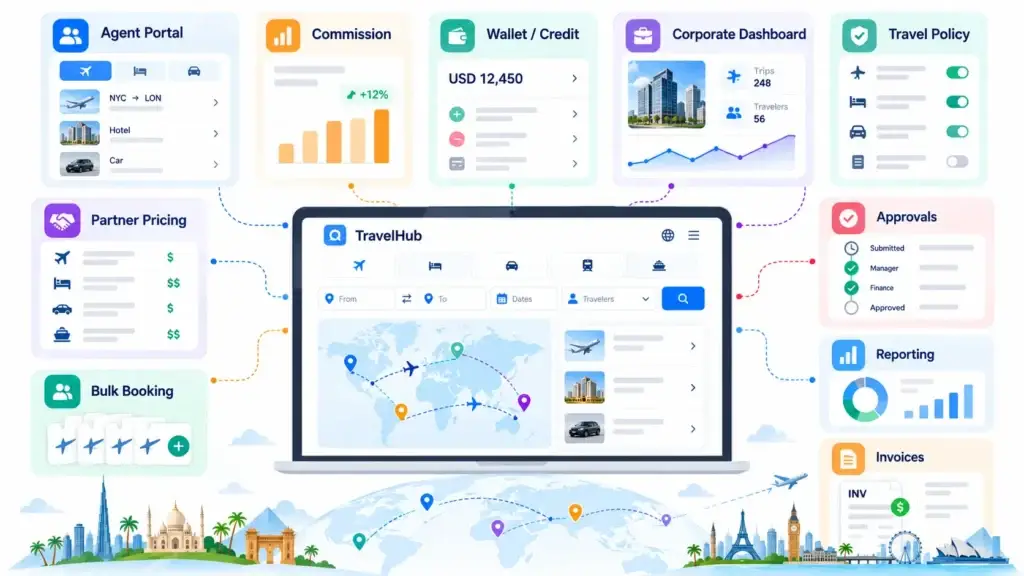
Some regional travel platforms serve more than direct consumers. They may also support travel agents, corporate clients, local operators, or reseller networks.
Depending on the business model, useful B2B features may include:
- Agent portal
- Agent commission tracking
- Credit limit or wallet balance
- Corporate booking dashboard
- Employee travel policies
- Approval workflows
- Department-wise reporting
- Invoice generation
- Bulk booking support
- Partner-specific pricing
These features are useful when the platform wants to serve agencies, small businesses, corporate travel managers, or regional reseller networks.
Not every founder needs these features at launch. But if B2B travel is part of the business model, these workflows should be planned early.
White-Label and Source-Code Ownership Features
A regional travel booking platform should represent the founder’s brand. That means custom logo, colors, domain, app name, content, supplier structure, pricing rules, and customer experience.
White-label control helps founders launch under their own identity. Source-code ownership matters because it gives long-term flexibility, especially when the business needs custom integrations, new categories, regional payment methods, or unique supplier workflows.
This is where a launch-ready regional travel booking platform can support faster validation. Miracuves helps founders start with a ready-made foundation that includes core booking workflows, admin control, source code, and deployment support, with 6-day solution delivery available for ready-made travel platform scope.
Ready-Made vs Custom Travel Platform Development
Founders usually face two paths: build from zero or start with a ready-made foundation. Before deciding, it helps to compare a ready-made travel platform vs custom development approach based on speed, budget, control, and launch risk.
Both can work, but they serve different situations.
| Build Approach | What It Means | Best For | Founder Consideration |
|---|---|---|---|
| Ready-Made Travel Platform | Core booking flows, admin panels, supplier workflows, and app foundation are already built. | Founders who want faster launch and market validation. | Faster deployment, lower initial build complexity, customization still needed for unique market needs. |
| Custom Development | The entire platform is designed and developed from scratch. | Businesses with highly unique workflows or long-term enterprise requirements. | More flexibility, but usually higher cost, longer timeline, and more planning risk. |
| Hybrid Approach | Start with a ready-made base and customize important workflows. | Regional platforms with common booking flows but local business rules. | Often practical for founders who need speed and differentiation together. |
The right choice depends on budget, launch urgency, supplier readiness, customization needs, and business model clarity.
Founders should also be careful about common travel platform development mistakes, especially around weak admin control, unclear refund logic, poor supplier onboarding, and building too many features without validating regional demand.
Mistakes Founders Should Avoid
Building only the customer app and ignoring admin control
A travel platform cannot scale if the owner cannot manage bookings, commissions, cancellations, refunds, suppliers, and support from one dashboard.
Treating flights, hotels, cars, and tours as identical categories
Each travel category has different rules for inventory, pricing, confirmation, cancellation, and supplier management. The platform should reflect those differences.
Skipping supplier dashboards
Without supplier access, every inventory update becomes manual. That slows operations and increases errors as the platform grows.
Leaving refund and cancellation logic unclear
Travelers need clarity before and after payment. Poor cancellation handling quickly creates support pressure and trust issues.
Practical Feature Checklist for a Regional Travel Booking Platform
Use this checklist when planning your platform.
Customer App and Website
- User registration and profile
- Search for flights, hotels, cars, and tours
- Filters and sorting
- Wishlist or saved trips
- Booking checkout
- Payment options
- Trip dashboard
- Cancellation requests
- Refund status
- Notifications
- Reviews and ratings
- Customer support
Flight Module
- One-way, round-trip, and multi-city search
- Fare comparison
- Passenger details
- Baggage information
- Seat selection where available
- Ticket confirmation
- Cancellation and refund rules
Hotel Module
- Destination search
- Room availability
- Room type selection
- Amenities
- Photos
- Map view
- Meal plan
- Booking voucher
- Review system
Car Module
- Pickup and drop location
- Vehicle type
- Rental duration
- Transfer booking
- Fare estimate
- Driver or provider details
- Cancellation rules
Tours Module
- Activity listing
- Schedule management
- Group size
- Tour itinerary
- Guide details
- Inclusions and exclusions
- Pickup points
- Voucher generation
Supplier Panel
- Listing management
- Availability control
- Pricing updates
- Booking view
- Payout tracking
- Policy management
Admin Panel
- User management
- Supplier management
- Booking management
- Commission settings
- Refund workflow
- Promo code control
- Reports and analytics
- Support management
- Role-based permissions
How Miracuves Supports Faster Travel Platform Launches
Miracuves helps founders, agencies, and travel businesses launch white-label, source-code-owned travel booking platforms with customer apps, supplier workflows, admin control, and monetization-ready modules.
For founders who do not want to build every booking flow from zero, Miracuves offers a ready-made travel platform foundation that can support flights, hotels, cars, tours, payments, supplier management, and admin operations. The solution can be rebranded for your business and deployed faster when the selected scope fits the ready-made package.
If you are planning a regional travel business, the stronger decision is not only choosing features. It is choosing the right platform foundation and a reliable travel app development partner that can help you test demand, onboard suppliers, manage bookings, and improve the product after launch.
Final Thoughts
A regional travel booking platform succeeds when it makes complex travel decisions feel simple. Flights, hotels, cars, and tours may look like separate modules, but users experience them as one journey. The platform must connect search, pricing, availability, payment, confirmation, cancellation, support, and supplier management into one reliable system.
For founders, the right feature set should support three goals: better booking convenience for travelers, stronger operational control for the business, and enough flexibility to adapt to local travel behavior.
A ready-made, white-label foundation can help reduce the time spent building standard travel workflows and allow the business to focus more on supplier partnerships, regional positioning, marketing, and customer experience.
FAQs
What features should a regional travel booking platform include?
A regional travel booking platform should include user registration, flight booking, hotel booking, car booking, tours and activities, secure payments, booking management, cancellations, refunds, supplier dashboards, admin controls, reviews, offers, notifications, and analytics.
Why does a regional travel platform need flights, hotels, cars, and tours together?
Travelers often plan complete trips, not isolated bookings. Combining flights, hotels, cars, and tours helps users manage the full journey in one place while giving the platform owner more revenue opportunities across categories.
What is the most important backend feature for a travel booking platform?
The admin dashboard is one of the most important backend features. It allows the platform owner to manage users, suppliers, bookings, commissions, refunds, promotions, reports, and support workflows from one place.
Should a travel booking platform include supplier dashboards?
Yes. Supplier dashboards help hotels, car providers, tour operators, and other partners manage listings, availability, pricing, booking requests, and payouts. This reduces manual work for the platform owner and improves scalability.
How do regional travel platforms make money?
Regional travel platforms can earn through booking commissions, supplier markups, service fees, featured listings, travel packages, advertising, corporate plans, cancellation fees where applicable, and add-on services such as insurance, visa support, or premium assistance.
Is a ready-made travel booking platform better than custom development?
A ready-made travel booking platform is useful for founders who want faster launch and market validation. Custom development may be better when the business has highly unique workflows. Many founders choose a hybrid approach: start with a ready-made foundation and customize key regional features.
How important is localization in a regional travel booking platform?
Localization is very important. Regional platforms should support local language, currency, payment methods, destination content, customer support, local inventory, and seasonal travel behavior to improve trust and relevance.
Can Miracuves help launch a regional travel booking platform quickly?
Yes. Miracuves provides ready-made and white-label travel booking platform solutions with source code, branding, admin control, supplier workflows, and 6-day solution delivery where the selected scope fits the ready-made package.
Miracuves is an independent software development company. We are not affiliated with, connected to, sponsored by, or endorsed by any company or product named in this article.
Terms such as “X Clone” are used descriptively. It is how the software industry refers to building a platform with functionality comparable to a known service, and how clients search for it.
The entire design and codebase of our products is built by our own team. Our products contain no code, design, graphics, or content originating from any third-party website or applications.
All third-party names and marks referenced in this article are the property of their respective owners, referenced solely to identify the services discussed.