


Building a travel startup is not only about creating a booking screen. A real travel platform has to connect travelers, suppliers, agents, payments, refunds, cancellations, support, pricing rules, and admin control in one reliable system. That is why many founders now compare custom development with a ready-made regional travel booking platform before committing their budget.
Custom development gives flexibility, but it also brings a longer build cycle, higher uncertainty, repeated testing, and more operational risk before the first booking happens. A ready-made platform gives startups a working foundation that can be branded, configured, localized, and improved around a specific market.
For regional travel startups, this difference matters. The first challenge is not building every feature from zero. The first challenge is validating whether travelers, suppliers, agents, and local partners will actually use the platform. A ready-made foundation helps founders reach that learning stage faster while still keeping room for customization, ownership, and growth.
Miracuves helps founders launch travel booking platforms with branded design, admin dashboards, booking workflows, supplier integrations, payment flows, and source-code ownership. For ready-made solution scopes that match the project requirement, Miracuves’ 6-day delivery can help startups move from planning to market testing much faster than a traditional custom build.
Key Takeaways
- A ready-made regional travel booking platform helps startups avoid building every booking, payment, supplier, and admin workflow from zero.
- Custom development can be useful for highly unique travel products, but it often slows down early market validation.
- Regional travel startups need more than app screens. They need supplier readiness, pricing control, secure payments, refund workflows, and operational visibility.
- The strongest ready-made platform is not a shortcut to copying another business. It is a launch-ready foundation that can be adapted to local routes, destinations, user behavior, and revenue logic.
- Miracuves helps founders move faster with white-label travel booking platforms, source-code ownership, admin control, and 6-day delivery where the ready-made scope fits.
Why Regional Travel Startups Think Differently About Development
A regional travel startup usually does not begin with unlimited inventory, national brand recall, or a large engineering team. It begins with a sharper market insight. The founder may know a specific tourist corridor, a pilgrimage route, a holiday destination, a student travel segment, a corporate travel opportunity, or a group of local hotels that need better digital distribution.
That makes regional travel different from generic travel app development. The startup is not simply asking, “Can we build an app?” The better question is, “Can we connect the right supply with the right travelers quickly enough to validate demand?”
This is where a ready-made regional travel booking platform becomes useful. Instead of spending the first several months building login screens, search filters, admin roles, payment flows, booking histories, cancellation logic, and vendor dashboards, founders can start with a working structure and focus on regional execution.
That execution includes deciding which booking categories should launch first, which suppliers should be onboarded, how local pricing should work, what travelers trust, and how support will handle changes after booking. These are business questions, not only technical questions.
Custom Development Sounds Flexible, But It Delays the Real Market Test
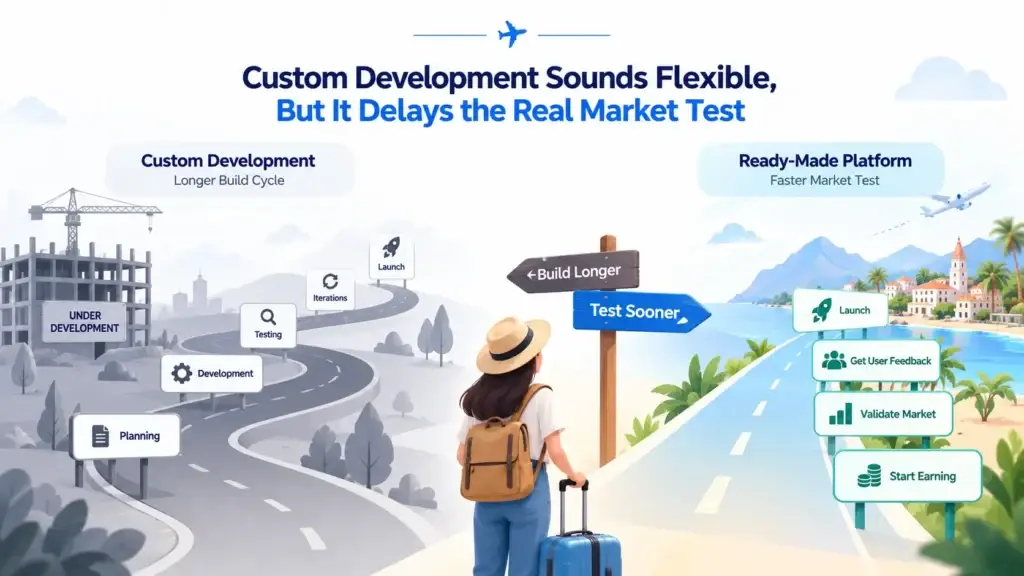
Custom development can be the right choice when a startup is building a completely new travel model with unusual workflows, proprietary inventory logic, or complex enterprise integrations. But for many regional booking businesses, the core workflows are already known: search, compare, select, pay, confirm, manage, cancel, refund, review, and rebook.
The risk is that founders spend too much time building known workflows before they learn what is unknown: whether users will trust the platform, which destinations convert, which suppliers cooperate, which categories create repeat bookings, and which acquisition channels work.
A custom build may give complete freedom, but it can also stretch the distance between idea and evidence. The longer the build cycle, the longer the founder waits before seeing real searches, booking drop-offs, payment failures, support questions, supplier objections, and retention behavior.
For travel startups, those signals are valuable. A founder can debate feature ideas for months, but the market reveals the truth only when travelers search and suppliers receive bookings. A ready-made platform shortens the path to that learning stage.
Ready-Made Does Not Mean Generic When the Platform Is Configured for a Region
Some founders hesitate because they assume ready-made software means a generic product. That concern is valid when the platform is rigid. A regional travel business needs flexibility across destinations, categories, currencies, tax logic, supplier types, language preferences, promotions, booking rules, support flows, and admin permissions.
The better way to judge a ready-made travel platform is not by asking whether it is pre-built. The better question is whether the platform lets the business owner configure the parts that matter in the target market.
For example, one regional travel startup may focus on hotel stays, weekend packages, and cabs. Another may begin with buses, trains, and group travel. A third may need agents and corporate bookings from the start. The foundation can be ready-made, but the launch strategy should still be market-specific.
This is why a white-label travel portal is often more practical for regional founders than building every module from zero. The platform can carry the common booking infrastructure while the startup customizes branding, categories, supplier connections, margins, content, and customer experience around its own region.
The Real Startup Advantage Is Faster Validation, Not Just Faster Development
Speed matters, but only when it creates useful business learning. A startup does not win because the app is launched quickly. It wins when launch speed helps the team test demand, improve operations, and make better decisions before the budget is exhausted.
A ready-made regional travel booking platform can help founders validate several assumptions earlier:
- Which travel categories users search most often
- Which routes, destinations, hotels, packages, or activities convert
- Whether travelers trust the payment and confirmation process
- How often users abandon search or checkout
- Which suppliers are responsive and commercially useful
- Whether agent-led or direct-to-consumer bookings perform better
- Which offers, coupons, and loyalty triggers encourage repeat bookings
These insights are difficult to collect from mockups. They come from real users interacting with real booking flows. A ready-made foundation helps a startup reach that point earlier, which can be more valuable than spending months perfecting assumptions inside a development plan.
Founder Decision Signals
Speed
Choose a ready-made platform when the core booking flows are standard and the business needs to validate demand quickly.
Cost Control
Choose a ready-made foundation when the budget should support suppliers, marketing, support, and operations instead of only engineering.
Scalability
Choose a platform with clear booking architecture, admin controls, supplier workflows, payment logic, and room for future customization.
Market Fit
Choose a regional approach when the opportunity depends on local destinations, specific traveler segments, supplier relationships, and focused demand.
Ready-Made vs Custom Development: What Startups Should Actually Compare
The decision is not simply ready-made versus custom. The real comparison is between two business paths. One path spends more time building the foundation. The other path starts with a foundation and spends more time adapting the product to the market.
For early-stage travel founders, the second path can be more practical because the travel business depends on more than software. It depends on supplier agreements, pricing rules, refund handling, local marketing, user trust, and operational discipline.
Ready-Made Regional Travel Platform vs Custom Development
| Decision Area | Ready-Made Regional Travel Platform | Custom Development From Zero | Founder Impact |
|---|---|---|---|
| Launch Timing | Starts from a working booking foundation that can be branded and configured. | Requires discovery, design, development, testing, and repeated revisions before launch. | Ready-made helps founders reach market feedback faster. |
| Budget Allocation | More budget can move toward supplier onboarding, marketing, support, and regional partnerships. | A larger share of early budget goes into building core infrastructure. | Useful for startups that need to prove demand before expanding scope. |
| Booking Workflows | Core workflows such as search, checkout, confirmation, cancellation, refund, and booking history are already planned. | Every workflow needs to be defined, built, tested, and corrected from scratch. | Reduces avoidable build risk around standard travel operations. |
| Regional Customization | Can be adapted around local categories, destinations, supplier rules, branding, and pricing logic. | Can be deeply customized, but the startup waits longer before testing the market. | Ready-made works well when the business model is regional but the core booking pattern is familiar. |
| Operational Control | Admin dashboards can help manage users, categories, bookings, suppliers, margins, offers, and support. | Admin control must be designed and built as a separate operational layer. | Founders can operate without depending on developers for every small change. |
| Future Expansion | New categories, supplier types, agent workflows, or corporate bookings can be added based on traction. | Expansion is flexible but depends on engineering capacity and roadmap timelines. | Startups can grow in stages instead of overbuilding before validation. |
Why Travel Booking Platforms Are Harder Than They Look
Many founders begin by thinking of a travel platform as a simple app: users search, choose, pay, and receive confirmation. But the difficulty sits behind the screen. Travel booking requires multiple systems to agree with each other at the right moment.
A hotel may show availability but update rates later. A payment may succeed while supplier confirmation fails. A traveler may cancel during a partial refund window. An agent may need to book on behalf of a customer. A corporate user may need manager approval before payment. A local supplier may need a dashboard to update inventory manually.
These situations are not edge cases in travel. They are normal operating realities. A regional travel platform must manage them clearly if the business wants to build trust.
This is why ready-made travel booking platforms are attractive to startups. They reduce the number of foundational problems the team needs to solve before launch. The founder can then focus on market selection, supplier quality, customer acquisition, conversion improvement, and service experience.
Core Platform Layers Startups Should Look for Before Choosing Ready-Made
A ready-made platform is only useful when it includes the operating layers a travel business needs. A basic booking website may not be enough. Founders should check whether the platform can support the entire booking journey from search to post-booking service.
1. Traveler Search and Booking Experience
The traveler experience should feel simple even when the backend is complex. Users need fast search, clear filters, transparent pricing, booking summaries, secure payment, confirmation messages, and easy access to booking history. For regional platforms, the experience should also support local travel patterns such as weekend routes, seasonal destinations, religious trips, group travel, budget stays, local transfers, and custom packages.
2. Supplier and Inventory Workflows
Travel platforms depend on supply. Hotels, homestays, transport operators, activity providers, package sellers, and other suppliers need a way to share inventory, manage availability, view bookings, and understand payouts. Without supplier clarity, the platform may attract users but struggle to fulfill bookings reliably.
3. Agent and Assisted Booking Channels
In many regional markets, assisted booking still matters. Travelers may prefer speaking to a local agent for group trips, family holidays, pilgrimage travel, business movement, or complex itineraries. A platform that supports agents can grow beyond direct app users and build distribution through local relationships.
4. Corporate and Group Travel Logic
Regional travel is not only leisure. Startups may serve small companies, institutions, event groups, education travel, or local business travel. Corporate workflows may need approvals, employee records, billing control, policy rules, travel history, and reporting. Founders should decide early whether this segment is part of the launch or a later expansion.
5. Admin Control and Margin Management
The admin panel is where the travel startup actually runs the business. It should give the operator control over categories, pricing, commissions, margins, coupons, users, suppliers, bookings, refunds, disputes, support tickets, and reporting. If a founder needs developers for every pricing or supplier change, the platform becomes harder to operate at speed.
Founders comparing scope and rollout budget can review this travel booking platform development cost breakdown to understand which modules usually affect planning.
Cost Control Is Not Only About Paying Less for Development
Startup cost control is often misunderstood. The goal is not to choose the lowest possible build. The goal is to avoid spending heavily on the wrong things before the business model is proven.
In a travel startup, engineering is only one part of the budget. The founder also needs money for supplier onboarding, content creation, destination marketing, performance campaigns, support operations, payment setup, app store readiness, local partnerships, and post-launch improvements.
A custom build can consume a large share of early capital before the platform has tested user behavior. A ready-made regional travel booking platform can make the early budget more balanced. Instead of directing most resources toward building standard workflows, the startup can invest earlier in the activities that actually create demand and bookings.
This does not mean ready-made is always the right answer. If the startup has a unique travel concept that cannot fit standard booking flows, custom development may be required. But if the goal is to launch a regional travel marketplace with familiar booking categories and market-specific branding, a ready-made foundation can be the more practical starting point.
How Ready-Made Platforms Help Startups Avoid Overbuilding
Overbuilding is one of the biggest risks in early travel product development. Founders often try to launch with every possible feature: multiple booking categories, loyalty tiers, AI recommendations, complex corporate flows, advanced analytics, multi-language interfaces, custom supplier dashboards, referral campaigns, and detailed automation.
Some of those features may become useful later. But adding everything before market validation can delay launch and confuse the first version of the business. A strong ready-made platform allows the founder to launch with the right essentials and expand in stages.
The smarter approach is to decide which layers are essential for the first market version:
- Which booking categories are necessary on day one?
- Which suppliers are already available or realistic to onboard?
- Will the first users book directly, through agents, or through partners?
- Which payment and refund flows must be stable before launch?
- Which admin controls are needed to run operations daily?
- Which marketing channels will drive the earliest booking signals?
- Which features can wait until real usage data justifies them?
This kind of staged thinking protects the startup from building for imaginary demand. It also helps the team focus on real traveler behavior instead of internal assumptions.
Regional Travel Platforms Need Local Differentiation, Not Just More Features
A regional travel startup cannot always win by offering the largest inventory. It can win by being more relevant to a specific audience. That relevance may come from local destinations, trusted suppliers, better packages, regional language support, curated experiences, reliable assistance, flexible cancellations, or partnerships with local operators.
This is why the product foundation should not absorb all strategic attention. The founder must still build differentiation around the market. A ready-made platform provides the operating system, but the startup’s positioning comes from how it serves the region.
For example, a regional booking platform can differentiate through:
- Curated weekend packages from nearby cities
- Verified local hotels, homestays, and activity providers
- Assisted booking for families, groups, and senior travelers
- Local transport and transfer bundles
- Seasonal offers around festivals, holidays, events, or peak travel windows
- Regional language content and support
- Travel agent partnerships in high-demand local corridors
When the platform foundation is already available, the startup can spend more energy building these local advantages. That is often more useful than spending months recreating the same booking infrastructure that users already expect.
Why Source-Code Ownership Matters for Long-Term Travel Startups
Ready-made software should not trap a founder into a closed system. A travel startup may begin regionally, but future growth can require new suppliers, new categories, new payment options, deeper analytics, partner tools, mobile app improvements, or custom workflows.
Source-code ownership gives the founder more control over that future. It allows the business to extend the platform, review the technical foundation, customize modules, and avoid being fully dependent on a rented system. For startups that want to build a real travel brand, this matters because the platform becomes part of the company’s long-term asset base.
A rented portal may help a business start quickly, but it can limit margin control, supplier flexibility, and product ownership. A custom build may provide ownership but take longer to complete. A source-code-owned ready-made platform sits between these two extremes: faster launch than building from zero, with more control than simply renting access to someone else’s system.
Founders evaluating this path can explore Miracuves’ travel booking app foundation to understand how a launch-ready product can support branding, booking flows, admin control, and source-code ownership.
The Role of Security, Payments, and Refund Trust
Travel bookings involve money, personal data, dates, supplier commitments, and customer expectations. A weak security or refund experience can damage trust quickly, especially for a new regional brand that does not yet have strong market recognition.
Founders should treat security as part of the product foundation, not as a later add-on. Important layers include encrypted data transfer, secure payment gateway integration, role-based access control, audit logs, refund visibility, booking history, supplier verification, admin approval controls, and fraud monitoring signals.
Travelers need to know that their payment is handled safely and their booking status is clear. Suppliers need visibility into bookings and payout records. Operators need control over refunds, support issues, user access, and sensitive admin actions. These trust layers are especially important for regional startups because early user confidence can influence repeat bookings and referrals.
For a deeper operational checklist, founders can review this booking platform security guide before finalizing launch scope.
When Custom Development Still Makes Sense
A ready-made regional travel booking platform is not the correct choice for every founder. Custom development may be better when the business requires a completely new booking model, unique supplier contracts, proprietary recommendation logic, non-standard settlement rules, complex enterprise approval systems, or unusual integrations that cannot be adapted from a ready-made foundation.
Custom development can also make sense for funded teams with strong technical leadership, longer timelines, and a clear product roadmap supported by market evidence. In that case, the team may already know exactly what needs to be built and why.
But many early travel startups are not at that stage. They are still testing market demand, supplier response, category selection, acquisition channels, and booking behavior. For them, a ready-made platform can reduce the cost of learning.
The decision should come down to clarity. If the business model is clear, the workflows are familiar, and speed matters, ready-made can be practical. If the product logic is truly new and cannot fit a proven travel booking structure, custom development may be worth the extra time.
How a Ready-Made Platform Supports Faster Go-To-Market Execution
Go-to-market is not only marketing. It is the coordination between product readiness, supplier readiness, support readiness, and demand generation. A travel startup can run ads and collect signups, but if the platform cannot handle booking confirmation, payment validation, cancellations, or supplier updates, growth can become expensive very quickly.
A ready-made travel booking platform helps founders prepare go-to-market execution around working flows instead of assumptions. The team can test the actual user journey, collect feedback from suppliers, create launch offers, prepare support scripts, and train operations before traffic begins.
This matters because regional travel demand is often seasonal. Holiday windows, festivals, school breaks, business events, and local tourism peaks can create short periods where launch timing matters. A delayed custom build may miss those demand windows. A ready-made foundation can help the startup prepare faster when the market opportunity is time-sensitive.
For founders who want to understand the backend planning behind supplier APIs, payments, booking status, and admin workflows, this regional travel booking architecture guide explains the operational layers in more depth.
Revenue Planning Starts Earlier With a Ready-Made Foundation
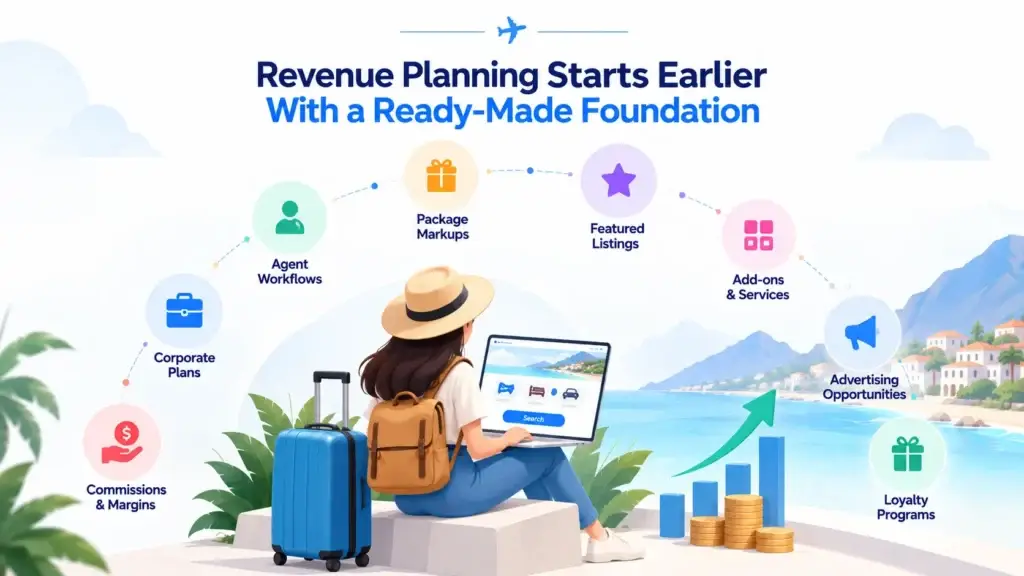
Travel startups should not wait until after launch to think about revenue logic. Booking platforms can earn through category margins, commissions, service fees, package markups, featured listings, agent workflows, corporate plans, add-ons, advertising, loyalty programs, and partner-led services. But each revenue stream needs the right operational support.
For example, a commission model needs supplier agreements and payout visibility. A package margin model needs bundled inventory and clear price control. Agent-led distribution needs agent dashboards, commission rules, statements, and booking history. Corporate travel needs approval workflows, reporting, and billing logic.
A ready-made platform helps founders think about monetization earlier because the operating pieces are already visible. Instead of asking, “Can we earn from this later?” the startup can ask, “Which revenue stream should we activate first in this region?”
Founders planning monetization can use this travel booking business model guide to map revenue streams against suppliers, travelers, agents, and platform operations.
Mistakes Founders Should Avoid When Choosing a Ready-Made Travel Platform
A ready-made platform can reduce launch risk, but only when founders evaluate it properly. Choosing the wrong foundation can create problems later, especially if the product looks polished but lacks operational depth.
Mistakes Founders Should Avoid
Choosing Screens Instead of Workflows
A polished interface is not enough. Founders should check how the platform handles search, booking status, payment validation, supplier updates, cancellations, refunds, support, and admin permissions.
Ignoring Supplier Readiness
A travel platform needs inventory. Before launch, startups should know which suppliers, hotels, activity providers, agents, or transport partners can realistically participate.
Overloading the First Version
Launching with too many categories and features can slow execution. Start with the booking flows and regions that support the strongest demand signals, then expand based on usage.
Forgetting Admin Control
If every margin change, offer update, supplier approval, or refund issue needs developer involvement, the startup will struggle to operate quickly after launch.
Treating Security as a Later Upgrade
Payment safety, role-based access, audit logs, refund controls, and account protection should be planned before launch because trust is central to travel bookings.
What Startups Should Ask Before Choosing Between Ready-Made and Custom
The right development path becomes clearer when founders ask practical questions instead of only comparing timelines. The goal is to understand whether the startup needs invention, validation, or execution.
- Are the core booking workflows standard or highly unique?
- Does the startup already know which categories should launch first?
- Are supplier accounts, local partners, or inventory sources available?
- Does the team need agent, supplier, or corporate booking workflows?
- How important is source-code ownership for future expansion?
- Can the founder operate pricing, offers, refunds, and suppliers from an admin panel?
- Is the first goal to validate demand or build a completely original travel product?
- Will a delayed launch cause the startup to miss a seasonal demand window?
If most answers point toward market validation, operational readiness, and faster rollout, a ready-made regional travel booking platform is usually worth serious evaluation. If most answers point toward a completely new travel model that cannot fit known booking workflows, custom development may be more suitable.
How Miracuves Helps Founders Launch Faster Without Losing Control
Miracuves’ approach is built around faster execution with practical control. Instead of asking founders to wait through a long build cycle before testing demand, Miracuves helps them start with a ready-made and white-label travel booking foundation that can be aligned with the business model, branding, supplier needs, and launch scope.
The value is not only speed. The value is having a platform structure that supports booking operations, admin visibility, monetization planning, and future customization. For ready-made scopes that fit the requirement, 6-day delivery can help founders move faster while keeping the product foundation under their own brand.
This is especially useful for regional travel startups that want to test one city, state, country, travel corridor, destination cluster, or customer segment before expanding. The founder can begin with a focused launch, learn from real bookings, and then improve the platform based on actual usage rather than assumptions.
Final Thoughts: Build Faster, Validate Smarter, and Keep Room to Grow
Startups choose a ready-made regional travel booking platform over custom development because speed, cost control, and operational readiness matter in the early stage. The goal is not to avoid customization forever. The goal is to avoid delaying market learning by rebuilding standard booking infrastructure from zero.
A strong ready-made platform gives founders a practical foundation for travelers, suppliers, agents, payments, refunds, support, admin control, and monetization. From there, the business can adapt the experience around its region, audience, suppliers, and growth plan.
For founders, the better question is not “ready-made or custom?” The better question is “what do we need to prove first?” If the first priority is validating demand, onboarding suppliers, launching under your own brand, and learning from real booking behavior, ready-made can be the stronger starting point. Custom development can always come later when the business has clearer evidence, stronger traction, and more specific product requirements.
FAQs
What is a ready-made regional travel booking platform?
A ready-made regional travel booking platform is a launch-ready software foundation that helps startups sell travel services such as hotels, flights, buses, packages, activities, transfers, and local experiences under their own brand. It usually includes traveler booking flows, supplier workflows, payments, admin controls, and customization options.
Why do startups choose ready-made travel platforms over custom development?
Startups choose ready-made travel platforms because they can reduce launch delays, avoid rebuilding standard booking workflows, control early development risk, and test market demand faster. This helps founders spend more time on suppliers, customers, marketing, and operations.
Is a ready-made travel booking platform suitable for regional markets?
Yes, a ready-made travel booking platform can be suitable for regional markets when it allows customization for local destinations, supplier types, languages, pricing rules, payment preferences, booking categories, and support workflows.
When should a startup choose custom travel app development instead?
A startup should consider custom development when the business model requires highly unique workflows, proprietary supplier logic, complex enterprise integrations, or a product structure that cannot fit a proven travel booking foundation.
What features should founders check in a ready-made travel platform?
Founders should check traveler search, booking management, secure payments, cancellation and refund flows, supplier dashboards, agent workflows, admin controls, margin settings, user roles, reporting, notifications, and customization support.
Can a ready-made travel platform be customized after launch?
Yes, a good ready-made platform should support post-launch customization. Founders can add categories, improve user flows, connect suppliers, adjust pricing, expand marketing features, and adapt the platform based on real user behavior.
How does a ready-made platform help travel startups validate demand?
It helps startups validate demand by reaching launch faster with working booking flows. Founders can then measure searches, bookings, cancellations, supplier response, payment trust, repeat usage, and marketing performance using real market data.
Can Miracuves help launch a regional travel booking platform?
Yes. Miracuves helps founders launch ready-made and white-label travel booking platforms with branded design, booking workflows, supplier logic, payment flows, admin dashboards, source-code ownership, and customization support. A 6-day delivery may apply when the ready-made scope matches the project requirement.
Miracuves is an independent software development company. We are not affiliated with, connected to, sponsored by, or endorsed by any company or product named in this article.
Terms such as “X Clone” are used descriptively. It is how the software industry refers to building a platform with functionality comparable to a known service, and how clients search for it.
The entire design and codebase of our products is built by our own team. Our products contain no code, design, graphics, or content originating from any third-party website or applications.
All third-party names and marks referenced in this article are the property of their respective owners, referenced solely to identify the services discussed.



