


Launching a regional travel booking platform is not only a product challenge. It is a trust, timing, supply, and demand challenge. A founder may have the app ready, suppliers connected, payment flow configured, and destination pages designed, but the platform will still struggle if travelers do not know why they should book through it.
This is where pre-launch and post-launch marketing become very different jobs. Pre-launch marketing is about building confidence before the first booking happens. Post-launch marketing is about turning real users, real searches, real bookings, and real feedback into repeatable growth.
For a regional travel startup, the question is not whether pre-launch or post-launch marketing matters more. The smarter question is: what should be prioritized at each stage so the platform does not waste budget, attract the wrong audience, or launch without enough trust?
This guide explains how travel founders should plan both phases, what metrics matter, what mistakes to avoid, and how a launch-ready product foundation from Miracuves can help teams move faster without treating marketing as an afterthought.
Key Takeaways
- Pre-launch marketing for a regional travel booking platform should focus on audience validation, supplier confidence, destination demand, waitlist growth, and early trust-building.
- Post-launch marketing should focus on booking conversion, user retention, reviews, referral loops, paid acquisition discipline, and repeat travel behavior.
- Regional travel startups should not spend heavily on broad acquisition before confirming which routes, destinations, hotels, experiences, or trip types users actually want.
- The best launch strategy connects product readiness with marketing readiness: search filters, pricing rules, cancellation flows, payment trust, vendor onboarding, and support must match the campaigns being promoted.
- Miracuves helps founders move faster with ready-made and white-label travel booking platforms that can support branded launch plans, admin control, and 6-day deployment where the ready-made scope fits.
Why Regional Travel Platforms Need a Different Marketing Plan
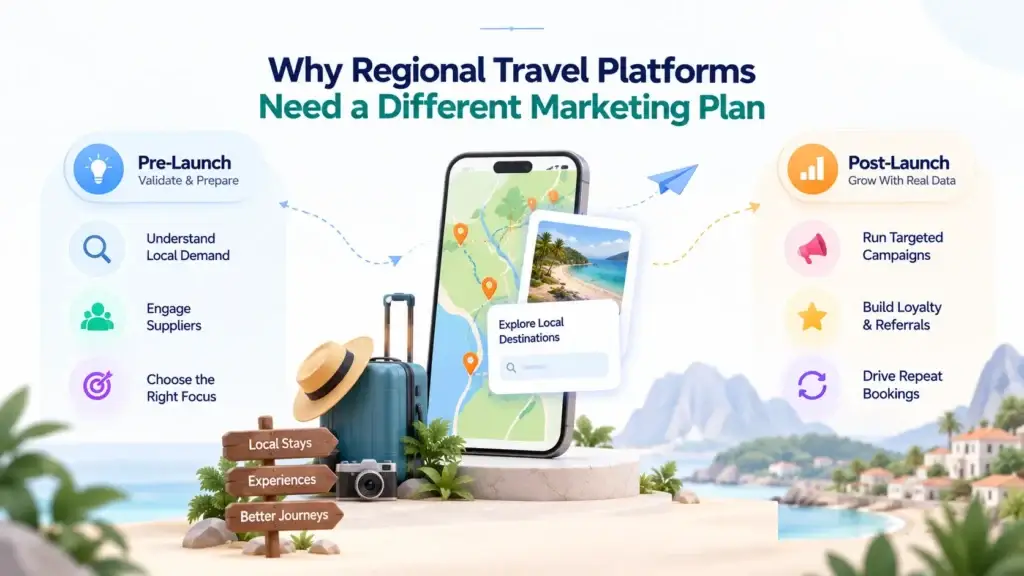
A regional travel booking platform cannot market itself exactly like a large national travel portal. Large platforms usually compete on massive inventory, brand recall, loyalty rewards, and wide coverage. A regional travel startup has a different advantage: it can be more focused, more local, more personal, and more relevant to a specific traveler segment.
That advantage only works when marketing is built around regional intent. A traveler searching for a weekend stay near a specific city does not behave like a traveler comparing international holiday packages. A family booking a pilgrimage trip has different concerns from a student group booking budget transport. A local hotel owner joining a platform has different expectations from a large chain partner.
This is why pre-launch marketing must validate the market before spending heavily. The startup needs to understand which destinations people search for, which seasonal moments drive demand, which suppliers are willing to participate, which trust signals matter, and which booking categories should launch first.
Post-launch marketing then turns those insights into growth. Once travelers start searching, booking, cancelling, reviewing, and returning, the marketing team can work with real behavior instead of assumptions. That is when paid campaigns, app store optimization, retargeting, loyalty, referral offers, and lifecycle messaging become more powerful.
Pre-Launch Marketing: What Travel Startups Should Prioritize Before Going Live
Pre-launch marketing is not about making noise for the sake of attention. For a regional travel booking platform, the pre-launch stage should answer one question: can the startup create enough trust and demand before asking users to book?
The answer depends on how well the founder prepares audience positioning, supplier readiness, regional content, lead capture, and launch offers. A strong pre-launch campaign gives the platform a warm start. A weak pre-launch campaign forces the team to spend more after launch just to explain who they are.
1. Define the Regional Travel Niche Before Promoting the Platform
The first pre-launch decision is positioning. A travel booking platform that tries to serve everyone from day one often struggles to build a clear message. Regional startups should begin with a focused launch wedge.
That wedge could be weekend getaways from one metro city, pilgrimage travel, local homestays, budget bus-and-hotel bundles, curated family holidays, corporate travel for regional companies, or activity-led tourism in a specific geography. The point is not to limit long-term growth. The point is to make the first campaign specific enough that users immediately understand the value.
For example, “book hotels and trips online” sounds generic. “Book verified weekend stays, transfers, and local experiences near your city” is more specific, more regional, and easier to test. The more precise the starting niche, the easier it becomes to create landing pages, search ads, destination content, influencer briefs, supplier pitches, and referral campaigns.
2. Validate Demand Before Spending on Broad App Promotion
Many travel startups make the mistake of launching ads before they know what users actually want to book. Pre-launch marketing should help validate demand signals before paid acquisition begins at scale.
Useful signals include destination search interest, landing page signups, early inquiries, WhatsApp conversations, form submissions, abandoned itinerary requests, social comments, partner referrals, and email waitlist growth. These signals show whether the platform’s first set of destinations and categories match real traveler intent.
At this stage, the goal is not vanity traffic. The goal is evidence. If users are signing up for hill-station packages but ignoring airport transfers, that tells the founder what to prioritize. If corporate travel inquiries are stronger than leisure demand, the launch message may need to shift. If hotel owners respond faster than activity providers, supplier onboarding should begin there.
3. Build a Landing Page That Captures Intent, Not Just Emails
A pre-launch landing page should do more than say “coming soon.” It should help the founder understand what different user groups want. For a travel platform, the page should capture destination preferences, trip frequency, budget range, booking category, travel dates, and preferred communication channel.
A strong landing page can include:
- Clear regional positioning in the hero section
- Primary destination or category focus
- Early access form for travelers
- Partner inquiry form for hotels, activity providers, transport operators, or agents
- Launch offer or early booking incentive
- Trust signals such as support availability, secure payment messaging, and transparent cancellation language
- Simple explanation of how booking will work once the platform goes live
This turns the landing page into a research tool, not just a lead magnet. Every signup gives the founder better clarity on which campaigns, cities, and booking flows should be prioritized first.
4. Start Regional SEO Before the App Launches
Travel search behavior often starts before the traveler is ready to book. People search for destinations, routes, stays, weather expectations, activities, transport options, itineraries, local tips, and budget ideas. This gives regional travel startups a major pre-launch opportunity: build organic visibility before the booking engine is fully live.
Instead of publishing generic travel blogs, the startup should create content tied to its launch market. Examples include “best weekend trips from [city],” “family-friendly stays near [destination],” “how to plan a 2-day trip to [place],” “hotel and transport guide for [route],” and “local experiences to book in [region].” These topics attract users who may later convert into bookings.
Regional SEO also helps supplier conversations. When a hotel, homestay owner, or local tour operator sees that the platform is building destination visibility, the partnership pitch becomes stronger. The platform is not only asking for inventory; it is showing a plan to bring demand.
5. Build Supplier-Side Marketing Before Traveler Demand Peaks
A travel booking marketplace needs both sides to work together. If traveler demand arrives before the platform has enough relevant inventory, users leave. If suppliers join before there is any demand plan, partners lose interest. Pre-launch marketing must therefore include supplier-side communication.
Supplier marketing should explain why regional hotels, hosts, activity providers, cab operators, and travel agents should join early. The message should focus on visibility, direct booking opportunities, dashboard access, booking rules, payout clarity, and regional demand generation.
Founders should prepare simple onboarding assets: a partner page, rate-card explanation, commission logic, cancellation policy overview, listing checklist, dashboard screenshots, and support process. When suppliers understand how bookings, payments, cancellations, and payouts will be handled, they are more likely to participate confidently.
6. Use Micro-Creators for Regional Trust, Not Just Reach
Influencer marketing is useful in travel, but regional startups should avoid choosing creators only by follower count. Local trust matters more. A regional creator who regularly posts about weekend trips, food trails, budget stays, temples, trekking routes, or family travel can often create stronger relevance than a broad lifestyle page.
Before launch, micro-creators can help test messaging. They can promote early access, ask audiences about preferred destinations, collect travel wishlists, introduce local partners, or create short content around upcoming booking categories. This gives the startup both visibility and market feedback.
The best pre-launch creator campaigns do not simply say “download the app soon.” They tell a regional travel story: where people can go, what problem the platform solves, why local discovery is easier, and what early users will get at launch.
7. Prepare Launch Offers Around Booking Behavior
Pre-launch offers should be designed carefully. A discount can attract attention, but it should not train users to book only when prices are heavily reduced. Travel startups should connect offers to the behavior they want to encourage.
Examples include early access credits for first bookings, referral rewards after successful booking completion, destination-specific launch deals, limited-period partner offers, or loyalty points for verified bookings. For regional platforms, the offer should support marketplace liquidity, not just installs.
A founder should ask: does this offer help us get real bookings, repeat users, supplier confidence, or useful data? If the answer is no, the campaign may create temporary noise without improving the platform’s launch quality.
Post-Launch Marketing: What Travel Startups Should Prioritize After Going Live
Once the platform goes live, the marketing job changes. The startup now has real app behavior, booking funnels, cancellation patterns, support queries, user reviews, and campaign data. Post-launch marketing should use this data to improve growth quality.
The biggest mistake after launch is chasing downloads without tracking bookings. Travel apps do not win because users install them once. They win when users search, compare, trust, pay, complete trips, review their experience, and return for the next journey.
1. Optimize for Bookings, Not Just App Installs
Post-launch campaigns should be measured against booking behavior. Installs matter, but they are only the beginning. A regional travel platform should track how many users complete searches, open listings, compare prices, add traveler details, reach checkout, complete payment, and return after the trip.
If many users install the app but do not search, the onboarding message may be weak. If users search but do not open listings, inventory or pricing may be unclear. If users reach checkout but abandon payment, trust, payment options, cancellation clarity, or pricing transparency may need improvement.
Marketing and product teams should review this funnel together. A paid campaign cannot fix a confusing booking flow. A discount cannot repair weak supplier inventory. A push notification cannot replace trust at checkout. Post-launch growth depends on the whole platform experience.
2. Improve App Store Optimization With Regional Search Terms
App store optimization becomes more important after launch because users now have a real product to review, download, and compare. The app title, short description, screenshots, category tags, preview text, and review responses should communicate the platform’s regional advantage.
Instead of relying only on broad travel terms, the listing should include relevant destination, booking category, and regional intent phrases where appropriate. Screenshots should show the most important booking flows: destination search, hotel listing, trip package, transport option, payment screen, booking confirmation, support access, and offers.
For regional travel startups, trust-building screenshots are especially important. Users want to see that the app can handle payments, cancellations, booking status, customer support, and trip details clearly. The listing should reduce uncertainty before the user installs.
3. Use Paid Ads With Funnel Discipline
Paid marketing after launch should be structured around the funnel. A single install campaign is usually not enough. Travel users may browse multiple times before booking, especially for hotels, holidays, and family trips. This makes retargeting and segmented messaging important.
A practical post-launch paid media structure can include awareness campaigns for destination discovery, search-intent campaigns for users actively planning trips, retargeting campaigns for users who viewed listings or abandoned checkout, and retention campaigns for previous bookers.
The creative should match the booking stage. A first-time user may need destination inspiration. A returning user may need a price drop, limited-time offer, saved itinerary reminder, or loyalty benefit. A checkout abandoner may need cancellation clarity, payment reassurance, or support availability.
4. Turn Reviews and User-Generated Content Into Trust Assets
Travel decisions are emotional and trust-heavy. Users want confidence that the stay exists, the price is real, the booking is confirmed, and support is available if plans change. After launch, reviews and user-generated content become powerful growth assets.
The platform should encourage verified users to review stays, trips, transfers, and experiences. It should also collect travel photos, short testimonials, destination feedback, and support ratings. These assets can be reused across listing pages, app store screenshots, email campaigns, social posts, and retargeting ads.
However, travel startups should never fake social proof. Trust grows slowly and breaks quickly. It is better to show a smaller number of real reviews than to publish exaggerated claims that users cannot verify.
5. Build Referral Loops Around Completed Trips
Referral marketing works best when it follows a positive travel experience. A user who has completed a smooth booking, stayed at the property, received support, or enjoyed a local experience is more likely to recommend the platform.
Instead of pushing referrals immediately after install, travel startups should trigger referral prompts after booking confirmation, trip completion, positive support interaction, or review submission. This keeps the referral tied to trust rather than interruption.
Referral rewards should also protect business margins. Dual-sided credits, wallet points, first-booking benefits, and category-specific discounts can work well, but they should be tracked against repeat booking value, not only referral signups.
6. Use Lifecycle Messaging to Bring Travelers Back
Travel is not always a daily-use category, so retention has to be designed differently. A user may not need the app every week, but the platform can still remain useful through seasonal reminders, saved destinations, fare alerts, festival travel campaigns, long-weekend prompts, business trip reminders, and loyalty updates.
Email, SMS, WhatsApp, push notifications, and in-app messages should be used with care. Too many generic promotions can lead to uninstalls. The strongest lifecycle messages are contextual: a user searched for a destination, saved a stay, booked a route, travelled during a specific season, or showed interest in a category.
Post-launch marketing should therefore connect CRM workflows with actual user behavior. The more relevant the message, the more likely it is to bring the traveler back without damaging trust.
7. Expand Partnerships After Proving Initial Demand
Once the platform has early bookings, founders can use that proof to expand supply partnerships. Hotels, homestays, activity providers, cab operators, and agents are more likely to join when they see real demand, not only a pitch deck.
Post-launch partner marketing should focus on performance: booking inquiries, conversion rates, customer segments, popular dates, and destination demand. The founder can then approach new suppliers with clearer evidence of what the platform is already generating.
This is also the right stage to create co-marketing campaigns. A regional hotel can promote a package with the platform. A local activity provider can offer exclusive slots. A transport partner can support bundled travel. These collaborations make the platform more useful and harder to replace.
Pre-Launch vs Post-Launch Marketing Priorities
| Marketing Area | Pre-Launch Priority | Post-Launch Priority |
|---|---|---|
| Core Goal | Validate demand, build trust, collect early users, and prepare suppliers. | Convert traffic into bookings, improve retention, and scale channels that show profitable signals. |
| Audience | Early travelers, local explorers, travel agents, suppliers, and regional partners. | Active searchers, booked users, repeat travelers, abandoned checkout users, and referral audiences. |
| Content | Destination guides, launch pages, partner onboarding assets, and early access campaigns. | Booking-focused landing pages, app store content, reviews, offers, retargeting creatives, and seasonal campaigns. |
| Metrics | Waitlist signups, partner inquiries, destination interest, lead quality, and campaign engagement. | Search-to-booking rate, checkout completion, cost per booking, repeat booking rate, review quality, and retention. |
| Founder Risk | Launching without clarity on demand, positioning, or supplier readiness. | Spending on installs without fixing booking conversion, trust, or repeat usage. |
How Much Should Startups Focus on Pre-Launch vs Post-Launch?
There is no universal split that works for every regional travel startup. The right balance depends on product readiness, supplier coverage, market familiarity, competition, launch location, and available budget. However, founders can use a simple decision rule.
If the startup has weak brand awareness, untested destinations, limited supplier commitments, or unclear audience segments, pre-launch work deserves more attention. Spending too much after launch without market validation can create expensive learning.
If the startup already has travel agency relationships, local supplier access, an existing audience, or a ready-made product foundation, the pre-launch phase can be shorter and more focused. In that case, more energy can move toward post-launch conversion, reviews, retargeting, and retention.
The important point is sequencing. Pre-launch should reduce uncertainty. Post-launch should improve performance. Both stages should work together instead of competing for attention.
Founder Decision Signals: What to Prioritize First
Founder Decision Signals
Speed
If the product foundation is launch-ready, marketing can begin earlier with real screens, real flows, and clearer booking promises. This helps the startup avoid promoting an idea that still feels abstract.
Cost
Pre-launch campaigns should test demand before major paid acquisition. Post-launch budgets should move toward channels that prove booking conversion, not just install volume.
Scalability
Campaigns should match operational capacity. Do not promote destinations, suppliers, or categories that the platform cannot support reliably after launch.
Market Fit
Regional platforms should validate which trips, destinations, user groups, and booking categories create repeat interest before expanding into wider inventory.
The Marketing Metrics That Matter at Each Stage
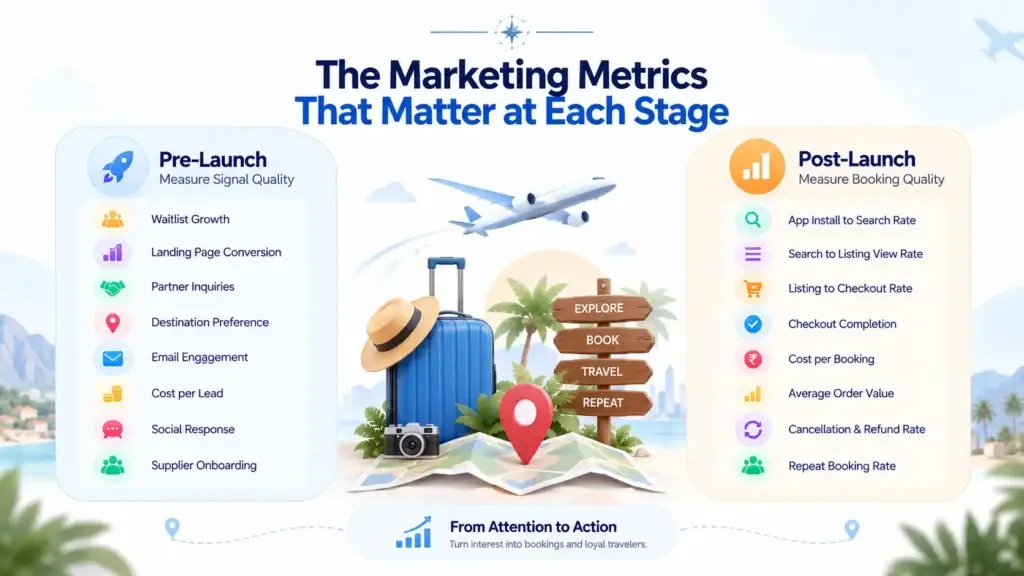
A travel startup can waste a lot of time by tracking the wrong numbers. Pre-launch metrics should measure signal quality. Post-launch metrics should measure booking quality.
Before launch, useful metrics include waitlist growth, landing page conversion rate, partner inquiry volume, destination preference, email engagement, cost per lead, social comments, creator campaign response, and supplier onboarding progress. These numbers help founders understand whether the market is warming up.
After launch, useful metrics include app install-to-search rate, search-to-listing view rate, listing-to-checkout rate, checkout completion, cost per booking, average order value, cancellation rate, refund rate, support response time, review volume, referral activation, repeat booking rate, and lifetime value.
The most important shift is from attention to action. A pre-launch campaign can be successful if it creates the right audience pool. A post-launch campaign is successful only when that audience starts booking and returning.
How Platform Features Influence Travel App Marketing
Marketing does not work separately from the product. A regional travel booking platform can only promote what the platform can actually deliver. If the campaign promises instant booking confirmation, the booking engine must support reliable confirmation workflows. If the campaign promotes easy cancellations, refund rules and support visibility must be clear. If the campaign highlights local experiences, supplier listings must be complete and trustworthy.
This is why founders should review the travel booking platform features before finalizing campaign promises. The marketing team should know which booking categories are live, which partner dashboards are ready, which payment methods are supported, which cancellation rules are configurable, and which user flows are strong enough to promote.
Strong features create stronger campaigns. Clear filters support search ads. Verified listings support trust messaging. Wallet credits support referral campaigns. Agent dashboards support B2B outreach. Corporate booking workflows support business travel campaigns. Admin margin control supports seasonal pricing and category-specific offers.
How Revenue Planning Shapes Marketing Priorities
Marketing decisions should also connect to the revenue model. A platform that earns mainly from hotel commissions may prioritize accommodation-led destination campaigns. A platform that earns from holiday packages may need longer lead nurturing and itinerary content. A platform that includes agents or corporate accounts may need partner outreach, sales collateral, and account-based marketing.
Founders can review the travel booking platform business model to align campaign priorities with actual monetization. Without this alignment, a startup may attract users who browse but never book profitable categories.
For example, flight bookings may create high search volume but thinner margins. Curated trips, activities, transfers, add-ons, insurance, agent commissions, or corporate plans may create better long-term revenue potential depending on the operating model. Marketing should therefore promote the categories that support both user demand and business sustainability.
Where Security and Trust Fit Into Travel Marketing
Travelers share personal details, trip dates, payment information, contact numbers, guest information, and sometimes identity-related data. They also need confidence that bookings, refunds, cancellations, and support requests will be handled properly. This makes security and trust part of the marketing message, not just a backend concern.
Pre-launch trust messaging can include clear cancellation policies, secure payment communication, partner verification, support availability, and transparent pricing. Post-launch trust-building can include verified reviews, booking confirmations, refund updates, support response visibility, and safe account access.
For a deeper product-side view, founders can study this travel booking platform security guide before preparing launch campaigns. Trust-focused marketing works best when the platform itself supports secure workflows, role-based access, audit visibility, payment safety, and controlled partner access.
A Practical 90-Day Marketing Roadmap for Regional Travel Startups
A clear roadmap helps founders avoid doing everything at once. The first 90 days should move from validation to launch momentum to growth optimization.
Days 1–30: Validate Positioning and Demand
The first month should focus on market clarity. Choose the first region, define the target traveler, shortlist launch categories, prepare landing pages, create destination content, start supplier outreach, collect early leads, and test messaging with small campaigns.
This stage should answer: who wants this platform, what do they want to book, which destinations create interest, which partners are ready, and what promise can the brand confidently make?
Days 31–60: Build Launch Assets and Early Trust
The second month should turn validation into launch preparation. Build app store assets, prepare screenshots, create onboarding emails, finalize partner listing content, record product walkthroughs, prepare launch offers, activate micro-creators, and set up analytics for the full booking funnel.
This stage should answer: are the campaigns connected to real product flows, are suppliers ready, is support prepared, and can early users understand the booking journey clearly?
Days 61–90: Launch, Measure, and Optimize
The third month should focus on controlled growth. Launch with a clear regional message, track search and booking behavior, fix funnel drop-offs, collect reviews, retarget warm users, test referral rewards, promote successful categories, and refine offers based on actual booking data.
This stage should answer: which channels generate bookings, where do users drop off, which categories drive revenue, what feedback keeps repeating, and which campaigns deserve more budget?
Mistakes Founders Should Avoid
Promoting too many destinations too early
A wide launch sounds impressive, but regional travel platforms need operational reliability. It is better to launch with fewer strong destinations than to promote inventory the team cannot support well.
Spending on installs before fixing booking trust
If users do not trust the checkout, cancellation policy, supplier quality, or support process, paid installs will not turn into sustainable bookings.
Ignoring supplier-side marketing
Travel platforms need strong partner participation. Hotels, hosts, agents, and local operators should understand the platform’s demand plan before users arrive.
Using the same message before and after launch
Pre-launch messaging should build curiosity and trust. Post-launch messaging should drive bookings, reviews, repeat usage, and referrals.
How Miracuves Helps Travel Startups Move From Plan to Launch Faster
A marketing plan becomes stronger when the product foundation is ready to support it. Founders need booking flows, destination listings, payment workflows, partner access, admin control, and user-facing experiences that can be shown, tested, and improved quickly.
Miracuves helps founders launch white-label travel booking platforms with branded design, source-code ownership, admin dashboards, booking workflows, supplier-side controls, and customization support. For ready-made scopes, Miracuves can support 6-day solution delivery, helping founders begin regional launch campaigns without waiting months for every core module to be built from zero.
For founders evaluating a MakeMyTrip Clone foundation, the smarter approach is not to copy a large platform blindly. It is to use a proven travel booking structure, adapt it to a regional market, and connect the marketing plan to the platform’s real booking categories, supplier workflows, and monetization logic.
You can explore Miracuves’ launch-ready travel booking platform to understand how a ready-made travel app foundation can support regional travel startups with faster deployment, admin control, and room for market-specific customization.
Final Thoughts: Pre-Launch Creates Direction, Post-Launch Creates Scale
Pre-launch and post-launch marketing should not be treated as separate campaigns. They are two connected stages of the same growth system.
Pre-launch marketing helps a regional travel startup understand the market before spending heavily. It validates destinations, audiences, suppliers, messaging, and early demand. Post-launch marketing uses real user behavior to improve bookings, retention, referrals, reviews, and revenue.
For founders, the strongest launch plan is not the loudest one. It is the one that connects product readiness, regional demand, supplier trust, booking conversion, and long-term retention. Build the demand before launch. Measure the behavior after launch. Then scale only what the market proves.
FAQs
What is pre-launch marketing for a regional travel booking platform?
Pre-launch marketing is the work done before the platform goes live to validate demand, build a waitlist, prepare suppliers, create destination content, test positioning, and build early trust with travelers. For regional travel startups, it helps identify which destinations, booking categories, and user segments should be prioritized first.
What should a travel startup prioritize after launch?
After launch, a travel startup should prioritize booking conversion, app store optimization, retargeting, reviews, referral campaigns, retention messaging, supplier expansion, and funnel analytics. The goal is to move beyond awareness and focus on real searches, completed bookings, repeat users, and profitable acquisition channels.
Should regional travel startups spend more before launch or after launch?
The split depends on product readiness, supplier access, brand awareness, and market validation. If the market is untested, more effort should go into pre-launch validation. If the platform already has suppliers, audience interest, and a launch-ready product foundation, more budget can move into post-launch conversion and retention.
How can a regional travel platform get early users before launch?
A regional travel platform can attract early users through destination-focused landing pages, waitlists, micro-creator campaigns, local travel content, partner promotions, early access offers, referral previews, and community-based travel groups. The goal is to collect intent signals, not only email addresses.
Which metrics matter most before launching a travel booking app?
Important pre-launch metrics include landing page conversion rate, waitlist signups, destination preferences, partner inquiries, cost per lead, email engagement, supplier onboarding progress, and early campaign response. These metrics show whether the startup has enough demand and trust before going live.
Which metrics matter most after launching a travel booking app?
Important post-launch metrics include install-to-search rate, search-to-listing view rate, checkout completion, cost per booking, cancellation rate, refund rate, review volume, referral activation, repeat booking rate, and lifetime value. These metrics show whether marketing is creating real booking behavior.
Why is supplier-side marketing important for travel platforms?
Supplier-side marketing is important because travel platforms need reliable inventory before demand arrives. Hotels, hosts, cab operators, activity providers, and agents should understand the platform’s booking rules, dashboard access, payout process, cancellation policy, and demand-generation plan before launch.
Can Miracuves help launch a regional travel booking platform faster?
Yes. Miracuves helps founders launch ready-made and white-label travel booking platforms with branded design, source-code ownership, booking workflows, supplier-side controls, admin dashboards, and customization support. A 6-day launch may apply when the ready-made scope matches the project requirement.
Miracuves is an independent software development company. We are not affiliated with, connected to, sponsored by, or endorsed by any company or product named in this article.
Terms such as “X Clone” are used descriptively. It is how the software industry refers to building a platform with functionality comparable to a known service, and how clients search for it.
The entire design and codebase of our products is built by our own team. Our products contain no code, design, graphics, or content originating from any third-party website or applications.
All third-party names and marks referenced in this article are the property of their respective owners, referenced solely to identify the services discussed.



