


Key Takeaways
- A regional travel booking platform growth strategy should balance local supplier inventory, traveler acquisition, booking conversion, destination coverage, and repeat bookings rather than focusing only on traffic.
- Strong local inventory across hotels, flights, car rentals, tours, and activities gives travelers more relevant choices while improving destination-level booking potential.
- Sustainable growth comes from matching reliable supply with localized discovery, competitive pricing, convenient payments, trustworthy booking experiences, and reasons for travelers to return.
Inventory & Demand Growth Signals
- Local inventory can grow through direct supplier onboarding, regional partnerships, travel agents, hotel groups, tour operators, car rental providers, and API-based inventory integrations.
- Traveler demand can be developed through destination SEO, localized content, paid campaigns, referral programs, seasonal promotions, regional partnerships, and personalized travel recommendations.
- Operators should track active suppliers, available inventory, destination coverage, search-to-booking conversion, acquisition cost, booking value, cancellation rate, and supplier utilization.
Repeat Booking Insights
- Saved traveler profiles, booking history, loyalty benefits, personalized offers, price alerts, reminders, destination recommendations, and simple rebooking can encourage repeat usage.
- Teams should monitor repeat booking rate, booking frequency, customer retention, cross-category purchases, referral activity, traveler lifetime value, and destination-level engagement.
- Miracuves develops customizable regional travel booking platforms with supplier management, localized inventory, flights, hotels, cars, tours, payments, recommendations, loyalty features, analytics, and admin controls.
A regional travel booking platform does not grow the same way as a broad national travel marketplace.
The goal is not only to list flights, hotels, buses, holiday packages, and local experiences. The real challenge is to create a trusted travel ecosystem where regional suppliers, local agents, destination partners, and repeat travelers all find a reason to stay active.
For founders, this changes the growth strategy completely. Instead of chasing every traveler in every city, a regional platform must win a focused geography first. That means building stronger local inventory, improving route and destination relevance, creating demand around real traveler behavior, and designing retention loops that bring users back for their next trip.
This guide explains how founders can grow a regional travel booking platform by balancing three layers: supply, demand, and repeat bookings. It also shows where a launch-ready travel technology foundation from Miracuves can help founders move faster without spending months building every booking module from scratch.
Why Regional Travel Platforms Need a Different Growth Playbook
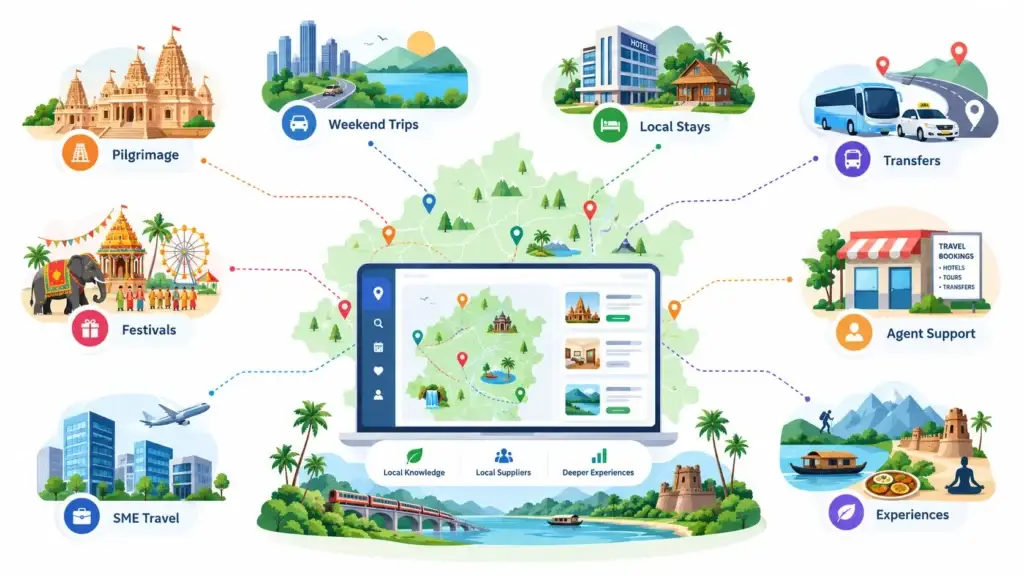
A regional travel booking platform wins through depth, not just scale.
Large travel platforms usually compete on breadth: more cities, more categories, more suppliers, more ads, and more discounts. A regional platform has a different advantage. It can understand local routes, regional languages, religious tourism, seasonal travel, weekend behavior, corporate travel corridors, domestic holiday patterns, and supplier relationships better than a broad platform trying to serve everyone.
For example, a regional booking platform may focus on:
- Pilgrimage routes and temple tourism
- Weekend getaways from a specific metro city
- Local hotel chains and homestays
- Bus, cab, and transfer routes that travelers actually use
- Regional festivals and seasonal holiday packages
- Local agent-assisted bookings
- Corporate travel for small and mid-sized businesses
- Niche experiences such as adventure tours, boat rides, heritage walks, food trails, or wellness retreats
This is why the growth strategy should not start with “how do we get more downloads?” It should start with a more practical question: “What travel need can we serve better than a generic booking platform?”
Once the founder answers that, marketing becomes sharper, supplier acquisition becomes easier, and repeat bookings become more realistic.
The Three Growth Pillars: Inventory, Demand, and Repeat Bookings
A regional travel booking platform grows when supply and demand move together.
If the platform attracts travelers before it has useful inventory, users leave. If the platform adds suppliers before there is demand, suppliers stop engaging. If users book once but never return, acquisition cost keeps rising.
That is why founders should treat growth as a three-pillar system.
| Growth Pillar | What It Means | Why It Matters |
|---|---|---|
| Local Inventory | Hotels, transport, packages, activities, agents, and destination suppliers | Gives travelers a reason to search and book locally |
| Traveler Demand | Paid campaigns, SEO, social content, partnerships, referrals, and app engagement | Brings qualified users into the platform |
| Repeat Bookings | Wallets, loyalty, saved travelers, seasonal offers, reminders, and post-trip journeys | Reduces dependency on new customer acquisition |
The strongest regional platforms do not treat these as separate departments. They connect them. A hotel partnership can become a destination campaign. A bus route can become a weekend package. A festival season can become a loyalty push. A frequent business route can become a corporate travel product.
Step 1: Define the Regional Positioning Before Scaling Inventory
Before onboarding suppliers, founders should define what the platform stands for.
A vague travel booking app is hard to market. A focused regional travel marketplace is easier to explain, rank, and sell.
The positioning can be based on geography, traveler type, trip type, supply strength, or booking convenience.
Possible Regional Positioning Angles
| Positioning Angle | Example Direction | Business Value |
|---|---|---|
| Destination-first | Travel bookings for a specific state, region, or tourism corridor | Strong local SEO and supplier relevance |
| Route-first | Flights, buses, cabs, and stays around high-demand routes | Better conversion from route-based search intent |
| Experience-first | Local tours, activities, stays, transfers, and packages | Higher margin potential through bundled bookings |
| Agent-assisted | Online booking platform supported by local travel agents | Useful for markets where travelers still prefer human help |
| Corporate regional travel | Business trips, approvals, invoices, and employee travel policies | Repeat booking potential from companies |
The mistake many founders make is trying to launch as a full-scale travel marketplace from day one. A better approach is to own one clear regional use case first, then expand categories after early traction.
Step 2: Build Local Inventory That Travelers Cannot Easily Find Elsewhere
Inventory is the backbone of any travel booking platform.
For a regional platform, the inventory strategy should not only depend on large supplier APIs. Those can help with flights, hotels, and standard travel categories, but regional differentiation often comes from suppliers that are offline, fragmented, or poorly represented online.
These may include boutique hotels, homestays, local cab operators, regional bus partners, activity providers, tour guides, boat operators, pilgrimage package sellers, resort owners, and destination management companies.
High-Value Inventory Sources for Regional Travel Platforms
| Inventory Type | Why It Matters | Growth Opportunity |
|---|---|---|
| Hotels and Homestays | Core search and booking category | Improve destination coverage and local stay options |
| Local Transport | Cabs, transfers, buses, and route-based travel | Capture end-to-end trip demand |
| Activities and Experiences | Tours, events, adventure, food, culture, and wellness | Add higher-margin booking opportunities |
| Holiday Packages | Bundled stays, transport, and activities | Increase average order value |
| Local Agents | Offline demand and assisted bookings | Bring existing customer relationships online |
| Corporate Travel Partners | Repeat bookings from teams and companies | Build predictable booking volume |
| Regional Tourism Partners | Destination visibility and seasonal campaigns | Improve trust and campaign reach |
A founder should not measure supply only by the number of listings. The better metric is “bookable relevance.” Ten useful local suppliers in a focused destination can perform better than hundreds of generic listings that do not match traveler intent.
Step 3: Create a Supplier Onboarding System, Not Just a Listing Form
Local inventory does not scale if supplier onboarding is manual forever.
A regional travel platform needs a structured supplier onboarding workflow. Hotels should be able to manage rooms, rates, amenities, photos, cancellation rules, blackout dates, and availability. Activity providers should be able to upload time slots, group sizes, inclusions, exclusions, and booking conditions. Cab or transfer partners should be able to manage routes, vehicle types, pricing, and operating zones.
This is where the backend matters. A founder needs more than a traveler-facing app. The platform should also include a supplier portal, approval workflows, admin controls, commission settings, booking management, refunds, cancellation logic, and payout visibility.
Without this control layer, growth becomes operationally expensive. Every price update, booking change, supplier issue, or refund request becomes a manual support task.
Founders should also review the core travel booking platform features needed to manage supplier onboarding, inventory updates, booking rules, commissions, cancellations, refunds, and admin control from one backend.
Supplier Onboarding Checklist
A regional travel booking platform should allow operators to manage:
- Supplier verification and approval
- Listing creation and content quality checks
- Category-specific inventory fields
- Availability and blackout dates
- Commission or margin rules
- Cancellation and refund rules
- Payout tracking
- Booking notifications
- Dispute handling
- Performance reporting
For founders evaluating technology options, this is one of the clearest signs that a platform is ready for real operations, not just a demo.
Step 4: Build Demand Around Routes, Seasons, and Real Travel Intent
Traveler demand should not be built only around generic app promotion.
Regional travel searches are often very specific. People search for weekend trips from their city, hotel deals near a landmark, cab routes between two destinations, holiday packages during school vacations, group tours for festivals, or last-minute stays around an event.
That means campaigns should be built around intent clusters.
Demand Clusters That Work for Regional Travel Platforms
| Demand Cluster | Example Campaign Angle | Best Channel |
|---|---|---|
| Route-based travel | “Book cabs, hotels, and stays for your next city-to-city trip” | Search ads, SEO, WhatsApp, retargeting |
| Weekend getaways | “Plan your 2-day escape with stay, transfer, and activities” | Instagram, short videos, local SEO |
| Festival and seasonal travel | “Book early for peak-season stays and transport” | Email, push notifications, landing pages |
| Pilgrimage and religious travel | “Complete trip planning with stay, cab, and guided packages” | SEO, community groups, agent networks |
| Corporate regional travel | “Manage employee travel, approvals, and invoices in one place” | LinkedIn, outbound, partnerships |
| Family holidays | “Bundle hotels, transfers, sightseeing, and support” | Paid social, referral, WhatsApp campaigns |
The platform should not only ask, “How do we acquire users?” It should ask, “Which trip type creates the strongest booking intent in our region?”
That one shift helps founders reduce wasted ad spend and improve conversion quality.
Step 5: Use Local SEO as a Compounding Growth Channel
Regional travel platforms are ideal for SEO because travel intent is naturally location-based.
Instead of writing generic travel blogs, the platform can build search visibility around destination pages, route pages, stay pages, travel guide pages, event pages, and package pages.
For example, a regional platform can create:
- Destination booking pages
- City-to-city route pages
- Weekend getaway guides
- Seasonal travel guides
- Festival travel landing pages
- Hotel cluster pages
- Local activity pages
- Family travel pages
- Corporate travel pages
- Travel agent partner pages
Each page should connect search intent to booking action. A destination guide should not only describe a place. It should guide the traveler toward hotels, cabs, activities, packages, and saved itinerary options.
This is where product and SEO should work together. If SEO attracts the traveler but the booking flow is slow, incomplete, or confusing, traffic will not convert. A regional travel booking platform needs search-friendly pages and a booking engine that can move users from discovery to confirmation without friction.
Step 6: Design the First Booking Flow Around Trust
Travel booking is a trust-heavy decision.
A user may browse casually, but they will not pay unless the platform feels reliable. Trust is especially important for new regional platforms because travelers may not know the brand yet.
The first booking flow should remove uncertainty.
Trust Signals That Improve Booking Confidence
| Trust Signal | Why It Helps |
|---|---|
| Transparent pricing | Reduces checkout hesitation |
| Clear cancellation rules | Helps travelers understand risk before paying |
| Verified supplier details | Builds confidence in hotels, transport, and activities |
| Real photos and descriptions | Reduces mismatch between expectation and experience |
| Support visibility | Reassures users that help is available if plans change |
| Booking confirmation clarity | Makes payment feel safe and complete |
| Saved traveler details | Makes repeat bookings faster |
| Wallet or refund credit | Helps retain value inside the platform |
Many travel platforms lose users at checkout because fees, cancellation rules, room details, or payment outcomes are unclear. Regional platforms can win trust by being simpler and more transparent.
Trust also depends on strong travel booking platform security controls such as secure payment flows, supplier verification, role-based access, refund tracking, activity logs, and permission-based admin workflows.
Step 7: Turn Local Agents Into a Growth Channel
In many regional markets, travel is still influenced by local agents.
This does not mean a digital platform should ignore agents. It means the platform can bring agents into the ecosystem instead of treating them as outdated competition.
Local agents already have customer relationships, neighborhood trust, and offline demand. A regional travel platform can give them a digital booking layer where they manage customers, search inventory, book trips, earn commission, track payments, and serve repeat travelers more efficiently.
Agent-Led Growth Opportunities
| Agent Use Case | Platform Requirement |
|---|---|
| Booking for walk-in customers | Agent dashboard and customer records |
| Selling holiday packages | Package builder and commission rules |
| Managing repeat family travelers | Saved profiles and booking history |
| Serving small businesses | Corporate account and invoice support |
| Promoting regional inventory | Supplier visibility and local package access |
This approach helps the platform grow beyond direct app downloads. It creates a hybrid model where online booking and assisted travel work together.
For founders planning this route, a regional travel booking platform foundation can help because the business does not depend only on consumer app flows. It also needs partner portals, admin workflows, booking control, supplier management, and support for assisted booking models.
Step 8: Build Repeat Bookings With Wallets, Loyalty, and Trip Memory
Travel is not always daily-use behavior, but it is repeat behavior.
A traveler may not book every week, but they may book several times a year across flights, hotels, buses, cabs, holiday packages, and activities. The founder’s job is to make sure the next booking happens inside the same platform.
That requires retention systems.
Retention Features That Matter in Regional Travel
| Retention Layer | How It Works | Founder Impact |
|---|---|---|
| Wallet | Refunds, credits, cashback, and stored value | Keeps booking value inside the platform |
| Loyalty Tiers | Rewards based on booking frequency or value | Encourages repeat usage |
| Saved Travelers | Reuse passenger and guest details | Speeds up future checkout |
| Trip History | Past bookings, invoices, and support records | Builds trust and convenience |
| Personalized Offers | Route, destination, and season-based deals | Improves campaign relevance |
| Reminder Campaigns | Holiday, event, renewal, or repeat route reminders | Brings users back at the right time |
| Referral Rewards | Incentives for inviting friends and family | Lowers acquisition dependency |
Retention should not feel like random discounting. It should feel like the platform understands the traveler’s next need.
A user who booked a hotel may need a cab. A user who booked a pilgrimage package may need another seasonal trip. A company that booked employee travel once may need monthly travel management. A family that booked a summer stay may return for a winter vacation.
The platform should remember these signals and act on them.
Step 9: Improve Conversion With Bundled Travel Products
Regional platforms can increase revenue by bundling related services.
A traveler rarely needs only one thing. A hotel guest may need airport pickup. A family booking a holiday may need activities. A business traveler may need invoices and policy approval. A pilgrim may need transport, stay, local guidance, and meal arrangements.
Bundling helps the platform increase average order value while improving traveler convenience.
Practical Bundle Ideas
| Bundle Type | Included Services | Best For |
|---|---|---|
| Weekend Escape Bundle | Stay, cab, breakfast, local activity | Couples and families |
| Pilgrimage Travel Bundle | Transport, hotel, guide, local transfer | Religious travelers |
| Business Travel Bundle | Flight, hotel, cab, invoice, approval | Corporate users |
| Festival Travel Bundle | Stay, transfer, event access, local guide | Seasonal tourists |
| Adventure Bundle | Stay, activity, gear, transport | Niche travelers |
| Family Holiday Bundle | Hotel, sightseeing, cab, support | Group travel |
Bundling also helps regional platforms differentiate. Instead of selling the same flight or hotel inventory as everyone else, the platform sells a more complete local travel outcome.
Step 10: Track Growth Metrics That Actually Matter
A regional travel platform should not measure growth only by downloads.
Downloads can look impressive but still fail to produce bookings. A better growth dashboard should connect marketing, inventory, booking behavior, and retention.
Useful Growth Metrics for Regional Travel Platforms
| Metric | What It Shows |
|---|---|
| Search-to-booking conversion | Whether users find relevant inventory |
| Supplier activation rate | Whether onboarded suppliers are actually bookable |
| Repeat booking rate | Whether travelers return |
| Average booking value | Whether bundles and cross-sells are working |
| Route-level conversion | Which routes or destinations create demand |
| Cancellation rate | Whether pricing, availability, and expectations are aligned |
| Wallet reuse rate | Whether wallet credits bring users back |
| Agent booking volume | Whether offline partners are contributing demand |
| Corporate account activity | Whether B2B travel workflows are creating repeat business |
| Support ticket reason | Where the booking experience needs improvement |
The best growth decisions come from understanding where the funnel breaks. If users search but do not book, the issue may be inventory. If users book once but do not return, the issue may be retention. If suppliers join but do not update availability, the issue may be supplier tooling. If paid ads bring traffic but not revenue, the campaign may be attracting low-intent users.
Once these metrics are visible, founders should connect them with a clear travel booking business model so commissions, supplier markups, package margins, wallet usage, agent bookings, and repeat reservations support long-term revenue growth.
Founder Decision Signals
Inventory Depth
If travelers cannot find relevant hotels, transfers, packages, or activities in your region, marketing will not convert. Build supply before scaling demand.
Demand Quality
Route-based, destination-based, and seasonal campaigns usually bring stronger intent than broad app-install campaigns.
Operational Control
Supplier onboarding, margins, cancellations, refunds, payouts, and booking support need admin control from the beginning.
Retention Potential
Wallets, loyalty, saved travelers, repeat routes, and personalized offers turn one-time bookings into long-term platform value.
Product Foundation: Why Growth Depends on the Platform Behind the App
A regional travel booking platform is not just a mobile app.
Behind the traveler interface, the business needs a booking engine, supplier management, category control, pricing rules, margin settings, payment flows, refund handling, agent workflows, corporate accounts, notifications, support tools, analytics, and admin permissions.
Before scaling campaigns, founders should understand the travel platform architecture behind booking engines, supplier dashboards, payment flows, refund logic, admin reporting, and category-wise inventory management.
Without these layers, growth becomes fragile. More users create more support pressure. More suppliers create more manual work. More categories create more pricing confusion. More bookings create more refund and cancellation complexity.
This is why founders should evaluate the product foundation before spending heavily on marketing.
A scalable travel booking platform should support:
- Multi-category travel inventory
- Flights, hotels, transport, packages, and activities
- Supplier onboarding and inventory controls
- Agent and corporate booking flows
- Commission, margin, and markup settings
- Payment gateway integration
- Refund and cancellation workflows
- Wallet and loyalty logic
- Admin dashboards and reporting
- Role-based access control
- Source-code ownership for long-term flexibility
Miracuves helps founders launch a <a href=”https://miracuves.com/makemytrip-clone/“>white-label travel commerce foundation</a> with traveler, supplier, agent, corporate, and admin workflows. For ready-made deployments, the 6-day delivery model helps founders shift focus from basic platform development to supplier partnerships, launch campaigns, and regional growth.
Common Mistakes Founders Should Avoid
Launching With Too Many Destinations at Once
A broad launch can dilute inventory quality. It is better to dominate a focused region, corridor, or traveler segment before expanding.
Depending Only on Paid App Installs
Install campaigns may create downloads without bookings. Regional platforms need route pages, local SEO, supplier partnerships, agent channels, and referral loops.
Ignoring Supplier Experience
If hotels, cab partners, activity providers, or agents cannot update availability and pricing easily, the platform becomes difficult to operate at scale.
Using Discounts Without Retention Logic
Discounts can attract first-time users, but wallet credits, loyalty tiers, personalized offers, and saved traveler profiles are better for repeat behavior.
A Practical 90-Day Growth Roadmap for Regional Travel Platforms
Founders can use the first 90 days to validate regional supply, demand, and retention.
Days 1–30: Build the Local Supply Base
Focus on one region, corridor, or travel segment. Onboard the most relevant hotels, transport partners, activity providers, and local agents. Prepare destination pages and route pages before scaling campaigns.
Key actions:
- Choose the first target region
- Identify high-demand routes and destinations
- Onboard priority suppliers
- Set commission and margin rules
- Create SEO pages for routes and destinations
- Prepare launch offers and support workflows
Days 31–60: Launch Demand Campaigns
Start with campaigns around specific traveler intent. Avoid generic “download our travel app” messaging. Use route-based, weekend, seasonal, and destination-led campaigns.
Key actions:
- Run search campaigns for high-intent routes
- Launch local SEO content
- Build social creatives around regional travel moments
- Activate agent referrals
- Start email and WhatsApp campaigns
- Track search-to-booking conversion
Days 61–90: Improve Retention and Repeat Bookings
Once bookings start, use the data to improve repeat behavior. Segment travelers by route, destination, category, and booking frequency.
Key actions:
- Launch wallet credit campaigns
- Send repeat route reminders
- Promote bundles to past bookers
- Build loyalty tiers or booking rewards
- Retarget users who searched but did not book
- Use support feedback to improve checkout clarity
This roadmap helps founders avoid the common trap of spending heavily on marketing before the product and supply base are ready.
Founders can also support this roadmap with a clear pre-launch and post-launch marketing plan that separates early awareness, supplier readiness, launch campaigns, retargeting, and repeat booking campaigns.
When a Ready-Made Travel Platform Makes Business Sense
A ready-made travel platform makes sense when the founder wants to validate a regional travel opportunity quickly without building every module from zero. For budgeting decisions, founders can review the key factors that influence travel booking platform development cost, including features, integrations, supplier workflows, payment systems, and customization scope.
It is especially useful when the business needs multiple booking categories, supplier workflows, agent channels, corporate travel, admin control, wallet logic, and source-code flexibility from the beginning.
A custom build can make sense for highly unusual workflows or enterprise-specific requirements. But for many founders, the first priority is not to spend months building the standard booking engine. The priority is to launch, onboard suppliers, test demand, refine offers, and improve repeat bookings.
If the founder wants expert help turning this regional growth plan into a working product, choosing the right travel booking development partner becomes important for platform planning, customization, deployment, and post-launch improvements.
That is where a launch-ready platform gives the business a practical advantage. Miracuves can help founders start with a ready-made travel booking foundation, customize it for the brand, and deploy faster while keeping control over the source code and business workflows.
Final Thoughts
A regional travel booking platform grows when it becomes locally useful before it tries to become widely known.
The strongest strategy is not to copy the broadest travel marketplace. It is to build a focused platform with relevant local inventory, clear traveler demand, trusted booking flows, useful supplier tools, and retention systems that bring users back for their next trip.
For founders, the right question is not only “How do we market the app?” The stronger question is: “How do we build a travel ecosystem that suppliers, agents, companies, and travelers all want to use again?”
When the product foundation supports that ecosystem, growth becomes easier to manage. With Miracuves, founders can move faster using a launch-ready travel booking platform designed for branding, admin control, supplier workflows, repeat booking logic, and source-code ownership.
FAQs
What is a regional travel booking platform growth strategy?
A regional travel booking platform growth strategy is a plan for building local travel inventory, attracting high-intent travelers, converting searches into bookings, and increasing repeat bookings within a focused geography or travel segment.
How can a regional travel platform attract more users?
A regional travel platform can attract users through local SEO, route-based landing pages, destination campaigns, social content, agent referrals, seasonal offers, corporate partnerships, and retargeting campaigns based on traveler search behavior.
What inventory should a regional travel booking platform add first?
The best starting inventory usually includes hotels, homestays, local transport, activities, holiday packages, and high-demand route options. The exact mix depends on the region, traveler behavior, and supplier availability.
How do regional travel platforms increase repeat bookings?
Repeat bookings can be improved through wallet credits, loyalty tiers, personalized offers, saved traveler details, booking history, seasonal reminders, referral rewards, and post-trip engagement campaigns.
Why are local suppliers important for travel platform growth?
Local suppliers help the platform offer inventory that may not be easily available on broad platforms. This creates differentiation, improves regional relevance, and helps the business build stronger destination-level trust.
Should a travel startup build from scratch or use a ready-made platform?
A custom build can work for highly unique requirements, but a ready-made platform is often faster for founders who want to validate demand, onboard suppliers, and start bookings without waiting months for standard travel modules to be built.
What features help a regional travel platform scale?
Important features include supplier onboarding, booking management, payment integration, cancellation workflows, wallet, loyalty, admin dashboards, agent portals, corporate travel support, margin controls, and reporting.
How does Miracuves help travel founders launch faster?
Miracuves helps founders launch white-label travel booking platforms with source code, branded design, admin control, supplier workflows, booking modules, and faster deployment. For ready-made solutions, Miracuves offers a 6-day delivery path so founders can focus on market growth sooner.
Miracuves is an independent software development company. We are not affiliated with, connected to, sponsored by, or endorsed by any company or product named in this article.
Terms such as “X Clone” are used descriptively. It is how the software industry refers to building a platform with functionality comparable to a known service, and how clients search for it.
The entire design and codebase of our products is built by our own team. Our products contain no code, design, graphics, or content originating from any third-party website or applications.
All third-party names and marks referenced in this article are the property of their respective owners, referenced solely to identify the services discussed.



