


An OnlyFans clone scripts is not just a collection of creator profiles, paid posts, private messages, and subscription plans. For founders building a content subscription platform, the real business engine sits behind the screen: payment routing, creator balances, platform commissions, refunds, chargebacks, escrow rules, and payout automation.
This is where many creator platform projects become risky. The frontend may look launch-ready, but if the payout system is weak, the business can quickly face creator disputes, failed withdrawals, reconciliation errors, chargeback losses, compliance gaps, and manual finance operations.
A strong content subscription platform needs more than “secure payments.” It needs a payment architecture that clearly answers:
- Who receives the fan payment?
- When does the creator become eligible for payout?
- How is the platform commission deducted?
- What happens during refunds or chargebacks?
- How are creator balances tracked?
- How does the admin team audit money movement?
- How are global creators paid in different regions?
That is why escrow and split-payout architecture matters. For founders evaluating an OnlyFans clone solution, this guide explains how the payment layer should work before you invest in development cost, customization, or launch.
Why Payment Architecture Matters in an OnlyFans Clone Script
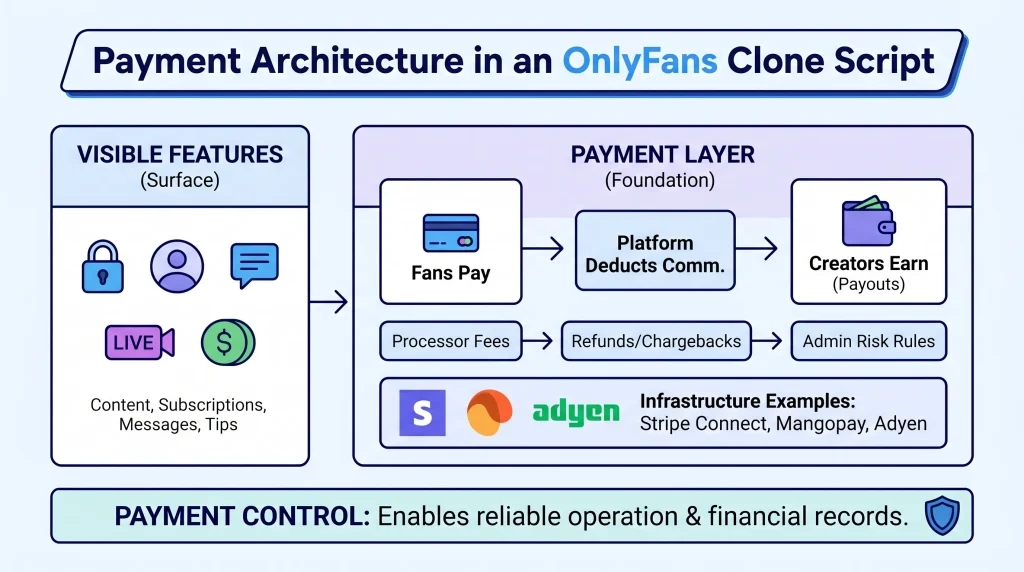
Most founders first think about visible features: creator pages, locked content, monthly subscriptions, direct messages, livestreaming, tips, and pay-per-view posts. These features matter, but they are not enough to run a creator monetization business.
The payment layer decides whether your platform can operate reliably when thousands of fans subscribe, creators request payouts, users dispute transactions, and admins need accurate financial records.
In an OnlyFans-style creator platform, money flows across multiple parties:
- Fans pay for subscriptions, messages, tips, or exclusive content.
- Creators earn revenue from those transactions.
- The platform deducts commission.
- Payment processors deduct processing fees.
- Refunds and chargebacks may reverse earlier transactions.
- Admins may hold, approve, or delay payouts based on risk rules.
Stripe Connect is commonly used by platforms and marketplaces that need to manage money movement across multiple parties, including payments, account balances, and payouts. Mangopay and Adyen also provide marketplace-oriented infrastructure for wallet balances, split funds, and payout workflows.
For a founder, the decision is simple: an OnlyFans clone script should not only support payments; it should support payment control.
What Escrow Means in a Creator Subscription Platform
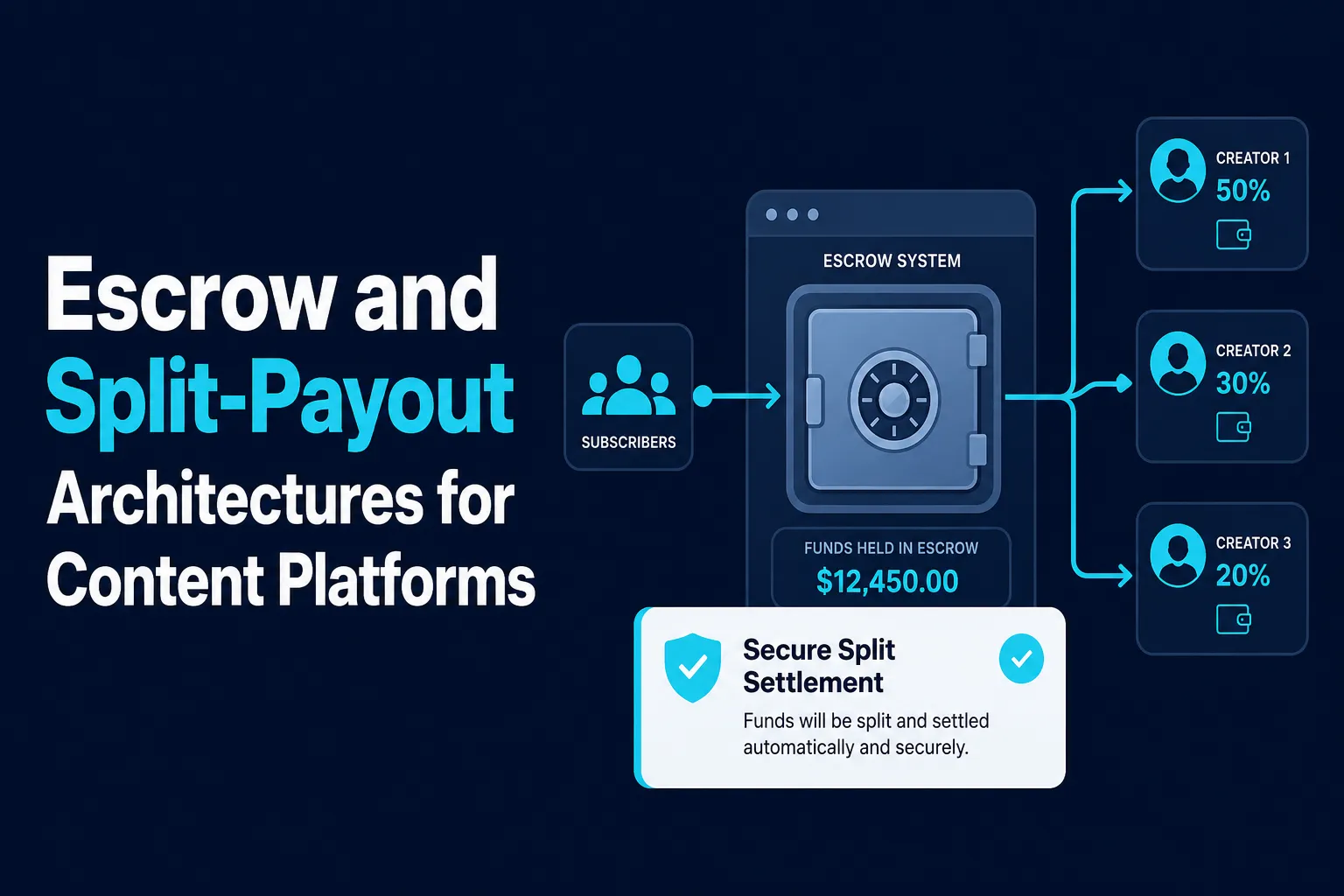
Escrow means funds are collected from the fan but not released immediately to the creator. Instead, the money is held for a defined period or until platform rules confirm that the transaction is eligible for payout.
In a content subscription platform, escrow may be used for:
- Subscription payments during a refund window
- Pay-per-view purchases before content delivery is confirmed
- High-risk creator accounts under review
- New creators with limited payout history
- Transactions flagged for fraud or chargeback risk
- Payout reserves to protect the platform from disputes
Escrow is not always about legal escrow in the strict banking sense. In product architecture, founders often use the word to describe a controlled fund-holding workflow where the platform tracks pending, available, reserved, and paid balances.
Mangopay’s documentation describes wallet infrastructure that can receive, hold, split, and transfer funds, which is exactly the type of capability marketplace and creator platforms often need. Stripe also supports separate charges and transfers, where the platform charge can be decoupled from transfers to connected accounts.
For an OnlyFans clone script, escrow-like logic helps prevent a common founder problem: paying creators too quickly and then absorbing losses when a fan files a chargeback later.
Direct Payout vs Escrow-Based Creator Monetization
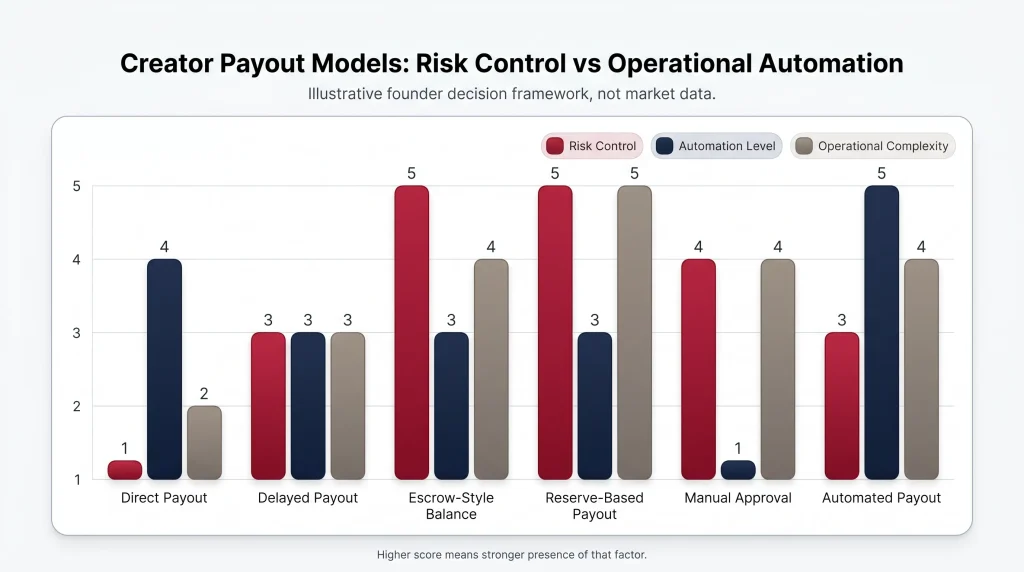
Not every creator platform uses the same payout model. The right model depends on risk, region, content type, payment provider, refund rules, creator trust level, and platform maturity.
| Model | How It Works | Best For | Main Risk |
|---|---|---|---|
| Direct payout | Fan payment is routed quickly to the creator after platform commission | Low-risk creators, simple marketplaces, mature platforms | Harder to recover funds after disputes |
| Delayed payout | Creator earnings become available after a fixed holding period | Subscription platforms with refund or chargeback risk | Creators may dislike waiting |
| Escrow-style balance | Funds move from pending to available after rules are satisfied | Platforms needing stronger admin control | Requires better ledger design |
| Reserve-based payout | A percentage of earnings is held temporarily as a risk reserve | High-risk categories or new creators | More complex creator communication |
| Manual approval payout | Admin approves withdrawal requests | Early-stage platforms or high-risk markets | Operationally slow at scale |
| Automated payout | Eligible creator balances are paid on schedule | Scaled creator platforms | Requires strong fraud and reconciliation systems |
For most founder-led content subscription platforms, a hybrid model works best. New creators may begin with delayed payouts or reserve rules. Trusted creators may later move to automated weekly or monthly payouts.
This gives the platform room to protect itself while still creating a fair creator experience.
How Split-Payout Architecture Routes Subscription Revenue
Split payout architecture decides how a single fan payment is divided between different parties.
For example, when a fan pays $20 for a creator subscription, the system may need to allocate:
- Creator earnings
- Platform commission
- Payment processing fees
- Tax or compliance-related deductions
- Refund reserve
- Affiliate or referral commission
- Creator wallet balance
- Admin revenue reports
Adyen’s marketplace documentation explains that platforms can include split instructions for sale amounts, platform commissions, payment fees, and user balances. Stripe’s split payment guidance also describes payment processors dividing a transaction between multiple recipients, such as sellers in a marketplace.
A creator subscription platform usually needs split logic across several revenue types:
- Monthly subscriptions
- Pay-per-view posts
- Private media unlocks
- Direct message purchases
- Creator tips
- Livestream payments
- Premium community access
- Referral commissions
- Promotional bundles
The split-payout system should be configurable from the admin dashboard. A founder may want a 20% platform commission on subscriptions, a different rate for tips, and special creator-level commission plans for high-performing creators.
A basic OnlyFans clone script may hardcode commission logic. A stronger platform makes commission rules configurable.
Typical Creator Subscription Payment Flow
A healthy creator subscription payment flow usually looks like this:
- Fan selects a creator subscription plan.
- Payment gateway authorizes or captures the payment.
- Platform creates a transaction record.
- System calculates creator earnings and platform commission.
- Creator earnings move into a pending balance.
- Platform waits for refund, fraud, or chargeback rules.
- Eligible funds move from pending balance to available balance.
- Creator requests withdrawal or receives scheduled payout.
- Payout provider transfers funds to the creator’s bank, wallet, or supported payout method.
- Admin dashboard updates transaction, payout, and reconciliation reports.
This workflow looks simple on the surface, but each step has backend consequences.
If the webhook fails, the subscription may not activate.
If the ledger is weak, the creator balance may be wrong.
If the refund logic is disconnected, the platform may overpay creators.
If payout status is not tracked, admins may not know whether a creator was actually paid.
That is why the payment layer must be event-driven, auditable, and connected to the subscription engine.
Wallets, Ledgers, and Balance Systems
A creator platform should not rely only on the payment gateway dashboard to understand creator earnings. It needs its own internal ledger.
The ledger is the system of record that tracks every movement of money inside the platform.
A good ledger records:
- Fan payment received
- Platform commission deducted
- Payment processing fee recorded
- Creator pending balance created
- Funds released to available balance
- Refund deducted
- Chargeback deducted
- Payout requested
- Payout approved
- Payout completed
- Payout failed
- Reserve applied or released
For a content subscription platform, the ledger should ideally work like a double-entry accounting model. Every credit should have a matching debit. This reduces the chance of invisible balance errors.
Example:
- Fan pays $20
- Creator pending balance: +$16
- Platform revenue: +$4
- Processor fee: recorded separately
- Transaction status: pending release
If the fan later receives a refund before payout:
- Creator pending balance: -$16
- Platform revenue: -$4
- Refund event: recorded
- Subscription access: revoked or adjusted
Without ledger discipline, finance teams end up fixing creator payout problems manually. That may work for ten creators, but it breaks when the platform grows.
Stripe Connect vs Mangopay vs Adyen for Creator Platforms
There is no single payment provider that is right for every creator platform. The decision depends on geography, content category, platform risk, payout countries, compliance needs, developer resources, and commercial approval.
| Provider | Useful For | Strengths | Founder Consideration |
|---|---|---|---|
| Stripe Connect | Marketplace and platform payments, subscriptions, connected accounts, split transfers | Strong developer ecosystem, marketplace payment flows, creator economy use cases | Commercial approval and supported business category matter |
| Mangopay | Marketplace wallets, fund holding, split payments, payouts | Wallet-based architecture for receiving, holding, splitting, and transferring funds | Regional availability and onboarding requirements must be reviewed |
| Adyen for Platforms | Larger marketplace and platform payment operations | Split transactions between balance accounts, commissions, fees, chargebacks | Often better suited for more mature or higher-scale platform operations |
| Custom payout orchestration | Platforms operating across multiple payment providers | More flexibility, fallback routing, provider redundancy | More engineering complexity and compliance review required |
Modern creator economy payment infrastructures help subscription platforms onboard creators, manage secure fund flows, and automate global payouts efficiently. Advanced payout architectures can route subscription revenue into dedicated balance systems, hold funds temporarily for escrow protection, and distribute earnings to connected creator bank accounts based on predefined commission structures.
For a founder choosing an OnlyFans clone script, the important question is not only “Which gateway is integrated?” The stronger question is:
Can the platform support the payout model my business will need six months after launch?
Handling Chargebacks, Refunds, and Failed Payouts
Chargebacks are one of the biggest financial risks in creator subscription platforms. A fan may pay for content, access it, and later dispute the transaction. If the platform has already paid out the creator, the platform may be left with the loss.
That is why payout architecture should include:
- Refund windows
- Chargeback reserves
- Delayed fund release
- Risk-based creator payout limits
- Automated dispute records
- Admin review workflows
- Negative balance handling
- Creator payout suspension rules
- Webhook-based payment status updates
A strong OnlyFans clone script should allow admins to see which creator earnings are pending, available, paid, refunded, disputed, or reserved.
Failed payouts also need careful handling. A creator’s bank details may be wrong. A provider may reject the transaction. A payout route may fail due to country, currency, compliance, or account verification issues.
The system should not simply mark the payout as “failed.” It should:
- Keep the balance safe
- Notify the creator
- Show the reason if available
- Allow bank detail updates
- Retry payout if appropriate
- Maintain admin audit logs
- Prevent duplicate payouts
For founders, this matters because creator trust depends on payout clarity. Creators can forgive a delayed payout if the platform communicates clearly. They rarely forgive missing money or vague admin responses.
KYC, AML, Age Verification, and Platform Risk Controls
Content subscription platforms need stronger trust and safety workflows than ordinary social apps. This becomes even more important when creators earn money directly from fans.
Compliance-ready workflows may include:
- Creator identity verification
- Age verification where relevant
- KYC checks before payout activation
- AML workflow support
- Bank account verification
- Creator agreement acceptance
- Tax information collection where applicable
- Content moderation workflows
- Abuse reporting
- Payout risk monitoring
- Admin approval controls
- Audit logs
Some competitor content now correctly mentions that OnlyFans-like platforms should address KYC for creator payouts, age verification, moderation policies, and payment processor transparency. However, founders should treat those as operational workflows, not just checklist items.
Important caveat: no clone script can guarantee legal, payment, or regulatory approval in every country. Final compliance depends on jurisdiction, content policy, payment provider approval, legal review, identity verification vendors, and the platform’s operating model.
Miracuves can help founders build a compliance-ready foundation, but legal and payment processor approvals should always be validated before launch.
Global Creator Payout Infrastructure
Creator platforms become more complex when creators operate across different countries. A platform may accept card payments from fans in one currency and pay creators in another currency through local banking rails, wallets, or payout partners.
Global payouts may involve:
- Multi-currency balances
- FX conversion
- Local payout rails
- Bank transfer timing
- Country-specific payout restrictions
- Creator verification requirements
- Tax reporting requirements
- Payout fees
- Failed transfer handling
- Reconciliation across providers
Stripe’s global payout guide explains that cross-border transfers can involve currency conversion, regulatory checks, and local banking networks, making global payouts more complex to track and operate. Creator payout infrastructure providers also increasingly emphasize fast disbursements and multiple payout rails for creator monetization platforms.
For founders, this means the platform should be built with payout flexibility from the beginning. Even if the first launch is local, the architecture should not block future expansion.
A practical approach is to start with one approved payout provider and design the backend so more payout providers can be added later.
Recommended Backend Architecture for Creator Monetization Platforms
A scalable creator subscription platform should separate the payment architecture into clear modules.
Core modules should include:
- Subscription engine
- Payment gateway integration
- Wallet and balance service
- Ledger service
- Commission rules engine
- Escrow or holding logic
- Payout orchestration
- Refund and chargeback management
- Creator verification workflow
- Admin finance dashboard
- Notification service
- Webhook processor
- Audit log system
- Reconciliation reports
Here is a practical backend flow:
- Fan payment enters the platform through the payment gateway.
- Webhook confirms payment status.
- Subscription engine activates access.
- Commission engine calculates platform and creator shares.
- Ledger records all financial entries.
- Creator earnings move into pending balance.
- Risk rules decide the holding period.
- Funds move into available balance.
- Payout service sends eligible withdrawals.
- Reconciliation service compares provider records with internal records.
- Admin dashboard shows every transaction status.
This modular structure matters because payment systems change. A founder may start with Stripe Connect, then add a second payout provider later. The platform may begin with monthly subscriptions, then add tips, PPV content, livestream gifts, or affiliate commissions.
For founders thinking deeply about money movement, Miracuves’ Wise clone solution is also a useful reference point because remittance-style products depend on wallet logic, transfer flows, payout tracking, and transaction visibility.
If the payment architecture is modular, growth is easier. If everything is hardcoded into one script, every new monetization feature becomes expensive to modify.
Key Features an OnlyFans Clone Script Should Include for Payment Control
Payment Features Every Creator Subscription Platform Should Consider
| Feature | Business Value | Founder Impact |
|---|---|---|
| Creator Wallet | Tracks pending, available, reserved, and paid balances. | Reduces payout confusion and creator support issues. |
| Split-Payout Rules | Separates creator earnings, platform commission, and fees. | Supports flexible monetization and commission models. |
| Escrow-Style Holding | Delays payout release based on risk or refund windows. | Helps protect the platform from chargeback losses. |
| Transaction Ledger | Records every financial movement inside the platform. | Improves auditability and finance reporting. |
| Payout Orchestration | Automates creator withdrawals and payout status updates. | Reduces manual admin work as creator volume grows. |
A strong OnlyFans clone script should include more than a payment gateway button. It should support the operational workflows that help founders manage money responsibly.
| Feature | Business Value | Founder Impact |
|---|---|---|
| Creator wallet | Tracks pending, available, reserved, and paid balances | Reduces payout confusion |
| Split payout rules | Divides revenue between creator and platform | Supports flexible commission models |
| Escrow-style holding | Delays release until risk rules are satisfied | Reduces refund and chargeback exposure |
| Payout dashboard | Shows withdrawal requests and payout status | Improves admin control |
| Transaction ledger | Records every money movement | Supports audit and reconciliation |
| Refund management | Adjusts balances when users are refunded | Prevents overpayment |
| Chargeback handling | Tracks disputes and negative balances | Protects platform revenue |
| KYC workflow | Verifies creators before payouts | Supports safer platform operations |
| Payout retry logic | Handles failed withdrawals | Improves creator experience |
| Multi-currency support | Helps global creators receive payments | Supports international expansion |
This is why founders should evaluate a content subscription platform by its financial backend, not only its user interface.
Founder Decision Signals Before Choosing an OnlyFans Clone Script
Founder Decision Signals
Speed
A ready-made creator platform can reduce launch friction, but payout logic must be planned before going live.
Cost
Fixing broken payout workflows later can be more expensive than choosing a platform with wallet, ledger, and admin controls from the start.
Scalability
Creator platforms need modular payment architecture so subscriptions, tips, PPV content, and global payouts can grow without rebuilding the backend.
Market Fit
Creators join platforms that pay clearly and consistently. Transparent balances and payout status can improve creator trust.
Before buying or customizing an OnlyFans clone script, founders should ask these questions:
- Can the platform separate fan payments, creator earnings, platform commission, refunds, and payout records?
- Can admins control payout schedules, minimum withdrawal limits, and creator-level payout rules?
- Can the system handle chargebacks without manually editing creator balances?
- Can the platform support KYC or identity verification before creator payouts?
- Can the architecture support more than one payment provider in the future?
- Can the business add new monetization models such as tips, PPV content, paid messages, or livestream gifts?
- Can the platform generate finance reports that match payment provider records?
- Can creators clearly see pending, available, and paid earnings?
If the answer is unclear, the script may be fine for a demo but risky for a real creator monetization business.
Common Mistakes Founders Should Avoid
The first mistake is treating payouts as an afterthought. Many founders focus on the frontend and assume payment logic can be fixed later. In reality, payout architecture affects subscriptions, creator trust, admin operations, legal review, and platform economics.
The second mistake is paying creators too quickly without risk controls. Fast payouts are attractive, but instant withdrawals can expose the platform to refund and chargeback losses.
The third mistake is using a single wallet balance without status separation. Pending, available, reserved, and paid balances should be different states, not one editable number.
The fourth mistake is ignoring payment provider approval. Some payment providers restrict certain content categories or require additional review. Founders should confirm provider fit before launch.
The fifth mistake is skipping reconciliation. If internal transaction records do not match gateway records, finance operations become unreliable as volume grows.
How Miracuves Helps Founders Build Creator Subscription Platforms
Miracuves helps founders launch ready-made and white-label app solutions with source-code ownership, custom branding, admin control, and monetization-ready workflows. For content subscription businesses, that means the product conversation should go beyond “Can we build an OnlyFans clone script?”
The better question is:
Can we build a creator platform that gives founders control over subscriptions, creator earnings, payout rules, content access, moderation, and financial reporting?
A ready-made foundation from Miracuves can help founders move faster while still customizing the platform around their business model. Depending on the launch scope, the platform can support creator profiles, paid subscriptions, locked content, messaging, admin dashboards, payment integrations, payout workflows, and monetization logic.
Founders exploring adjacent creator products can also review Miracuves’ TikTok clone app to understand how short-video platforms manage creator engagement, video feeds, content discovery, monetization workflows, and scalable backend infrastructure.
To discuss the right creator platform approach for your business model, connect with Miracuves through the contact page.
Final Thoughts: The Strongest Creator Platforms Are Built Around Trust
The real value of an OnlyFans clone script is not copying another platform’s visible features. The stronger value is building a creator monetization system where fans can pay safely, creators can understand their earnings, and admins can control money movement with confidence.
Escrow, split payouts, wallets, ledgers, chargebacks, KYC, and payout reconciliation may sound like backend details, but they directly shape the business. They affect creator trust, platform risk, payment provider relationships, and long-term scalability.
For founders, the right decision is not simply choosing the fastest script. It is choosing a platform foundation that can support the financial reality of a creator subscription business while leaving room for future creator-led formats, including short-video engagement models seen in products like Miracuves’ TikTok clone app.
Miracuves helps founders build launch-ready, white-label, source-code-owned creator platforms that can be customized around monetization, admin control, content engagement, and scalable payout operations.
FAQs
What is escrow in an OnlyFans clone script?
Escrow in an OnlyFans clone script refers to a controlled fund-holding workflow where fan payments are collected but creator payouts are delayed until platform rules are satisfied. This may include refund windows, fraud checks, chargeback risk review, or creator verification.
Why does a creator subscription platform need split payouts?
A creator subscription platform needs split payouts because every transaction may involve creator earnings, platform commission, payment processing fees, taxes, refunds, reserves, and sometimes referral commissions. Split-payout logic keeps these amounts separate and traceable.
How should an OnlyFans clone app handle creator payouts?
An OnlyFans clone app should handle creator payouts through wallet balances, transaction ledgers, payout schedules, withdrawal limits, KYC checks, admin approvals, payout status tracking, and failed payout handling. This gives both creators and admins better financial visibility.
Is Stripe Connect suitable for creator platform payouts?
Stripe Connect is commonly used for platform and marketplace payments, including connected accounts, money movement, balances, and payouts. Suitability depends on your business category, supported countries, content policy, compliance requirements, and Stripe’s commercial approval.
What is the difference between a creator wallet and a payment gateway balance?
A payment gateway balance is managed by the payment provider. A creator wallet is the platform’s internal record of creator earnings, including pending, available, reserved, refunded, and paid balances. A creator wallet gives the platform better product-level control.
How do chargebacks affect creator payouts?
Chargebacks can reverse a fan payment after the creator has already earned from it. If the platform pays creators too quickly, it may absorb the loss. Escrow-style holding, payout reserves, and chargeback tracking help reduce this risk.
Can an OnlyFans clone script support global creator payouts?
Yes, but it needs the right architecture. Global payouts may require multi-currency support, local payout rails, FX handling, bank verification, compliance checks, payout failure handling, and reconciliation across payment providers.
Does Miracuves offer an OnlyFans clone script?
Miracuves offers ready-made and white-label app solutions for founders who want to launch faster with source-code ownership, custom branding, admin control, and monetization-ready workflows. You can explore the OnlyFans clone solution or contact Miracuves for the latest scope and customization options.