

Twitter Clone App - White-Label Social Platform with an Ad Desk and a Developer API
A launch-ready public conversation platform. Posting spans text, images, video, audio, GIFs, polls, quote posts, threads, scheduling and content warnings, and the timeline resolves into For You, Following and Bookmarks rather than one undifferentiated feed. Direct messaging carries audio, reactions, read receipts, typing indicators and group conversations.
Three surfaces on one Firebase core. A Next.js web application, a Flutter mobile application and an operator console all consume the same REST API under /api/v1/, secured by Firebase Bearer tokens for members and hashed API keys for integrators, with cursor-based pagination and one documented response envelope across every list endpoint.
Go Live in 6 Days with Posts & ThreadsFor You FeedDirect MessagesAd CampaignsCreator SubsDeveloper API
⚡ Platform at a Glance
5
Revenue Streams
tiers, ads, creator subs, tips, API access
6 days
To Launch
branded, deployed and taking signups
0
Revenue Share
you own the source outright, no per-seat fee
3
Clients, One API
web, Flutter mobile and the operator console
An Ad Desk, Not an Ad Slot
Campaigns typed as promoted post, banner or sponsored, each with a budget, a daily cap, spend tracking and targeting. An advertiser side you can sell.
The API Is the Second Product
Scoped OAuth apps and hashed, rate-limited keys let other products build on your network. That is how a social app becomes infrastructure.
Trusted by teams shipping social products







Live in Action
Twitter Clone Demo - Member, Conversation, Operator Console & Android
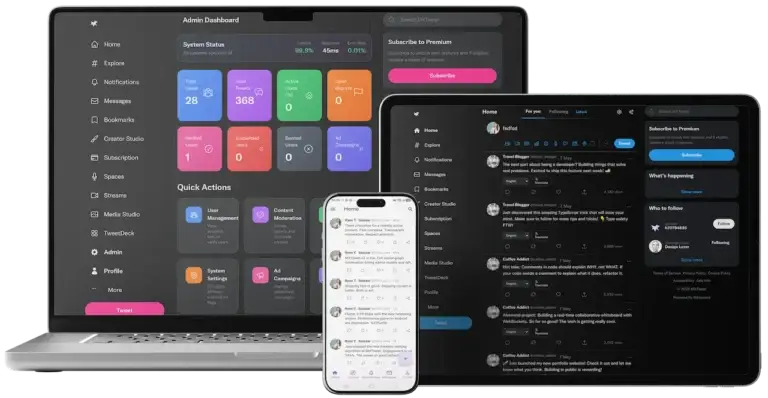
Every surface below is the shipped build on live infrastructure, not a slide deck. Sign in with the credentials shown, post something, message the second account, then open the operator console and watch the same record from the other side.
MEMBER EXPERIENCE
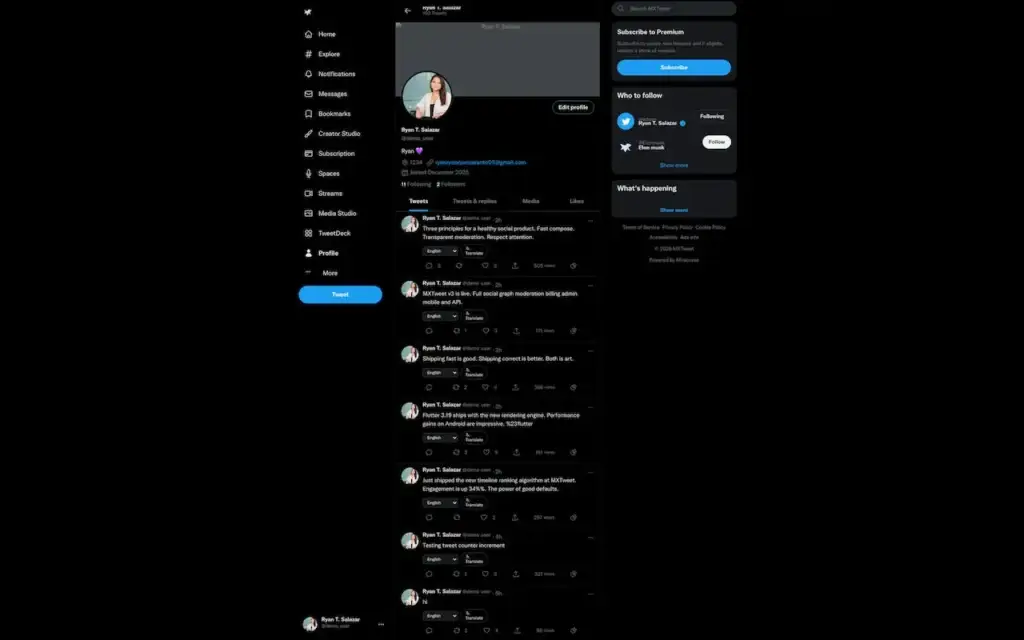
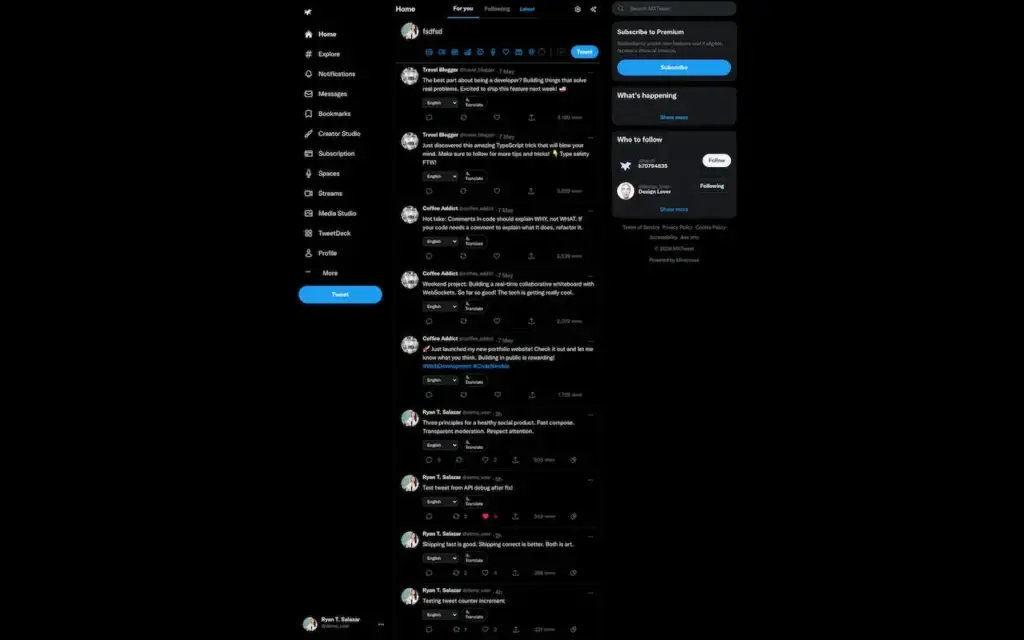
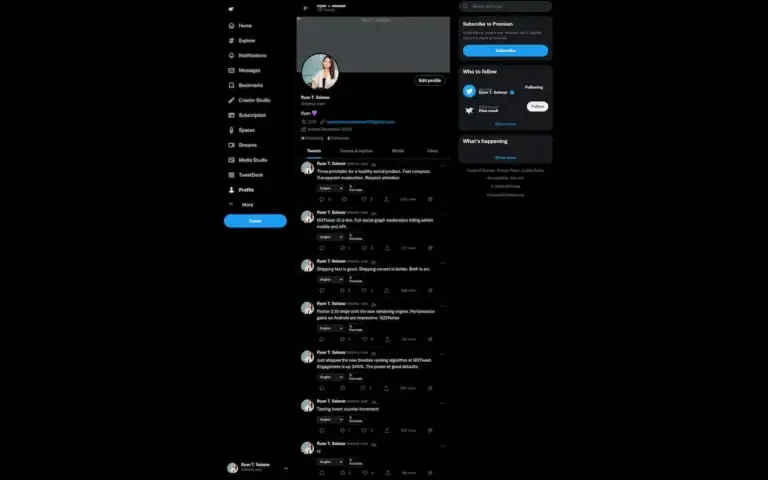
Twitter Clone - Feed, Composer & Profile
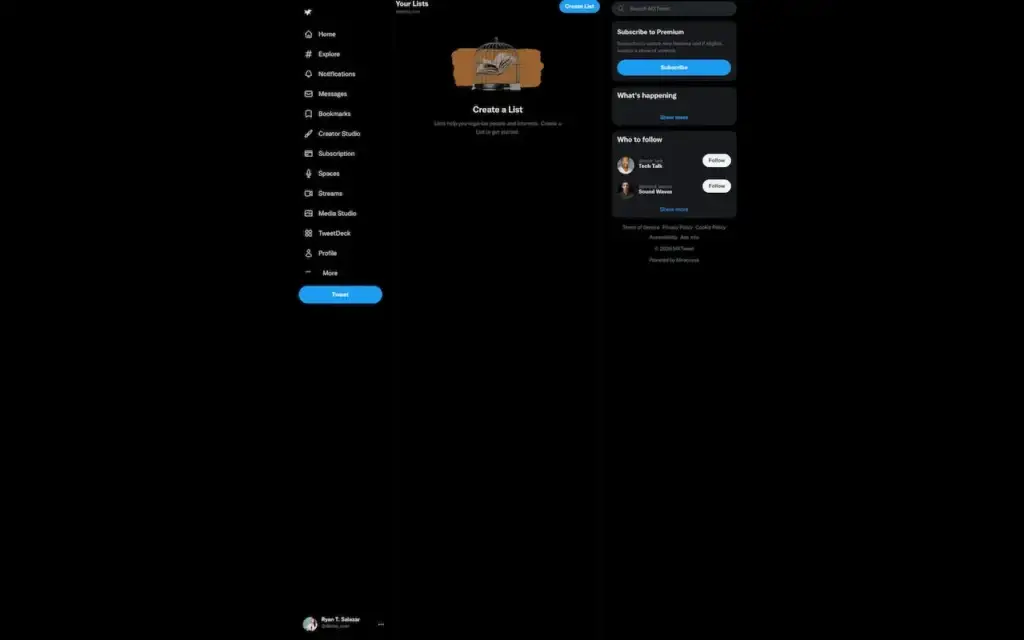
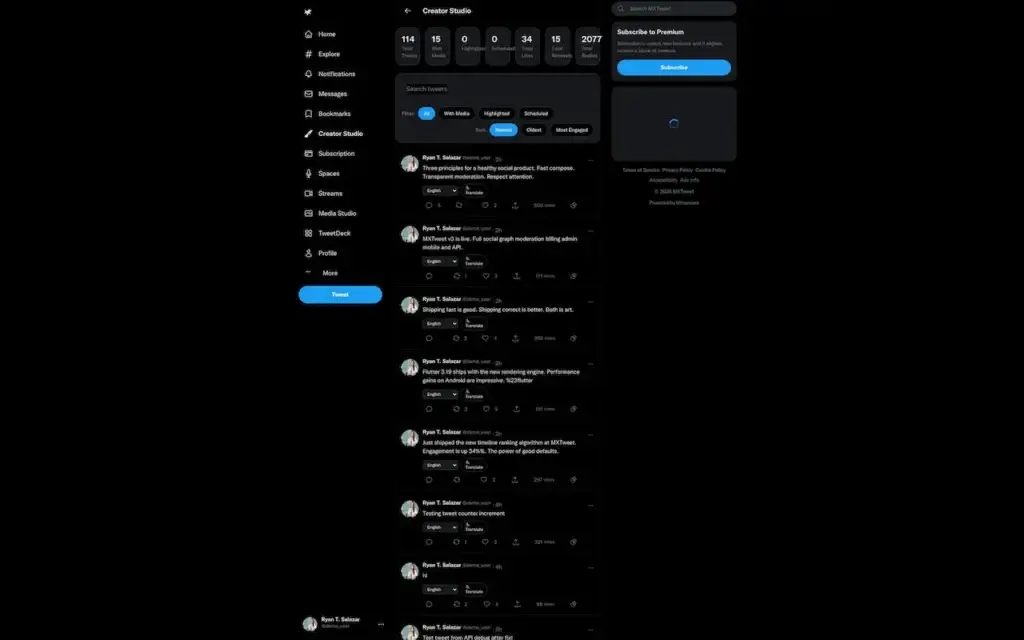
The consumer surface. Compose with images, video, audio, GIFs, polls, quote posts and threads, switch between the For You, Following and Bookmarks timelines, follow accounts, build lists, save searches and work through notifications.
-
Open the web app in your browser
-
Login with the member credentials below
-
Try: compose a thread, run a poll, save a bookmark
-
Try: demo@mxtweet.com / Demo@123
CONVERSATION & MESSAGING
Twitter Clone - Replies, Quotes & Direct Messages
The two-account surface. Sign in as the second member to reply, quote, retweet and follow the first, then open a direct conversation carrying audio messages, reactions, read receipts and live typing indicators.
-
Login as the second member in a private window
-
Reply to and quote the first account
-
Open a DM: send audio, react, watch read receipts
-
Try: test@mxtweet.com / Test@123
OPERATOR CONSOLE
Twitter Clone - Moderation, Ads & Audit
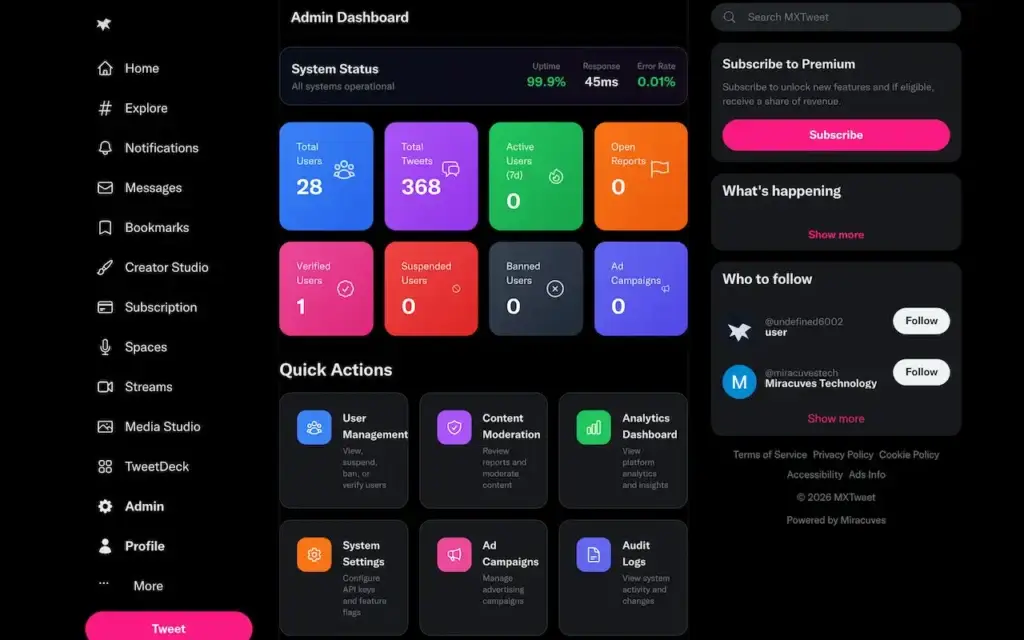
The business surface. Work the report queue with hide, unhide, delete, suspend and ban, review ad campaigns and their spend, inspect login history, and read the audit log that records which administrator did what, to whom, and why.
-
Login with the admin credentials below
-
Open Reports and resolve one
-
Check the audit log for the action you just took
-
Try: admin@demo.com / Admin@123
MOBILE APPLICATION
Twitter Clone - Flutter App for Android
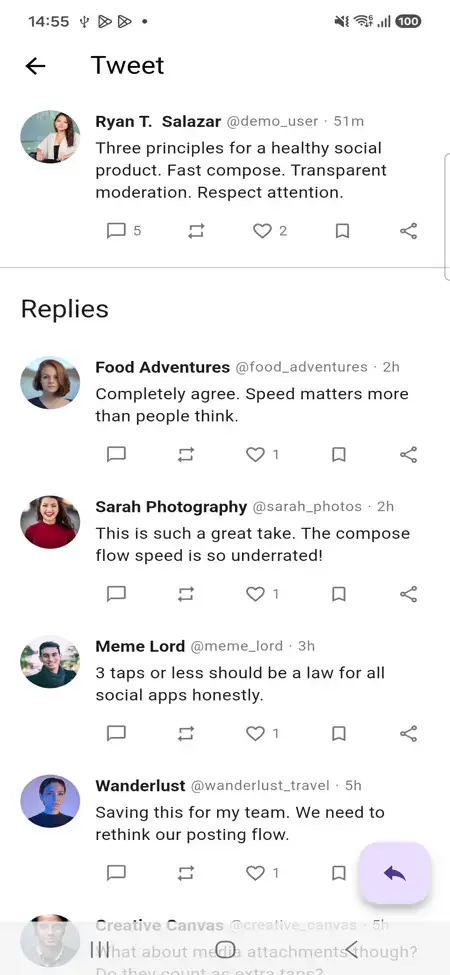
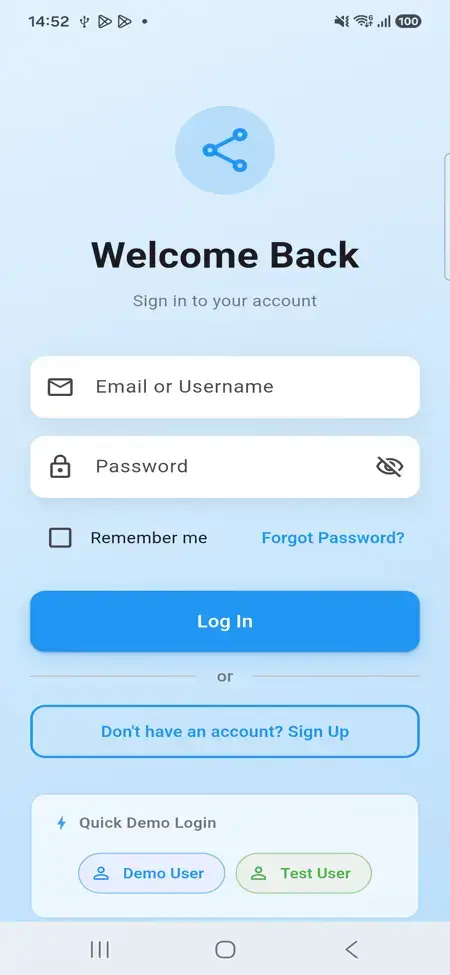
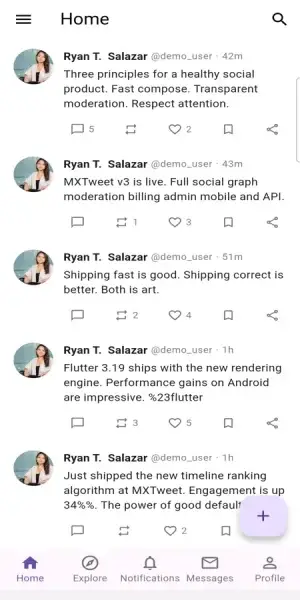
The native surface. A Flutter application covering the core social experience with the same REST API behind it as the web app, so a change to the feed, the composer or messaging lands on both without a second backend.
-
Install the Android build from the app portal
-
Login with the same member credentials
-
Compare parity against the web feed
-
Same credentials as the member demo
Not a Feed Widget
Built for Operators Who Want the Whole Network
A social platform is easy to demo and hard to run. What decides whether it survives contact with real users is everything around the timeline: whether abuse has a queue, whether an advertiser can be invoiced, whether a developer can get a scoped key, and whether an administrator action leaves a record. All of that is in this build rather than on a roadmap.
Parity by Construction
One API, Three Clients
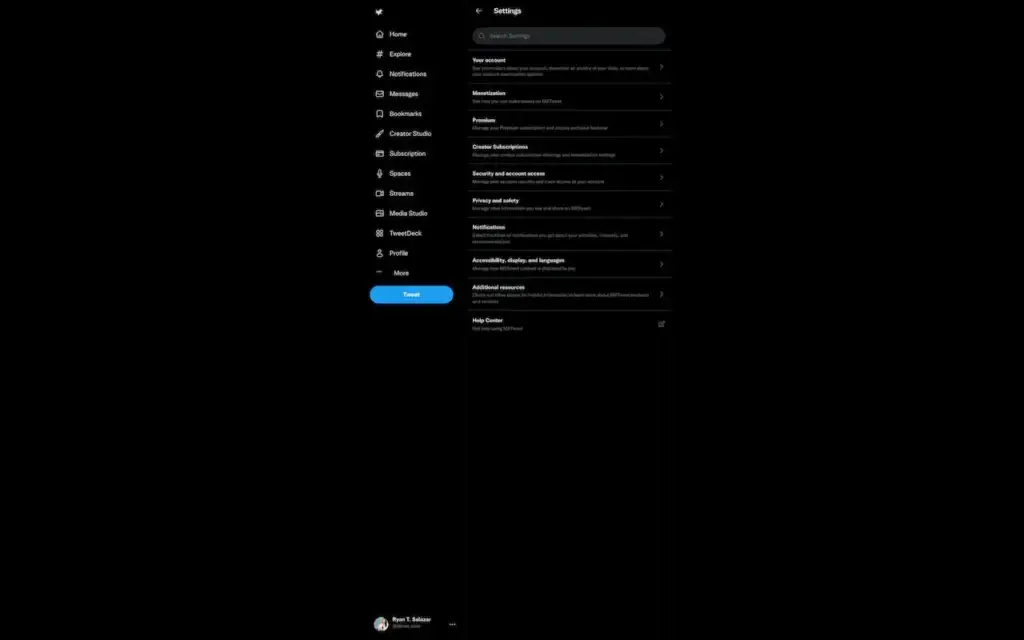
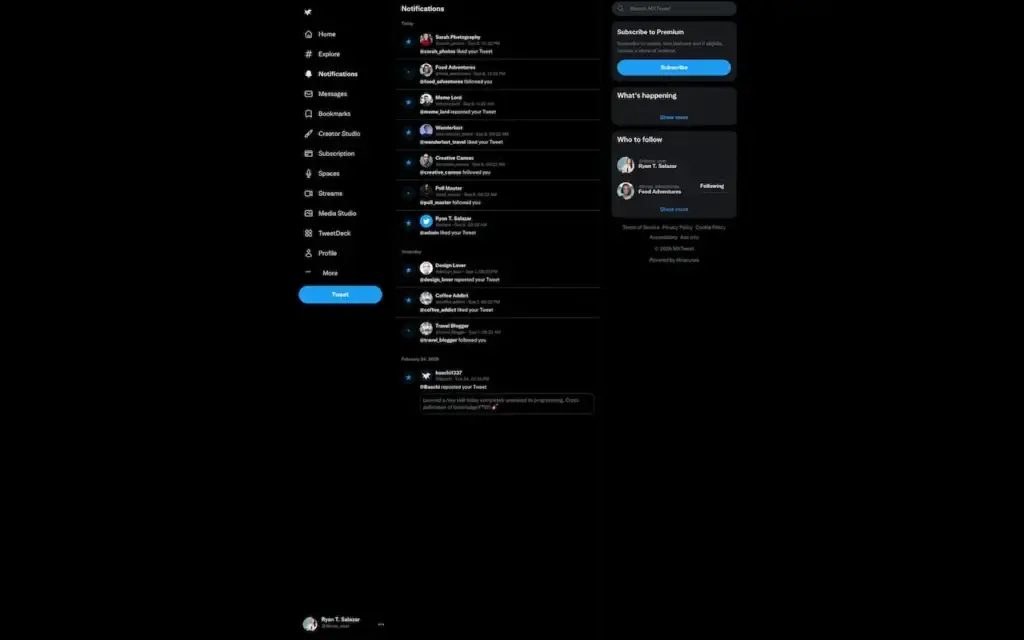
The Next.js web application, the Flutter mobile application and the operator console all call the same REST surface under /api/v1/. Route families cover auth, users, posts, timeline, conversations, notifications, search, hashtags, lists, media and settings.

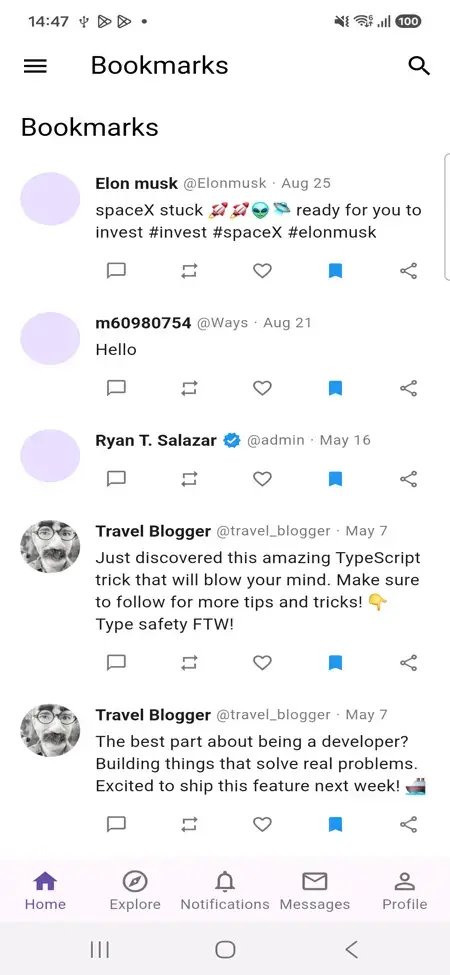
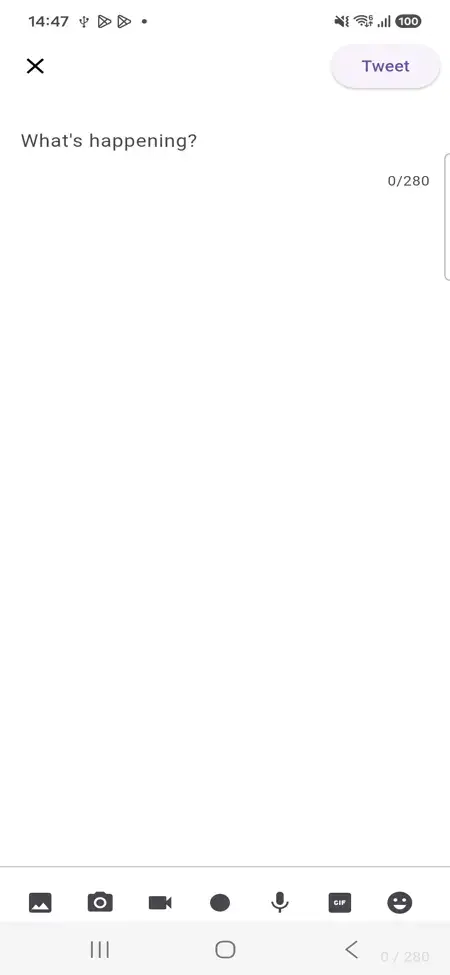
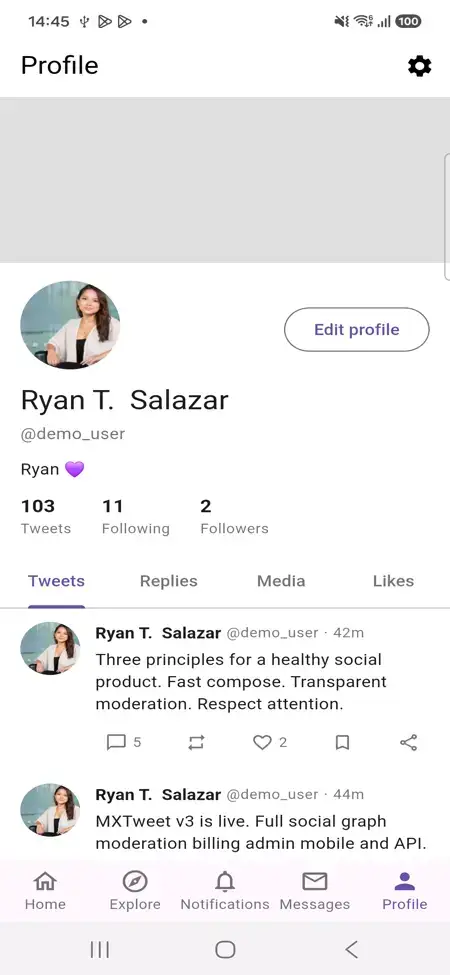
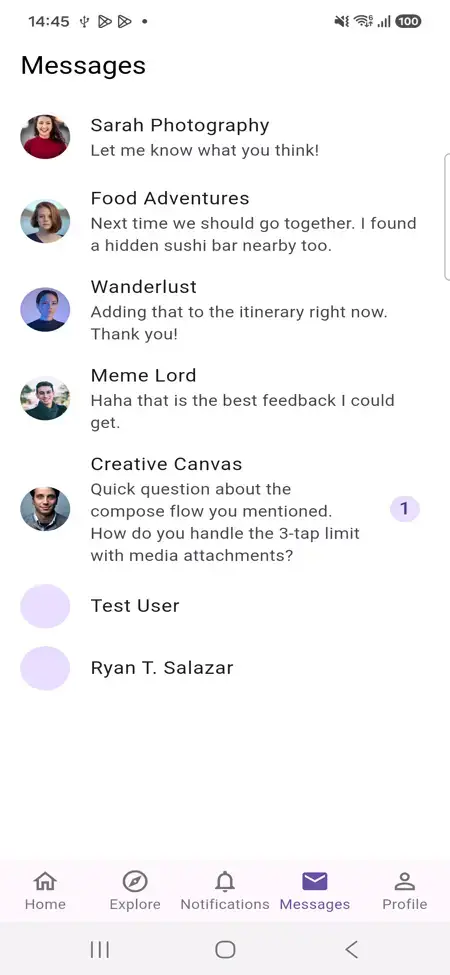
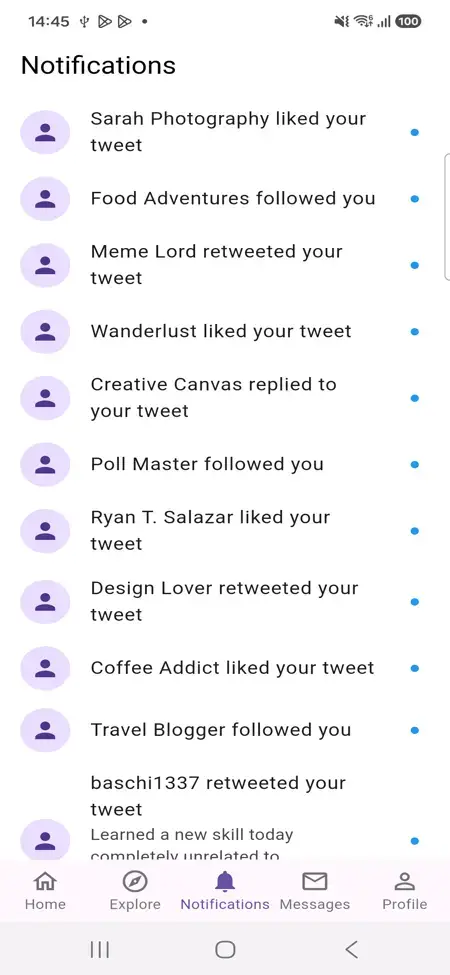
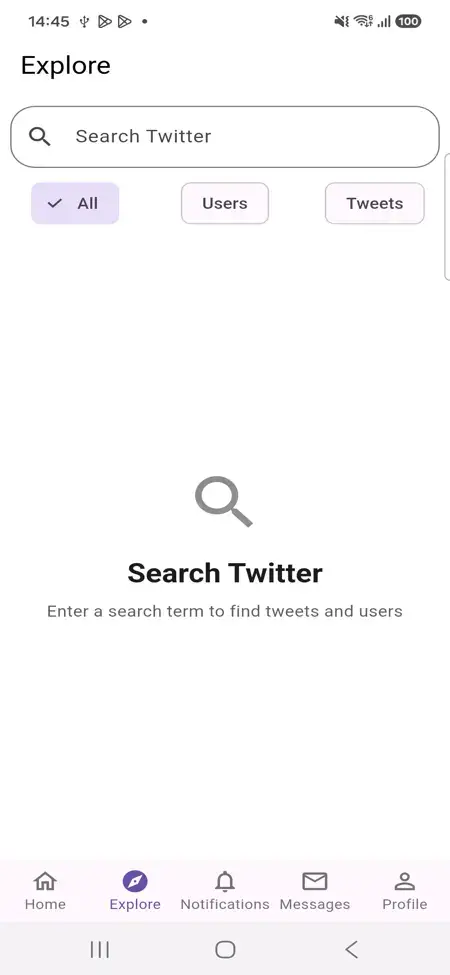
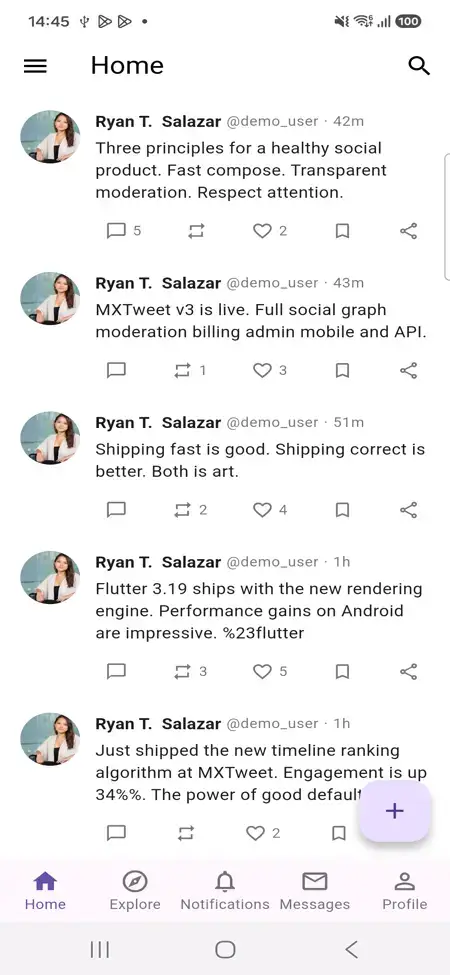
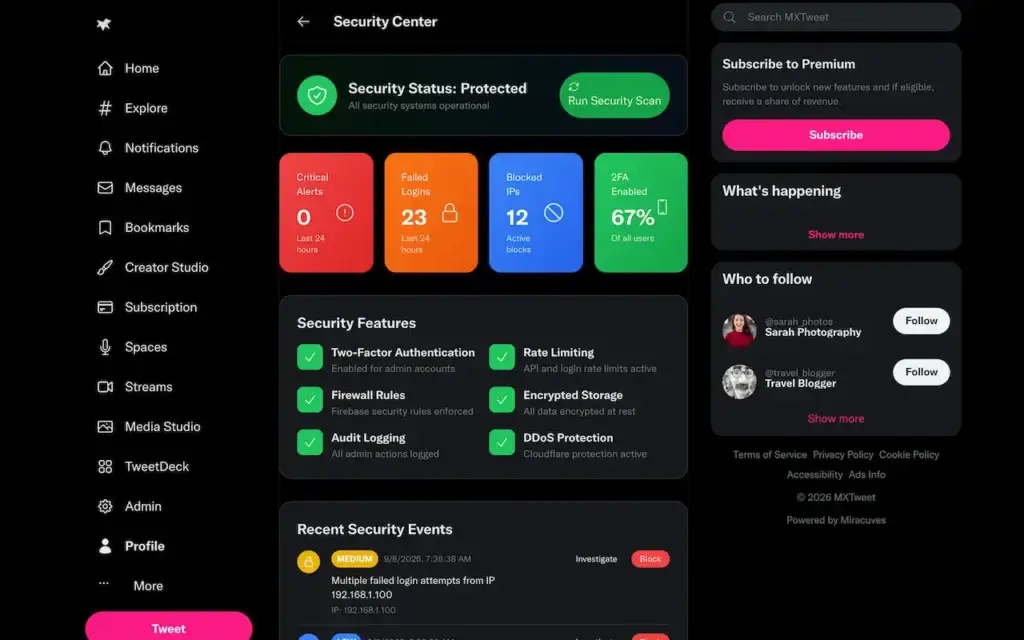
That is what keeps the clients honest. A new field on a post, a new moderation action or a change to how the timeline paginates arrives everywhere at once, because there is one contract and one set of ownership checks rather than three implementations that drift apart over a year.
Yours From Day One
Every Surface, Ready to Brand
Full source for the web application, the Flutter mobile application, the API layer and the operator console, with the Firestore rules, indexes and converters that make them work. No per-seat licence, no revenue share and no dependency on a vendor roadmap.
How an Operator Configures It
Modelled Reference Deployment
An illustrative configuration rather than a client engagement: how the shipped platform is set up for an operator launching a niche public network, with the feed and messaging live first, ad campaigns switched on once there is inventory worth selling, and the developer API opened last.
Illustrative
Niche Public Network Launch
How the shipped platform is configured for an operator launching a niche public network: conversation and messaging live first, tips enabled at launch, subscription tiers switched on once there is a reason to upgrade, ad campaigns once there is inventory worth selling, and the developer API opened last.
- A feed that works but has no moderation queue behind it
- Advertisers with nowhere to buy and no spend tracking
- Developers locked out, so nothing is ever built on the network
- Open a niche public network with moderation working on day one
- Give trust and safety a queue and an audit trail, not a delete button
- Ship the ad desk and the developer API rather than quoting them as phase two
- Ten post types from one composer, across three named timelines
- Typed ad campaigns with budgets, daily caps, spend tracking and targeting
- Five resolution actions with an audit entry on every one
- Fifteen page operator console on a separate authentication path
- Scoped OAuth apps and SHA-256 hashed keys with per-key rate limits
This is a modelled reference deployment, not a client engagement. It shows how the shipped platform is configured for an operator launching a niche public network, with the commercial surfaces switched on in sequence.
Read This Before You Buy
What This Is, and What It Is Not
Clone is the industry term for a platform built to work like a known product. It describes the functional target, not the origin of the code. This is an original implementation on Next.js, Flutter and Firebase.
Not Affiliated With Twitter or X
This is independent software built to a functional target. No code, design, graphics or content originates from the Twitter or X website or applications, and the name is used descriptively to say what the platform does.
Not a Rented Platform
You receive the source for the web app, the Flutter app, the API layer and the operator console, plus the Firestore rules and indexes. No per-seat fee, no revenue share, and a mainstream stack any team can hire for.
Not an Audience
The hard part of a social product is supply and demand, not software. This gives you the surfaces, the moderation tooling and the monetization; the community is the work you do after launch.
The Honest Version
What You Are Actually Buying
What arrives is a working social network with the commercial surfaces attached, deployed under your brand on your infrastructure, with the source in your hands.
-
Posts with images, video, audio, GIFs, polls, quotes and threads
-
For You, Following and Bookmarks timelines
-
Direct messages with audio, reactions and read receipts
-
A typed ad campaign engine with budgets and targeting
-
OAuth 2.0 apps and hashed API keys for integrators
What does not arrive is an audience. Software cannot supply the thing a social network actually runs on, and any vendor implying otherwise is selling you something they do not have.
The Full Surface
Features That Decide Whether a Social Product Survives
A composer is not a product. What follows is the machinery around the timeline that determines whether a network can be moderated, monetized and built upon once real people arrive on it.
One Composer, Ten Post Types
Text, images, video, audio, GIFs, polls, quote posts, threads, scheduling and content warnings all publish from the same control. A member never has to find a different surface to post a different kind of thing.
- Text, images, video, audio and GIFs
- Polls with timed expiry
- Quote posts and threads
- Scheduling and content warnings
Three Named Timelines
For You, Following and Bookmarks are distinct feeds rather than one opaque ranking. The operator has something to tune and the member has something to choose, which is the difference between a feed people trust and one they suspect.
- For You algorithmic timeline
- Following chronological timeline
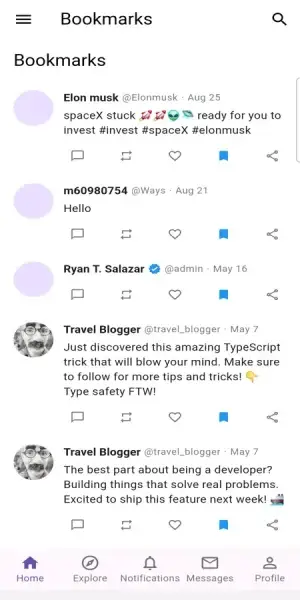
- Bookmarks as a saved feed
- Per-member timeline preferences
Messaging With Presence
Conversations carry audio messages, reactions, read receipts through readBy arrays and live typing through a typingUsers map. Group conversations use member ids, so a DM thread is a real object rather than a chat log.
- Likes, reposts and quote counts
- View and impression tracking
- Denormalized onto the feed document
- No per-render aggregation queries
Counters Instead of Fan-Out Queries
Likes, reposts, quotes, replies, views and impressions are denormalized onto the documents the feed already reads. The timeline stays cheap as the graph grows, which is where naive social builds fall over.
- Direct and group conversations
- Audio messages and reactions
- Read receipts through readBy arrays
- Live typing via a typingUsers map
Moderation Is a Queue, Not a Delete Button
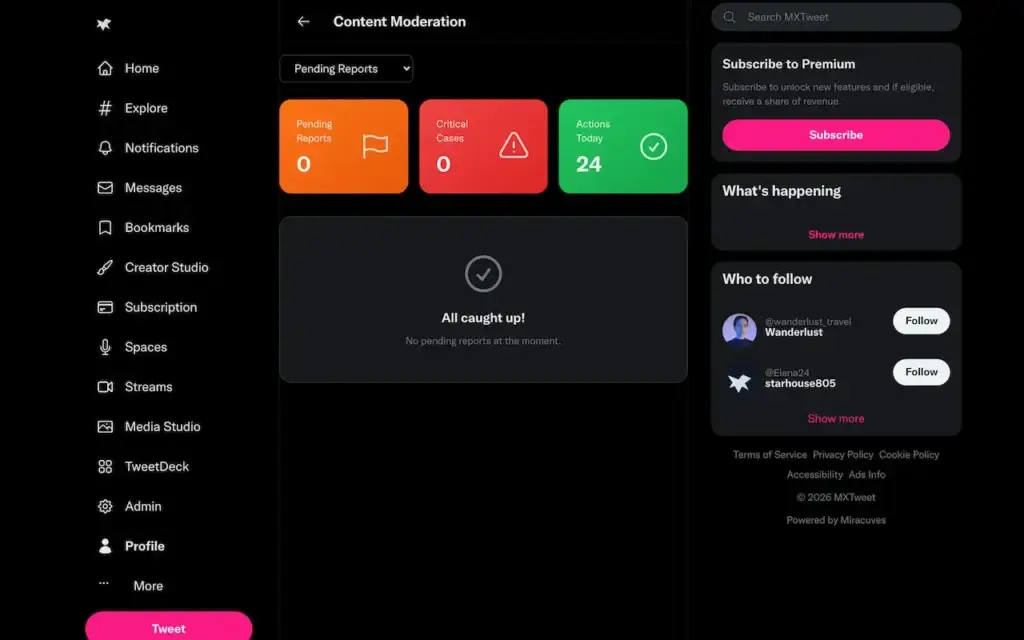
Reports arrive in a queue and resolve through hide, unhide, delete, suspend or ban. Each resolution writes an audit entry naming the administrator, the action, the target and the reason.
- Follows and followers
- Lists with member ids
- Blocks and mutes as explicit records
- Verification badges on approval
An Audit Log That Answers Questions
Admin id, action, target user, target post, target report, reason and timestamp are recorded on privileged actions, so "who suspended this account and why" has an answer months later.
- Full-text search across posts and people
- Hashtag extraction and trending
- Saved searches per member
- Composite indexes for search queries
Typed Ad Campaigns
Promoted post, banner and sponsored are distinct campaign types, each with budget, daily budget, spend tracking and targeting keywords, so the advertiser side is something an operator can actually sell against.
- Per-user notification subcollection
- Mentions, replies, follows and likes
- Cursor paging through history
- Push delivery to the mobile client
Three Tiers, Enforced Server-Side
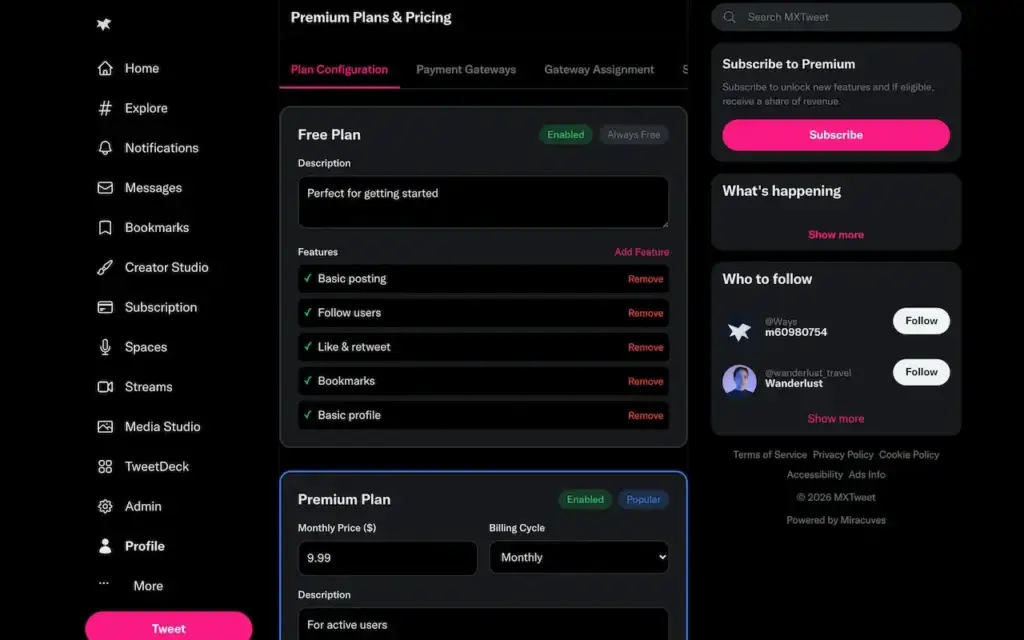
Free, Premium at $9.99 and Pro at $29.99, with entitlement checks on the server. Repricing or regating is an operator decision rather than a deployment.
- Report queue with member submissions
- Hide, unhide, delete, suspend, ban
- Audit entry on every resolution
- Appeal review by an operator
Scoped Keys for Integrators
API keys are SHA-256 hashed and stored per user with their own rate limits, and OAuth 2.0 apps carry client id, secret, redirect URI and scopes. Third-party access is granted, measured and revocable.
- Promoted post, banner and sponsored types
- Budget and daily budget per campaign
- Spend tracking against the cap
- Targeting keywords per campaign
One Response Envelope
Every endpoint returns success, data, error with a code and message, and meta with count, limit and nextCursor. Client error handling is written once rather than per route.
- Free, Premium at $9.99, Pro at $29.99
- Server-side entitlement checks
- Creator subscriptions via subscriber ids
- Tips between members
Cursor Pagination Throughout
Timelines, notifications and search all page by cursor rather than offset, which is the only approach that stays correct when new posts arrive between one page and the next.
- OAuth 2.0 apps with scopes
- Client id, secret and redirect URI
- SHA-256 hashed API keys per user
- Per-key rate limits
Login History as Evidence
IP, user agent, device, browser, location, timestamp and success are recorded per sign-in. When an account is disputed or compromised, support has a record instead of a guess.
- Login history with IP and device
- Browser, location and timestamp
- Success and failure recorded
- Two-factor fields on the member record
Account security records login history with IP, user agent, device, browser, location, timestamp and outcome, which is the evidence trail a support desk needs when an account is disputed.
How Operators Earn
Twitter Clone Revenue Models - Tiers, Ads, Creator Subscriptions & API Access
A social network with one revenue line is fragile, because the line that works depends entirely on which side of the market fills first. This build ships five, and they draw on different sides: members pay for tiers, advertisers pay for attention, fans pay creators, and developers pay for access.
Subscription Tiers
Free, Premium at $9.99 and Pro at $29.99, with entitlements checked on the server. The obvious first line, and the one that needs an audience least, because it sells to the members you already have.
Ad Campaigns
Promoted posts, banners and sponsored placements, each with a budget, a daily cap, spend tracking and targeting keywords. This is the line that scales with attention rather than with headcount.
Creator Subscriptions
Subscriber ids are held on the creator, so paid followings are a first-class relationship. The platform takes its share of a transaction between two members it never has to fund.
Tips
Direct member-to-creator payments on a post or a profile. Low friction, no commitment, and the line that tends to move first on a young network where nobody is ready to subscribe yet.
API and Developer Access
Scoped OAuth apps and rate-limited keys, priced per tier. The line most social products never build, and the one that turns a network into something other companies depend on.
White-Label Licensing
The whole platform under a second brand for a partner or a regional operator. You own the source outright, so sub-licensing is a commercial decision rather than a negotiation with a vendor.
None of them requires a code change to switch on. Plan gating is enforced server-side, campaigns are records an operator creates, and API keys are issued per user, so the sequencing is a commercial decision rather than a release.
Run It Without a Developer
Twitter Clone Operator Console - Reports, Ads, Users & Audit
The console exists so that trust and safety does not queue behind engineering. Report resolution, account suspension, ad campaign review and audit inspection are operator tasks with their own interface, on a separate authentication path from member accounts, across fifteen admin pages.
Operator Console Sections
Report Queue
Member reports arrive as records to work, with resolution actions attached rather than a free-text status field.
Five Resolution Actions
Hide, unhide, delete, suspend and ban, so a moderator can respond proportionately instead of choosing between nothing and removal.
Audit Log
Administrator id, action, target user, target post, target report, reason and timestamp on privileged operations.
Account Status Control
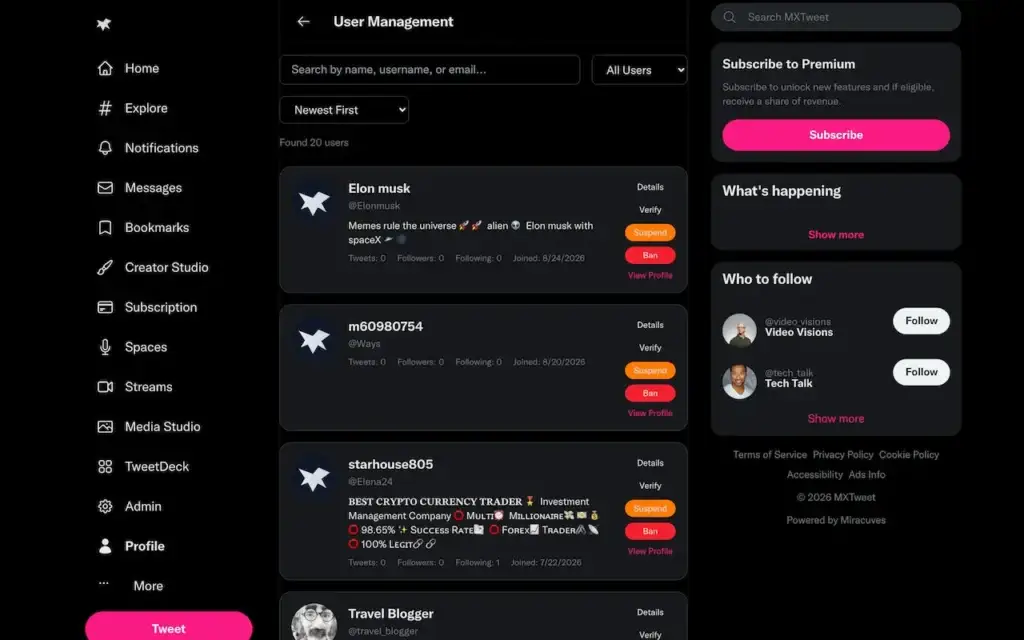
Suspend, ban and restore with reasons recorded, so an appeal has something to review.
Ad Campaign Oversight
Campaign type, budget, daily budget, spend and targeting visible to the operator running the inventory.
Verification Review
Badge assignment as an operator decision with a record, rather than a flag someone sets in the database.
Platform Analytics
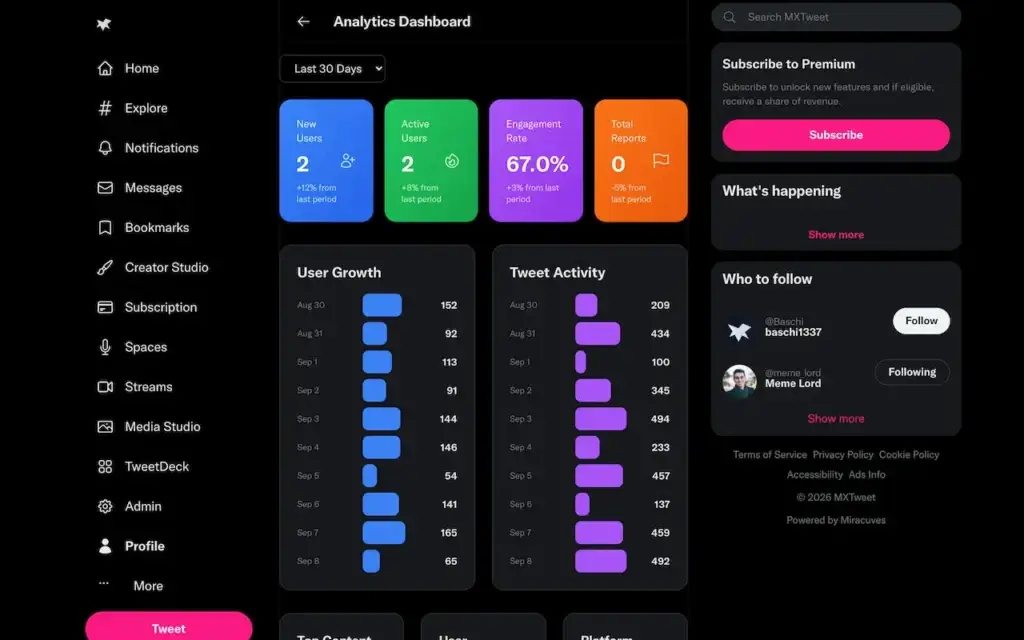
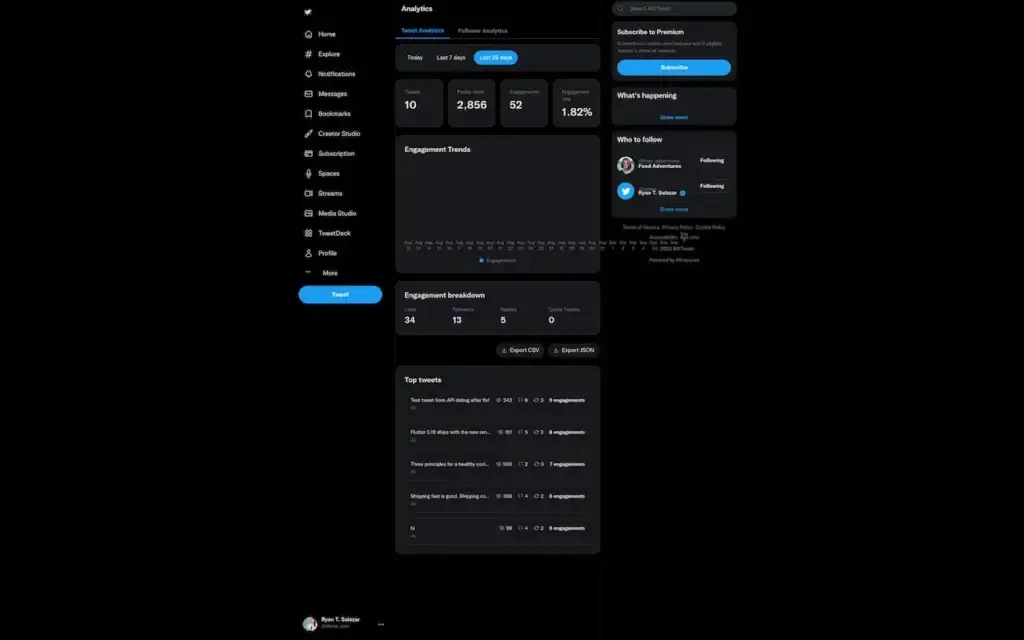
Activity and growth statistics for the people who have to report on the network, not just run it.
Login History
IP, user agent, device, browser, location, timestamp and outcome per sign-in, for disputes and compromise.
Developer Access Oversight
Which OAuth applications exist, which keys are live, and what rate limits they carry.
- User list, detail and account status changes
- Report queue with hide, unhide, delete, suspend and ban
- Suspension and ban management with reasons
- Ad campaign review with budget and spend
- Verification review and badge assignment
Separate Admin Auth
The console does not share a session with member accounts, so a compromised member cannot reach operator tooling.
- Platform statistics and activity analytics
- Audit log viewer across privileged actions
- Login history with device and location
- Settings and platform configuration
- API key and OAuth application oversight
Need deeper governance? Admin authentication is separate from member authentication, and every privileged action writes an audit entry naming the administrator, the target and the reason. Role granularity beyond that is configuration we scope with you.
Transparent Pricing
How Much Does It Cost to Build a Social Media App Like Twitter in 2026?
The honest answer is that it depends on what you count. Building a public conversation platform from scratch means the feed, the composer, the social graph, messaging with presence, search, moderation tooling, an ad engine and a developer platform, on three clients. Quotes for that work start in the tens of thousands and run for months. This is the same surface, already built, at a fixed price.
Not sure which option
is right for you?
Talk to us - we'll understand your goals, timeline, and budget, and point you to exactly what you need. No upselling, just honest advice.
The Full Package
What's Included - Twitter Clone Source Code, Apps & Deployment
Ownership transfers in full. You receive the web application, the Flutter mobile application, the API layer, the operator console and the Firebase configuration that makes them work together, with no per-seat licence and no revenue share.
Full Source Code
Web, mobile, API and console, transferred outright with no per-seat fee and no revenue share.
- Next.js web application
- 68 user-facing pages
- 190 React components
- TypeScript 4.7 with React 18.2
- SWR for data fetching and caching
Firestore Configuration
Security rules, composite indexes and typed converters, which is the part a from-scratch build gets wrong first.
- 64 API route handlers under /api/v1/
- Eleven route families
- One documented response envelope
- Cursor-based pagination throughout
- Ownership checks on every mutation
Member Web Application
Sixty-eight pages covering feed, composer, profiles, lists, bookmarks, notifications, messages and settings.
- Firestore data layer
- Security rules and composite indexes
- Typed converters in src/lib/types/
- Denormalized counters and arrays
- Subcollections for notifications, bookmarks and messages
Flutter Mobile App
Twenty-eight screens on the same REST API, so the clients cannot drift apart.
- Flutter mobile application
- 28 screens across the core experience
- Shared REST API with the web app
- Android build supplied
- iOS build on request
Operator Console
Fifteen admin pages with a separate authentication path and an audit trail.
- Fifteen page operator console
- Separate admin authentication path
- Report queue and resolution actions
- Audit log viewer
- Ad campaign oversight
Monetization Stack
Tiers, ad campaigns, creator subscriptions and tips, wired rather than stubbed.
- Twelve Cloud Functions
- Firebase Authentication with Google sign-in
- OAuth 2.0 application support
- SHA-256 hashed API keys
- Per-key rate limiting
Developer Platform
OAuth applications, hashed API keys and per-key rate limits.
- PM2 process configuration
- Environment-driven configuration
- Firestore rules and index definitions
- Deployment guidance for a Linux host
- Six working days to a branded deployment
Technical Documentation
Schema, ERD, API collection, security handbook and VAPT reference material.
- Technical documentation set
- Schema and ERD references
- API collection
- Security handbook
- VAPT reference material
Want to see it running first? Use the member, second-account and operator logins on the demo above, then ask us anything the console does not answer.
Explore Every Angle of the Twitter Clone
Four deeper guides covering features, cost, choosing a builder, and how a public network earns once both sides of the market fill.
Features
A composer is the smallest part of it: the timeline around it, the moderation queue and the notification machinery, built as 64 API handlers and 190 React components.
See the full breakdown→Development Cost
The fixed $3,699 against freelancer, agency and custom quotes, moved not by the build but by integration work: payment rails beyond the reference, and payouts in more than one currency.
See exact pricing→Development Company
Agency, freelancer and Miracuves compared on the machinery around the timeline: reports entering a queue rather than an inbox, and every privileged action evidenced with an audit entry.
Compare options→Business Model
Five lines across three sides of the market, ranked by which side fills first, from paid subscriptions and creator income through to advertising and developer API access.
See the playbook→Know Your Buyer
Who Is Our Twitter Clone App Built For?
This suits operators who already know where their audience comes from. The software is the fast part; supply is the slow part, and the people who succeed with it arrive with a community, a niche or a distribution channel already in hand.
Niche Community Founders
Creator Platform Operators
Media and Publishing Groups
Brand and Enterprise Networks
Regional Social Operators
Agencies and White-Label Resellers
It suits them because the commercial surfaces are present on day one. There is no phase where the network works but cannot be monetized, and no phase where monetization exists but moderation does not.
Where It Fits
Twitter Clone Use Cases - Communities, Creators, Publishers & Developer Networks
Launch a niche public network. One profession, one region, one language or one interest, with the full conversation surface and a moderation queue from day one rather than after the first abuse incident.
Niche Public Networks
Lead with creators instead. Subscriptions, tips and paid followings are first-class records, so a creator can earn on the platform in week one and the operator takes a share of a transaction it does not have to fund.
Creator-Led Platforms
Give a publisher its own square. Comments and community moved off a rented platform onto infrastructure the publisher controls, with an ad desk it sells directly and audience data it keeps.
Publisher Communities
Run an internal or customer-facing network. Account status control, audit logs and a separate operator authentication path matter more in this setting than growth features, and they are present rather than promised.
Internal Social Networks
Enter a market the incumbents serve badly. Local language, local moderation policy and local payment rails are configuration on an owned codebase rather than a request into someone else global roadmap.
Regional Launches
Open a developer ecosystem. Scoped OAuth applications and rate-limited keys let other products build on your network, which is the difference between an app and a piece of infrastructure.
Developer Ecosystems
Every one of these is the same deployment with different surfaces emphasized. That is what owning the source buys: the product can follow the market you actually find rather than the one you guessed at.
Text-first social is not a solved category. The incumbents have moved repeatedly on moderation, pricing and API access, and each move has left an audience looking for somewhere else to be. Owning the platform is what lets you be that somewhere.
Market Timing
Why Launch a Social Platform in 2026?
The incumbents have spent three years teaching their users that terms can change without notice. Moderation policy, verification, pricing and API access have all moved, and each change has pushed a cohort of people and developers to look for an alternative.
Platform Risk Is Now Obvious
Every operator who built an audience on a rented platform has watched the terms move. Owning the square is a strategic position, not a technical preference.
Developers Are Looking for Homes
API pricing changes displaced an entire ecosystem of small products. A network that offers scoped keys and predictable limits is attractive to the people who build on top.
Creators Want a Bigger Share
Paid followings and tips are established behaviour now. The question a creator asks is what percentage they keep and how fast they are paid.
Moderation Is a Buying Criterion
Advertisers and enterprises will not attach to a network with no queue, no audit trail and no account controls. Trust and safety is commercial infrastructure.
Niche Beats General
A network does not need to be large to be valuable. It needs to be the place a specific group considers default, which is achievable where a general network is not.
Six Days to a Branded Deployment
The software is not the bottleneck any more. What decides the outcome is how quickly you can start learning from real members.
Platform by the Numbers
That is the opening. Not to build a general-purpose network, which is a capital problem rather than a software one, but to serve a specific audience properly on infrastructure you control and cannot be evicted from.
Under the Hood
Twitter Clone Tech Stack - Next.js, Flutter, Firebase & TypeScript
One language across the surfaces that matter. TypeScript in the web application and the API layer, Dart in the mobile client, and a managed backend that removes an entire class of infrastructure work from a small team.
Web Application
Next.js · React 18.2 · TypeScript 4.7
- 68 user-facing pages
- 190 components
- SWR 1.3 for fetching and caching
API Layer
Next.js API routes under /api/v1/
- 64 handlers across eleven route families
- Zod validation on bodies and queries
- One success, data, error, meta envelope
Data
Firebase Firestore
- Typed converters in src/lib/types/
- Composite indexes for timeline, search and notifications
- Denormalized counters and arrays for feed reads
Mobile Application
Flutter
- 28 screens on the shared REST API
- Android build supplied, iOS on request
- Feature parity on the core social experience
Identity & Access
Firebase Authentication · OAuth 2.0 · API keys
- Email, password and Google sign-in
- Admin SDK verifyIdToken in middleware
- SHA-256 hashed keys with per-key rate limits
Deployment
PM2 · Linux · Cloud Functions
- Twelve Cloud Functions
- Environment-driven configuration
- Firestore rules and indexes as code
Why this stack: Firestore removes the operational burden a small team cannot carry at launch, real-time listeners make feeds and messaging cheap to build correctly, and a managed authentication layer means the riskiest code on the platform is not code you wrote.
End to End
How the Twitter Clone Works - Join, Post, Connect & Earn
The path below is the shipped flow, not an idealised diagram. Each step maps to routes that exist and records that are written, which is what makes the demo above worth opening.
Member Journey, From Signup to Earning
Join and Verify
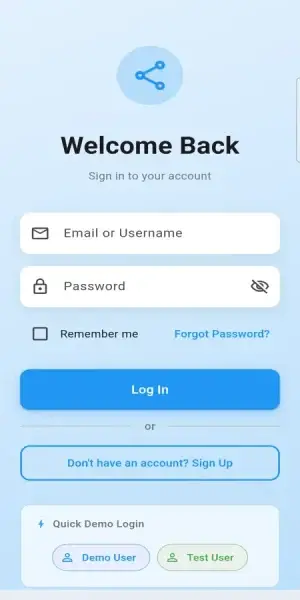
A member signs up through Firebase Authentication with email and password or Google sign-in. The session is a Firebase ID token that middleware verifies on every request through the Admin SDK.
- Email, password and Google sign-in
- Token verification in middleware on every call
- Account status checked before any mutation
- Login history recorded with device and location
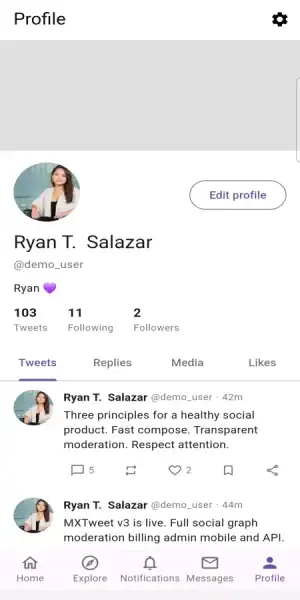
Build a Profile
Profile, preferences and privacy settings are written to the member record, alongside the counters the feed will later read rather than compute.
- Display name, bio, avatar and banner
- Timeline, notification and privacy preferences
- Two-factor fields, phone, email, timezone, language
- Counter fields initialized on the document
Post and Converse
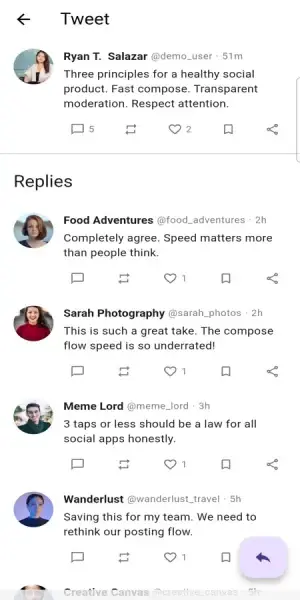
The composer publishes text, images, video, audio, GIFs, polls, quote posts and threads, with scheduling and content warnings available on the same control.
- Ten post types from one composer
- Replies, quotes and threads with parent links
- Link previews and hashtag extraction
- Ownership checks on every edit and delete
Follow and Message
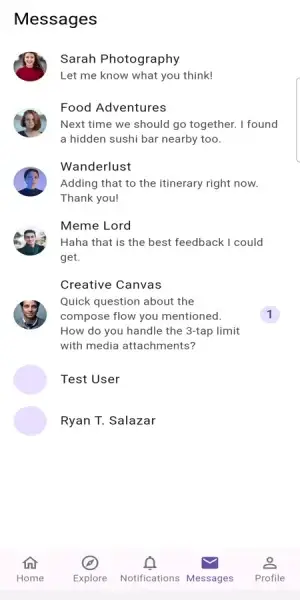
The social graph is explicit. Follows, lists, blocks and mutes are records, and conversations carry presence rather than just history.
- Follows, followers, lists, blocks and mutes
- Direct and group conversations by member ids
- Audio messages, reactions and read receipts
- Live typing indicators through a typingUsers map
Monetize the Audience
The commercial surfaces switch on without a release. Tiers gate entitlements server-side, campaigns are operator records, and creator subscriptions are a relationship on the creator document.
- Free, Premium at $9.99 and Pro at $29.99
- Promoted post, banner and sponsored campaigns
- Budgets, daily caps, spend and targeting keywords
- Creator subscriptions and tips between members
Moderate and Account For It
Reports enter a queue and resolve through five actions, and every privileged action leaves an audit record. This is the step that decides whether advertisers and enterprises will attach to the network.
- Hide, unhide, delete, suspend and ban
- Audit entries naming admin, target and reason
- Separate operator authentication path
- Login history available for disputes
Notice where the commercial surfaces appear. They are not at the end as a phase two: a member can be monetized as soon as there is something worth paying for.
How It's Built
Twitter Clone Platform Architecture & Data Flow
Three Clients, One Contract
Web, mobile and console all call /api/v1/. There is one set of ownership checks and one pagination convention, so the clients cannot quietly diverge.
Middleware as the Gate
Firebase Admin SDK verifyIdToken runs in middleware, which checks the token, confirms account status and attaches user context before a handler sees the request.
Two Ways to Authenticate
Firebase Bearer tokens for members and x-API-Key for integrators, so a third-party product never needs a member session to read public data.
Denormalized for Reads
Counters and arrays live on the documents the feed already loads. The timeline is a read of records rather than an aggregation across collections.
Real-Time Where It Matters
Firestore snapshot listeners drive feeds, notifications and messages, so presence and delivery are properties of the data layer rather than a socket server to operate.
Indexed Before It Is Slow
Composite indexes are defined for timeline, search and notification queries as part of the build, which is the work most from-scratch social projects discover a month after launch.
Performance Targets
Built to Scale - Denormalized Reads, Cursor Paging & Managed Infrastructure
Social products fail on read volume rather than write volume. One post is written once and read thousands of times, so the architecture is arranged around making that read cheap.
Counters and engagement arrays sit on the documents the feed already fetches, which removes the per-render aggregation that makes naive implementations collapse at exactly the moment they start working.
Pagination is cursor-based everywhere it matters. Offsets are wrong on a feed by definition, because new posts arrive between one page and the next and an offset silently skips or repeats.
Composite indexes for timeline, search and notification queries are part of the build rather than a response to the first slow page in production.
Real-time listeners handle feeds, notifications and messages, so presence is a property of the data layer instead of a socket tier to run, scale and monitor separately.
Reads Optimized First
Denormalized counters and arrays on the feed documents, because a social timeline is a read problem long before it is a write problem.
Cursor Paging Everywhere
Timelines, notifications and search page by cursor, which stays correct while new content arrives mid-scroll.
Indexes Defined Up Front
Composite indexes for timeline, search and notification queries ship with the build.
Real-Time Without a Socket Tier
Snapshot listeners drive feeds, notifications and messaging, so there is no separate realtime service to operate.
Rate Limits on Access
Per-API-key counters and express-rate-limit on the API surface, so one integrator cannot degrade the platform for members.
A Trade We State Plainly
Managed infrastructure trades ceiling for speed. Right for launch, worth revisiting deliberately at scale, and not something we pretend away.
Firestore removes an entire operational burden at launch. There is no database to size, patch or fail over while you are still discovering whether the product works.
The trade is honest: managed infrastructure means less control at very large scale. That is the right trade for a launch and a decision to revisit deliberately, not a limitation we hide.
Built to Be Audited
Twitter Clone Security - Documented, Not Decorated
Security claims on a social platform are worth checking, because the attack surface is unusually wide: user-generated content, direct messaging, third-party API access and an advertising system all in one product.
Rate Limiting Needs Tuning
Firestore Rules Are the Perimeter
Two-Factor Fields Exist, Enforcement Is Configuration
Content Moderation Is Human Plus Tooling
Third-Party Access Is Scoped
Independent Testing Is Yours to Commission
Token Verification in Middleware
Included. Firebase Admin SDK verifyIdToken runs before handlers, checking the token, the account status and attaching user context.
Ownership Checks on Mutations
Included. Post, user and conversation mutations verify the caller owns the record rather than trusting a client-supplied id.
Hashed API Keys
Included. Keys are SHA-256 hashed and stored under the owning user, so the plaintext key exists only at issue time.
Input Validation
Included. Zod schemas validate request bodies and query parameters at the API boundary.
Audit Logging
Included. Privileged actions record administrator, action, target and reason, which is what makes an incident reconstructable.
Secrets Management
Configuration required. Configuration is environment-variable driven, which is correct for a codebase and insufficient for production. Moving credentials into a managed secret store is a deployment step we do with you.
The PRD for this platform specifies its own claim vocabulary – Included, Supported, Configuration required – and the list below uses it exactly. Anything that is deployment work is named as deployment work.
Go Further
Twitter Clone Add-Ons - Moderation AI, Payments, Media & Enterprise
The base platform is complete for launch. These are the extensions operators ask for once they know which way their network is growing, and each one is scoped separately rather than bundled into a price you may not need.
Automated Moderation
Classification of text and image content ahead of the human queue, so moderators triage rather than read everything.
Payment Rails
Stripe is referenced in the build. Wiring your chosen processor for tiers, tips and creator subscriptions, including local rails, is integration work.
Media Pipeline
Transcoding, thumbnailing and CDN delivery for video at volume, which becomes the dominant cost line on a media-heavy network.
Live Audio Rooms
The rules define a spaces collection. Building the live audio surface on top of it is a scoped extension rather than a switch.
Advanced Analytics
Cohort retention, creator earnings reporting and advertiser dashboards beyond the platform statistics included in the console.
iOS Build and Store Submission
The Flutter codebase supports it; producing, signing and submitting the iOS build is a defined piece of work.
Localization
Multi-language interface and right-to-left support for regional launches, including moderation policy per market.
Enterprise SSO
SAML or OIDC for organizations running the platform as an internal network alongside their existing identity provider.
Building a Social Product? We Have the Whole Category Covered.
Text-first is one shape a social network takes. If your audience wants photos, short video, professional identity or private communities instead, the platform underneath is different and so is the page.

Threads Clone
Text-first social platform with ad accounts, campaigns and consent-gated messaging.
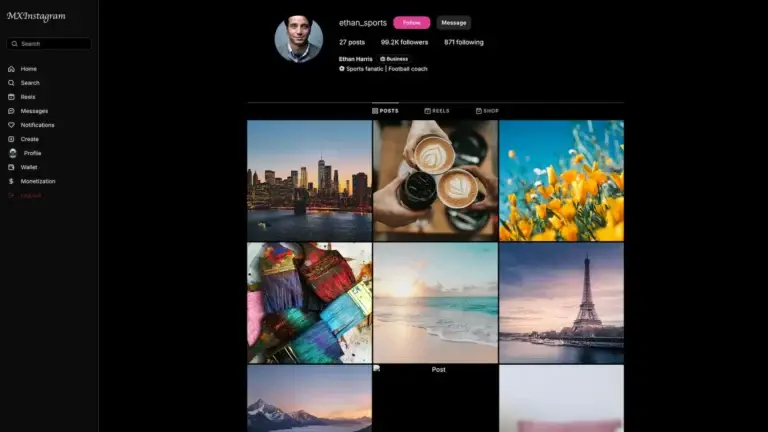
Instagram Clone
Photo and video social platform with stories, reels, creator tools and a shopping surface.

LinkedIn Clone
Professional network with profiles, hiring, recruiter seats and metered sales tooling.

Reddit Clone
Community platform with subreddits, voting, moderation tooling and threaded discussion.
The Commercial Case
Marketability, Revenue Potential & Business Prospects
The commercial question for a social platform is never whether the software works. It is whether you can acquire supply and demand on the same network faster than you burn cash, and whether you can monetize before the audience gets bored.
Revenue Before Scale
Tips and tiers monetize an engaged hundred. You do not need an audience of millions before the platform earns anything.
Two-Sided Upside
Ads and creator subscriptions draw money from advertisers and fans rather than only from members, which is what lets a free tier stay free.
A Developer Moat
A network with scoped API access accumulates products built on top of it. That is the switching cost a pure feed never develops.
No Platform Risk
Owned source on your infrastructure. Nobody can change your terms, your pricing or your API access.
Most operators launch the conversation surface with a single payment method wired and tips enabled, because tips need no commitment from a member who has just arrived. Subscription tiers follow once there is a reason to upgrade, and the gating is server-side entitlement rather than code, so repricing needs no release. Advertising comes third, because an advertiser buys attention and attention has to exist first. The developer API comes last and is the slowest to pay, but it is the line that makes the network hard to leave. The constraint is almost never the platform: all four surfaces are in the build. It is audience, and audience is the work you do after deployment.
On a rented platform you do not own the relationship, the data or the terms. Every operator who has built an audience on someone else infrastructure has watched moderation policy, pricing or API access change without notice, and some have watched their product become impossible overnight. Running your own square costs more effort and removes that risk entirely. It also means the monetization is yours: the tier revenue, the ad revenue and the creator share do not pass through a platform that takes a cut and sets the rate.
Example Revenue Scenarios
This build shortens the second half of that problem. The monetization surfaces are present from launch, so revenue can start with the first hundred engaged members rather than waiting for a phase two that a small team may never reach.
Community Launch
Revenue Lines Live
Tips and a single paid tier, ads switched off until there is inventory.
An operator opening a niche network, monetizing with tips from week one and a single Premium tier once there is a reason to upgrade, with the ad desk and the developer API deliberately dark.
Creator Platform
Revenue Lines Live
Creator subscriptions and tiers carrying the business, ads beginning.
A creator-led network where paid followings and tips are the majority of revenue, tiers segment the audience, and the first promoted posts are sold against an audience that now exists.
Network as Infrastructure
Revenue Lines Live
Ad desk running at volume and the developer API opened.
A mature operator running typed ad campaigns with real budgets, creator subscriptions compounding, and scoped API access turning the network into something other products depend on.
Why Miracuves
Miracuves vs Other Twitter Clone Developers
There are several ways to get a social platform, and they fail in different places:
What you are comparing
Freelancer
Cheapest and slowest to complete. The feed arrives quickly; moderation, ads, audit logging and the API platform are where the estimate doubles and the timeline stops being real.
Agency
Full scope at full price, typically tens of thousands and several months, with discovery you have already done billed back to you.
Generic Clone Script
Convincing demo, thin underneath. Usually no ownership checks, no audit trail, no index strategy and no upgrade path, which becomes your problem at the worst moment.
Build In-House
Correct if social infrastructure is your company core competence. Expensive and slow if the product is the community rather than the platform.
Miracuves
A fixed price, a six-day branded deployment, full source ownership, and a page that tells you what is configuration rather than pretending everything is switched on.
What Actually Differs
Not the feed, which everyone builds. The difference is whether an abuse report has a queue, whether an advertiser can be billed, whether a developer can get a scoped key, and whether an admin action leaves a record.
Compare & Discover Why Clients Choose Us as
#1 Ready-Made Clone Solution Partner
| Criteria | Miracuves Twitter Clone | Generic Clone Script | Custom Dev Agency |
|---|---|---|---|
| Time to Launch | 6 days (Production) | Unknown / DIY | 6-9+ months |
| Source-Code Ownership | ✔ Full | Often limited / encrypted | Usually yes |
| Feature Depth (Twitter-like) | High (feed, live, monetization) | Basic (upload & feed only) | Depends on budget |
| Security & Compliance | Strong (ISO mindset, GDPR-ready) | Minimal | Varies widely |
| Scalability & Performance | Cloud & CDN-optimized | Rarely considered | Depends on architecture |
| Monetization Options | Multiple (ads, gifts, subs) | Limited / needs custom work | Custom (more time & cost) |
| Admin & Analytics | Full-fledged dashboard | Very basic or missing | Custom build (extra cost) |
| Cost vs Speed vs Quality | Balanced | Cheap but risky | High cost, slow |
| Ongoing Support & Updates | Available with clear plans | Usually none | Depends on contract |
A freelancer will build the feed and stop short of moderation, ads and the developer platform, because those are the unglamorous two thirds. An agency will quote the whole thing at a price and a timeline that assume discovery you have already done. A generic script will look complete in a demo and turn out to have no audit trail, no ownership checks and no index strategy the moment real traffic arrives.
Industries
Industries We Serve
A public conversation surface is not industry-specific, but the moderation policy, the payment rails and the compliance posture are. These are the sectors where operators most often run their own network rather than rent one.
- 💬 Niche Communities
- 🎨 Creator Platforms
- 📰 Media & Publishing
- 🏢 Enterprise & Internal
- 🌍 Regional Networks
- 🎓 Education & Alumni
- 🏛️ Public Sector & Civic
- ⚽ Sports & Fandom
- 🎮 Gaming Communities
- 💼 Professional Bodies
- 🛡️ Advocacy & Nonprofit
- 🔬 Research & Academia
Each of these deployments is the same platform with different switches thrown, which is what owning the source is for.
Changelog
Twitter Clone Release Log - Version History & Updates
| Version | Date | What's New |
|---|---|---|
| v2026.1 | Sep 2026 | Initial release. Ten post types, three timelines, messaging with presence, typed ad campaigns, three tiers, a developer API and a 28 screen app. |
Blog & Resources
Twitter Clone App - Latest Insights & Guides
Writing on building, moderating and monetizing social platforms, including what the incumbents have changed and what it means for operators running their own network.
Last Updated on September 18, 2026 by sakshi Key Takeaways A real-time microblogging platform connects…
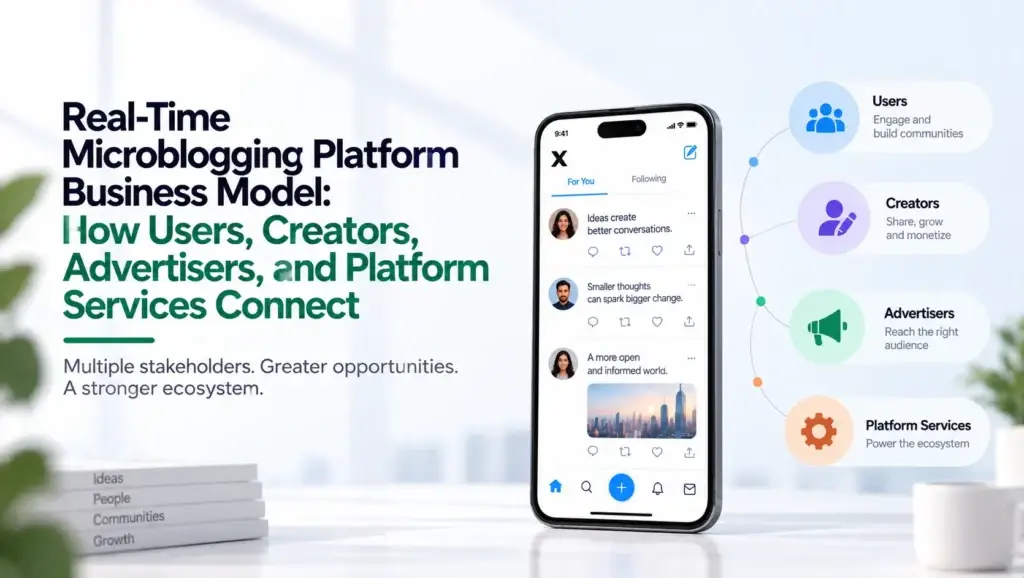
Last Updated on September 18, 2026 by sakshi Key Takeaways A successful real-time microblogging platform…
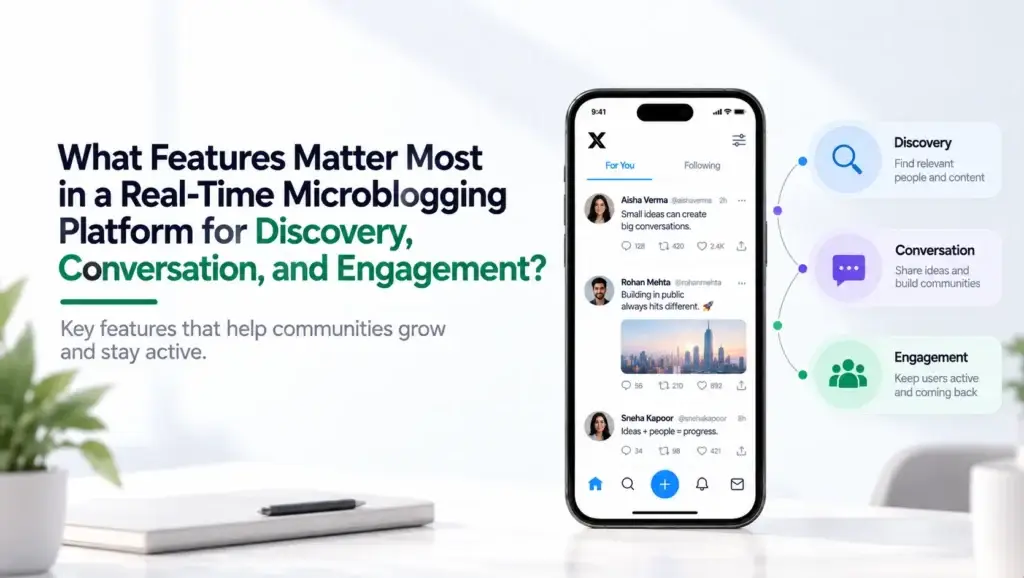
Last Updated on September 18, 2026 by sakshi Key Takeaways A real-time microblogging platform requires…
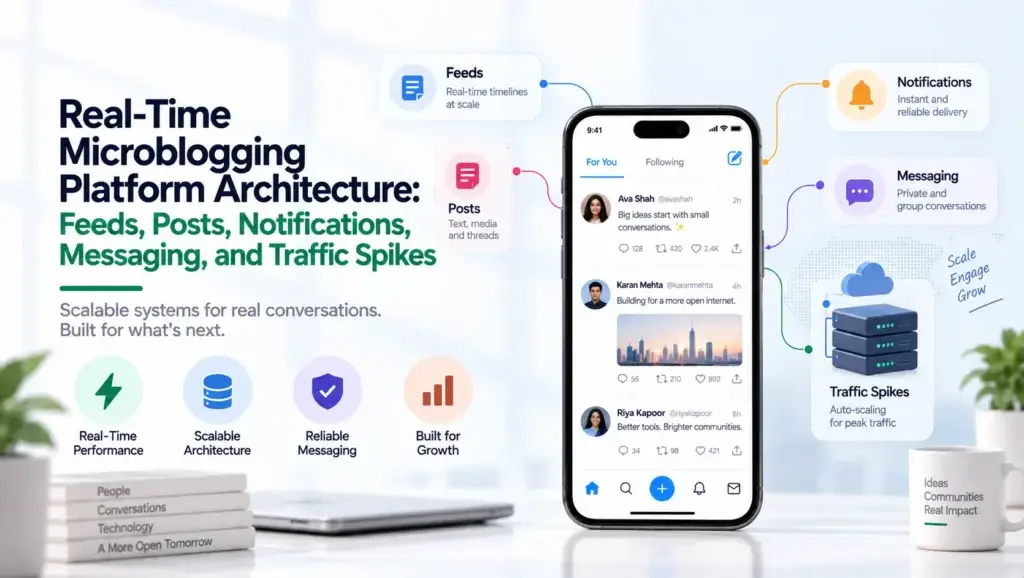
Why Startups Choose a Ready-Made Real-Time Microblogging Platform Over Custom Development
Last Updated on September 18, 2026 by sakshi Key Takeaways A ready-made real-time microblogging platform…
Last Updated on September 17, 2026 by sakshi Key Takeaways Real-time microblogging platforms can generate…
FAQ
Twitter Clone FAQ - Features, Monetization, Moderation & Deployment
The questions buyers actually ask, answered without hedging. Where the answer is that something is configuration rather than a default, it says so.
It is a public conversation platform built to work like Twitter and X: a composer covering text, images, video, audio, GIFs, polls, quote posts and threads, timelines resolving into For You, Following and Bookmarks, a social graph of follows, lists, blocks and mutes, and direct messaging with audio, reactions, read receipts and live typing. Around that sit the two businesses a network of this kind runs on: a typed advertising engine with budgets and targeting, and a developer platform issuing scoped OAuth applications and rate-limited API keys. It ships as a Next.js web application, a Flutter mobile application and a fifteen page operator console on a shared REST API, with full source ownership.
No. Miracuves is an independent software company and this platform is not affiliated with, connected to, sponsored by or endorsed by Twitter or X. The name is used descriptively, which is how the software industry refers to building a platform with functionality similar to a known product and how buyers search for it. No code, design, graphics or content originates from the Twitter or X website or applications.
The platform is $3,699 as a one-time fixed price, not a starting figure. That covers the web application, the Flutter mobile application, the API layer, the operator console, the Firestore rules and indexes, and a six working day branded deployment. There is no per-seat licence, no revenue share and no percentage of anything you earn. What moves the number is integration work: payment rails beyond the referenced Stripe setup, automated moderation, a media transcoding pipeline, an iOS build and store submission, or localization for a specific market.
The source for every surface: the Next.js web application with its 68 pages and 190 components, the 64 API handlers, the Flutter application with its 28 screens, the fifteen page operator console, the twelve Cloud Functions, and the Firestore security rules, composite indexes and typed converters. Ownership transfers outright. You can extend it, rebrand it, sub-licence it to a partner or hand it to another development team without asking us.
Five lines, drawing from different sides of the market. Subscription tiers at Free, Premium $9.99 and Pro $29.99, enforced server-side. Advertising through typed campaigns – promoted post, banner and sponsored – each with a budget, a daily cap, spend tracking and targeting keywords. Creator subscriptions, where subscriber ids sit on the creator record so paid followings are first-class. Tips between members. And developer access through scoped OAuth applications and rate-limited API keys. None requires a code change to switch on.
Yes, and this is the part most clone scripts skip. Member reports enter a queue rather than an inbox, and resolve through five actions: hide, unhide, delete, suspend and ban. Every privileged action writes an audit entry recording the administrator, the action, the target user, post or report, the reason and the timestamp. Login history captures IP, user agent, device, browser, location and outcome for disputes. The operator console runs on a separate authentication path from member accounts. Automated classification of abusive content is an integration rather than an included default, and we will say so rather than implying the software moderates itself.
On the core social experience, yes. The Flutter application covers 28 screens and consumes the same REST API under /api/v1/ as the web client, so the feed, composer, profiles, messaging and notifications behave the same way and a change to the contract lands on both. The operator console is a web surface and is not duplicated in the app, which is deliberate: moderation work belongs on a screen with room for context. The Android build is supplied; an iOS build and store submission is a scoped piece of work.
A Next.js web application on React 18.2 and TypeScript 4.7 with SWR for data fetching, 64 API route handlers under /api/v1/ with Zod validation, Firebase Firestore for data with typed converters and composite indexes, Firebase Authentication for identity including Google sign-in, twelve Cloud Functions, and a Flutter mobile client. Deployment runs under PM2 on a Linux host with environment-driven configuration.
Six working days to a branded, deployed platform on your infrastructure. That covers branding, configuration, your Firebase project, payment credentials and the Android build. It does not cover integrations scoped separately, such as automated moderation, a media pipeline or enterprise SSO, and it does not cover App Store review, which is outside anyone control. Deeper custom work runs two to eight weeks and is quoted in writing.
Yes. You own the source, so deploying the platform under a second brand for a partner or a regional operator is a commercial decision rather than a licence negotiation. Branding, configuration and feature emphasis differ per deployment while the codebase stays common, which is how agencies and white-label resellers use it.
An audience, which is the honest answer and the one that matters most. Beyond that: automated content moderation, a video transcoding and CDN pipeline, live audio rooms, payment processor integration beyond the referenced Stripe setup, an iOS build and submission, enterprise SSO, and advanced advertiser analytics are all scoped separately. Two-factor fields exist on the member record but enforcement is configuration work. Secrets management moves from environment variables to a managed store as a deployment step.
Sixty days of launch guidance, six months of priority bug fixes and twelve months of product evolution updates, with a first response under two hours during working hours Monday to Saturday. Support covers the platform we shipped; it does not extend to code your team writes on top of it, though we will review an approach if you ask.
Let's turn your idea into
a live platform.
Get a free consultation, a clear timeline, and honest answers. We'd rather earn your trust than rush a sale.
Go deeper on this platform
The detail pages, the guides behind it, and where it fits.
Social media app development
See the service→ ProductDevelopment Company
Agency, freelancer and Miracuves compared on the machinery around the timeline: reports entering a queue rather than an inbox, and every privileged action evidenced with an audit entry.
Compare options→Business model
How this kind of platform is structured and where its revenue comes from.
Read the guide→ ProductFeatures
A composer is the smallest part of it: the timeline around it, the moderation queue and the notification machinery, built as 64 API handlers and 190 React components.
See the full breakdown→ ProductBusiness Model
Five lines across three sides of the market, ranked by which side fills first, from paid subscriptions and creator income through to advertising and developer API access.
See the playbook→Media and entertainment
See the industry→ GuideHow it works
The user journey, the core mechanics and what sits behind them.
Read the guide→ GuideFeatures and pricing
What a ready-made script includes and what it costs.
Read the guide→Development Cost
The fixed $3,699 against freelancer, agency and custom quotes, moved not by the build but by integration work: payment rails beyond the reference, and payouts in more than one currency.
See exact pricing→ GuideRevenue model
The income streams and fee structure, broken down.
Read the guide→ Talk to an expert →Miracuves is an independent software development company. We are not affiliated with, connected to, sponsored by, or endorsed by Twitter.
“Twitter Clone” is used descriptively. It is how the software industry refers to building a platform with functionality similar to Twitter, and how clients search for it.
The entire design and codebase is built by our own team. The product contains no code, design, graphics, or content originating from the Twitter website or applications.
Twitter and all other third-party names and marks are the property of their respective owners, referenced here solely to describe the category of software offered.
