


Key Takeaways
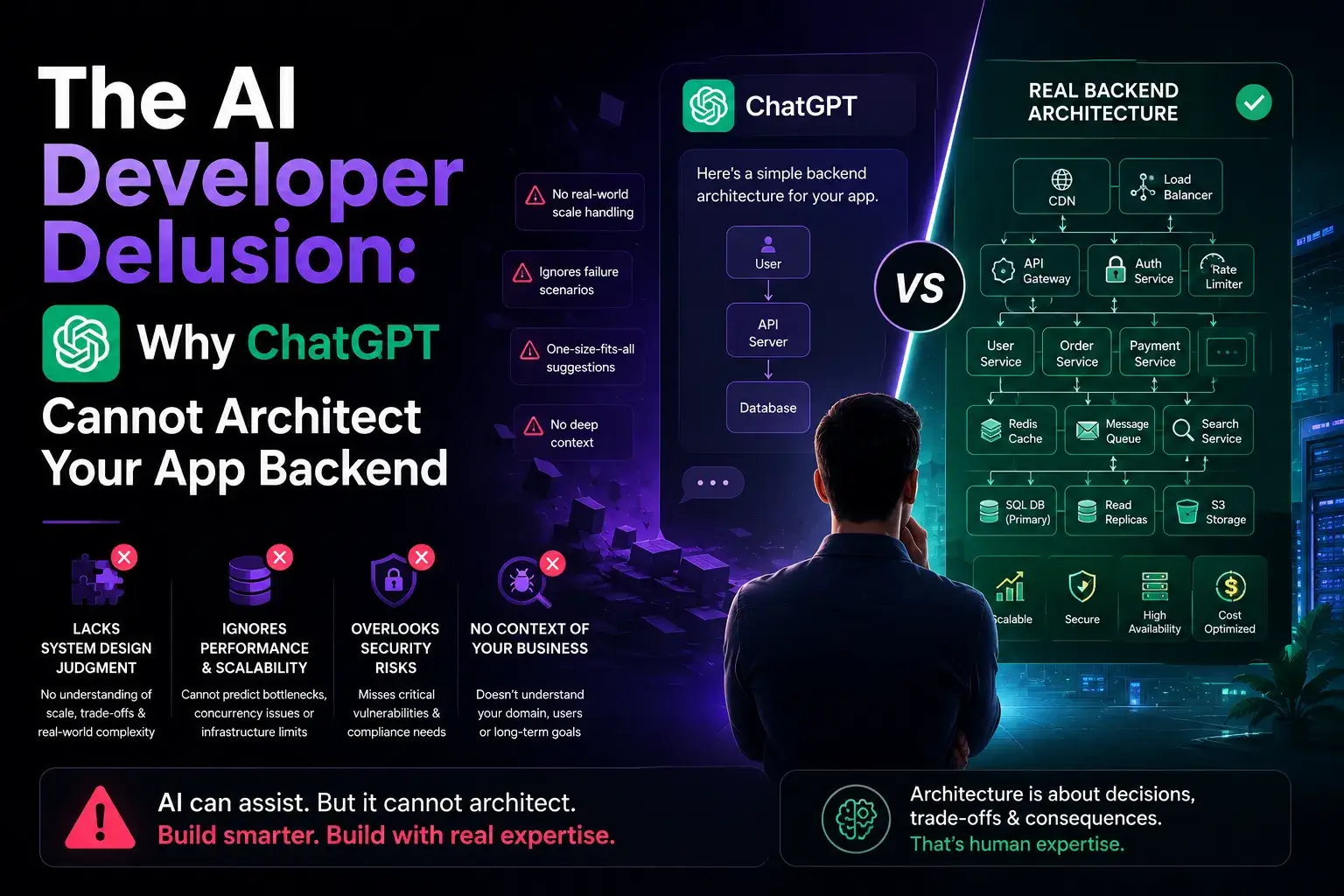
- ChatGPT can generate code but cannot guarantee scalable architecture.
- Production backends need more than isolated code snippets.
- Context collapse creates inconsistent system decisions.
- Security and database design require engineering oversight.
- AI assists developers but does not replace backend architecture.
Architecture Signals
- Design database relationships before generating endpoints.
- Secure APIs with authentication and access controls.
- Plan queues, webhooks, caching, and background jobs.
- Validate AI-generated code before production deployment.
- Maintain one engineered blueprint across the backend.
Real Insights
- Working code is not the same as production-ready architecture.
- AI-generated modules can conflict across large systems.
- Backend failures often appear only after real traffic arrives.
- Human engineering remains critical for secure scaling.
- Miracuves builds production-ready app backends with scalable system architecture.
Generative AI has made software demos dangerously easy. A non-technical founder can open ChatGPT, describe a product idea, and receive a clean React component, a login screen, a sample database schema, a payment integration snippet, or even a simple full-stack prototype. The output looks structured. The code has comments. The folder names feel professional. The illusion is powerful.
But a demo is not a product. A generated screen is not an app. A prompt is not architecture. The real failure begins when the founder asks AI to move beyond isolated components and design the invisible systems that decide whether software can survive real users: database constraints, authentication boundaries, webhook retries, API versioning, audit logs, transaction states, role-based access, admin permissions, background jobs, queue failures, error recovery, and operational monitoring.
This is where the AI-generated app backend collapses. Not because AI is useless. It is useful. It can accelerate boilerplate, generate draft components, explain code, produce test ideas, and help engineers work faster. The delusion is believing that ChatGPT Clone can independently architect a secure, scalable, production-ready backend from natural language prompts alone.
For founders, product managers, and non-technical startup operators, this distinction matters. The wrong belief can turn a fast prototype into a fragile business liability.
At Miracuves, this is why production software starts from structured architecture, reusable backend modules, source-code-owned frameworks, and deliberate product logic — not from a blank prompt pretending to be a senior engineering team.
The Illusion of Prompt Engineering: Where Generative AI Code Fails
The AI-generated app trend is built on a misleading truth.
Yes, ChatGPT can generate code. It can create a landing page, a dashboard card, a login form, a REST API controller, a Prisma schema, a Flutter screen, a Laravel route, or a Node.js middleware file. In isolation, many of these outputs are useful. They save time. They reduce blank-page friction. They help teams explore options faster.
The problem starts when founders mistake code output for system ownership. A production backend is not a collection of files. It is a network of decisions.
It defines how users are authenticated, how roles are separated, how payments are confirmed, how failed webhooks are retried, how sensitive records are protected, how admins override disputes, how logs are retained, how API limits are enforced, how edge cases are handled, and how every action is traceable when something goes wrong.
A prompt can describe these needs. It does not guarantee that the generated system will preserve them consistently across hundreds of files.
Why AI-Generated Code Looks More Reliable Than It Is
AI-generated code often feels trustworthy because it follows familiar patterns.
It names files correctly. It uses modern frameworks. It includes comments. It may even pass basic tests. For a product manager or non-technical founder, this creates the appearance of engineering completeness.
But backend reliability is not judged by how readable a file looks. It is judged by what happens when:
- two users trigger the same transaction at the same time,
- a payment succeeds but the webhook arrives late,
- a provider updates a record they should not access,
- an admin changes a commission rule after a booking is already created,
- a background job fails halfway through execution,
- a database migration breaks existing data,
- a third-party API rate limit blocks a critical workflow,
- a malicious user manipulates route parameters,
- a rollback needs to preserve financial records.
These are not prompt-writing problems. They are system architecture problems.
Read more : Business Model of ChatGPT 2026: Features, Revenue, and Strategy
The Frontend Bias of AI-Generated App Demos
Most AI-generated app demos overrepresent the frontend because frontend work is visually rewarding.
A prompt can quickly produce a polished screen. The founder sees buttons, cards, filters, profile images, dashboards, and charts. It feels like progress.
Backend failure is quieter.
A broken authorization model does not look ugly on a demo screen. A weak webhook design does not expose itself during a happy-path walkthrough. A missing database constraint does not announce itself until real users create conflicting records. A poor audit trail only matters when the business needs to investigate abuse, refunds, chargebacks, or compliance issues.
That is why prompt-only development is dangerous for business operators. It creates visible confidence before invisible systems are ready.
Unveiling Context Collapse: The Structural Fragility of LLM Databases
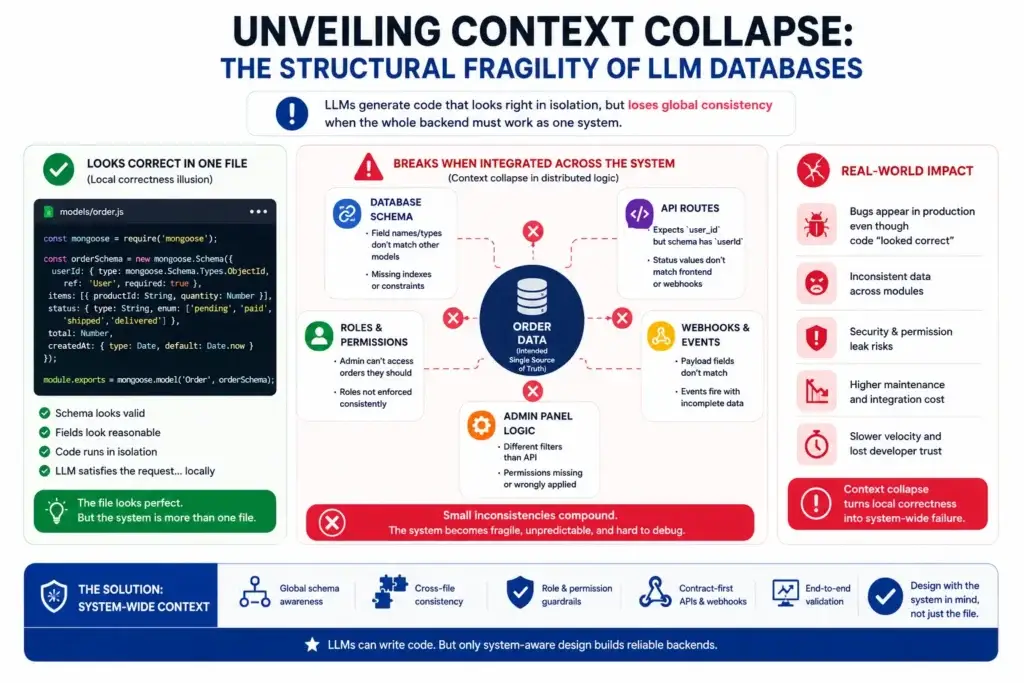
The strongest technical reason ChatGPT cannot reliably architect your app backend is context collapse.
Context collapse happens when an AI model can produce plausible local answers but fails to preserve global system logic across the full product surface.
A backend is not one answer. It is a living map of relationships.
Users connect to roles. Roles connect to permissions. Permissions connect to routes. Routes connect to controllers. Controllers connect to services. Services connect to database transactions. Transactions connect to events. Events connect to webhooks, queues, notifications, logs, analytics, and admin dashboards.
When the model generates one part of the system, it may not preserve the assumptions it made in another part. It may create a database field in one file, forget it in another, expose it through an API route, fail to validate it in a service layer, and ignore it in an admin permission check.
That is not a small bug. That is structural drift.
How Context Collapse Breaks Database Design
Database design is one of the clearest places where prompt-only app generation fails.
A scalable backend database must define not just tables, but constraints, relationships, indexes, deletion rules, uniqueness logic, historical records, transaction states, and access boundaries.
For example, a marketplace app does not simply need a bookings table. It needs rules around:
- who can create a booking,
- when a booking can be cancelled,
- whether cancellation creates a refund record,
- whether provider payout changes after cancellation,
- how disputes affect payout release,
- whether admin edits are logged,
- how commission is calculated,
- whether deleted users preserve financial history,
- how duplicate bookings are prevented,
- how records are filtered by organization, region, role, or account.
A generic AI prompt may generate tables that look correct. But the deeper issue is whether every constraint matches the business model.
That is where AI often collapses from architecture into approximation.
The Multi-Tenant Database Problem
Multi-tenant systems are especially dangerous for prompt-only generation because they require strict data isolation.
In a business platform serving multiple brands, organizations, vendors, or workspaces, every query must respect data boundaries. One account should never see another account’s users, invoices, orders, analytics, settings, documents, or payment records.
This requires more than adding an organization field.
It requires consistent filtering across every query, route, middleware, background job, export function, admin screen, analytics query, webhook handler, and permission rule. It also requires a clear decision on whether isolation is handled at the application layer, database row-level security layer, schema layer, or separate infrastructure layer.
A generated backend may remember the account boundary in some places and forget it in others.
That is context collapse with real commercial risk.
Read more : How Safe is a White-Label ChatGPT App? Security Guide 2026
Why Relational Constraints Need Deterministic Thinking
Relational database constraints are hard because they encode business truth.
A payment should not exist without a user. A payout should not exist without a completed transaction. A refund should not exceed the original amount. A subscription should not renew after cancellation. A provider should not edit another provider’s booking. A deleted product should not erase historical orders.
These are not decorative rules. They protect the business.
AI-generated schemas often under-model these relationships because the model optimizes for a plausible answer, not for the full lifecycle of operational failure.
A senior backend architect asks uncomfortable questions before writing the schema:
- What must never happen?
- What can happen concurrently?
- What should be reversible?
- What must be permanently recorded?
- What should be soft deleted?
- What should be immutable?
- What should be recalculated?
- What must be auditable?
- What should be handled synchronously or asynchronously?
Prompt engineering can suggest some of these questions. It cannot guarantee that the entire backend enforces the answers.
Where AI-Generated Backend Code Commonly Breaks
| Backend Layer | What AI Can Generate | Where Production Risk Appears | What a Blueprint Must Define |
|---|---|---|---|
| Database Schema | Tables, fields, sample relations | Missing constraints, weak isolation, poor migration logic | Relational rules, indexes, ownership boundaries, deletion policy |
| API Routing | Basic endpoints and controllers | Inconsistent permissions, route sprawl, versioning gaps | Route contracts, auth middleware, validation, rate limits |
| Webhooks | Simple payment callback handler | Duplicate events, failed retries, race conditions, partial updates | Idempotency, event logs, retry queues, reconciliation workflows |
| Admin Panel | CRUD screens and dashboard cards | Unsafe overrides, missing audit trails, weak role separation | Role-based access, approval flows, logs, dispute controls |
| Security | JWT auth, password hashing, generic middleware | Broken access control, exposed secrets, weak input validation | Secure API design, encrypted data handling, activity logs |
Why Transactional Webhooks Expose the AI Developer Delusion
Payment systems are where AI-generated backends often reveal their weakness.
A simple prompt can generate a Stripe, Razorpay, PayPal, or wallet webhook handler. It may parse the event, update the order, and return a success response.
That is not enough.
Real webhook systems must handle delayed delivery, duplicate delivery, failed delivery, partial updates, retries, conflicting states, signature verification, idempotency keys, reconciliation, and manual admin review.
A payment webhook is not just a route. It is a financial state machine.
If the generated backend marks an order as paid before verifying the event signature, the system is unsafe. If it processes the same webhook twice, the platform may duplicate credits or payouts. If it fails after updating one table but before updating another, the business now has inconsistent financial records.
These issues are not visible in a demo. They appear after money moves.
Why “It Works on My Prompt” Is Not Engineering
The AI-generated app trend encourages founders to think in outputs:
“Generate the backend.”
“Add payments.”
“Add login.”
“Add admin.”
“Make it scalable.”
“Fix the bug.”
“Make it secure.”
But software architecture is not a sequence of wishes. It is a sequence of constraints.
A senior engineering team does not simply ask what the app should do. It defines what the app must prevent.
The app must prevent unauthorized access.
The app must prevent duplicate transactions.
The app must prevent invalid state transitions.
The app must prevent data leakage across accounts.
The app must prevent admin abuse without logs.
The app must prevent silent failure in background jobs.
AI can help draft pieces of this. It cannot replace the blueprint that decides these rules before code is written.
Why Complex API Routing Networks Break Prompt-Only Development
A production app backend may contain hundreds of routes.
Some routes are public. Some require user authentication. Some require provider roles. Some require admin privileges. Some are internal. Some are called by third-party services. Some are versioned. Some are rate-limited. Some trigger queues. Some must be blocked in certain states.
When ChatGPT generates APIs in fragments, it often creates local consistency without global governance.
One route may validate input. Another may not.
One controller may check ownership. Another may assume it.
One admin route may use role-based access. Another may rely on frontend hiding.
One webhook may verify a signature. Another may skip it.
One service may return sensitive fields. Another may sanitize them.
This is how backend drift begins.
API Architecture Requires a Contract, Not Just Code
A scalable API network needs a contract.
That contract defines naming conventions, versioning, authentication, request validation, error responses, pagination, sorting, filtering, rate limits, permission checks, logging, and response shape.
Without a contract, every generated route becomes a separate opinion.
For a small internal tool, that may be manageable. For a commercial app with customers, vendors, creators, drivers, merchants, admins, payments, notifications, and analytics, it becomes chaos.
This is why production systems need hardcoded blueprints before AI-assisted implementation. The blueprint gives the AI guardrails. Without it, the AI becomes a file generator, not an architect.
Why Defensible, Commercially Sound Software Requires Hardcoded Blueprints
Commercial software does not become defensible because the code exists.
It becomes defensible because the architecture protects the business model.
A food delivery app needs order allocation, merchant operations, delivery partner tracking, commission logic, refunds, ratings, and dispute handling.
A fintech app needs KYC workflows, transaction monitoring, wallet ledger accuracy, audit logs, admin risk controls, and compliance-ready operational flows.
A marketplace app needs listing management, booking rules, escrow-style payment flow where relevant, refunds, reviews, vendor verification, and admin moderation.
A short video app needs upload workflows, encoding, CDN delivery, content moderation, creator controls, feed ranking, abuse reporting, and background processing.
None of these are just screens.
They are structured systems. They require a product foundation that already understands the operational model.
That is why Miracuves focuses on launch-ready and white-label app foundations where the backend, admin control, source code, and core workflows are part of the product architecture — not improvised from a single AI prompt.
What a Hardcoded Blueprint Actually Means
A hardcoded blueprint is not “old-school coding.”
It is the disciplined structure that makes fast development safe.
It includes:
- database models designed around real business workflows,
- reusable authentication and role-control layers,
- API contracts with consistent validation and error handling,
- transaction-safe payment and webhook flows,
- admin dashboards with permission-based controls,
- event logs and audit trails,
- queue and background job design,
- scalable file, media, or notification workflows,
- deployment and environment configuration,
- documentation for source-code ownership and future customization.
This is the difference between generating files and launching a product foundation.
Why AI Works Better After the Blueprint Exists
The strongest use of AI in software development is not replacing architecture. It is accelerating execution inside architecture.
Once the database rules, API contracts, security patterns, and product modules are defined, AI can help engineers generate repetitive code faster. It can draft tests, refactor components, produce documentation, suggest edge cases, and speed up repetitive implementation.
But the blueprint must come first.
Without a blueprint, AI improvises.
With a blueprint, AI assists.
That distinction decides whether AI becomes a productivity tool or a production risk.
Founder Decision Signals
Speed
If you only need a prototype, AI-generated code can move fast. If you need users, payments, data safety, and admin operations, speed without structure becomes technical debt.
Cost
Prompt-only development feels cost-efficient upfront, but weak backend architecture can create expensive rebuilds, security fixes, and operational failures later.
Scalability
A scalable app needs database boundaries, queues, API governance, monitoring, and deployment logic. These cannot be reliably inferred from scattered prompts.
Market Fit
Founders should validate the market quickly, but validation should happen on a stable product foundation that can support real users and future customization.
AI-Generated App Backend vs Production-Ready App Foundation
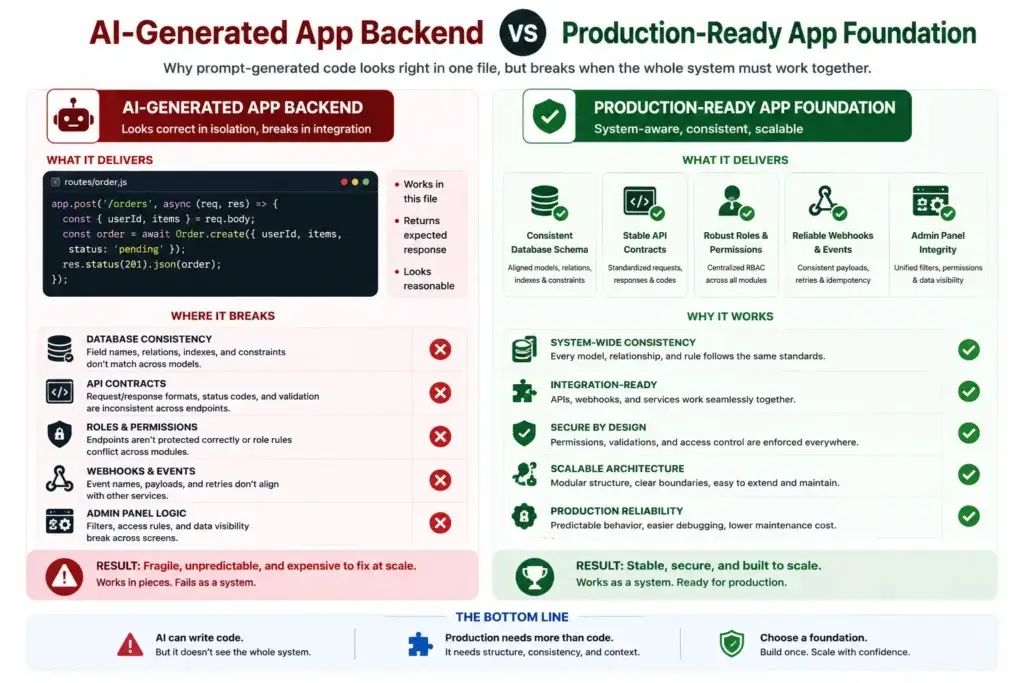
| Decision Area | AI-Generated Backend | Production-Ready App Foundation |
|---|---|---|
| Starting Point | Natural language prompt | Defined architecture and product scope |
| Database Logic | Plausible schema | Tested relationships, constraints, indexes, and access rules |
| API Design | Fragmented route generation | Consistent contracts, validation, permissions, and versioning |
| Security | Generic middleware | Role-based access, audit logs, secure API integration, encrypted data handling |
| Webhooks | Simple event handler | Idempotent transaction flow with retry and reconciliation logic |
| Admin Control | CRUD dashboard | Permission-based operations, overrides, reporting, disputes, and logs |
| Scalability | Claimed in prompt | Supported through modular backend, queues, caching, monitoring, and deployment planning |
| Ownership | Often unclear or tool-dependent | Source-code-owned foundation that can be customized and extended |
Mistakes Founders Should Avoid When Using AI to Build Apps
Confusing a working demo with a production backend
A demo proves that a happy path can run. It does not prove that payments, permissions, failures, retries, data isolation, and admin operations are safe.
Letting AI design the database without business rules
The database is where the business model becomes enforceable. If the schema does not encode the right relationships and constraints, the app can become unstable as soon as real users appear.
Adding security after code generation
Security is not a final polish layer. Authentication, authorization, validation, logs, and access boundaries must be part of the architecture from the beginning.
Using AI-generated webhooks without transaction planning
Payment and event webhooks require idempotency, retry handling, verification, and reconciliation. A simple callback route is not enough for financial workflows.
Final Thoughts: AI Can Generate Code, But It Cannot Own Your Architecture
The AI developer delusion is not the belief that AI can help build software. It can.
The delusion is believing that a language model can replace backend architecture, security planning, transactional logic, database design, API governance, operational monitoring, and product accountability.
ChatGPT can generate a component.
It can draft a controller.
It can explain a schema.
It can suggest a payment flow.
But a commercial app backend needs more than plausible code. It needs rules that survive real users, real money, real abuse, real scale, and real business pressure. For founders, the smart decision is not to avoid AI. It is to stop treating prompts as architecture. Use AI as an accelerator. Build on a real product foundation. Own the source code. Define the backend before the backend defines your risk.
FAQs
1. Can ChatGPT build a complete app backend?
ChatGPT can generate backend code snippets, routes, schemas, and sample integrations. However, it cannot reliably own the full architecture of a production backend without human engineering, defined requirements, security controls, testing, and system blueprints.
2. Why do AI-generated apps fail in production?
AI-generated apps often fail because the code may work for a simple happy path but miss deeper backend requirements such as authorization, transactional integrity, database constraints, webhook retries, audit logs, error handling, and operational monitoring.
3. What is context collapse in AI-generated backend development?
Context collapse is when an AI model loses consistency across a large software system. It may generate one correct file but fail to preserve the same database rules, permission logic, or API assumptions across the rest of the backend.
4. Is AI-generated code always insecure?
No. AI-generated code is not automatically insecure. The risk is that it can appear correct while missing important security details. It should be reviewed, tested, and integrated into a controlled architecture before production use.
5. Can non-technical founders use AI to build app prototypes?
Yes. AI can help non-technical founders create prototypes, wireframes, documentation, feature lists, and early proof-of-concept code. But production apps require engineering review, secure backend design, deployment planning, and long-term maintainability.
6. What is better than building an app backend from prompts?
A better approach is to start with a structured product blueprint, ready-made foundation, or custom backend architecture. AI can then assist implementation inside defined boundaries instead of inventing the entire system from scratch.
7. How does Miracuves help founders avoid AI-generated backend risk?
Miracuves helps founders launch with ready-made, white-label, source-code-owned, and custom app foundations that include admin control, backend workflows, and production-focused architecture. AI can support the process, but the core system is built around defined product logic.