



1mg App Development Cost in 2026 | Pricing & Features
Create a powerful, customizable streaming solution with Miracuves’ 1mg, equipped with high-performance features and next-gen technology.
Planning to launch your own online pharmacy app like 1mg? Before you decide on features or tech stacks, it’s crucial to understand the real cost of development.
A 1mg-like app is more than just an e-pharmacy — it’s a complete healthcare ecosystem. From medicine ordering and lab test bookings to teleconsultations and e-prescriptions, building such a platform requires careful planning, compliance, and scalable technology. Many startups explore ready-made 1mg clone solutions as a faster way to enter the market while keeping costs in check.
Whether you’re a healthtech startup or an entrepreneur exploring the digital pharmacy space, knowing the 1mg app development cost helps you budget wisely, avoid hidden surprises, and build for long-term growth.
In this guide, we’ll cover the key cost factors, regional price variations, complexity breakdowns, hidden expenses, and strategies to optimize your budget.
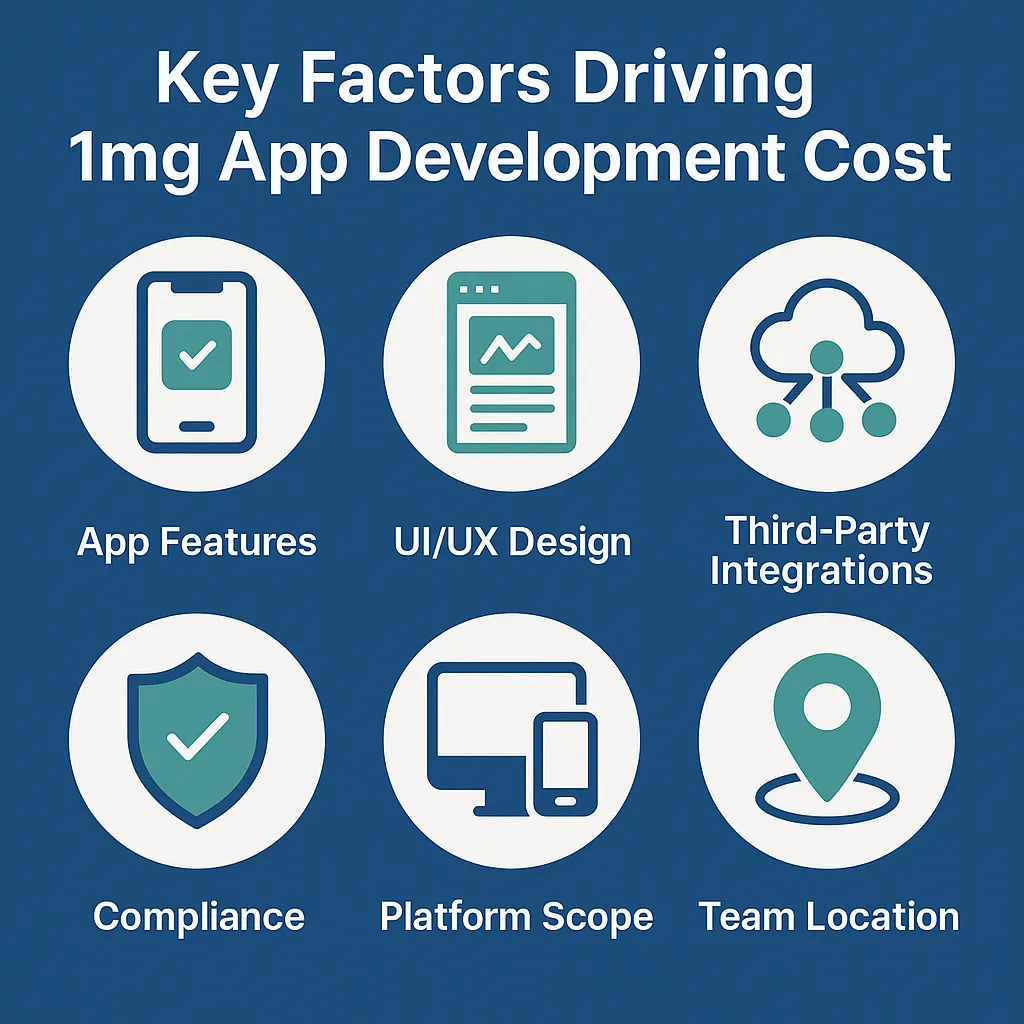
Key Factors That Influence 1mg App Development Cost
There’s no one-size-fits-all cost for a 1mg-like app. The budget largely depends on how complex your platform is and the resources you choose.
App Features & Complexity → A simple medicine-ordering app is cheaper than a full-scale platform with teleconsultations, health records, and lab tests.
Design & UX → Healthcare apps must be easy to navigate and secure, which requires advanced UI/UX planning.
Third-Party Integrations → Payment gateways, pharmacy APIs, telemedicine platforms, and logistics services all add costs.
Compliance Requirements → HIPAA, GDPR, or local data protection laws mean additional legal and technical expenses.
Platform Scope (iOS, Android, Web) → Multi-platform development increases cost and testing effort.
Customization vs. Clone Solutions → Clone apps reduce time-to-market but limit flexibility, while custom builds require larger budgets.
Development Team Location → Developer rates differ widely across North America, Europe, and Asia.
1mg App Cost Estimates by Type
To give you a clearer breakdown, here’s how development cost varies with complexity.
This range includes design, development, QA testing, and basic post-launch support — not licensing or marketing.
|
App Type
|
Estimated Cost Range (USD)
|
Description
|
|---|---|---|
|
MVP (Minimum Viable Product)
|
$15,000 – $30,000
|
Core features: User registration, medicine catalog, prescription upload, order flow
|
|
Standard Version
|
$30,000 – $70,000
|
Add-ons: Advanced search, teleconsultation module, wallet, notifications, admin panel
|
|
Full-Featured App
|
$70,000 – $150,000+
|
Full pharmacy stack: AI suggestions, lab test bookings, doctor chat, EHR, analytics, custom UI
|
Note: These costs exclude compliance certifications, infrastructure, and user acquisition expenses.
Want a modular approach? Miracuves helps you scale your healthtech app from MVP to a fully loaded enterprise platform.
Region-Wise Development Cost Comparison : 1mg
Where you hire your development team has a major impact on the final cost. Here’s how average costs compare regionally:
|
Region
|
Hourly Rate (USD)
|
Typical Cost for Standard App
|
|---|---|---|
|
North America
|
$100 – $200/hr
|
$100,000 – $200,000+
|
|
Western Europe
|
$80 – $150/hr
|
$80,000 – $160,000+
|
|
Eastern Europe
|
$40 – $80/hr
|
$40,000 – $90,000+
|
|
India & Southeast Asia
|
$20 – $50/hr
|
$20,000 – $60,000+
|
Outsourcing to Asia or Eastern Europe offers cost savings without compromising quality, especially when working with healthtech-focused teams.
Cost Breakdown by Development Stage : 1mg Clone
Knowing how your budget is allocated across stages helps you avoid cost overruns and plan strategically. Here’s how a typical 1mg clone development budget is distributed:
|
Development Stage
|
Estimated % of Total Cost
|
Includes
|
|---|---|---|
|
Discovery & Planning
|
5–10%
|
Market research, competitor analysis, defining user personas, feature scoping, technical requirements.
|
|
UI/UX Design
|
10–15%
|
Wireframing, prototyping, responsive design, visual branding, user experience mapping.
|
|
Frontend & Backend Dev
|
40–50%
|
Core feature development, database architecture, APIs, payment integrations, dashboard and logic build.
|
|
Testing & QA
|
10–15%
|
Manual and automated testing, bug fixing, device/browser compatibility checks, performance tuning.
|
|
Deployment & Launch
|
5–10%
|
App store submission (Android/iOS), server setup, production deployment, performance monitoring tools.
|
|
Maintenance & Updates
|
10–20%
|
Post-launch bug fixes, new features, server maintenance, user support, compliance updates.
|
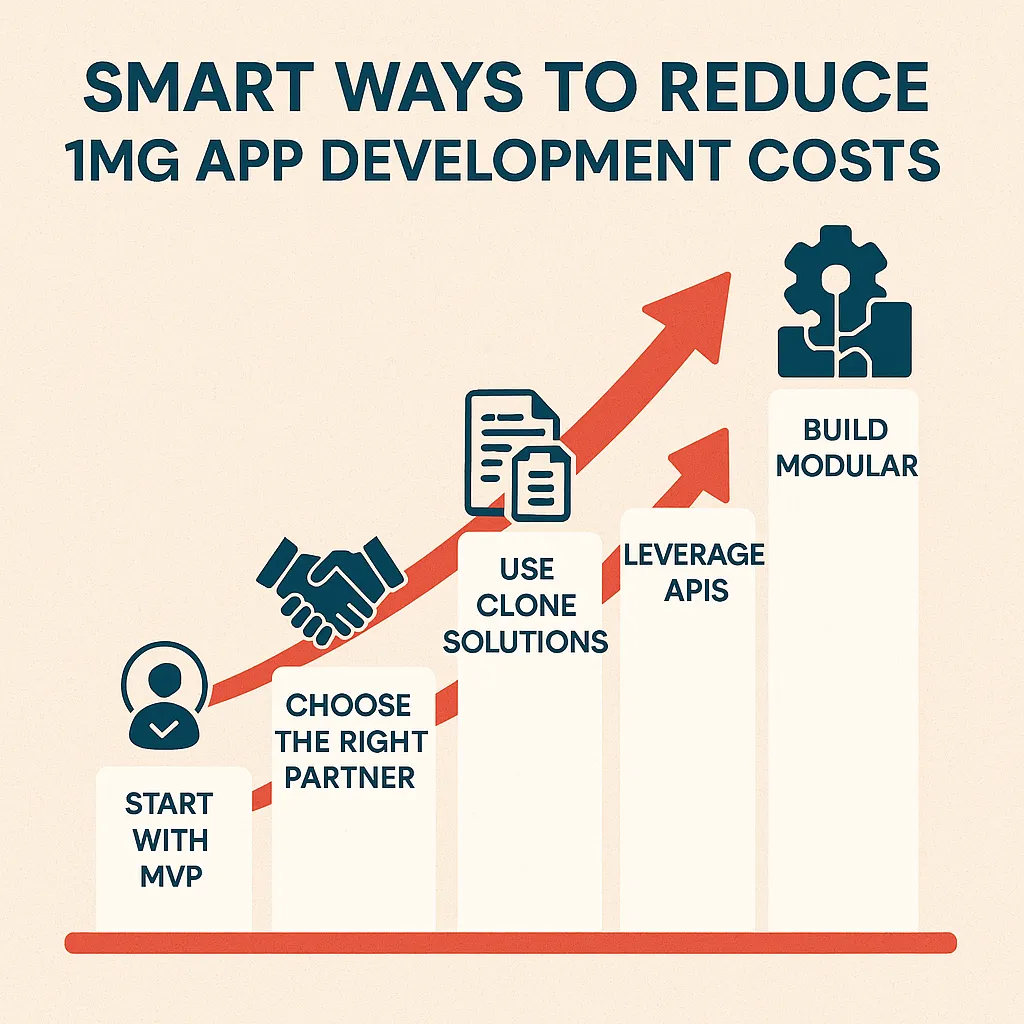
How to Reduce 1mg App Development Costs (Without Compromising Quality)
Building an e-pharmacy app like 1mg requires investment, but smart planning can help you save significantly:
Start with an MVP → Launch with essential features and expand based on demand.
Choose the right partner → Work with healthtech specialists for efficiency and compliance.
Use clone or white-label solutions → Speed up development and cut costs.
Leverage pre-built APIs → For payments, logistics, and consultation modules.
Adopt modular architecture → Add advanced features over time without rebuilding.
This approach allows you to enter the market faster and scale sustainably.
Choose the Right Development Partner
Even with a clear roadmap, healthcare app development requires expertise in compliance, security, and scalability. Choosing the right partner is critical.
Look for:
Experience in healthtech app development
Proven track record with e-pharmacy or telemedicine platforms
End-to-end services from design to post-launch support
Strong expertise in compliance and data security
At Miracuves, we don’t just replicate apps — we create tailored solutions that balance cost, compliance, and performance. Whether you’re targeting local pharmacies or building a nationwide platform, we help you launch faster and smarter.`
Conclusion
The cost to develop a 1mg-style app in 2025 depends on your goals, region, and features. From $30,000 MVPs to $250,000+ full platforms, the range is wide — but with the right strategy, you can build a scalable, compliant e-pharmacy without overspending.
Ready to build your 1mg app?
Talk to Miracuves today for a tailored cost estimate and development roadmap.
For more insights into healthtech app features, business models, and monetization strategies, explore our clone app series.
Frequently Asked Questions
The cost ranges from $15,000 to $150,000+, depending on your features, platform choice (iOS/Android/Web), development team location, and whether you’re starting from scratch or using a white-label solution. A basic MVP costs around $15K–$30K, while a full-featured app can go beyond $100K.
An MVP typically includes:
User registration & profile
Medicine catalog & search
Prescription upload
Cart & order management
Payment integration
Admin panel for product/order control
MVP: 6–10 weeks
Standard version: 3–4 months
Full-featured platform: 5–7 months
Timelines may vary depending on the complexity of features and revisions during development.
Using a white-label solution drastically cuts development time and cost, making it ideal for startups. However, building from scratch gives you more control, customization, and scalability in the long run.
Yes. Starting with an MVP and adding modules like doctor consultation, lab integrations, and subscription plans later is a smart and budget-friendly strategy.