





















Key Takeaways
- Live streaming monetization helps video platforms generate recurring revenue through gifts, subscriptions, creator rewards, and interactive engagement.
- Popular monetization models include virtual coins, paid memberships, tipping, live shopping, premium streams, and creator revenue sharing.
- Strong live streaming systems require low-latency infrastructure, wallet logic, payout management, moderation tools, and real-time analytics.
- Creator-focused monetization increases platform retention because streamers earn directly from audience engagement and community activity.
- Long-term success depends on balancing creator incentives, platform revenue, user trust, payment security, and scalable streaming performance.
Monetization Signals
- Virtual gifts and coins create microtransaction revenue because viewers purchase digital items to support creators during live streams.
- Subscription models help platforms generate predictable recurring income through premium creator access, badges, exclusive streams, and member-only content.
- Creator reward systems improve engagement because streamers stay more active when revenue sharing and incentives are transparent.
- Live commerce, sponsored streams, and brand collaborations can expand monetization beyond direct viewer payments.
- Real-time analytics help platforms optimize creator earnings, user retention, gifting behavior, conversion rates, and audience engagement patterns.
Real Insights
- The strongest live streaming platforms monetize community participation, not just video playback.
- Virtual gifting works because it creates emotional engagement, visibility, competition, and creator-fan interaction during streams.
- Founders should design monetization systems early because wallet architecture, payout flows, moderation, and compliance affect scalability later.
- Low-latency streaming, reliable payments, and fraud prevention are critical because monetization depends on real-time interaction quality.
- The future of live streaming monetization will depend on AI engagement systems, creator commerce, gamification, interactive experiences, and multi-platform creator ecosystems.
Live streaming monetization has become one of the strongest revenue opportunities in the creator economy. Unlike traditional video platforms that depend mostly on ads or subscriptions, live streaming allows viewers to spend money during real-time moments. A fan can send a virtual gift, join a paid subscription, unlock exclusive chat access, support a creator during a live event, or contribute to a reward-based creator economy.
For founders, this changes how a video platform should be built. A live streaming app is not just a video player with chat. It is a monetization engine where creators, viewers, and platform operators interact through payments, rewards, engagement, and trust.
Large platforms already show how this works. YouTube allows viewers to buy Jewels and send gifts during eligible live streams, while creators earn Rubies from those gifts. TikTok LIVE lets creators interact with viewers, collect virtual Gifts, and offer subscriptions. Twitch Partners and Affiliates can earn from subscriptions, gift subscriptions, and other viewer support tools.
For a founder planning to build a live streaming or short video platform, the real question is not “Can we add monetization?” The better question is: Which monetization model creates sustainable value for creators, viewers, and the platform owner?
Miracuves helps founders build ready-made and white-label video platform solutions with source-code ownership, branded design, admin control, and monetization-ready workflows. For live streaming businesses, this means the product foundation should support gifts, subscriptions, creator rewards, wallet logic, payout controls, content moderation, and analytics from the start.
Why Live Streaming Monetization Is Different From Normal Video Monetization
Traditional video monetization usually depends on ads, paid access, sponsorships, or platform subscriptions. Live streaming monetization is more dynamic because the viewer is not passively watching. The viewer is participating.
During a live stream, fans react to the creator in real time. They ask questions, send emojis, join chat events, unlock badges, compete on leaderboards, send gifts, subscribe to exclusive access, or support creators during important moments. This live interaction creates payment triggers that do not exist in normal on-demand video.
That is why platforms such as YouTube, TikTok, and Twitch have built monetization tools around live interaction. YouTube gifts appear as overlays on live streams, TikTok LIVE supports virtual Gifts and subscriptions, and Twitch supports subscriptions and gift subscriptions for creators.
For founders, this means monetization should be designed around behavior, not just payment buttons. The product should answer:
- Why would a viewer pay during a live stream?
- What emotional or social reward does the viewer receive?
- How does the creator earn?
- How much commission does the platform retain?
- How are payouts managed?
- How does the admin team detect abuse or fraudulent activity?
- How do rewards encourage better content without damaging trust?
A successful live streaming platform does not depend on one revenue stream. It combines microtransactions, recurring payments, performance incentives, and creator tools into one scalable business model.
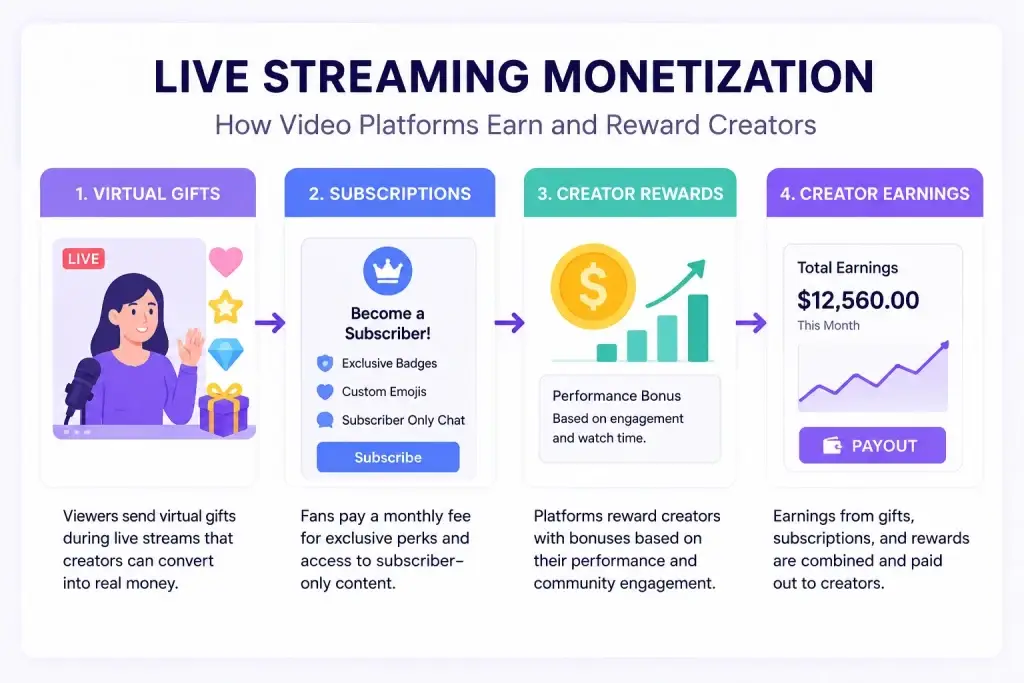
The Three Core Revenue Pillars of Live Streaming Monetization
Most scalable live streaming platforms use three core monetization pillars: virtual gifts, subscriptions, and creator rewards.
Each model solves a different business problem.
Virtual gifts convert real-time viewer excitement into microtransactions. Subscriptions convert loyal fans into recurring revenue. Creator rewards help attract and retain streamers by giving them a reason to publish consistently and improve content quality.
Live Streaming Monetization Models and Business Value
| Monetization Model | How It Works | Business Value | Founder Impact |
|---|---|---|---|
| Virtual Gifts | Viewers buy coins, jewels, or credits and send gifts during live streams. | Creates real-time spending and increases stream engagement. | Useful for entertainment, gaming, influencer, music, education, and fan-community platforms. |
| Subscriptions | Fans pay monthly for exclusive content, badges, chat access, private streams, or member perks. | Builds predictable recurring revenue. | Best for creators with loyal audiences and niche communities. |
| Creator Rewards | The platform rewards creators based on performance, engagement, quality, or watch-time criteria. | Improves creator retention and content consistency. | Useful when the platform needs to attract creators before organic monetization matures. |
| Platform Commission | The platform keeps a percentage of gifts, subscriptions, or transactions. | Creates direct platform revenue from creator activity. | Important for marketplace-style creator platforms. |
| Paid Promotions | Creators pay to boost streams, appear in discovery, or access premium placement. | Creates B2B-style monetization from creators or brands. | Works when creator competition and platform traffic are high enough. |
How Virtual Gifts Turn Viewer Emotion Into Revenue
Virtual gifts are one of the most powerful monetization tools in live streaming because they convert attention into action.
The flow usually works like this:
- A viewer purchases platform currency such as coins, jewels, credits, or tokens.
- The viewer sends a virtual gift during a live stream.
- The gift appears on-screen with animation, chat visibility, badges, or creator acknowledgement.
- The creator receives a platform-defined earning unit.
- The platform keeps a commission or applies a revenue-share rule.
- The creator withdraws earnings through a wallet or payout system.
TikTok also supports Gifts, where viewers need Coins to send Gifts, and creators can collect Diamonds through eligible gifting features. TikTok notes that users must meet age and regional requirements to purchase and use Coins.
For a founder, the lesson is simple: gifts are not just visual effects. They require serious product infrastructure.
A proper virtual gifting system needs:
- Coin or credit purchase flow
- Gift catalogue management
- Gift animation and live overlay
- Creator wallet
- Platform commission rules
- Withdrawal requests
- Refund and dispute logic
- Fraud monitoring
- Creator eligibility rules
- Admin reporting
- Payment gateway integration
- Tax and payout documentation where applicable
Without these layers, gifting can create operational risk. Viewers may request refunds, creators may dispute payouts, users may abuse payment systems, and admins may struggle to track platform earnings.
Why Subscriptions Create More Predictable Creator Platform Revenue
Virtual gifts are powerful, but they can be unpredictable. A creator may earn heavily during one stream and very little during the next. Subscriptions solve this problem by creating recurring revenue.
In a live streaming platform, subscriptions can include:
- Monthly creator memberships
- Paid fan clubs
- Subscriber-only chat
- Exclusive live streams
- Private community access
- Custom badges
- Loyalty levels
- Early content access
- Ad-free viewing
- Premium creator updates
- Gifted subscriptions
Twitch has made subscriptions a core creator monetization tool. Twitch Partners can earn revenue from viewer subscriptions, including Tier 1, Tier 2, Tier 3, and Prime subscriptions. Twitch Affiliates also have subscription monetization available, with standard affiliate subscription revenue sharing and eligibility for enhanced rates through specific programs.
TikTok’s LIVE ecosystem also includes fan engagement features such as Fan Club levels, member badges, exclusive chat rooms, special Gifts, and entrance spotlights. These features show how subscriptions and loyalty systems can deepen fan relationships beyond one-time payments.
For founders, subscriptions are valuable because they improve revenue predictability. They also give creators a reason to stay on the platform. A creator who builds 500 paying subscribers has a stronger reason to continue streaming than a creator who depends only on random gifts.
However, subscriptions only work when the platform gives fans enough value. Charging users without exclusive access, identity, status, or community benefits leads to churn.
How Creator Rewards Help Platforms Attract Better Streamers
Creator rewards are performance-based incentives paid by the platform to creators. They can be based on watch time, engagement, qualified views, live stream duration, content quality, retention, follower growth, or other platform-defined metrics.
TikTok’s Creator Rewards Program is an example of a reward model where approved creators can track estimated rewards, performance metrics, qualified views, engagement, payout information, and reward trends from a dedicated dashboard. TikTok also notes that rewards may be subject to processing fees, adjustments, payout setup, and payment thresholds.
For new video platforms, creator rewards can be useful because creators need motivation before the platform has a large paying audience. A founder may use reward pools to attract early creators, encourage consistent streaming, or promote high-quality content categories.
But creator rewards must be designed carefully. Poorly designed reward systems can attract spam, low-quality content, engagement manipulation, fake views, or reward farming.
A strong creator rewards system should include:
- Creator eligibility rules
- Minimum content quality standards
- Watch-time validation
- Engagement quality scoring
- Fraud detection
- Abuse reporting
- Reward caps
- Category-level reward budgets
- Manual review queues
- Admin approval workflows
- Transparent creator dashboard
The goal is not just to pay creators. The goal is to reward behavior that improves platform quality.
The Wallet and Payout Layer Behind Live Streaming Revenue
Every serious live streaming monetization model needs a wallet layer. Gifts, subscriptions, and creator rewards all create balances that must be tracked accurately.
A wallet system usually includes:
- Viewer coin balance
- Creator earning balance
- Platform commission ledger
- Refund adjustment records
- Withdrawal requests
- Payout status tracking
- Payment gateway records
- Tax or invoice fields where required
- Admin reconciliation dashboard
This is where many founders underestimate complexity. A beautiful live streaming interface is not enough. If wallet balances are wrong, creator trust breaks immediately.
For a platform owner, the wallet layer should answer:
- How many coins did a viewer purchase?
- Which creator received the gift?
- What was the platform commission?
- What is the creator’s pending balance?
- Has the withdrawal been approved?
- Was there a refund or chargeback?
- Is the creator eligible for payout?
- Are there suspicious payment patterns?
A monetization-ready platform must treat wallet accuracy as a core product feature, not a backend afterthought.
Admin Controls Founders Need for Live Streaming Monetization
The admin dashboard is where platform operators manage revenue, creators, viewers, payments, and risk.
For live streaming monetization, admin controls should include:
| Admin Feature | Why It Matters |
|---|---|
| Gift catalogue control | Helps the platform create, price, update, or remove virtual gifts. |
| Coin package management | Allows admins to define purchase bundles and promotional credits. |
| Commission settings | Lets the business control platform revenue share across gifts, subscriptions, and rewards. |
| Creator eligibility | Ensures only approved creators can monetize. |
| Withdrawal approval | Reduces payout risk and allows manual checks before settlement. |
| Subscription plan control | Helps define creator memberships, platform plans, and fan benefits. |
| Reward rule management | Allows the platform to adjust creator reward criteria. |
| Fraud monitoring | Helps detect suspicious gifts, fake engagement, or payment abuse. |
| Moderation queues | Supports safer live chat, streams, and creator behavior. |
| Analytics dashboard | Shows revenue, active creators, top streams, ARPU, churn, and engagement trends. |
For founders, admin control is business control. Without it, every small monetization change requires developer intervention. With it, the platform operator can adjust revenue rules, creator permissions, gift pricing, and payout workflows based on real market behavior.
Founder Decision Signals: Choosing the Right Monetization Mix
Not every live streaming platform should start with every monetization model. The right mix depends on the audience, creator category, and launch strategy.
Founder Decision Signals
Speed
If you want to launch quickly, start with core monetization flows such as gifts, wallet, creator earnings, and admin commission settings before adding complex reward pools.
Cost
Subscriptions and reward systems require more backend logic than simple ads. Plan for wallet, payout, fraud control, analytics, and payment integration from the beginning.
Scalability
Live monetization creates real-time load through chat, gift animations, wallet updates, notifications, and stream overlays. The backend must be prepared for peak activity.
Market Fit
Use gifts for entertainment-heavy communities, subscriptions for loyal creator audiences, and rewards when you need to attract creators before organic earnings mature.
Which Monetization Model Fits Your Live Streaming Platform?
A founder should choose monetization based on audience behavior.
If the platform is entertainment-led, virtual gifts may be the strongest starting point. This applies to music, gaming, lifestyle, influencer, comedy, talent, and social discovery platforms where viewers enjoy public recognition.
If the platform is expertise-led, subscriptions may work better. This applies to education, fitness, coaching, finance education, creator communities, and professional learning platforms where fans pay for depth, access, and consistency.
If the platform is creator-acquisition-led, creator rewards can help in the early stage. This is useful when the platform needs quality supply before viewer spending becomes reliable.
Most mature platforms eventually combine all three.
Security, Moderation, and Compliance Considerations
Live streaming monetization involves user payments, creator payouts, content, and real-time interaction. That makes security and trust essential.
A platform should include:
- Encrypted data transfer
- Secure payment gateway integration
- Role-based access control
- Creator verification
- User verification where needed
The compliance requirements depend on jurisdiction, payment partners, user age rules, creator payout structure, and operating model. A platform can be built with compliance-ready workflows, but final compliance should be reviewed based on the target market and legal requirements.
For creator and user-generated content platforms, moderation is not optional. Content safety affects creator trust, advertiser confidence, user retention, and long-term platform reputation.
Mistakes Founders Should Avoid in Live Streaming Monetization
Mistakes Founders Should Avoid
Adding gifts without wallet accuracy
Virtual gifts depend on trust. If coin balances, creator earnings, or withdrawal records are inaccurate, creators lose confidence in the platform quickly.
Launching subscriptions without exclusive value
Fans need a reason to pay monthly. Badges alone may not be enough. Strong subscriptions usually include access, recognition, community, content, or creator interaction.
Using creator rewards without fraud controls
Reward pools can attract fake engagement if eligibility, watch-time validation, abuse detection, and manual review workflows are missing.
Ignoring admin monetization controls
Founders need the ability to change commission rates, gift pricing, payout rules, subscription plans, and creator eligibility without rebuilding the product every time.
How Miracuves Helps Founders Build Monetization-Ready Video Platforms
Building a live streaming platform from zero can be time-consuming because the product must support video streaming, real-time chat, creator profiles, wallets, payment flows, gift animations, subscriptions, admin controls, moderation, and analytics.
A ready-made solution from Miracuves can help founders reduce avoidable development effort by starting with a launch-ready foundation. For video platform founders, Miracuves’ white-label approach can support branded app experiences, source-code ownership, creator workflows, admin dashboards, monetization modules, and faster deployment.
Related reading: Live Streaming Entertainment Platform Monetization.
Final Thoughts
Live streaming monetization is not about adding a payment button to a video app. It is about designing a complete creator economy inside the platform.
Virtual gifts help viewers participate emotionally. Subscriptions create recurring fan relationships. Creator rewards help the platform attract and retain quality creators. But these models only work when supported by wallet accuracy, admin control, secure payments, moderation, fraud monitoring, analytics, and transparent payout workflows.
For founders, the strongest decision is to think beyond features. The real opportunity is to build a monetization-ready video platform where creators want to stream, viewers want to participate, and the platform owner has enough control to scale the business responsibly.
Miracuves helps founders move from idea to launch faster with ready-made, white-label, source-code-owned app solutions built for branding, admin control, monetization, and market validation.
FAQs
What is live streaming monetization?
Live streaming monetization is the process of generating revenue from live video content through virtual gifts, paid subscriptions, creator rewards, ads, premium access, platform commissions, and fan engagement tools.
How do live streaming apps make money from virtual gifts?
Viewers buy platform currency such as coins, credits, or jewels and use it to send gifts during live streams. The creator receives earnings based on platform rules, while the platform may retain a commission or service fee.
Are subscriptions better than virtual gifts for live streaming platforms?
Subscriptions are better for predictable recurring revenue, while virtual gifts are better for real-time engagement and impulse spending. Most scalable live streaming platforms use both models together.
Can Miracuves help build a live streaming monetization platform?
Yes. Miracuves helps founders build ready-made and white-label creator platform solutions with branded design, source-code ownership, admin dashboards, monetization workflows, and faster deployment.
What is the best revenue model for a live streaming app?
The best model depends on the audience. Entertainment platforms usually benefit from virtual gifts, niche creator communities benefit from subscriptions, and early creator platforms may use rewards to attract quality creators.
Miracuves is an independent software development company. We are not affiliated with, connected to, sponsored by, or endorsed by any company or product named in this article.
Terms such as “X Clone” are used descriptively. It is how the software industry refers to building a platform with functionality comparable to a known service, and how clients search for it.
The entire design and codebase of our products is built by our own team. Our products contain no code, design, graphics, or content originating from any third-party website or applications.
All third-party names and marks referenced in this article are the property of their respective owners, referenced solely to identify the services discussed.