


Key Takeaways
- TikTok clone apps need multiple revenue models to grow beyond basic video engagement.
- Ads, subscriptions, and creator tools can turn traffic into income.
- Live gifts and virtual coins help increase real-time fan spending.
- Brand partnerships and social commerce create extra monetization options.
- The best model balances creator earnings, user experience, and platform revenue.
What You’ll Learn
- How TikTok clone monetization works for founders and creators.
- Ad revenue models include in-feed ads, banners, and sponsored content.
- Creator subscriptions support recurring income and premium access.
- Coins, gifts, and live streaming help monetize active communities.
- Growth depends on engagement, retention, creator tools, and payment flow.
Real Insights
- Monetization works best when creators and users both see value.
- Ad-heavy platforms can lose retention if the feed feels interrupted.
- Creator earnings improve loyalty and long-term content supply.
- Social commerce adds value by turning attention into sales.
- The best strategy is to combine ads, subscriptions, gifts, partnerships, and commerce.
Short-video apps are no longer built only for entertainment. They are now powerful creator economy platforms where users watch content, creators build communities, brands run campaigns, and businesses generate revenue through multiple monetization channels.
For founders, TikTok clone monetization is not just about showing ads between videos. A profitable TikTok-like app needs a complete revenue system that connects engagement, creators, payments, live streaming, virtual gifts, brand partnerships, and social commerce.
The real opportunity is not in copying TikTok’s interface. The opportunity is in building a short-video platform that can turn attention into revenue.
A TikTok clone app becomes a revenue engine when every major activity inside the platform creates business value. When users watch videos, the platform can show ads. When fans support creators, the platform can earn commission from gifts or coins. When brands collaborate with influencers, the platform can manage paid campaigns. When creators sell products, the app can earn from social commerce.
That is why founders should plan monetization before launch, not after the app starts growing.
Why TikTok Clone Monetization Needs More Than Ads
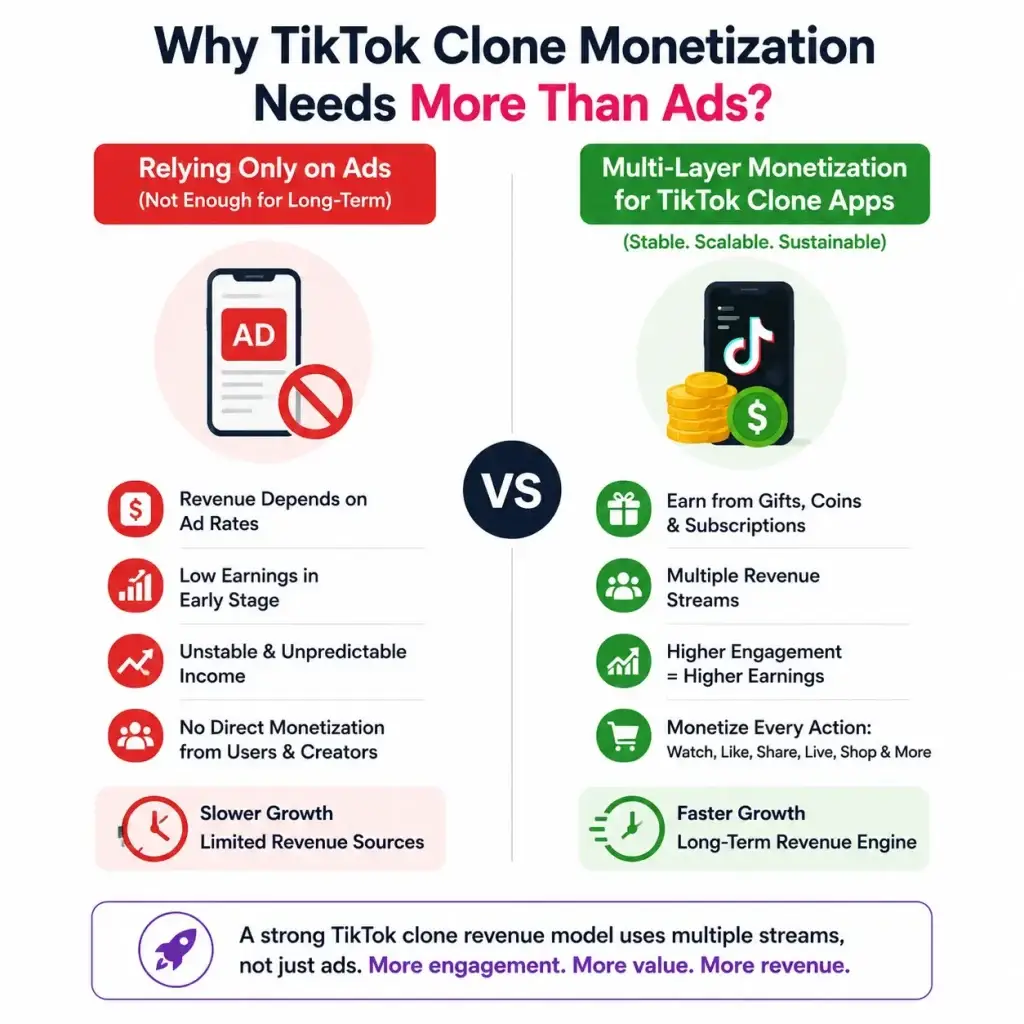
Many founders think the easiest way to monetize a TikTok-like app is through advertisements. Ads are important, but they are not enough for long-term revenue.
Short-video platforms work differently from traditional apps. They depend on frequent user engagement, creator activity, personalized recommendations, and community interaction. Every scroll, like, share, comment, follow, live session, and purchase can become part of the monetization journey.
A strong TikTok clone revenue model should include:
- in-app ads
- creator subscriptions
- virtual gifts
- coin-based economy
- live streaming revenue
- brand partnerships
- paid video promotions
- influencer campaigns
- social commerce
- affiliate sales
- premium creator tools
This multi-layer approach helps the business avoid depending on one income source. If ad revenue is low in the beginning, the platform can still earn from gifts, paid boosts, subscriptions, or brand collaborations.
Read more: What is TikTok App and How Does It Work?
The Revenue Architecture Behind a Profitable TikTok Clone App
A monetization-ready TikTok clone app needs more than visible features. It needs backend systems that manage money, users, creators, campaigns, and platform commissions.
| Revenue Layer | Feature Required | How Platform Earns |
| Ads | Ad placement engine | CPM, CPC, sponsored views |
| Creator subscriptions | Premium access system | Monthly commission |
| Virtual gifts | Wallet and coin system | Gift commission |
| Live streaming | Live video module | Gifts, tickets, sponsorships |
| Brand partnerships | Campaign dashboard | Brand fee or commission |
| Social commerce | Product tagging and checkout | Sales commission |
| Paid promotion | Boosting system | Creator/business payments |
This architecture is important because monetization cannot work properly without admin control. The platform owner should be able to manage ad placements, creator payouts, commission percentage, gift values, coin packages, campaign pricing, product commissions, and promotional visibility.
Without these controls, the app may get users but fail to generate predictable revenue.
In-App Advertising for TikTok Clone Monetization
Advertising is one of the most common monetization models for TikTok clone apps. Once the app starts receiving regular traffic, ads can become a stable income stream.
A short-video platform can use different types of ads, such as:
- native feed ads
- full-screen video ads
- sponsored videos
- banner placements
- splash screen ads
- hashtag challenge sponsorships
- brand takeover ads
The biggest advantage of short-video ads is that they appear naturally inside the content feed. If the ad feels similar to regular videos, users are more likely to watch, engage, or click.
For founders, the key is not only adding ads but controlling where and how they appear. Too many ads can reduce user experience. Too few ads can limit revenue. A smart admin panel should allow the platform owner to manage frequency, placement, category, location, and campaign duration.
How recommendation engines improve ad revenue
A TikTok-like app becomes more profitable when its recommendation system understands user behavior. If the app knows what users watch, skip, like, and share, it can display more relevant ads.
Better personalization can increase:
- watch time
- ad impressions
- click-through rate
- brand campaign performance
- advertiser confidence
This is why TikTok clone monetization is directly connected to engagement and recommendation logic.
Creator Subscriptions for Recurring Revenue
Creator subscriptions are one of the best ways to create recurring revenue inside a TikTok-like app. Instead of relying only on ads, the platform allows users to pay for exclusive creator content.
Creators can offer:
- premium videos
- subscriber-only live sessions
- private community access
- early content access
- behind-the-scenes updates
- exclusive tutorials
- paid fan groups
The platform can earn by taking a percentage from each subscription payment.
| Subscription Model | Creator Benefit | Platform Benefit |
| Monthly creator plan | Predictable income | Recurring commission |
| Premium video access | Higher content value | Paid content revenue |
| VIP fan community | Stronger fan loyalty | Better retention |
| Subscriber-only live stream | Direct fan engagement | Premium access fees |
This model works well when the app has niche creators, educators, entertainers, fitness experts, influencers, musicians, or consultants. It gives creators a reason to stay active on the platform because they can build direct income from their audience.
For founders, subscriptions help create more stable revenue than ads because users pay regularly.
Virtual Gifts and Coin-Based Monetization
Virtual gifts are one of the strongest monetization models for short-video and live-streaming platforms. Users buy coins inside the app and use those coins to send gifts to creators.
The basic flow works like this:
- user buys coins
- user sends gifts to creator
- creator receives gift value
- platform keeps a commission
- creator withdraws earnings based on platform rules
This model works because it is emotional. Fans support creators they like. Creators feel rewarded. The platform earns commission from every transaction.
Examples of virtual gifts can include:
- hearts
- badges
- stickers
- premium emojis
- animated gifts
- live stream gifts
- ranking gifts
- festival gifts
The admin panel should allow control over coin packages, gift pricing, creator payout percentage, minimum withdrawal limit, and transaction history.
Virtual gifts can often generate stronger revenue than ads because users are not just watching content; they are actively spending money to support creators.
Live Streaming Monetization
Live streaming adds a powerful revenue layer to TikTok clone apps. It turns passive video consumption into real-time interaction.
Creators can go live and earn through:
- virtual gifts
- paid live rooms
- premium access
- live shopping
- sponsored live sessions
- fan donations
- ticketed events
| Live Streaming Feature | Revenue Opportunity |
| Live gifts | Platform earns commission |
| Paid live access | Users pay to join |
| Sponsored live sessions | Brands pay creators/platform |
| Live shopping | Platform earns sales commission |
| VIP rooms | Premium fan access |
Live streaming monetization works best because viewers feel directly connected to creators. They can comment, react, ask questions, send gifts, and participate in real time.
However, live streaming needs strong technical support. The app should handle low-latency streaming, moderation, reporting, viewer limits, payment flow, and server scalability. If the live experience is slow or unstable, users will leave quickly.
For founders, live streaming can become one of the highest-value monetization features once the creator base becomes active.
Brand Partnerships and Influencer Campaigns
Brand partnerships create enterprise-level monetization opportunities for TikTok-like apps. As the platform grows, brands may want to work with creators to promote products, services, events, or campaigns.
The app can support brand monetization through:
- sponsored creator videos
- branded hashtag challenges
- influencer campaigns
- product placement
- sponsored live streams
- brand profile pages
- creator marketplace
- campaign analytics
The platform can earn revenue by charging brands directly or taking commission from creator-brand deals.
A strong TikTok clone app should include campaign tracking features so brands can measure:
- views
- engagement
- clicks
- conversions
- creator performance
- audience demographics
- campaign reach
This makes the app more attractive for advertisers because brands do not want only visibility. They want measurable results.
Social Commerce Monetization
Social commerce is becoming one of the most important revenue models for short-video platforms. Users are no longer discovering products only through search engines or marketplaces. They are discovering products through creators, short videos, live streams, and recommendations.
A TikTok-like app can support social commerce through:
- product tagging in videos
- creator storefronts
- affiliate links
- live shopping
- in-app checkout
- sponsored product placements
- shoppable video feeds
| Social Commerce Feature | Revenue Opportunity |
| Product tagging | Affiliate commission |
| Creator storefront | Marketplace revenue |
| Live shopping | Real-time product sales |
| Sponsored product videos | Brand promotion revenue |
| In-app checkout | Transaction commission |
This model is powerful because creators already influence audience decisions. If a beauty creator recommends skincare, a fitness creator recommends supplements, or a fashion creator promotes clothing, users can buy directly through the app.
For founders, social commerce can turn the TikTok clone app into more than a content platform. It can become a video-driven shopping ecosystem.
Paid Promotions and Boosted Videos
Paid promotion allows creators, businesses, or influencers to pay for more visibility. This is useful for new creators who want faster reach or brands that want to promote specific content.
Paid promotion can include:
- boost video
- promote profile
- feature in trending feed
- sponsor hashtag
- increase local visibility
- promote product videos
- run campaign-based reach
This model works well because not every creator wants to wait for organic reach. Some users are willing to pay if the platform can help them reach more viewers.
For the platform owner, paid promotion creates direct revenue without depending only on external advertisers. The admin panel should allow control over campaign duration, budget, targeting, approval, and performance reports.
Premium Creator Tools
Another smart monetization model is charging creators for advanced tools. As creators grow, they need better insights, editing options, audience analytics, and promotional features.
Premium creator tools can include:
- advanced analytics
- profile growth insights
- content performance reports
- AI caption suggestions
- video editing tools
- scheduled posting
- audience behavior data
- competitor-style insights
- premium filters and effects
This model works best for serious creators, influencers, educators, and businesses that use the platform for growth. The platform can offer these features through monthly plans or one-time upgrades.
This also helps the app attract professional creators who are more likely to publish regularly and bring audiences with them.
Affiliate Marketing Revenue
Affiliate marketing is another useful revenue stream for TikTok clone apps. Creators can promote products through videos and earn commission when users buy through their links.
The platform can earn by:
- taking a share from affiliate sales
- charging brands for product listing
- charging creators for affiliate tools
- managing product discovery inside the app
Affiliate monetization is especially useful for niches like fashion, beauty, fitness, gadgets, food, travel, education, and lifestyle.
For this model to work, the app needs tracking links, product tagging, conversion tracking, creator dashboards, and payment reporting.
Read more: Best TikTok Clone Scripts in 2025: Features & Pricing Compared
Which Monetization Model Works Best at Each Growth Stage?
Not every monetization model should be launched at the same time. Founders should choose monetization based on platform stage, audience size, and creator activity.
| Platform Stage | Best Monetization Models | Why It Works |
| MVP stage | Ads, paid boosts | Simple to launch and test |
| Early growth | Gifts, coins, creator tools | Encourages creator activity |
| Creator growth stage | Subscriptions, live streaming | Builds creator income |
| Brand growth stage | Sponsorships, campaigns | Attracts advertisers |
| Mature stage | Social commerce, marketplace | Expands revenue ecosystem |
In the early stage, the main focus should be engagement and creator onboarding. Heavy monetization too early can hurt growth. Once users and creators become active, the platform can gradually introduce subscriptions, gifting, live monetization, and commerce.
Common TikTok Clone Monetization Mistakes
Many short-video apps fail to generate revenue because they add monetization without strategy.
Common mistakes include:
- relying only on ads
- launching without creator incentives
- not having a wallet system
- weak admin commission controls
- poor content recommendation
- no live streaming monetization
- no creator payout system
- weak moderation
- adding too many ads too early
- ignoring social commerce
- not tracking revenue analytics
The biggest mistake is treating monetization as an extra feature. In reality, monetization should be part of product planning from the beginning.
If creators cannot earn, they may not stay. If users do not find valuable content, they will not spend. If brands cannot track results, they will not invest. If the admin cannot control commissions, the platform cannot scale revenue properly.
Why TikTok Clone Apps Should Be Built as Revenue Ecosystems
A profitable TikTok clone app is not just a video feed. It is a revenue ecosystem where different users create different types of value.
Users create value through attention and purchases. Creators create value through content and influence. Brands create value through advertising and campaigns. The platform creates value by connecting all of them through technology.
A strong revenue ecosystem includes:
- personalized content feed
- creator profiles
- wallet and coins
- virtual gifts
- live streaming
- subscription access
- brand campaign tools
- paid promotions
- social commerce
- admin commission control
- analytics dashboard
- moderation system
- scalable backend
When these systems work together, the platform can generate revenue from multiple directions instead of depending on one model.
This is what turns a TikTok clone app into a real business engine.
Read more: TikTok Features Explained for Startups and Creators
How Miracuves Helps Founders Launch Monetization-Ready TikTok-Like Platforms Faster
Miracuves helps founders launch TikTok-like platforms with ready-made speed and white-label flexibility. Instead of starting from zero, founders can begin with a short-video app foundation that already supports core platform flows and can be customized for their business model.
The focus is not only on creating a TikTok-style interface. The goal is to help founders build a platform with engagement, creator tools, monetization options, admin control, and scalable architecture.
Miracuves can support TikTok clone monetization through features such as:
- short-video feed
- creator profiles
- user engagement tools
- admin dashboard
- monetization modules
- live streaming support
- wallet and coin-based systems
- virtual gifting
- paid promotion options
- social commerce integrations
- white-label branding
- source code ownership
- scalable backend structure
This helps founders move faster while still keeping future customization open. A business may begin with basic monetization like ads and paid boosts, then later add creator subscriptions, live gifts, premium tools, brand campaigns, or social commerce as the platform grows.
For startups, this approach reduces launch time and helps validate the market faster. For growing businesses, it provides a stronger base to build creator economy features and revenue systems over time.
Conclusion
TikTok clone monetization is not limited to ads. The most successful short-video platforms use multiple revenue models together.
Ads bring visibility-based revenue. Subscriptions create recurring income. Virtual gifts and coins support creator earnings. Live streaming increases real-time engagement. Brand partnerships open business-level revenue. Social commerce turns content into transactions. Paid promotions help creators and brands grow faster.
For founders, the main lesson is simple: a TikTok-like app should be built as a revenue engine from the beginning.
The real value is not only in launching a short-video app. The real value is in building a platform where creators can earn, users can engage, brands can promote, and the business can scale revenue through multiple channels.
Ready to launch a monetization-ready TikTok-like app with scalable creator economy features and faster deployment?
Contact Us to build a powerful video content platform designed for engagement, growth, and long-term revenue generation.
FAQs
What is TikTok clone monetization?
TikTok clone monetization means generating revenue from a TikTok-like short-video app through ads, subscriptions, virtual gifts, coins, live streaming, paid promotions, brand partnerships, and social commerce.
What is the best monetization model for a TikTok clone app?
The best model depends on the platform stage. Early-stage apps can start with ads and paid promotions. Growing platforms can add gifts, coins, subscriptions, live streaming, and social commerce.
Do TikTok clone apps make money only from ads?
No. Ads are only one revenue source. TikTok-like apps can also earn from creator subscriptions, virtual gifts, coin purchases, paid boosts, brand campaigns, affiliate sales, and shopping features.
Why are virtual gifts important in TikTok-like apps?
Virtual gifts allow fans to support creators directly. The platform earns commission from gift transactions, while creators get a new income stream.
How does live streaming monetization work?
Live streaming monetization works through gifts, paid live rooms, sponsored sessions, live shopping, premium access, and fan donations.
Can social commerce work inside a TikTok clone app?
Yes. Social commerce allows creators to tag products, sell through videos, host live shopping events, and earn affiliate revenue while the platform earns commission.
What features are needed for TikTok clone monetization?
Important features include wallet system, coin packages, ad engine, creator payout system, subscription access, live streaming, campaign dashboard, paid promotion system, and admin commission controls.
How can Miracuves help with TikTok clone monetization?
Miracuves helps founders launch white-label TikTok-like platforms with monetization-ready features, admin controls, creator tools, scalable architecture, source code ownership, and faster launch support.
How do brand partnerships generate revenue in a TikTok clone app?
Brand partnerships generate revenue through sponsored videos, influencer campaigns, branded hashtag challenges, sponsored live sessions, and campaign commissions.
Why should monetization be planned before launching a TikTok-like app?
Monetization should be planned before launch because wallet systems, creator payouts, ads, subscriptions, gifts, and admin commissions need proper backend setup from the beginning.