Key Takeaways
- A short-form video platform should combine vertical feeds, video uploads, recording, editing, creator profiles, discovery, engagement, moderation, monetization, and admin management.
- Core development scope depends on video processing, personalized recommendations, social interactions, notifications, creator tools, analytics, content moderation, and monetization requirements.
- Development cost is influenced by mobile and web scope, streaming infrastructure, storage, CDN usage, AI features, third-party integrations, security, scalability, and customization depth.
Feature & Cost Signals
- Essential features may include vertical video feeds, uploads, recording, filters, likes, comments, shares, follows, hashtags, search, notifications, profiles, and reporting tools.
- Cost can increase with AI recommendations, advanced video editing, live streaming, virtual gifts, advertising, subscriptions, creator payouts, multilingual support, and complex moderation systems.
- Infrastructure requirements such as transcoding, media storage, CDN delivery, databases, caching, cloud hosting, analytics, backups, and content processing also affect total development and operating cost.
Founder Planning Insights
- Founders should define target users, creator workflows, content categories, feed logic, monetization model, moderation requirements, infrastructure needs, and MVP scope before estimating development cost.
- A phased roadmap can prioritize uploads, vertical feeds, creator profiles, discovery, engagement, and admin controls first, then add live streaming, AI personalization, monetization, and advanced analytics later.
- Miracuves develops customizable short-form video platforms with vertical feeds, creator tools, video processing, recommendations, engagement features, monetization, analytics, moderation, and admin controls.
Short-form video platforms are no longer just entertainment products. They are now used by creators, educators, brands, communities, fitness coaches, ecommerce businesses, local influencers, media companies, and niche content startups to build owned audiences.
For founders, the real question is not simply, “Can we build a short-video app?” The better question is, “What should we build first, what will it cost, and which features actually matter for launch?”
A short-form video platform may look simple from the outside. Users open the app, scroll through videos, like content, follow creators, and upload clips. Behind that smooth experience, however, there is a much deeper product system: video uploads, compression, CDN delivery, personalized feeds, creator tools, moderation, analytics, monetization, user reporting, wallet flows, notifications, and admin control.
This guide helps founders understand what to plan before investing in a vertical video platform. It covers the core features, cost factors, technical layers, monetization options, and launch decisions that influence the final product. For teams that want a faster route to market, Miracuves also offers a launch-ready short-video app foundation that can be branded, customized, and delivered in 6 days depending on the selected scope.
Why Founders Are Planning Short-Form Video Platforms in 2026
Short-form video has become one of the strongest formats for digital attention. It is fast to consume, easy to share, and powerful for discovery. Users do not need to search deeply to find content. A strong feed brings relevant videos to them.
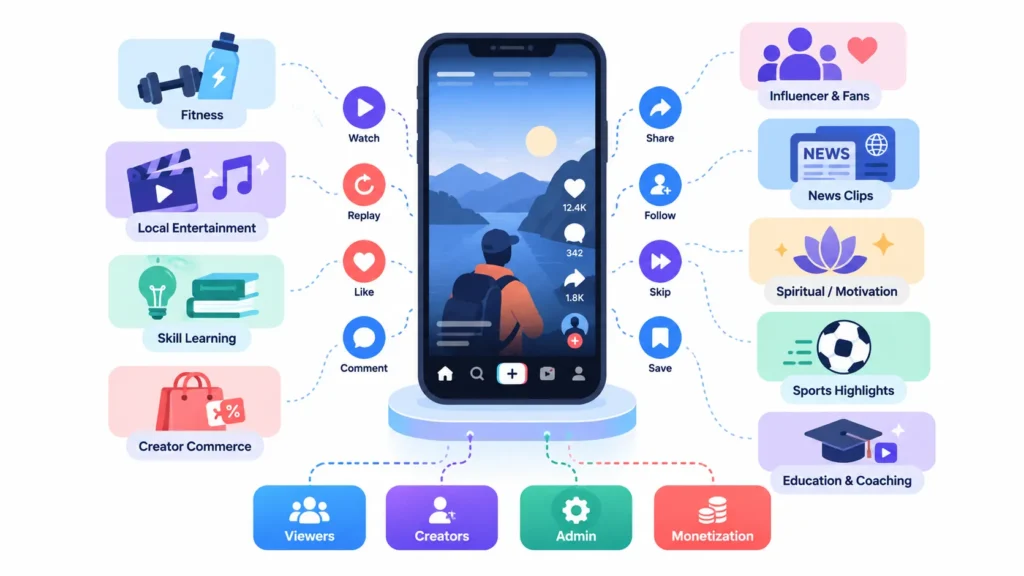
This makes short-form video useful beyond entertainment. A founder can use the same product pattern for:
- Fitness creator communities
- Local language entertainment
- Skill-learning platforms
- Creator-led commerce
- Influencer marketplaces
- Fan engagement apps
- News and opinion clips
- Spiritual or motivational content
- Sports highlights
- Brand-owned media channels
- Education and coaching communities
The opportunity is attractive because short videos reduce content friction. Creators can publish frequently, users can consume quickly, and the platform can collect strong engagement signals such as watch time, replays, likes, shares, comments, follows, skips, and saves.
But this also creates product complexity. A short-video business needs more than upload and playback. It needs a system that keeps viewers engaged, helps creators publish, gives admins control, and supports monetization without damaging user trust.
That is why founders should plan the platform in layers instead of starting with a random feature list.
How This Blog Supports the Main Solution Page Without Competing With It
The main solution page should remain the commercial page for founders who are already searching for a ready-made short-video app solution. This blog has a different role.
This article is designed for planning-stage readers who are still asking:
- What features should a short-form video platform include?
- What affects short video app development cost?
- Which modules are necessary for launch?
- How should founders think about scalability and monetization?
- Is a ready-made foundation better than building from scratch?
That makes this blog a supporting asset, not a replacement for the money page. It educates readers first, then naturally directs them to the relevant Miracuves solution when they are ready to explore a launch-ready product.
Recommended internal link anchor examples for the money page:
- launch-ready short-video solution
- white-label short-video app foundation
- Miracuves short-video platform solution
- branded vertical video app solution
- ready-made video platform for creators
Avoid using the exact money-page keywords repeatedly in this blog.
Core Features Every Short-Form Video Platform Should Plan First
Founders often begin with visible features such as video recording, filters, likes, and comments. Those matter, but the stronger approach is to divide the product into user-side, creator-side, admin-side, infrastructure, and monetization features.
A short-form video platform succeeds when these layers work together.
Founders who want to plan the product more deeply can review the short-form video platform features that usually shape the user app, creator tools, admin panel, engagement system, moderation layer, and monetization controls.
User App Features
The user app is where retention is won or lost. If users cannot discover content quickly, watch smoothly, and interact without friction, the platform will struggle to keep attention.
Important user features include:
- User registration and login
- Interest selection during onboarding
- Vertical video feed
- Swipe-based browsing
- Like, comment, share, and save options
- Creator follow system
- Search and hashtag discovery
- User profiles
- Notifications
- Report content option
- Block or mute user controls
- Language and region preferences
The feed experience matters most. Users expect instant playback, smooth swiping, and relevant recommendations. Even a strong creator community can lose users if videos buffer, feeds feel repetitive, or discovery does not improve over time.
This is also where viral product mechanics become important. Features such as watch-time signals, share loops, trending sounds, creator discovery, and engagement triggers can help a creator platform improve repeat usage. For more detail, read this guide on viral features for short-video platforms.
Creator Features
Creators need tools that make publishing easy and rewarding. A platform that only supports basic upload may work for early testing, but it will struggle to attract serious creators unless it gives them control, visibility, and monetization options.
Important creator-side features include:
- Video recording
- Gallery upload
- Trimming and editing
- Filters and effects
- Music or sound selection
- Captions and hashtags
- Draft saving
- Creator profile
- Follower analytics
- Video performance insights
- Live streaming, if required
- Creator wallet or earnings dashboard
- Content status tracking
For founders, creator features are not only product features. They are supply-side growth tools. If creators can publish faster, understand performance, and earn from their audience, they have a stronger reason to stay active.
Admin Panel Features
The admin dashboard is where the platform owner controls operations. Many founders underestimate this layer because users do not see it. But without strong admin controls, the business becomes difficult to manage once content, creators, payments, and reports increase.
A practical admin panel should include:
- User management
- Creator management
- Video management
- Category and hashtag control
- Reported content review
- Manual moderation queue
- Dashboard analytics
- Monetization settings
- Ad placement control
- Subscription settings
- Wallet and payout overview
- Push notification management
- Language and region settings
- Role-based access control
- Content policy management
For a founder, admin control reduces dependency on developers for everyday decisions. The team should be able to remove harmful content, review reports, update categories, monitor growth, and adjust monetization settings without needing code changes for every small action.
Feature Planning Table for Founders
Short-Form Video Platform Feature Planning
| Feature Layer | What It Includes | Why It Matters for Founders |
|---|---|---|
| User Experience | Onboarding, vertical feed, likes, comments, shares, search, profiles, notifications | Improves retention, session length, and daily usage habits |
| Creator Tools | Upload, recording, editing, filters, captions, drafts, analytics, live options | Helps attract and retain creators who produce the platform’s content supply |
| Discovery System | Feed ranking, hashtags, interests, search, trending content, personalized recommendations | Controls whether users find relevant content quickly |
| Moderation | Reports, review queue, content status, blocked users, abuse handling | Protects platform trust, brand safety, and user experience |
| Monetization | Ads, subscriptions, creator earnings, virtual gifts, premium content, brand promotions | Turns engagement into revenue without relying on one income source |
| Infrastructure | Video compression, storage, CDN delivery, adaptive playback, background processing | Determines playback quality, upload reliability, and scaling cost |
| Admin Control | Users, creators, content, analytics, payouts, settings, notifications, roles | Gives the operator control over growth, safety, and business decisions |
Miracuves Short-Form Video Platform Solution Cost and Tech Stack
Miracuves Pricing for a Short-Form Video Platform developed in PHP For $3,999 USD (One-Time Price) in just 6 days
Get a fully developed, deployment-ready short-form video platform built for creator economy startups, social media founders, entertainment apps, influencer communities, and businesses planning to launch a video-first engagement platform. Built on a stable PHP foundation, this complete package includes everything you need to launch and scale:
Core Workflows: User registration, creator profiles, short video uploads, personalized video feeds, likes, comments, follows, hashtags, shares, video discovery, notifications, and content reporting.
Built-in Revenue Logic: Sponsored videos, promoted content, creator subscriptions, in-app purchases, virtual gifts, advertising placements, premium creator tools, referral programs, and platform service fees.
Management Hub: Centralized admin dashboard, user management, creator management, video moderation, report handling, hashtag controls, monetization tracking, content visibility settings, and platform analytics.
Launch-Ready: Fully prepared for your custom branding, configuration, creator onboarding, payment gateway setup, content categories, moderation rules, monetization setup, and immediate market entry.
Why Is Short-Form Video Platform Development More Affordable?
Most short-form video platforms become expensive when businesses choose fully custom development from scratch. Building separate workflows for users, creators, video uploads, recommendation feeds, engagement, notifications, monetization, content moderation, analytics, and admin controls can significantly increase cost, timeline, and technical complexity.
We took a smarter, more practical approach:
You Aren’t Paying for Ground-Up Development: Our short-form video platform engine is already developed, tested, and ready to deploy. You skip the inflated cost and long development cycles normally associated with building a complete video-first social platform from scratch.
The Power of PHP: We built this solution on a reliable and cost-effective PHP architecture. This keeps the upfront price affordable while supporting essential creator workflows, video management, engagement features, monetization logic, user accounts, and administrative operations.
You get a launch-ready short-form video platform with practical creator, engagement, monetization, moderation, and management features, source code access, and faster deployment without the high custom development price tag.
Note: This cost is for the solution, re-branding, deployment, and source code only.
What Actually Drives Short Video App Development Cost?
The development cost of a short-form video platform depends on the product scope. A simple video feed with basic upload is very different from a creator economy platform with live streaming, wallet flows, AI recommendations, moderation tools, and advanced analytics.
Founders should avoid asking for a flat estimate before defining the required modules. The better approach is to understand the cost drivers.
If budget planning is the main priority, founders should first understand the key short video app development cost factors, including platform coverage, video infrastructure, creator tools, monetization features, integrations, and customization depth.
1. Platform Coverage
Building only for Android costs less than launching Android, iOS, web, and admin together. However, many creator platforms need at least Android, iOS, and an admin panel to operate properly.
Platform choices may include:
- Android app
- iOS app
- Web app or PWA
- Admin dashboard
- Creator dashboard
- Moderator dashboard
More platforms mean more testing, interface work, API coordination, and deployment effort.
2. Video Infrastructure
Video infrastructure is one of the biggest cost drivers. A short-form video app must handle uploads, compression, transcoding, storage, thumbnails, playback, and delivery.
The cost increases when the platform needs:
- High-volume uploads
- Multiple video quality versions
- CDN delivery
- Adaptive bitrate streaming
- Fast feed preloading
- Cloud storage optimization
- Background processing
- Video moderation workflows
- Real-time live streaming
Founders should not treat video infrastructure as a backend detail. It directly affects user retention. Slow video starts, failed uploads, and buffering can hurt the product even when the app design looks good.
3. Recommendation and Discovery Logic
A short-video platform depends heavily on discovery. At launch, the recommendation system can be simple and rule-based. Over time, it may need to become more personalized.
Discovery logic may include:
- Interest-based onboarding
- Category-based feeds
- Follow-based feeds
- Trending videos
- Hashtag discovery
- Location or language filters
- Watch-time signals
- Engagement-based ranking
- Creator freshness logic
- Content diversity controls
Advanced recommendation engines increase cost because they require more event tracking, data processing, testing, and continuous tuning.
4. Creator Monetization
If the app includes creator earnings, the product becomes more complex. Monetization must connect user payments, creator wallets, admin commissions, payout rules, tax or document workflows, and transaction records.
Possible monetization features include:
- In-app ads
- Premium subscriptions
- Creator tips
- Virtual gifts
- Coins or wallet system
- Paid live sessions
- Sponsored content
- Brand campaign tools
- Premium creator profiles
- Platform commissions
The more revenue models you add, the more operational control the admin dashboard needs.
5. Content Moderation and Safety
User-generated video platforms need moderation from the beginning. Even niche communities need reporting, review queues, blocked accounts, policy flags, and admin visibility.
A practical moderation setup may include:
- User reporting
- Video review queue
- Comment moderation
- Spam detection
- Creator verification
- Age-sensitive content controls where relevant
- Manual approval workflows
- Admin activity logs
- Abuse management
Automated moderation and AI-assisted content review can increase cost, but they may reduce operational workload as the platform grows.
6. Custom Branding and UI/UX
A white-label foundation can be rebranded faster, but deeper UI/UX customization requires additional design and development effort.
Branding scope may include:
- Logo and color updates
- Custom onboarding screens
- Custom feed layout
- New creator profile design
- Localized language interface
- Custom monetization screens
- Custom animations
- Unique community features
Founders should separate essential branding from advanced product differentiation. The first launch should look credible and usable, but not every visual idea needs to be built before market validation.
7. Third-Party Integrations
Integrations add convenience but also affect cost, testing, and maintenance.
Common integrations include:
- Payment gateways
- SMS or email verification
- Cloud storage
- CDN provider
- Analytics tools
- Push notification services
- Live streaming tools
- Music or sound libraries
- KYC or creator verification tools
- Ad networks
Each integration needs setup, API work, error handling, and testing across real user flows.
Ready-Made Foundation vs Custom Development: Which Should Founders Choose?
A custom build gives maximum flexibility, but it also requires more time, planning, testing, and budget. A ready-made foundation gives founders a faster way to launch common short-video workflows and then customize based on market response.
The right choice depends on your business stage.
Choose a ready-made foundation when:
- You want to launch quickly
- You need standard short-video workflows
- You want source-code ownership
- You want to validate a niche audience
- You need a branded app without starting from zero
- You want admin controls and monetization modules already planned
- You want to reduce early product risk
Choose custom development when:
- Your product model is highly unique
- Your workflows do not match existing short-video patterns
- You need complex enterprise integrations
- You are building a deeply proprietary recommendation system from day one
- You have a larger budget and longer runway
For many founders, the practical path is not either-or. They start with a ready-made video sharing platform, validate user and creator behavior, and then invest in custom modules once they know what the market actually wants.
This is where a launch-ready short-video solution from Miracuves can support faster execution. Instead of spending months rebuilding common app flows, founders can begin with a branded foundation, source-code ownership, admin control, and a 6-day delivery path for the ready-made solution.
Founders still comparing build routes can also explore why a ready-made short-form video platform for startups may be more practical than a long custom build when the goal is faster market validation.
Founder Decision Signals
Speed
If the goal is to test a creator niche quickly, a ready-made app foundation can reduce the time spent building common video, feed, and admin workflows.
Cost
Budget depends on features, integrations, infrastructure, and customization. Cost planning should separate launch essentials from advanced growth features.
Scalability
Video platforms need scalable storage, background processing, CDN delivery, and moderation systems before traffic starts growing aggressively.
Market Fit
The first launch should prove viewer retention, creator activity, content supply, and monetization potential before overbuilding complex features.
Suggested Launch Scope for a Short-Form Video Platform
Not every platform needs every feature on day one. A focused first release should include enough functionality to test user behavior, creator publishing, content discovery, and admin control.
A practical launch scope may include:
- User registration and login
- Profile creation
- Video upload and recording
- Vertical video feed
- Like, comment, share, and follow
- Search and hashtags
- Creator profiles
- Basic notifications
- Admin dashboard
- Content management
- Report and moderation tools
- Basic analytics
- Branding and app publishing support
Advanced features can be added after validation:
- Live streaming
- Virtual gifting
- Creator wallet
- Paid subscriptions
- Advanced recommendation engine
- Brand campaign dashboard
- Creator marketplace
- AI-assisted moderation
- Advanced analytics
- Multi-language expansion
- Social commerce features
This phased approach protects budget. It also helps founders avoid building expensive features before they know which ones users and creators actually value.
Monetization Models Founders Can Plan
A short-form video platform can generate revenue in several ways. The strongest model depends on audience type, content category, creator behavior, and market positioning.
Before adding every possible revenue stream, founders should map the short-video platform business model around their audience, creator supply, payment flow, commission structure, and long-term monetization strategy.
Advertising
Ads work well when the platform has strong user traffic and enough watch time. The admin dashboard should allow control over ad placements, campaign settings, and performance reporting.
Creator Subscriptions
Subscriptions are useful for creators with loyal audiences. This model works well for education, fitness, entertainment, coaching, fan communities, and exclusive content.
Virtual Gifts and Coins
Virtual gifting can support live sessions, creator appreciation, and fan engagement. It requires wallet logic, transaction records, creator earnings, and platform commission settings.
Sponsored Content
Brands may pay creators or the platform to promote campaigns. This model needs clear campaign tracking, creator selection, pricing rules, and reporting.
Premium Features
Some platforms may charge for advanced creator analytics, promoted posts, profile boosts, or business accounts.
Platform Commission
If creators earn through subscriptions, gifts, paid content, or brand campaigns, the platform can charge a percentage-based commission.
Founders should not add every monetization method at launch. The smarter move is to select the revenue model that fits the content category and audience maturity.
Technical Layers That Affect Performance and Long-Term Cost
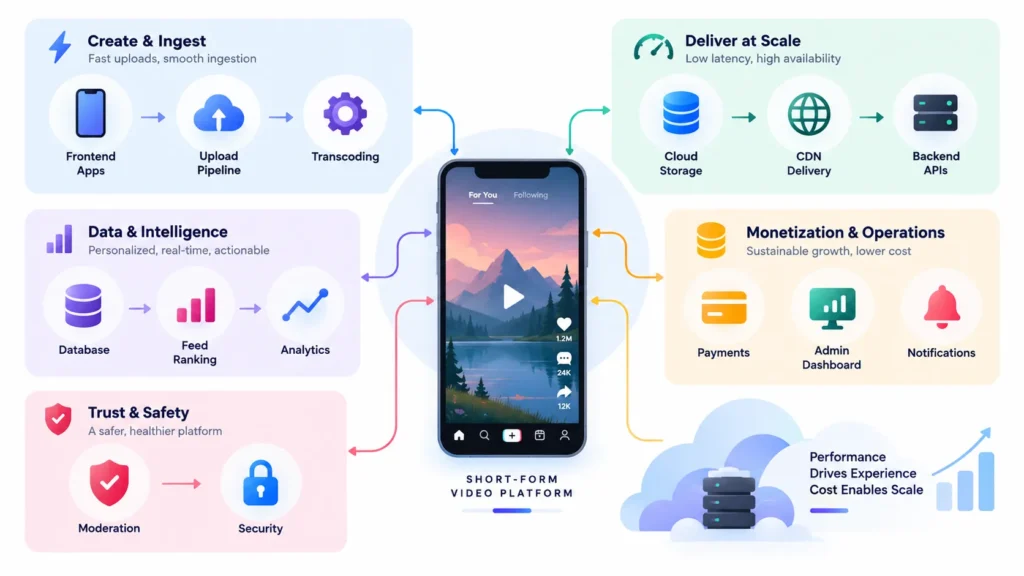
A short-form video platform has a heavier technical footprint than many standard apps. The product depends on media handling, user activity, content delivery, background jobs, and analytics.
Important technical layers include:
- Frontend apps for users and creators
- Backend APIs
- Video upload pipeline
- Transcoding and compression
- Cloud storage
- CDN delivery
- Database design
- Feed ranking logic
- Notification system
- Analytics tracking
- Moderation workflows
- Admin dashboard
- Payment and wallet systems
- Security and access control
The cost of these layers depends on expected traffic, video length, upload volume, monetization depth, and deployment architecture.
Because media delivery can become expensive as usage grows, founders should also understand how video hosting and infrastructure costs affect storage, CDN usage, playback quality, and long-term platform scalability.
For example, an app that supports short uploaded clips only will have a different infrastructure requirement than a platform that also supports live streaming, creator payouts, high-resolution video, and real-time engagement.
Performance should also be tested early because short-video app performance benchmarks can reveal feed delays, slow playback starts, buffering issues, and user-experience problems before they affect retention.
This is why founders should define the launch model before asking for development cost. The clearer the scope, the more accurate the budget conversation becomes.
Security, Moderation, and Trust Controls
Short-form video platforms depend on trust. When users can upload content, comment, share, and interact, the platform needs clear safety controls.
Founders should plan for:
- Encrypted data transfer
- Secure login and authentication
- Role-based admin access
- Creator verification where needed
- User reporting
- Content moderation queues
- Comment moderation
- Spam controls
- Abuse reporting
- Blocked account workflows
- Activity logs
- Secure payment gateway integration
- Wallet and payout monitoring where relevant
Security and moderation should not be treated as optional extras. They protect user experience, creator trust, advertiser confidence, and platform reputation.
For a deeper look at platform protection, moderation workflows, data safety, and admin controls, founders can read this guide on short-video app security controls.
If the platform operates in sensitive categories or specific regions, final compliance planning should depend on jurisdiction, legal review, integrations, and the operating model.
Common Mistakes Founders Should Avoid
Building Too Many Advanced Features Before Validation
Live streaming, creator wallets, AI recommendations, and brand dashboards can be valuable, but they may not all be needed at launch. Start with the features required to test retention, creator activity, and content supply.
Ignoring Video Infrastructure
A beautiful app will still fail if videos load slowly, uploads break, or the feed buffers. Video processing, CDN delivery, and background workflows should be planned early.
Treating the Admin Panel as Secondary
The admin dashboard controls users, creators, content, reports, monetization, and analytics. Weak admin tools create operational problems as the platform grows.
Choosing the Lowest Initial Cost Without Checking Ownership
Founders should understand whether they receive source code, deployment control, customization flexibility, and post-launch support. Low upfront cost can become expensive if it creates lock-in later.
How Miracuves Helps Founders Launch Faster
Miracuves helps founders build ready-made and white-label app solutions with source-code ownership, branded design, admin control, and deployment support.
For short-form video platform founders, this means you do not have to begin from a blank screen. A ready-made foundation can include the key app flows needed for users, creators, admins, content management, engagement, and monetization. The platform can then be customized around your niche, brand, content category, and business model.
The biggest advantage is speed. Miracuves’ ready-made short-video solution can be delivered in 6 days depending on the selected scope, while deeper customizations, integrations, or advanced workflows may extend the final timeline.
If you are comparing a fully custom build with a white-label starting point, the main decision is not just price. It is also speed, ownership, admin control, infrastructure readiness, and your ability to validate the market before spending months on development.
If you want expert help planning your launch scope, Miracuves can act as your short-form video development partner with ready-made delivery, source-code ownership, admin control, and customization support.
Related reading: Real vs Superficial Feed Personalization.
Final Thoughts
A short-form video platform is not just a media app. It is a creator ecosystem, discovery engine, moderation system, monetization layer, and operations dashboard working together.
Founders should plan the product around business outcomes: viewer retention, creator activity, content safety, infrastructure reliability, and revenue control. The strongest first version is not always the one with the most features. It is the one that launches quickly, works smoothly, gives the operator control, and leaves room for smart customization.
For founders who want to move faster, Miracuves offers a practical path through ready-made, white-label, source-code-owned video app solutions that can support faster validation without rebuilding every core module from zero.
FAQs
What features should a short-form video platform include?
A short-form video platform should include user onboarding, vertical video feed, video upload, creator profiles, likes, comments, sharing, follows, search, hashtags, notifications, admin dashboard, moderation tools, analytics, and monetization options. Advanced platforms may also include live streaming, creator wallets, virtual gifts, subscriptions, and personalized recommendations.
How much does short video app development cost?
Short video app development cost depends on features, platforms, video infrastructure, design customization, third-party integrations, admin controls, monetization modules, and support requirements. A ready-made app foundation can reduce development time, while highly custom builds require more planning, engineering, and testing.
What is the most important feature in a vertical video app?
The most important feature is the video feed experience. Users expect fast playback, smooth swiping, relevant discovery, and minimal buffering. If the feed feels slow or repetitive, users may leave even if the app has strong content.
Should founders build a short-form video platform from scratch?
Building from scratch makes sense when the product requires highly unique workflows or proprietary technology. However, many founders start with a white-label app foundation to launch faster, validate demand, and customize after understanding real user behavior.
Why is video infrastructure important for short-form apps?
Video infrastructure handles upload, compression, storage, CDN delivery, adaptive playback, background processing, and performance. It affects how fast videos load, how smoothly the feed works, and how well the platform handles growth.
How can a short-form video platform make money?
A short-form video platform can earn through ads, subscriptions, virtual gifts, creator commissions, paid live sessions, sponsored content, premium creator tools, brand promotions, and featured placements. The right revenue model depends on audience type and creator behavior.
What admin features are needed for a creator video platform?
The admin panel should manage users, creators, videos, reports, moderation queues, categories, hashtags, monetization settings, payouts, analytics, notifications, and role-based permissions. Strong admin control helps founders manage the platform without depending on developers for every operational task.
How fast can Miracuves deliver a short-video app solution?
Miracuves can deliver a ready-made short-video app solution in 6 days depending on the selected scope. Custom features, integrations, advanced workflows, and additional business requirements may extend the final timeline.
Miracuves is an independent software development company. We are not affiliated with, connected to, sponsored by, or endorsed by any company or product named in this article.
Terms such as “X Clone” are used descriptively. It is how the software industry refers to building a platform with functionality comparable to a known service, and how clients search for it.
The entire design and codebase of our products is built by our own team. Our products contain no code, design, graphics, or content originating from any third-party website or applications.
All third-party names and marks referenced in this article are the property of their respective owners, referenced solely to identify the services discussed.