


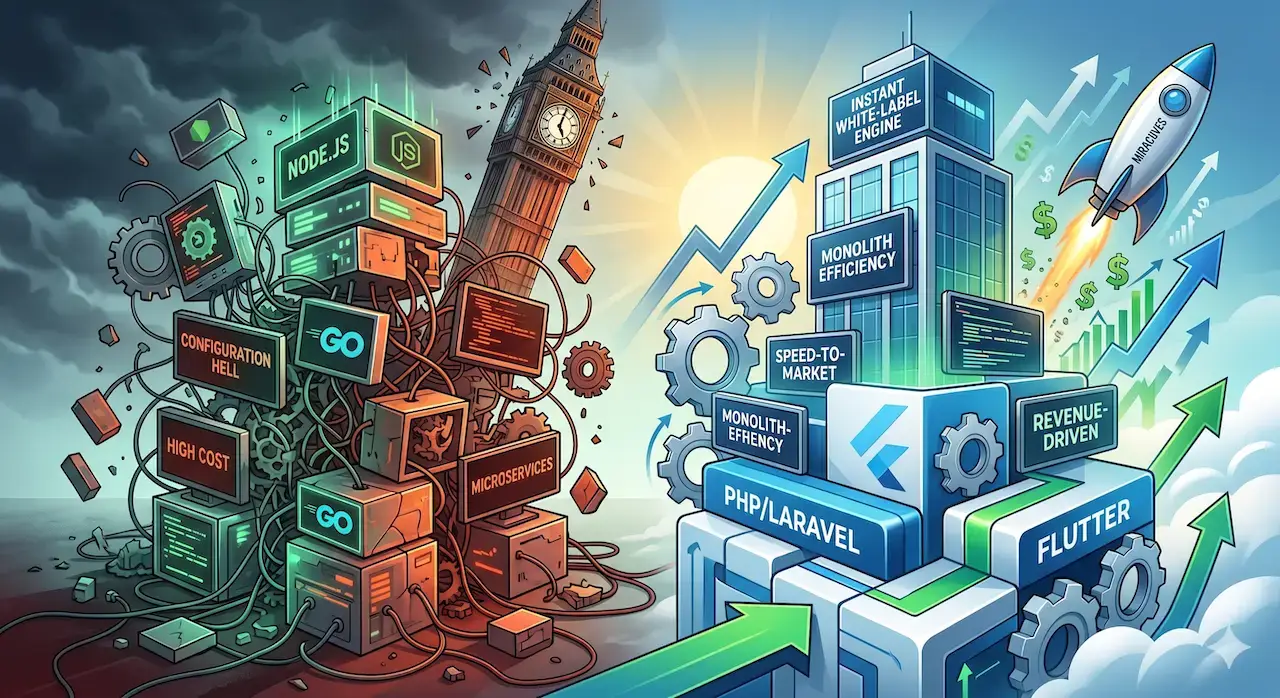
How the Laravel and Flutter monolith became the secret behind the Miracuves Instant White-Label Engine.
The Introduction
Every tech blog on the internet will tell you that if you want to build a modern, scalable digital platform, you must use Node.js, Go, or a complex web of microservices. They will tell you PHP is a relic and that monolithic architecture cannot scale.
They are wrong. And listening to them is the fastest way to burn through your runway before your application handles its first hundred transactions.
After nine years in the SEO and development trenches—building, deploying, and scaling white-label clone applications that actively drive massive sales for our clients—we have noticed a devastating pattern. Founders come to us completely broke after spending $150,000 on a fractured Node.js setup that doesn’t work, built by developers who cared more about their resumes than the client’s business model.
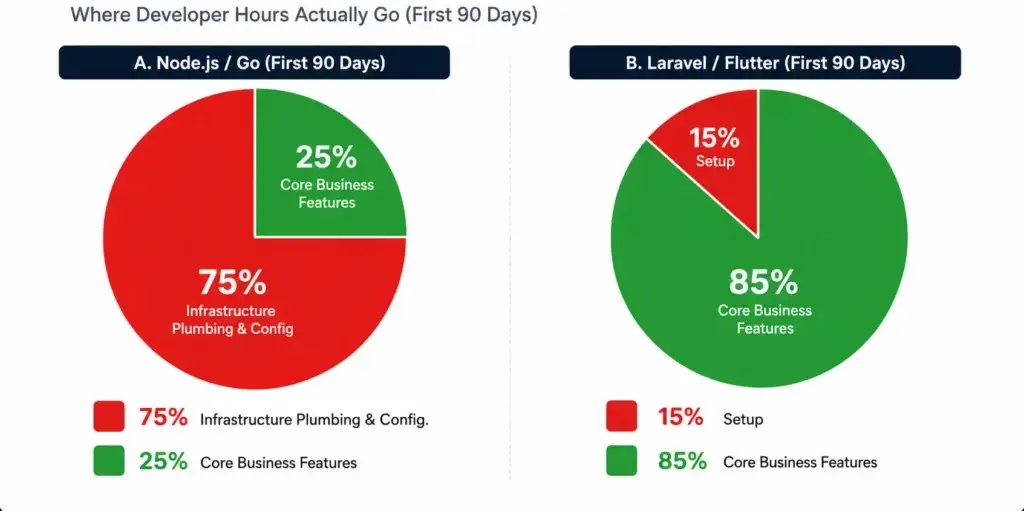
When you are launching a complex digital clone—whether it is a Revolut-style fintech hub, a localized Grab platform, or a delivery-focused Glovo model—your enemy isn’t runtime performance in microseconds. Your enemy is time-to-market and talent liquidity.
At Miracuves, we openly refuse to build initial clone frameworks using Node.js or Go. Instead, we aggressively advocate for a PHP/Laravel backend paired with a Flutter frontend.
It is a smarter, leaner, and fiercely defensible architectural choice. Here is the raw, unvarnished truth about why this stack outperforms the Silicon Valley hype cycle every single time you are building a business meant to generate revenue today.
Speed to Market: The Monolith Always Wins the Race to Zero
When you are launching a clone application like a delivery network or a fintech platform, your absolute priority is validation. You need real users making real transactions as fast as humanly possible. In this environment, infrastructure fragmentation is financial suicide.
The Fragmented Chaos of the Node.js Ecosystem
If you choose Node.js or Go for an MVP clone, you aren’t just choosing a programming language—you are signing up to be an accidental systems architect.
Node.js is notoriously minimalist. Out of the box, it gives you almost nothing. To build a standard backend for a Grab or Uber clone, your development team has to manually stitch together an ecosystem of disparate third-party libraries:
- They must select an ORM (like Prisma or Sequelize) and hope it plays nice with their migrations.
- They must manually configure authentication, JWT handling, password hashing, and role management.
- They have to write custom queue workers, notification dispatchers, and mail drivers from scratch.
Every single one of these choices introduces a point of failure, an independent dependency to maintain, and weeks of unforced configuration delay. Your developers spend 70% of their billable hours setting up the plumbing before they even write a single line of your actual core business logic.
The Out-of-the-Box Supremacy of the Laravel Monolith
Laravel approaches the problem with an aggressive philosophy: batteries included. Laravel is an elegant monolith designed specifically to bypass the plumbing stage. The features that take a Node team two weeks to securely stitch together are native, standard configurations in Laravel:
- Authentication? Completely scaffolded securely in minutes using Laravel Breeze or Jetstream.
- Queues and Background Jobs? Built straight into the core, ready to process thousands of delivery dispatches immediately via Redis.
- Database Management? Driven by Eloquent, arguably the most expressive, seamless ORM in existence.
By using a unified monolith, there is no debate over architecture. Every Laravel developer on the planet steps into a project knowing exactly where the models, controllers, and jobs sit. You don’t lose weeks to developer arguments over folder structures. You ship features on Day 1.
Flutter: Eliminating the Front-End Tribalism
The backend fragmentation trap is frequently compounded on the front-end by building separate iOS and Android codebases, or wrestling with React Native dependencies that break on every minor version upgrade.
We choose Flutter for clone development because it completely dominates the cross-platform paradigm. Flutter compiles down directly to native ARM machine code, meaning your users get smooth 60fps performance, custom animations, and map integrations that feel completely native—whether they are on an iPhone 15 or a budget Android device.
More importantly, it enforces a single, incredibly stable codebase. When we build a feature—like a real-time driver tracking map—we build it once. It works identically on iOS and Android. This halves your front-end development costs, slashes your QA testing timelines by 50%, and ensures that your app store update cycles happen simultaneously.
When you combine a Laravel monolithic backend with a Flutter frontend, you aren’t just cutting corners—you are eliminating the operational friction that kills 90% of early-stage software startups. You win the race to market because you refuse to pay the developer fragmentation tax.
Interactive Visual Tool: The Ecosystem Fragmentation Tax Calculator
Time-to-Market & Cost Simulator
Compare a Monolith (Laravel+Flutter) vs. a Fragmented Stack (Node.js/Go + React Native).
Select Core Features:
Developer Team Size: 2
The Developer Cost Trap (The Real Unit Economics)
Founders love to brag about their tech stack on X (formerly Twitter). They stop bragging the moment they have to run their first year’s payroll.
The most dangerous myth in startup culture is that your technology choices only dictate performance. In reality, your tech stack dictates your burn rate. When you choose an over-engineered stack for a day-one clone application, you are permanently binding your company to the most expensive, scarce talent pools on the market.
The “Silicon Valley Premium”
Node.js and Go (Golang) are exceptional languages. Go, for instance, was built by Google to handle massive, concurrent network services. But here is the hard truth: You do not have Google-scale problems yet. You have “I need to process my first 5,000 local delivery orders” problems.
Because Node.js and Go are positioned as premium, modern-scale languages, the developers who write them command a massive salary premium. In 2026, a mid-to-senior Full Stack Node.js or Go developer costs anywhere from 1.5x to 3x more than an equivalent PHP/Laravel developer.
If you are a bootstrapped founder or working with limited seed capital, you are effectively paying a 200% tax for concurrency capabilities your app won’t use for at least three years.
Talent Liquidity: The Unseen Risk
Cost is only half the trap; the other half is talent liquidity—how fast you can hire, fire, and replace engineers.
- The Node/Go Trap: The talent pool for experienced Go developers is incredibly shallow. If your lead Go engineer quits three weeks before a major feature rollout, you are paralyzed. Recruiting, vetting, and onboarding a replacement will take months, and they will likely demand a higher salary than the person who just left.
- The Laravel/Flutter Moat: PHP powers nearly 77% of the known web. The Laravel ecosystem is the most robust, standardized framework in that space. The talent pool is deep, mature, and highly liquid. If a Laravel developer leaves your team, we can have three qualified, affordable replacements vetted and ready to code by next Tuesday.
Scaling the Maintenance Team
Building the app is just the down payment; maintaining it is the mortgage.
Once your Glovo or Revolut clone is live, 80% of the daily development work is mundane: fixing UI bugs, adding new payment gateways, and updating admin dashboards. Paying a $120,000+/year Go specialist to update a CSS layout or tweak a database query is capital destruction.
Laravel and Flutter allow you to structure a highly efficient, tiered development team. You can hire an affordable fleet of mid-level developers to handle 90% of the daily feature work, ensuring your runway lasts years, not months.
See the Burn Rate Difference
Long-Term Tech Stack Burn Rate
Calculate the capital saved on salaries by utilizing liquid talent pools.
Backend Developers: 2
Frontend/Mobile Developers: 2
Runway/Timeframe: 12 Months
The Proof: What Driving “Crazy Sales” Actually Looks Like
Theoretical architecture debates are for Reddit. In the real world, the only metric that validates a tech stack is revenue.
Over the last nine years of building businesses and engineering software designed to drive crazy sales, the correlation has become undeniable: Founders who obsess over hyper-scalable, fragmented microservices usually run out of money. Founders who leverage mature, monolithic ecosystems launch, acquire users, and generate cash flow.
When you are deploying a white-label platform, the nuances of your specific business model matter far more than the language processing speed. Take a Glovo-style clone, for example. Many development agencies will try to sell you a bloated, “everything-app” architecture that jams ride-hailing and delivery into the same backend using Node.js to handle the “concurrency.”
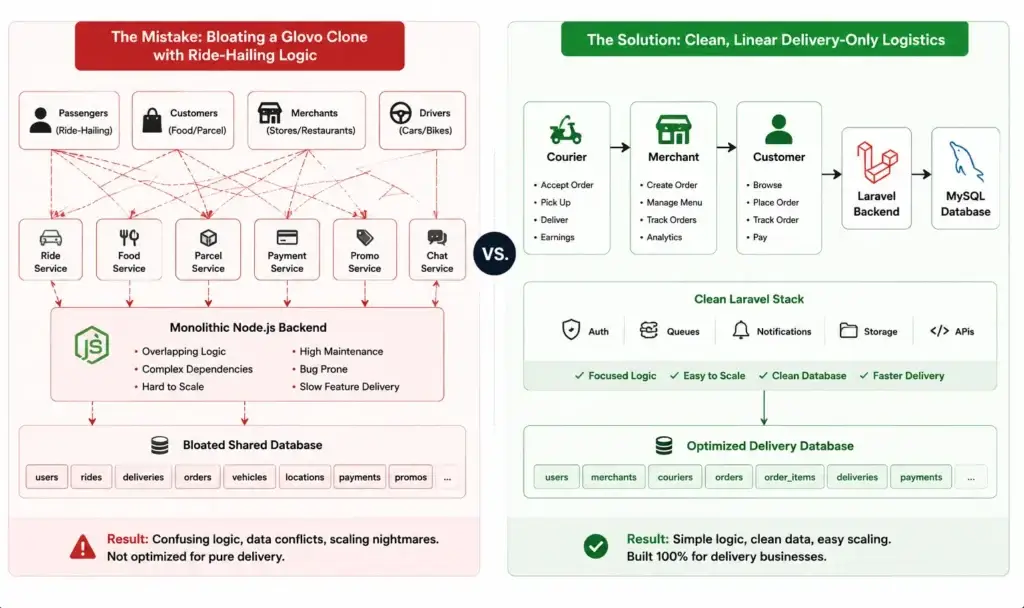
This is a massive architectural mistake. An accurate Glovo business model is strictly delivery-focused. Jamming ride-hailing into that specific build pollutes the database relationships, overcomplicates the matching algorithms, and wrecks the merchant UI.
Because we use the Laravel/Flutter ecosystem, we don’t waste time wrestling with routing plumbing. Instead, we spend our development hours building what actually makes a Glovo model profitable: precision delivery mechanics, real-time courier dispatching, and seamless merchant dashboards. The tech gets out of the way so the business can function.
Whether it is a delivery-only platform, a localized Grab clone, or a Revolut-style fintech hub, performance is about execution velocity. Your app succeeds because your checkout is frictionless and your marketing budget is fully funded—not because you burned $80,000 on a Go backend that nobody uses.
The Takeaway: Stop Building MVPs, Start Building Businesses
If you are a venture-backed unicorn with 50 million daily active users and a bottomless engineering budget, by all means, migrate your infrastructure to Node.js and Go microservices.
But if you are a founder launching a digital platform today, your competitive advantage is speed, capital efficiency, and go-to-market execution. PHP/Laravel and Flutter give you an impenetrable moat in all three categories.
This exact architectural philosophy is why we built the Miracuves Instant White-Label Engine.
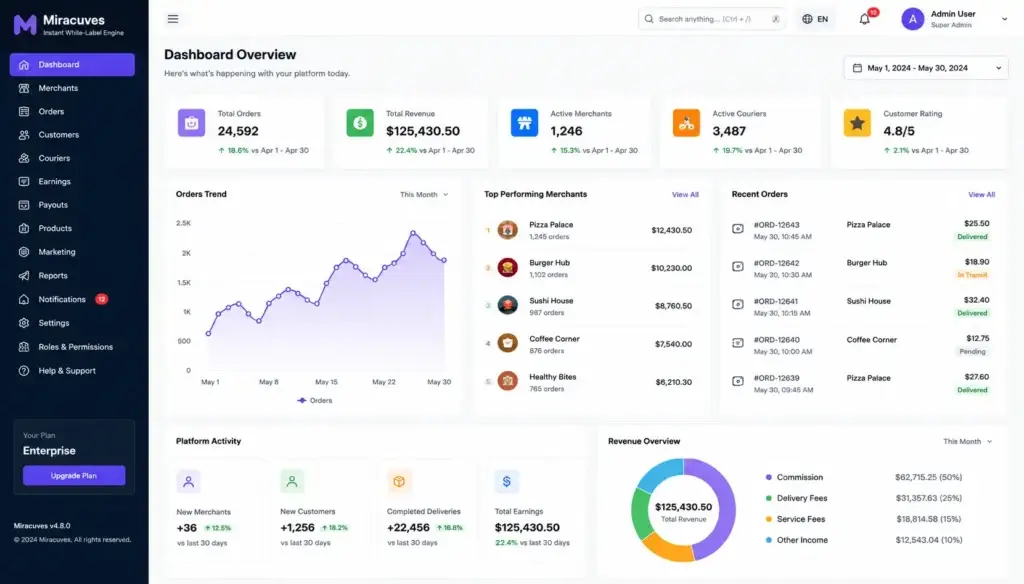
We grew tired of watching founders bleed capital on fractured, slow-moving development cycles. We engineered our white-label platform specifically to disrupt the industry’s obsession with over-engineering. By centralizing the power of a Laravel backend and a Flutter frontend, our engine allows you to deploy enterprise-grade, scalable technology—whether it’s a delivery network, a taxi app, or a fintech hub—at a fraction of the Silicon Valley burn rate.
At Miracuves Solutions, we don’t just write code; we engineer revenue vehicles. We get the technology out of your way so you can focus on what actually matters: dominating your market and driving crazy sales.
If you are ready to launch a platform that generates revenue today—without paying the fragmentation tax—let’s talk.
Everyone on tech Twitter says PHP is dead. Why build a modern business on it?
Tech Twitter does not pay your server bills or fund your payroll. While developers chase the latest trendy frameworks, PHP (specifically via Laravel) continues to power over 75% of the web. Modern PHP 8+ is incredibly fast, type-safe, and actively maintained. More importantly, Laravel provides an enterprise-grade ecosystem that lets you launch features in days, not months. You are building a business to generate revenue, not to win a popularity contest on developer forums.
What happens when my app scales? Will a Laravel monolith crash under heavy traffic?
This is the biggest myth in software architecture. A well-optimized Laravel monolith can easily handle tens of thousands of concurrent users, especially when paired with tools like Laravel Octane and Redis for queue management. If your platform eventually hits true “hyper-scale” (think millions of daily active users), you will have the revenue and capital to carve out specific high-load functions into microservices. Until then, premature optimization is just a waste of money.
Why choose Flutter over React Native for the mobile app?
React Native relies on a JavaScript bridge to communicate with native device components, which can lead to performance bottlenecks and dependency nightmares every time iOS or Android releases a major update. Flutter compiles directly to native ARM machine code. This means your app runs at a flawless 60 frames per second, looks identical on both platforms, and requires exactly one codebase to maintain. It is the ultimate tool for cutting front-end development costs in half.
Does this tech stack work for complex, Glovo-style delivery apps?
Absolutely, but with a critical caveat: a true Glovo business model is strictly delivery-focused. Many founders make the mistake of using complex Node.js architectures to try and force ride-hailing and delivery into the exact same platform. By keeping the architecture focused purely on delivery logistics, courier dispatching, and merchant interfaces, a Laravel/Flutter stack executes the core business model flawlessly without the bloated overhead.
If I use Node.js or Go, won’t I attract “better” developers?
You will attract more expensive developers. The talent pool for Go and Node.js is much smaller, which artificially inflates their salaries. If your lead Go developer quits, it could take months to replace them, stalling your entire business. The PHP/Laravel and Flutter talent pools are massive, mature, and highly liquid. You get reliable, senior-level engineering at a fraction of the cost, ensuring your runway lasts as long as you need it to.