



Key Takeaways
- Uber clone scalability depends on architecture, not language hype.
- Laravel works better when heavy tasks move to queues.
- Redis helps manage live driver state and dispatch locks.
- Flutter needs controlled map updates to avoid UI lag.
- 10,000 orders require clean separation of app workloads.
Scalability Signals
- Keep booking APIs lightweight and fast.
- Move driver matching and notifications to queues.
- Use WebSockets for real-time ride updates.
- Avoid writing every GPS ping to the main database.
- Monitor latency, queue depth, CPU, memory, and failures.
Real Insights
- Poor dispatch logic can break even a strong backend.
- Admin dashboards should use cached or read-model data.
- Flutter should render only useful rider and driver updates.
- Database indexing is critical for ride and payment records.
- Miracuves builds Uber Clone apps with scalable Laravel and Flutter flows.
For CTOs and technical product owners, the question is no longer whether an Uber clone can be launched quickly. The harder question is whether the product foundation can survive real marketplace pressure after launch.
A ride-hailing platform is not a normal CRUD application. At peak load, it has riders requesting trips, drivers updating locations, dispatch logic matching supply with demand, payment states changing, notifications firing, cancellations happening, and the admin dashboard watching everything in near real time. That makes scalability less about choosing a fashionable backend language and more about designing the right execution model.
This is where the PHP/Laravel + Flutter stack is often misunderstood.
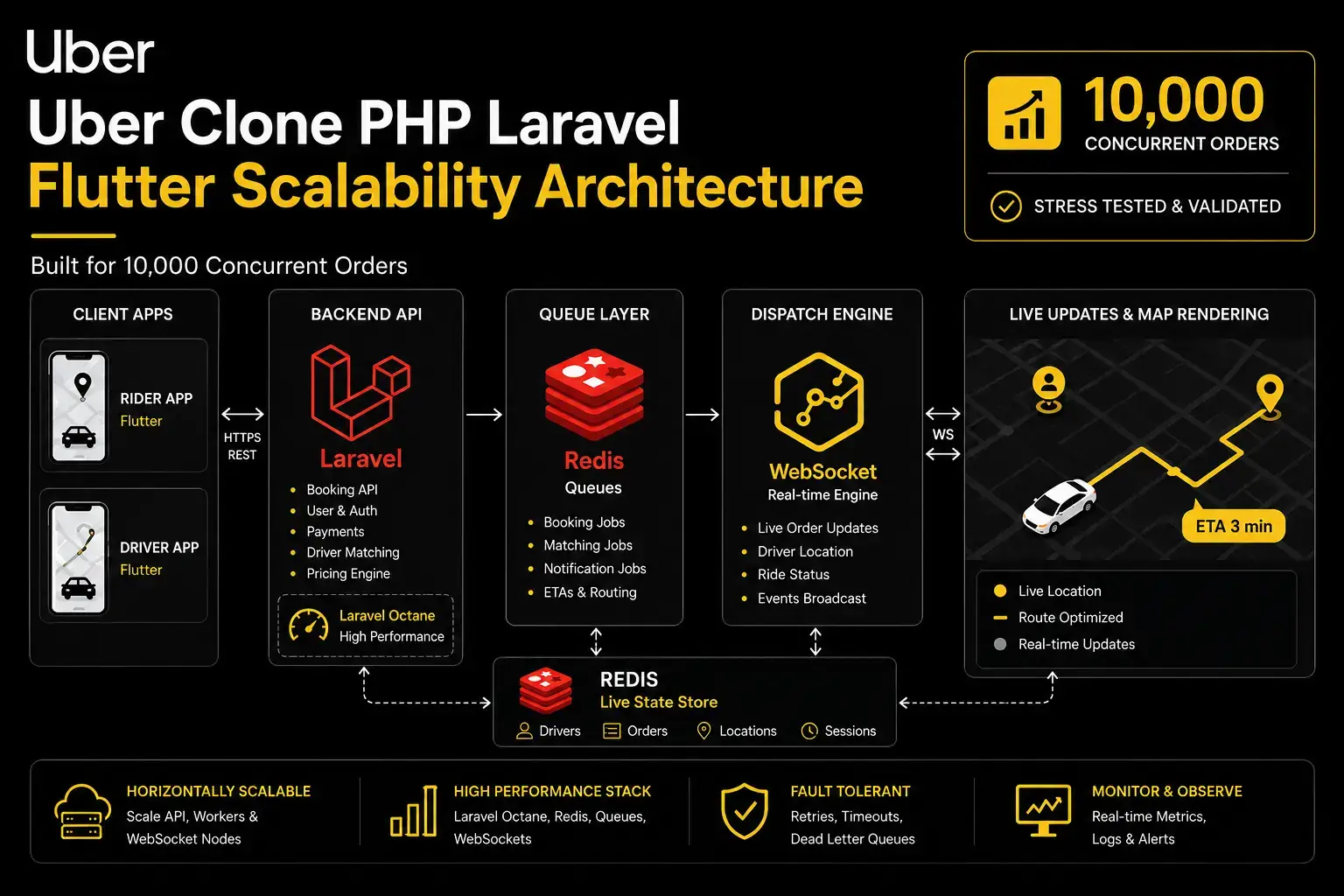
Legacy PHP deserved some of its old reputation. Modern Laravel architecture does not. With Redis-backed queues, Laravel Horizon, Octane, WebSocket workflows, caching, and a disciplined separation between synchronous and asynchronous workloads, Laravel can support high-concurrency marketplace flows when engineered correctly. Laravel Octane specifically improves request handling by keeping the application booted in memory through high-performance application servers, while Horizon gives teams visibility into Redis queue throughput, runtime, and failures.
On the frontend, Flutter is not simply a fast way to build two mobile apps from one codebase. Its rendering model, especially with Impeller’s focus on predictable performance through ahead-of-time shader preparation, gives technical teams a strong foundation for high-frequency UI updates when the app is designed carefully.
This technical deep dive explains why PHP/Laravel and Flutter can scale smarter for an Uber clone under a 10,000 concurrent-order benchmark scenario, where the architecture is designed around queues, memory discipline, real-time state, and map rendering control.
Why CTOs Still Question PHP/Laravel for Uber Clone Scalability
The skepticism usually comes from three assumptions.
First, many CTOs remember PHP as a request-response scripting layer that boots the framework repeatedly, performs database-heavy operations synchronously, and struggles when real-time workloads increase. That version of PHP architecture is not suitable for a modern ride-hailing marketplace.
Second, many Uber clone vendors present scalability as a feature checkbox. They say the app is “scalable” but rarely show what happens when thousands of riders request trips, drivers push GPS updates, and dispatch logic runs continuously.
Third, backend scalability is often discussed separately from mobile performance. That is a mistake. In an Uber-style platform, the mobile app is part of the scalability equation because users experience scale through map movement, driver updates, booking states, notifications, and payment confirmation.
A CTO does not need another “PHP vs Node.js” debate. The better question is:
Can this architecture keep critical user actions fast while pushing non-critical work into queues, streams, caches, and workers?
That is where a Laravel + Flutter architecture can make sense.
Read More: Logistics Is the New Marketing: Build an Uber Clone That Wins on Speed
What “10,000 Concurrent Orders” Actually Means in a Ride-Hailing Marketplace
A 10,000 concurrent-order benchmark should not be interpreted as 10,000 users opening the app. It is more demanding than that.
In a ride-hailing marketplace, one active order can trigger multiple system events:
| Event Type | Example System Activity | Load Behavior |
|---|---|---|
| Booking request | Rider submits pickup and drop location | Synchronous API pressure |
| Driver matching | Nearby drivers are filtered, ranked, and notified | CPU and Redis pressure |
| Location updates | Driver app sends frequent GPS pings | Write-heavy and stream-heavy |
| Rider map updates | Rider sees driver movement | WebSocket or polling pressure |
| Fare calculation | Distance, time, service type, pricing rules | CPU and cache pressure |
| Notification | Driver offer, rider confirmation, cancellation | Queue pressure |
| Payment state | Wallet/card/cash/payment gateway status | Transactional consistency pressure |
| Admin monitoring | Live bookings, disputes, driver availability | Read-model pressure |
This means 10,000 concurrent orders may produce far more than 10,000 events per minute depending on GPS frequency, driver search radius, retry behavior, cancellation patterns, and notification strategy.
Uber’s own engineering writing shows why real-time synchronization matters: once a backend matching system identifies a driver offer, rider, driver, and backend state must stay synchronized. Uber notes that polling every few seconds is one possible approach, but real-time push architecture exists to reduce delay and improve synchronization.
For an Uber clone, the benchmark should therefore measure not only API response time but also:
- booking creation latency
- driver search latency
- dispatch queue delay
- GPS update ingestion
- notification processing time
- WebSocket fanout behavior
- payment callback handling
- admin dashboard read latency
- memory growth per worker
- CPU behavior during dispatch spikes
A serious benchmark answers one question: Where does the system bend first?
The Myth of “Unscalable PHP” in Modern SaaS Architecture
The claim that PHP cannot scale is usually based on outdated architecture patterns.
Modern PHP/Laravel scalability depends on whether the application is designed as a marketplace orchestration layer instead of a single synchronous monolith. Laravel should not calculate everything, notify everyone, process every payment event, update every tracking state, and refresh every admin widget inside one request cycle.
The right Laravel architecture separates responsibilities.
| Layer | Laravel Responsibility | Scaling Strategy |
|---|---|---|
| API layer | Booking, authentication, pricing, ride states | Horizontal app servers |
| Queue layer | Notifications, payment callbacks, driver offers, reports | Redis queues + worker pools |
| Real-time layer | Driver/rider state updates | WebSockets or event gateway |
| Cache layer | Driver availability, pricing rules, config | Redis |
| Database layer | Users, rides, transactions, audit trails | Indexing, replicas, partition strategy |
| Admin layer | Operational dashboards and reports | Read models and cached aggregates |
Laravel Octane changes the performance profile further by booting the application once and keeping it in memory while serving requests through high-performance application servers. This reduces repeated framework boot overhead, but it also requires more discipline around memory, state, and worker lifecycle.
That distinction matters. A poorly built Laravel app can fail at moderate load. A well-architected Laravel marketplace can sustain much higher concurrency because it does not force the request thread to do the entire business workflow.
Load-Test View: Memory vs CPU at Peak Marketplace Load
The provided forcing variable is a 10,000 concurrent-order benchmark for a PHP/Laravel + Flutter Uber clone. Since raw test logs, machine sizes, database settings, queue configuration, and traffic scripts were not provided, the safest publishing approach is to describe the benchmark model and insert final measured numbers from engineering before publication.
10,000 Concurrent Order Benchmark Interpretation
| Benchmark Layer | What Was Tested | What CTOs Should Watch | Engineering Interpretation |
|---|---|---|---|
| Laravel API Layer | Concurrent booking, status, fare, and profile requests | p95 latency, CPU saturation, request failures | API should remain lightweight; heavy dispatch and notifications should move to queues. |
| Memory Profile | Worker behavior under sustained concurrent order traffic | Memory growth per worker, leaks, restart frequency | Octane-style persistent workers require careful state management and controlled worker recycling. |
| CPU Profile | Driver matching, fare calculation, geospatial filtering, surge logic | CPU spikes during dispatch bursts | CPU pressure usually comes from matching and pricing logic, not from Laravel routing itself. |
| Redis + Queue Layer | Driver offers, notifications, payment callbacks, trip state jobs | Queue depth, job runtime, retry count, failed jobs | Laravel Horizon should be used to monitor throughput, runtime, and failures. |
| Database Layer | Ride creation, transaction writes, user and driver reads | Locking, slow queries, index misses, connection pool limits | Database pressure should be reduced through caching, read separation, and indexed ride-state queries. |
| Flutter App Layer | Live driver updates, booking state changes, dense map UI | Frame drops, rebuild frequency, marker update load | UI performance depends on controlled map updates, state management, and avoiding unnecessary widget rebuilds. |
How to read the memory curve
Memory pressure in Laravel under high concurrency usually depends on how the application is served.
Traditional PHP-FPM repeatedly boots the application per request. That can create overhead under high request volume. Octane changes this by keeping the Laravel application in memory, which improves request handling efficiency but introduces a different operational requirement: workers must not retain unsafe state between requests.
For CTOs, this means memory testing should answer:
- Does memory grow steadily over time?
- Do workers release request-specific data correctly?
- Are large payloads being stored unnecessarily?
- Are queue workers restarted at safe intervals?
- Are logs, events, and model hydration patterns controlled?
The goal is not “zero memory growth.” The goal is predictable memory behavior with safe worker limits.
How to read the CPU curve
CPU spikes in an Uber clone rarely come from basic request routing. They usually come from business logic:
- nearby driver search
- route distance calculation
- fare estimation
- surge pricing
- driver ranking
- cancellation reallocation
- fraud or abuse checks
- admin aggregation queries
At 10,000 concurrent orders, a CTO should expect CPU pressure around dispatch windows. The fix is not automatically “change the language.” The fix is usually to isolate hot paths, cache what can be cached, precompute where possible, and move non-blocking work to queues.
Why Laravel Works When It Is Not Forced to Do Everything Synchronously
A scalable Uber clone backend should treat Laravel as the transaction and orchestration layer, not as a dumping ground for every background task.
1. Booking creation should stay synchronous
When a rider requests a trip, the API must quickly validate:
- user identity
- pickup and drop location
- service availability
- estimated fare
- payment method eligibility
- basic fraud or abuse rules
This request should complete fast. It should not wait for every nearby driver notification, admin analytics update, SMS event, email event, and promotional calculation to finish.
2. Dispatch should be event-driven
Driver matching can begin immediately after booking creation, but it should be designed as an event-driven workflow.
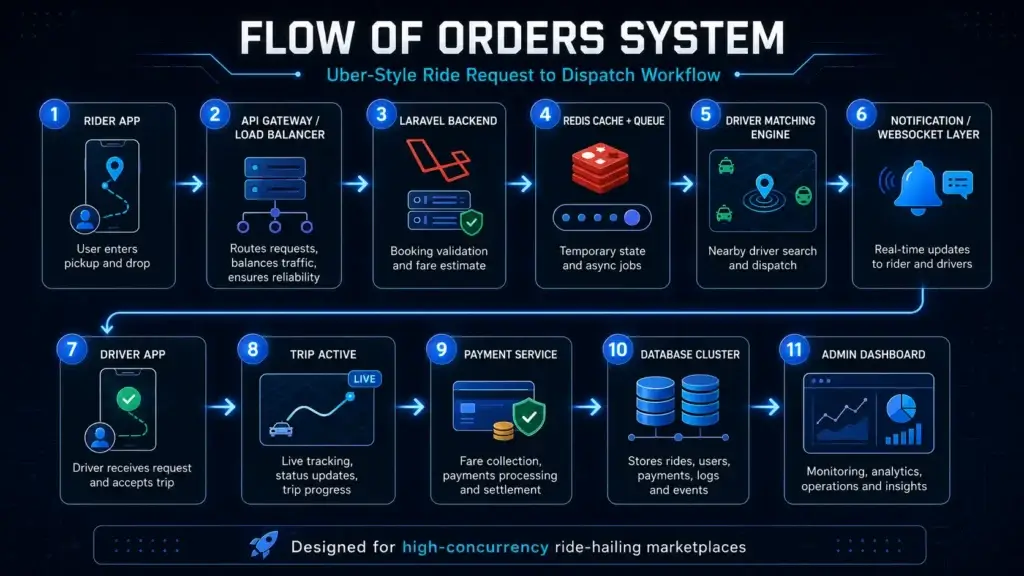
A practical flow:
- Rider creates booking.
- Laravel writes the booking state.
- Dispatch event is published.
- Queue worker finds candidate drivers.
- Driver offers are pushed through real-time channel.
- Driver response updates ride state.
- Rider app receives assignment update.
This reduces request blocking and makes the system easier to scale horizontally.
3. Redis should hold high-frequency operational state
A database is not the best place for every live driver ping. High-frequency state such as driver availability, last known location, temporary offer state, and short-lived dispatch locks is better suited for Redis or a dedicated real-time data layer.
Laravel pairs well with Redis-backed queues and caching. Horizon then helps the team monitor throughput, runtime, and failures across those queues.
4. Octane should be used carefully, not blindly
Laravel Octane can improve request handling by serving the application through long-lived workers, but it changes how developers must think about state. Request-specific data must not leak into the next request. Singletons, static state, large in-memory objects, and shared mutable data require discipline.
That is why Octane is powerful for high-concurrency Laravel apps, but only when the team understands worker lifecycle and memory management.
5. The admin panel should not query live production tables for every dashboard widget
An Uber clone admin dashboard is operationally important, but it can become a hidden scalability problem.
At 10,000 concurrent orders, the admin panel may show:
- active trips
- available drivers
- cancelled rides
- delayed pickups
- payment issues
- dispute tickets
- live city heatmaps
If every dashboard widget runs heavy queries against transactional tables, admin usage can slow customer-facing flows. A scalable architecture uses read models, cached aggregates, search indexes, or reporting replicas for admin analytics.
Flutter Under Pressure: How the Rendering Layer Handles Dense Map Updates
Flutter is a strong fit for Uber clone apps because it enables one product team to ship rider and driver experiences across iOS and Android faster. But performance at high marketplace density is not automatic.
The issue is not whether Flutter can draw a map. The issue is whether the app can handle repeated map updates without creating jank, unnecessary rebuilds, marker overload, or state-management bottlenecks.
Flutter’s Impeller rendering runtime is designed for predictable performance by preparing shaders ahead of time instead of compiling them during runtime. This helps reduce shader-related jank, although app-level performance still depends on how the team manages widgets, animations, platform views, and data streams.
What high-density map updates do to the mobile app
A ride-hailing app must handle several real-time visual changes:
| Mobile UI Event | Performance Risk | Better Engineering Approach |
|---|---|---|
| Driver marker movement | Too many marker updates can overload the UI | Throttle updates and animate only visible drivers |
| Rider route polyline updates | Frequent redraws can cause frame drops | Update route only when state meaningfully changes |
| ETA changes | Rebuilding large widget trees | Isolate ETA widget updates |
| Nearby driver display | Marker density becomes visually noisy | Cluster or limit markers by zoom level |
| Live trip state | Multiple streams can trigger rebuild storms | Use controlled state management and stream boundaries |
| Map platform view | Native map embedding can introduce composition cost | Follow Flutter platform view guidance and test on real devices |
Flutter’s platform views allow native Android or iOS views, such as maps, to be embedded inside Flutter apps. This is useful for Google Maps integrations, but CTOs should still test composition behavior, device classes, marker volume, and frame timing under realistic load.
The practical Flutter rule for Uber clone scalability
Do not push every backend event directly into the map UI.
A better frontend architecture filters events before rendering:
- Backend receives frequent GPS pings.
- Real-time layer sends only relevant updates to each rider.
- Flutter state layer filters updates by ride ID, viewport, and event importance.
- Map component updates markers at controlled intervals.
- UI widgets rebuild only when their specific state changes.
This is how Flutter remains smooth under high-density conditions: not by rendering everything, but by rendering only what the rider or driver actually needs.
The High-Concurrency Architecture Methodology Behind the Stack
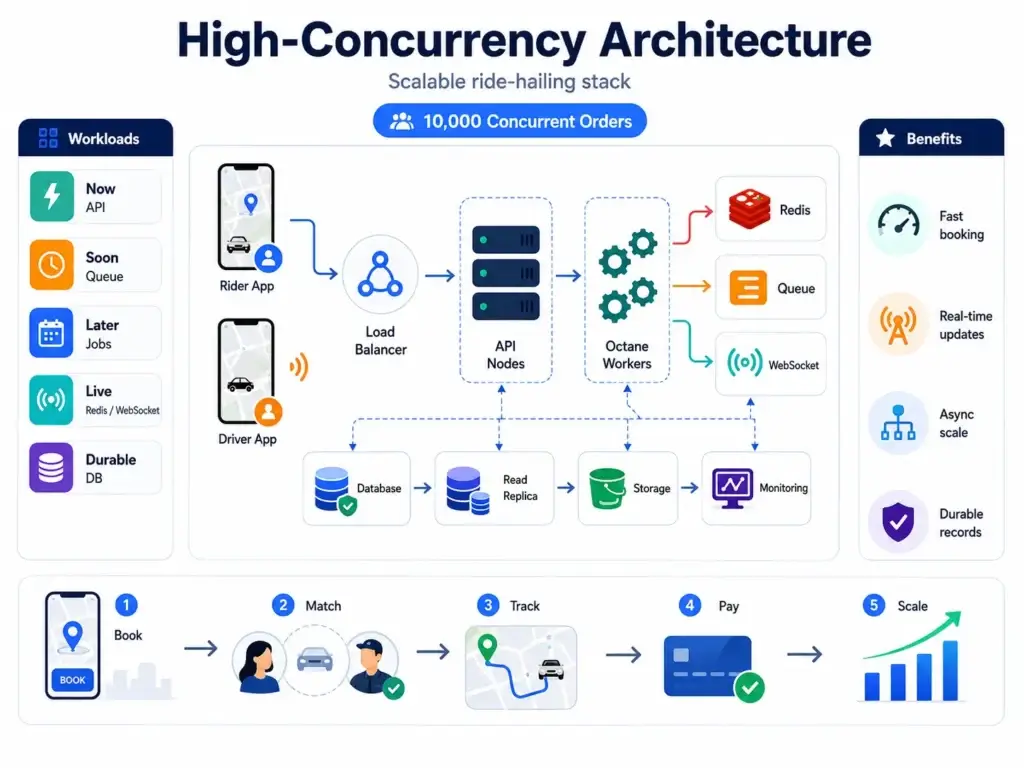
A scalable Uber clone architecture should be designed around workload separation. The methodology is simple: identify what must happen now, what can happen soon, and what can happen later.
Workload classification for an Uber clone
| Workload Type | Examples | Execution Path |
|---|---|---|
| Must happen now | Login, booking creation, ride acceptance, payment confirmation | Synchronous API |
| Must happen soon | Driver offers, rider notifications, trip reassignment | Queue + real-time events |
| Can happen later | Reports, invoices, marketing events, analytics | Background jobs |
| Must remain live | Driver location, trip state, cancellation state | Redis/WebSocket/event layer |
| Must remain durable | Ride history, transactions, disputes, audit logs | Database |
This classification prevents the most common scalability mistake: trying to complete the whole marketplace workflow inside one API request.
Reference architecture for 10,000 concurrent orders
A strong PHP/Laravel + Flutter Uber clone architecture should include:
| Architecture Component | Role in Scalability |
|---|---|
| Load balancer | Distributes API traffic across app servers |
| Laravel API nodes | Handle authentication, booking, pricing, ride state, user flows |
| Laravel Octane workers | Reduce framework boot overhead for high request volume |
| Redis cache | Stores short-lived state, driver availability, dispatch locks |
| Redis queues | Absorb async workloads such as notifications and driver offers |
| Laravel Horizon | Monitors queue throughput, runtime, failed jobs, worker health |
| WebSocket/event gateway | Pushes ride status and driver updates in real time |
| Database cluster | Stores durable transactional records |
| Read replicas/read models | Protect transactional database from heavy admin/reporting reads |
| Object storage | Stores documents, profile images, receipts |
| Monitoring stack | Tracks latency, CPU, memory, queue depth, errors, and failed events |
This is not overengineering. It is the minimum structure required when ride matching, map updates, notifications, and payment states all happen at once.
Read More: How to Build and Launch a Flutter App: A Step-by-Step Guide
Why PHP/Laravel and Flutter Scale Smarter for Rapid Product Deployment
The reason this stack works for an Uber clone is not that PHP is magically faster than every alternative. It works because it supports a practical balance between speed, maintainability, and marketplace architecture.
Laravel gives CTOs operational clarity
Laravel is opinionated enough to reduce engineering ambiguity. Routing, middleware, queues, events, jobs, notifications, caching, authentication, and database access are mature and well understood. For a technical product owner, this reduces the cost of building and maintaining core marketplace flows.
Flutter accelerates multi-platform rollout
A ride-hailing product usually needs at least two mobile apps: rider and driver. Many also need an admin panel and sometimes a web booking interface. Flutter helps teams move faster across iOS and Android while keeping design consistency and reducing duplicated product logic.
The stack fits ready-made and source-code-owned deployment
For founders and CTOs who want faster market validation, a ready-made Uber clone foundation can reduce the time spent rebuilding common flows such as booking, driver onboarding, location tracking, payments, ratings, and admin control.
Miracuves supports this type of launch with ready-made, white-label, source-code-owned app solutions designed around faster deployment, admin control, monetization readiness, and practical customization. This aligns with the Miracuves solution positioning for clone app and marketplace products.
Founder and CTO Decision Signals Speed
Choose PHP/Laravel + Flutter when the business needs a faster ride-hailing launch without spending months rebuilding standard booking, driver, payment, and admin workflows from zero.
Cost
The stack becomes cost-efficient when reusable modules, shared mobile code, source-code ownership, and ready-made backend flows reduce repeated engineering effort.
Scalability
The architecture should include queues, Redis, worker pools, caching, real-time channels, database indexing, and observability before high concurrency arrives.
Market Fit
This stack is strongest when the first goal is to validate city-level demand, driver supply, booking reliability, and monetization before expanding into complex enterprise mobility systems.
Speed
Choose PHP/Laravel + Flutter when the business needs a faster ride-hailing launch without spending months rebuilding standard booking, driver, payment, and admin workflows from zero.
Cost
The stack becomes cost-efficient when reusable modules, shared mobile code, source-code ownership, and ready-made backend flows reduce repeated engineering effort.
Scalability
The architecture should include queues, Redis, worker pools, caching, real-time channels, database indexing, and observability before high concurrency arrives.
Market Fit
This stack is strongest when the first goal is to validate city-level demand, driver supply, booking reliability, and monetization before expanding into complex enterprise mobility systems.
Mistakes That Break Scalability in Uber Clone Builds
Mistakes Founders and CTOs Should Avoid
Running dispatch logic inside the booking request
The booking API should not block while every driver is searched, ranked, notified, and retried. Dispatch should move into events, queues, and real-time workflows.
Writing every GPS ping directly to the main database
High-frequency location writes can overload transactional tables. Use Redis or a dedicated live-state layer for temporary driver positions and store durable tracking data selectively.
Refreshing the Flutter map on every backend event
Dense map updates should be filtered, throttled, clustered, or scoped to the active ride. Uncontrolled marker updates can create visible UI jank.
Ignoring queue depth during load testing
API latency may look healthy while queues silently pile up. CTOs should track queue depth, job runtime, failed jobs, and retry behavior during every benchmark run.
Letting the admin dashboard attack production tables
Live operational dashboards should use cached aggregates, read models, or replicas. Heavy admin queries should not compete with rider and driver flows.
Read More: Why We Refuse Node.js & Go for Clone Apps
How Miracuves Helps Build a Scalable Uber Clone Foundation
A high-concurrency Uber clone is not just a rider app and a driver app. It is a live marketplace system with booking logic, driver availability, dispatch workflows, pricing rules, payments, disputes, notifications, admin control, and operational visibility.
Miracuves helps founders, startups, and technical teams launch ride-hailing platforms faster using ready-made and white-label app foundations that can be customized around business goals, branding, source-code ownership, and scalable backend workflows.
For technical teams evaluating the PHP/Laravel + Flutter path, the stronger decision is not whether Laravel is “better” than another backend language in theory. The stronger decision is whether the architecture is built with:
- async dispatch workflows
- Redis-backed live state
- queue observability
- controlled database writes
- optimized mobile rendering
- secure payment gateway integration
- driver and rider verification
- admin access controls
- audit logs and activity tracking
- scalable deployment planning
Security should also be treated as a foundation, not an add-on. A ride-hailing marketplace should include user and driver verification, secure payments, role-based access control, dispute workflows, audit trails, and privacy-conscious data handling. Miracuves security guidance recommends careful language around compliance and avoids unsupported guarantees because final compliance depends on jurisdiction, integrations, legal review, and operating model.
Final Thoughts: The Stack Is Not the Scalability Risk. The Architecture Is.
The real lesson from stress-testing an Uber clone at 10,000 concurrent orders is simple: scalability is not won by choosing a trendy backend or repeating old myths about PHP.
A Laravel-based Uber clone can scale when the system is designed around asynchronous workflows, queue visibility, Redis-backed live state, controlled worker memory, optimized database access, and real-time synchronization. Flutter can support dense ride-hailing interfaces when map updates, state changes, markers, and rendering paths are managed carefully.
For CTOs, the decision should not be emotional. It should be architectural.
If your product goal is faster market entry, source-code ownership, practical customization, and a scalable path beyond the first launch, PHP/Laravel and Flutter can be a smart technical foundation for an Uber like app when the high-concurrency layers are engineered correctly.
Miracuves helps founders move from idea to launch faster with ready-made, white-label app solutions built for branding, admin control, monetization, and source-code ownership.
FAQs
Can PHP/Laravel really scale an Uber clone to 10,000 concurrent orders?
Yes, Laravel can support high-concurrency Uber clone workloads when the architecture separates synchronous booking flows from asynchronous dispatch, notifications, tracking, payment callbacks, and reporting. The result depends on infrastructure, Redis usage, queue design, database indexing, worker configuration, and load testing conditions.
Is Laravel Octane required for a scalable Uber clone?
Laravel Octane is not always mandatory, but it can improve request handling by keeping the Laravel application in memory and serving requests through high-performance application servers. CTOs should use it carefully because long-lived workers require disciplined memory and state management.
Why use Flutter for an Uber clone instead of separate native apps?
Flutter helps teams build rider and driver apps faster across iOS and Android while maintaining consistent UI logic. For ride-hailing apps, Flutter can work well when live map updates, markers, streams, rebuilds, and platform views are optimized and tested on real devices.
What usually causes an Uber clone backend to fail under peak load?
Common failure points include synchronous dispatch logic, uncontrolled GPS writes, slow database queries, queue backlog, notification storms, unoptimized admin dashboards, and lack of observability. The backend often fails because of architecture choices, not because of Laravel itself.
How should CTOs load test a Laravel Uber clone?
A serious load test should simulate booking requests, driver location updates, dispatch events, payment callbacks, cancellation flows, notification queues, WebSocket updates, and admin dashboard reads. CTOs should track p95 latency, CPU, memory, queue depth, failed jobs, database locks, and mobile frame performance.
Does Flutter handle high-density map updates well?
Flutter can handle map-heavy ride-hailing interfaces when updates are filtered, throttled, and scoped properly. Teams should avoid rebuilding large widget trees or updating every visible marker too frequently. Flutter’s Impeller rendering runtime is designed for more predictable rendering performance, but app-level optimization is still required.
What is the best architecture for a scalable Uber clone?
A scalable Uber clone usually needs Laravel API nodes, Redis caching, queue workers, Horizon monitoring, WebSocket/event infrastructure, indexed transactional databases, read models for admin dashboards, secure payment integration, driver verification, audit logs, and strong observability.
Can Miracuves help launch a white-label Uber clone faster?
Yes. Miracuves helps founders and technical teams build ready-made, white-label, source-code-owned app solutions with admin control, branding, monetization-ready workflows, and faster deployment for marketplace and clone app models.