


















Key Takeaways
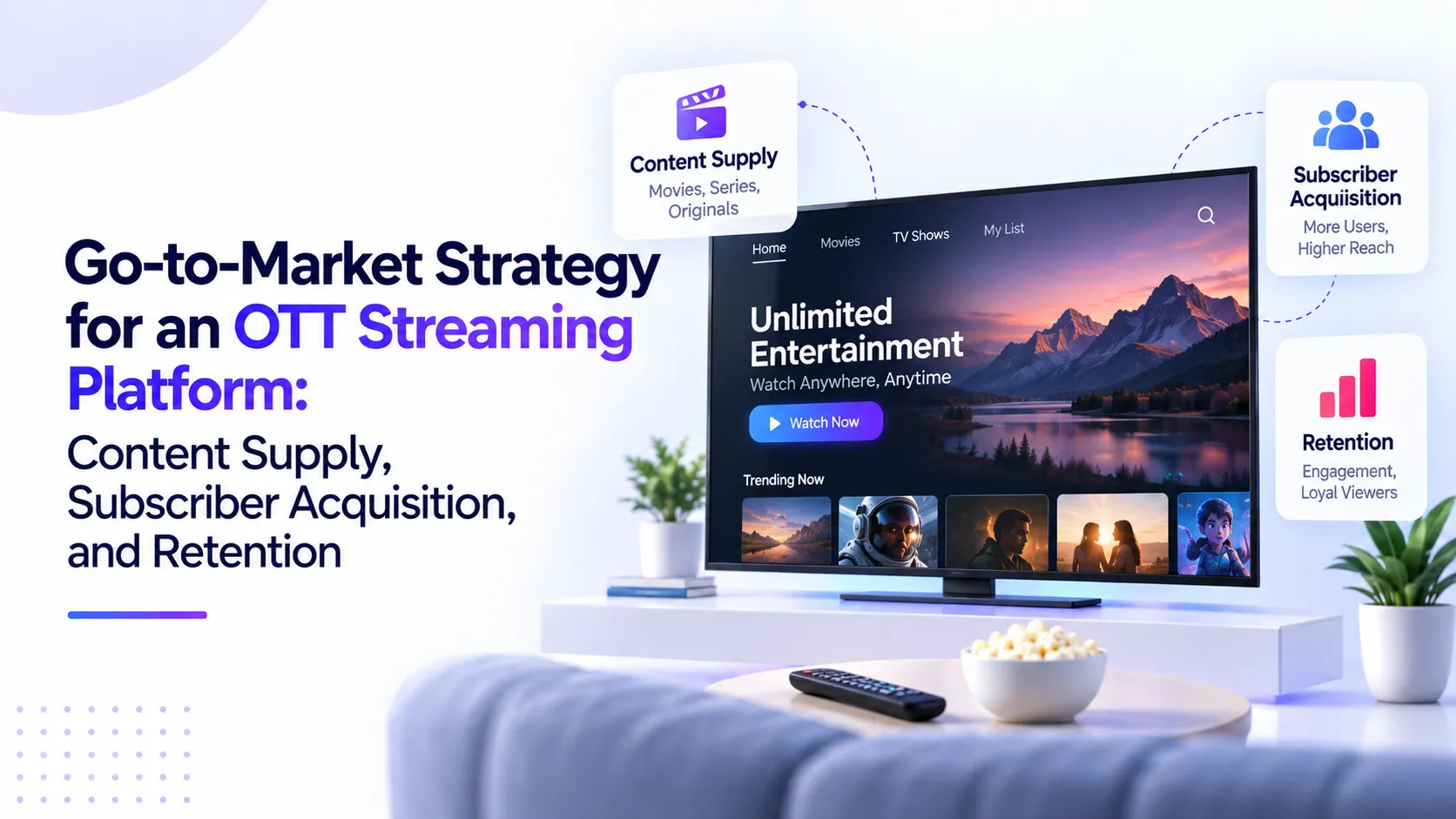
- An OTT streaming platform go-to-market strategy should balance content supply, subscriber acquisition, activation, monetization, and long-term retention instead of focusing only on app downloads.
- Strong content supply requires a clear mix of licensed titles, originals, niche programming, live content, regional libraries, and a consistent release schedule.
- Subscriber growth becomes stronger when content discovery, pricing, free trials, recommendations, payment flows, marketing channels, and retention campaigns work together.
Content & Acquisition Signals
- Operators can strengthen content supply through licensing partnerships, production deals, content acquisition APIs, regional creators, original programming, and scheduled catalogue expansion.
- Subscriber acquisition can use SEO, trailers, social campaigns, influencer partnerships, referral programs, free trials, promotional pricing, app store visibility, and bundled offers.
- Track catalogue depth, content starts, signup conversion, trial activation, paid subscriptions, acquisition cost, viewing hours, and content-driven conversions to measure go-to-market quality.
Retention & Growth Insights
- Personalized recommendations, watchlists, continue-watching, new-release alerts, profile preferences, loyalty benefits, and consistent content drops can encourage repeat viewing.
- Operators should monitor churn, renewal rate, viewing frequency, completion rate, subscriber lifetime value, dormant users, plan upgrades, and return sessions to understand retention.
- Miracuves develops customizable OTT streaming platforms with content management, subscriptions, recommendations, payments, streaming infrastructure, analytics, retention tools, notifications, and admin controls.
Launching an OTT streaming platform is not only a technology decision. It is a content, audience, monetization, and retention decision.
Many founders focus first on the app interface, video player, subscription plans, and admin dashboard. Those are important. But a streaming platform only grows when the go-to-market strategy answers three practical questions:
Who will provide the content?
How will the platform attract subscribers?
Why will viewers keep coming back?
A strong OTT go-to-market strategy connects content supply, audience positioning, pricing, launch channels, viewer retention, analytics, and monetization. It helps founders avoid launching a beautiful streaming app with no clear content pipeline, no subscriber acquisition engine, and no repeat-viewing habit.
Miracuves helps founders launch OTT and video streaming platforms faster with a ready-made, white-label, source-code-owned foundation that can be customized around content strategy, subscriptions, rentals, producer workflows, and long-term audience growth.
Prefer to start from the platform itself? See our white label video streaming platform.
Why OTT Go-to-Market Strategy Matters Before Development
An OTT product can fail even when the technology works.
The reason is simple: streaming success depends on repeated viewing behavior. A viewer may download the app because of one show, one film, one event, or one campaign. But they continue paying only when the platform delivers ongoing value.
Before development, founders should define:
- Target audience
- Content niche
- Launch catalog
- Content acquisition method
- Subscription or rental model
- Free trial or freemium logic
- Promotional channels
- Viewer retention plan
- Producer or creator onboarding workflow
- Analytics and admin control requirements
This prevents the product roadmap from becoming a random feature list. The business model should shape the platform.
For example, a regional entertainment platform needs language filters, local genres, payment flexibility, and culturally relevant promotions. A sports streaming platform may need live events, pay-per-view access, highlights, and event reminders. An education video platform may need course-style organization, instructor profiles, progress tracking, and premium access rules.
OTT Go-to-Market Strategy Framework
A useful go-to-market plan should connect the business model with the product experience.
| GTM Layer | What It Answers | Founder Impact |
|---|---|---|
| Audience positioning | Who is the platform built for? | Makes marketing sharper and reduces generic positioning |
| Content supply | What will viewers watch at launch and after launch? | Creates the core reason to subscribe or return |
| Acquisition channels | How will users discover the platform? | Builds predictable traffic and subscriber growth |
| Conversion strategy | Why will visitors become paid users? | Improves trial, subscription, rental, or PPV conversion |
| Retention plan | Why will viewers keep watching? | Reduces churn and increases customer lifetime value |
| Monetization model | How will the platform earn? | Connects pricing, access, and revenue logic |
| Analytics system | What should the team measure? | Helps improve content, pricing, campaigns, and retention |
| Admin control | How will the operator manage the platform? | Supports content, users, plans, reports, and campaigns |
This framework is especially useful for founders who want to launch faster but still make strategic decisions before going live.
Step 1: Define the Audience Before Choosing the Content Catalog
The most common OTT mistake is trying to serve everyone.
A broad platform needs a huge content library, high marketing spend, continuous licensing, and strong brand recognition. A focused platform can start with a sharper audience and build depth before scale.
Founders can position an OTT platform around:
- Regional entertainment
- Independent films
- Faith-based content
- Fitness videos
- Education and training
- Kids and family content
- Sports and events
- Local creators
- Niche documentaries
- Music and performances
- Professional learning
- Lifestyle communities
Audience positioning affects almost every product decision. It shapes homepage sections, categories, pricing, content rights, marketing channels, language support, payment options, push notifications, and partnership strategy.
A founder should be able to describe the audience in one clear sentence:
“This platform is for [audience] who want [content value] in a format that helps them [desired outcome].”
That clarity makes acquisition easier.
Step 2: Build a Content Supply Strategy
Content supply is the engine of an OTT platform.
Without enough relevant content, subscriber acquisition becomes expensive. Users may join once, watch one title, and leave. A strong supply strategy ensures the platform has enough content to launch, enough variety to explore, and enough freshness to retain viewers.
Common Content Supply Models
| Content Supply Model | Best For | What Founders Need to Plan |
|---|---|---|
| Licensed catalog | Regional films, shows, documentaries, niche entertainment | Rights, contracts, duration, territories, exclusivity, cost |
| Original content | Strong brand identity and differentiation | Production budget, release calendar, talent, promotion |
| Producer-submitted content | Producer networks, independent films, creator-led OTT | Producer onboarding, review workflows, revenue share, approvals |
| Live content | Sports, events, concerts, education, faith-based programs | Scheduling, live streaming, PPV access, moderation, replay rights |
| User or creator-led content | Communities, influencers, instructors, local creators | Creator tools, submission rules, monetization, quality control |
| Enterprise or learning content | Training, internal education, professional learning | Access rules, roles, progress, private libraries, reporting |
A founder does not need every model at launch. The right decision depends on audience demand and monetization strategy.
If your platform needs structured content, producer, and viewer-side modules, explore Miracuves’ complete OTT platform feature breakdown for a clearer view of catalog, streaming, subscription, and admin workflows.
For many startups, producer-submitted content is practical because it helps expand the catalog without creating every title internally. But it requires a clear content approval process, payout logic, watch-minute tracking, and admin control.
For readers who want a deeper product checklist, this OTT platform feature list explains important user, admin, content, subscription, and streaming features that support a stronger content experience.
Step 3: Package the Launch Catalog Around Viewer Intent
An OTT launch catalog should not look like a random folder of videos.
It should be organized around what viewers want to do.
Useful catalog sections include:
- New releases
- Trending now
- Continue watching
- Recommended for you
- Regional favorites
- Popular in your language
- Editor’s picks
- Recently added
- Premium rentals
- Free previews
- Live events
- Short films
- Series
- Documentaries
- Kids section
- Learning paths where relevant
The catalog should help users make decisions quickly. If viewers open the platform and feel lost, they are less likely to subscribe or return.
Strong catalog design also helps marketing. Campaigns can promote specific sections instead of the entire platform. For example, a launch campaign can promote a regional film week, a fitness challenge, a live event pass, or a creator collection.
Step 4: Choose the Right Monetization Model Before Launch
Monetization should be planned before launch because pricing affects product design.
An OTT platform can earn through:
- Monthly subscriptions
- Annual subscriptions
- Pay-per-view events
- One-time rentals
- Premium releases
- Freemium access
- Ads
- Sponsored content
- Producer revenue sharing
- Course or learning bundles
- Live event tickets
- Corporate licensing
Each model needs different workflows.
For a deeper revenue breakdown, review Miracuves’ OTT streaming platform business model guide, covering subscriptions, rentals, pay-per-view, producer revenue sharing, ads, and premium content models.
Subscriptions need plan management, recurring billing, invoices, access rules, and cancellation handling. Rentals need expiry windows and title-level access. Pay-per-view needs event access control. Producer revenue sharing needs watch-minute tracking, payout logic, and admin approvals.
Once your content strategy is clear, Miracuves’ ready-made OTT streaming platform foundation can help you launch with core monetization workflows such as subscriptions, rentals, pay-per-view access, producer operations, and admin control.
Step 5: Plan Subscriber Acquisition Channels
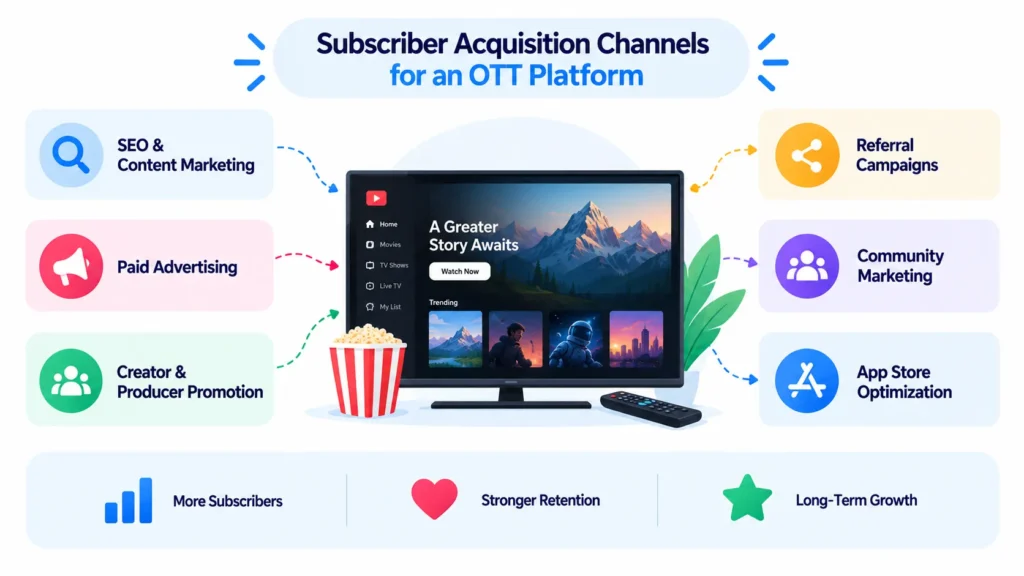
Subscriber acquisition should not depend on one channel.
If budget planning is part of your launch decision, this OTT platform development cost guide explains how features, integrations, streaming infrastructure, and customization affect the final investment.
A strong OTT launch plan usually combines multiple acquisition paths:
SEO and Content Marketing
SEO helps capture people searching for niche content, regional entertainment, live events, learning topics, or streaming access. Blog posts, landing pages, category pages, and episode pages can all support discovery.
Paid Advertising
Paid ads can support faster launch visibility. Founders can test campaigns around specific shows, categories, creators, events, or subscription offers instead of promoting the entire platform generically.
Creator and Producer Promotion
Creators, producers, instructors, and content partners can bring their own audiences. The platform should give them shareable pages, promo links, and campaign assets.
Referral Campaigns
Referral programs can encourage existing users to invite friends. This works better when the content has community value, family appeal, or regional relevance.
Community Marketing
Communities are powerful for niche OTT products. Founders can promote through groups, local events, creator communities, fan pages, newsletters, and partnerships.
App Store Optimization
If the product has mobile apps, app store titles, descriptions, screenshots, reviews, and preview videos should clearly communicate the platform’s audience and content value.
Step 6: Convert Visitors Into Subscribers
Traffic does not matter unless users convert.
Conversion depends on how clearly the platform explains value before asking for payment.
Important conversion elements include:
- Clear value proposition
- Strong homepage messaging
- Featured content previews
- Trial or preview logic
- Pricing transparency
- Plan comparison
- Social proof where available
- Easy signup
- Simple payment flow
- Clear cancellation terms
- Trust and security messaging
- Mobile-first onboarding
Founders should avoid hiding the catalog behind too many steps. Viewers usually want to understand what they can watch before creating an account or choosing a plan.
A useful approach is to let visitors browse selected titles, watch trailers, view categories, and understand pricing before subscribing.
Step 7: Build Retention Into the Product Experience
Subscriber retention is where OTT businesses become stronger.
Acquiring a subscriber is only the beginning. The platform needs to keep users watching after the first session.
Retention features include:
- Continue watching
- Watchlist
- Personalized recommendations
- New release alerts
- Content reminders
- Multi-profile viewing
- Viewing history
- Download option where supported
- Smart notifications
- Category-based discovery
- Seasonal collections
- Language preferences
- Parental controls where relevant
- Loyalty offers
- Win-back campaigns
Content freshness also matters. If users do not see new or relevant content, churn increases.
For a technical build perspective, read this OTT streaming app developer guide to understand platform setup, architecture, backend planning, and development workflow.
Founders should plan a release calendar before launch. This can include weekly drops, live events, new creator uploads, premium releases, themed collections, or monthly content campaigns.
Step 8: Use Analytics to Improve Content, Acquisition, and Retention
Analytics should be part of the go-to-market strategy, not only a backend report.
An OTT team should track:
- Website visits
- App installs
- Trial starts
- Subscription conversions
- Rental purchases
- Pay-per-view purchases
- Watch time
- Completion rate
- Drop-off points
- Search queries
- Most watched titles
- Least watched titles
- Churn rate
- Renewal rate
- Revenue by plan
- Revenue by content type
- Producer performance
- Campaign source
- Cost per acquisition
- Lifetime value
These insights help founders decide what to promote, what to license, what to produce, what to remove, and which audience segments are most valuable.
For example, if a low-cost content category drives high watch time, it may deserve more investment. If paid campaigns bring installs but not subscriptions, the landing page or pricing may need improvement. If users cancel after one week, the content release schedule may be too thin.
Step 9: Create a Retention Calendar Before Launch
A retention calendar helps the platform stay active after launch.
It can include:
| Timeline | Retention Action | Purpose |
|---|---|---|
| Launch week | Featured catalog, welcome emails, push notifications, launch offers | Drive first viewing sessions |
| Week 2 | New release reminders, content collections, referral campaign | Bring users back after first session |
| Week 3 | Personalized recommendations, watchlist prompts, creator/producer highlights | Build viewing habits |
| Month 2 | Premium drop, live event, seasonal collection, loyalty offer | Reduce early churn |
| Month 3 | Win-back campaigns, annual plan offer, survey, new category launch | Improve long-term retention |
A retention calendar also helps content partners. Producers and creators can align their promotions with the platform’s release schedule.
Step 10: Make Admin Control Part of the GTM Plan
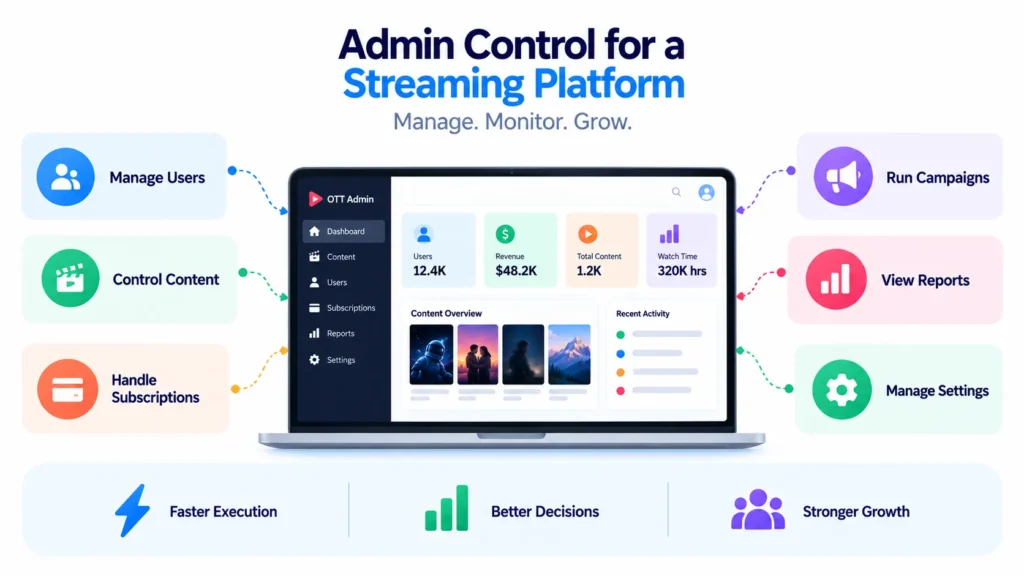
A streaming platform needs operational control after launch.
The admin dashboard should help the team manage:
- Users
- Subscriptions
- Rentals
- Pay-per-view access
- Content catalog
- Producers
- Content approvals
- Coupons
- Banners
- Notifications
- Revenue reports
- Payouts
- Watch-minute data
- Support issues
- Refund workflows
- Analytics
- Roles and permissions
Without admin control, every campaign or content update becomes slow. That hurts go-to-market execution because OTT teams need to react quickly to trends, content performance, user feedback, and partner requests.
Founder Decision Signals
Content Supply
If you do not have enough content for launch and retention, start with a focused niche, producer partnerships, rentals, or live events instead of trying to build a broad catalog.
Subscriber Acquisition
If your acquisition budget is limited, choose a clearly defined audience and build campaigns around specific content categories, not a generic streaming promise.
Retention
If viewers are likely to subscribe for one title only, plan new releases, watchlists, recommendations, reminders, and win-back campaigns before launch.
Launch Speed
If you need faster market validation, a ready-made OTT foundation can reduce setup time while keeping room for branding, monetization, and content workflow customization.
Common GTM Mistakes OTT Founders Should Avoid
1. Launching without a content supply pipeline
A streaming app needs more than a few launch titles. Founders should plan how new content will keep entering the platform after launch.
2. Targeting everyone from day one
Broad positioning makes marketing expensive. A focused audience helps the platform create clearer messaging, better catalog organization, and stronger acquisition campaigns.
3. Treating retention as a later-stage problem
Retention starts before launch. Watchlists, reminders, recommendations, new releases, and content calendars should be planned early.
4. Choosing monetization without matching content value
Subscriptions, rentals, and pay-per-view models work differently. Pricing should match content exclusivity, audience demand, and viewing frequency.
5. Ignoring producer and admin workflows
If producers, studios, instructors, or creators are part of the supply model, the platform needs onboarding, approvals, payouts, analytics, and content management workflows.
How Miracuves Helps Founders Launch OTT Platforms Faster
Miracuves helps founders, media businesses, studios, agencies, and content-led startups move faster with a ready-made OTT streaming platform foundation.
Instead of building every module from zero, founders can start with a white-label, source-code-owned platform and customize it around their audience, content strategy, monetization model, and growth roadmap.
A launch-ready OTT foundation can support core workflows such as:
- Viewer registration
- Web and mobile streaming experience
- Content catalog management
- Subscriptions
- Rentals
- Pay-per-view access
- Producer workflows
- Admin dashboard
- Watch history
- Continue watching
- Revenue reporting
- Content approval
- Coupons
- Platform branding
- Future customization
Where the ready-made scope fits the business requirement, Miracuves can support 6-day solution delivery. Advanced customizations, custom integrations, Smart TV expansion, DRM, unique payment workflows, and enterprise-level infrastructure can be planned based on the final scope.
Founders comparing launch options can explore Miracuves’ ready-made OTT streaming platform foundation to understand how a branded streaming product can move from idea to market faster.
Related reading: The Evolution of OTT Streaming Platforms.
Final Thoughts: OTT Growth Starts Before the App Goes Live
A successful OTT launch is not just about uploading videos and waiting for users.
Founders need a clear go-to-market strategy built around content supply, subscriber acquisition, pricing, retention, monetization, analytics, and operational control. The stronger the strategy, the easier it becomes to choose the right features, launch channels, and platform roadmap.
You can also explore Miracuves’ broader video content platform solutions if you are planning an OTT, streaming, creator, or video-first entertainment product.
The smartest approach is to start with a focused audience, build a content supply pipeline, choose a monetization model that matches content value, and create retention systems before launch.
Miracuves helps founders move faster with ready-made, white-label, source-code-owned OTT platform foundations built for branded streaming, admin control, subscriptions, rentals, producer workflows, and scalable growth.
Founders comparing build partners can read this OTT platform development company guide before choosing a team for launch, customization, source-code ownership, and support.
FAQs
What is an OTT go-to-market strategy?
An OTT go-to-market strategy is the plan for launching and growing a streaming platform. It includes audience positioning, content supply, subscriber acquisition, pricing, retention, monetization, analytics, and platform operations.
Why is content supply important for OTT platforms?
Content supply is important because viewers subscribe and return when the catalog feels relevant and fresh. Without a steady content pipeline, users may watch one title and leave.
How can a new OTT platform acquire subscribers?
A new OTT platform can acquire subscribers through SEO, paid ads, producer partnerships, creator promotion, referral programs, community marketing, app store optimization, launch offers, and content-led campaigns.
What monetization models work for OTT platforms?
Common OTT monetization models include subscriptions, annual plans, rentals, pay-per-view access, ads, sponsored content, producer revenue sharing, premium content, live event tickets, and corporate licensing.
How can OTT platforms improve viewer retention?
OTT platforms can improve retention with new release schedules, Continue Watching, watchlists, recommendations, personalized notifications, multi-profile viewing, content collections, loyalty offers, and win-back campaigns.
Should founders launch a broad or niche OTT platform?
Most founders should start with a focused niche unless they have the budget and content access to compete broadly. Niche positioning makes acquisition, catalog planning, messaging, and retention easier.
What features should an OTT platform include before launch?
A launch-ready OTT platform should include viewer registration, content catalog, video playback, search, watchlist, Continue Watching, subscriptions or rentals, payment flow, admin dashboard, content management, analytics, and support workflows.
Can Miracuves help launch an OTT streaming platform quickly?
Yes. Miracuves helps founders launch ready-made and white-label OTT streaming platforms with source-code ownership, branded design, admin dashboards, monetization workflows, producer tools, and faster deployment. Where the ready-made scope fits, 6-day solution delivery can support faster market entry.
Miracuves is an independent software development company. We are not affiliated with, connected to, sponsored by, or endorsed by any company or product named in this article.
Terms such as “X Clone” are used descriptively. It is how the software industry refers to building a platform with functionality comparable to a known service, and how clients search for it.
The entire design and codebase of our products is built by our own team. Our products contain no code, design, graphics, or content originating from any third-party website or applications.
All third-party names and marks referenced in this article are the property of their respective owners, referenced solely to identify the services discussed.