


Key Takeaways
- Building a ride-hailing app like Uber requires connected workflows for riders, drivers, dispatch teams, and admins.
- Ride booking, driver matching, fare calculation, live tracking, payments, and ratings are core features.
- Development cost depends on app platforms, map integrations, driver tools, payment gateways, and customization level.
- A strong MVP should focus on reliable booking, location accuracy, trip status, and secure payments before advanced features.
- An Uber-like app can help startups launch a scalable transport marketplace with on-demand mobility workflows.
Development Signals
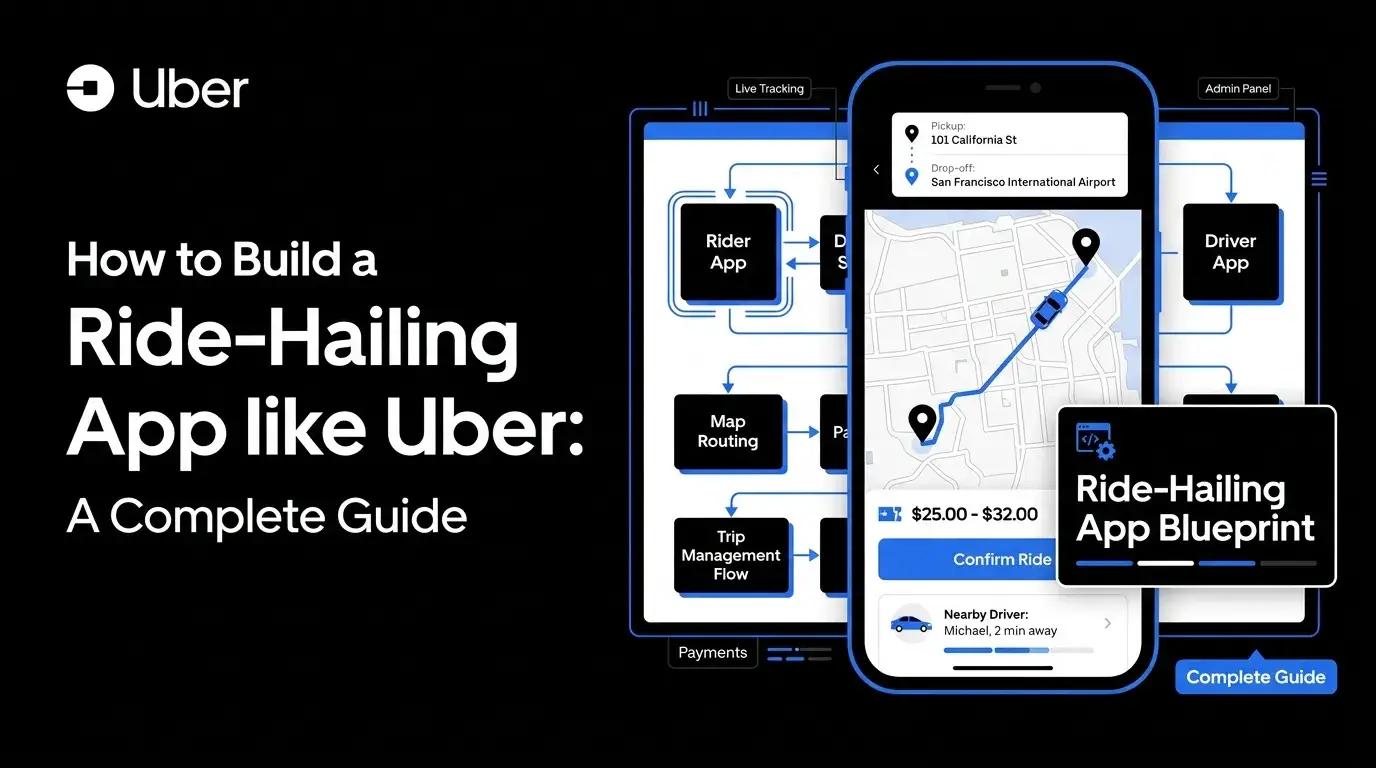
- Riders need simple onboarding, pickup and drop-off selection, fare estimates, booking, payments, and trip tracking.
- Drivers need ride requests, navigation, trip status updates, earnings tracking, availability control, and payout visibility.
- Admins need control over riders, drivers, trips, fares, commissions, disputes, payments, and platform reports.
- Backend systems need GPS tracking, dispatch logic, pricing rules, secure APIs, notifications, and scalable server architecture.
- Real-time alerts keep riders, drivers, and admins updated on bookings, arrivals, cancellations, payments, and trip completion.
Real Insights
- A ride-hailing app succeeds when booking, driver assignment, tracking, and payment flows work without friction.
- Weak location accuracy or poor dispatch logic can increase wait times, cancellations, and rider complaints.
- Clear fares, driver details, ETA updates, and trip history help users trust the platform.
- Driver verification, rating systems, route visibility, and dispute handling improve safety and marketplace quality.
- Miracuves builds Uber Clone apps with rider apps, driver apps, dispatch logic, payments, live tracking, and admin management.
The ride-hailing industry no longer rewards founders who build a generic taxi app. Riders expect fast booking, live driver tracking, transparent fares, secure payments, flexible ride options, and reliable support. Drivers expect smooth onboarding, fair earnings visibility, navigation, and quick payouts. For the business owner, the real challenge is not just building an app interface. It is creating a controlled ride-booking ecosystem with rider apps, driver apps, dispatcher workflows, admin panels, payments, commissions, safety tools, and scalable backend logic.
This guide explains how to build a ride-hailing app like Uber from a founder’s perspective, including features, technology, monetization, cost factors, launch planning, admin control, and security. If you already know you want a faster route to market, Miracuves’ launch-ready Uber-style ride-hailing solution can help you compare a ready-made product foundation with building every module from zero.
Why Build a Ride-Hailing App?
Ride-hailing apps changed the way people move across cities by making transportation more accessible, trackable, and app-driven. Instead of calling taxi operators manually, users can book a ride, see driver availability, estimate fare, track the trip, pay digitally, and rate the experience from one platform.
For founders, taxi companies, fleet operators, and mobility startups, this creates a strong opportunity. A ride-hailing app can help digitize local transport, improve dispatch efficiency, reduce manual booking errors, create new revenue streams, and build a direct relationship with riders and drivers.
The opportunity is not limited to copying Uber. Many successful ride-hailing models are built around local market gaps, such as airport transfers, women-focused rides, premium chauffeur services, corporate transport, intercity travel, local taxi fleets, or fare negotiation models.
Read More: What Is Uber Freight and How Does It Work?
When Building a Ride-Hailing App Becomes a Real Startup Opportunity
A ride-hailing app becomes a serious business opportunity when it solves a local mobility gap better than existing taxi services or large global platforms. Founders do not always need to compete with Uber city by city. A stronger strategy is often to focus on a specific market segment, city, region, fleet network, corporate travel use case, airport transfer model, women-focused safety model, or premium ride category.
For example, a local taxi company may already have vehicles and drivers but lack digital booking, dispatch control, automated fare calculation, and customer retention tools. A startup may want to launch in a city where riders complain about availability, pricing transparency, driver behavior, or limited payment options. A fleet operator may want to digitize bookings while keeping control over drivers, commissions, service zones, and ride categories.
This is where ride-hailing app development becomes more than software development. It becomes a business model decision. The platform must help the founder control supply, demand, pricing, safety, support, payouts, and expansion without depending on manual operations for every ride.
Read More: Uber-for-Massage Revenue Model: How it Make Money in 2026
Market Trends for Ride-Hailing Apps
Ride-hailing continues to grow because urban users want convenience, transparency, and flexible transport options. Smartphone adoption, digital payments, urban mobility challenges, and real-time location technology have all made app-based transportation easier to launch and manage.
Several trends are shaping ride-hailing app development:
- Localized ride-hailing models are gaining attention because many regions still depend on fragmented taxi networks.
- Corporate ride programs are becoming useful for employee transport, hotel transfers, airport mobility, and business travel.
- Electric vehicles and sustainable ride options are becoming part of modern mobility planning.
- Fare bidding and flexible pricing models are creating alternatives to fixed-price ride booking.
- Fleet digitization is helping traditional taxi operators manage drivers, vehicles, bookings, and payouts through one system.
- Safety features such as SOS, trip sharing, driver verification, and complaint management are becoming essential trust layers.
- Admin analytics are becoming more important because founders need visibility into ride volume, cancellations, driver activity, revenue, and service zones.
For founders, the trend is clear: users want convenience, but business owners need control. A strong ride-hailing platform must support both.
Read More: Best Uber for Massage Clone Script in 2026: Features & Pricing Compared
Different Types of Ride-Hailing Apps
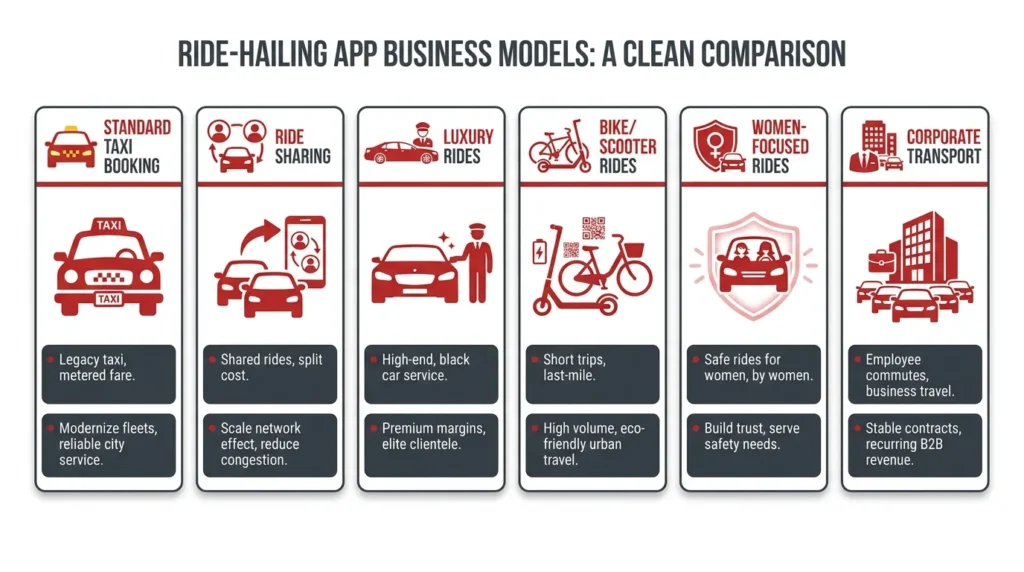
There are different types of ride-hailing apps depending on the market, customer segment, pricing model, and operational structure.
1. Traditional Ride-Hailing Apps
These apps allow users to book a ride from one location to another. They usually include rider apps, driver apps, live tracking, fare calculation, payment integration, ratings, and admin controls.
Examples include Uber, Lyft, Bolt, Ola, and similar taxi booking platforms.
2. Ride-Sharing and Carpooling Apps
Ride-sharing apps allow users going in the same direction to share rides. This can reduce cost for riders and improve vehicle utilization for drivers or operators.
This model works well in cities where daily commute routes are predictable.
3. Luxury Ride-Hailing Apps
Luxury ride-hailing apps focus on premium vehicles, executive drivers, airport transfers, chauffeur services, and high-end customer experiences. These platforms usually require stronger service quality control, vehicle verification, and customer support.
4. Bike and Scooter Ride-Hailing Apps
Bike and scooter ride-hailing apps are useful in high-traffic urban areas where users need quick short-distance transport. They can also work well in markets where two-wheelers are more affordable and faster than cars.
5. Women-Only Ride-Hailing Apps
Women-focused ride-hailing apps are designed around safety, privacy, verified drivers, trusted ride flows, and stronger support features. These platforms often need additional verification, emergency support, and user protection workflows.
6. Healthcare Ride-Hailing Apps
Healthcare ride-hailing apps help patients, elderly users, and people with mobility needs reach hospitals, clinics, therapy centers, or care providers. These apps may require scheduling, caregiver coordination, accessibility options, and support workflows.
7. Corporate Ride Platforms
Corporate ride platforms help companies manage employee transport, client rides, airport transfers, monthly billing, route control, and trip reports. This model can be attractive because corporate customers may bring repeat demand.
8. Fare Bidding Ride Apps
Fare bidding ride apps allow riders and drivers to negotiate or accept prices based on demand, distance, and availability. This is useful in markets where users prefer price flexibility instead of fixed fares. If your business model depends on negotiable fares, you can also explore Miracuves’ inDrive-style fare bidding app.
How to Choose the Right Ride-Hailing Model Before Development
Before you start development, decide which ride-hailing model matches your market. This prevents unnecessary features, budget waste, and confusing user flows.
| Ride-Hailing Model | Best For | Founder Decision |
|---|---|---|
| Standard taxi booking app | Local taxi businesses and city-based startups | Best when users need simple point-to-point rides. |
| Shared ride platform | Price-sensitive urban users | Useful when affordability and route pooling matter. |
| Rental and outstation ride app | Intercity travel, tourism, and long-distance bookings | Good for markets where daily rides are not the only revenue source. |
| Corporate ride platform | Businesses, hotels, airports, and employee transport | Strong B2B opportunity with predictable recurring demand. |
| Fare bidding ride app | Markets where users and drivers prefer negotiable pricing | Useful when pricing flexibility is part of the value proposition. |
| Premium ride app | Luxury cars, executive transfers, and airport rides | Works when the market values service quality over low fares. |
The right model affects your app features, pricing logic, driver onboarding, admin controls, and monetization strategy. A founder building a corporate ride platform will need different workflows than someone launching a public taxi booking marketplace.
Read More: Business Model of Uber in 2026: How It Works & What Founders Can Learn
Key Features of a Ride-Hailing App
Before development begins, founders should understand the core features required to run a successful ride-hailing platform.
1. User Registration and Profiles
Riders and drivers need secure registration flows. Rider profiles should include contact details, saved locations, payment methods, ride history, and ratings. Driver profiles should include documents, vehicle details, availability status, earnings, ratings, and verification status.
2. Geolocation and Routing
Real-time GPS tracking helps riders choose pickup locations, track drivers, estimate arrival time, and follow the trip route. For drivers, routing helps with navigation and trip completion.
3. Ride Matching
The app should match riders with nearby drivers based on location, availability, vehicle type, service zone, and ride category. Poor matching can increase wait times, cancellations, and driver dissatisfaction.
4. Fare Estimation
Fare estimation should calculate pricing based on distance, time, base fare, vehicle category, location, demand, waiting time, tolls, taxes, and surge rules where applicable.
5. In-App Payments
A ride-hailing app should support secure payment options such as cards, wallets, cash, coupons, refunds, and invoices. Payment accuracy is important because disputes can affect both riders and drivers.
6. Push Notifications
Push notifications help users and drivers stay updated about ride requests, driver arrival, cancellations, payment confirmation, promotions, and support messages.
7. Ratings and Reviews
Ratings and reviews help maintain trust between riders and drivers. They also help the admin identify poor service quality, repeated complaints, and high-performing drivers.
8. Ride History
Riders should be able to view previous rides, receipts, payment status, pickup/drop details, and driver information. Drivers should be able to view completed rides, earnings, payouts, and ratings.
9. Admin Dashboard
The admin dashboard gives the business owner control over users, drivers, vehicles, fares, zones, commissions, payments, disputes, promotions, and reports.
For a deeper feature breakdown, read Miracuves’ related guide on Uber Clone app features.
Product Modules That Decide Ride-Hailing App Success
A ride-hailing platform needs more than a rider app. The business works only when all operational modules connect properly.
| Module | What It Controls | Business Value |
|---|---|---|
| Rider App | Registration, pickup/drop location, ride type, fare estimate, booking, tracking, payments, ratings | Creates a simple booking experience and improves user retention. |
| Driver App | Ride requests, navigation, earnings, trip status, availability, ratings, payouts | Helps drivers accept trips, complete rides, and track income clearly. |
| Admin Panel | Users, drivers, vehicles, commissions, fares, zones, payments, disputes, reports | Gives the business owner full platform control. |
| Dispatcher Panel | Manual booking, ride assignment, phone-based requests, offline ride handling | Useful for call centers, corporate bookings, and assisted ride operations. |
| Fleet Panel | Vehicle owners, driver groups, fleet earnings, vehicle documents, performance | Helps fleet operators manage multiple drivers and vehicles. |
| Payment System | Cards, wallets, cash, coupons, refunds, invoices, transaction records | Supports flexible payments and cleaner financial tracking. |
| Safety Layer | SOS, ride sharing, driver verification, reporting, ratings, trip history | Builds rider and driver trust. |
| Analytics Dashboard | Revenue, bookings, cancellations, driver activity, zone performance | Helps founders make pricing, expansion, and marketing decisions. |
A strong ride-hailing app should make every ride traceable from request to payment. This is why the admin and dispatcher layers are as important as the rider-facing app.
Read More: Indrive Clone vs. Uber Clone: Which Ride-Hailing App is Better for Your Business?
Step-by-Step Process to Build a Ride-Hailing App Like Uber
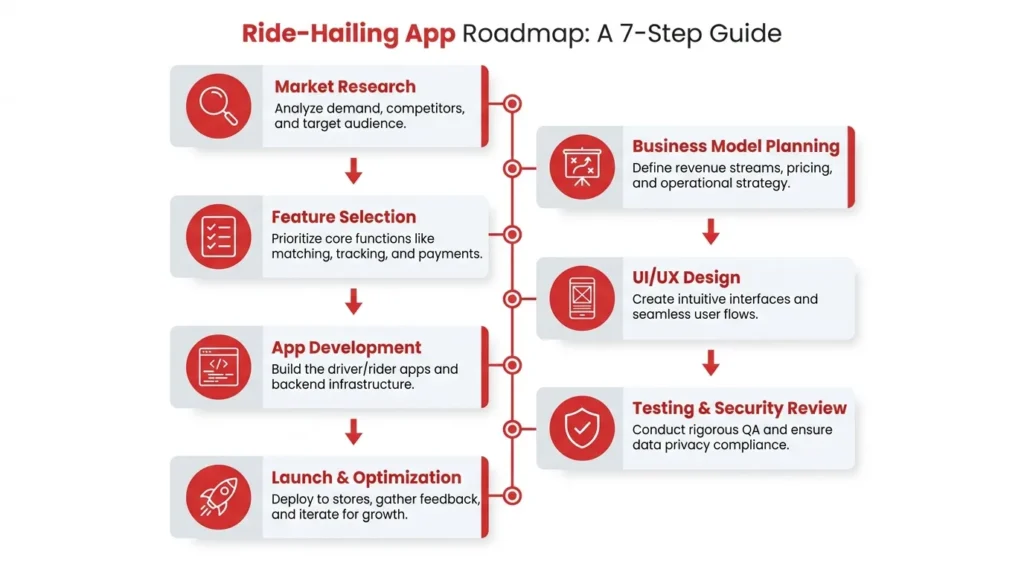
1. Market Research and Analysis
Start by identifying the market you want to serve. Study rider pain points, driver expectations, transport availability, local taxi behavior, competitor pricing, payment habits, regulatory requirements, and city-level demand.
Good research should answer questions such as:
- Which customer segment is underserved?
- Are riders unhappy with pricing, safety, availability, or service quality?
- Do local taxi operators need digital dispatch?
- Are drivers looking for better earnings visibility?
- Is the market better suited for fixed fares, bidding fares, rentals, corporate rides, or premium rides?
- What local rules apply to transport, driver verification, insurance, and payments?
This step helps you avoid building a generic app that does not match local demand.
2. Define Your Unique Value Proposition
A ride-hailing app needs a clear reason to exist. Your unique value proposition may be faster pickup, better driver verification, lower commissions, premium vehicles, city-specific pricing, corporate billing, women-focused safety, eco-friendly rides, or flexible fare negotiation.
The value proposition should guide feature selection. For example, if your app focuses on corporate rides, you may need company accounts, billing reports, scheduled rides, employee profiles, and admin approvals. If your app focuses on airport transfers, you may need fixed routes, luggage options, waiting time rules, and flight-related coordination.
3. Plan the App Architecture
A ride-hailing platform usually includes multiple connected layers:
- Rider mobile app
- Driver mobile app
- Admin dashboard
- Dispatcher panel
- Fleet panel
- Backend server
- Database
- Map and location APIs
- Payment gateway
- Notification system
- Analytics and reporting
- Support and dispute workflows
The architecture should support real-time ride requests, live location updates, fare calculation, driver matching, payment handling, and admin actions without slowing down during peak demand.
4. Choose the Technology Stack
The right technology stack depends on your launch scope, expected traffic, development budget, and scaling plan.
Common technical components include:
- Mobile apps: Flutter, React Native, Kotlin, Swift, or native development
- Backend: Node.js, Laravel, Python, Ruby on Rails, or similar server-side technologies
- Database: MySQL, PostgreSQL, MongoDB, or hybrid database setup
- Maps: Google Maps, Mapbox, Apple MapKit, or location APIs
- Payments: Stripe, Braintree, Razorpay, PayPal, wallet systems, or regional gateways
- Notifications: Firebase Cloud Messaging, APNs, SMS APIs, email APIs
- Hosting: AWS, Google Cloud, Azure, DigitalOcean, or other cloud infrastructure
The stack should be selected based on business requirements, not trends. A single-city launch may not need the same architecture as a multi-country ride-hailing platform.
5. Design the User Experience
Ride-hailing users want speed and clarity. The app should make booking simple, show fare estimates clearly, reduce unnecessary steps, and help users track rides without confusion.
Important UX decisions include:
- Simple onboarding
- Clear pickup and drop selection
- Easy ride category selection
- Fare visibility before confirmation
- Driver details and vehicle information
- Live map tracking
- Quick cancellation and support access
- Simple payment confirmation
- Clear rating and feedback flow
Driver UX is equally important. Drivers should be able to accept rides quickly, view route details, track earnings, manage availability, and receive payout updates without friction.
6. Build and Test the Core Platform
Development should focus first on the most important ride-booking workflows: registration, booking, driver matching, live tracking, fare calculation, payments, notifications, admin control, and support flows.
Testing should cover:
- Rider booking flow
- Driver acceptance and cancellation flow
- Live tracking accuracy
- Fare calculation accuracy
- Payment success and failure cases
- Push notifications
- Admin controls
- Dispatcher assignment
- Fleet management
- Load handling during peak traffic
- Security and access permissions
- App performance on different devices
A ride-hailing app should be tested from both business and user perspectives. It is not enough for the screen to work. The full ride journey must work from booking to completion.
7. Launch and Market the App
A strong launch plan should focus on both rider acquisition and driver availability. Many ride-hailing startups fail because they attract riders before enough drivers are available, or onboard drivers before demand exists.
Useful launch strategies include:
- Start with one city, zone, or niche segment
- Onboard a reliable driver base before public launch
- Partner with local taxi companies or fleet owners
- Offer referral rewards for riders and drivers
- Run local social media and community campaigns
- Build partnerships with hotels, offices, campuses, airports, and event venues
- Use coupons carefully to encourage repeat usage, not only one-time bookings
- Track cancellation rates, pickup times, ride completion, and driver activity from day one
The goal is not just app downloads. The goal is completed rides, repeat users, active drivers, and healthy unit economics.
Read More: Navigating the Roadblocks: Key Challenges in Developing an Uber-Like App
Ready-Made Ride-Hailing Platform vs Custom Development
Founders usually have two routes: build a custom ride-hailing platform from scratch or start with a ready-made taxi booking app foundation and customize it for their market.
| Build Route | Best For | Advantage | Watch-Out |
|---|---|---|---|
| Custom development | Unique business models, complex enterprise workflows, or heavily differentiated mobility platforms | Full flexibility from day one | Higher cost, longer timeline, and more technical planning required. |
| Ready-made ride-hailing platform | Founders who want faster validation with proven ride-booking workflows | Faster launch, existing rider/driver/admin modules, lower starting risk | Needs careful customization so the app does not feel generic. |
| Hybrid approach | Startups that want a quick launch now and custom enhancements later | Balances speed with future flexibility | Requires clear roadmap and source-code ownership. |
For many founders, the smarter decision is not to build every module from zero immediately. It is to launch with a strong foundation, validate the market, collect real user feedback, and then customize the platform based on demand.
Miracuves supports this approach through ready-made and customizable ride-hailing app foundations with source-code ownership, branded design, admin control, and deployment support. For founders who need a fully custom build, review Miracuves’ custom mobile app development service.
Revenue Model for a Ride-Hailing App
A ride-hailing app can generate revenue from multiple sources. The right model depends on your market, target users, driver supply, vehicle categories, and operational structure.
| Revenue Model | How It Works | Best For |
|---|---|---|
| Commission per ride | The platform takes a percentage of each completed ride fare. | Standard ride-hailing marketplaces. |
| Surge pricing | Fare increases during high-demand periods, peak hours, bad weather, or low driver availability. | High-density cities and peak-demand zones. |
| Driver subscription | Drivers pay a fixed fee to access the platform or premium benefits. | Markets where drivers prefer lower per-ride commissions. |
| Corporate ride programs | Companies pay for employee rides, airport transfers, or business travel. | B2B mobility and employee transport models. |
| In-app advertising | Local businesses or brands promote offers inside the app. | Apps with strong user volume and local business partnerships. |
| Fleet partnerships | Fleet owners register vehicles and share revenue with the platform. | Taxi companies and multi-vehicle operators. |
| Premium ride categories | Users pay more for luxury, priority, or specialized rides. | Airport, executive, and premium mobility markets. |
| Cancellation fees | A fee is charged when riders or drivers cancel after a defined stage. | Platforms that need to reduce unnecessary cancellations. |
A strong revenue model should be supported by clear admin controls. If the admin cannot adjust commissions, fares, coupons, surge rules, corporate accounts, or payout logic, monetization becomes difficult to manage as the business grows.
How Platform Controls Support Monetization
A ride-hailing app can earn from commissions, ride fares, cancellation fees, driver subscriptions, corporate accounts, promotions, fleet partnerships, and premium ride categories. But these revenue streams only work when the admin panel gives the business owner enough control.
For example, commission settings should be adjustable by ride type, city, driver group, or fleet owner. Surge pricing should be configurable based on demand, time, or location. Coupon campaigns should be trackable so the founder knows whether discounts are creating repeat bookings or only one-time users. Corporate rides should have separate billing and reporting workflows.
This is why monetization should be planned with the backend. The app should not only collect payments. It should help the founder understand where revenue is coming from, where margins are weak, and which ride categories deserve more investment.
Competitor Analysis: Uber vs Lyft vs Regional Ride-Hailing Apps
When developing a ride-hailing app, it helps to study leading and regional platforms. The goal is not to copy them blindly. The goal is to understand which product patterns users already trust and where local gaps still exist.
Uber
Uber is known for automated dispatch, live tracking, dynamic pricing, multiple ride categories, digital payments, driver ratings, and broad market presence. Its strength is convenience and scale. Its challenge in some markets is pricing sensitivity, driver dissatisfaction, and regulatory pressure.
Lyft
Lyft is strong in North America and often positions itself around community, user experience, and driver-friendliness. Its model is similar to Uber but with different brand positioning and market focus.
Ola
Ola has built strong relevance in India with local ride categories, regional payment preferences, auto-rickshaw options, and market-specific adaptations. It shows why localization matters in ride-hailing.
Grab
Grab expanded beyond ride-hailing into delivery, payments, and broader services across Southeast Asia. It shows how a mobility app can become part of a larger digital ecosystem.
Bolt
Bolt focuses on affordability and driver-friendly positioning in multiple markets. Its growth shows that pricing and driver economics can become strong differentiation points.
For founders, the lesson is simple: competing directly with the largest platform is not always the smartest path. A localized, specialized, or better-operated ride-hailing platform can still create strong business value.
Read More: Logistics Is the New Marketing: Build an Uber Clone That Wins on Speed
What Affects the Cost of Building a Ride-Hailing App Like Uber?
The cost of building a ride-hailing app depends on the product scope, app modules, technology stack, integrations, customization, launch region, and operational requirements. A simple taxi booking app with rider, driver, and admin workflows will cost less than a multi-city ride-hailing platform with fleet management, dispatcher control, corporate accounts, multi-currency support, advanced analytics, and AI-based demand forecasting.
The main cost factors include:
| Cost Factor | Why It Matters |
|---|---|
| Rider and driver apps | Both apps need separate workflows, interfaces, notifications, and real-time ride updates. |
| Admin dashboard | The admin panel controls users, drivers, fares, commissions, payments, zones, disputes, and reports. |
| Dispatcher and fleet panels | These are important for taxi companies, fleet operators, call-center bookings, and corporate ride operations. |
| Maps and location APIs | Real-time tracking, route optimization, ETA, distance calculation, and driver matching depend on map integrations. |
| Payment integrations | Card payments, wallets, cash, refunds, invoices, and payout workflows affect both cost and complexity. |
| Security and verification | Driver verification, SOS, audit logs, role-based access, and abuse reporting improve platform trust. |
| Custom branding | Logo, color theme, app name, onboarding screens, and store assets affect launch readiness. |
| Scalability requirements | A single-city launch needs a different backend approach than a multi-region ride-hailing platform. |
A ready-made Uber-style app foundation can reduce development time because core ride-booking workflows are already built. The final cost should still be confirmed based on selected modules, branding, integrations, third-party APIs, and customization scope.
Founders should avoid choosing only by the lowest initial price. A ride-hailing app needs reliable dispatch logic, payment accuracy, driver trust, admin visibility, and backend stability. A low-cost build that fails during peak booking hours can become more expensive than a stronger product foundation.
Read More: How Safe is a White-Label Uber Delivery App? Security Guide 2026
Why Admin Panel Control Matters Before You Scale
The admin panel is the operating center of a ride-hailing business. Without a strong admin dashboard, the founder may depend on developers or manual teams for everyday decisions such as changing fares, approving drivers, resolving disputes, adjusting commissions, or reviewing ride performance.
A strong admin panel should help the platform owner manage:
- Rider and driver accounts
- Driver documents and approval status
- Vehicle categories and service types
- Fare rules, surge pricing, and cancellation fees
- Coupons, wallets, and payment records
- Ride history and trip disputes
- Zone-based operations
- Dispatcher assignments
- Fleet owners and vehicle groups
- Ratings, complaints, and support tickets
- Revenue, commissions, and payout reports
For startups, admin control directly affects speed of learning. If you can quickly identify high-cancellation zones, inactive drivers, low-performing vehicle categories, or payment issues, you can improve the business faster. That is why admin control should be treated as a growth feature, not just a backend feature.
Challenges in Building a Ride-Hailing App
Developing a ride-hailing app is complex because the business depends on real-time operations, trust, payments, location accuracy, and local market execution.
1. Regulatory and Legal Challenges
Every market may have different rules for ride-hailing, taxi licensing, insurance, driver verification, payment handling, and transport operations. Founders should work with local legal advisors before launch.
2. Driver Recruitment and Retention
A ride-hailing app needs enough active drivers to meet rider demand. Without driver supply, users face long wait times and may not return. Driver incentives, transparent earnings, smooth onboarding, and fair payout workflows are important.
3. Rider Trust and Safety
Riders need to feel safe before, during, and after the trip. Verification, ratings, ride sharing, emergency support, support tickets, and visible driver details help build trust.
4. Real-Time Performance
Ride matching, live tracking, fare calculation, and notifications must work reliably. Slow tracking or delayed ride requests can reduce completion rates.
5. Competition
Large platforms already have brand recognition in many markets. Founders should compete through local focus, better driver relationships, niche positioning, corporate partnerships, or specialized ride categories.
6. Payment and Payout Accuracy
Payment disputes can damage trust quickly. The app should maintain clear records for rider payments, driver earnings, platform commissions, refunds, and cancellation fees.
7. Scaling Across Locations
A single-zone launch is different from multi-city operations. Scaling requires zone management, driver availability planning, localized pricing, support workflows, and performance monitoring.
Security and Trust Layers Needed in a Ride-Hailing App
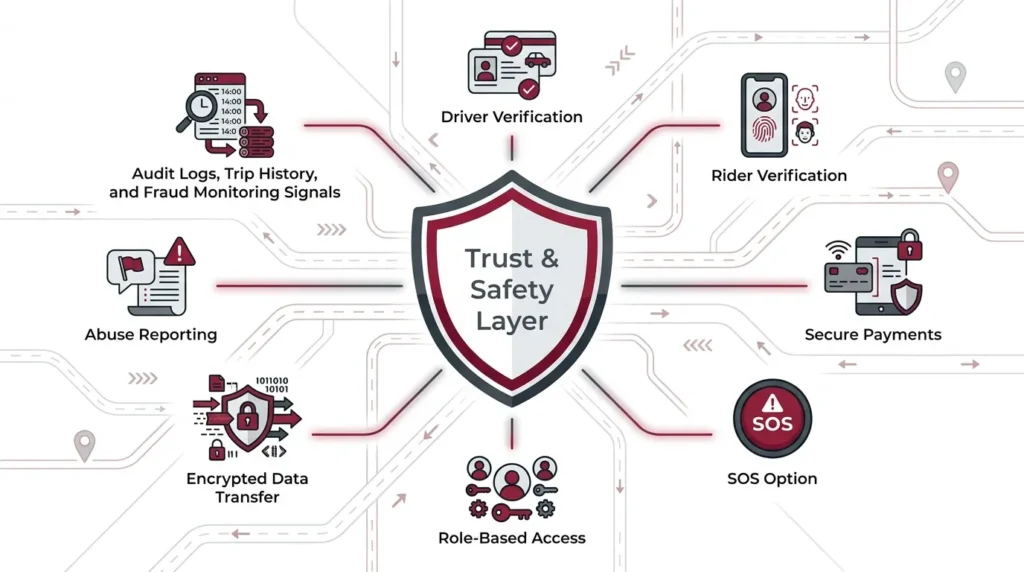
Trust is one of the most important parts of ride-hailing app development. Riders are sharing location data and payment details. Drivers are accepting trip requests from unknown users. The platform owner is responsible for creating workflows that reduce misuse, improve visibility, and support safe operations.
Important security and trust layers include:
- Driver verification and document approval
- Rider account verification
- Secure payment gateway integration
- Encrypted data transfer
- Role-based admin access
- Trip history and ride receipts
- SOS or emergency contact option
- Driver and rider ratings
- Abuse reporting and complaint management
- Audit logs for admin actions
- Dispatcher access control
- Fraud monitoring signals
- Cancellation and refund rules
Security should not be treated as a marketing add-on. It should be built into the ride booking, payment, driver onboarding, support, and admin workflows from the beginning. Final legal and compliance requirements depend on the launch region, local transport rules, payment providers, insurance model, and legal review.
Strategies to Compete With Established Ride-Hailing Apps
A new ride-hailing app does not need to win the whole market immediately. It needs to win a specific segment better than existing alternatives.
Useful strategies include:
Target a Niche Market
Instead of launching everywhere, focus on one market segment such as airport rides, corporate transport, local taxi fleets, women-focused rides, healthcare rides, student mobility, tourism, or premium vehicles.
Build Strong Local Partnerships
Hotels, offices, residential communities, event venues, universities, airports, and local businesses can become powerful acquisition channels.
Improve Driver Economics
Drivers are the supply side of the platform. Better onboarding, transparent payouts, fair commissions, and rewards can help improve retention.
Use Referral Programs Carefully
Referral programs can attract early riders and drivers, but discounts should be tied to repeat usage and completed rides, not only registrations.
Offer Strong Support
Customer and driver support can become a competitive advantage in markets where large platforms feel impersonal.
Localize the Product
Language options, local payment methods, vehicle categories, cultural expectations, and city-specific fare rules can improve adoption.
Track Operational Metrics
Founders should monitor pickup time, ride completion rate, cancellation rate, driver acceptance rate, revenue by zone, support tickets, and repeat booking rate.
Read More: Best Uber for X Clone script in 2026: Features & Pricing Compared
Mistakes to Avoid When Building a Ride-Hailing App
1. Ignoring Market Research
Many startups rush into development without understanding rider needs, driver expectations, local transport behavior, or competitor gaps. This can lead to wasted budget and poor adoption.
2. Overcomplicating the First Launch
Adding too many features at the start can delay launch and confuse users. Focus first on the ride-booking flow, payments, driver matching, admin control, and support.
3. Treating the Admin Panel as Secondary
The admin panel is not optional. It is where the business manages operations, pricing, drivers, users, disputes, payments, and growth decisions.
4. Underestimating Legal Requirements
Ride-hailing can involve licensing, insurance, local transport laws, driver documentation, tax handling, and safety rules. Legal review should happen before launch.
5. Weak Driver Onboarding
If driver onboarding is slow or confusing, supply will suffer. Driver verification should be structured but not unnecessarily difficult.
6. Poor Payment and Payout Planning
Riders need reliable payment options, and drivers need clear earnings. Payment failures, unclear commissions, or delayed payouts can damage trust.
7. No Support Workflow
Ride-hailing issues happen in real time. The platform should have support workflows for cancellations, disputes, refunds, driver behavior, lost items, and payment issues.
8. No Scalability Planning
A platform that works for 100 rides may fail at 10,000 rides if the backend, database, tracking logic, and support operations are not planned properly.
Final Thoughts: Build the Right Ride-Hailing Foundation Before You Scale
Building a ride-hailing app like Uber is not only about copying familiar features. The real decision is how quickly you can launch a reliable platform, attract riders and drivers, control operations, manage payments, and improve the business based on real market feedback.
A custom build may be the right path when your ride-hailing model is highly unique. A ready-made platform may be the smarter route when your priority is faster validation, lower starting risk, admin control, branded launch, and source-code ownership.
Miracuves helps founders launch customizable ride-hailing platforms with rider apps, driver apps, dispatcher workflows, fleet control, admin dashboards, secure payment flows, and scalable ride-booking logic. If you want to move from planning to launch faster, review the Uber Clone solution.
FAQ
How do I build a ride-hailing app like Uber?
To build a ride-hailing app like Uber, you need rider and driver apps, real-time GPS tracking, ride matching, fare calculation, payments, ratings, notifications, admin control, and support workflows. The process usually starts with market research, business model planning, feature selection, UI/UX design, backend development, testing, deployment, and post-launch optimization.
What features should a ride-hailing app include?
A ride-hailing app should include rider registration, driver onboarding, pickup and drop selection, fare estimate, ride booking, live tracking, in-app payments, wallet, ride history, ratings, push notifications, SOS, support, dispatcher panel, fleet panel, and an admin dashboard. These features help the platform manage bookings, users, drivers, payments, and service quality.
What affects the cost of ride-hailing app development?
Ride-hailing app development cost depends on the number of apps and panels, feature complexity, map integrations, payment gateways, admin controls, dispatcher workflows, fleet management, branding, security layers, and customization requirements. A ready-made Uber-style app foundation can reduce development time because the core modules are already built.
Is a ready-made Uber Clone solution better than custom development?
A ready-made Uber Clone solution is useful when the founder wants faster launch, proven ride-booking workflows, source code, admin control, and white-label branding. Custom development is better when the business model is highly unique or requires complex enterprise workflows. Many founders start with a ready-made foundation and customize it as the business grows.
Why is the admin panel important in a taxi booking app?
The admin panel helps the business owner manage riders, drivers, vehicles, fares, commissions, service zones, payments, disputes, coupons, ratings, and reports. Without strong admin control, the platform becomes difficult to operate and scale because every operational change may require manual effort or developer support.
How can a ride-hailing app make money?
A ride-hailing app can make money through ride commissions, service fees, surge pricing, cancellation fees, driver subscriptions, fleet partnerships, premium ride categories, corporate ride accounts, in-app promotions, and advertising. The right monetization model depends on the target market, driver supply, ride volume, and customer segment.
What is the role of a dispatcher panel in a ride-hailing platform?
A dispatcher panel helps the business manually assign rides, manage offline or phone-based bookings, monitor ongoing rides, handle driver cancellations, and support customers when automated booking is not enough. It is especially useful for taxi companies, corporate transport providers, hotels, call centers, and fleet operators.
Can a ride-hailing app be customized for my brand?
Yes. A ride-hailing app can be customized with your brand name, logo, color theme, app screens, ride categories, fare rules, payment options, language preferences, and business workflows. Founders should confirm customization scope before development so the app matches their market and does not feel generic.
How can Miracuves help with Uber Clone app development?
Miracuves helps founders launch customizable Uber-style ride-hailing platforms with rider apps, driver apps, dispatcher workflows, fleet panels, admin dashboards, secure payments, source code, and white-label branding.