



GMX has emerged as one of the most talked-about decentralized exchanges (DEXs) in the crypto space, especially among derivatives traders. Unlike centralized exchanges like Binance or Coinbase, GMX enables permissionless, on-chain trading of perpetual futures with no intermediaries. Built on Arbitrum and Avalanche, it offers low fees, deep liquidity, and up to 50x leverage—attracting a loyal, fast-growing user base.
But beyond its trading interface and DeFi-friendly ethos lies a smart, sustainable revenue model. If you’re a founder eyeing the crypto space, understanding how GMX earns money is key to replicating its success. In this blog, we’ll unpack GMX’s income sources, why its monetization strategy works in 2025, and how Miracuves can help you build a GMX clone with built-in revenue generation.
What GMX Does and Its Market Impact
GMX is a decentralized spot and perpetual exchange that allows users to trade cryptocurrencies directly from their wallets. It operates with a unique on-chain model that provides low-slippage, high-leverage trading without relying on traditional order books. Instead, GMX uses a multi-asset liquidity pool model (GLP) to enable seamless trading.
Since its launch, GMX has carved out a strong niche in the DeFi landscape:
- Over $200 million in Total Value Locked (TVL)
- $150+ billion in total trading volume
- Tens of thousands of active users monthly
- Consistent daily protocol revenue (sometimes exceeding $100,000/day)
This traction has positioned GMX as a go-to DEX for traders looking for leverage and transparency. As a result, its tokenomics and revenue-sharing design have attracted both traders and liquidity providers.
Why Studying GMX’s Revenue Model Matters
In a crypto market flooded with hype and unsustainable tokenomics, GMX stands out with a real, functioning business model that generates daily cash flow. For startup founders, DeFi entrepreneurs, and SaaS builders, it offers a proven blueprint for building an exchange that can sustain itself—without burning millions in incentives or relying solely on token appreciation.
Understanding GMX’s revenue model not only shows what works in today’s market but also reveals how your own decentralized exchange can be profitable from day one—especially if built with a tailored clone solution.
Let’s dive into how GMX earns its money.
How GMX Makes Money
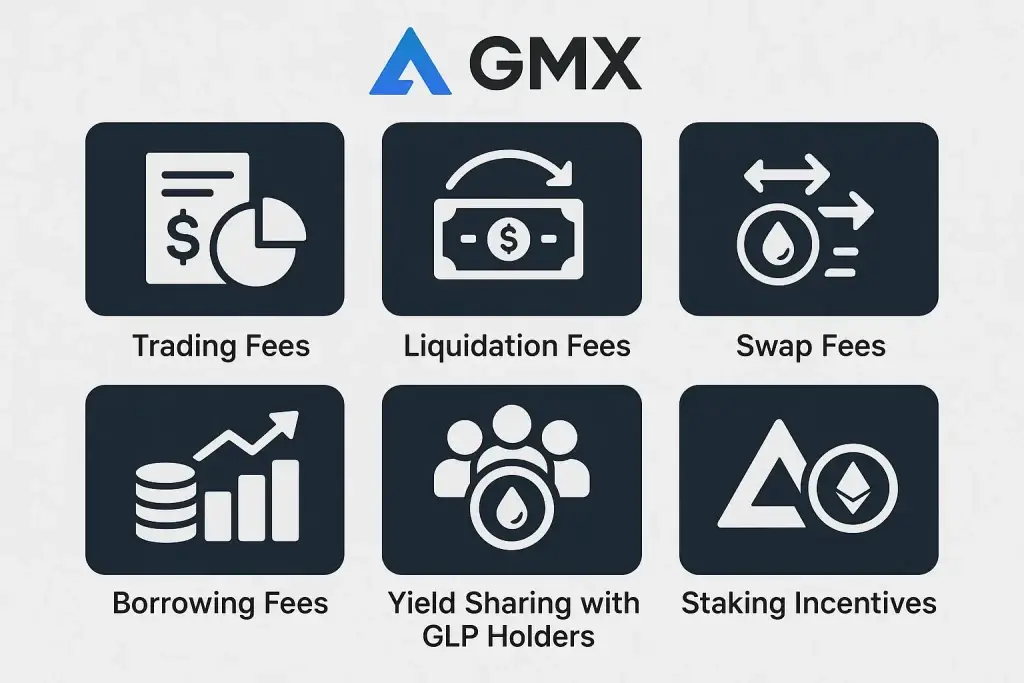
GMX’s revenue model is impressively simple yet powerful. It generates income through several core streams designed to benefit both the protocol and its stakeholders:
- Trading Fees: Charged on every swap or leveraged trade (typically 0.1%–0.2%)
- Liquidation Fees: Collected when leveraged positions are force-closed
- Swap Fees: Incurred during token swaps in the GLP pool (usually 0.2%–0.8%)
- Borrowing Fees: Dynamic fees paid by traders based on the utilization of assets
- Yield Sharing with GLP Holders: Part of protocol revenue is distributed to liquidity providers
- Staking Incentives: GMX stakers earn a share of platform fees in ETH/AVAX, encouraging long-term holding
This combination of transaction-based revenue and community-aligned tokenomics makes GMX both scalable and sustainable in the current DeFi climate.
GMX powers user profitability by sharing trading and swap fees with stakers and liquidity providers. Discover the full business model of GMX and how revenue flows in DeFi.
Detailed Breakdown of Revenue Channels
Trading Fees
GMX charges a fixed fee on every trade—typically 0.1% for market orders and up to 0.2% for leveraged positions. This fee is split between the protocol treasury, GLP (liquidity) providers, and GMX token stakers. With high-volume trading activity and up to 50x leverage, even small fees accumulate into substantial daily revenue. Traders pay these fees for access to leverage, transparency, and non-custodial execution.
Liquidation Fees
When a trader’s margin balance falls below maintenance levels, their position is automatically liquidated. GMX collects a fixed fee for each liquidation event. These liquidation fees disincentivize excessive risk and provide the protocol with additional revenue. They’re also shared with network participants (keepers and stakers), creating a circular benefit structure.
Swap Fees
Users can swap tokens within the GLP liquidity pool. These swaps come with dynamic fees ranging from 0.2% to 0.8%, depending on pool balance. This incentivizes users to keep the pool well-balanced and generates revenue from casual traders and liquidity movers who don’t use leverage.
Borrowing Fees
Borrowing fees are variable and accrue every second a leveraged position remains open. The rate is based on real-time asset utilization—more demand leads to higher fees. These charges create a continuous income stream that scales with user engagement and market volatility, which is common in perpetual DEXs.
GLP Yield Distribution
A large portion of GMX’s protocol fees are shared with GLP token holders (liquidity providers). These yields, paid in ETH or AVAX, are made possible through trading, swap, and borrowing fees. This model encourages users to provide liquidity and hold GLP long-term, locking capital into the protocol and creating a sustainable revenue flywheel.
Staking Rewards
GMX token holders who stake their tokens receive real, protocol-generated rewards in ETH/AVAX—not just inflationary tokens. This revenue-sharing mechanism reduces sell pressure and boosts community alignment. Staking incentives come from trading fees and platform earnings, turning users into stakeholders.
Before you start trading, it’s important to know the GMX features list that make it stand out and understand how the GMX app works so you can use it with confidence.
Why This Revenue Model Works in 2025
In 2025, the GMX revenue model continues to thrive due to a confluence of market trends, evolving user expectations, and decentralized finance maturation. Here’s why it remains highly effective:
Decentralization and Trustless Trading Are in Demand
Post-FTX and centralized exchange failures, users increasingly prioritize security, transparency, and control. GMX’s non-custodial approach directly aligns with this shift. Its model allows users to trade and earn without giving up custody of their funds—boosting long-term platform loyalty and fee generation.
High-Leverage Demand Remains Strong
Despite bear and bull cycles, leveraged trading remains popular. GMX captures this demand with low-fee, high-leverage trading that works without intermediaries. The borrowing and trading fees scale with volatility—making this model more profitable during market swings.
Dynamic Fee Structures Promote Sustainability
Unlike fixed models, GMX uses dynamic fees to balance incentives and protocol health. Borrowing costs fluctuate with demand, and swap fees adjust to pool imbalance. This allows GMX to optimize revenue while protecting liquidity stability.
Tokenomics That Reward Users, Not Just Speculators
GMX’s revenue-sharing mechanism with stakers and GLP providers encourages participation beyond speculation. It turns everyday users into ecosystem investors—contributing capital and receiving real yield. This investor alignment supports both token value and platform usage.
Interoperability and L2 Expansion
With Layer 2 solutions like Arbitrum and Avalanche becoming DeFi hubs, GMX is well-positioned to grow. Its model is chain-agnostic and can expand to additional networks without needing major changes. That flexibility gives the revenue model more surface area for growth.
In short, GMX’s monetization strategy works in 2025 because it’s responsive, community-aligned, and built on sustainable trading activity rather than hype.
Standing out in DeFi requires more than features—it needs visibility. See how the GMX marketing strategy turned a trading app into a global brand.
Can Startups Replicate GMX’s Revenue Model?
Absolutely—but not without overcoming serious challenges. While GMX’s success may appear straightforward, building such a robust, secure, and scalable DEX from scratch involves complex technical architecture, liquidity design, and tokenomics engineering. Here’s what makes it hard—and how Miracuves simplifies it.
Challenges in Building a GMX-like Platform
- Smart Contract Complexity: GMX’s core features—perpetual trading, real-time PnL, liquidation mechanisms, and dynamic fees—rely on sophisticated smart contracts.
- Liquidity Pool Design: Creating a GLP-like liquidity system that handles multiple tokens, slippage, and pricing requires deep DeFi expertise.
- Security & Audits: Any on-chain trading system must be airtight. Security flaws can lead to hacks and major financial loss.
- Tokenomics Engineering: Aligning incentives for stakers, traders, and LPs while avoiding inflation is tricky to get right.
- Time-to-Market Pressure: By the time a custom DEX is developed, market trends may shift or competitors may dominate the space.
Miracuves: Your Shortcut to a Revenue-Ready GMX Clone
Miracuves offers a battle-tested GMX Clone that replicates the exact monetization blueprint—trading fees, liquidation income, GLP-based liquidity, and staking rewards. What’s more, it’s fully customizable to your brand, region, and audience.
- Faster Launch: Go live in weeks, not months
- Cost-Efficient: Avoid huge dev costs with a ready-made backend
- Revenue Flexibility: Set your own fee structure and incentives
- Scalable Design: Built for multi-chain expansion
Instead of reinventing the wheel, founders can start with a proven framework and focus on user acquisition, community building, and growth.
Launching a DeFi exchange is easier when you start with the best GMX clone scripts in 2025 and plan ahead with the true cost of building a GMX-like platform.
The GMX Clone by Miracuves is priced at $3,299, delivering a fully customizable perpetual crypto exchange platform .
Miracuves development timeline including setup, configuration, admin deployments, API integrations, and platform handover in 6 Days, depending on customization and additional functional layers requested. This ensures a stable, market-ready system with predictable delivery and no hidden engineering delays.
Tech Stack
This solution is built with robust frameworks — Web using PHP, MySQL & Apps using Flutter, optimized for performance, stability, and easy maintenance. Other tech stacks can be discussed upon request — Contact us
Conclusion
GMX has redefined how decentralized exchanges can earn money—without relying on centralized control or unsustainable token inflation. Through trading fees, borrowing charges, swap commissions, and real-yield sharing with users, GMX built a model that’s not only profitable but also community-aligned and future-proof.
For startups looking to enter the DeFi space, replicating this revenue model is entirely possible—if you have the right technology partner. With Miracuves’ GMX clone, you get a ready-made platform that mirrors GMX’s monetization strategy while giving you the freedom to innovate, scale, and grow.
FAQs
How does GMX generate revenue?
GMX earns revenue primarily through trading fees, liquidation charges, swap fees, and borrowing interest. These fees are shared among the protocol treasury, stakers, and liquidity providers.
Is GMX profitable in 2025?
Yes. As of 2025, GMX continues to generate daily protocol fees—sometimes exceeding $100,000—making it one of the most sustainable DEXs in the DeFi space.
What are the main income sources for GMX?
The main revenue streams include trading fees, borrowing fees, swap fees from the GLP pool, and liquidation penalties. These are distributed to GMX stakers and GLP holders.
Can startups use the same revenue model as GMX?
Startups can absolutely adopt GMX’s model, but replicating it from scratch is complex. Using a ready-made GMX clone from Miracuves simplifies the process and accelerates time to market.
Does Miracuves offer GMX clone with monetization features?
Yes. Miracuves offers a customizable GMX clone that includes all key revenue features—like trading fees, staking incentives, GLP-style liquidity, and real-time PnL tracking.
Related Articles :-
- Revenue Model of Coinbase: How the Crypto Giant Monetizes Trust and Transactions
- Revenue Model of Paxful: How the Peer-to-Peer Crypto Marketplace Earns Money
- Revenue Model of MEXC and How This Crypto Exchange Makes Money
- Understanding the Revenue Model Behind PinkSale’s Crypto Success
- Revenue Model For Decentralized Crypto Launchpad