


Key Takeaways
- Chewy’s revenue model is built around online pet product sales, recurring autoship orders, pharmacy services, private-label products, and customer loyalty.
- Its biggest revenue stream comes from selling pet food, treats, toys, healthcare products, grooming items, and accessories through its eCommerce platform.
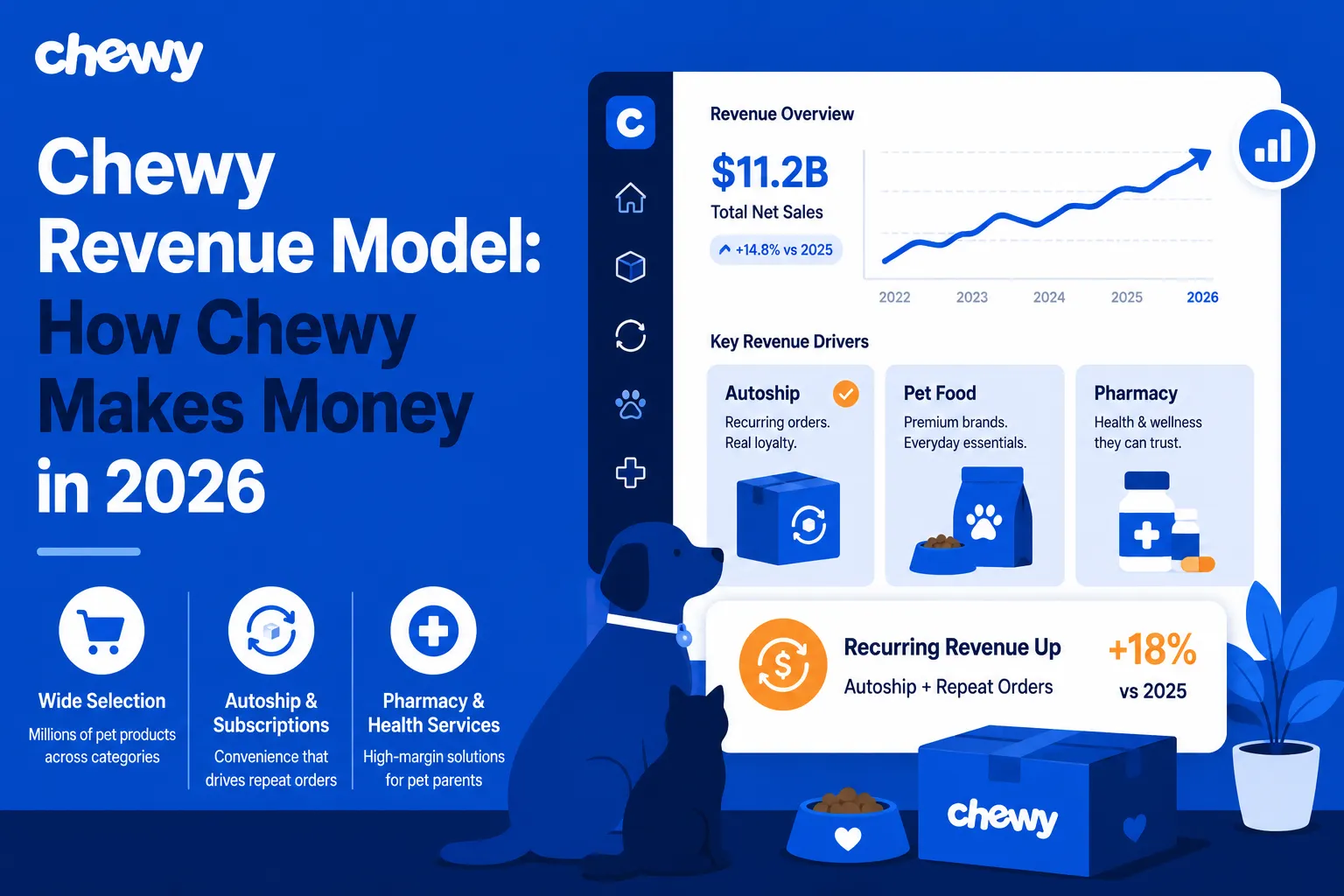
- Autoship subscriptions create predictable repeat revenue by encouraging customers to schedule regular deliveries for food, medicine, and essential pet supplies.
- Chewy shows how niche eCommerce platforms can grow by combining convenience, personalization, customer service, recurring orders, and category depth.
- For founders, the main lesson is clear: a specialized marketplace becomes stronger when it solves repeat buying needs and builds trust around a focused customer segment.
Revenue Signals
- Product sales generate core revenue from pet food, supplies, wellness products, pet beds, toys, crates, cleaning items, and accessories.
- Autoship orders improve retention because customers regularly reorder essentials without manually returning to the platform every time.
- Chewy Pharmacy adds a higher-trust revenue layer through prescription medications, pet health products, supplements, and veterinary-related purchases.
- Private-label and exclusive products can improve margins because the platform controls more of the product positioning, pricing, and supply strategy.
- Personalized recommendations, customer support, loyalty programs, and targeted offers help increase average order value and repeat purchase frequency.
Real Insights
- Chewy is not just an online pet store; it is a repeat-purchase ecosystem built around pet care, convenience, and customer trust.
- The strongest part of the model is recurring demand because pet owners need food, medicine, and supplies on a regular schedule.
- Customer experience matters because pet care purchases are emotional, urgent, and trust-driven compared to many general eCommerce categories.
- Founders can learn from Chewy by building niche commerce platforms with strong retention loops, personalized journeys, and dependable fulfillment.
- The future of Chewy-style revenue will depend on subscription depth, pet health services, AI recommendations, private-label growth, faster delivery, and stronger customer loyalty.
Chewy has quietly become one of the most powerful eCommerce businesses in the pet industry, serving millions of pet parents across the United States with a category-focused, digital-first model. By specializing exclusively in pet products and care, Chewy has built deep expertise in customer behavior, repeat purchasing patterns, and supply chain efficiency that generalist marketplaces struggle to match.
What looks like a simple online pet store is actually a highly optimized, recurring-revenue machine built on logistics, subscriptions, and customer loyalty. Chewy’s Autoship program drives predictable demand, reduces churn, and lowers acquisition costs, while its nationwide fulfillment network ensures fast, reliable delivery for bulky and time-sensitive pet supplies. This combination turns everyday consumables into long-term customer relationships.
For entrepreneurs building vertical marketplaces or subscription-driven platforms, Chewy’s revenue model offers some of the most practical lessons in modern eCommerce. It shows how focusing on consumables, emotional customer connection, and frictionless reordering can dramatically increase lifetime value. More importantly, Chewy demonstrates that niche dominance and retention-first design can outperform broader, price-only competition.
Chewy Revenue Overview – The Big Picture
Chewy operates as a direct-to-consumer pet commerce platform with deep supplier integration and strong customer retention.
Key Financial Highlights (2026):
- 2026 Revenue: ~$11.2 billion
- Valuation: ~$15–16 billion
- YoY Growth: ~8–9%
- Primary Markets: United States (dominant), limited international exposure
- Gross Margin: ~28–29%
- Net Margin: ~1–2% (improving profitability trend)
Competition Benchmark:
- Amazon Pets: Broader catalog, weaker loyalty
- Petco / PetSmart: Physical-first, lower digital efficiency
- Walmart Pets: Price-driven, low personalization
Read More: What is Chewy and How Does It Work?
Primary Revenue Streams Deep Dive
Chewy’s monetization is designed around lifetime value rather than one-time purchases.
Revenue Stream #1: Pet Product Sales (Core Revenue)
Chewy earns margins on food, toys, accessories, and health products.
- Share: ~70% of total revenue
- Pricing: Competitive, low-friction pricing
- 2026 Insight: Consumables drive repeat behavior
Revenue Stream #2: Autoship Subscriptions
Recurring scheduled deliveries for food, treats, and medicines.
- Share: ~55% of total sales volume (overlapping with product sales)
- Pricing: 5–10% discount for subscribers
- 2026 Data: Over 70% of active customers use Autoship
Revenue Stream #3: Private Label Brands
Chewy-owned brands across food, supplements, and accessories.
- Share: ~8%
- Advantage: Higher margins, brand control
Revenue Stream #4: Pharmacy & Pet Healthcare
Prescription meds and health products via Chewy Pharmacy.
- Share: ~7%
- Benefit: High retention, regulatory moat
Revenue Stream #5: Services & Partnerships
Vet partnerships, insurance referrals, and brand collaborations.
- Share: ~2–3%
- Growth Area: Still early-stage monetization
Revenue Streams Percentage Breakdown
| Revenue Stream | Share (%) |
|---|---|
| Product Sales | 70% |
| Autoship Subscriptions | Embedded |
| Private Labels | 8% |
| Pharmacy & Health | 7% |
| Services & Partnerships | 3% |
The Fee Structure Explained
Chewy does not monetize users with platform fees. All revenue is embedded in product economics.
User-Side Fees
- No subscription fee
- No membership cost
- Free shipping above minimum order value
Supplier-Side Economics
- Wholesale pricing agreements
- Volume-based rebates
- Inventory commitments
Hidden Revenue Layers
- Subscription-driven predictability
- Reduced churn costs
- Data-backed inventory optimization
Regional Pricing Variation
- US pricing optimized for retention
- Aggressive discounts in competitive categories
Complete Fee Structure by User Type
| User Type | Fees Applied |
|---|---|
| Pet Owners | None |
| Autoship Users | Discounted pricing |
| Suppliers | Wholesale margin sharing |
| Private Brands | Internal margins |
| Partners | Revenue-share agreements |
How Chewy Maximizes Revenue Per User
Chewy focuses relentlessly on lifetime value.
- Segmentation: Pet type, size, lifecycle stage
- Upselling: Supplements, treats, grooming products
- Cross-Selling: Toys and accessories post-food purchase
- Dynamic Pricing: Subscription incentives
- Retention Monetization: Personalized reminders
- LTV Optimization: Multi-pet household targeting
- Psychological Pricing: Convenience-first framing
Real Data Example:
Autoship customers spend nearly 2× more annually than non-subscribers.
Cost Structure & Profit Margins
Chewy’s margins depend on logistics efficiency and retention.
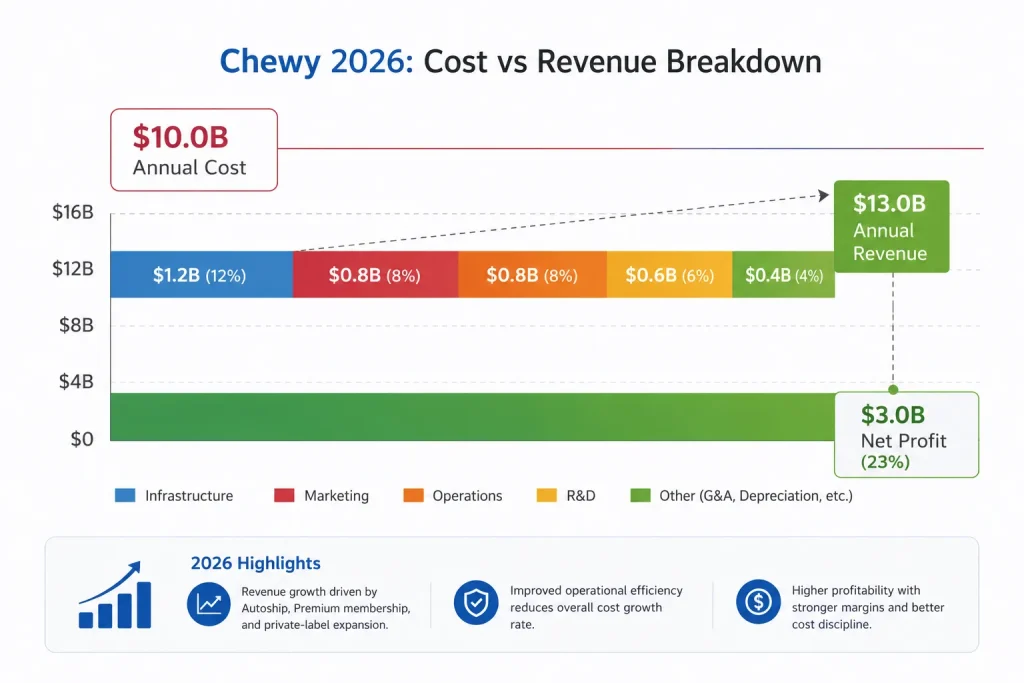
- Infrastructure: Warehouses, fulfillment (~11%)
- Marketing & CAC: Paid ads, onboarding (~7–8%)
- Operations: Support, returns (~6%)
- R&D: Personalization, logistics tech (~4%)
Unit Economics Insight:
Each retained Autoship customer reduces CAC impact by over 35% within 12 months.
Read More: Best Chewy Clone Script 2025 –Build a Pet-Care Ecommerce Platform
Miracuves Chewy-Like Pet Commerce Platform Solution Cost and Tech Stack
Miracuves Pricing for a Chewy-Like Pet Commerce Platform developed using Node.js / React.js Architecture is available on request. Contact Miracuves for custom pricing based on ecommerce workflows, subscription features, logistics modules, healthcare add-ons, and deployment scope. Estimated delivery timeline: 30 to 90 Days.
Build a scalable pet ecommerce and subscription platform designed for pet food, medicines, accessories, wellness products, repeat orders, and customer loyalty.
- Core Workflows: Product catalog, pet profiles, cart, checkout, order tracking, subscription orders, repeat delivery, and customer accounts.
- Built-in Commerce: Online payments, discount logic, subscription billing, inventory management, seller/vendor control, and revenue tracking.
- Management Hub: Admin dashboard, product management, customer data, order analytics, delivery control, and promotional campaign tools.
- Enterprise-Ready: Fully customizable architecture prepared for large catalogs, recurring orders, pet healthcare expansion, and long-term ecommerce growth.
Why does a Chewy-Like Platform require Node.js / React.js architecture?
A Chewy-like business is more than a normal ecommerce store. It needs repeat ordering, subscription logic, personalized recommendations, inventory control, delivery tracking, and customer retention systems.
We recommend a modern JavaScript-based architecture because:
- Built for Scalable Commerce Operations: Node.js handles product browsing, checkout events, subscriptions, inventory updates, and high-volume order activity.
- Advanced Shopping Experience: React.js supports smooth product discovery, pet profile flows, subscription dashboards, personalized recommendations, and fast checkout experiences.
- Subscription & Retention Ready: This architecture supports auto-ship orders, loyalty programs, wellness bundles, recurring billing, and personalized pet care journeys.
- Flexible Integration Layer: Easily integrates with payment gateways, delivery partners, CRM tools, inventory systems, analytics platforms, and AI recommendation engines.
You get a scalable, enterprise-grade pet commerce foundation designed for modern ecommerce growth.
Note: Final pricing depends on subscription features, product catalog size, logistics workflows, healthcare modules, integrations, and custom development requirements.
Future Revenue Opportunities & Innovations
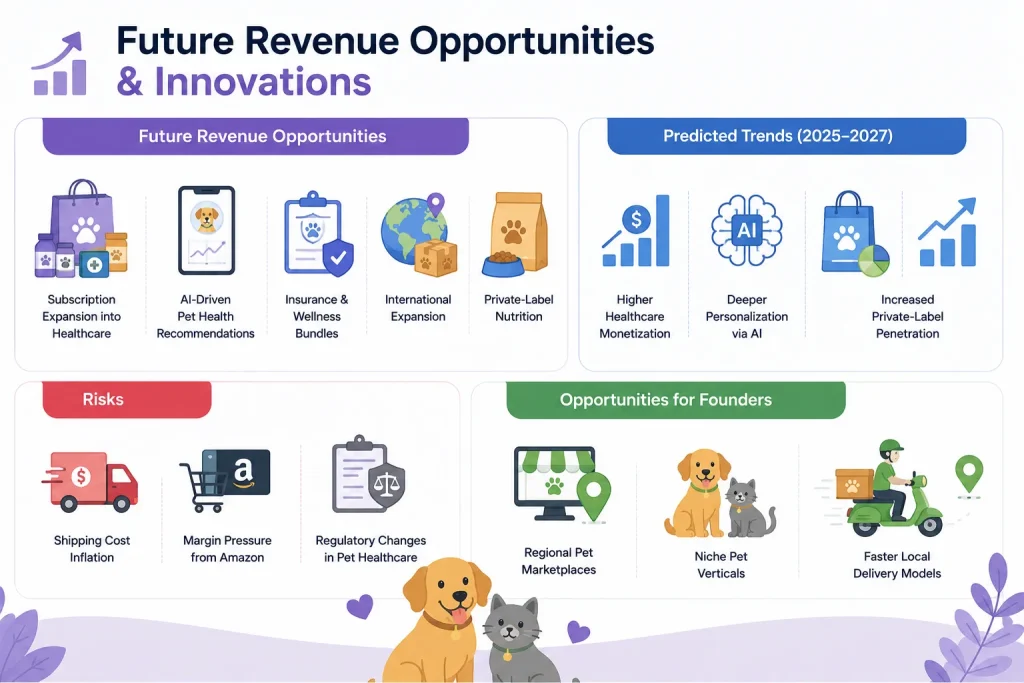
Chewy’s growth is shifting toward services and intelligence.
- Subscription expansion into healthcare
- AI-driven pet health recommendations
- Insurance and wellness bundles
- International expansion
- Private-label nutrition
Predicted Trends (2025–2027):
- Higher healthcare monetization
- Deeper personalization via AI
- Increased private-label penetration
Risks:
- Shipping cost inflation
- Margin pressure from Amazon
- Regulatory changes in pet healthcare
Opportunities for Founders:
- Regional pet marketplaces
- Niche pet verticals
- Faster local delivery models
Lessons for Entrepreneurs & Your Opportunity
What Works:
- Subscription-first design
- Consumable-driven retention
- Emotional brand loyalty
What to Replicate:
- Autoship-style recurring orders
- Predictable demand modeling
- Personalized lifecycle targeting
Market Gaps:
- Emerging markets
- Pet services aggregation
- Local fulfillment optimization
Founder Improvements:
- Lower logistics overhead
- Faster onboarding
- Smarter subscription UX
Final Thought
Chewy proves that loyalty beats discounts in modern eCommerce. Rather than competing solely on price, the company invests heavily in customer experience, reliable delivery, and emotional brand connection with pet owners. This loyalty-driven strategy reduces churn, increases repeat purchases, and creates long-term value that short-term discounts cannot sustain.
Its subscription-led approach turns everyday purchases into predictable revenue. Programs like Autoship smooth demand cycles, improve inventory planning, and significantly increase customer lifetime value by locking in repeat orders. As a result, Chewy benefits from stable cash flows and lower marketing costs over time, even in competitive product categories.
For founders, Chewy is a masterclass in building defensible, recurring commerce. It demonstrates how subscriptions, consumable products, and trust-based branding can form strong competitive moats that are difficult for new entrants to break. Entrepreneurs who apply these principles can create scalable platforms that monetize consistently while maintaining high customer satisfaction.
FAQs
1. How much does Chewy make per transaction?
Margins average 25–30% depending on category.
2. What’s Chewy’s most profitable revenue stream?
Autoship subscriptions combined with private labels.
3. How does Chewy’s pricing compare to competitors?
More competitive than Petco, more loyal than Amazon.
4. What percentage does Chewy earn from products?
Typically 20–35% gross margin.
5. How has Chewy’s revenue model evolved?
Shifted from growth-first to retention-first after 2022.
6. Can small platforms use similar models?
Yes, especially in niche pet categories.
7. What’s the minimum scale for profitability?
Around 30k–50k active subscribers.
8. How to implement similar revenue models?
Start with subscriptions, then layer private labels.
9. What are alternatives to Chewy’s model?
Marketplace commissions or membership fees.