

Key Takeaways
- Boring B2B clone software can generate stronger revenue than viral consumer apps because it solves direct business problems.
- Founders do not always need massive downloads when a smaller group of paying business users creates predictable income.
- Subscriptions, licensing, workflow automation, admin control, and white-label deployment are core monetization layers.
- Success depends on niche demand, operational value, retention, pricing clarity, and business willingness to pay.
- A focused B2B clone platform can help startups build cleaner revenue with less dependency on consumer virality.
Business Signals
- Business users need role-based access, workflow tools, reporting, secure payments, and clear productivity gains.
- Founders need niche positioning, subscription plans, usage tracking, onboarding flows, and revenue analytics.
- Admins need control over users, permissions, billing, features, reports, support, and platform settings.
- White-label B2B software helps companies launch faster without building every operational module from scratch.
- Notifications keep teams updated on tasks, payments, approvals, renewals, usage limits, and workflow activity.
Real Insights
- Consumer apps often chase attention, while B2B platforms win by becoming useful inside daily operations.
- Boring software becomes valuable when it reduces manual work, improves visibility, or helps businesses earn more.
- Clear pricing, measurable ROI, and workflow fit make B2B users more likely to pay repeatedly.
- The strongest clone software opportunities are often hidden in industries with repetitive operational pain.
- Miracuves builds B2B clone software with white-label deployment, subscriptions, workflow automation, analytics, and admin control.
Use this more natural version:
Everyone wants to build the next viral consumer app.
That is the problem.
The founder fantasy is predictable. Build something social. Make it addictive. Get creators. Push referrals. Wait for network effects. Raise money. Scale. Win.
In reality, most consumer app ideas walk straight into an acquisition bloodbath. They compete for attention against platforms with larger budgets, better recommendation systems, deeper creator ecosystems, and years of user behavior data. A founder entering that game with a small team is not usually making a bold move. They are often volunteering to buy traffic in the most expensive casino on the internet.
The more interesting opportunity is not glamorous. It does not trend on the App Store. It does not get founder Twitter excited.
It is boring B2B clone software.
Think localized logistics dashboards, multi-vendor operations trackers, workspace scheduling platforms, procurement request systems, equipment booking tools, field-service coordination apps, and niche workflow platforms that remove daily friction for businesses.
For founders comparing software development paths, this is where ready-made and white-label clone app solutions become useful. Instead of rebuilding every panel, dashboard, workflow, and backend module from zero, a founder can start with a proven product foundation and customize it around a specific B2B pain point.
That is where the boring software premium lives.
The App Store Consumer Graveyard: Why B2C App Budgets Bleed Cash
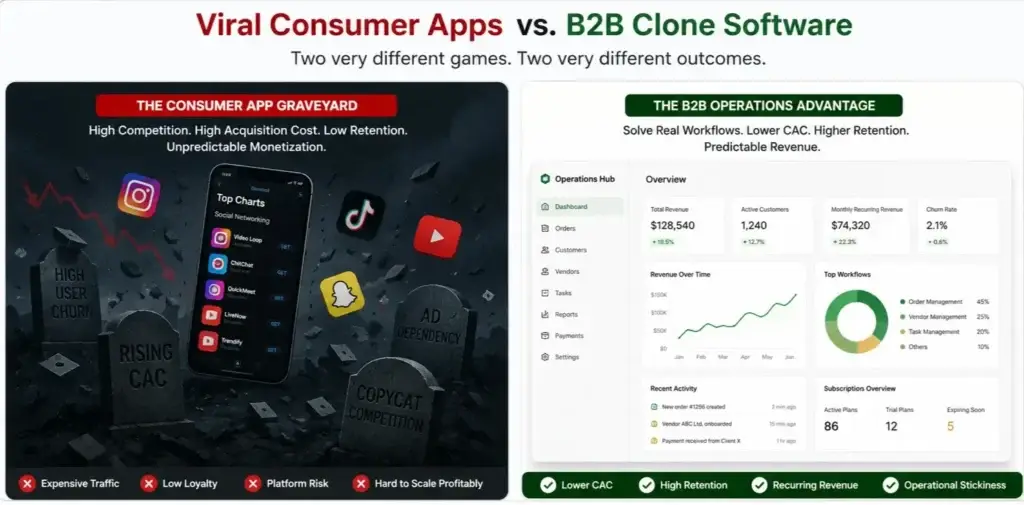
Consumer apps are seductive because they look simple from the outside.
A video feed looks simple. A marketplace looks simple. A dating app looks simple. A delivery app looks simple. But the visible product is not the business. The business is acquisition, liquidity, retention, trust, moderation, payments, operations, and repeat usage.
A viral consumer clone usually fights three wars at once.
First, it fights for attention. The user already has default habits. They already scroll, order, watch, chat, date, and shop somewhere else. To break that habit, the new app must either be dramatically better, dramatically cheaper, or dramatically more relevant to a specific local market.
Second, it fights for liquidity. A marketplace without enough users feels empty. A creator app without creators feels dead. A delivery app without merchants and delivery partners feels unreliable. Consumer apps often need multiple sides of the market to wake up at the same time.
Third, it fights for monetization. Ads need scale. Subscriptions need trust. Commissions need transaction volume. Premium features need strong perceived value. A consumer app can show exciting user growth and still struggle to produce disciplined revenue.
That is why “trending app” thinking is dangerous for serious founders. A trend tells you where attention is. It does not tell you where margin is.
Read More: A Comprehensive Guide to Building Your Own Platform
Why “Top Trending App Ideas” Can Be a Commodity Trap
The classic app idea list usually says the same thing: build a short video app, ride-hailing app, food delivery app, dating app, grocery app, or social platform.
Those categories can work, but the lazy version of that strategy is weak. If the only reason to build something is that a popular app already exists, the founder has not found a business. They have found a visual reference.
The stronger question is:
What expensive operational problem can this software pattern solve for a specific business buyer?
That question changes everything.
A delivery app is not just a food delivery idea. It can become a B2B route allocation system for local distributors.
A marketplace app is not just an ecommerce idea. It can become a vendor procurement platform for industrial suppliers.
A scheduling app is not just a calendar product. It can become a workspace allocation engine for coworking operators, clinics, training centers, or corporate campuses.
A messaging app is not just chat. It can become a secure coordination layer for field teams, support teams, or service providers.
That is the shift founders need to make. Stop copying consumer behavior. Start cloning proven operational logic and applying it to neglected business workflows.
Read More:
Capitalizing on Inefficiency: The Economics of the “Boring Software Premium”
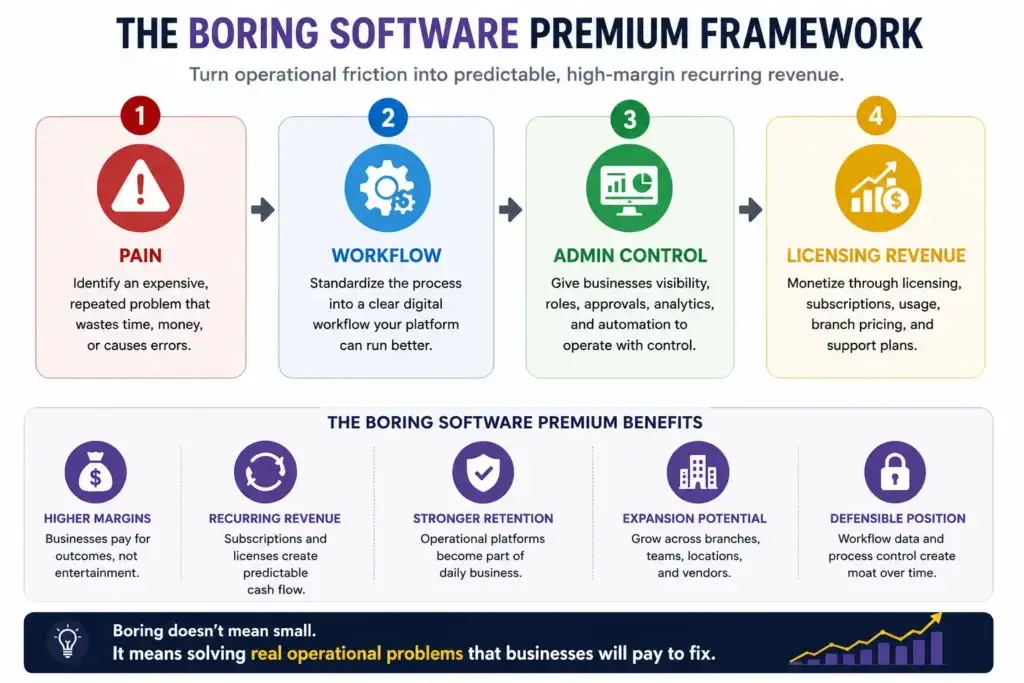
The boring software premium is the extra business value created when software solves an unsexy but expensive workflow problem.
Most founders underestimate how much businesses will pay to remove friction. A company may not care about a beautiful consumer-style interface if its current process runs through spreadsheets, WhatsApp groups, email chains, manual approvals, or disconnected vendor portals.
B2B buyers often pay for outcomes that consumer users ignore:
| Business Problem | Boring B2B Clone Opportunity | Why It Can Monetize Better |
|---|---|---|
| Manual dispatching | Local logistics tracker | Saves coordinator time and reduces missed deliveries |
| Messy vendor communication | Multi-vendor operations dashboard | Gives procurement teams visibility and control |
| Workspace confusion | Corporate scheduling platform | Reduces admin load and improves asset utilization |
| Field team delays | Service task allocation app | Helps managers assign, track, and verify work |
| Payment and invoice gaps | Order-to-payment workflow system | Improves financial visibility and reduces follow-up |
| Compliance records scattered across tools | Role-based document workflow | Creates audit-friendly operational control |
The point is not that every B2B clone becomes huge. The point is that many of them do not need mass consumer adoption to become valuable. They need a clear buyer, a painful workflow, a practical software base, and a pricing model that matches business value.
A B2B product can win with fewer customers if each customer pays more, stays longer, and expands usage across teams, branches, departments, or partners.
That is a very different game from chasing millions of low-intent consumer downloads.
Read more: Best Midjourney Clone Scripts 2026 for AI Image Generator App Development
Enterprise Licensing Beats Hope-Based Consumer Monetization
Consumer monetization often begins with hope.
Hope that users keep coming back. Hope that ads perform. Hope that creators join. Hope that subscriptions convert. Hope that referral loops work. Hope that paid acquisition does not destroy the margin.
B2B monetization can be more direct.
A useful operational platform can charge through:
| Revenue Model | How It Works | Founder Advantage |
| Monthly licensing | Businesses pay for access each month | Predictable recurring revenue |
| Per-branch pricing | Pricing grows with locations or business units | Expansion without changing the core product |
| Per-user pricing | Teams pay based on active staff or managers | Revenue scales with internal adoption |
| Setup and customization fee | One-time fee for branding, workflows, and integrations | Helps recover implementation effort |
| Support and maintenance plans | Ongoing support for updates and operational continuity | Creates post-launch revenue |
| Transaction or usage fee | Platform earns from bookings, orders, or processed activity | Aligns revenue with customer usage |
This is why boring software can outperform loud consumer products. The buyer is not paying for entertainment. They are paying because the software helps the business run.
That difference matters.
Entertainment must be constantly earned. Operational software becomes part of the workday.
Why B2B Clone Software Is Often More Defensible Than Consumer Clones
Consumer clones are easy to compare. Users can delete one app and move to another in seconds.
B2B clone software becomes harder to replace when it controls workflow memory.
Once a company runs scheduling, dispatch, vendor approvals, reporting, payments, and staff roles through a platform, switching becomes an operational decision. The software is not just a screen. It becomes a control layer.
That control layer includes:
- User roles and permissions
- Admin dashboards
- Branch or location management
- Vendor or partner records
- Task histories
- Booking or order logs
- Payment records
- Reports and analytics
- Internal approval flows
- Notifications and escalation rules
- Secure access controls
- Audit logs where relevant
This is where a ready-made B2B clone software foundation becomes powerful. The core structure already exists, but the founder can customize the workflows around a specific niche.
A generic consumer app asks, “Can we get users?”
A strong B2B clone asks, “Can we become the operating system for this workflow?”
That is a much better question.
Read More: Best HungryPanda Clone Scripts 2025 for Food Delivery App Development
What “Boring” B2B Clone Software Actually Looks Like
Boring does not mean low quality.
Boring means the product is not built for applause. It is built for execution.
Here are examples of practical B2B clone software categories founders should study:
| B2B Clone Category | Example Use Case | Ideal Buyer |
| Logistics tracker | Local distributor delivery and route visibility | Transport operators, wholesalers, regional delivery firms |
| Multi-vendor operations platform | Vendor onboarding, orders, approvals, and payouts | Procurement teams, B2B marketplaces, managed service operators |
| Workspace scheduling app | Desk, room, equipment, or facility booking | Coworking spaces, corporate offices, training centers |
| Field service coordination app | Assign jobs, track staff, collect proof of work | Maintenance companies, home service brands, facility managers |
| Appointment and resource platform | Booking, staff schedules, reminders, and records | Clinics, consultants, education centers, wellness operators |
| Internal request management system | Approvals, tickets, task routing, and status tracking | SMEs, agencies, manufacturers, distributed teams |
These are not glamorous. That is the advantage.
The less glamorous the workflow, the less likely every consumer-app founder is crowding the space.
How a Flutter and Laravel Base Changes the Launch Math
A pre-built Flutter and Laravel foundation can be a practical base for B2B clone software because it supports speed, flexibility, and multi-platform execution.
Flutter helps founders build cross-platform mobile experiences from a shared codebase. Laravel gives a structured backend foundation for dashboards, APIs, business logic, and admin workflows. The pairing works well for operational platforms because most B2B products need both mobile access and backend control.
A strong B2B clone software base should support:
- Mobile apps for users, staff, vendors, drivers, providers, or partners
- Web dashboards for managers and admins
- Role-based access control
- Workflow-specific modules
- Payment or invoice integration where needed
- Notifications and activity logs
- Reporting and analytics
- API-ready architecture
- Custom branding
- Source-code ownership
- Future customization
Miracuves helps founders build ready-made and white-label app solutions with source code, admin control, branded design, and faster deployment. For B2B clone software, this matters because the founder is not just launching screens. They are launching an operational product foundation.
Read More: Mobile App Development Cost Breakdown for Startups
How White-Label Operations Engines Capture Instant B2B Market Share
White-label B2B software works best when the founder already understands a niche.
The opportunity is not to sell “software to everyone.” That is weak positioning.
The opportunity is to sell a specialized operations engine to a narrow buyer group with a clear pain.
For example:
A generic scheduling app is forgettable.
A scheduling and resource allocation platform for diagnostic centers is more specific.
A logistics dashboard is useful.
A localized cold-chain delivery tracker for regional food distributors is sharper.
A marketplace platform is broad.
A managed vendor ordering system for construction suppliers is more commercially focused.
That specificity makes sales easier. The landing page becomes clearer. The demo becomes more relevant. The feature roadmap becomes more disciplined. The buyer sees their workflow in the product faster.
This is the opposite of viral consumer thinking. You are not trying to be loved by everyone. You are trying to become necessary to a narrow operational buyer.
Founder Decision Signals
Founder Decision Signals
Speed
Choose a ready-made B2B clone foundation when the workflow is already proven and the main advantage is faster niche adaptation, not inventing every module from zero.
Cost
B2B clones can be more cost-efficient because founders focus customization budget on workflows, dashboards, integrations, and buyer-specific value instead of rebuilding standard app flows.
Scalability
Look for role-based dashboards, API-ready backend logic, reporting, and source-code ownership so the product can evolve as customers add branches, teams, vendors, or locations.
Market Fit
A strong signal is when buyers already use spreadsheets, email, or disconnected tools to manage the workflow and can clearly explain what delay, error, or manual work costs them.
The Real B2B Clone App Formula: Pain, Workflow, Control, Licensing
The best B2B clone software ideas usually follow a simple formula.
Pain is the expensive problem. Workflow is the repeated process. Control is the dashboard layer. Licensing is the monetization model.
If one of these is missing, the product becomes weaker.
A founder should not start with “I want to build an app.” That is too vague.
Start with:
“What workflow is painful enough that a business will pay to organize it?”
Then ask:
Can the workflow be repeated across many similar businesses?
Can a ready-made software base handle the core modules?
Can the product be branded and localized?
Can the admin panel give the buyer enough control?
Can the pricing model expand as the buyer grows?
Can the software become part of daily operations?
This is how B2B clone app development becomes a strategic play rather than a copycat idea.
Consumer Clone vs B2B Clone: The Founder-Level Difference
| Factor | Viral Consumer Clone | Boring B2B Clone Software |
| Primary challenge | Attention and retention | Workflow adoption and buyer trust |
| Buyer/user | Individual consumers | Businesses, teams, operators, managers |
| Monetization | Ads, subscriptions, commissions, upgrades | Licensing, setup fees, branch pricing, support, usage fees |
| Sales motion | Broad marketing and paid acquisition | Targeted outbound, partnerships, niche demos |
| Product value | Entertainment, convenience, social behavior | Time savings, visibility, control, compliance support, operational efficiency |
| Risk | High churn and expensive acquisition | Longer sales cycle but stronger stickiness |
| Better for | Founders with strong consumer growth engine | Founders with niche insight and B2B distribution access |
The aggressive truth is simple: most founders do not have a consumer growth engine.
They have a product idea.
That is not enough.
If you do not have audience access, creator supply, paid acquisition discipline, retention loops, or marketplace liquidity, then chasing viral hits is not strategy. It is theater.
A narrow B2B workflow may look smaller, but it can be more executable.
Read More: EdTech App Development Guide
What Founders Should Build Instead of Another Viral App
Founders should look for B2B workflows where the buyer already has budget, pain, and urgency.
Strong categories include:
Localized Logistics and Delivery Operations
Regional logistics operators often need order tracking, driver allocation, proof of delivery, route visibility, customer updates, and admin reporting. A white-label logistics tracker can serve local delivery companies, distributors, courier businesses, or specialized delivery verticals.
Relevant Miracuves internal path: founders can explore the broader Miracuves solutions hub to identify ready-made delivery, logistics, and operations-style foundations.
Multi-Vendor B2B Marketplaces
Many industries still run supplier discovery, quote requests, order approvals, and vendor communication manually. A B2B marketplace clone can be adapted for procurement, wholesale, construction materials, medical supplies, equipment, or business services.
The money is not only in transactions. It can also come from vendor subscriptions, featured listings, quote management, premium dashboards, and support plans.
Corporate Workspace and Resource Scheduling
Hybrid offices, training centers, clinics, coworking brands, and enterprise campuses need scheduling logic. A workspace scheduling platform can manage rooms, desks, equipment, staff, visitors, and approval flows.
This is exactly the kind of product that sounds boring until a buyer realizes it removes daily administrative friction.
Field Service and Workforce Coordination
Home services, facility management, repairs, inspection teams, installation crews, and maintenance businesses need task assignment, status updates, staff tracking, proof of work, customer communication, and admin reporting.
A clone foundation with provider, customer, and admin workflows can be adapted into a niche B2B field operations product.
Finance, Wallet, and Payment Workflow Platforms
Some B2B products need wallet logic, transaction records, vendor payouts, remittance flows, or payment tracking. Founders exploring regulated or finance-adjacent workflows should study the fintech app development ecosystem and build with compliance-ready workflows rather than treating security as an afterthought.
Read More: Comprehensive Guide to Custom OTT App Development
Security and Admin Control Are Not Optional in B2B Software
B2B buyers care about control.
They want to know who can access what, which manager approved what, where records are stored, how reports are generated, and whether the platform can support internal accountability.
A strong B2B clone software foundation should include practical security and control layers such as:
- Role-based access control
- Permission-based dashboards
- Secure API integration
- Encrypted data transfer
- Encrypted data storage
- Activity logs
- Audit logs where relevant
- Admin approval controls
- Vendor or provider verification
- Payment gateway integration
- Dispute or issue management
- Privacy-conscious data handling
For regulated industries, final compliance depends on jurisdiction, legal review, integrations, and the operating model. The product foundation can support compliance workflows, but founders should not treat software alone as legal approval.
Read More: Ultimate Guide to Custom iOS App Development Services
Why Source-Code Ownership Matters More in B2B Than B2C
Source-code ownership is not just a technical preference. It is a business control issue.
In B2B software, the product may need custom workflows, private integrations, data migration, reporting changes, role updates, and enterprise-specific deployment requirements. If the founder cannot control the codebase, the business may become dependent on the original vendor for every serious change.
That is dangerous.
A source-code-owned app solution gives founders more flexibility to:
- Customize workflows for niche buyers
- Add integrations requested by enterprise customers
- Improve security and access logic
- Move hosting or infrastructure when required
- Extend modules for new verticals
- Bring in internal developers later
- Reduce long-term vendor lock-in risk
This is why Miracuves’ white-label app approach is especially relevant for B2B clone software. The founder needs a launch-ready base, but also enough ownership to adapt the product around real customer requirements.
Read More: Mobile App Development from Scratch : The Ultimate Guide
Mistakes Founders Should Avoid
Mistake 1: Choosing an App Category Before Choosing a Buyer
A category is not a strategy. “Logistics app” is not enough. “Scheduling app” is not enough. “Marketplace app” is not enough.
The stronger move is to define the buyer first. A scheduling platform for coworking spaces has different workflows than one for clinics, schools, or corporate offices.
Mistake 2: Building for Everyone
Horizontal software sounds larger, but it often creates vague messaging. B2B buyers respond faster when the product feels built for their operating reality.
Narrow positioning is not a weakness. It is a sales advantage.
Mistake 3: Ignoring the Admin Dashboard
In consumer apps, the front-end experience gets most of the attention. In B2B clone software, the admin dashboard is often the business.
The admin layer controls users, roles, vendors, workflows, approvals, payments, reports, disputes, and configuration. Weak admin control creates support dependency and scaling friction.
Mistake 4: Renting a Product Future
Some white-label models give branding flexibility but not real control. Founders should understand what they own, what they can customize, what support includes, and what happens if they want to expand the platform later.
Mistake 5: Treating B2B Sales Like Consumer Growth
B2B clone software does not need viral loops first. It needs demos, sales conversations, niche proof, buyer education, and workflow ROI.
The go-to-market motion should match the buyer.
How Miracuves Helps Founders Launch B2B Clone Software Faster
Miracuves helps founders, startups, agencies, and venture builders launch ready-made and white-label app solutions with source-code ownership, branded design, admin control, and monetization-ready workflows.
For founders exploring boring B2B clone software, the advantage is practical. You do not need to build every user panel, admin flow, authentication process, dashboard, notification system, or backend module from zero. You can start with a ready-made foundation and customize it around the workflow that matters.
That could mean a localized logistics tracker, a B2B vendor platform, a service marketplace, a corporate scheduling app, a delivery operations platform, or a niche workflow tool.
Pricing depends on features, integrations, tech stack, customization, and launch scope. For ready-made Miracuves solutions, a 6-day launch can be relevant when the selected foundation and customization scope fit the deployment model.
Final Thoughts: Boring Is Not Small. Boring Is Focused.
The next serious founder opportunity may not look viral.
It may look like a dashboard that helps a regional distributor stop losing track of deliveries. It may look like a booking system that helps clinics manage rooms and staff. It may look like a vendor portal that helps procurement teams stop drowning in spreadsheets. It may look like a field-service workflow that helps managers know what is happening without calling five people.
That is not boring in business terms.
That is useful.
The strongest founders do not chase applause. They chase pain, budget, workflow, and control. B2B clone software gives them a practical way to turn proven app patterns into specialized operating systems for real businesses.
For founders planning to launch faster, Miracuves offers ready-made and white-label app foundations that can be customized around niche B2B workflows, source-code ownership, admin control, and monetization-ready execution.
FAQs
What is B2B clone software?
B2B clone software is a ready-made or customizable software foundation based on proven business workflows. Instead of copying a consumer app for mass users, it adapts app logic for business use cases such as logistics, scheduling, vendor management, field service, procurement, or internal operations.
Why are boring B2B clones often more profitable than viral consumer apps?
Boring B2B clones can monetize through licensing, setup fees, support, branch pricing, and usage-based models. They do not always need massive consumer traffic to become valuable. They need a clear buyer, a painful workflow, and enough operational value to justify payment.
What are examples of boring B2B clone software ideas?
Examples include logistics tracking platforms, multi-vendor operations dashboards, corporate workspace scheduling apps, field-service coordination tools, procurement marketplaces, resource booking systems, and internal approval workflow platforms.
Is white-label B2B software better than custom development?
White-label B2B software is often better when the founder wants to launch faster using a proven product foundation. Custom development may be better when the workflow is highly unique, technically complex, or requires a completely new architecture. The right choice depends on scope, budget, integrations, and control requirements.
Why does source-code ownership matter for B2B clone software?
Source-code ownership gives founders more control over future customization, integrations, hosting, security improvements, and product expansion. This is especially important in B2B software because enterprise customers may request workflow changes, reporting logic, access controls, or private integrations.
Can a Flutter and Laravel base support B2B clone app development?
Yes, a Flutter and Laravel base can be suitable for many B2B clone app projects. Flutter supports cross-platform mobile development, while Laravel can support backend workflows, dashboards, APIs, and admin logic. The final suitability depends on the product scope and customization requirements.
How should founders choose a B2B clone software idea?
Founders should start with buyer pain. Look for workflows that businesses still manage through spreadsheets, email, disconnected tools, or manual coordination. The strongest ideas have a clear buyer, repeated workflow, measurable friction, and a monetization model tied to business value.
How fast can Miracuves launch a B2B clone software solution?
For ready-made Miracuves solutions, a 6-day launch may be possible when the selected foundation and customization scope are aligned. Final timelines depend on features, integrations, branding, workflow changes, and deployment requirements.
Miracuves is an independent software development company. We are not affiliated with, connected to, sponsored by, or endorsed by any company or product named in this article.
Terms such as “X Clone” are used descriptively. It is how the software industry refers to building a platform with functionality comparable to a known service, and how clients search for it.
The entire design and codebase of our products is built by our own team. Our products contain no code, design, graphics, or content originating from any third-party website or applications.
All third-party names and marks referenced in this article are the property of their respective owners, referenced solely to identify the services discussed.