


Imagine you’re planning a weekend trip and suddenly realize you need everything at once — flights, a hotel, airport transfer, and maybe even attraction tickets after you land. Normally, that means opening five different apps, comparing prices across tabs, and hoping your bookings actually line up.
That’s exactly where Traveloka becomes useful.
Traveloka is designed to bring your whole trip into one place. On its official platform, it offers flights, accommodations, airport transfers, car rentals, attractions and activities, and other travel services through the same app and website. Traveloka describes itself as a travel platform where users can manage their entire trip in one app.
How Traveloka Started and Why It Matters
Traveloka describes itself as Southeast Asia’s leading travel platform, and its official About page says the company provides a wide range of travel, local service, and financial service products through its app and website. That broader positioning matters because Traveloka is no longer just a flight-booking app — it has grown into a full travel ecosystem.
According to Traveloka’s official company profile, the platform now works with more than 250 airline partners, offers access to over 2.2 million accommodations in more than 100 countries, includes more than 90,000 travel activities, supports over 2,000 car rental and airport transfer providers, and reports 40 million plus monthly active users and 140 million plus app downloads. Those numbers explain why Traveloka has become such a major name in travel across Southeast Asia and beyond.
What You’ll Learn in This Guide
By the end of this guide, you’ll clearly understand what Traveloka is, how Traveloka works for travelers, how the platform makes money, which features make it successful, what technology powers the experience, and why many businesses want to build similar all-in-one travel platforms. Traveloka’s current product mix already points to that bigger opportunity because it spans transportation, accommodation, activities, and payment flexibility inside one connected system.
What Is Traveloka? The Simple Explanation
What Is Traveloka ?
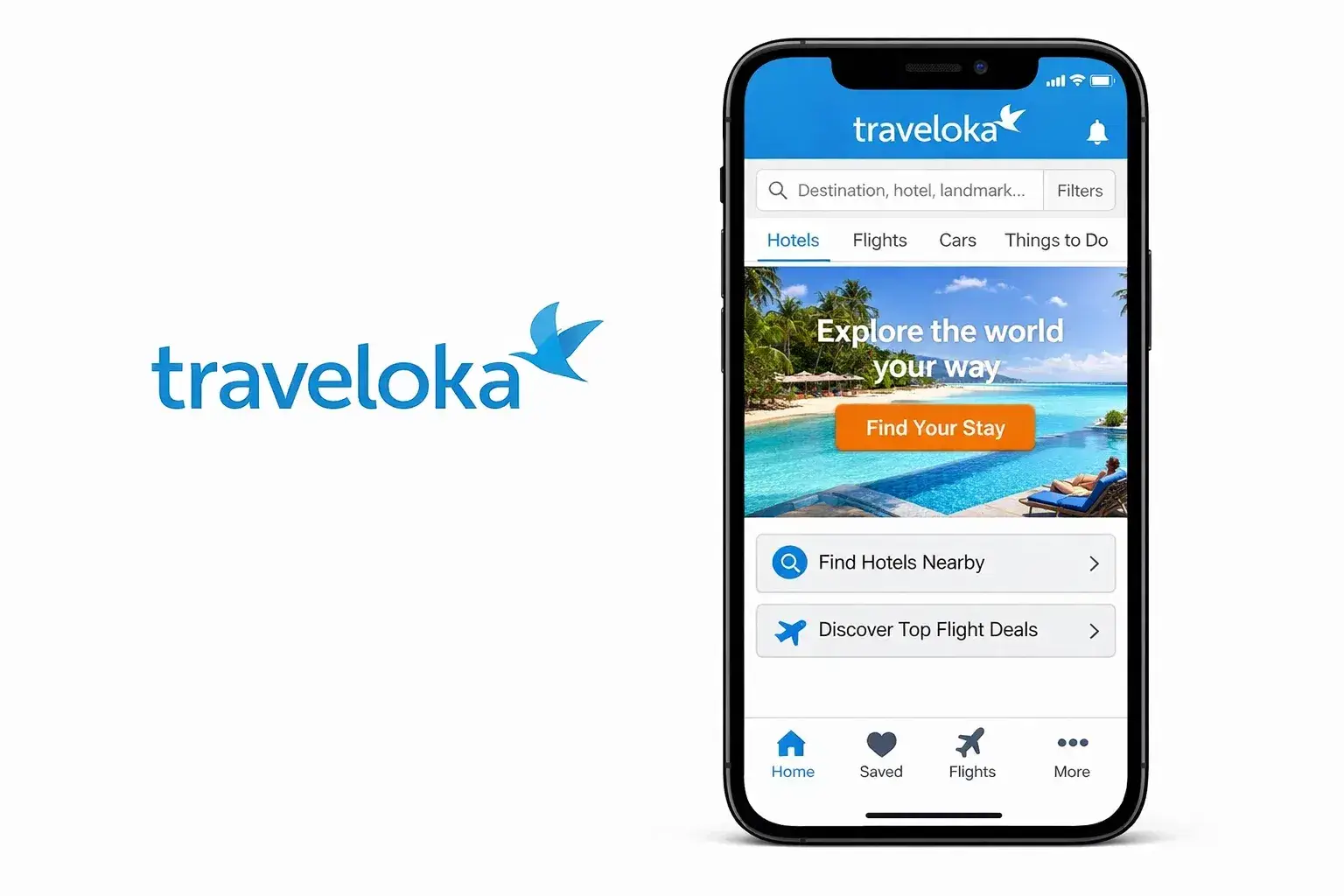
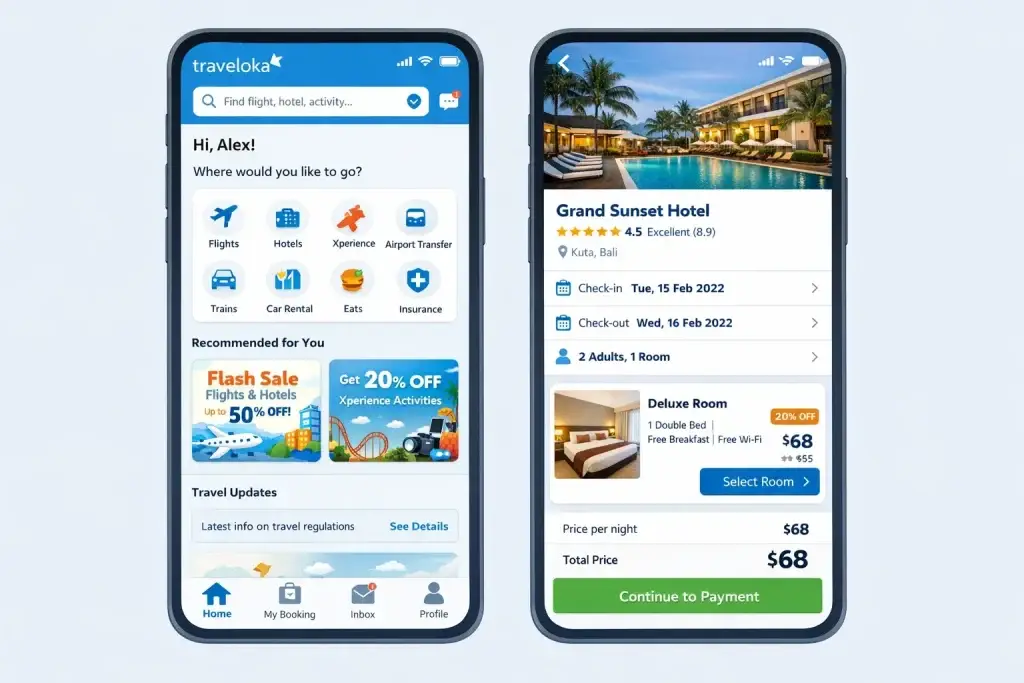
Traveloka is an all-in-one travel booking platform that helps people search, compare, and book flights, hotels, airport transfers, car rentals, attractions, and other travel services in one place. Instead of using separate apps for each part of a trip, users can plan and manage most of their journey inside the Traveloka app or website. Traveloka itself positions the product as a platform for managing your whole trip in one app.
The Core Problem Traveloka Solves
Travel planning is often messy. A traveler might book a flight on one site, a hotel on another, then use a third app for airport transfer and a fourth for local activities. That creates confusion, wasted time, and a higher chance of pricing surprises or booking mistakes.
Traveloka solves that by combining multiple travel categories into one platform. On its official site, the platform includes flights, accommodations, airport transfers, car rentals, and attractions and activities, which makes it easier for users to handle trip planning in a single workflow.
In simple terms, Traveloka makes travel planning faster, cleaner, and more convenient.
Who Uses Traveloka?
Traveloka serves several major user groups:
• Leisure travelers booking holidays and short trips
• Families planning end-to-end travel in one app
• Budget-conscious travelers comparing options
• Frequent flyers who need transport and stays regularly
• Users booking local attractions and experiences after arrival
Because the platform covers more than just flights or hotels, it is useful for both simple and more complex travel planning. Traveloka’s official company page also highlights travel, local services, and financial-service-related features, which shows how broad the platform has become.
Traveloka’s Market Position
Traveloka is one of the biggest travel platforms in Southeast Asia. On its official About page, the company says it has more than 40 million monthly active users, over 140 million app downloads, partnerships with more than 250 airlines, access to 2.2 million+ accommodations in 100+ countries, more than 90,000 travel activities, and over 2,000 car rental and airport transfer providers.
That scale matters because it shows Traveloka is no longer a niche booking site. It operates more like a regional travel super app.
Why Did Traveloka Become So Successful?
Traveloka became successful because it simplified a real travel pain point: too many disconnected bookings.
Its growth comes from a few strong advantages:
• One app for multiple travel needs
• Strong airline and hotel inventory
• Extra services like transfers and attractions
• Large regional brand recognition
• High mobile adoption across its target markets
Traveloka’s current company profile supports that story directly through its reported scale, partner network, and monthly active users.
What Makes Traveloka Different from Traditional Travel Booking?
Traditional travel booking usually means using separate platforms for transport, stays, and local activities. Traveloka turns that into a connected booking experience.
What makes it stand out is that it does not stop at flight or hotel search. It brings together booking, trip support, and add-on services inside one ecosystem, which is exactly why many travelers prefer it for convenience.
How Does Traveloka Work? Step-by-Step Breakdown
Traveloka works like a connected travel marketplace. Instead of sending users to separate sites for flights, hotels, transfers, and activities, it keeps those services inside one app and website. On its official platform, Traveloka currently offers flights, accommodations, airport transfers, car rentals, and attractions and activities, while also giving users flexible booking options, secure payments, and booking management tools.
How Traveloka Works for Travelers
Account Setup and Search
• Users open the Traveloka app or website and choose the product they need, such as flights, hotels, airport transfer, car rental, or things to do
• They enter travel details like destination, dates, passenger count, or pickup information depending on the service
• Search results show available options that users can compare by price, schedule, location, and features
Traveloka’s current homepage positions this clearly as one place for multiple travel needs rather than a single-category booking tool.
Booking Flights
• Travelers search routes, travel dates, and passenger details
• They compare airline options and prices from Traveloka’s airline network
• After choosing a flight, they enter passenger details, review the fare, and complete payment
• Once booked, the e-ticket is stored inside the account and can be managed later through My Booking
Traveloka also supports online check-in through its app or website for eligible flights, which means users can go into their e-ticket and complete check-in before arriving at the airport.
Booking Hotels and Accommodations
• Users search by city, dates, and guest count
• They compare hotel or accommodation options by price, location, room type, and availability
• After selecting a property, they confirm guest details and payment
• The booking then appears in their Traveloka account for later access and management
Traveloka says it offers more than 2.2 million accommodations in over 100 countries, which is a big reason the hotel side of the platform feels so broad. # Booking Airport Transfers and Cars
• Users choose airport transfer or car services inside the app
• They enter pickup and drop-off locations, travel date, and pickup time
• They then choose a vehicle, review passenger and baggage details, and continue to payment
• After payment is verified, the voucher becomes available in the app or is sent by email
Traveloka’s airport transfer help pages also show that users can choose different transport modes, including private cars, buses, trains, minibuses, or rental-car-style transport depending on location and availability. # Booking Attractions and Activities
• Travelers search local experiences, attractions, and things to do
• They compare ticket options, timing, and offers
• After purchase, vouchers and booking details are stored digitally
This is one of the reasons Traveloka feels more like a full trip app than a flight-only platform. Its official company page says it now offers more than 90,000 travel activities. aging a Booking After Purchase
• Users can log in to see active and past bookings
• They can manage unfinished bookings and access e-tickets or vouchers
• Traveloka’s booking-retrieval pages say users can also manage certain actions like refunds or reschedules from the booking area
That booking-management layer is important because it keeps the post-purchase experience inside the same platform. Traveloka Works Behind the Scenes for Partners
For Airlines, Hotels, and Travel Providers
• Airlines, hotels, car providers, and activity operators connect inventory to Traveloka
• Traveloka displays those options inside its marketplace for users to search and compare
• When a user books, Traveloka processes the booking and sends the confirmed reservation or voucher back to the traveler
Traveloka’s own company page says it works with more than 250 airline partners and more than 2,000 airport transfer and car rental providers, which shows how much of the platform depends on a large partner network. Overview Explained Simply
At a simple level, Traveloka works like this:
• Travel providers supply inventory such as flights, rooms, or transport slots
• Traveloka organizes that inventory into searchable categories inside one app
• Users compare options and pay through Traveloka
• The system issues e-tickets, hotel confirmations, or vouchers
• Users manage the booking later through their account
What makes the model powerful is that the same platform handles both discovery and after-booking management. That reduces friction and keeps the whole travel journey more organized.
Traveloka’s Business Model Explained
Traveloka works like a multi-category online travel platform, and its business model is built around connecting travelers with airlines, hotels, transport operators, and activity providers through one app. Instead of selling only one kind of booking, it earns value across multiple parts of the trip — transport, stays, local experiences, and payment-related services. Traveloka’s official company page says the platform covers flights, accommodations, transport, attractions, local services, and financial-service-related products, which is why its revenue model is broader than a simple hotel-booking site.
How Traveloka Makes Money
• Commissions from hotel and accommodation bookings
• Flight and transport booking margins or partner fees
• Commissions from attractions, airport transfers, and car rentals
• Advertising, campaigns, and promotional visibility for partners
• Financial-service-related revenue through products like PayLater
Because Traveloka sits between the traveler and the supplier, the platform can monetize every time a user books through one of those categories. Its official About page highlights a very large partner network, including 250+ airlines, 2.2 million+ accommodations, 90,000+ activities, and 2,000+ car rental and airport transfer providers.
Accommodation Booking Revenue
Hotels and other stays are one of the strongest parts of Traveloka’s revenue engine. The platform gives users access to hotels, apartments, guest houses, homestays, resorts, and villas, which means it can earn from a very broad accommodation base. Since Traveloka acts as the booking intermediary, it typically benefits from supplier-side commissions or commercial agreements tied to completed reservations. That last part is an inference based on the standard OTA model and Traveloka’s role as a booking platform.
Why It Matters: Accommodation is a high-volume category that gives Traveloka repeated monetization opportunities.
Technical Innovation: Inventory aggregation and availability systems let users compare a very large lodging network inside one interface.
Flight and Transport Revenue
Traveloka also monetizes through transportation bookings, including flights, airport transfers, buses, trains, and car rentals, depending on market availability. The platform’s official pages make it clear that transportation is one of its core product categories.
Why It Matters: Flights often bring users into the app first, then open the door for cross-selling hotels, transfers, and activities.
Technical Innovation: Multi-supplier search and booking flows help Traveloka aggregate schedules, prices, and availability into one purchase journey.
Activities, Transfers, and Add-On Services
Traveloka’s business gets stronger because it does not stop at the main booking. It also offers airport transport, car rentals, and attractions and activities, which creates more monetization points per trip. Its official About page says the platform includes more than 90,000 travel activities and works with more than 2,000 car rental and airport transfer providers.
Why It Matters: Add-on services increase revenue per customer and make the platform more useful end to end.
Technical Innovation: A shared booking system across products lets users combine multiple travel services inside one app instead of switching platforms.
Promotions and Partner Visibility
Traveloka also creates commercial value through promotions and campaign visibility. Its EPIC Sale pages show that the platform regularly runs broad promotional campaigns across hotels, flights, attractions, airport transfers, rentals, and more. That suggests supplier-funded promotions and visibility campaigns are an important part of the ecosystem.
Why It Matters: Promotions attract user demand while giving suppliers a reason to spend more for visibility and conversion.
Technical Innovation: Campaign systems and product merchandising help push targeted offers across categories and markets.
Financial Services and PayLater
Traveloka’s model also extends into financial services. Its official pages include Traveloka PayLater, and the company explicitly describes itself as offering financial-service-related products alongside travel. PayLater can be used across products such as flight tickets, hotel vouchers, and activity tickets.
Why It Matters: Flexible payment options can increase booking conversion and create another revenue stream beyond the booking itself.
Technical Innovation: Embedded travel-finance workflows allow users to book now and pay later without leaving the platform ecosystem.
Market Strength and Scale
Traveloka’s scale supports the model. According to its official About page, the platform has 40 million+ monthly active users and 140 million+ app downloads. That kind of audience makes the business more valuable to airlines, hotels, activity providers, and payment partners because it creates both high traffic and strong repeat usage.
Revenue Model Breakdown
| Revenue Stream | How It Works | Why It Matters |
|---|---|---|
| Accommodation Bookings | Traveloka earns from hotel and stay bookings | High-volume core category |
| Flights and Transport | Revenue comes from flight and mobility bookings | Brings users into the platform |
| Activities and Add-Ons | Attractions, transfers, and rentals add more monetization points | Increases revenue per trip |
| Promotions and Visibility | Partners gain exposure through campaigns and deals | Supports supplier-side spending |
| PayLater and Finance | Flexible payment products support conversion and monetization | Expands beyond pure booking revenue |
Traveloka’s business model works because it is not dependent on one travel category. It monetizes across the whole trip, which is exactly why it has grown into a travel super app rather than staying a single-purpose OTA.
Key Features That Make Traveloka Successful
Traveloka stands out because it is not just a flight-booking app or a hotel app. It combines multiple parts of the travel journey in one platform, including flights, accommodations, airport transfers, car rentals, attractions, and payment flexibility. That connected setup is one of the biggest reasons it has become such a strong travel brand in Southeast Asia.
All-in-One Travel Booking
Traveloka lets users book flights, hotels, airport transfers, car rentals, and activities from the same app or website.
Why It Matters: Travelers do not need to jump between multiple apps to complete one trip.
Technical Innovation: A unified booking system brings different travel inventories into one search-and-payment flow.
Large Partner Network
Traveloka says it works with more than 250 airline partners, over 2.2 million accommodations in 100+ countries, more than 90,000 travel activities, and 2,000+ car rental and airport transfer providers.
Why It Matters: A large supply base gives users more choices and makes the platform more useful across many trip types.
Technical Innovation: Supplier integration systems aggregate inventory from airlines, hotels, transport operators, and activity providers at scale.
Easy Refund and Reschedule
Traveloka actively promotes easy refund and reschedule support on its live platform and app messaging.
Why It Matters: Travel plans change often, so flexibility reduces booking anxiety and improves trust.
Technical Innovation: Post-booking management workflows allow travelers to adjust certain bookings without leaving the platform ecosystem.
Instant Notifications and Alerts
Traveloka highlights instant notifications and trip alerts as a core app benefit.
Why It Matters: Travelers need quick updates about booking status, flight changes, and important trip details.
Technical Innovation: Real-time push notification systems keep users informed throughout the travel journey.
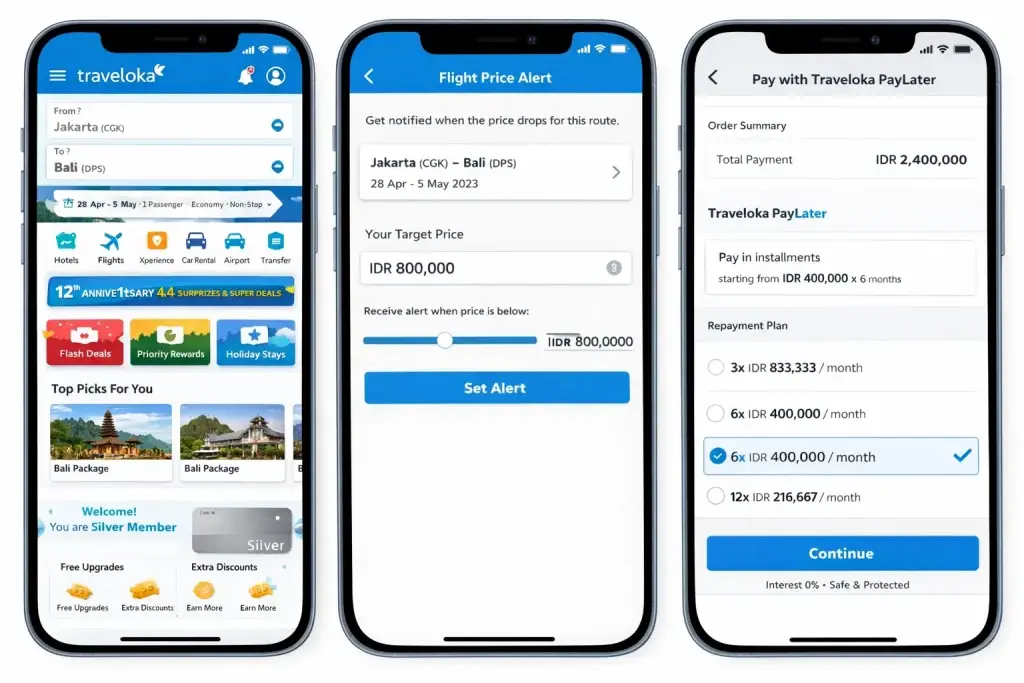
Flight Price Alerts
Traveloka offers a Price Alert feature that monitors airfare changes and sends notifications or emails when prices move.
Why It Matters: This helps travelers book when fares drop instead of checking prices manually every day.
Technical Innovation: Fare-monitoring logic tracks selected routes and triggers alerts based on price changes and user preferences.
Traveloka Priority Loyalty Program
Traveloka Priority is a free loyalty program that rewards users with tier-based perks and experience points from successful transactions. Traveloka’s own pages describe tiers ranging from Bronze up to Diamond.
Why It Matters: Loyalty benefits encourage repeat bookings and stronger long-term engagement.
Technical Innovation: Tiered rewards systems track user transactions and unlock status-based benefits across the platform.
App-Only Deals
Traveloka promotes exclusive app discounts and app-only deals as part of its mobile experience.
Why It Matters: This pushes more users into the app, where repeat engagement and retention are usually stronger.
Technical Innovation: Mobile-first merchandising lets Traveloka personalize and promote offers inside its app ecosystem.
Flexible Payment Options
Traveloka supports flexible payments, including Traveloka PayLater and TPayLater options in supported markets. Traveloka says PayLater can be used for products like flights, hotel vouchers, and activity tickets.
Why It Matters: Flexible payment can increase conversion, especially for travelers booking bigger trips.
Technical Innovation: Embedded travel-finance infrastructure lets users book now and spread payments over time.
Booking Management in One Place
Traveloka positions the app as a place where users can manage their entire trip in one app.
Why It Matters: Keeping tickets, hotel confirmations, transfers, and activities in one account makes the travel experience much more organized.
Technical Innovation: Centralized booking management connects multiple product categories to one user profile and trip history.
Strong Mobile-First Experience
Traveloka’s messaging strongly emphasizes the app experience, including app-only deals, notifications, and mobile booking management.
Why It Matters: Travel planning is increasingly mobile, especially in Traveloka’s core markets.
Technical Innovation: Mobile-native workflows support search, booking, alerts, loyalty, and post-booking changes in one interface.
What Sets Traveloka Apart
What really sets Traveloka apart is the combination of trip breadth and mobile convenience. Many travel platforms are strong in one area, like flights or hotels. Traveloka is stronger as a connected travel ecosystem, where users can book transport, stays, local experiences, and even use flexible payments without leaving the platform. That is a big reason it feels more like a travel super app than a standard OTA.
The Technology Behind Traveloka
Traveloka runs on a large travel-commerce platform that connects flights, hotels, transfers, activities, loyalty, booking management, and flexible payments inside one system. On its official platform, Traveloka describes itself as a place to manage your whole trip in one app, and its company page shows the scale behind that claim: 250+ airline partners, 2.2 million+ accommodations, 90,000+ activities, 2,000+ transport providers, and nearly 50 million monthly active users.
Cloud-Based Multi-Product Travel Platform
Traveloka supports multiple travel categories through one app and website, which means it relies on a cloud-based system that keeps inventory, user accounts, and bookings synced across devices and services. Its app download page also emphasizes that users can take bookings with them on the move and manage changes from the app.
Why It Matters: Travelers expect one account to handle flights, hotels, transfers, and activities without friction.
Technical Innovation: Centralized booking architecture ties multiple product categories to one user profile and one trip-management layer.
Large Supplier Integration Layer
A major part of Traveloka’s technology is supplier connectivity. Its official About page says it works with more than 250 airlines, 2.2 million+ accommodations, 90,000+ activities, and 2,000+ transport providers.
Why It Matters: The platform is only useful if it can aggregate a huge amount of travel inventory reliably.
Technical Innovation: Supplier integration systems connect Traveloka to airlines, hotels, activity operators, and mobility providers so users can compare options in one place.
Search and Price Comparison Systems
Traveloka’s booking flow depends on strong search and filtering across multiple categories, especially flights and hotels. Its flight pages emphasize intuitive booking tools and secure payment options, while the homepage highlights flexible booking and one place for all needs.
Why It Matters: Users need fast comparison tools to make booking decisions without leaving the app.
Technical Innovation: Search and availability engines organize inventory by route, date, destination, and service type so results can be compared quickly.
Price Alert Technology
Traveloka offers a Price Alert feature for flights. The official feature page says it monitors fare changes and notifies users by app notification and email when prices change.
Why It Matters: Travelers want help timing their bookings instead of manually checking fares every day.
Technical Innovation: Fare-monitoring and alerting systems track route-specific changes and trigger personalized notifications automatically.
Booking Management Infrastructure
Traveloka’s “Retrieve Booking” and help pages show that users can view active and past bookings and manage actions like refund or reschedule from the platform.
Why It Matters: Travel apps are much more useful when they handle post-booking changes, not just the initial sale.
Technical Innovation: Centralized reservation-management systems keep booking records, vouchers, and service updates attached to the user account.
Mobile-First App Experience
Traveloka’s app page promotes app-only deals, instant notifications, and easy refund and reschedule support, which shows how strongly the product is built around mobile usage.
Why It Matters: Travel decisions often happen while users are on the move.
Technical Innovation: Mobile-native workflows support real-time alerts, stored bookings, and app-exclusive merchandising in one interface.
Embedded Payment and PayLater Systems
Traveloka also includes embedded finance through Traveloka PayLater and TPayLater. Its official PayLater pages say eligible users can book now and pay later, including installments across supported products.
Why It Matters: Flexible payments can improve conversion, especially for more expensive trips.
Technical Innovation: Embedded payment and installment infrastructure adds financial flexibility without sending users to a separate finance product.
Notifications and Trip Alerts
Traveloka emphasizes instant notifications and alerts for flight changes and important trip updates.
Why It Matters: Travel is time-sensitive, so users need fast updates after they book.
Technical Innovation: Real-time notification systems connect booking status changes to user-facing alerts in the app.
Why This Technology Matters for Business
The technology behind Traveloka matters because it lets the platform monetize across the full trip instead of just one category. By combining inventory aggregation, booking management, mobile alerts, and flexible payments, Traveloka becomes harder to replace than a single-purpose travel app. That is exactly why it functions more like a travel super app than a standard OTA.
Traveloka’s Impact & Market Opportunity
Traveloka has helped change how people in Southeast Asia plan trips. Instead of treating travel as a series of separate bookings, it pushes a much more connected experience where users can search flights, book hotels, arrange airport transfers, add activities, and manage bookings in one place. That matters because the company is operating at very large scale: Traveloka says it has nearly 140 million app downloads, nearly 50 million monthly active users, more than 250 airline partners, over 2.2 million accommodations in 100+ countries, more than 90,000 travel activities, and over 2,000 car rental and airport transfer providers.
How Traveloka Changed the Travel Booking Experience
One of Traveloka’s biggest impacts is convenience. It turned travel planning from a fragmented process into an app-centered workflow. On its official platform, users can handle flights, stays, airport transfers, car rentals, and attractions from one app, while also using tools like price alerts, booking retrieval, refund and reschedule support, and flexible payment options. That broader product design is a big reason Traveloka feels more like a travel super app than a narrow OTA.
Traveloka has also pushed harder into the “whole trip” model than many older travel platforms. Its official positioning emphasizes not just booking, but managing the journey in one app, which strengthens repeat usage and gives it more chances to cross-sell other services.
Market Size and Growth Opportunity
The opportunity around Traveloka is huge because Southeast Asia remains one of the world’s most important digital travel markets. Phocuswright’s Southeast Asia Travel Market data sheet tracks the region’s travel market through 2026, including online and total travel market size across Indonesia, Malaysia, Singapore, and Thailand. That matters because Traveloka sits directly inside that growing online travel demand.
The wider digital-economy context is also favorable. Temasek’s e-Conomy SEA 2025 report says ASEAN’s digital economy is on track to surpass $300 billion in GMV in 2025, and specifically includes online travel as one of the major tracked sectors. That signals a large and still-expanding digital commerce environment for companies like Traveloka.
User Demand and Regional Reach
Traveloka’s scale is not limited to one country. Its official company profile presents it as a Southeast Asia leader, and third-party investment and market profiles also describe its presence across several countries, including Singapore, Indonesia, Thailand, Malaysia, Vietnam, the Philippines, Japan, and Australia. JETRO’s 2025 note on Traveloka similarly describes it as operating in Australia, Indonesia, Japan, Malaysia, the Philippines, Singapore, Thailand, and Vietnam.
That regional footprint matters because it gives Traveloka multiple growth levers:
• domestic leisure travel
• cross-border regional travel
• accommodation booking
• airport and mobility services
• attractions and in-destination spending
• fintech-style travel payments
In other words, the platform can grow by deepening usage per traveler, not only by adding more users. This is an inference from its multi-category product mix and regional expansion. It is supported by Traveloka’s official product scope and geography.
Recent Growth Signals and Future Direction
Traveloka’s recent announcements suggest it is still expanding and refining its regional role. Its press room shows active 2025 campaigns tied to emerging travel patterns like short getaways, wellness travel, and “slow travel” destinations, which suggests the company is adapting its merchandising and promotions to current traveler behavior.
There are also signs of geographic expansion. In July 2025, industry coverage reported that Traveloka officially launched in Australia, positioning itself there as an all-in-one platform for flights, accommodation, airport transfers, car rentals, and in-destination experiences. JETRO also described Traveloka in 2025 as operating across multiple Asia-Pacific markets.
Opportunities for Entrepreneurs
Traveloka’s success is a strong signal for founders and travel-tech businesses. There is room to build niche travel apps, regional OTA platforms, multi-service mobility-and-stay products, itinerary tools, local-experience marketplaces, and embedded travel-finance solutions. The bigger lesson is simple: when one platform can own more of the travel journey, it becomes much more valuable than a single-purpose booking app. Traveloka’s official scale and product breadth make that very clear.
This massive success is why many entrepreneurs want to create similar platforms that connect transport, stays, activities, and payments in one travel marketplace.
Building Your Own Traveloka-Like Platform
Traveloka’s growth makes one thing very clear: travelers increasingly prefer platforms that handle more than one part of the journey. A modern travel app is no longer just about booking a flight or reserving a hotel. The stronger model is a connected ecosystem that combines transport, stays, local experiences, trip management, and flexible payments in one place. Traveloka’s own platform shows exactly that direction through flights, accommodations, airport transfers, car rentals, attractions, and PayLater support inside one app.
Why Businesses Want a Traveloka Clone
Entrepreneurs are attracted to this model because travel is a high-frequency, high-intent market with multiple revenue opportunities from a single user.
A Traveloka-like platform can create value across several layers:
• Flight and transport bookings
• Hotel and accommodation bookings
• Local activities and attractions
• Airport transfers and rentals
• Loyalty and repeat-booking engagement
• Embedded payment and PayLater options
Traveloka’s official scale helps explain why this is attractive: the company reports nearly 50 million monthly active users, 140 million app downloads, 250+ airline partners, 2.2 million+ accommodations, and 90,000+ travel activities. That kind of ecosystem gives one platform many ways to monetize the same trip.
Key Considerations Before Development
Before building a Traveloka-style platform, a business needs to decide what kind of travel product it wants to become.
Important questions include:
• Will the platform focus on one country, one region, or multiple markets?
• Will it start with flights and hotels, or go broader from day one?
• Will it include airport transfers, car rentals, and local activities?
• Will it support flexible payments like PayLater?
• Will it be mobile-first, web-first, or both?
• How will supplier inventory from airlines, hotels, and experience providers be integrated?
These decisions matter because Traveloka’s strength comes from connected trip planning, not from a single booking category.
Cost Factors & Pricing Breakdown
Building a Traveloka-style OTA travel booking platform from scratch normally requires real-time search + availability, hotel inventory & room-rate management, flight/hotel booking workflows, cancellations/refunds logic, multi-currency payments, coupon/offer engines, notifications, and multiple third-party integrations (payments, maps, email/SMS, analytics, supplier/aggregator feeds). Because Traveloka is not just “listings” but a transaction-heavy booking ecosystem, scope and cost scale up quickly.
Traveloka–Like App Development — Market Price
| Development Level | Inclusions | Estimated Market Price (USD) |
|---|---|---|
| 1. Basic OTA MVP | Hotel listings, user login, search + basic filters, property detail pages, booking request flow, basic admin panel | $60,000–$120,000 |
| 2. Mid-Level Travel Booking Platform | Advanced filters, map view, reviews/ratings-ready structure, cancellations/refunds logic, notifications, partner onboarding workflows, richer analytics, mobile-responsive experience | $120,000–$250,000 |
| 3. Advanced Traveloka-Style Ecosystem | Multi-region scale, real-time availability + pricing sync, flight + hotel modules, advanced integrations (supplier feeds/channel tools), personalization, enterprise analytics, high-availability architecture | $250,000–$500,000+ |
Traveloka-Style OTA Platform Development
The prices above reflect the global market cost of developing a Traveloka-like OTA marketplace—typically ranging from $60,000 to $500,000+, with a delivery timeline of around 4–12 months for a full, from-scratch build. Cost increases mainly due to availability/pricing synchronization, booking reliability, payment workflows, cancellations/refunds, and third-party integrations.
Miracuves Pricing for a Traveloka–Like Custom Platform
Miracuves Price: Starts at $15,999
This is positioned for a feature-rich, JS-based OTA travel booking platform that can include:
- Hotel/property onboarding and listing management (admin + partner workflows)
- Search, filters, map view, property detail pages, favorites/saved items
- Booking flow (request/reserve) with configurable rules (scope-based)
- Notifications and analytics dashboards for booking + listing performance
- A scalable base that can be extended into flight bookings, promo engines, multi-currency rules, loyalty modules, and deeper integrations as your travel marketplace grows
Note: This includes full non-encrypted source code, complete deployment support, backend setup, admin panel configuration, and publishing on the Google Play Store and Apple App Store—ensuring you receive a fully operational ecosystem ready for launch and future expansion.
Delivery Timeline for a Traveloka–Like Platform with Miracuves
For a Traveloka-style, JS-based custom build, the typical delivery timeline with Miracuves is 30–90 days, depending on:
- Availability/pricing rules and booking/cancellation workflows
- Number and complexity of integrations (payments, maps, email/SMS, analytics, supplier feeds)
- Partner onboarding depth, admin roles/permissions, and reporting needs
- Scope of web portal, mobile apps, branding, and scalability targets
Tech Stack
We preferably will be using JavaScript for building the entire solution and Flutter / React Native for apps, considering speed, scalability, and one codebase for multiple platforms. Other tech stacks can be discussed upon request – Contact us.
Essential Features to Include
A strong Traveloka-like platform should include:
• Flight search and booking
• Hotel and accommodation search
• Airport transfer and mobility booking
• Attractions and activities discovery
• Booking management and trip history
• Refund and reschedule workflows
• Price alerts and travel notifications
• Loyalty or rewards tracking
• Secure checkout and multiple payment methods
• Mobile-first user experience
More advanced features should include:
• PayLater or installment payment options
• App-only offers and personalized promotions
• Cross-sell recommendations across categories
• Regional language and currency support
• Supplier dashboards or partner-management tools
Traveloka’s live platform already reflects many of these features, especially all-in-one booking, price alerts, booking retrieval, loyalty, and PayLater support.
Conclusion
Traveloka shows how a travel platform can grow far beyond simple booking. What makes it especially powerful is not just the number of flights, hotels, or activities it offers, but the way it connects those services into one mobile-first journey. Traveloka’s own platform positions it as a place to manage an entire trip in one app, and its official company profile backs that up with broad scale across airlines, accommodations, activities, transport partners, monthly active users, and app downloads.
For entrepreneurs, the bigger lesson is simple: the strongest travel products do not just help people book, they help people plan, pay, manage, and return. When one platform handles more of the travel journey, it becomes more useful to travelers and more valuable to partners at the same time. That is exactly why so many founders want to build Traveloka-like platforms today.
FAQs :-
What is Traveloka?
Traveloka is an all-in-one travel booking platform where users can book flights, hotels, airport transfers, car rentals, and attractions through one app or website. Traveloka also positions itself as a platform for managing an entire trip in one app.
How does Traveloka make money?
Traveloka makes money from multiple travel categories, including accommodation bookings, flights, airport transfers, car rentals, attractions, and partner promotions. It also has financial-service-related products such as PayLater, which expands its revenue model beyond basic travel booking.
Is Traveloka only for Southeast Asia?
No. Traveloka is strongest in Southeast Asia, but its official company profile says it offers over 2.2 million accommodations in more than 100 countries, and recent reporting has also described its expansion into markets like Australia.
Can I book hotels and flights in the same app?
Yes. Traveloka supports both flight and accommodation booking, along with other services like airport transfers, car rentals, and activities, all inside the same platform.
Does Traveloka offer airport transfers and car rentals?
Yes. Traveloka offers airport transfer services and works with more than 2,000 car rental and airport transfer providers, according to its official company profile.
Does Traveloka have price alerts?
Yes. Traveloka has a flight Price Alert feature that monitors airfare changes and sends app or email notifications when prices change.
Can I reschedule or request a refund on Traveloka?
Traveloka promotes refund and reschedule support and also provides booking-management tools through its booking retrieval and management flow, where users can access active bookings and handle certain post-booking actions.
What is Traveloka PayLater?
Traveloka PayLater is a flexible payment feature that lets eligible users book now and pay later, including with installment options on supported products like flights, hotel vouchers, and activity tickets.
What makes Traveloka different from other travel apps?
Traveloka stands out because it combines multiple travel categories, mobile-first booking management, price alerts, loyalty features, and flexible payments in one platform. That makes it feel more like a travel super app than a single-purpose booking site.
Can I build a platform like Traveloka?
Yes. A Traveloka-like platform would usually need flight and hotel booking, supplier integrations, payment systems, booking management, notifications, local-experience inventory, and mobile-first design. Traveloka’s current product scope shows that the biggest opportunity comes from combining multiple parts of the trip into one connected ecosystem.