


Key Takeaways
What You’ll Learn
- A white label app reseller business lets you launch under your own brand without building the technology from scratch.
- The model works best for founders, agencies, consultants, and local entrepreneurs who understand a market.
- Branding, pricing, customer acquisition, and operations stay in your control while the tech partner handles the foundation.
- Revenue can come from setup fees, subscriptions, commissions, service fees, and ongoing support.
- The business is more than software reselling because it can grow into a full platform business.
Stats That Matter
- The app foundation is already developed by a clone app development company, and you add your own brand, pricing, payments, and market strategy.
- This model is useful for founders, agencies, consultants, and local entrepreneurs who want to enter the app business without becoming a software company first.
- White label development works as a practical middle path between custom development and DIY builders because it balances speed, cost, branding control, and scalability.
- It fits high-demand categories such as delivery apps, marketplaces, consultation platforms, ride-sharing apps, and entertainment platforms.
- Miracuves’ role includes ready-made app solutions, branding customization, deployment support, payment integration, and post-launch technical assistance.
Real Insights
- The biggest advantage is speed with ownership because you launch faster while still controlling brand and customer relationships.
- This model becomes stronger when treated like a business platform, not just a one-time software resale.
- Recurring revenue matters more than one-time setup income because platform businesses can grow through subscriptions, commissions, ads, and premium access.
- Local market knowledge becomes a competitive edge when the reseller understands vendors, pricing gaps, and customer behavior better than larger platforms.
- Long-term success depends on market choice, branding, operations, and execution after launch, not only on the app itself.
The app economy is no longer limited to large tech companies. Today, local businesses, agencies, consultants, and solo founders are launching their own branded apps to serve real market needs. From food delivery and ride-sharing to consultation platforms, marketplaces, rentals, and creator platforms, mobile apps have become a direct way to reach customers, manage services, and build recurring revenue.
But building an app from scratch is not easy. It requires developers, designers, testers, backend setup, payment integration, infrastructure planning, and ongoing maintenance. For many founders, this makes app development expensive, slow, and risky.
This is where the white label reseller business model becomes useful. Instead of starting from zero, you can use ready-made clone app solutions, customize the platform, add your own branding, and launch it in your target market.
With a technology partner like Miracuves, founders can focus more on business strategy, customer acquisition, vendor onboarding, and revenue growth while the technical foundation is already prepared.
This makes white label app development a practical way to start an app business without coding and enter high-demand digital markets faster.
What Is a White Label Reseller Business?
The easiest way to understand a white label reseller business is to think about a ready-made app that is built by a technology company but launched under your own brand.
For example, a business may want to launch a taxi booking app, food delivery app, consultation platform, rental marketplace, or service booking app. Instead of building the complete app from scratch, the business uses a ready-made app solution, customizes it, adds its own branding, and launches it as its own platform.
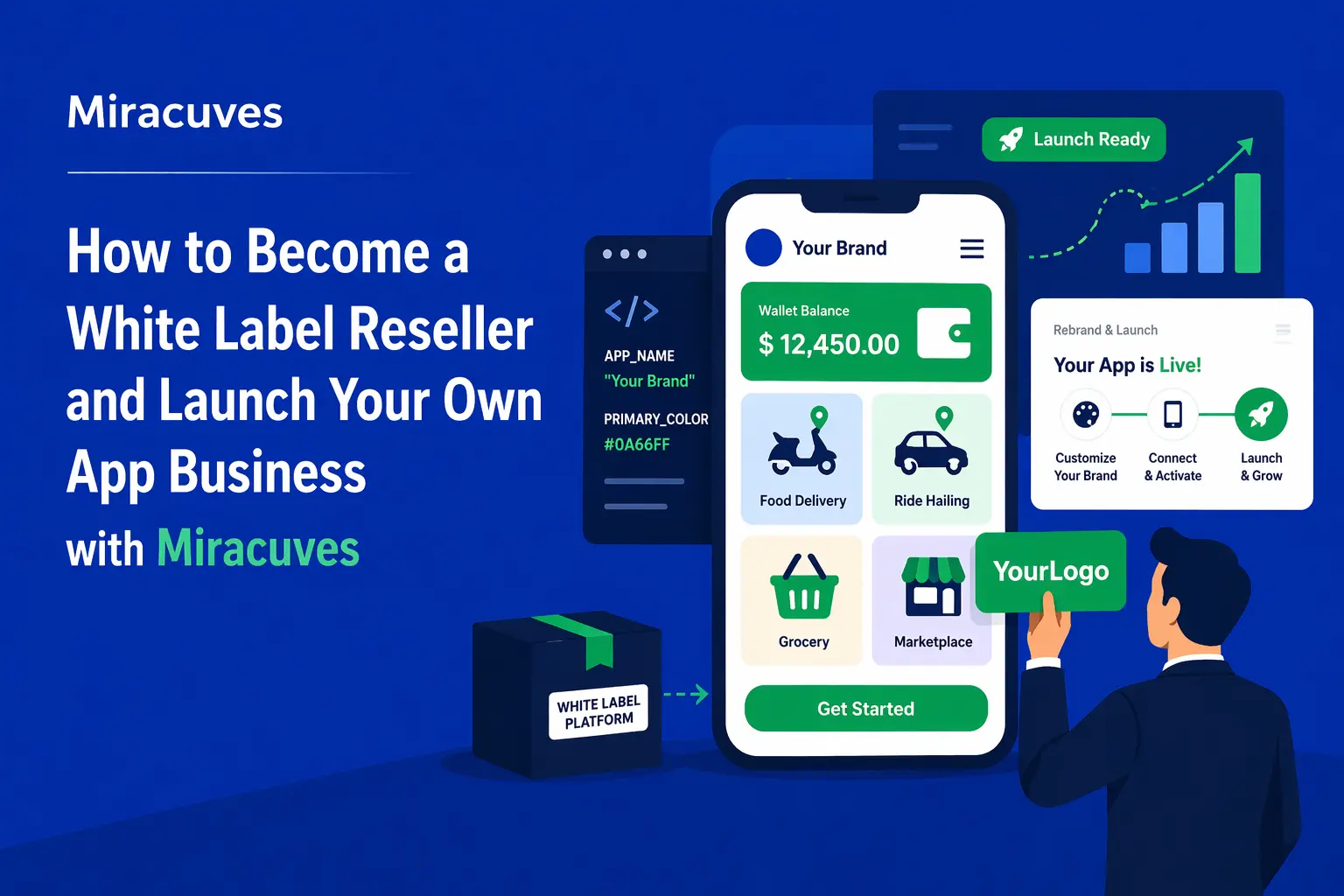
In this model, the app foundation is already developed by a clone app development company. You add your business identity, logo, colors, app name, pricing, payment setup, and market strategy. From the customer’s perspective, it becomes your app, your brand, and your platform.
That is why this model is useful for founders, agencies, consultants, and local entrepreneurs who want to enter the app business without becoming a software company first.
A white label reseller is not only selling software. In many cases, they are launching a branded app business that can serve real users, vendors, service providers, drivers, experts, or sellers in a selected market.
Here is a simple comparison of how this model works:
| Model | What It Means | Best For | Main Business Focus |
|---|---|---|---|
| Software Selling | Selling app licenses or access to a ready-made tool | Agencies, IT resellers, consultants | Earning from setup fees, monthly support, or resale margins |
| White Label App Business | Launching a branded app platform using ready-made technology | Founders, local entrepreneurs, startups | Acquiring users, onboarding vendors, managing transactions, and growing revenue |
| Custom App Business | Building a complete app from scratch and operating it | Funded startups or highly unique ideas | Full product ownership, but with higher cost, time, and technical responsibility |
White label reselling sits in the middle in the best possible way. It gives you more ownership than simple software resale and more speed than custom development. You can start with a working app foundation, customize it for your niche, and focus on building the actual business around it.
You do not need coding knowledge to start. The technical side — backend systems, APIs, app performance, deployment, and updates — is handled by your app development partner. Your role is to choose the market, build the brand, acquire users, onboard vendors or service providers, manage operations, and grow revenue.
This clear separation makes the model practical. The technology partner focuses on the app foundation, while you focus on the business strategy, customer acquisition, and market growth.
Why White Label Businesses Are Growing Fast
The growth of the white label reseller business is driven by real business demand, not just a trend. Customers want app-based services, local businesses want digital platforms, and founders want faster ways to launch without heavy development costs.
Mobile-First User Behavior
People now prefer apps for daily activities like ordering food, booking taxis, consulting experts, making payments, watching content, and using local services.
This creates strong demand for branded mobile apps across many industries. Businesses no longer want only a website; they want an app that helps them manage users, orders, payments, and repeat customers.
Rise of Local Service Apps
Global apps cannot fully serve every city, region, or niche. Local markets have different languages, pricing, payment habits, vendor networks, and customer expectations.
This opens opportunities for entrepreneurs to launch:
- City-based delivery apps
- Regional taxi booking apps
- Local consultation platforms
- Niche marketplaces
- Rental or service booking apps
With white label app development, they can launch these platforms faster using a ready-made clone app foundation.
Demand Across High-Growth Industries
White label app businesses work across many profitable categories.
| Category | App Business Examples |
|---|---|
| Delivery & Logistics | Food, grocery, pharmacy, courier apps |
| Ride-Sharing | Taxi booking, fleet, carpooling apps |
| On-Demand Services | Home service, beauty, wellness, expert booking apps |
| Marketplaces | Freelance, ecommerce, rental, real estate platforms |
| Entertainment | Streaming, short video, creator platforms |
| Fintech | Wallet, remittance, digital payment, crypto apps |
These industries already have proven demand, so founders can focus more on branding, operations, and customer acquisition instead of building the entire app from scratch.
Need for Faster Launch
Speed is one of the biggest reasons white label businesses are growing.
Custom development can take months because every feature, screen, workflow, and admin panel needs to be built from zero. During that time, market opportunities can become more competitive.
A ready-made app solution helps founders:
- Launch faster
- Test market demand early
- Onboard vendors sooner
- Collect real user feedback
- Improve the app based on actual usage
Lower Technical Risk
Building from scratch can create technical risks such as bugs, delays, payment issues, poor performance, and high maintenance costs.
A white label clone app already includes the basic structure, user flow, admin panel, and business logic. This reduces development uncertainty and gives the business owner a stronger starting point.
New Revenue Stream for Agencies and Consultants
Digital agencies, IT firms, and consultants can use white label mobile apps to expand their services.
They can offer app platforms to restaurants, clinics, salons, transport companies, real estate firms, and local service providers. This helps them earn through setup fees, customization, monthly support, marketing, and maintenance plans.
Opportunity for Local Entrepreneurs
Local entrepreneurs understand their market better than large global platforms. They know the local vendors, customer behavior, pricing gaps, and service problems.
A white label business allows them to turn that local knowledge into a branded digital platform without needing a large technical team.
In simple words, white label app businesses are growing because they offer faster launch, lower technical pressure, better cost control, and strong local business opportunities.
White Label App Development vs Custom App Development vs DIY App Builders
Choosing the right approach is not just a technical decision — it directly impacts your time to market, cost structure, scalability, and long-term business success.
Here is a clear and practical comparison:
| Model | What It Means | Best For | Main Benefit | Main Limitation |
|---|---|---|---|---|
| Custom App Development | Building an app from scratch with a full development team | Funded startups, enterprises, unique product ideas | Complete control over features, architecture, and scalability | High cost, long development time, higher execution risk |
| DIY App Builders | Using no-code or drag-and-drop tools to create apps | Small businesses, basic apps, MVP testing | Low cost, quick setup, no technical skills required | Limited customization, weak scalability, not suitable for complex platforms |
| White Label App Development | Using a ready-made clone app and rebranding it as your own | Founders, agencies, consultants, entrepreneurs | Faster launch, branding control, customization, and ownership | Depends on quality and flexibility of the technology partner |
Why White Label Is the Practical Middle Path
Most founders are not trying to invent a completely new app category. They want to:
- Enter an existing market (delivery, taxi, marketplace, consultation, etc.)
- Launch quickly before competitors grow stronger
- Maintain full control over branding and revenue
- Build a scalable and operational business
White label app development fits this goal perfectly because it balances speed, cost, and flexibility.
Compared to other options:
- Faster than custom development → no need to build core features from zero
- More scalable than DIY tools → supports real business workflows (users, vendors, payments, admin)
- Lower risk → core app structure is already tested
- More business-ready → designed for real transactions, not just basic use
It may not always be the cheapest option, but it is often the most practical and execution-focused approach for launching a real app business.
Who Can Start a White Label Reseller Business?
A white label reseller business is not limited to software companies or technical founders. It is useful for anyone who understands a market, has access to customers, and wants to launch a branded app platform without building the full technology from scratch.
| Audience | How They Can Use It | Business Value |
|---|---|---|
| Digital Marketing Agencies | Agencies can offer branded apps to restaurants, clinics, salons, gyms, real estate firms, and service businesses along with SEO, ads, branding, and social media services. | Helps increase project value, create monthly retainers, and position the agency as a complete digital growth partner. |
| IT Service Companies | IT firms can use ready-made clone app foundations instead of building every solution from zero for each client. | Reduces development workload, improves delivery speed, and allows the company to serve more industries profitably. |
| Startup Founders | Founders can launch delivery apps, taxi apps, consultation platforms, marketplaces, rental apps, or creator platforms faster. | Helps validate demand, onboard users, test monetization, and improve the product before investing heavily in custom development. |
| Business Consultants | Consultants can guide clients from business idea to app launch by helping with category selection, positioning, revenue model, and go-to-market strategy. | Turns consulting from advice-only into an execution-based service with higher business value. |
| Local Entrepreneurs | Entrepreneurs can build city-specific or niche-specific apps such as local delivery, taxi booking, home services, rental, or consultation platforms. | Uses local knowledge to compete better through language, pricing, vendor network, and regional customer behavior. |
| SaaS Resellers | Resellers can move from selling small tools to offering full white label mobile app platforms with support, hosting, and customization. | Creates higher-ticket offers, stronger client retention, and recurring monthly or yearly revenue. |
| Franchise Owners | Franchise businesses can launch apps for ordering, booking, loyalty, delivery tracking, service requests, or branch-level customer management. | Improves customer experience, standardizes operations, and supports multi-location growth. |
| Existing Businesses | Restaurants, clinics, grocery stores, logistics firms, real estate companies, and service providers can launch their own branded apps. | Reduces dependency on third-party platforms and gives more control over customers, pricing, offers, and repeat sales. |
| Investors | Investors can test app models across different categories, regions, or cities using ready-made app solutions. | Enables faster market testing, diversified digital investments, and scaling of the most successful platforms. |
The main advantage is simple: you do not need to be a developer to start. You need the right market, a clear business model, strong branding, and a reliable app development partner.
What Makes a White Label App Business Different from Simple Software Reselling?
A white label app business is different from simple software reselling because you are not only selling access to an app. You are building a branded platform that can attract users, onboard vendors, manage transactions, and generate recurring revenue.
In software reselling, the focus is mainly on selling a product. In a white label app business, the focus is on running and growing a digital business.
| Point | Simple Software Reselling | White Label App Business |
|---|---|---|
| Main Goal | Sell software access | Build and grow a branded app platform |
| Revenue | Setup fee, license fee, renewal fee | Commission, subscription, ads, transaction fees, premium access |
| Control | Limited control after sale | Full control over brand, users, vendors, pricing, and offers |
| Customer Relationship | Mostly short-term or support-based | Long-term relationship with users and service providers |
| Growth | Depends on selling more licenses | Grows with more users, vendors, cities, services, and transactions |
| Business Value | Product resale income | Platform ownership and recurring revenue potential |
Beyond Selling a Product
A white label app business includes more than software delivery. You need to manage the business side of the platform, such as:
- Choosing the right market
- Defining the brand identity
- Setting pricing and commission
- Onboarding vendors or service providers
- Acquiring users
- Managing bookings, orders, or transactions
- Running promotions and marketing campaigns
- Improving customer experience
This makes it a complete business model, not just a product resale model.
Ownership of Customer Relationship
In a white label app business, you own the relationship with your users and partners.
You control:
- Customer communication
- Vendor or provider network
- Pricing and offers
- User experience
- Support process
- Brand trust
This ownership helps you build long-term value because your business grows with every user, vendor, order, booking, or transaction added to the platform.
Role of the Development Partner
The development partner handles the technical side of the platform, including app setup, customization, deployment, updates, and technical support.
But the business growth depends on how well you manage marketing, vendor onboarding, customer support, pricing, and operations.
Why This Difference Matters
If you treat it only as software reselling, revenue may stay limited to one-time setup fees or license margins.
If you treat it as a white label app business, you can build recurring revenue through commissions, subscriptions, service fees, featured listings, ads, and premium access.
That is the main difference: software reselling gives you a product to sell, while a white label app business gives you a platform to grow.
High-Demand White Label App Categories You Can Launch with Miracuves
Choosing the right app category is one of the most important decisions in a white label app reseller business. Every category has a different customer need, revenue model, operational requirement, and growth potential. The goal is not just to pick a trending app idea, but to choose a category that fits your market, budget, audience, and execution capacity.
Below is a clear category-wise breakdown based on high-demand white label app opportunities.
| App Category | Clone App Examples | Best For | Revenue Opportunities | Why It Works |
|---|---|---|---|---|
| Super App Platforms | Gojek Clone, Grab Clone, Glovo Clone | Entrepreneurs, investors, regional service aggregators | Service commission, vendor fees, delivery charges, featured listings | One platform can offer taxi, food, grocery, courier, and home services, creating multiple revenue streams from one ecosystem. |
| Ride Sharing Apps | Uber Clone, inDrive Clone | Taxi operators, fleet owners, transport startups | Ride commission, driver plans, booking fees, corporate travel | These apps create daily usage and repeat transactions, especially when local driver supply is strong. |
| Delivery App Ecosystem | Swiggy Clone, UberEats Clone, Instacart Clone, Blinkit Clone, Netmeds Clone, FedEx Clone | Restaurants, grocery networks, pharmacy businesses, courier startups | Order commission, delivery fees, vendor plans, ads, surge pricing | Delivery apps solve frequent customer needs, which helps build recurring orders and strong local demand. |
| On-Demand Services & Consultation Apps | Thumbtack Clone, Rover Clone, Astrotalk Clone, Practo Clone | Service aggregators, healthcare, wellness, astrology, pet care, home service businesses | Booking commission, expert fees, consultation charges, premium listings | These platforms connect users with trusted experts or service providers and often have strong margins. |
| Freelance & Professional Marketplace Apps | Fiverr Clone, Upwork Clone | Agencies, consultants, startup founders, gig economy platforms | Project commission, freelancer plans, featured profiles, job posting fees | Freelance marketplaces can scale across regions because they do not depend heavily on physical infrastructure. |
| Finance & Investment Apps | Revolut Clone, NeoBank Clone, Banking Solution, Wise Clone | Fintech startups, remittance businesses, financial service providers | Transaction fees, exchange margin, subscriptions, service commissions | Fintech apps have high user retention, but require strong planning for KYC, compliance, security, and regulations. |
| Social Network & Dating Apps | Facebook Clone, LinkedIn Clone, Twitter Clone, Tinder Clone | Community builders, niche networks, dating startups, media brands | Ads, premium memberships, profile boosts, subscriptions | These platforms grow through engagement and network effects, where more users increase platform value. |
| Communication & Productivity Apps | Skype Clone, Zoom Clone, Mailchimp Clone, Google Drive Clone, WeTransfer Clone | SaaS founders, B2B providers, corporate solution companies | SaaS plans, storage upgrades, enterprise pricing, usage billing | These apps work well for recurring revenue because businesses pay for communication, storage, and productivity tools. |
| AI & Website Builder Apps | ChatGPT Clone, Wix Clone | SaaS entrepreneurs, digital agencies, AI tool founders | Monthly subscriptions, usage credits, premium features, templates | AI and no-code tools are in high demand because businesses want faster content, automation, and website creation. |
| Listings, Rentals, eCommerce, Travel & Jobs | Airbnb Clone, Zillow Clone, Turo Clone, Blueground Clone, Buildium Clone, GetMyBoat Clone, Alibaba Clone, Amazon Clone, Expedia Clone, MakeMyTrip Clone, Job Portal | Real estate firms, rental businesses, travel companies, marketplace founders, recruiters | Listing fees, booking commission, sales commission, featured listings, subscriptions | These platforms connect supply and demand at scale, making them useful for property, travel, rental, ecommerce, and recruitment markets. |
| Education Apps | Byju’s Clone | Educators, coaching institutes, EdTech startups | Course sales, subscriptions, certification fees, tutoring fees | Education apps build long-term engagement because learners return for courses, tests, lessons, and skill development. |
| Entertainment & Creator Economy Apps | Netflix Clone, YouTube Clone, TikTok Clone, Cameo Clone, Thrillz Clone, OnlyFans Clone | Media brands, influencers, creator platforms, content startups | Subscriptions, ads, creator commission, paid content, fan memberships | These apps help creators and media businesses monetize audience attention, video content, and community engagement. |
| Blockchain & Crypto Apps | Binance Clone, Paxful Clone, GMX Clone, ICO Launchpad, OpenSea Clone | Crypto entrepreneurs, blockchain startups, trading platforms | Trading fees, listing fees, launch commissions, platform usage fees | Crypto platforms can offer high transaction value, but they need strong security, liquidity planning, compliance awareness, and risk control. |
How to Choose the Right Category
The best category is not always the most popular one. It should match your market reality and execution strength.
Before choosing a white label app category, check:
- Is there real demand in your target city, country, or niche?
- Can you onboard enough vendors, drivers, experts, sellers, or creators?
- Is the revenue model clear and practical?
- Can you market the app consistently after launch?
- Does the category need legal, financial, or compliance planning?
- Can the app expand into more cities, services, or user segments later?
A food delivery app may need strong vendor and delivery operations. A consultation app may need trusted experts. A marketplace needs both buyers and sellers. A fintech or crypto platform needs deeper compliance and security planning.
That is why the right category should be selected based on market demand, operational capability, revenue potential, and long-term scalability.
How Miracuves Helps You Launch a White Label App Business
Launching a white label app business needs more than a ready-made product. You need a complete setup that can support your brand, users, payments, operations, and future scaling. Miracuves helps by giving you a ready technical foundation that can be customized for your business model and target market.
From App Idea to Launch-Ready Platform
| What You Need | How It Supports Your Launch |
|---|---|
| App Foundation | A ready-made app base with core features, user flow, backend logic, and admin control already structured. |
| Brand Identity | Your own app name, logo, colors, UI style, content, and brand positioning. |
| Business Panels | User app, vendor/provider app, driver/agent app, and admin panel depending on the app category. |
| Market Customization | Service categories, language, currency, commission rules, notifications, and local workflows. |
| Payment Setup | Payment gateway, wallet, payout logic, commission tracking, and region-based transaction flow. |
| Launch Support | Server setup, deployment, app configuration, testing support, and store publishing assistance. |
| Growth Support | Technical fixes, updates, performance improvements, feature additions, and scaling support after launch. |
Why This Helps Founders and Resellers
The biggest advantage is that you do not get stuck in technical complexity. Instead of spending months building the base product, you can focus on the business activities that actually create growth:
- Finding the right market
- Building a strong brand
- Onboarding vendors or service providers
- Bringing users to the platform
- Running SEO, ads, and local campaigns
- Testing commission, subscription, or booking models
- Improving operations after launch
From Ready-Made App to Real Business Platform
A ready-made app becomes valuable only when it is shaped for a real market. That means the app should match your audience, location, service model, payment flow, and revenue plan.
With the right customization, you can launch a platform that is not generic, but built around your business goals. You control the brand, pricing, users, vendors, offers, and growth strategy, while Miracuves supports the technical foundation needed to keep the platform running.
This makes the white label model practical for founders, agencies, consultants, and entrepreneurs who want to enter the app business faster without building every technical layer from scratch.
Revenue Models for White Label App Businesses
A white label app business becomes stronger when it has more than one way to earn revenue. Relying only on one-time app sales or a single commission model can limit growth. A better approach is to design revenue around how users, vendors, service providers, and businesses interact inside the platform.
Core Revenue Models You Can Use
Commission per Order, Booking, or Transaction
This is one of the most common models. The platform earns a percentage every time a user places an order, books a service, completes a ride, hires a freelancer, or makes a transaction.
Vendor or Provider Subscription Plans
Restaurants, sellers, experts, drivers, property owners, or service providers can pay monthly or yearly to stay listed, access leads, receive orders, or use premium tools.
Platform or Service Fees
You can charge users a small fixed fee on each order, booking, payment, delivery, or consultation. This works well when transaction volume is high.
Featured Listings and Paid Visibility
Vendors, experts, properties, products, freelancers, or creators can pay to appear in top results, homepage sections, category pages, or promoted placements.
Premium User Memberships
Users can pay for extra benefits such as faster delivery, priority booking, exclusive content, better discounts, advanced filters, verified profiles, or ad-free access.
Advertising and Sponsored Promotions
Once the platform has traffic, you can monetize through sponsored banners, in-app ads, brand promotions, paid campaigns, and partner offers.
Lead Generation Fees
For service-based apps, you can charge professionals or businesses for verified leads, appointment requests, inquiry forms, or customer connections.
Franchise or City Licensing
If your platform model works in one city, you can license it to partners in other regions. This is useful for delivery, taxi, rental, service, and marketplace apps.
SaaS Monthly Plans
For B2B platforms, you can offer the app as a monthly service where businesses pay for access, support, hosting, maintenance, and upgrades.
Practical Revenue Examples
| App Type | Revenue Opportunities |
|---|---|
| Food Delivery App | Restaurant commission, delivery charges, featured restaurants, subscription delivery passes, in-app ads |
| Taxi Booking App | Ride commission, driver subscription, cancellation charges, premium ride options, corporate bookings |
| Marketplace App | Seller subscription, product listing fees, transaction commission, featured products, advertising |
| Consultation App | Per-minute consultation charges, expert commission, appointment fees, premium expert profiles, lead fees |
| Real Estate Platform | Property listing fees, agent subscriptions, featured listings, lead generation fees, booking commission |
| Entertainment App | Monthly subscriptions, ads, pay-per-view content, creator revenue sharing, fan memberships |
| Fintech App | Transaction fees, withdrawal charges, currency exchange margin, premium account plans, merchant service fees |
| SaaS or AI App | Monthly plans, usage credits, team accounts, API access, premium templates, enterprise plans |
Why Multiple Revenue Streams Matter
A single revenue model can make the business fragile. For example, if you only depend on commissions, your income depends completely on transaction volume. But when you combine commissions with subscriptions, featured listings, ads, and premium access, the platform becomes more stable.
A strong white label app business can earn from:
- Users who pay for convenience
- Vendors who pay for visibility
- Businesses that pay for leads
- Transactions that happen inside the app
- Brands that pay for promotion
- Partners who want city or regional access
This creates a more balanced business model and helps the platform grow beyond basic app ownership.
How Much Does It Cost to Start a White Label App Business?
There is no fixed cost for starting a white label app business because every app category, feature requirement, and launch plan is different. A simple single-service app will cost less than a multi-service platform with user apps, vendor apps, driver apps, admin panels, wallets, and advanced automation.
The final cost usually depends on these factors:
| Cost Factor | Why It Matters |
|---|---|
| App Category | A taxi app, delivery app, marketplace, fintech app, or super app will each have different technical and operational needs. |
| Number of Panels | More panels such as user app, vendor app, driver app, provider app, and admin panel increase setup complexity. |
| Customization Level | Basic logo and color changes cost less than deep UI, feature, workflow, or business logic customization. |
| Feature Complexity | Advanced search, wallet, live tracking, chat, video call, subscriptions, analytics, or AI features can increase cost. |
| Payment Integration | Local payment gateways, wallets, payouts, refunds, and multi-currency support may require extra setup. |
| Localization Needs | Language, currency, tax logic, region-specific flow, and local user behavior can affect customization effort. |
| App Publishing | Google Play Store and Apple App Store submission may need technical setup, compliance checks, and version management. |
| Source Code Access | Source code access gives more long-term control and flexibility, but it may affect the overall pricing. |
| Support & Maintenance | Ongoing fixes, updates, performance checks, and technical support are important after launch. |
| Marketing Budget | SEO, paid ads, social media, influencer marketing, vendor onboarding, and launch campaigns need separate planning. |
Why Ready-Made Apps Are More Cost-Efficient
A ready-made clone app is usually more affordable than full custom development because the main app foundation is already built.
This means:
- Core user flow is already available
- Admin structure is already prepared
- Main features are already developed
- Basic testing has already been done
- Launch time is reduced
- Development risk is lower
So, instead of paying to build every screen, module, and workflow from zero, you invest mainly in branding, customization, integrations, deployment, and growth.
This makes white label app development a practical option for founders, agencies, and entrepreneurs who want to launch faster while still keeping control over brand, market, pricing, and business model.
What to Check Before Choosing a White Label App Development Partner
Your app development partner can directly affect your launch quality, user experience, and long-term growth. A strong idea can still fail if the app foundation is weak, the admin panel is difficult to manage, or post-launch support is missing.
Before choosing a partner, check these points carefully:
Essential Partner Checklist
Rebranding Flexibility
The app should support your own logo, app name, colors, UI style, domain, and brand identity. Without full rebranding, the platform may not feel like your own business.
Source Code Availability
If you want long-term control, future customization, or internal development later, ask whether source code access is available and what it includes.
Admin Panel Quality
The admin panel should be easy to use because this is where you manage users, vendors, services, payments, orders, reports, and platform activity.
Multi-Panel Support
Depending on your app category, you may need user app, vendor app, driver app, provider app, and admin panel. Make sure all required panels are included.
Payment Integration Options
Check whether the platform can support your preferred payment gateways, wallet system, refunds, payouts, commissions, and local currency.
App Publishing Assistance
Google Play Store and Apple App Store publishing can be technical. A good partner should support submission, updates, and store guidelines.
Scalability of the Platform
The app should be able to grow with more users, vendors, cities, transactions, and features without becoming unstable.
Customization Capability
Your market may need unique categories, workflows, pricing rules, languages, or features. Make sure the partner can customize beyond basic branding.
Post-Launch Support
After launch, you may need bug fixes, updates, performance improvements, and feature changes. Support is important for long-term stability.
Security and Performance Standards
The app should be built with proper security, fast loading, stable performance, and reliable transaction flow, especially for payment, healthcare, fintech, or marketplace apps.
Choosing the wrong partner can limit your growth even if your business idea is strong. The right partner should not only deliver the app but also support your launch, customization, and scaling needs.
Mistakes That Can Stop Your White Label App Business from Growing
Many white label app businesses fail because founders focus only on getting the app ready. But a successful app business needs more than software. It needs market research, operations, branding, vendor onboarding, marketing, and customer support.
Choosing a Niche Only Because It Is Trending
A trending category does not always mean it is profitable for your market. Before choosing a delivery app, taxi app, marketplace, fintech app, or consultation app, check whether people in your target region actually need it.
Look at customer problems, competitor gaps, vendor availability, pricing behavior, and your ability to manage the business after launch.
Ignoring Local Market Demand
Every city, country, and niche works differently. Users may prefer different payment methods, languages, delivery expectations, service categories, and pricing models.
If your app does not match local behavior, users may download it once and never return. Localization should be planned before launch, not after launch.
Not Planning Operations Properly
Apps like delivery, taxi booking, marketplace, rental, and service platforms need strong operations.
You must plan:
- Vendor or provider management
- Order, booking, or ride flow
- Refunds and cancellations
- Customer support
- Quality control
- Delivery or service coordination
A good app can still fail if the operations behind it are weak.
Weak Branding and Positioning
If your app looks generic, users may not trust it. A strong app business needs a clear name, clean design, simple messaging, and a reason why users should choose it over alternatives.
Your branding should explain what the app does, who it is for, and why it is useful.
No Marketing Budget
Publishing the app on the Play Store or App Store does not bring users automatically.
You need a launch plan that includes SEO, Google Ads, social media, WhatsApp marketing, referrals, influencer promotions, local partnerships, and vendor onboarding campaigns.
Without marketing, even a good app can stay invisible.
Poor Vendor or Provider Onboarding
A platform needs strong supply before demand can grow. If users open the app and find very few restaurants, drivers, experts, sellers, properties, or service providers, they will not return.
Vendor onboarding should start before launch so the app feels active from day one.
Choosing Cheap Software Without Checking Quality
The lowest-cost option can become expensive later if the app is slow, unstable, difficult to customize, or missing important admin controls.
Before choosing any white label app solution, check the app flow, admin panel, performance, payment setup, support, and scalability.
Ignoring Scalability
Your app should be ready to grow with more users, vendors, cities, services, and transactions.
If the platform cannot scale, you may face performance issues just when the business starts growing.
Expecting Passive Income Too Early
A white label app business is not passive from the first day. It needs active execution, especially in the early stage.
You need to track performance, solve user issues, improve features, support vendors, run campaigns, and keep improving the platform based on real feedback.
Avoiding these mistakes helps your app business become more than a launched product. It helps you build a platform that can attract users, retain vendors, generate revenue, and scale over time.
Final Thoughts: Build the Business, Not Just the App
A white label reseller business is not about launching an app and waiting for users to come automatically. The app is only the starting point. The real success depends on how well you choose the market, position the brand, onboard vendors or service providers, attract users, and manage daily operations.
To build a strong app business, you need more than technology. You need a clear niche, a practical revenue model, trusted supply partners, consistent marketing, customer support, and a plan to scale step by step. Whether you are launching a delivery app, taxi platform, consultation app, marketplace, or creator platform, execution is what turns the app into a real business.
A reliable partner like Miracuves can help you launch faster with ready-made clone app solutions, white-label customization, and technical support. But long-term growth comes from how you run, promote, and improve the platform after launch.
Ready to launch your own white label app business? Contact Miracuves today and explore the right ready-made clone app solution for your market.
FAQs
What is a white label app reseller business?
A white label app reseller business allows you to launch and operate a branded app platform using ready-made solutions, without building the technology from scratch.
Can I start a white label app business without coding?
Yes. The technical development is handled by the app development partner, while you focus on branding, marketing, and operations.
Which white label app categories are best for resellers?
High-demand categories include delivery apps, marketplaces, consultation platforms, ride-sharing apps, and entertainment platforms, depending on your target market.
How does Miracuves help with white label app development?
Miracuves provides ready-made app solutions, branding customization, deployment support, payment integration, and post-launch technical assistance.
How much does it cost to start a white label app business?
The cost depends on factors like app category, features, customization, and region-specific requirements. Ready-made solutions are generally more affordable than custom development.
Is a white label clone app better than custom development?
For most founders, white label apps offer faster launch, lower risk, and sufficient customization, making them a practical alternative to full custom development.