
Key Takeaways
- HungryPanda uses a food delivery model focused on Asian restaurants and communities.
- Commission fees are a major revenue source from restaurant orders.
- Delivery charges add revenue while supporting logistics operations.
- Restaurant promotions help businesses gain more visibility on the app.
- The model depends on local demand, restaurant supply, delivery speed, and customer loyalty.
What You’ll Learn
- How HungryPanda makes money through food delivery services.
- Restaurant commissions come from each completed order.
- Delivery and service fees support platform operations.
- Ads and featured listings help restaurants attract more customers.
- Growth depends on niche targeting, app experience, logistics, and repeat orders.
Real Insights
- HungryPanda succeeds by serving a focused audience instead of a broad food market.
- Localized restaurant choices improve customer relevance and retention.
- Fast delivery builds trust in competitive food delivery markets.
- Restaurant partnerships matter for menu variety and order volume.
- The best insight is that HungryPanda grows through niche focus, logistics, and loyal users.
In 2017, a Chinese student in London struggled to order familiar food — not because restaurants weren’t nearby, but because mainstream apps didn’t speak his language or understand his tastes. That experience sparked HungryPanda, a food delivery platform built specifically for overseas Chinese and broader Asian communities. From a niche startup to a platform serving over 6 million users across 80+ cities and 10 countries ,business model of HungryPanda proves a powerful lesson:hyper-focused market specialization can outmaneuver broad-spectrum giants in crowded digital ecosystems.
By balancing community-centric design with diversified monetization — from delivery fees to premium listings — HungryPanda has carved out a profitable niche while maintaining double-digit growth and expanding into groceries and lifestyle commerce.
For modern founders building on-demand, marketplace, or platform businesses, HungryPanda’s strategy isn’t just another delivery model — it’s a blueprint for scalable niche dominance in the platform economy.
How the HungryPanda Business Model Works
HungryPanda operates as a community-focused, hybrid marketplace platform that connects Asian restaurants and grocery merchants with overseas Asian consumers — primarily Chinese students and diaspora communities — in Western markets.
At its core, it looks like a typical food delivery app. But strategically, it functions as a culturally embedded digital ecosystem, optimized around language, cuisine authenticity, and community trust.
Type of Business Model
HungryPanda uses a hybrid marketplace model combining:
- Two-sided marketplace (restaurants ↔ consumers)
- On-demand delivery logistics
- Commission-based monetization
- Advertising & merchant promotion revenue
- Expansion into grocery & lifestyle commerce
Unlike Uber Eats or Deliveroo, which serve broad demographics, HungryPanda is vertically focused on Asian cuisine and culturally aligned services.
Value Proposition
HungryPanda succeeds because it delivers cultural relevance at scale.
For Consumers:
- Native-language interface (Mandarin-first UX in many regions)
- Authentic Asian restaurant aggregation
- Familiar payment options (Alipay, WeChat Pay in select markets)
- Community-trusted delivery experience
- Access to groceries and specialty Asian goods
For Restaurants & Merchants:
- Direct access to a concentrated, high-intent Asian customer base
- Reduced competition versus mainstream platforms
- Targeted marketing tools
- Localized merchant onboarding
- Promotional visibility options
HungryPanda doesn’t compete on “largest selection.” It competes on belonging and relevance.
Key Stakeholders in the Ecosystem
To maintain marketplace balance, HungryPanda orchestrates four primary groups:
- Consumers – Students, expats, and diaspora families.
- Restaurant & Grocery Merchants – Primarily Asian SMEs.
- Delivery Riders – Often culturally aligned gig workers.
- Platform & Regional Operations Teams – Localization specialists.
The ecosystem thrives because all stakeholders operate within a culturally familiar framework — reducing friction compared to mainstream delivery apps.
Evolution of the Model (2017–2026)
HungryPanda’s strategy evolved in three major phases:
Phase 1 – Niche Penetration (2017–2019)
- Focused on UK Chinese students.
- Built density in university cities.
- Leveraged word-of-mouth growth.
Phase 2 – International Expansion (2020–2022)
- Entered the US, Canada, Australia.
- Expanded to 80+ cities globally.
- Added grocery & Asian supermarket partnerships.
- Raised significant funding, reaching ~$500M valuation.
Phase 3 – Ecosystem Diversification (2023–2026)
- Integrated lifestyle services.
- Increased merchant advertising tools.
- Strengthened logistics tech and route optimization.
- Positioned as a “cultural commerce platform,” not just food delivery.
Why It Works in 2026
HungryPanda thrives today because of broader market trends:
- Rising Asian diaspora populations in Western cities.
- Increased demand for culturally authentic digital experiences.
- Platform fatigue from generic delivery apps.
- Growth in cross-border e-commerce behaviors.
- Consumer preference for localized, identity-aligned brands.
In a market where Uber Eats fights on price and scale, HungryPanda wins through community concentration and targeted liquidity.
Target Market & Customer Segmentation Strategy
HungryPanda didn’t scale by targeting “everyone who eats.”
It scaled by obsessively serving a specific cultural micro-economy — and then expanding from within.
This precision targeting is the real engine behind its international growth.
Primary Customer Segments
Overseas Chinese Students (Core Segment)
- Age: 18–28
- Location: University cities in the UK, US, Canada, Australia
- Behavior: High-frequency ordering, late-night demand, price-sensitive but loyalty-driven
- Need: Comfort food, language familiarity, trusted payment options
This segment provided early density and recurring revenue. Students order frequently and share apps rapidly within social circles.
Asian Diaspora Families & Professionals
- Age: 25–45
- Higher purchasing power
- Value grocery delivery and bulk ordering
- Seek authentic regional cuisines
This group drives higher average order value (AOV) and stable long-term retention.
Asian Restaurants & Grocery Merchants
- Independent SMEs
- Limited marketing budgets
- Often underserved by mainstream delivery platforms
- Need targeted reach to culturally aligned consumers
HungryPanda becomes not just a delivery partner — but a growth enabler for diaspora businesses.
Customer Journey: From Discovery to Retention
HungryPanda’s funnel is culturally engineered.
Discovery
- WeChat groups
- Chinese student associations
- Campus ambassadors
- Social media platforms like Xiaohongshu (Little Red Book)
- Referral programs
This hyper-targeted acquisition lowers CAC compared to mass-market delivery apps.
Conversion
- Native-language interface builds trust instantly
- Familiar food listings increase emotional resonance
- Localized promotions and first-order discounts
- Easy payment integration
Trust + relevance = fast conversion.
Retention
- Push notifications for cultural festivals (Lunar New Year, Mid-Autumn Festival)
- Loyalty promotions
- Merchant advertising for repeat customers
- Grocery expansion for higher basket frequency
Retention is driven by identity alignment, not just discounts.
Market Positioning Strategy
HungryPanda positions itself as:
“The delivery platform built for overseas Asians.”
That’s a powerful differentiator.
While Uber Eats competes on scale and speed, HungryPanda competes on:
- Cultural understanding
- Community loyalty
- Curated merchant selection
- Language-first UX
In many university cities, it dominates Asian restaurant listings — effectively owning that micro-market share.
Its competitive advantage lies in focused liquidity:
Instead of spreading thin across demographics, it creates high-density demand within a specific community — strengthening network effects faster.
Revenue Streams and Monetization Design
Now we move from who HungryPanda serves to how money flows through the ecosystem.
Like most delivery marketplaces, HungryPanda monetizes transactions.
But what makes its revenue architecture powerful is how each stream reinforces ecosystem density.
Core Revenue Streams
Commission on Orders (Primary Revenue Stream)
This is the backbone of HungryPanda’s business model.
- Charges restaurants a commission per order
- Estimated range: 15–30% depending on market and partnership tier
- Scales proportionally with order volume
- Higher-margin in dense student cities
Why it works:
- Predictable, scalable revenue
- No inventory risk
- Aligns incentives: more orders = more revenue for both parties
As the platform expanded to groceries, this commission model extended beyond restaurants — increasing basket size and frequency.
Delivery Fees (Consumer-Paid Revenue)
Consumers pay delivery charges that vary by:
- Distance
- City
- Surge demand
- Time of day
This partially offsets logistics costs and improves unit economics in lower-density areas.
Merchant Advertising & Sponsored Listings
HungryPanda monetizes visibility.
Restaurants can:
- Pay for priority placement
- Sponsor banner ads
- Boost listings during peak seasons
This is a high-margin revenue stream because:
- It doesn’t increase operational cost
- It leverages existing platform traffic
- It scales as merchant competition grows
In 2026, sponsored listings are becoming a more meaningful revenue layer as marketplace competition intensifies.
Grocery & Cross-Category Expansion
HungryPanda expanded into:
- Asian supermarkets
- Specialty imported goods
- Festival-based bundles
This increases:
- Average Order Value (AOV)
- Order frequency
- Basket size during holidays
Groceries typically produce lower commission rates but higher volume stability.
Strategic Partnerships & Promotions
Revenue also flows from:
- Brand collaborations
- Promotional campaigns
- Cross-border product integrations
- Seasonal cultural event campaigns
These create temporary revenue spikes and strengthen ecosystem loyalty.
The Monetization Strategy Explained
HungryPanda doesn’t rely on one revenue engine — it builds layered monetization.
Here’s how it interconnects:
- Commission = predictable base revenue
- Delivery fees = cost balancing mechanism
- Ads = high-margin profit layer
- Grocery expansion = frequency multiplier
- Promotions = seasonal revenue boost
The psychology behind its pricing strategy:
- Low entry friction for students
- Discounts for first-time users
- Premium placement upsell for merchants
- Seasonal demand pricing during festivals
It’s a classic example of a multi-sided revenue architecture designed to improve lifetime value on both sides of the marketplace.
At Miracuves, when we architect scalable platforms, we emphasize designing at least three monetization levers from day one — not just transaction commissions.
Operational Model & Key Activities
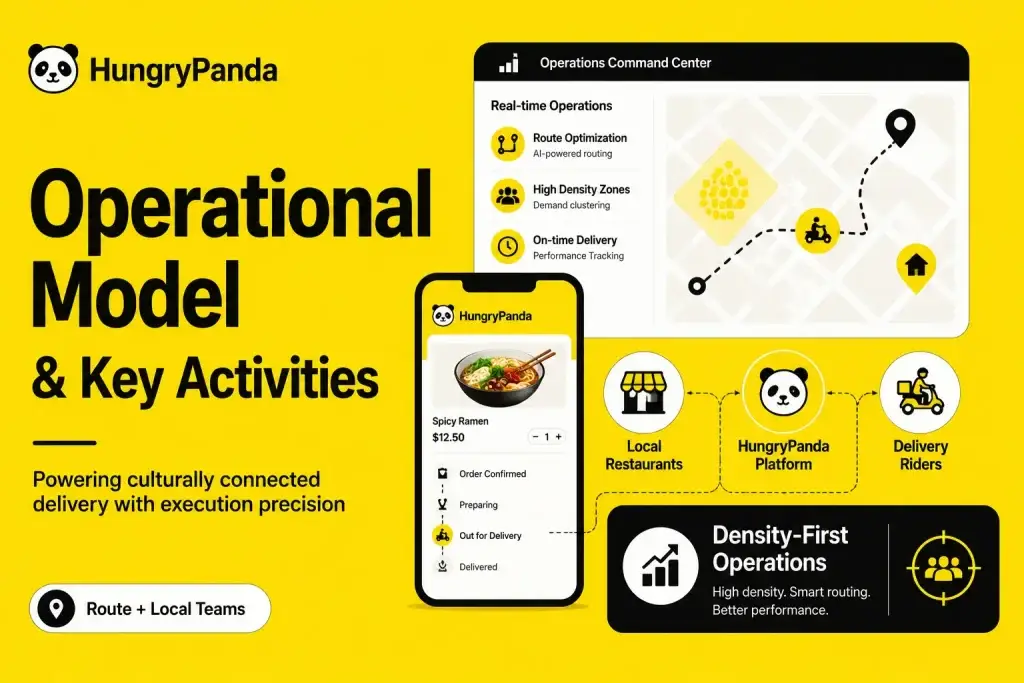
Behind HungryPanda’s culturally focused interface lies a sophisticated operational engine.
Delivery marketplaces don’t succeed on branding alone — they succeed on execution precision.
HungryPanda’s operations combine centralized technology with hyper-local management.
Core Operations
Platform & Technology Infrastructure
- Mobile app development (iOS, Android)
- Real-time order management systems
- Dispatch & route optimization algorithms
- Payment integrations (local + Asian payment gateways)
- Merchant dashboards
- Data analytics for demand forecasting
By 2026, route optimization and density clustering are critical in improving delivery margins — especially in student-heavy zones with peak demand spikes.
Merchant Onboarding & Quality Control
- Local city teams recruit Asian restaurants
- Standardized onboarding workflows
- Menu digitization and translation support
- Performance tracking (delivery time, ratings, order volume)
- Promotional campaign coordination
Unlike Uber Eats’ scale-first onboarding, HungryPanda prioritizes community-aligned merchant curation.
Delivery Fleet Management
- Gig-based rider model
- City-level dispatch hubs
- Peak-hour dynamic allocation
- Rider incentive programs
Operational efficiency improves dramatically once a city reaches liquidity threshold (high order density per hour).
Marketing & Community Engagement
- Campus ambassador programs
- Festival campaigns
- WeChat & Xiaohongshu engagement
- Referral incentives
- Local cultural event sponsorships
This reduces reliance on expensive mass-market paid advertising.
Resource Allocation Strategy (Estimated Operational Focus)
While exact financial breakdowns are private, marketplace models like HungryPanda typically allocate:
- 30–40% Technology & Product Development
- 20–30% Marketing & User Acquisition
- 15–25% Operations & Local City Teams
- 10–15% Rider & Logistics Optimization
- Remainder in admin, legal, and expansion
The strategic emphasis is clear:
Technology enables scale. Localization enables adoption.
Regional Expansion Playbook
HungryPanda enters new markets using a repeatable model:
- Identify cities with high Asian student populations.
- Partner with local Asian restaurant clusters.
- Deploy localized marketing ambassadors.
- Achieve density before scaling outward.
This is a density-first expansion strategy — not a nationwide launch model.
Strategic Partnerships & Ecosystem Development
HungryPanda’s real strength isn’t just in connecting restaurants to customers — it’s in orchestrating a culturally integrated ecosystem.
Instead of acting like a simple intermediary, HungryPanda behaves like a community infrastructure layer for overseas Asian commerce.
Its partnership philosophy is clear:
Build alliances that deepen cultural relevance, increase transaction frequency, and strengthen network effects.
Key Partnership Categories
Technology & API Partners
To ensure scalability and efficiency, HungryPanda collaborates with:
- Cloud infrastructure providers (for scaling across 10+ countries)
- Payment gateway providers (including Asian wallet integrations)
- Route optimization & logistics tech partners
- POS system integrations for restaurant automation
These partnerships reduce friction for merchants and improve operational performance.
Payment & Financial Alliances
One of HungryPanda’s strategic differentiators is supporting culturally preferred payment systems.
In select markets, it integrates:
- Alipay
- WeChat Pay
- UnionPay
- Local Western payment gateways
This builds trust among overseas Asian users and reduces checkout friction.
Payment familiarity is a subtle but powerful competitive advantage.
Marketing & Distribution Partnerships
HungryPanda deeply embeds itself within the community through:
- Chinese student associations
- University organizations
- Asian cultural festivals
- Local diaspora influencers
- WeChat community group collaborations
These partnerships reduce CAC and build organic brand equity.
Merchant & Grocery Alliances
Beyond restaurants, HungryPanda partners with:
- Asian supermarkets
- Specialty importers
- Festival product suppliers
- Regional franchise groups
This expands basket size and transforms the platform into a broader commerce ecosystem.
Regulatory & Expansion Alliances
Operating across the UK, US, Canada, Australia, and parts of Europe requires:
- Local compliance advisors
- Gig-economy regulatory specialists
- Logistics and insurance providers
- Regional business development partners
This reduces expansion risk and accelerates market entry.
Ecosystem Strategy Insight
HungryPanda strengthens its moat by increasing ecosystem interdependence.
Here’s how:
- More restaurants → more consumer demand.
- More consumers → more merchant advertising revenue.
- More grocery partners → higher order frequency.
More payment integrations → higher trust & conversion.
Growth Strategy & Scaling Mechanisms
HungryPanda’s growth story is not about blitz-scaling across entire countries overnight.
It’s about controlled density expansion — winning one community cluster at a time.
In a market dominated by giants like Uber Eats and DoorDash, this disciplined growth framework became its secret weapon.
Growth Engines
Organic Virality & Referral Loops
HungryPanda benefits from tightly connected diaspora communities.
Growth drivers include:
- WeChat group sharing
- Campus ambassador programs
- Referral discount loops
- Festival-based promotions
- Influencer marketing within Asian social platforms
When one student downloads HungryPanda, it often spreads quickly across an entire dorm or community group.
This reduces CAC significantly compared to mainstream delivery apps.
Paid Marketing — Hyper-Targeted, Not Mass
Instead of national TV ads or mass digital campaigns, HungryPanda focuses on:
- Geo-targeted student zones
- Social ads on Asian-focused platforms
- Cultural holiday campaigns
- Localized city-level promotions
This precision targeting ensures efficient marketing spend with higher ROI.
Product Line Expansion
Growth also came from increasing order frequency and AOV:
- Adding Asian grocery delivery
- Introducing specialty goods
- Holiday bundle packages
- Merchant promotions during peak seasons
Rather than relying solely on new users, HungryPanda increases value per existing user.
This is LTV-driven scaling.
Geographic Expansion Model
HungryPanda uses a cluster expansion strategy:
- Enter university-heavy city.
- Recruit 50–100 core merchants.
- Achieve demand density.
- Optimize rider efficiency.
- Expand into adjacent neighborhoods.
This density-first approach improves delivery economics early.
By 2026, the platform operates across:
- UK (origin market)
- United States
- Canada
- Australia
- Select European markets
Scaling Challenges & How They Were Addressed
Challenge 1: Competing Against Global Giants
Solution:
Niche focus instead of direct competition.
HungryPanda doesn’t try to beat Uber Eats in pizza and burgers — it dominates authentic Asian cuisine.
Challenge 2: Operational Complexity Across Countries
Solution:
Localized teams + centralized technology backbone.
Technology scales globally.
Operations localize culturally.
Challenge 3: Delivery Unit Economics
Solution:
High-density micro-markets reduce per-order logistics cost.
Cluster-based expansion improves rider utilization rates.
Challenge 4: Regulatory Pressure on Gig Work
Solution:
Strategic legal partnerships and compliance frameworks in each region.
Regulatory adaptation is critical for long-term sustainability in the delivery industry.
Read more : Best HungryPanda Clone Scripts 2025 for Food Delivery App Development
Lessons for Entrepreneurs & Implementation
Now let’s step back.
HungryPanda isn’t just a delivery app success story — it’s a masterclass in niche platform dominance, ecosystem layering, and strategic restraint.
If you’re a founder planning to build the next marketplace, on-demand app, or community-driven platform, there are powerful lessons here.
Key Factors Behind HungryPanda’s Success
Laser-Focused Targeting
HungryPanda didn’t chase “all food lovers.”
It focused on overseas Asian communities — deeply and unapologetically.
Clarity beats scale in early-stage platforms.
Density-First Expansion
Instead of launching nationwide, it:
- Targeted university-heavy cities
- Built merchant density
- Achieved liquidity
- Then expanded outward
Liquidity before expansion = healthier unit economics.
Cultural Differentiation as a Moat
Language-first UX.
Familiar payment systems.
Festival-based campaigns.
These aren’t cosmetic features — they are retention engines.
Layered Monetization
HungryPanda didn’t rely solely on commissions.
It added:
- Sponsored listings
- Grocery expansion
- Promotional partnerships
- Seasonal campaigns
Multiple revenue levers = resilience.
Common Mistakes Founders Should Avoid
- Expanding geographically before achieving liquidity.
- Competing on price instead of positioning.
- Ignoring cultural or behavioral nuances.
- Relying on a single revenue stream.
- Scaling marketing before validating retention.
Growth without retention is just expensive noise.
How to Adapt This Model to Your Market
You don’t need to replicate HungryPanda’s niche — you need to replicate its strategy framework.
Step 1: Identify an Underserved Community
This could be:
- A professional group
- A cultural diaspora
- A hobbyist segment
- A hyperlocal neighborhood economy
Step 2: Build Liquidity Before Scale
Focus on:
- Merchant onboarding
- Core supply strength
- High-frequency users
- Local ambassador programs
Step 3: Design Multi-Layer Monetization
Launch with:
- Commission-based revenue
- Add premium placement
- Introduce value-added services
- Expand into complementary categories
Ready to implement HungryPanda’s proven business model for your market?
Miracuves builds scalable platforms with tested business models and growth mechanisms.
We’ve helped entrepreneurs launch profitable apps across food delivery, marketplaces, and on-demand services.
Get your free business model consultation today.
Conclusion
HungryPanda’s success isn’t just about “niche delivery” — it’s about crafting a purpose-driven platform that serves a specific audience with precision. In the platform economy, it’s not enough to innovate; you must also position your innovation to solve a clear, unaddressed need. HungryPanda’s focus on:
HungryPanda’s success proves that in the platform economy, intentional growth through clear positioning, operational focus, and strategic restraint is the key to creating a resilient and profitable business model.
As the platform economy continues to evolve, the next wave of winning companies won’t be the ones trying to cater to everyone—they’ll be the ones with clear purpose, niche expertise, and strong operational execution.The future belongs to founders who understand that clarity in vision, discipline in execution, and strategy in scaling are the true pillars of sustainable success in this rapidly growing economy.
FAQs
What type of business model does HungryPanda use?
HungryPanda uses a hybrid marketplace model combining food delivery, grocery commerce, and merchant advertising. It connects Asian diaspora consumers with culturally aligned restaurants and merchants while earning through commissions and promotions.
How does HungryPanda’s model create value?
It creates value by offering culturally relevant services — native-language UX, authentic cuisine listings, and familiar payment options. For merchants, it delivers targeted customer access and marketing visibility.
What are HungryPanda’s key success factors?
Its success comes from niche market focus, density-first expansion, layered monetization, and strong community trust. Cultural alignment acts as both an acquisition and retention engine.
How scalable is the HungryPanda business model?
Highly scalable — once liquidity is achieved in a city, the marketplace framework can be replicated across similar demographic clusters globally. Technology scales centrally while operations localize.
What are the biggest challenges in this model?
Delivery logistics costs, regulatory pressure on gig work, and competition from large platforms are major challenges. Maintaining unit economics while expanding geographically requires disciplined execution.
How can entrepreneurs adapt this model to their region?
Identify an underserved community, build supply density first, and create culturally or behaviorally aligned value propositions. Focus on retention and ecosystem depth before broad expansion.
What are alternatives to this business model?
Alternatives include pure subscription-based food services, dark kitchen models, or hyperlocal community marketplaces without delivery infrastructure. However, these lack the multi-sided network effect strength.
How has HungryPanda’s model evolved over time?
It began as a student-focused food delivery app and expanded into groceries, merchant advertising, and broader diaspora segments. The evolution reflects a shift from single-category delivery to ecosystem commerce.
Miracuves is an independent software development company. We are not affiliated with, connected to, sponsored by, or endorsed by any company or product named in this article.
Terms such as “X Clone” are used descriptively. It is how the software industry refers to building a platform with functionality comparable to a known service, and how clients search for it.
The entire design and codebase of our products is built by our own team. Our products contain no code, design, graphics, or content originating from any third-party website or applications.
All third-party names and marks referenced in this article are the property of their respective owners, referenced solely to identify the services discussed.