

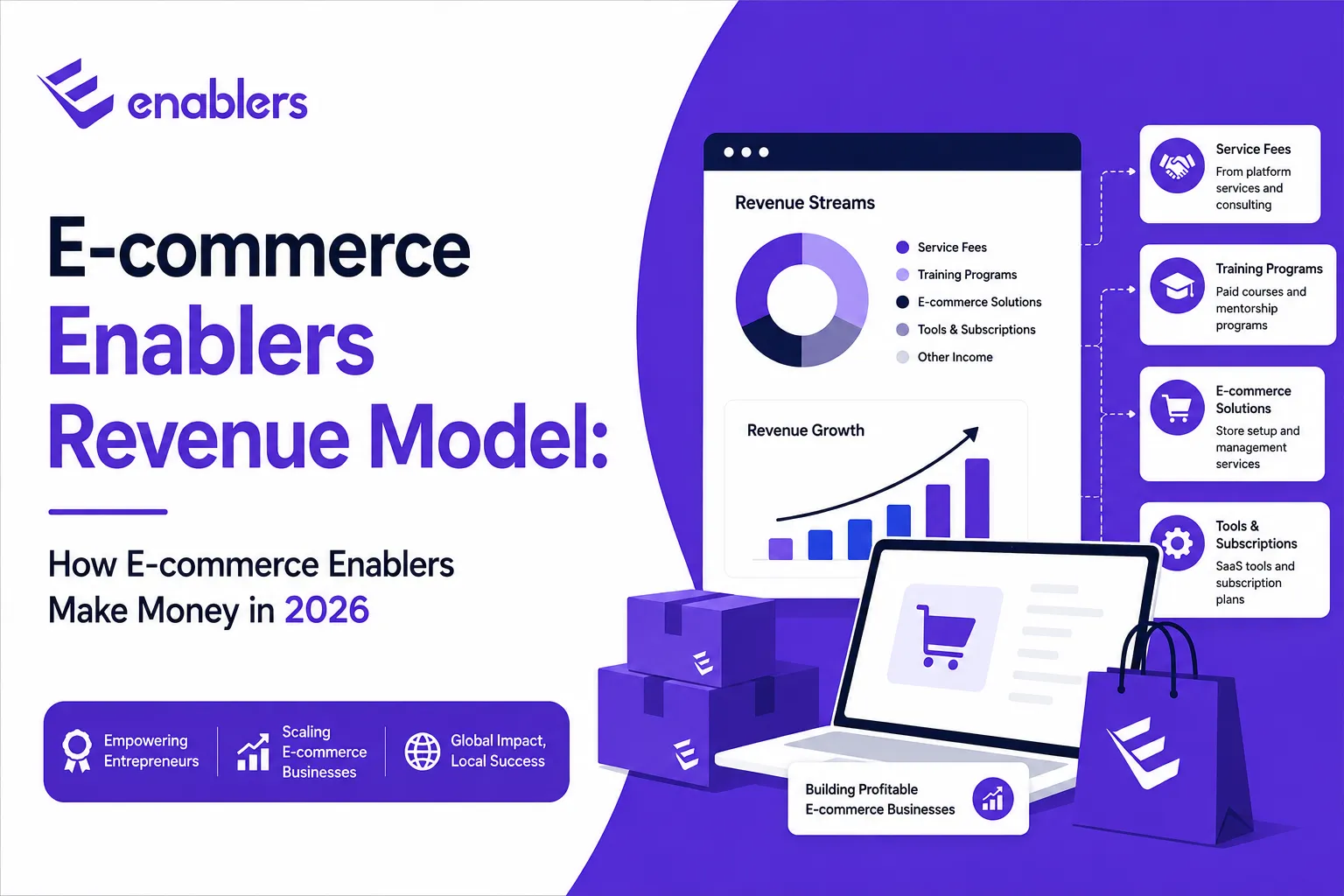
Key Takeaways
What You’ll Learn
- E-commerce enablers build infrastructure for online businesses helping merchants manage stores, logistics, payments, marketing, fulfillment, and digital operations.
- The revenue model is built around recurring SaaS and service-based monetization including subscriptions, transaction fees, logistics services, payment processing, and merchant tools.
- Ecosystem dependency is the biggest business advantage because merchants increasingly rely on integrated platforms for day-to-day commerce operations.
- Merchant growth directly increases platform revenue through higher transaction volumes, premium services, fulfillment expansion, and operational scaling.
- The biggest takeaway for founders is that eCommerce enablers scale successfully when merchant infrastructure, automation, payments, logistics, and recurring SaaS revenue work together.
Stats That Matter
- The article positions eCommerce enablers as the backbone of digital commerce ecosystems supporting merchants, marketplaces, D2C brands, and online retail operations.
- Core revenue comes from subscriptions and transaction-based services including store hosting, fulfillment, logistics coordination, payment processing, and merchant software.
- Additional monetization comes from ecosystem services such as advertising tools, analytics platforms, automation systems, financing, and premium integrations.
- The industry benefits from global eCommerce expansion as businesses increasingly require scalable digital infrastructure for online selling and customer management.
- Merchant retention is strengthened through operational dependency because businesses rely on integrated systems for payments, inventory, shipping, marketing, and order management.
Real Insights
- The real strength of eCommerce enablers comes from merchant reliance because online businesses increasingly depend on connected infrastructure instead of building operations independently.
- Recurring SaaS revenue improves long-term scalability since subscription-driven commerce infrastructure generates predictable and compounding income streams.
- Integrated logistics and payments improve platform stickiness because merchants prefer unified ecosystems instead of managing multiple disconnected vendors.
- Automation becomes more valuable as merchants scale since inventory management, fulfillment coordination, customer communication, and analytics become operationally complex.
- For entrepreneurs, the biggest lesson is to build an eCommerce enabler platform around merchant infrastructure, recurring SaaS monetization, operational automation, scalable integrations, and ecosystem-driven commerce growth.
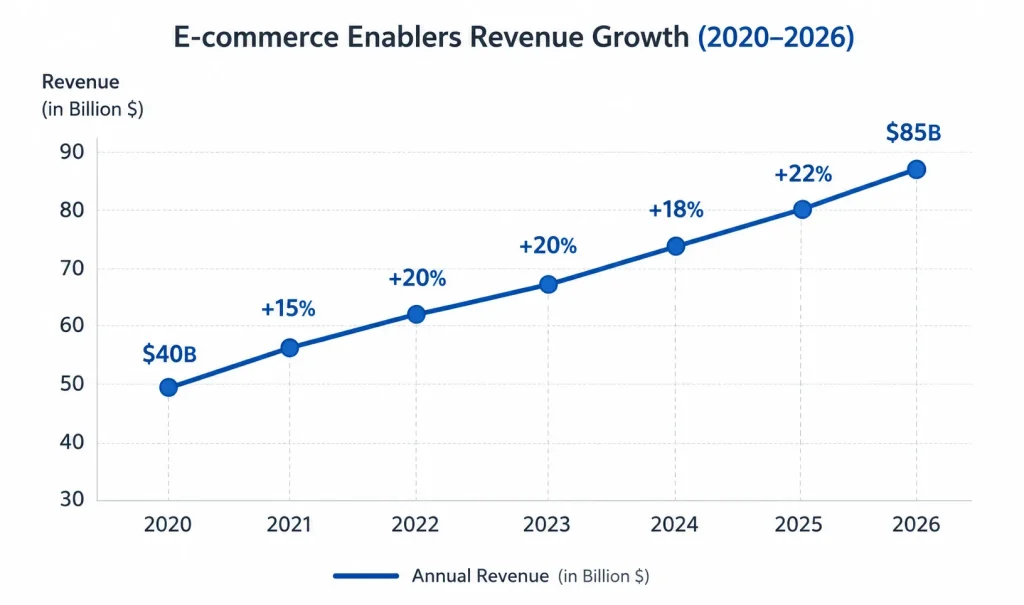
In 2026, E-commerce Enablers collectively generate over $85 billion in global revenue, quietly powering thousands of online brands behind the scenes. From storefront creation to payments, logistics, and growth automation, these platforms sit at the core of modern digital commerce.
Founders studying E-commerce Enablers aren’t just analyzing tools—they’re decoding the infrastructure economy of online retail.
Understanding this revenue model helps entrepreneurs build scalable SaaS, marketplace, and commerce-tech platforms with predictable, recurring income.
E-commerce Enablers Revenue Overview – The Big Picture
E-commerce Enablers include platforms offering storefront tech, payments, fulfillment, analytics, marketing automation, and cross-border commerce services.
2026 Snapshot
- Global Revenue (2026): ~$85–90 billion
- Estimated Market Valuation: ~$450–500 billion (combined public + private)
- YoY Growth (2024–2026): ~18%
- Profit Margins: 18–32% (SaaS-heavy players higher)
Revenue by Region
- North America: ~42%
- Europe: ~26%
- Asia-Pacific: ~24%
- Rest of World: ~8%
Competition Benchmark
- Pure SaaS enablers outperform logistics-heavy players on margins
- Platforms bundling payments + fulfillment show highest ARPU
- Vertical-specific enablers (D2C, B2B, cross-border) grow fastest
Primary Revenue Streams Deep Dive
Revenue Stream #1: SaaS Subscriptions
How it works: Monthly or annual fees for storefronts, integrations, analytics, and automation tools.
Share: ~34%
Pricing: $29–$2,000+/month depending on scale
2026 Insight: Subscription ARPU increased due to bundled AI tools.
Revenue Stream #2: Transaction Fees
How it works: Percentage cut on every sale processed via platform payments.
Share: ~26%
Pricing: 1.5%–3.5% per transaction
2026 Insight: Embedded payments outperform standalone gateways.
Revenue Stream #3: Fulfillment & Logistics Margins
How it works: Warehousing, shipping, returns, and last-mile services.
Share: ~21%
Pricing: Variable per order, weight, and region
2026 Insight: Automation reduced per-order costs by ~12%.
Revenue Stream #4: Value-Added Services
How it works: Marketing tools, loyalty engines, tax compliance, fraud protection.
Share: ~11%
Pricing: Add-on based or usage-based
2026 Insight: High-margin upsell layer for mature merchants.
Revenue Stream #5: Data & Partner Monetization
How it works: Insights, benchmarks, API access, app marketplaces.
Share: ~8%
Pricing: Revenue share or enterprise licensing
2026 Insight: AI-driven insights increased enterprise demand.
Revenue Streams Percentage Breakdown
| Revenue Stream | % Share (2026) |
|---|---|
| SaaS Subscriptions | 34% |
| Transaction Fees | 26% |
| Fulfillment & Logistics | 21% |
| Value-Added Services | 11% |
| Data & Partnerships | 8% |
The Fee Structure Explained
E-commerce Enablers monetize both sides of the ecosystem—merchants and service providers.
User-Side Fees (Merchants)
- Platform subscription fees
- Transaction processing fees
- Add-on service charges
- Usage-based API fees
Provider-Side Fees
- Revenue share from third-party apps
- Fulfillment partner commissions
- Advertising placement fees
Hidden Revenue Layers
- Float income on settlements
- FX margins on cross-border sales
- AI optimization premium features
Regional Pricing Variation
- Higher pricing tolerance in North America & EU
- Usage-based dominance in Asia
- Bundled pricing in emerging markets
Complete Fee Structure by User Type
| User Type | Fee Type | Typical Range |
|---|---|---|
| Small Merchants | SaaS + transaction | $29–$79 + 2–3% |
| Mid-Market Brands | SaaS + services | $299–$2,000/month |
| Enterprise Merchants | Custom licensing | $50k–$500k/year |
| App Developers | Revenue share | 15–30% |
| Logistics Partners | Commission | 5–12% |
How E-commerce Enablers Maximize Revenue Per User
Revenue growth is driven by LTV expansion, not just user acquisition.
- Segmentation: SMB, D2C, enterprise, cross-border sellers
- Upselling: AI tools, analytics, advanced checkout
- Cross-selling: Payments → fulfillment → marketing
- Dynamic Pricing: Volume-based and geography-based
- Retention Monetization: Long-term contracts, switching costs
- LTV Optimization: Bundled ecosystems increase LTV by 2–3×
- Psychological Pricing: Tiered plans anchor value
- Real Data Example: Merchants using 4+ services generate ~2.6× ARPU vs single-tool users
Cost Structure & Profit Margins
Despite scale advantages, cost discipline defines profitability.
Major Cost Buckets
- Infrastructure: Cloud, data, security (~14–18%)
- CAC & Marketing: Paid acquisition, partnerships (~20–25%)
- Operations: Support, compliance, onboarding (~12–15%)
- R&D: Product, AI, integrations (~10–14%)
Unit Economics
- Gross margin (SaaS): 70–85%
- Gross margin (logistics): 18–30%
Profitability Path
- Break-even at ~3,000–5,000 active merchants
- Margin expansion via automation and AI
Future Revenue Opportunities & Innovations
New Streams
- Embedded lending & working capital
- Creator-commerce infrastructure
- Social commerce integrations
AI/ML Monetization
- Predictive inventory pricing
- Conversion-rate optimization engines
- AI customer support upsells
Market Expansion
- Cross-border enablement
- B2B commerce tooling
- Emerging market digitization
Predicted Trends (2026–2027)
- Commerce OS platforms dominate
- Payments + data converge
- Fewer tools, deeper platforms
Risks & Threats
- Margin pressure in logistics
- Regulatory complexity
- Platform dependency concerns
Opportunities for New Founders
- Vertical-specific enablers
- Region-focused solutions
- AI-first commerce stacks
Lessons for Entrepreneurs & Your Opportunity
What Works
- Recurring SaaS + transactional revenue
- Ecosystem lock-in
- Bundled value delivery
What to Replicate
- Multi-layer monetization
- Usage-based scaling
- Partner marketplaces
Market Gaps
- Affordable enterprise-grade tools for SMBs
- Unified cross-border stacks
- AI-native commerce platforms
Final Thought
E-commerce Enablers are no longer tools—they are digital infrastructure businesses.
Their success comes from stacking monetization layers while simplifying commerce for merchants.
For founders, this model offers one of the clearest paths to scalable, defensible, and recurring revenue in the digital economy.
FAQs
1. How much do E-commerce Enablers make per transaction?
Typically 1.5%–3.5% depending on volume and region.
2. What’s the most profitable revenue stream?
SaaS subscriptions and AI add-ons deliver the highest margins.
3. How does pricing compare to competitors?
Bundled platforms offer better value but higher long-term spend.
4. What percentage is taken from providers?
App and partner revenue shares range from 15–30%.
5. How has the revenue model evolved?
From tools → ecosystems → AI-powered platforms.
6. Can small platforms use similar models?
Yes, by starting with SaaS + transactions.
7. What’s the minimum scale for profitability?
Around 3,000–5,000 active merchants.
8. How to implement similar revenue models?
Combine subscriptions, usage fees, and ecosystem partnerships.
9. What are alternatives to this model?
Pure SaaS, marketplace-only, or logistics-only platforms.
Miracuves is an independent software development company. We are not affiliated with, connected to, sponsored by, or endorsed by any company or product named in this article.
Terms such as “X Clone” are used descriptively. It is how the software industry refers to building a platform with functionality comparable to a known service, and how clients search for it.
The entire design and codebase of our products is built by our own team. Our products contain no code, design, graphics, or content originating from any third-party website or applications.
All third-party names and marks referenced in this article are the property of their respective owners, referenced solely to identify the services discussed.