


Key Takeaways
- A P2P car sharing script needs layered security because it handles users, vehicles, payments, GPS data, bookings, documents, and owner-renter trust.
- The most important security integrations include identity verification, driver license checks, secure payments, GPS tracking, telematics, digital keys, and fraud monitoring.
- No single API can protect the full platform; the strongest setup combines KYC, vehicle access control, backend security, admin logs, and dispute workflows.
- Security priority depends on business model, geography, vehicle value, insurance requirements, remote unlock features, and launch scope.
- Long-term trust depends on verified users, safe bookings, protected payments, clear damage records, strong admin control, and continuous risk monitoring.
Security Integration Signals
- KYC and driver license verification help reduce fake accounts, underqualified renters, stolen identities, and risky booking behavior.
- Digital key and remote unlock security become launch-critical when renters can access vehicles without meeting the owner in person.
- GPS tracking, geofencing, and telematics help monitor trip activity, detect misuse, support disputes, and improve vehicle safety.
- Payment security should include trusted gateways, tokenized cards, deposits, fraud checks, refund controls, and payout tracking.
- Backend protection requires API security, role-based access, audit logs, encrypted data, device checks, rate limits, and incident monitoring.
Real Insights
- A peer-to-peer car sharing platform is not just a rental app; it is a trust system between private vehicle owners and renters.
- Founders should not wait until after launch to add security because weak verification, unsafe access, or payment fraud can damage marketplace trust quickly.
- Premium or multi-city platforms need stronger controls such as telematics, deposits, geofencing, digital key security, and advanced fraud detection.
- Admin visibility is critical for reviewing suspicious users, monitoring bookings, handling damage claims, managing refunds, and controlling vehicle access issues.
- The safest P2P car sharing platforms combine identity verification, vehicle protection, secure payments, location intelligence, backend security, and compliance-ready operations.
Peer-to-peer car sharing is no longer just a booking marketplace where one user lists a vehicle and another user rents it. In 2026, a serious P2P car sharing platform must work like a trust engine, a payments system, an IoT access layer, a telematics dashboard, a fraud monitoring tool, and a mobility operations platform at the same time.
That is why security cannot be treated as a small feature inside a P2P car sharing script. It is the foundation that decides whether vehicle owners trust the platform, renters complete bookings confidently, admins control risk, and the business can scale without exposing itself to fraud, theft, payment disputes, or data privacy issues.
Modern car sharing platforms now depend heavily on digital keys, real-time tracking, connected vehicle data, automated payments, identity verification, mobile APIs, and third-party integrations. Industry platforms such as Geotab and INVERS highlight how keyless vehicle access, telematics, and fleet control have become central to shared mobility operations.
For founders building a Turo-style car sharing marketplace, the real question is not only “What features should we add?” The stronger question is: “What security integrations should exist before users can safely unlock, drive, pay for, and return someone else’s vehicle?”
This guide breaks down the key security integrations every peer-to-peer car sharing app should consider in 2026.
Why Security Matters More in P2P Car Sharing Than Standard Car Rental
Traditional car rental businesses usually own the fleet, control the pickup location, verify users at counters, and operate under centralized staff supervision. Peer-to-peer car sharing is different. The platform connects private vehicle owners with renters, often without physical staff at the handover point.
That creates a much wider trust gap.
A P2P car sharing platform needs to protect:
- Vehicle owners who worry about theft, misuse, unpaid damage, late returns, fake renters, and unauthorized access.
- Renters who worry about payment safety, identity privacy, vehicle condition, unfair claims, and pickup reliability.
- Platform operators who need to manage fraud, disputes, payments, insurance workflows, admin approvals, and operational risk.
This is why marketplace security must include user verification, secure payments, refund and dispute workflows, role-based dashboards, admin approval controls, and fraud detection signals. For rental marketplaces, trust depends on identity, payment safety, dispute control, and transparent activity records.
A weak P2P car sharing script may let users browse cars and make bookings. A secure P2P car sharing platform should verify the renter, validate the vehicle owner, protect payments, secure vehicle access, track vehicle activity, log admin decisions, detect suspicious behavior, and generate enough evidence to handle disputes.
That is the difference between a simple rental app and a scalable mobility marketplace.
Core Security Risks Facing P2P Car Sharing Apps in 2026
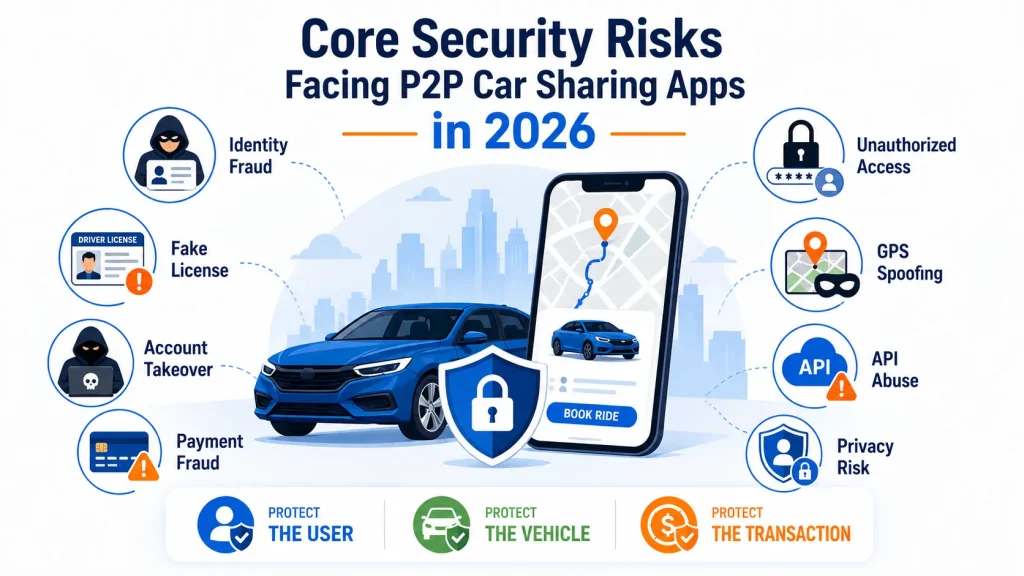
A P2P car sharing app like Turo has more security risks than a normal ecommerce or service marketplace because the platform is not only handling users and payments. It is also giving one person temporary access to another person’s vehicle.
That means one weak security step can lead to bigger problems such as car theft, fake bookings, payment fraud, vehicle damage, privacy issues, or disputes between owners and renters.
Here are the biggest risks founders should understand:
Identity fraud:
A renter may create an account using a fake name, stolen ID, or someone else’s personal details. If the platform does not verify users properly, vehicle owners may end up handing access to an unknown or high-risk person.
Fake driver license submissions:
Some users may upload an expired, edited, or fake driver license. Without proper license verification, the platform may allow someone to book a car even if they are not legally allowed to drive.
Account takeover:
A real user’s account can be hacked through weak passwords, phishing, or stolen login details. Once inside, the attacker may try to book cars, change payment details, or misuse the platform.
Payment fraud:
A renter may use a stolen card, make a booking, complete the trip, and then trigger a chargeback. Others may try to manipulate refunds, deposits, cancellation fees, or damage claims.
Unauthorized vehicle access:
If digital key access is not controlled properly, a renter may unlock the vehicle before the booking starts, after the booking ends, or from an unapproved device.
GPS spoofing:
A renter may try to fake their phone location to show they are near the car, at the pickup point, or inside the allowed area when they are not. This can affect pickup verification, drop-off confirmation, and trip monitoring.
Telematics tampering:
Telematics devices send vehicle data such as location, mileage, lock status, fuel level, and movement. If this data is blocked, manipulated, or not monitored, the platform may lose visibility during an active trip.
API abuse:
APIs connect the app, backend, payments, admin panel, maps, and vehicle access systems. If APIs are weak, attackers may try to access other users’ bookings, vehicle details, payouts, or admin functions.
IoT security gaps:
Many car sharing platforms use connected devices, Bluetooth modules, digital keys, or vehicle tracking hardware. If these devices are not secured, they can become entry points for attackers.
Dispute manipulation:
A renter or owner may make a false claim about fuel level, damage, late return, vehicle condition, or payment. Without trip photos, lock/unlock logs, GPS records, and admin notes, disputes become difficult to resolve fairly.
Privacy exposure:
A P2P car sharing app collects sensitive information such as identity documents, driver licenses, payment details, trip history, location data, and messages. If this data is not protected properly, it can damage user trust and create legal risk.
In simple terms, a car sharing platform must protect three things at the same time: the user, the vehicle, and the transaction. That is why security should be designed from the beginning across onboarding, booking, payments, vehicle access, tracking, admin control, support, and post-trip dispute workflows.
Read More : How to Build an App Like Turo: A Developer’s Guide
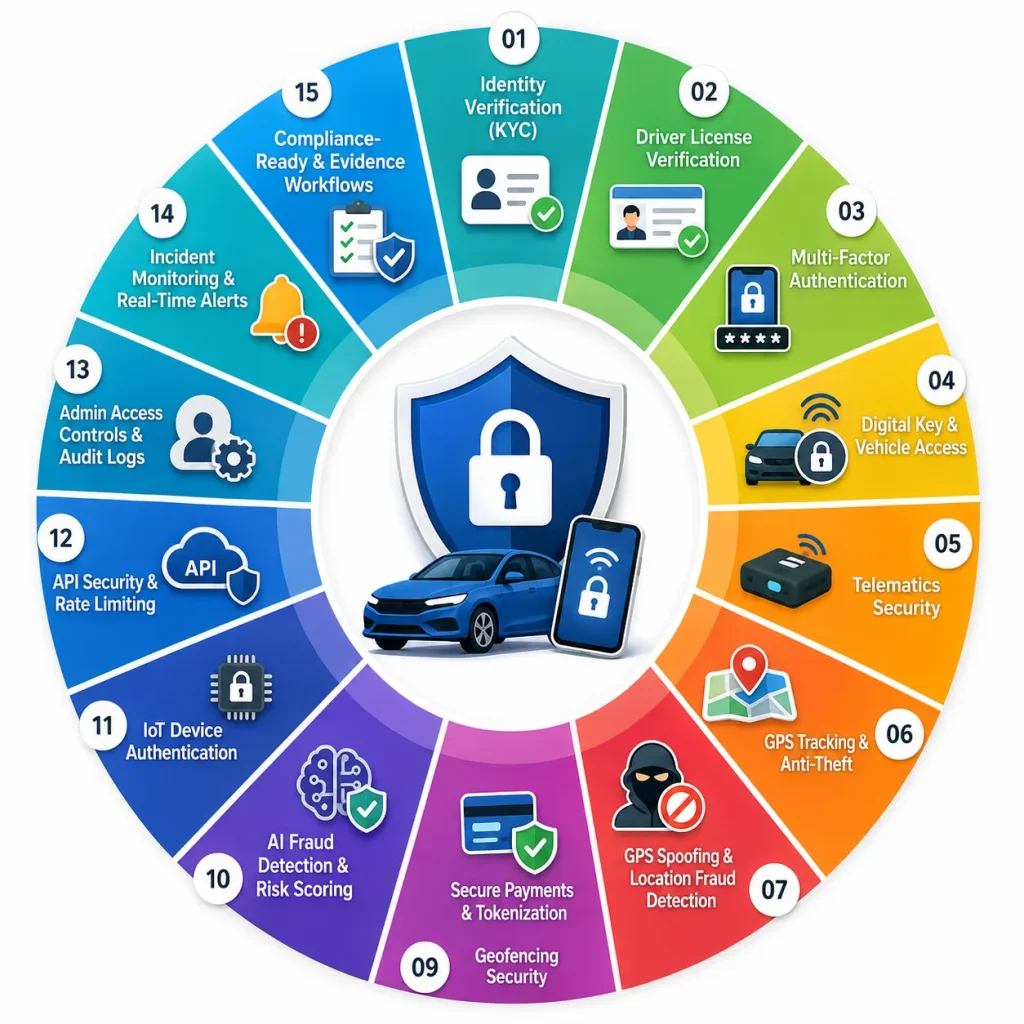
15 Key Security Integrations Every P2P Car Sharing Script Needs
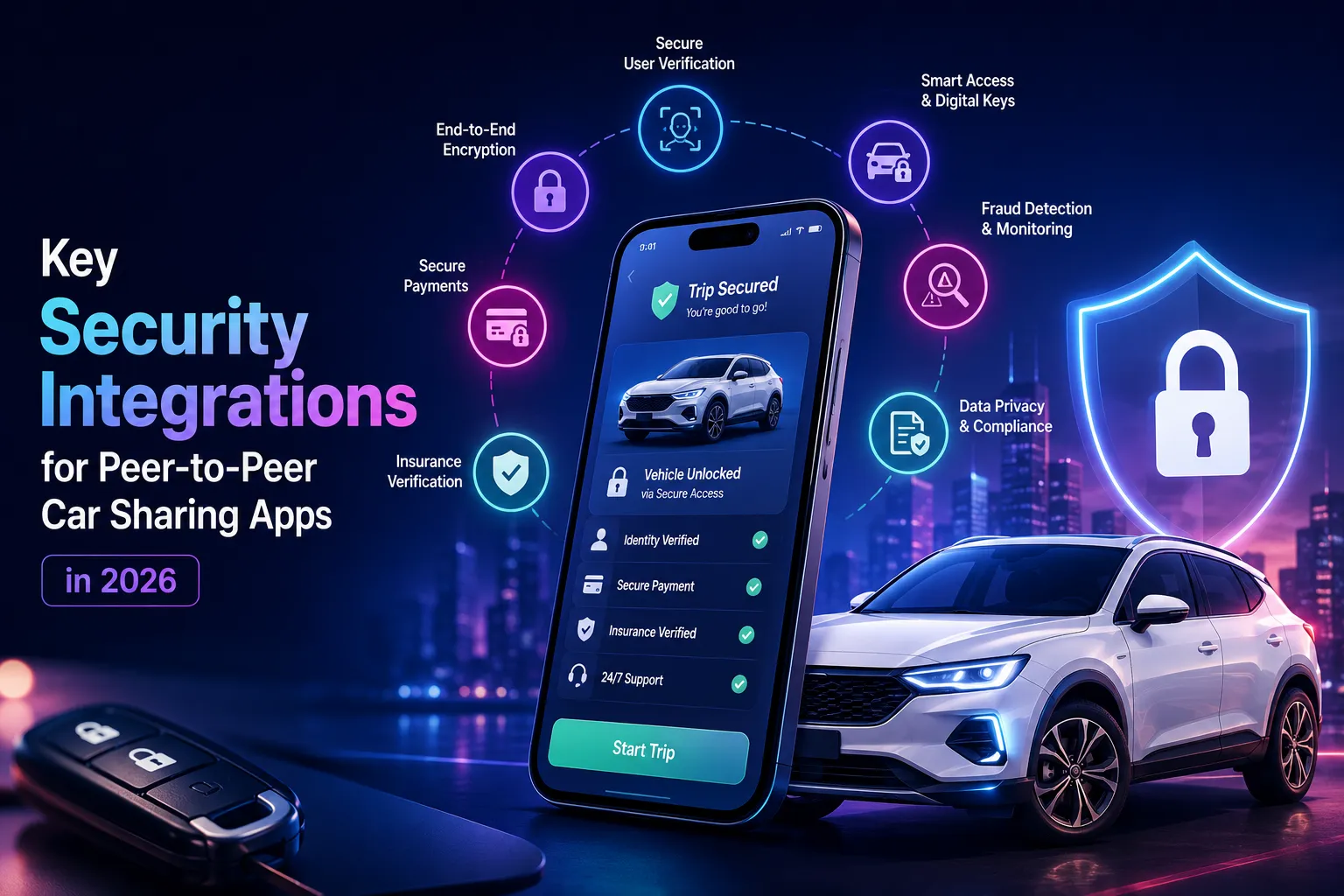
A secure P2P car sharing script should include multiple layers of security. No single API can solve the entire problem. Identity verification reduces fake users. Digital keys protect vehicle access. Telematics helps monitor activity. Payment security reduces fraud. API security protects the backend. Admin audit logs support accountability.
The strongest approach is a layered security stack.
1. Identity Verification and KYC Integration
Identity verification is the first security layer in a peer-to-peer car sharing app. Before a renter can book a vehicle, the platform should confirm that the user is a real person and that their submitted identity matches their profile.
A strong KYC flow may include:
- Government ID verification
- Selfie and liveness check
- Face match between ID and selfie
- Document authenticity checks
- Address verification where required
- Risk scoring based on device, geography, and behavior
- Manual review queue for failed or suspicious checks
Tools such as Persona support government ID verification across many countries and territories, including driver’s licenses and passports.
For a P2P car sharing platform, identity verification helps reduce fake accounts, stolen identity usage, high-risk renters, duplicate profiles, and repeat abuse. It also gives vehicle owners more confidence because the platform is not allowing anonymous users to access their cars.
Founder decision: Do not make KYC a one-time checkbox. Build it as a risk-based workflow. A low-risk renter may pass standard verification, while a high-risk renter may require additional checks before booking expensive vehicles.
2. Driver License Verification API
A car sharing app should not rely only on generic identity verification. It also needs driver license validation because the renter must be legally eligible to drive.
A license verification workflow should check:
- License number
- License class
- Expiry date
- Country or state validity
- Age eligibility
- Name match with verified identity
- Document tampering signals
- Manual review status
In a P2P car sharing script, license verification should be connected to booking rules. For example, users with unverified or expired licenses should not be able to book. Users with pending verification may browse cars but should not receive access credentials until approval.
This protects the platform from preventable risk. It also helps vehicle owners feel safer because the platform is confirming more than just an email address and phone number.
3. Multi-Factor Authentication for Renters, Owners, and Admins
Passwords are not enough for a platform that controls payments, personal identity records, and vehicle access. Multi-factor authentication should be used for high-risk actions.
Important MFA checkpoints include:
- New device login
- Password reset
- Changing payout details
- Booking a high-value vehicle
- Starting a trip
- Unlocking a vehicle
- Admin login
- Changing vehicle availability or pricing
- Issuing refunds or approving disputes
A secure P2P car sharing app should not create friction everywhere. Instead, it should trigger additional verification when risk increases. For example, if a user logs in from a new country and tries to book a premium car immediately, MFA should be required.
Founder decision: MFA is not just about user login. It should protect financial actions, vehicle access actions, and admin actions.
4. Digital Key and Remote Vehicle Access Security
Digital key integration is one of the most important security layers in modern car sharing. It allows approved renters to lock and unlock a vehicle from the app without physical key exchange.
Platforms such as Geotab Keyless position digital keys as a scalable access solution for shared fleets, simplifying vehicle access while improving security for pooled and shared vehicles.
A secure digital key system should include:
- Time-limited access tokens
- Booking-based permission windows
- Encrypted communication between app, backend, and vehicle access device
- Bluetooth Low Energy security where BLE is used
- Revocable access after trip completion
- One-user-one-trip access mapping
- Admin override with audit logs
- Remote lock and unlock history
- Emergency access controls
- Failed unlock attempt tracking
The platform should never issue permanent unlock permissions to renters. Vehicle access should be limited to the approved booking window, verified user, verified device, and approved vehicle.
A good access flow looks like this:
- User completes KYC and license verification.
- User books a vehicle and payment authorization succeeds.
- Backend creates a time-limited vehicle access permission.
- Mobile app receives a secure access token.
- User unlocks the vehicle during the approved window.
- Every unlock, lock, failed attempt, and remote action is logged.
- Access automatically expires after trip completion.
Founder decision: Digital key security is not only a convenience feature. It protects vehicle owners from unauthorized access and gives admins evidence during disputes.
5. Telematics Security Integration
Telematics connects the platform to real vehicle data. In a car sharing business, this can include location, mileage, fuel level, battery level, lock status, diagnostic alerts, trip events, driving behavior, and device health.
INVERS describes a car sharing telematics unit as a core hardware component that turns a vehicle into a connected asset that can be rented through a mobile app.
A secure telematics integration should support:
- Encrypted vehicle data transfer
- Device authentication
- Tamper detection
- Trip start and end signals
- Mileage tracking
- Fuel or battery state monitoring
- Remote diagnostics
- Lock/unlock status
- Location verification
- Device heartbeat monitoring
- Anomaly alerts
Telematics helps admins identify suspicious events. For example, if a vehicle is moving before the trip officially starts, the platform can trigger an alert. If a device stops reporting during an active trip, the admin team can investigate. If mileage is much higher than the agreed booking terms, the system can calculate overage or flag misuse.
Founder decision: Telematics is not just operational technology. It is a security and evidence layer.
6. GPS Tracking and Anti-Theft Monitoring
GPS tracking helps vehicle owners and platform admins understand where a vehicle is during an active booking. In a P2P car sharing model, this is essential because the platform does not own every car and cannot physically supervise trips.
A GPS security layer should support:
- Live vehicle location during active trips
- Pickup and drop-off location verification
- Route history for dispute review
- Suspicious movement alerts
- No-movement alerts when pickup is expected
- Vehicle leaving permitted region
- Late return detection
- Location mismatch between user device and vehicle
GPS tracking should be handled carefully because location data is sensitive. The platform should collect what is needed for safety and operations while applying privacy-conscious data handling.
Founder decision: Give admins enough location visibility to protect vehicles, but avoid unnecessary exposure of personal movement data.
7. GPS Spoofing and Location Fraud Detection
Location fraud is a serious issue in mobility apps. A renter may attempt to spoof device GPS, hide vehicle usage, manipulate pickup status, or falsely claim that they returned the vehicle.
GPS spoofing prevention should combine multiple signals:
- Mobile device location
- Vehicle telematics location
- IP address location
- Bluetooth proximity
- Pickup photo metadata
- Timestamp consistency
- Geofence entry and exit data
- Device integrity checks
If the phone says the user is near the vehicle but the telematics unit shows the car elsewhere, the platform should flag the session. If a user starts a trip without physical proximity to the vehicle, the app should require additional verification.
Founder decision: Never rely on mobile GPS alone for vehicle security. Cross-check location data with vehicle-side signals.
8. Geofencing Security
Geofencing allows the platform to define virtual boundaries around pickup zones, operating regions, restricted areas, airports, parking lots, or high-risk locations.
Geofencing can help with:
- Pickup confirmation
- Drop-off validation
- Unauthorized region alerts
- Late return monitoring
- Cross-border restriction enforcement
- Insurance boundary rules
- Parking zone compliance
- High-risk area detection
For example, if a vehicle is booked for city use but leaves the permitted operating zone, admins can receive an alert. If a renter tries to end a trip outside the approved return area, the app can block completion or trigger a support workflow.
Founder decision: Geofencing should be connected to booking rules, insurance rules, and admin alerts, not just maps.
9. Secure Payment Gateway and Tokenized Payments
Payments in a P2P car sharing app involve multiple risks: stolen cards, failed deposits, chargebacks, delayed payouts, refunds, damage claims, cancellation fees, and host earnings.
A secure payment setup should include:
- Tokenized card storage
- Payment authorization before trip start
- Security deposit or pre-authorization where applicable
- Fraud scoring
- Chargeback monitoring
- Refund controls
- Payout approval workflows
- Split payment logic
- Invoice and receipt generation
- PCI-aware payment handling
The PCI Security Standards Council develops standards and resources for the safe handling of payment data, and PCI DSS is designed as a baseline of technical and operational requirements for protecting account data.
Stripe Radar, for example, uses machine learning and transaction signals to score payments and help detect fraud.
Founder decision: Do not store raw card data inside your own platform unless your business has the compliance maturity to manage it. Use secure payment gateway integrations and tokenization.
10. AI Fraud Detection and Risk Scoring
Fraud in car sharing is not always obvious. A user may pass basic onboarding but still behave suspiciously later. AI fraud detection can help identify risk patterns across identity, booking, payments, device, and vehicle behavior.
Fraud signals may include:
- Multiple accounts from one device
- Repeated failed payment attempts
- High-value booking from a newly created profile
- Mismatch between KYC country and booking region
- Repeated booking cancellations
- Abnormal pickup behavior
- Device fingerprint changes
- Card mismatch with profile identity
- Unusual driving or mileage pattern
- Multiple users using the same license document
A strong fraud engine should create a risk score and trigger different actions:
- Approve automatically
- Ask for more verification
- Hold for manual review
- Limit booking value
- Block high-risk payment
- Suspend account
- Escalate to admin
Founder decision: Fraud prevention should not block every unusual user. It should create a controlled review process so the business can reduce risk without hurting legitimate bookings.
11. IoT Device Authentication
Vehicle access devices, telematics units, Bluetooth modules, and mobile apps must authenticate securely. If an attacker can impersonate a device, intercept commands, or replay access tokens, vehicle security becomes weak.
IoT device authentication should include:
- Unique device identity
- Certificate-based authentication
- Secure provisioning
- Rotating keys
- Firmware integrity checks
- Encrypted device-to-cloud communication
- Device revocation
- Secure OTA update workflows
- Backend validation of every device command
Connected vehicle cybersecurity guidance increasingly emphasizes secure-by-design thinking, lifecycle protection, and machine identity management across connected vehicle ecosystems.
Founder decision: Treat every vehicle device as a security-sensitive endpoint. The platform should know which device is connected to which vehicle, user, booking, and access session.
12. API Gateway Security and Rate Limiting
A P2P car sharing platform runs on APIs. The mobile app, admin panel, payment gateway, KYC provider, telematics provider, notification service, and vehicle access system all communicate through APIs.
If API security is weak, attackers may target:
- User profiles
- Vehicle listings
- Booking IDs
- Payment endpoints
- Payout endpoints
- Refund workflows
- Admin actions
- Vehicle unlock commands
- Trip records
- Document uploads
OWASP lists Broken Object Level Authorization as the top API security risk because APIs often expose endpoints with object identifiers that attackers may manipulate.
API security should include:
- API gateway
- Rate limiting
- Strong authentication
- Object-level authorization
- Role-based permissions
- Request validation
- Webhook signature verification
- Bot protection
- IP reputation checks
- Admin endpoint protection
- Sensitive data masking
- Audit logging
For example, a renter should never be able to change another user’s booking by modifying a booking ID in an API request. A vehicle owner should not access another owner’s payout data. A support executive should not unlock vehicles unless their role allows it.
Founder decision: API security must be tested at the object level, not only at the login level.
13. Admin Access Controls and Audit Logs
The admin panel is one of the most powerful parts of a car sharing platform. It can approve users, manage vehicles, issue refunds, resolve disputes, adjust payouts, block accounts, edit bookings, and sometimes trigger remote vehicle actions.
That makes admin security critical.
Admin controls should include:
- Role-based access control
- Permission-based dashboards
- Admin MFA
- Separate roles for support, finance, operations, and super admin
- Approval workflows for sensitive actions
- Audit logs for every admin action
- Export restrictions
- Session timeout
- IP or device restrictions for sensitive roles
- Refund and payout approval layers
A secure admin panel should answer: Who did what, when, from where, and why?
Founder decision: Admin control is a security feature. A weak admin panel can create more risk than a weak user app.
14. Incident Monitoring and Real-Time Alerts
Security incidents need fast detection. A platform should not discover fraud only after the vehicle is missing, the payment is reversed, or the user complains.
Incident monitoring should include alerts for:
- Vehicle moving without active booking
- Unlock attempt outside booking window
- Telematics device offline during trip
- Repeated failed login attempts
- Multiple failed payment attempts
- High-risk KYC failure
- Vehicle leaving permitted region
- Late return
- Admin override action
- Refund spike
- Chargeback event
- Suspicious device switching
These alerts should flow into an admin dashboard, support queue, or incident management tool. For high-risk events, the platform may notify the vehicle owner, renter, or internal operations team.
Founder decision: Real-time monitoring reduces response time. In mobility businesses, faster detection can prevent financial and operational loss.
15. Compliance-Ready Privacy, Security, and Evidence Workflows
Compliance depends on jurisdiction, legal review, business model, and data practices. A car sharing app should not claim to be automatically compliant everywhere. Instead, the platform should be built with compliance-ready workflows that support privacy, auditability, and operational control.
Important compliance-ready layers include:
- Privacy-conscious data collection
- User consent management
- Data retention rules
- Encrypted data transfer
- Encrypted sensitive storage
- Right-to-delete workflows where applicable
- Identity document access restrictions
- Payment data tokenization
- Audit logs
- Security incident records
- Role-based admin access
- Exportable reports for legal or insurance workflows
Relevant frameworks and regulations may include GDPR, CCPA, PCI DSS, ISO 27001, ISO/SAE 21434 for vehicle cybersecurity context, and local mobility or rental regulations depending on target markets. NHTSA also provides non-binding cybersecurity best practices for modern vehicles, intended for organizations involved in vehicle electronic systems and software.
Founder decision: Build the operational controls early. Final compliance depends on your target geography, legal review, integrations, and operating model.
Recommended Security Tech Stack for a P2P Car Sharing App
| Security Layer | Recommended Integration Type | Business Purpose |
|---|---|---|
| User authentication | Auth0, Firebase Auth, custom OAuth flow | Secure login, password reset, user sessions |
| MFA | Okta, Twilio Verify, Authenticator apps | Protect high-risk actions |
| Identity verification | Persona, Veriff, Onfido, Jumio | Verify renters and reduce fake accounts |
| Driver license verification | ID verification API with license checks | Confirm driving eligibility |
| Payments | Stripe, Adyen, Braintree | Secure payments, deposits, refunds, payouts |
| Fraud detection | Stripe Radar, Sift-style fraud engine, custom ML scoring | Detect risky payments and users |
| Digital key | Geotab Keyless, custom BLE SDK, OEM access APIs | Secure remote lock/unlock |
| Telematics | Geotab, INVERS, Samsara, Wialon | Track vehicle state, trip data, device health |
| GPS and geofencing | Maps APIs, telematics GPS, geofence engine | Location security and trip validation |
| API security | Cloudflare, Kong, AWS API Gateway | Rate limiting, API protection, abuse prevention |
| Monitoring | Datadog, New Relic, CloudWatch | System health and incident detection |
| Audit logs | Custom event logging, SIEM integration | Dispute evidence and admin accountability |
| Data security | Encryption, key management, access control | Protect sensitive user and vehicle data |
| Compliance workflows | Consent, retention, export, deletion controls | Support legal and privacy requirements |
Security Architecture of a Modern P2P Car Sharing Platform
A secure P2P car sharing platform should not work like one simple app connected to one database. Since it handles users, payments, vehicles, and remote access, the system should be divided into clear security layers.
| Layer | What It Does | Why It Matters |
|---|---|---|
| Renter App | Signup, KYC, car search, booking, payment, trip start, digital unlock, trip photos, and reviews. | Keeps the renter journey smooth while protecting bookings and access. |
| Owner App | Car listing, pricing, availability, booking approvals, earnings, and disputes. | Gives vehicle owners control over their cars and trips. |
| Admin Panel | User verification, vehicle approval, payments, fraud review, disputes, reports, and audit logs. | Helps the platform team manage risk and operations. |
| API Gateway | Connects apps, admin panel, payments, KYC, maps, and vehicle systems. | Protects the backend from unauthorized requests and API abuse. |
| Security Layer | Handles login, MFA, permissions, encryption, fraud checks, and session control. | Ensures only the right users can access the right data and actions. |
| Vehicle Access Layer | Manages digital keys, Bluetooth access, remote lock/unlock, and booking-based access windows. | Makes sure renters can unlock only the approved car during the approved time. |
| Telematics Layer | Tracks GPS, mileage, fuel or battery level, lock status, and vehicle health. | Gives visibility into what happens during the trip. |
| Payments Layer | Manages deposits, trip payments, refunds, owner payouts, and chargebacks. | Protects money movement between renters, owners, and the platform. |
| Evidence Layer | Stores trip photos, lock/unlock logs, payment records, admin notes, and dispute history. | Helps resolve claims fairly and supports compliance-ready records. |
A simple secure flow looks like this:
- The renter signs up and completes identity and driver license verification.
- The renter books a car and completes payment authorization.
- The backend checks the user, booking time, vehicle availability, and risk score.
- The system creates a limited digital key for that renter and trip.
- The renter unlocks the car only during the approved booking window.
- Telematics tracks location, mileage, and vehicle status.
- Admins receive alerts if something unusual happens.
- After the trip, photos, payments, mileage, access logs, and notes are saved for dispute handling.
This layered setup helps prevent fake bookings, unauthorized access, payment fraud, weak admin control, and missing dispute evidence.
Read More: Reasons startup choose our Turo clone over custom development
Suggested Architecture Diagram for the Blog Designer
Use this section as visual guidance for your design team.
Diagram Title: Secure P2P Car Sharing App Architecture
Suggested flow:
Renter App / Owner App
↓
Authentication + MFA
↓
API Gateway + Rate Limiting
↓
Core Booking Engine
↓
Payment Gateway + Fraud Engine
↓
KYC + Driver License Verification
↓
Digital Key Service
↓
Vehicle Telematics Unit
↓
GPS, Lock Status, Mileage, Diagnostics
↓
Admin Dashboard + Audit Logs + Incident Alerts
Founder Decision Signals: What to Prioritize First
Not every founder needs the same security stack on day one. The right priorities depend on the business model, target geography, vehicle value, insurance requirements, and launch scope.
For a small local marketplace, the first focus should be identity verification, driver license checks, secure payments, role-based admin control, GPS tracking, and basic dispute workflows.
For a premium car sharing platform, stronger controls become important earlier. This includes digital keys, deposits, telematics, geofencing, advanced fraud detection, and strict admin approval workflows.
For an enterprise-grade or multi-city platform, the security stack should go deeper with API gateway protection, incident monitoring, device authentication, compliance-ready reporting, and scalable cloud infrastructure.
If the platform includes remote unlock, digital key security should be treated as a launch-critical requirement, not a future upgrade.
If private vehicle owners are listing cars, trust workflows become even more important. Owners need to know that renters are verified, trips are logged, payments are secured, and disputes can be handled fairly.
Founder Decision Signals
Speed
Choose a ready-made P2P car sharing foundation when you want faster validation and already need common marketplace flows such as booking, payments, listings, and admin control.
Risk
Prioritize KYC, driver license checks, secure payments, digital key permissions, and dispute evidence before opening the platform to public users.
Scalability
Use API gateway security, audit logs, incident alerts, and telematics integrations early if the platform will operate across multiple cities or high-value vehicles.
Trust
Vehicle owners need clear verification, trip logs, GPS records, payment protection, and admin support before they confidently list their cars.
Cost Factors for Security Integrations in a Car Sharing App
The cost of adding security integrations to a P2P car sharing app depends on how advanced the platform needs to be. A basic platform may only need KYC, secure payments, and admin controls. A more advanced platform may need telematics, digital keys, GPS tracking, fraud detection, and compliance-ready workflows.
Security is not one single cost. It is usually spread across different parts of the app.
| Cost Factor | What It Includes | Why It Affects Cost |
|---|---|---|
| KYC and License Verification | ID checks, selfie verification, driver license validation, manual review flows. | Third-party verification tools often charge per check, and custom review workflows need development. |
| Payment Security | Payment gateway setup, deposits, refunds, chargebacks, tokenized payments, fraud checks. | Car sharing apps handle renter payments, owner payouts, deposits, and dispute deductions. |
| Telematics Integration | GPS, mileage, fuel or battery data, lock status, diagnostics, and device health. | Requires hardware support, API integration, testing, and real-time data handling. |
| Digital Key or BLE Access | Remote lock/unlock, Bluetooth access, access tokens, and booking-based permission windows. | Vehicle access must be secure, time-limited, and connected to verified bookings. |
| GPS and Geofencing | Pickup/drop-off validation, allowed zones, restricted areas, and live trip tracking. | Needs maps, location logic, alerts, and admin monitoring workflows. |
| Admin Permissions and Audit Logs | Role-based access, approval workflows, dispute logs, refund controls, and action history. | More roles and sensitive actions require stronger permission design. |
| Cloud and Monitoring Tools | Hosting, alerts, uptime monitoring, logs, and system health tracking. | Real-time vehicle and payment systems need stable infrastructure. |
| API Security Testing | Rate limiting, authorization checks, token validation, webhook security, and penetration testing. | Protects the backend from misuse, fake requests, and unauthorized access. |
| Compliance and Privacy Workflows | Consent records, data retention, identity document access control, and legal review support. | Requirements change based on country, operating model, and data collected. |
| Fraud Rules and Manual Review | Risk scoring, suspicious booking alerts, payment flags, and admin review queues. | Custom fraud workflows take planning, testing, and continuous improvement. |
A ready-made foundation can reduce development effort if the platform already includes user flows, booking logic, payment workflows, marketplace controls, and an admin dashboard. However, final pricing should always be confirmed based on selected modules, third-party integrations, vehicle access requirements, branding, and customization scope.
For founders comparing custom development with a ready-made P2P car sharing script, the better question is not only “How much will it cost?” The better question is: “Which security layers are already included, which ones need customization, and which third-party tools are required before launch?”
Common Security Mistakes Founders Should Avoid
Treating KYC as Enough Security
KYC verifies identity, but it does not secure the vehicle, payment, API, admin dashboard, or telematics layer. A verified user can still commit payment fraud, violate trip rules, or misuse a vehicle.
Allowing Vehicle Access Without Booking-Based Permissions
Digital keys should be tied to the booking window. Access should expire automatically after the trip ends. Permanent or loosely controlled access creates major risk.
Ignoring API Authorization
A user who is logged in should not automatically access every object in the system. Booking IDs, vehicle IDs, payout IDs, and document IDs need object-level authorization checks.
Weak Admin Panel Permissions
If every admin can approve refunds, unlock vehicles, change payouts, and view identity documents, the platform is exposed to internal misuse and accidental errors.
No Evidence Layer for Disputes
Trip photos, mileage, fuel level, lock/unlock logs, location history, payment records, and admin actions should be connected. Without evidence, disputes become subjective and expensive.
Overcollecting Sensitive Data
Collecting too much identity, location, or driving data can create privacy risk. Gather what the platform needs, protect it, and define retention rules.
How Miracuves Helps Build Secure Peer-to-Peer Car Sharing Platforms
Miracuves helps founders build marketplace and mobility platforms with user flows, admin control, monetization logic, and scalable product foundations. For a P2P car sharing business, the goal is not simply to launch a booking app. The goal is to create a trusted ecosystem where vehicle owners, renters, and platform admins can operate with clear controls.
A secure car sharing platform can include renter onboarding, owner verification, vehicle listings, availability calendars, booking management, secure payments, commission logic, trip records, admin approvals, dispute workflows, fraud signals, GPS tracking, and third-party integration support.
For founders exploring a ready-made clone app solution, Miracuves can help shape the product around business model clarity, source-code ownership, white-label branding, admin control, and faster market validation.
Security planning should happen before launch, not after the first dispute. That includes deciding which KYC provider to use, how driver licenses are verified, how vehicle access is controlled, how payments are authorized, how owners are protected, and how admins respond to incidents.
If you want to discuss a secure P2P car sharing platform for your market, you can contact Miracuves to explore the right product foundation and integration roadmap.
White-Label P2P Car Sharing Script vs Custom Development
| Decision Area | White-Label P2P Car Sharing Script | Fully Custom Development |
|---|---|---|
| Launch speed | Faster when core marketplace modules already exist | Longer because every workflow starts from planning and development |
| Security foundation | Can include ready user, booking, payment, and admin flows | Can be built exactly around enterprise security requirements |
| Customization | Suitable when business model matches proven car sharing workflows | Stronger when the model is highly unique or enterprise-specific |
| Cost control | More predictable when scope is clear | Can expand as requirements evolve |
| Integrations | KYC, payments, maps, GPS, and telematics can be added based on scope | Every integration is planned and built from the ground up |
| Source-code ownership | Important for long-term control if included | Usually possible depending on contract |
| Best for | Founders who want faster validation and branded launch | Businesses with complex compliance, fleet, or enterprise needs |
A white-label P2P car sharing script is useful when the founder wants to launch faster using a proven foundation. Custom development is better when the platform requires unusual workflows, proprietary integrations, advanced enterprise compliance, or deep operational complexity.
The stronger decision depends on your launch strategy, not just your budget.
Final Thoughts
The future of peer-to-peer car sharing belongs to platforms that can create trust at scale. Users will not share expensive vehicles through an app that feels risky. Renters will not upload documents or payment details to a platform that lacks transparency. Admins cannot manage growth if fraud, disputes, and access controls are handled manually.
A secure P2P car sharing script should include identity verification, driver license checks, MFA, digital key security, telematics, GPS tracking, geofencing, tokenized payments, fraud detection, API protection, admin controls, incident monitoring, and compliance-ready workflows.
The real value is not adding security features one by one. The real value is designing a connected security stack where onboarding, booking, payment, vehicle access, tracking, admin control, and dispute evidence work together.
For founders, this is the difference between launching a car rental app and building a trusted mobility marketplace.
FAQs
What is a P2P car sharing script?
A P2P car sharing script is a ready-made or customizable software foundation that allows private vehicle owners to list cars and renters to book them through a marketplace app. A strong script should include listings, booking, payments, owner panels, renter flows, admin control, reviews, dispute workflows, and security integrations.
What security integrations should a car sharing app include?
A secure car sharing app should include KYC verification, driver license checks, MFA, secure payments, fraud detection, GPS tracking, telematics, digital key security, geofencing, API gateway protection, audit logs, admin access control, and incident monitoring.
How do car sharing apps prevent vehicle theft?
Car sharing apps reduce theft risk through identity verification, driver license checks, digital key access control, GPS tracking, telematics monitoring, geofencing alerts, trip logs, remote lock/unlock records, and admin incident workflows.
How does digital key security work in a car sharing app?
Digital key security gives renters time-limited vehicle access based on an approved booking. The app should issue encrypted, revocable access permissions that work only for the verified user, approved vehicle, approved device, and valid booking window.
Why is telematics important in a P2P car sharing app?
Telematics provides vehicle-side data such as location, mileage, lock status, fuel or battery level, diagnostics, and trip activity. This helps admins monitor vehicle use, detect suspicious events, support disputes, and improve operational visibility.
Is KYC enough to secure a P2P car sharing platform?
No. KYC helps verify user identity, but it does not secure payments, APIs, admin actions, vehicle access, GPS tracking, or dispute evidence. A secure platform needs layered protection across the full user and vehicle journey.
What compliance standards should car sharing apps consider?
Depending on the target market, a car sharing platform may need to consider privacy laws, payment security standards, identity data handling rules, insurance requirements, and connected vehicle cybersecurity practices. Final compliance depends on jurisdiction, legal review, integrations, and operating model.
How much does it cost to add security integrations to a P2P car sharing app?
The cost depends on KYC provider fees, payment gateway setup, telematics hardware, digital key integration, GPS workflows, fraud detection, admin controls, API security, cloud infrastructure, and compliance requirements. Founders should request a scope-based quote instead of relying on generic pricing.