


Key Takeaways
- A food delivery marketplace connects customers, restaurants, delivery partners, and platform operators through one coordinated order system.
- Customers create demand, restaurants provide menu supply, and riders complete the physical delivery experience.
- The platform coordinates discovery, ordering, payments, dispatch, tracking, customer support, settlements, and reporting.
- Revenue can come from restaurant commissions, delivery charges, service fees, subscriptions, promotions, and sponsored visibility.
- Long-term profitability depends on order density, delivery efficiency, partner retention, repeat purchases, and disciplined unit economics.
Business Model Signals
- Build restaurant supply around relevant cuisines, accurate menus, reliable availability, and manageable preparation times.
- Give customers transparent pricing, secure checkout, live tracking, clear delivery estimates, and dependable support.
- Provide riders with order details, navigation, delivery status controls, earnings visibility, and payout tracking.
- Configure commissions, delivery fees, service charges, discounts, refunds, taxes, and restaurant settlements.
- Track restaurant activation, order conversion, delivery time, cancellation rate, average order value, repeat orders, and contribution margin.
Real Insights
- A large restaurant catalog creates little value when menus are incomplete, unavailable, incorrectly priced, or operationally inactive.
- High order volume does not guarantee profitability when discounts, refunds, rider incentives, and support costs remain uncontrolled.
- Delivery delays can originate from restaurant preparation, rider availability, dispatch logic, traffic, or inaccurate location data.
- Marketplace health should be measured through completed and repeated orders—not app installations alone.
- Miracuves develops white-label food delivery marketplaces with customer, restaurant, rider, and admin workflows, source-code ownership, and 6-day delivery for eligible ready-made scopes.
Food delivery marketplaces look simple from the outside. A customer opens an app, chooses a restaurant, places an order, tracks the rider, and receives food at the door. But behind that simple experience is a tightly connected business model involving restaurant margins, customer convenience, rider availability, delivery zones, commission logic, payout rules, and platform-level monetization.
For founders, this is the part that matters most.
A food delivery platform is not just an ordering app. It is a marketplace where every order has to satisfy four sides at once: the customer wants convenience, the restaurant wants profitable demand, the rider wants fair and predictable earnings, and the platform needs enough margin to keep operating and growing.
That is why understanding the food delivery marketplace business model is more important than simply copying a popular app interface. The real business is built in the economics: who pays, who earns, who absorbs discounts, how delivery charges are calculated, how restaurants are retained, and how the platform protects margin while keeping the experience attractive.
For founders planning to build a food delivery marketplace, this guide breaks down how restaurants, customers, riders, and platform economics connect – and how to think about the model before choosing your technology foundation.
What Is a Food Delivery Marketplace Business Model?
A food delivery marketplace business model is a platform structure where restaurants list menus, customers place orders, delivery partners fulfil deliveries, and the platform manages discovery, payments, commissions, logistics, support, and settlement.
Unlike a single restaurant ordering app, a marketplace brings together many restaurants and many customers in one digital environment. The platform does not need to cook the food. Its role is to create demand, route orders, coordinate delivery, process payments, manage trust, and earn revenue from every transaction or relationship it enables.
At a practical level, the model works through four connected layers:
| Marketplace Layer | Role in the Business | Why It Matters |
|---|---|---|
| Customers | Browse restaurants, place orders, pay online, track delivery | They create demand and repeat order volume |
| Restaurants | List menus, accept orders, prepare food, manage availability | They provide supply and local variety |
| Riders | Pick up and deliver orders within service zones | They control fulfilment speed and customer satisfaction |
| Platform Operator | Manages fees, commissions, dispatch, support, payouts, and growth | The operator connects the economics and controls profitability |
The stronger the connection between these four layers, the more stable the marketplace becomes. If restaurants are unhappy with commissions, supply weakens. If customers feel fees are too high, order frequency drops. If riders earn unpredictably, delivery reliability suffers. If the platform underprices delivery, growth becomes expensive.
This is why a food delivery marketplace needs both product design and business model clarity.
Why Food Delivery Marketplaces Are Not Just “Ordering Apps”
Many founders start with the visible side of food delivery: app screens, menus, cart, payment, tracking, and ratings. These features matter, but they are not the whole business.
The real marketplace challenge begins after the order is placed.
The platform needs to decide which restaurant receives the order, whether the restaurant can fulfil it, which rider should be assigned, what delivery fee applies, how commission is calculated, how the customer is notified, how refunds are handled, how the rider is paid, and how the restaurant settlement is recorded.
A basic ordering app may help a restaurant receive online orders. A marketplace must manage multi-party operations at scale.
That difference affects everything:
- The admin dashboard must control restaurants, riders, customers, orders, zones, payouts, and pricing.
- The dispatch system must reduce delays and failed deliveries.
- The commission engine must support different rates, plans, and promotions.
- The platform must support refunds, cancellations, disputes, and support workflows.
- The business model must work even when discounts, rider incentives, and payment fees are included.
A founder who only thinks about front-end features may launch an app that looks good but loses money operationally. A founder who understands marketplace economics can build a platform that is easier to scale, monetize, and optimize.
The Four-Sided Food Delivery Marketplace: How Each Participant Thinks
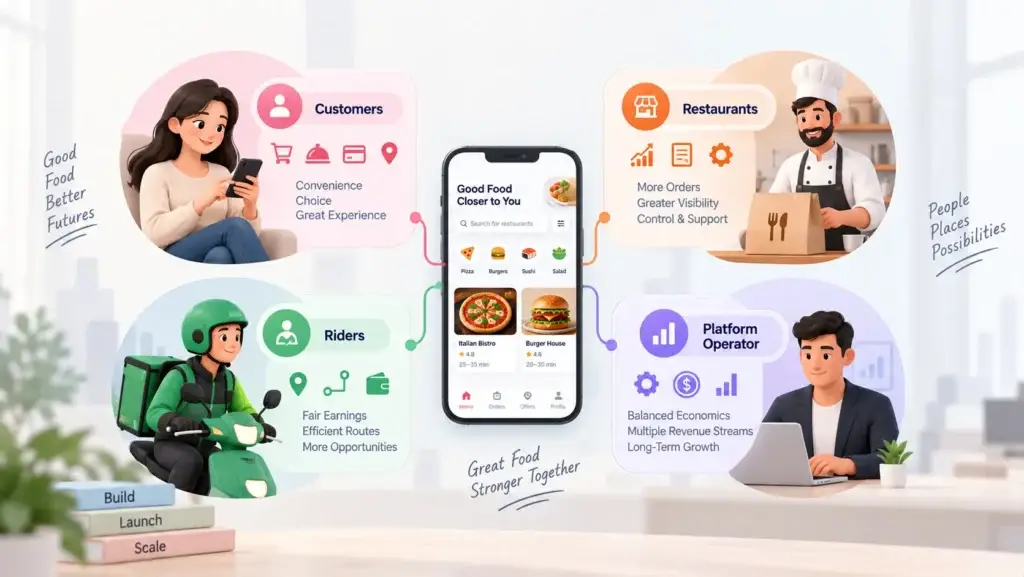
Image Source: AI-generated visual by Miracuves
A food delivery marketplace succeeds when each participant gets enough value to keep using the platform. The platform operator’s job is not only to generate orders, but to keep each side economically motivated.
1. Customers Want Convenience, Choice, and Predictable Pricing
Customers usually choose a food delivery platform because it saves time. They expect restaurant discovery, clear menus, secure payment, delivery tracking, offers, and reliable support if something goes wrong.
But customer loyalty is fragile. High delivery fees, late orders, inaccurate menus, poor support, or limited restaurant options can reduce repeat orders quickly.
From a business model perspective, customers affect:
- Order frequency
- Average basket size
- Delivery-fee acceptance
- Subscription adoption
- Coupon and offer usage
- Ratings and restaurant visibility
- Repeat revenue potential
The platform must keep pricing transparent. If customers feel the final checkout price is unpredictable, conversion can drop. This is why delivery fees, service charges, small-order fees, loyalty points, and discounts should be managed carefully inside the platform.
2. Restaurants Want More Orders Without Losing Margin
Restaurants join food delivery marketplaces to reach more customers. For small and mid-sized restaurants, marketplace visibility can bring order volume that would be hard to generate alone.
However, restaurants also worry about commission, packaging cost, preparation pressure, discount participation, delayed payouts, and customer complaints they cannot fully control.
From the restaurant side, the platform must offer:
- Simple onboarding
- Menu and pricing control
- Order acceptance workflows
- Availability and operating-hour settings
- Payout visibility
- Promotion tools
- Customer feedback visibility
- Support for cancellations and refunds
Restaurants stay active when the marketplace brings profitable orders, not just more orders. A platform that pushes too many discounts onto restaurants may grow order volume temporarily but damage long-term restaurant retention.
3. Riders Want Fair Earnings and Efficient Routes
Delivery partners are the operational backbone of a food delivery marketplace. Even if the app experience is excellent, late delivery can damage customer trust.
Riders care about delivery distance, waiting time at restaurants, payout per order, cash handling, tips, incentives, and the number of available jobs in their area.
The platform must manage:
- Rider availability
- Order assignment
- Delivery zones
- Pickup and drop-off distance
- Proof of delivery
- Cash collection rules where relevant
- Rider earnings
- Incentives and penalties
- Support for failed delivery or address issues
Poor rider allocation increases delays and support costs. Strong dispatch logic improves delivery reliability and helps the platform protect customer experience without overspending on incentives.
4. The Platform Operator Needs Balanced Unit Economics
The platform operator earns by connecting all sides, but the margin on each order can be thin if fees, discounts, payment charges, rider incentives, and support costs are not managed well.
The operator must decide:
- What commission to charge restaurants
- Whether to add service fees for customers
- How delivery fees are calculated
- Whether to subsidize delivery in new zones
- Which restaurants receive promotional visibility
- Whether to offer subscription plans
- How payouts and refunds are handled
- How to prevent abuse, fake orders, or repeated cancellations
A strong food delivery marketplace does not rely on one revenue stream only. It usually combines multiple small monetization layers so the platform can remain attractive to restaurants and customers while still building margin.
Read More: From Restaurant Onboarding to Repeat Orders: Growth Strategy for a Food Delivery Marketplace
Core Revenue Streams in a Food Delivery Marketplace
Revenue in a food delivery marketplace can come from several sources. The right mix depends on the launch city, restaurant density, average order value, delivery cost, customer willingness to pay, and competitive pressure.
Food Delivery Marketplace Revenue Streams
| Revenue Stream | How It Works | Founder Decision |
|---|---|---|
| Restaurant Commission | The platform takes a percentage from each restaurant order. | Set rates carefully so restaurants remain profitable and active. |
| Delivery Fee | Customers pay a fee based on distance, zone, order size, or demand. | Balance affordability with rider payout and logistics cost. |
| Service Charge | A small platform fee is added at checkout. | Keep it transparent to avoid checkout abandonment. |
| Restaurant Subscription | Restaurants pay monthly for lower commission, premium tools, or visibility. | Useful when restaurants prefer predictable cost over per-order commission. |
| Featured Listings | Restaurants pay to appear higher in search, category pages, or banners. | Works best after the platform has meaningful customer traffic. |
| Customer Membership | Customers pay for free delivery, discounts, or loyalty benefits. | Useful for increasing repeat orders and retention. |
The strongest revenue model is rarely “charge everyone more.” It is usually a balanced model where each stakeholder pays for the value they receive.
Restaurants pay for demand. Customers pay for convenience. Riders earn for fulfilment. The platform earns by coordinating the transaction efficiently.
How Platform Economics Connect Across Every Order
Every order creates a chain of financial events. A customer pays the total order value, delivery fee, taxes where applicable, service charges, and sometimes tips. The restaurant receives the food value minus commission or platform deductions. The rider receives delivery earnings and incentives where applicable. The platform keeps commission, service fee, delivery margin, or promotional revenue.
A simplified order flow looks like this:
- Customer places an order and pays through the app.
- Restaurant accepts and prepares the order.
- Rider is assigned based on location, availability, or dispatch rules.
- Customer receives live order updates.
- Order is delivered and marked complete.
- Platform calculates commission, delivery earnings, refunds if any, and settlement.
- Restaurant and rider payouts are recorded.
The business risk is that one weak link can affect the whole model.
If delivery fees are too low, the platform may subsidize every order. If commissions are too high, restaurants may increase menu prices or leave. If rider payouts are too low, delivery availability drops. If discounts are too aggressive, customers may order only when promotions are available.
This is why platform economics should be managed through configurable admin controls rather than hard-coded rules.
Admin Controls That Protect Marketplace Profitability
A food delivery marketplace needs a strong admin layer because the business model will change after launch. Founders may start with one commission rate, then adjust by zone, restaurant type, cuisine, demand level, or partnership tier.
Important admin controls include:
- Restaurant approval and onboarding
- Menu moderation and item availability
- Delivery zone setup
- Distance-based delivery fees
- Commission settings
- Restaurant payout tracking
- Rider payout rules
- Refund and cancellation workflows
- Coupon and promotion controls
- Customer support tools
- Order status monitoring
- Paid placement and advertising controls
- Reports for revenue, orders, riders, and restaurants
Without these controls, the founder depends on developers for every pricing or operational change. That slows experimentation.
With strong admin control, the platform operator can test commission plans, change delivery pricing, pause weak zones, promote high-performing restaurants, and manage disputes without rebuilding the product.
This is one of the reasons many founders prefer a ready-made food delivery platform foundation instead of building every operational workflow from zero.
Founder Decision Signals
Speed
If your launch depends on signing restaurants quickly, the platform foundation should already include ordering, dispatch, payments, and admin workflows.
Cost
Marketplace cost is not only development cost. It also includes delayed launch, restaurant onboarding time, rider operations, and support load.
Scalability
A scalable food delivery model needs configurable zones, commission settings, payout logic, and operational reporting from the beginning.
Market Fit
The right model depends on local restaurant density, delivery cost, customer ordering habits, and willingness to pay for convenience.
Food Delivery Commission Model: What Founders Should Think Through
Commission is one of the most common revenue streams in food delivery marketplaces. The platform charges restaurants a percentage of each order in exchange for visibility, order volume, payment processing, delivery access, and customer acquisition.
But commission is sensitive.
If the platform charges too little, it may not cover acquisition, support, and operational cost. If it charges too much, restaurants may raise prices, reduce participation, or push customers to order directly.
Founders should think about commission in layers:
Flat Commission
Every restaurant pays the same percentage. This is simple to launch but may not work equally across premium restaurants, small kitchens, cloud kitchens, and high-volume partners.
Category-Based Commission
Different restaurant types or cuisine categories pay different rates. This can support better margin control, especially if some categories have higher average order value.
Partner-Tier Commission
High-performing or exclusive restaurants receive better rates. This can help retain strategic partners.
Subscription Plus Lower Commission
Restaurants pay a monthly fee in exchange for reduced commission. This works well when restaurants want predictable platform cost and the operator wants recurring revenue.
The best model depends on the local market. In some cities, restaurants may accept commission in exchange for order volume. In other markets, a lower-commission or subscription-led model may help the platform sign supply faster.
Customer Pricing: Delivery Fees, Service Fees, and Subscription Logic
Customer pricing must feel fair. A customer may accept a delivery fee if the convenience is clear, but repeated surprise fees can reduce trust.
The platform can use different pricing options:
- Fixed delivery fee
- Distance-based delivery fee
- Zone-based delivery fee
- Small-order fee
- Peak-demand delivery fee
- Free delivery above a cart threshold
- Subscription-based free or discounted delivery
Customer subscription plans can improve retention when customers order frequently. But subscriptions only work if the platform has enough restaurant choice, reliable delivery, and real perceived value.
For new food delivery startups, the early goal is usually not to maximize every fee. It is to create repeat usage while making sure every order has a path to profitability.
Rider Economics: Why Delivery Partner Payouts Shape Customer Experience
Rider payouts directly affect service quality. If riders are underpaid, the platform may struggle with acceptance rates, delays, and availability during peak hours. If payouts are too high without pricing support, the platform may lose money on delivery.
A practical rider payout model may include:
- Base delivery pay
- Distance-based pay
- Waiting-time compensation
- Peak-hour incentives
- Tips
- Completion bonuses
- Penalties for repeated cancellations or failed delivery behavior
The platform must also reduce wasted rider time. Long restaurant wait times, poor address accuracy, and inefficient dispatch can increase fulfilment cost even when payout rates look reasonable on paper.
This is why rider economics should be connected to dispatch logic, restaurant preparation time, delivery zones, and customer communication.
Restaurant Retention: The Supply Side of Marketplace Growth
Many food delivery marketplaces focus heavily on customer acquisition. But restaurant retention is equally important.
If restaurants do not see profitable demand, menu control, fair payouts, and reliable support, they may stop prioritizing platform orders. That weakens supply, reduces customer choice, and damages repeat usage.
Strong restaurant retention depends on:
- Transparent commission terms
- Reliable payout cycles
- Easy menu management
- Order preparation visibility
- Promotion controls
- Performance reports
- Support for disputes and refunds
- Fair treatment during customer complaints
A marketplace should help restaurants understand what they are earning, which items sell well, which promotions work, and how delivery orders affect their kitchen operations.
This turns the platform from “another commission channel” into a growth partner.
Operational Mistakes That Hurt Food Delivery Marketplace Economics
Copying the interface without modeling the economics
A food delivery marketplace can look polished and still lose money if commissions, delivery fees, rider payouts, and discounts are not calculated properly.
Starting with one revenue stream only
Relying only on restaurant commission can put pressure on restaurant relationships. A healthier model may combine commission, delivery margin, subscriptions, and promotional tools.
Ignoring admin flexibility
Markets change quickly. Founders need control over zones, fees, commissions, restaurants, riders, offers, and payouts without waiting for development changes.
Underestimating support and refund workflows
Late deliveries, missing items, payment issues, and cancelled orders affect both customer trust and restaurant relationships. These workflows need clear operational handling.
Ready-Made vs Custom Food Delivery Marketplace Development
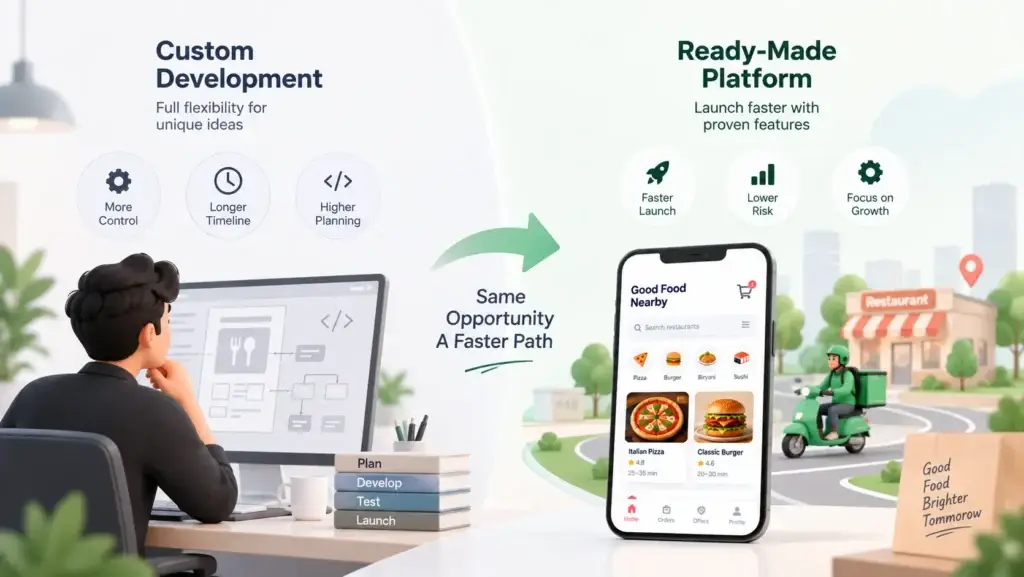
Image Source: AI-generated visual by Miracuves
Founders usually have two practical routes: build from scratch or start with a ready-made platform foundation.
A custom build gives complete flexibility, but it often requires more time, technical planning, testing, and operational design. For a food delivery marketplace, the first version still needs customer ordering, restaurant management, rider workflows, admin controls, payment handling, tracking, notifications, and settlement logic.
A ready-made platform can reduce launch risk because the core marketplace workflows are already built. The founder can focus more on branding, restaurant onboarding, city strategy, payment setup, pricing decisions, and launch operations.
| Build Approach | Best For | Business Tradeoff |
|---|---|---|
| Custom Development | Highly unique operating models with unusual workflows | More control, but longer planning and development cycle |
| Ready-Made Platform | Founders who want to validate a proven food delivery marketplace model faster | Faster launch, lower development uncertainty, and more focus on market execution |
| Hybrid Customization | Founders who want a proven base plus selected custom features | Practical balance between speed and differentiation |
For founders who want a branded food delivery marketplace with ordering, restaurant workflows, rider delivery, admin controls, and monetization logic already structured, Miracuves’ ready-made approach can help reduce the time between idea and launch.
A platform such as the ready-made UberEats Clone solution by Miracuves can be useful when the goal is not to copy a brand, but to start with a proven marketplace foundation and customize it for a specific city, restaurant segment, or operating model.
How Miracuves Helps Founders Build a Food Delivery Marketplace Faster
Miracuves helps founders launch food delivery platforms with ready-made, white-label app solutions that include the essential marketplace layers: customer ordering, restaurant management, delivery partner workflows, admin controls, payment logic, commission settings, and source-code ownership.
For a founder, the advantage is not just faster development. It is faster business validation.
Instead of spending months building standard food delivery modules from zero, founders can focus on decisions that directly affect growth:
- Which restaurants should be onboarded first?
- Which zones are most profitable to serve?
- What commission model will restaurants accept?
- Should delivery be platform-managed, restaurant-managed, or hybrid?
- Which customer offers can improve repeat orders without hurting margin?
- What payout and support workflows are needed before launch?
Where relevant, Miracuves can support a 6-day launch approach for ready-made food delivery solutions, depending on the selected scope, integrations, branding requirements, and deployment readiness.
Final Thoughts: Food Delivery Marketplace Success Depends on Connected Economics
A food delivery marketplace is not successful because it has restaurant menus and a checkout screen. It succeeds when customers order repeatedly, restaurants earn enough to stay active, riders can complete jobs efficiently, and the platform earns enough margin to support operations and growth.
That is why founders should treat the business model as part of the product foundation.
Before launching, define how each side of the marketplace benefits. Decide how commissions, delivery fees, subscriptions, promotions, payouts, refunds, and admin controls will work. Then choose a technology foundation that allows those rules to be managed without slowing down every business decision.
The strongest platforms are not just apps. They are operating systems for local food commerce.
FAQs
What is a food delivery marketplace business model?
A food delivery marketplace business model connects customers, restaurants, delivery partners, and platform operators in one system. Customers place orders, restaurants prepare food, riders deliver, and the platform earns through commissions, fees, subscriptions, promotions, or advertising.
How does a food delivery marketplace make money?
A food delivery marketplace can make money through restaurant commissions, customer delivery fees, service charges, restaurant subscriptions, featured listings, advertising placements, and customer membership plans. The right mix depends on local demand, delivery costs, restaurant margins, and customer behavior.
Why is restaurant commission important in food delivery platforms?
Restaurant commission is important because it is often one of the main revenue streams for the platform. However, it must be balanced carefully. High commissions can reduce restaurant profitability, while very low commissions may not support platform operations.
What role do riders play in food delivery marketplace economics?
Riders directly affect delivery speed, customer satisfaction, and operational cost. A good rider payout and dispatch model helps reduce delays, failed deliveries, and support issues while keeping fulfilment reliable.
What admin features are important for a food delivery marketplace?
Important admin features include restaurant onboarding, delivery zone control, commission settings, rider management, payout tracking, refund workflows, coupon management, order monitoring, reporting, and customer support tools.
Should founders build a food delivery platform from scratch or use a ready-made solution?
A custom build may fit highly unique models, but a ready-made solution can help founders launch faster with standard food delivery workflows already built. This allows more focus on restaurant onboarding, city launch strategy, pricing, operations, and market validation.
How can a food delivery startup improve profitability?
Profitability can improve by balancing commission rates, optimizing delivery zones, reducing rider idle time, improving restaurant retention, increasing repeat customer orders, introducing subscription plans, and using promotions carefully instead of relying only on discounts.
Why does source-code ownership matter in food delivery marketplace development?
Source-code ownership gives founders more control over customization, future scaling, integrations, and long-term product decisions. It helps reduce dependency on restrictive platforms and allows the business to evolve as operations grow.
Miracuves is an independent software development company. We are not affiliated with, connected to, sponsored by, or endorsed by any company or product named in this article.
Terms such as “X Clone” are used descriptively. It is how the software industry refers to building a platform with functionality comparable to a known service, and how clients search for it.
The entire design and codebase of our products is built by our own team. Our products contain no code, design, graphics, or content originating from any third-party website or applications.
All third-party names and marks referenced in this article are the property of their respective owners, referenced solely to identify the services discussed.



