


Key Takeaways
- Telehealth software development must include secure EHR storage because medical records contain highly sensitive patient information.
- A secure EHR system requires encryption, access control, audit logs, backup systems, role-based permissions, and compliance-ready infrastructure.
- The biggest risks usually come from weak authentication, insecure APIs, exposed databases, improper file storage, and poor access monitoring.
- Healthcare platforms should prepare for HIPAA, GDPR, regional healthcare privacy rules, and secure data retention workflows before launch.
- Long-term trust depends on secure architecture, protected patient records, reliable backups, access transparency, and continuous compliance management.
EHR Security Signals
- Patient records should be encrypted both in transit and at rest to reduce the risk of unauthorized access or data leaks.
- Role-based permissions help separate access between doctors, patients, admins, support staff, and healthcare providers.
- Audit logs are important because healthcare platforms must track who accessed, edited, downloaded, or shared medical records.
- Secure cloud storage architecture should support backups, disaster recovery, retention policies, and controlled document access.
- Development complexity changes based on telehealth workflows, video consultation storage, prescription handling, compliance rules, API integrations, and multi-region deployment.
Real Insights
- A telehealth platform is not only a video consultation app; it is a healthcare infrastructure system responsible for protecting patient trust and medical history.
- Founders should plan EHR architecture early because changing healthcare data structures after scaling becomes expensive and risky.
- Security should be integrated into backend architecture, database design, API management, and admin workflows from the beginning.
- Poor EHR protection can create legal exposure, patient trust issues, compliance penalties, and operational disruption for healthcare businesses.
- The strongest telehealth software development strategy combines secure EHR storage, encrypted communication, compliance-ready systems, audit visibility, and scalable healthcare infrastructure.
Telehealth is no longer only about video calls between doctors and patients. A serious digital healthcare platform must manage appointments, consultation notes, prescriptions, medical documents, patient profiles, payment records, doctor availability, and sometimes lab or pharmacy workflows. That makes telehealth software development directly connected to secure EHR storage.
In simple terms, Electronic Health Records are not just files saved inside a database. They are sensitive patient histories that may include diagnoses, prescriptions, allergies, test reports, doctor notes, follow-up plans, and identity details. When these records move through a telehealth platform, security must be built into the product foundation from day one.
This is especially important for founders planning a Practo clone app or doctor consultation marketplace. A Practo-style platform connects multiple users, including patients, doctors, clinics, specialists, administrators, and sometimes pharmacies or labs. Every role needs access to different information. Every action should be traceable. Every record should be protected during storage, transfer, and retrieval.
Healthcare authorities and security guidance consistently emphasize safeguards such as access controls, encryption, and audit trails for electronic health information. ONC notes that EHR systems may include access controls, encryption for stored information, and audit trails that record who accessed information and what changes were made.
For founders, this means the question is not just: “Can we build a telehealth app?” The better question is: “Can we build a telehealth platform where patient records remain secure, accessible to the right people, and manageable as the business grows?”
Why Secure EHR Storage Matters in Telehealth Software Development
Telehealth creates a digital bridge between patients and providers. That bridge is useful only when the information moving through it remains private, accurate, and available to authorized users.
A patient may book a video consultation, upload a past report, receive a prescription, schedule a follow-up, and share symptoms inside the app. A doctor may add notes, view history, review documents, and issue medical guidance. The admin may need to monitor appointments, disputes, payments, doctor verification, and platform activity. Each workflow touches healthcare data.
This is why secure EHR storage matters.
In traditional clinic systems, medical records may be accessed through internal software used by a smaller set of staff. In telehealth, records may be accessed across mobile apps, web dashboards, patient portals, doctor panels, APIs, cloud servers, and third-party integrations. HHS warns that using apps, websites, and patient portals for telehealth can create privacy and security risks for health information.
For founders, weak EHR storage creates several business risks:
- Patients may lose trust if records are exposed or mishandled.
- Doctors may hesitate to use the platform if record access is unclear.
- Admin teams may struggle to investigate disputes without activity logs.
- Scaling becomes risky when data permissions are not structured.
- Compliance preparation becomes harder if security was added as an afterthought.
A healthcare marketplace succeeds when every user understands that the platform protects sensitive information. Security is not a hidden backend concern. It is part of the product promise.
Read more : Step-by-Step Process to Build a Telehealth App Like Maple
How Telehealth Platforms Change the Way Patient Records Are Stored and Accessed
Telehealth platforms make healthcare more accessible by allowing care to happen through digital communication technologies. Mayo Clinic describes telehealth as the use of digital information and communication technologies to access healthcare services remotely and manage health care.
That convenience also changes how records are created and used.
In a Practo-style platform, EHR data may be generated from several touchpoints:
| Telehealth Touchpoint | Record Created or Accessed | Security Concern |
|---|---|---|
| Patient registration | Identity, contact details, health profile | Data privacy and account protection |
| Doctor booking | Appointment records, symptoms, specialist selection | Role-based visibility |
| Video/audio/chat consultation | Consultation notes, messages, attachments | Encrypted communication and secure retention |
| E-prescription | Medication details, dosage, doctor signature | Record integrity and authorized access |
| Lab or report uploads | Medical documents, diagnostic files | Secure file storage and access tracking |
| Follow-up care | Treatment history, previous prescriptions | Continuity and accurate retrieval |
| Admin review | Disputes, doctor verification, platform activity | Permission-based admin controls |
This is where telehealth software development becomes a storage architecture decision. The platform should not treat all users equally. A patient, doctor, clinic staff member, and admin should not have the same level of access. Each role should see only what is necessary for the workflow.
For example, a doctor may need access to patient history related to a consultation. A support admin may need appointment status but not full clinical notes. A clinic manager may need scheduling and billing visibility but not unrestricted access to sensitive patient documents.
This separation protects patient privacy and also protects the business from internal misuse.
Core Security Layers That Strengthen EHR Storage in Telehealth Apps
Secure EHR storage is not one feature. It is a set of coordinated layers across product design, backend architecture, infrastructure, and operations.
1. Encrypted Data Storage
Encrypted data storage helps protect patient records even if unauthorized access is attempted at the infrastructure level. Sensitive data such as medical documents, prescriptions, consultation summaries, and identity details should not be stored in plain readable form.
For telehealth founders, encryption matters because EHR records are long-lived. A video call may last 15 minutes, but the prescription, doctor notes, and patient history may remain part of the platform for years based on data retention rules and business requirements.
2. Encrypted Data Transfer
Telehealth systems constantly transfer information between mobile apps, web dashboards, APIs, cloud storage, payment systems, and sometimes EHR/EMR integrations. Encrypted data transfer helps protect patient information while it moves between these systems.
This matters when patients upload reports, doctors send prescriptions, admins review appointment logs, or clinics sync patient records with external systems.
3. Role-Based Access Control
Role-based access control decides who can see, edit, download, or approve specific information. ONC guidance highlights access controls such as passwords and PINs as a way to limit access to health information.
For a Practo app, role-based access may include:
- Patients accessing their own records.
- Doctors accessing records related to assigned consultations.
- Clinic staff managing appointment schedules.
- Admins managing users, disputes, and operational workflows.
- Super admins controlling sensitive platform settings.
This avoids the dangerous pattern where every backend user gets broad access to patient data.
4. Audit Logs and Activity Tracking
Audit logs record who accessed a record, when it was accessed, what was changed, and sometimes from which device or account. ONC notes that audit trails can record access and changes to health information.
In telehealth platforms, audit logs are important for:
- Investigating unauthorized access.
- Reviewing prescription changes.
- Monitoring doctor/admin actions.
- Handling patient complaints.
- Supporting internal governance.
- Preparing for compliance reviews.
Without audit logs, founders may not know whether a record was viewed, changed, exported, or deleted.
5. Consent and Permission Workflows
Patients should understand how their information is used and shared. Consent workflows help manage permissions for record sharing, doctor access, document uploads, and third-party integrations.
In a multi-provider telehealth platform, consent becomes especially important because patients may consult different doctors across specialties. The system should support controlled access rather than open-ended visibility.
6. Secure API Integration
Many telehealth apps connect with payment gateways, labs, pharmacies, hospital systems, appointment calendars, notification tools, or existing EHR/EMR platforms. SPSoft’s telemedicine development page, for example, describes integration with EHR/EMR platforms, practice management systems, billing services, and patient portals.
Every integration expands the security boundary. Secure API design should include authentication, authorization, request validation, logging, rate limits, and careful data mapping.
7. Backup, Recovery, and Data Integrity Controls
Secure EHR storage also means records should remain available and accurate. Backup and recovery workflows help prevent data loss. Integrity controls help reduce improper changes to patient data.
For founders, this is not only a technical requirement. If a prescription, report, or consultation note disappears, the platform loses trust.
Secure EHR Storage Layers in Telehealth Software Development
| Security Layer | Business Value | Founder Impact |
|---|---|---|
| Encrypted data storage | Protects stored patient records, prescriptions, and documents | Reduces risk when sensitive healthcare data grows |
| Encrypted data transfer | Protects information moving between apps, dashboards, APIs, and integrations | Supports safer consultations, uploads, and record sharing |
| Role-based access control | Limits access based on patient, doctor, clinic, or admin roles | Prevents unnecessary internal exposure of medical records |
| Audit logs | Tracks who accessed or changed patient records | Improves accountability and dispute investigation |
| Consent workflows | Helps patients control how information is shared | Builds trust and supports compliance-ready operations |
| Secure APIs | Protects integrations with labs, pharmacies, payments, and EHR systems | Makes scaling safer as the platform adds partners |
How a Practo Clone App Uses Secure EHR Workflows Across Patient, Doctor, and Admin Panels
A Practo app is not just a booking app. It is a healthcare marketplace where patients discover doctors, book appointments, consult online, receive prescriptions, and manage medical interactions in one place. Practo’s own platform experience includes doctor search, online consultation, appointment booking, health articles, and medical records access.
For founders, the Practo clone model needs strong panel-based architecture.
Patient Panel
The patient panel should allow users to manage personal health profiles, book consultations, upload reports, receive prescriptions, access appointment history, and manage follow-ups. Secure EHR storage ensures that patient records are available when needed but protected from unauthorized visibility.
Key patient-side security needs include:
- Secure login and account protection.
- Access to personal medical records.
- Safe report uploads.
- Consent-based record sharing.
- Prescription history.
- Private consultation messages.
Doctor Panel
The doctor panel should allow verified providers to view assigned consultations, review patient history, add consultation notes, issue e-prescriptions, and manage follow-up recommendations.
Doctor access should be controlled carefully. A doctor should not automatically access all platform records. Access should depend on active appointments, patient consent, clinic assignment, or platform-defined rules.
Admin Dashboard
The admin dashboard is the control layer of the telehealth business. It should manage users, doctors, appointments, payments, disputes, content, verification, reports, and platform settings. But admin control must not mean unrestricted clinical data access.
A secure admin dashboard should include:
- Permission-based dashboards.
- Doctor verification workflows.
- Appointment and payment monitoring.
- Dispute management.
- Audit logs.
- Admin activity tracking.
- Controlled access to sensitive records.
Miracuves positions healthcare and on-demand service marketplace solutions around user, provider, and admin panels, service listings, booking, scheduling, payments, ratings, verification, dispute handling, and location-based discovery. That structure is directly relevant to a Practo platform.
Read more : Healthcare Tech Is About Lives, Not Just Code: The Business of Telemedicine
Telehealth EHR Storage Architecture: What Founders Should Plan Early
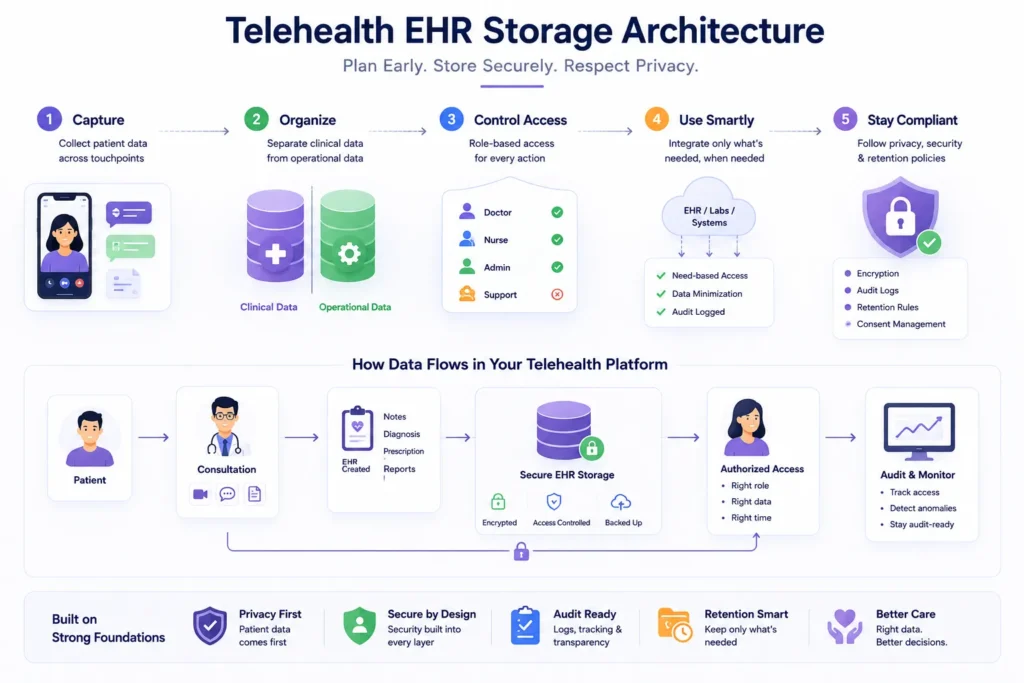
Founders often focus first on visible features: video call, chat, doctor search, payment, and appointment booking. But the EHR layer should be planned before the first patient record is created.
Decide What Counts as an EHR Record
Not every platform stores the same kind of data. A startup should define what it will store from day one.
Possible EHR-related data includes:
- Patient profile and demographics.
- Symptoms and intake forms.
- Doctor consultation notes.
- Prescriptions.
- Uploaded lab reports.
- Diagnosis summaries.
- Follow-up instructions.
- Appointment history.
- Billing-related medical records.
- Chat transcripts where medically relevant.
A clear data map helps the development team decide what needs encryption, restricted access, retention rules, and audit logging.
Separate Operational Data From Clinical Data
Operational data includes appointment status, payment status, doctor availability, notifications, and support tickets. Clinical data includes consultation notes, prescriptions, medical reports, diagnoses, and treatment history.
Separating these categories helps founders reduce unnecessary exposure. For example, a support agent may need to see that an appointment failed, but not the full medical report attached by the patient.
Build Permission Logic Around Real Healthcare Workflows
Permission logic should reflect how care actually happens.
A dermatologist may need access to skin-related consultation history. A general physician may need basic medical background. A support admin may need appointment metadata. A clinic manager may need provider schedules. The platform should not solve this by giving everyone broad access.
Healthcare security guidance from Miracuves requires patient data privacy, secure appointment records, role-based doctor/admin access, encrypted communication, prescription/document handling, consent workflows, and audit logs.
Plan for Interoperability Without Overexposing Data
EHR integration can make telehealth more useful because doctors may need context from previous visits, test results, medications, and care history. Decode’s telehealth development guide notes that EHR integration helps doctors get the full picture when it matters most.
However, integration should be selective. Pulling too much data into the telehealth system increases storage, access, and compliance complexity. A stronger architecture retrieves only what is needed, logs access, and applies permission controls.
Treat Compliance as a Workflow, Not a Badge
Different regions have different healthcare data rules. HIPAA in the United States, GDPR in Europe, India’s digital health ecosystem, and local medical laws may all shape how data should be collected, stored, accessed, and shared.
A responsible healthcare platform should be described as having a compliance-ready foundation or being configurable to support healthcare compliance requirements. Final compliance depends on jurisdiction, legal review, integrations, hosting, operations, and the business model. This careful wording is important because no software vendor should claim universal healthcare compliance without verified legal and operational review.
Founder Decision Signals
Speed
If you need to launch a doctor consultation platform quickly, a ready-made Practo clone foundation can reduce time spent building common patient, doctor, booking, and admin workflows from zero.
Cost
Secure EHR storage can become expensive when rebuilt late. Planning access control, audit logs, and encrypted storage early is usually more cost-efficient than patching security after launch.
Scalability
As consultations grow, the platform must manage more records, doctors, files, APIs, and admin actions without weakening privacy controls.
Market Fit
Patients and doctors are more likely to trust a telehealth platform when records, prescriptions, and communication workflows feel secure and professionally managed.
Ready-Made Practo Clone vs Custom Telehealth Software for Secure EHR Storage
A founder building a telehealth platform usually has two routes: start with a ready-made Practo clone foundation or build fully custom software from scratch.
Neither route is automatically right for everyone. The better decision depends on launch goals, security needs, integration complexity, budget, and operational readiness.
| Build Option | What It Means | Best For | EHR Storage Consideration |
|---|---|---|---|
| Ready-made Practo clone | Uses an existing healthcare marketplace foundation with patient, doctor, booking, consultation, and admin workflows | Founders who want faster market validation | Security layers should be reviewed and customized for patient data, prescriptions, audit logs, and access control |
| Custom telehealth software | Built from scratch around exact clinical, operational, and integration needs | Hospitals, large clinics, complex healthcare networks, or highly regulated workflows | EHR architecture can be designed deeply from day one but requires more planning, budget, and development time |
| Hybrid approach | Starts with a ready-made base and customizes sensitive modules | Startups that need speed plus specialized workflows | Useful when core marketplace flows are standard but EHR, compliance, or integration needs are specific |
Miracuves helps founders, startups, agencies, and businesses launch digital products faster using ready-made, white-label, source-code-owned clone app solutions and custom app development services. The Miracuves solution index also emphasizes source-code ownership, admin dashboards, scalable backend, monetization-ready platforms, and faster market validation where relevant.
For a healthcare founder, the practical advantage of a ready-made Practo is that common workflows do not need to be built from zero. The practical responsibility is to ensure the healthcare-specific layers are configured carefully: patient data privacy, role-based access, encrypted communication, prescription handling, secure records, and audit logs.
How Telehealth Software Development Supports Better Patient Trust
Patient trust is not built only through branding. It is built through product behavior.
When a patient logs into a telehealth app, they expect privacy. When they upload a report, they expect it to be visible only to the right doctor. When they receive a prescription, they expect it to be accurate and available later. When they change doctors, they expect their medical history to move safely through the platform.
Secure EHR storage supports this trust in five ways:
- Privacy: Patients know their records are not openly visible to every platform user.
- Continuity: Doctors can access relevant history during follow-ups.
- Accountability: Audit logs create traceability for sensitive actions.
- Convenience: Records, prescriptions, and reports remain accessible in one account.
- Professionalism: Secure workflows make the platform feel reliable to doctors and clinics.
Telemedicine can improve access and convenience because patients can connect with healthcare practitioners through video or phone appointments. Johns Hopkins Medicine notes that telemedicine enables appointments between patients and healthcare practitioners and benefits both health and convenience.
But convenience without record security creates long-term risk. The strongest telehealth platforms combine access with trust.
Common Mistakes Founders Make While Building Telehealth EHR Systems
Mistakes Founders Should Avoid
Treating EHR storage as a normal file upload feature
Medical reports, prescriptions, and consultation notes need stronger access rules than ordinary user files. Treating them as generic uploads can create privacy and governance problems later.
Giving broad admin access to patient records
Admins need operational control, but not every admin needs full clinical visibility. Permission-based dashboards help reduce unnecessary exposure.
Adding audit logs after launch
Audit logs are easier to design early. If access tracking is added later, the platform may lack a reliable history of past record activity.
Ignoring consent workflows
Patients should understand when and why their records are accessed or shared. Consent flows support trust and compliance-ready operations.
Assuming one compliance rule applies everywhere
Healthcare compliance depends on jurisdiction, operating model, legal review, hosting, integrations, and data handling. Avoid universal compliance claims.
How Miracuves Helps Build Secure, Launch-Ready Telehealth Platforms
Miracuves helps founders build white-label healthcare and on-demand marketplace solutions that can be customized around patient, doctor, booking, consultation, payment, and admin workflows. For a Practo clone app, the goal is not to copy another healthcare platform blindly. The goal is to use a proven digital healthcare model and adapt it for your market, provider network, security expectations, and monetization strategy.
A Miracuves-ready telehealth approach can support:
- Patient app workflows.
- Doctor panel workflows.
- Admin dashboard control.
- Appointment booking.
- Online consultation flows.
- E-prescription handling.
- Secure appointment records.
- Patient document management.
- Role-based dashboard access.
- Audit log planning.
- White-label branding.
- Source-code ownership.
- Custom integration planning.
For founders who want faster validation, a ready-made solution can reduce the effort of building every module from scratch. For healthcare businesses with more complex needs, custom development can extend the platform around deeper EHR workflows, lab integrations, pharmacy modules, clinic networks, and region-specific compliance preparation.
The right decision depends on your launch scope. But the security principle is the same: EHR storage must be treated as a foundation, not an add-on.
Final Thoughts: Secure EHR Storage Is the Backbone of Telehealth Growth
The real value of telehealth software development is not only remote consultation. It is the ability to manage patient data safely across digital healthcare journeys.
A strong telehealth platform should protect records at rest, secure records in transit, control who can access them, track sensitive actions, and support consent-based workflows. For a Practo clone app, this becomes even more important because the platform connects patients, doctors, clinics, admins, and sometimes additional healthcare partners.
Founders who plan secure EHR storage early are better prepared to build trust, scale operations, support provider confidence, and reduce avoidable technical risk. Miracuves helps founders move from idea to launch faster with ready-made and white-label healthcare app foundations that can be customized for secure patient data workflows, admin control, and long-term product growth.
FAQs
1. How does telehealth software development improve secure EHR storage?
Telehealth software development improves secure EHR storage by adding encrypted data storage, encrypted data transfer, role-based access control, audit logs, consent workflows, secure APIs, backup planning, and permission-based dashboards. These layers help protect patient records while allowing doctors and authorized users to access the right information.
2. Why is EHR security important in a Practo clone app?
A Practo app manages sensitive workflows such as patient profiles, appointment history, consultation notes, prescriptions, reports, doctor access, and admin activity. Without secure EHR storage, the platform may expose patient information, weaken trust, and create operational risk.
3. What features should a secure telehealth app include?
A secure telehealth app should include patient and doctor login, role-based access, encrypted communication, secure appointment records, prescription management, document uploads, consent workflows, audit logs, admin controls, and secure API integrations.
4. Can a ready-made Practo clone support secure EHR workflows?
Yes, a ready-made Practo clone can support secure EHR workflows when it is customized with proper access controls, encrypted storage, audit logs, prescription handling, document management, and consent-based sharing. The final setup should match the founder’s target market, legal review, and operating model.
5. Is telehealth software automatically HIPAA or GDPR compliant?
No. Software should not be described as automatically compliant everywhere. A telehealth platform can be built with a compliance-ready foundation, but final compliance depends on jurisdiction, legal review, hosting, integrations, policies, data handling, and operating procedures.
6. What is the role of audit logs in secure EHR storage?
Audit logs record who accessed, changed, downloaded, or managed patient records. They help healthcare platforms monitor sensitive activity, investigate disputes, improve accountability, and support internal governance.