
Key Takeaways
- Custom software maintenance costs continue long after the first product launch.
- Founders must budget for bug fixes, API updates, server upgrades, security patches, and developer support.
- Technical debt, poor documentation, and fragile architecture can increase annual maintenance spending.
- A custom build may become expensive when every small change requires specialist engineering time.
- A modular app foundation can reduce long-term operational cost and protect startup runway.
Cost Signals
- Founders need to track hosting, monitoring, bug fixes, integrations, updates, and post-launch developer hours.
- Developers need clean documentation, modular code, version control, testing, deployment notes, and stable architecture.
- Admins need control over users, roles, reports, payments, settings, logs, and operational workflows.
- Legacy code can create hidden costs when integrations break, libraries expire, or new features become hard to add.
- Maintenance planning should include security reviews, backups, uptime monitoring, support tickets, and upgrade cycles.
Real Insights
- The real cost of custom software is not only the build fee but the recurring cost of keeping it stable.
- Weak architecture can turn normal updates into expensive debugging, refactoring, and regression testing work.
- Founders should compare total ownership cost before choosing between custom development and ready-made systems.
- Modular platforms help reduce repeated engineering effort by starting from tested workflows and reusable components.
- Miracuves builds ready-made clone apps with modular architecture, source-code ownership, deployment support, maintenance-friendly workflows, and admin control.
For many founders, the software budget ends in their mind the moment the app goes live. The development invoice is approved, the product is launched, and the business starts planning acquisition, partnerships, and revenue.
That is where the maintenance trap begins.
Custom-coded software is not a one-time capital expense. It becomes a living operational asset that needs updates, monitoring, security patches, API fixes, dependency upgrades, infrastructure tuning, and developer attention every year. Public maintenance benchmarks often place annual software or app maintenance around 15–25% of the initial build cost, depending on complexity, stack quality, integrations, and usage volume. For custom agency-built systems, Miracuves’ internal operating benchmark — the Legacy Debt Coefficient — places the risk band higher: 20–30% of the original build fee annually just to maintain the core system.
For investors and founders, that number matters because software maintenance directly affects runway, EBITDA, technical scalability, and the cost of every future feature.
A $100,000 custom build does not simply cost $100,000. Over three years, it may require another $60,000 to $90,000 in core maintenance before meaningful new product development is even counted. That does not include customer support tooling, cloud scaling, analytics, compliance workflows, marketing automation, or major feature expansion.
This is why the smarter question is not only “How much does it cost to build the app?” The stronger question is: “What will this software cost us to keep alive, secure, compatible, and adaptable for the next three years?”
Miracuves helps founders approach that question differently by using ready-made, white-label, source-code-owned app foundations designed around modular architecture, admin control, and faster launch. Instead of starting every workflow from zero, founders can begin with a cleaner product foundation and reduce the maintenance burden tied to custom agency code.
The Hidden Invoice: Why Custom Code Fees Don’t Stop at Launch
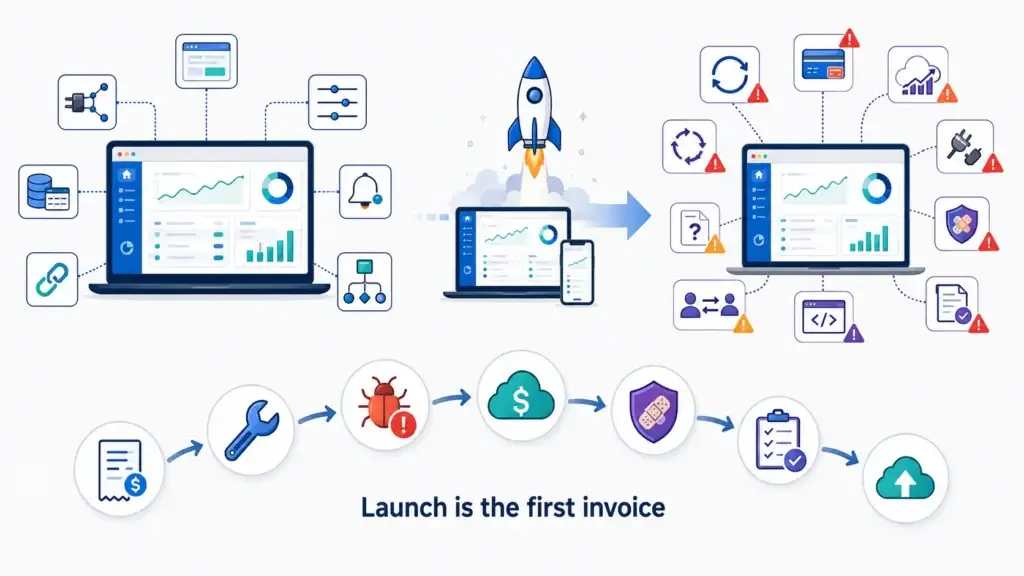
Custom code feels attractive because it promises full flexibility. A founder can define the exact user flow, business logic, dashboard, payment model, API layer, and customer experience they want.
That flexibility has value. But it also creates a maintenance surface area.
Every custom screen, API endpoint, database table, integration, admin action, notification rule, third-party SDK, and workflow adds future responsibility. Once the app is live, the code must keep working while everything around it changes.
Operating systems change. Payment gateways update documentation. Cloud costs shift. APIs deprecate older versions. User volumes grow unevenly. Security patches become urgent. App stores revise policies. Frameworks release breaking changes. Developers who wrote the first version may leave. Documentation may be incomplete. The business model may evolve.
This is why custom software often behaves less like a finished asset and more like an operating liability with recurring obligations.
For a founder, the danger is not maintenance itself. All serious software needs maintenance. The danger is unpriced maintenance.
When a custom build is scoped only around launch, the business may underestimate the cost of keeping that product reliable. The first invoice buys the product. The following invoices buy continuity.
Read More: The Un-Indexed Trap: Why AI Schemas Cause Exponential App Latency
Data Breakdown: The Annual Cost of API Maintenance and System Debt
A useful way to measure software maintenance exposure is to separate normal maintenance from legacy debt.
Normal maintenance includes predictable work:
- Bug fixes.
- OS and device compatibility updates.
- Server monitoring.
- Security patches.
- Minor performance optimization.
- Dependency updates.
- Basic admin and user support fixes.
Legacy debt is different. It is the extra cost created when the system becomes harder to change than it should be.
Legacy debt usually appears when:
- The original architecture was built quickly without long-term planning.
- Business logic is scattered across too many files or services.
- Documentation is weak.
- APIs are tightly coupled instead of isolated.
- Admin workflows require developer intervention.
- The system depends on outdated libraries.
- The code can only be safely changed by the original team.
- Testing, staging, and deployment practices are underdeveloped.
McKinsey’s technical debt research shows why this matters at a leadership level. Some CIOs reported that more than 20% of technology budget meant for new products gets diverted into technical debt issues. In other words, technical debt does not only increase maintenance cost; it slows future innovation.
For a startup, that can be the difference between shipping growth features and spending the quarter repairing old decisions.
The Legacy Debt Coefficient
Miracuves’ Legacy Debt Coefficient is a practical planning variable for founders and investors.
It estimates how much of the original build cost may be required annually to keep the core software stable, compatible, secure, and adaptable.
A simple version looks like this:
Annual Maintenance Exposure = Initial Build Cost × Legacy Debt Coefficient
For custom agency-coded products, Miracuves’ operational benchmark places this coefficient at 20–30% annually when the system has high dependency risk, weak modularity, poor handover, and heavy custom integrations.
For modular white-label systems, the benchmark can be significantly lower because the core workflows are already structured, reused, tested, and easier to update across similar product patterns.
Example: Three-Year Maintenance Exposure
| Initial Software Build | Legacy Debt Coefficient | Estimated Annual Core Maintenance | Estimated 3-Year Core Maintenance |
|---|---|---|---|
| $50,000 custom build | 20% | $10,000 | $30,000 |
| $50,000 custom build | 30% | $15,000 | $45,000 |
| $100,000 custom build | 20% | $20,000 | $60,000 |
| $100,000 custom build | 30% | $30,000 | $90,000 |
| $250,000 custom build | 20% | $50,000 | $150,000 |
| $250,000 custom build | 30% | $75,000 | $225,000 |
This is the capital problem investors care about. If a company raises money to build software but does not model maintenance, the post-launch burn rate may rise before product-market fit is proven.
The software may be live, but the financial model is incomplete.
API Maintenance Is Where Hidden Costs Compound
API maintenance is one of the most underestimated cost centers in custom software.
Modern apps rarely operate alone. They depend on payment gateways, maps, SMS, email, push notifications, identity verification, analytics, cloud storage, video processing, logistics APIs, AI services, CRM tools, and internal dashboards.
Each API creates a dependency. Each dependency can change.
When one API changes its response format, pricing model, authentication method, rate limit, webhook behavior, or security requirements, the product team has to respond. If the software architecture is clean, the change may be isolated. If the code is poorly structured, one API update can trigger regression risk across checkout, user onboarding, order tracking, notifications, admin reporting, and customer support workflows.
That is why API maintenance should be treated as a financial planning item, not just a developer task.
The hidden cost is not only the API subscription fee. It is the engineering time required to keep the business logic aligned with every external system the app depends on.
Read More: AI MVP Security Audit: The 14-Point Checklist for Founder Survival
Code Churn: The Maintenance Signal Founders Rarely Track
Code churn measures how much code is added, modified, or deleted over time. In simple terms, it shows how frequently the software is being disturbed.
Some churn is healthy. A growing product needs improvements. But uncontrolled churn can indicate unstable architecture, unclear requirements, poor testing, and recurring fixes.
Research from Microsoft has shown that relative code churn measures can help predict defect density, which means frequent or risky change patterns can become a useful early warning signal for future maintenance problems.
For investors, this matters because code churn affects cost predictability.
A startup with high code churn may look active from the outside. But internally, the engineering team may be spending too much time repairing, rewriting, or reworking unstable modules. That reduces the amount of engineering capacity available for revenue-generating features.
A practical investor question is:
“How much of the development team’s work is expanding the product, and how much is stabilizing past decisions?”
If the second number keeps rising, the business is carrying legacy debt.
Read More: Clone App vs AI-Built vs Custom: The Definitive Startup Choice Matrix
Operational Efficiency: How Modular Architecture Lowers Fixed Costs
The most effective way to reduce maintenance exposure is not to avoid maintenance. It is to reduce the surface area of unpredictable maintenance.
That is where modular architecture matters.
A modular system separates core app functions into cleaner, more manageable components. User accounts, payments, notifications, admin actions, vendor dashboards, order management, content workflows, analytics, and integrations should not be tangled together. When one component needs an update, the rest of the product should not become fragile.
This matters because maintenance cost is usually driven by complexity, not only feature count.
Two apps can have similar features but very different maintenance economics. One may require developer intervention for every small admin change. The other may allow the platform operator to adjust settings, commissions, categories, content, users, and workflows through a structured admin dashboard.
The second app is operationally cheaper because the business does not need engineering time for every minor change.
Miracuves’ white-label clone app approach is built around this principle. Founders can start with a ready-made product foundation, customize the brand and business model, retain source-code ownership, and reduce the need to build every core workflow from zero. Miracuves’ public service pages also position its ready-made and white-label approach around faster deployment, full source-code ownership, admin control, and post-launch support.
Custom Code vs Modular White-Label Systems: Maintenance Benchmark
| Cost Area | Custom Agency-Coded Software | Modular White-Label App Foundation |
| Initial build logic | Built from scratch for one project | Built from a reusable product foundation |
| Maintenance predictability | Often unclear until after launch | More predictable because core modules already exist |
| API update risk | Higher if integrations are tightly coupled | Lower when integrations are isolated into modules |
| Admin changes | May require developer support | Many operational changes can be handled from admin control |
| Developer dependency | Often tied to original agency or developer | Reduced when source code, documentation, and modular structure are available |
| Technical debt risk | Higher when launch speed overrides architecture | Lower when product patterns are standardized |
| Annual core maintenance benchmark | 20–30% of original build fee based on Miracuves’ Legacy Debt Coefficient | Can reduce core system maintenance costs by roughly half when the business uses a clean modular foundation |
| Investor concern | Burn rate may rise after launch | Operating cost is easier to forecast |
This does not mean every custom build is bad. Custom development is the right choice when the business model is deeply unique, the product requires novel technology, or the company has strong internal engineering leadership.
But for many founders launching marketplaces, delivery platforms, fintech-style workflows, service apps, creator platforms, rental marketplaces, or on-demand ecosystems, the main risk is not lack of custom code. The main risk is spending too much capital rebuilding proven workflows while underestimating the maintenance burden that follows.
The Founder’s Maintenance Model: How to Forecast 3-Year Software Burn
Before approving a custom software build, founders and investors should model three numbers.
1. Core Maintenance Cost
This is the cost required to keep the software alive and stable.
It includes bug fixes, API updates, security patches, infrastructure monitoring, app store compatibility, dependency updates, and backend stability work.
For custom agency code, use the Legacy Debt Coefficient planning range:
Initial build fee × 20–30% annually
2. Growth Maintenance Cost
This is the cost of keeping the app aligned with business growth.
It includes performance optimization, reporting improvements, admin workflow changes, new payment rules, user segmentation, vendor controls, moderation tools, and scaling-related updates.
This is often missed because teams confuse “maintenance” with “bug fixing.” Growth maintenance is not optional. The product must evolve as the business learns.
3. Strategic Feature Cost
This is new product development.
It includes major user-facing features, new monetization models, new panels, new integrations, AI workflows, regional expansion, and partner-specific customization.
This cost should be separated from maintenance. If not, founders may believe their software team is building new features when most of the budget is actually being consumed by technical upkeep.
Founder Decision Signals
Speed
If your launch window is short, rebuilding common app workflows from zero can delay validation while still creating future maintenance exposure.
Cost
If annual maintenance may consume 20–30% of the original build fee, your real software budget must include at least three years of operating cost.
Scalability
If every API, payment, notification, or admin change touches multiple parts of the system, scaling will become more expensive over time.
Market Fit
If the business model is still being validated, a modular white-label foundation may protect capital better than a full custom build.
Why Technical Debt Burns Capital Faster Than Founders Expect
Technical debt becomes expensive because it compounds.
A messy payment module does not only affect payments. It affects refunds, accounting, user trust, admin reporting, vendor settlement, dispute handling, and compliance workflows.
A poorly structured notification system does not only affect alerts. It affects onboarding, engagement, marketing automation, order updates, reminders, retention campaigns, and customer support.
A weak admin dashboard does not only frustrate the operator. It increases developer dependency because the business cannot make operational changes without code-level intervention.
This is how software turns into a margin problem.
The company may believe it owns a technology asset. In reality, it may own a codebase that requires constant expert intervention to perform basic business changes.
Research on code quality supports this business concern. A quantitative study of 39 proprietary production codebases found that low-quality code contained far more defects and took significantly more time to resolve issues than high-quality code. That means code quality is not just an engineering preference; it directly affects operating efficiency.
Mistakes Investors and Founders Should Avoid Before Funding a Custom Build
Budgeting only for launch
A launch budget without a maintenance model gives investors an incomplete view of runway. Always model at least three years of core maintenance, growth maintenance, and strategic feature development.
Ignoring API dependency risk
Every third-party API adds future maintenance exposure. If integrations are not modular, small external changes can create expensive regression work across the product.
Choosing custom code for standard workflows
If the product depends on common workflows such as booking, payments, delivery, vendor dashboards, listings, chat, notifications, or admin management, rebuilding everything from zero may create unnecessary cost.
Accepting source code without operational clarity
Source-code ownership matters, but it is not enough. Founders also need clean architecture, documentation, handover, admin control, and a maintainable module structure.
How Miracuves Helps Founders Protect Long-Term Software Margins
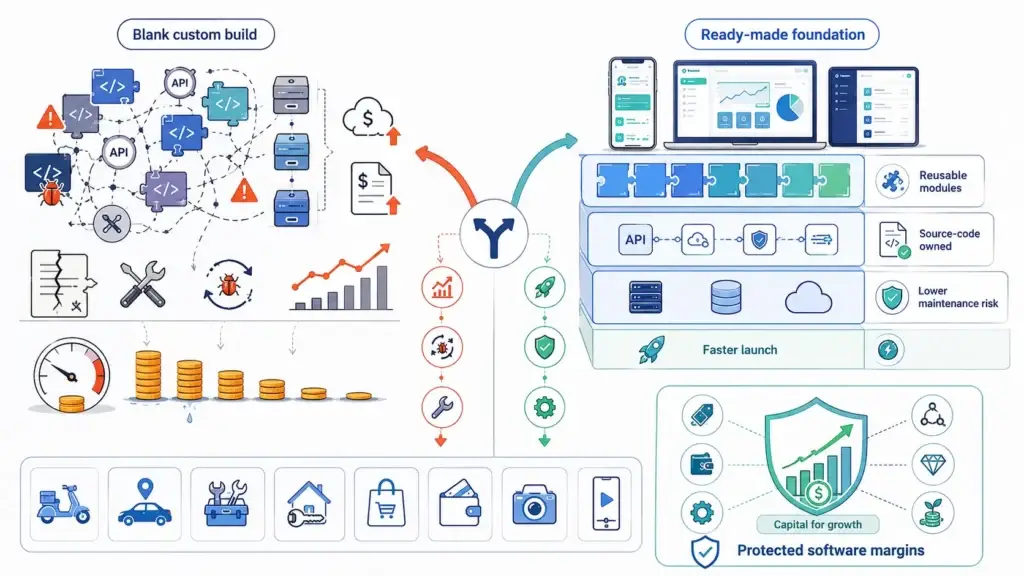
Miracuves helps founders reduce avoidable software maintenance risk by starting with ready-made, white-label, source-code-owned app foundations instead of forcing every product to begin as a blank custom build.
This is especially useful for founders building proven digital business models such as delivery apps, ride-hailing platforms, service marketplaces, rental marketplaces, ecommerce platforms, fintech-style apps, creator platforms, short video apps, and other clone app categories.
A modular Miracuves foundation can help reduce fixed maintenance costs because the core system is already structured around reusable app patterns. The founder can then focus capital on market positioning, branding, monetization, operations, integrations, and product differentiation.
That is the real advantage. The goal is not to copy another platform blindly. The goal is to avoid spending investor capital on rebuilding solved infrastructure while technical debt quietly expands after launch.
Founders exploring this route can review Miracuves’ clone app development company service page, compare broader ready-made app solutions, or evaluate custom mobile app development when the product requires a fully unique architecture.
When Custom Development Still Makes Sense
Custom development is still the right path when the product needs unique intellectual property, specialized workflows, deep enterprise integrations, uncommon data models, complex AI logic, proprietary algorithms, or highly differentiated user experiences.
The issue is not custom code itself. The issue is using custom code where a structured foundation would be more capital-efficient.
A founder should choose custom development when uniqueness creates defensible value. A founder should choose a modular white-label foundation when speed, cost control, validation, and operational predictability matter more than rebuilding common workflows.
This distinction protects margins.
Final Thoughts: Maintenance Is Where Software Margins Are Won or Lost
The real cost of software is not the first invoice. It is the long-term cost of keeping the system useful, secure, stable, and adaptable.
Custom code gives founders flexibility, but it also creates maintenance exposure. If the architecture is weak, the handover is poor, or the system is too tightly coupled, that exposure can quickly become a recurring capital drain.
The Legacy Debt Coefficient gives founders and investors a practical way to evaluate this risk before approving a build. If custom agency code may require 20–30% of the initial build fee annually for core maintenance, the financial model must reflect that from day one.
For many founders, the stronger path is to start with a modular, source-code-owned, white-label app foundation and use custom development only where differentiation truly matters. That is how software becomes a growth asset instead of a hidden maintenance liability.
FAQs
What is custom software maintenance cost?
Custom software maintenance cost is the recurring cost required to keep a software product stable, secure, compatible, and operational after launch. It usually includes bug fixes, API updates, hosting checks, security patches, dependency upgrades, performance improvements, and admin support.
How much does custom software maintenance cost annually?
Public benchmarks often place annual app or software maintenance around 15–25% of the original development cost. For custom agency-coded software with weaker architecture or high integration complexity, Miracuves’ Legacy Debt Coefficient estimates 20–30% annually for core maintenance exposure.
Why does custom code become expensive after launch?
Custom code becomes expensive when every update requires developer intervention. Costs rise because of API changes, security patches, OS updates, dependency conflicts, weak documentation, poor testing, and technical debt.
What is the Legacy Debt Coefficient?
The Legacy Debt Coefficient is a planning variable used to estimate annual maintenance exposure as a percentage of the original build fee. In this blog, it frames custom agency code at 20–30% annually and compares that against modular white-label systems with lower recurring maintenance risk.
Is white-label software cheaper to maintain than custom software?
White-label software can be more cost-efficient to maintain when the foundation is modular, documented, source-code-owned, and already structured around proven workflows. Final maintenance cost still depends on customization, integrations, usage, hosting, and business requirements.
Does source-code ownership reduce maintenance cost?
Source-code ownership reduces vendor lock-in, but it does not automatically reduce maintenance cost. The code still needs clean architecture, documentation, admin control, and modular structure. Poorly written source code can remain expensive even if the founder owns it.
When should a founder choose custom software development?
A founder should choose custom development when the product requires unique intellectual property, proprietary workflows, deep integrations, complex AI logic, unusual data models, or differentiation that cannot be supported by a ready-made foundation.
How can investors evaluate software maintenance risk before funding?
Investors should ask for the initial build cost, expected annual maintenance percentage, API dependency list, admin control scope, documentation quality, source-code ownership terms, technical debt plan, and three-year software operating budget.
Miracuves is an independent software development company. We are not affiliated with, connected to, sponsored by, or endorsed by any company or product named in this article.
Terms such as “X Clone” are used descriptively. It is how the software industry refers to building a platform with functionality comparable to a known service, and how clients search for it.
The entire design and codebase of our products is built by our own team. Our products contain no code, design, graphics, or content originating from any third-party website or applications.
All third-party names and marks referenced in this article are the property of their respective owners, referenced solely to identify the services discussed.