


Key Takeaways
- A fintech clone app must balance strong security with fast payment and wallet transactions.
- Users, merchants, admins, banking partners, and compliance teams need secure connected workflows.
- Payload encryption, KYC, wallet ledgers, fraud checks, audit logs, and secure APIs are core requirements.
- Latency depends on encryption design, backend architecture, payment gateways, database logic, and server performance.
- A well-built fintech platform can support secure transactions without damaging instant payment experiences.
Security Signals
- Users need protected login, encrypted transactions, wallet safety, transaction history, and privacy controls.
- Admins need permission control, fraud monitoring, KYC visibility, transaction review, and audit reports.
- Payment workflows need secure gateway handling, retry logic, ledger accuracy, and duplicate transaction prevention.
- Compliance teams need clear logs, data protection layers, identity checks, and suspicious activity tracking.
- Real-time alerts help detect payment abuse, unusual wallet activity, failed checks, and risky transaction patterns.
Real Insights
- Fintech users expect instant payments, but weak security can expose accounts, balances, and transaction data.
- Poor encryption planning can add unnecessary latency and slow down payment confirmation flows.
- Accurate wallet ledgers, idempotent callbacks, and audit trails help prevent payment confusion and financial disputes.
- Security reviews, compliance checks, and backend optimization keep fintech apps safer as transaction volume grows.
- Miracuves builds fintech clone apps with encrypted payloads, wallet workflows, payment security, and admin control.
Fintech founders often face a difficult tradeoff: build fast and risk weak security, or build securely and risk slow payment experiences. That tension becomes more serious in neobank, wallet, and remittance products where every transaction request passes through identity checks, balance validation, ledger updates, payment gateway workflows, fraud signals, and admin monitoring.
For a Revolut-style clone or neobank platform, security cannot be treated as a plugin added after launch. It must be part of the transaction engine, API structure, user verification flow, admin control layer, and audit trail from the beginning.
At Miracuves, our fintech architecture approach focuses on a practical question: Can a Laravel-backed fintech clone support strong payload encryption and compliance-ready workflows without damaging transaction speed? This is where fintech clone security becomes a core product decision, not just a backend checklist.
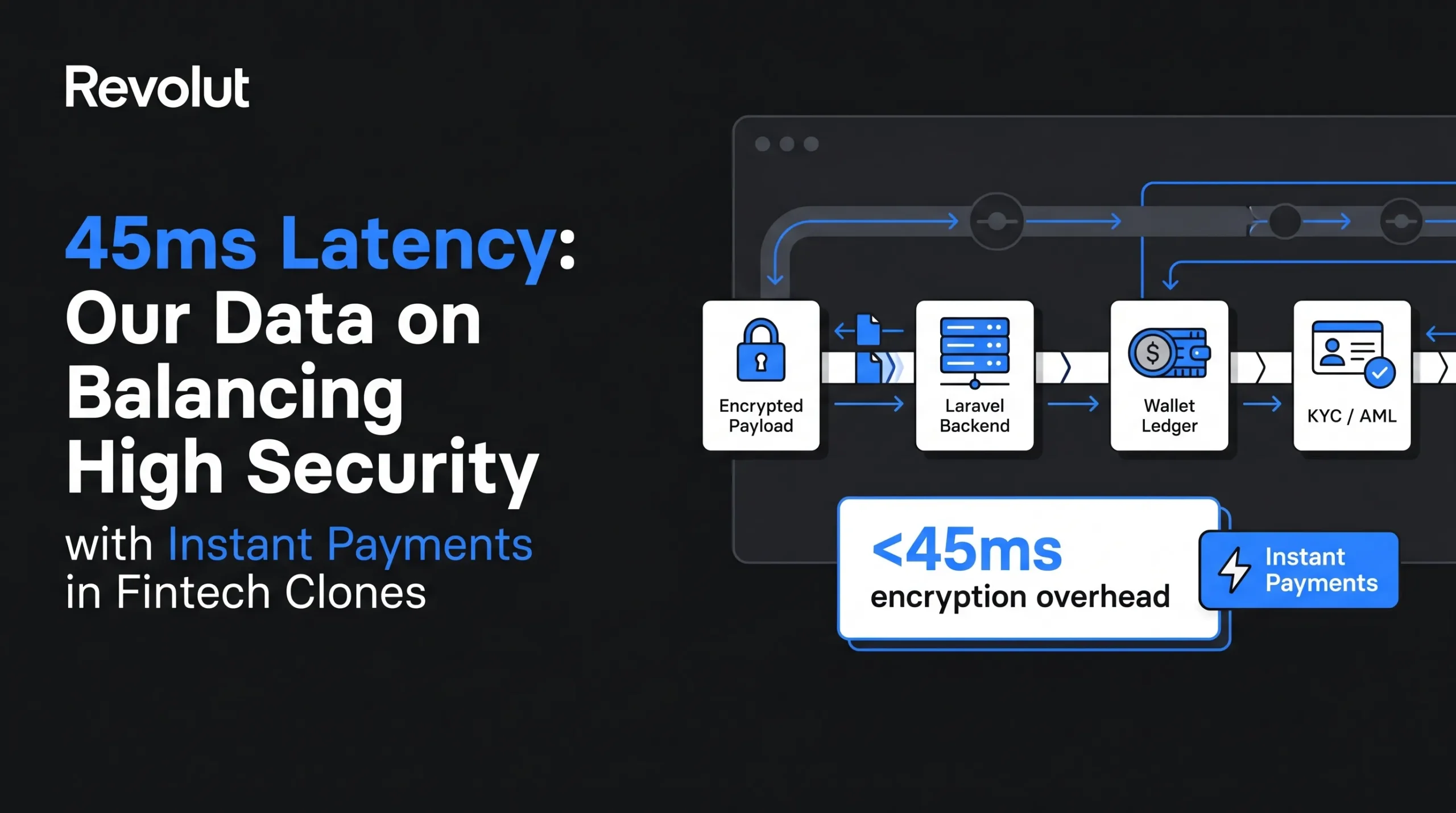
Based on internal Revolut-style clone build benchmarks provided in this brief, end-to-end payload encryption can be achieved with less than 45ms latency cost on Laravel. That number matters because fintech users expect instant actions, while founders and compliance teams need encrypted data flows, audit visibility, and operational control.
This article explains why many fast fintech app scripts become security risks, how encrypted payloads affect transaction latency, and what founders should prepare before neobank audits or banking partner reviews.
The Compliance Trap: Why Fast App Scripts Are Often Security Risks
The fintech clone market is crowded with fast-launch wallet apps, remittance apps, and neobank scripts. Many of them look complete from the outside because they include login, wallet balance, money transfer, transaction history, cards, notifications, and admin access.
The real risk is usually underneath.
A payment product can have attractive screens and still fail a serious technical review if it lacks encrypted payload handling, proper authorization checks, audit logs, user verification workflows, transaction monitoring, role-based dashboards, and secure key management. PCI DSS defines security requirements for environments where payment account data is stored, processed, or transmitted, which makes security architecture a foundational payment concern rather than a cosmetic feature.
For fintech founders, the trap is simple: a script that launches quickly may still create expensive rework later. Security gaps are often discovered when the startup approaches a banking partner, payment processor, compliance consultant, investor technical reviewer, or regulated-market advisor.
A risky fintech script often has these weaknesses:
- Payloads are protected only by transport-level security, with no additional application-layer encryption for sensitive transaction objects.
- Admin roles are too broad, allowing support teams to access more financial data than needed.
- User identity checks are separated from transaction rules, making suspicious activity review difficult.
- Logs exist, but they do not create a reliable audit trail for who did what, when, and why.
- Wallet balance logic is not clearly separated from display balance, ledger history, settlement state, and failed transaction recovery.
- API endpoints expose object IDs without strict object-level authorization checks.
Broken object-level authorization is one of the most serious API security risks because attackers can manipulate object identifiers in requests to access resources they should not control. In fintech, that risk can affect transaction records, wallet objects, KYC documents, beneficiary profiles, or admin actions.
The founder lesson is clear: speed is valuable only when the core engine is safe enough to scale.
Benchmarking Payload Encryption vs. Transaction Speed on Laravel
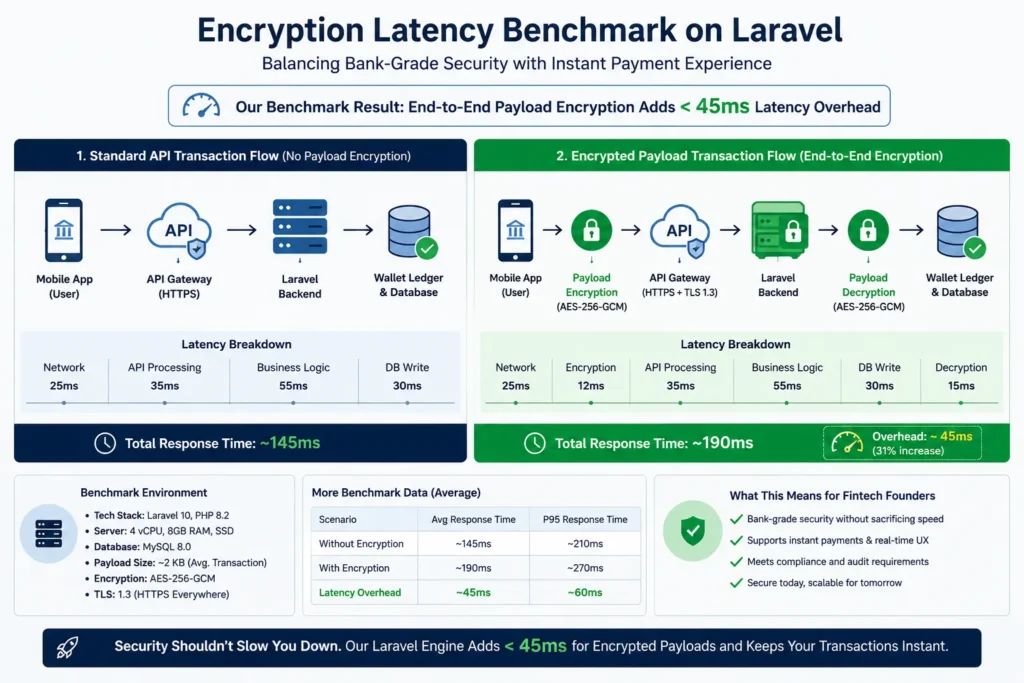
The biggest objection to stronger encryption is performance. Founders worry that encrypting more data will make money transfers feel slow. Compliance teams worry that reducing encryption scope will weaken the platform’s risk posture.
The right answer is not “encrypt everything blindly.” The right answer is to classify sensitive payloads, encrypt the right objects, benchmark the overhead, and keep transaction-critical APIs optimized.
Laravel provides encryption services using OpenSSL with AES-256 and AES-128 encryption, and encrypted values are signed with a message authentication code to help detect tampering. That makes Laravel a practical backend foundation when encryption is implemented with disciplined payload design, queue handling, indexing strategy, and key rotation planning.
Miracuves Benchmark Variable: Less Than 45ms Encryption Latency Cost
In the Revolut-style clone architecture described in your brief, the benchmark variable is:
End-to-end payload encryption can be achieved with less than a 45ms latency cost on Laravel.
For fintech product teams, that is the number that changes the conversation. It means encryption does not automatically make instant payment flows unusable. The actual outcome depends on payload size, database design, key handling, caching strategy, queue placement, server resources, and how much logic is kept inside the synchronous transaction path.
Practical Benchmark View
| Transaction Flow | Security Layer Applied | Expected Founder Concern | Miracuves Benchmark Position |
|---|---|---|---|
| Wallet-to-wallet transfer request | Encrypted sensitive payload fields, authenticated API request, authorization checks | “Will encryption slow the transfer?” | Payload encryption adds less than 45ms latency cost on Laravel when scoped and optimized correctly. |
| Beneficiary creation | Encrypted identity/payment fields, audit log, device/session validation | “Will onboarding feel slow?” | Slight overhead is acceptable because this is not always a high-frequency payment action. |
| Transaction history retrieval | Role-based access, object-level authorization, selective decryption | “Will users see delays in history screens?” | Use pagination, scoped access, and avoid decrypting unnecessary fields. |
| Admin transaction review | Audit trail, role-based access, encrypted sensitive data, activity logging | “Can support teams investigate without overexposure?” | Permission-based dashboards allow review without unrestricted data access. |
| Suspicious activity review | Transaction monitoring flags, audit logs, KYC/AML workflow support | “Can compliance teams investigate properly?” | Compliance-ready workflows depend on clean event history, not only encryption. |
The key is to avoid putting every heavy operation in the live payment path. A strong architecture separates synchronous transaction validation from asynchronous risk review where possible.
For example, a wallet transfer may need immediate authentication, balance validation, authorization, idempotency control, ledger write, and response generation. Deeper risk scoring, notification dispatch, reporting sync, and admin analytics can often run through background jobs after the transaction event is recorded.
That is how fintech platforms preserve speed without weakening control.
Read more: How Safe Is a White-Label Revolut app? Security Guide 2026
What “Bank-Grade” Should Mean in a Fintech Clone Context
The phrase “bank-grade security” is often overused. For founders, it should not mean vague marketing language. It should mean the platform includes serious technical controls that can support financial-product scrutiny.
A Revolut-style clone should include:
| Security Layer | What It Does | Why It Matters for Founders |
|---|---|---|
| Payload encryption | Protects sensitive request and transaction data beyond basic app logic | Reduces exposure risk if logs, payloads, or internal flows are mishandled |
| Encrypted data transfer | Protects data moving between app, backend, gateways, and services | Required for payment trust and secure financial communication |
| Role-based access control | Limits admin, support, finance, and compliance permissions | Prevents internal overexposure of financial and identity data |
| Audit logs | Records key user, admin, and system actions | Helps during investigations, disputes, partner reviews, and compliance preparation |
| KYC workflow support | Collects and verifies identity information through configurable workflows | Supports regulated onboarding models where identity verification is required |
| AML workflow support | Flags suspicious activity patterns for review | Helps founders prepare operational risk controls |
| Transaction monitoring | Tracks unusual payment patterns, failed attempts, and account behavior | Improves fraud visibility and admin decision-making |
| Secure API integration | Protects communication with gateways, KYC providers, banking APIs, and notification services | Reduces integration-level attack surface |
| Key management process | Defines how keys are generated, stored, rotated, and retired | Prevents encryption from becoming a long-term operational weakness |
Strong encryption only works when cryptographic keys are managed properly. Secure key management includes protecting keying material, rotating keys when needed, limiting access, and preventing keys from being exposed in code, logs, or unsecured storage. In fintech platforms, weak key handling can undermine even advanced encryption and put sensitive financial data at risk.
Miracuves’ fintech positioning should be careful here: a clone app can provide a compliance-ready foundation, but final compliance depends on the operating jurisdiction, legal review, banking/payment partners, integrations, documentation, and business model. This aligns with Miracuves’ security language rules: security should be positioned as a foundation, not as a guaranteed regulatory outcome.
Read More: Revolut App Marketing Strategy: How to Turn Banking into a Brand
How Laravel Can Support Secure Fintech Performance
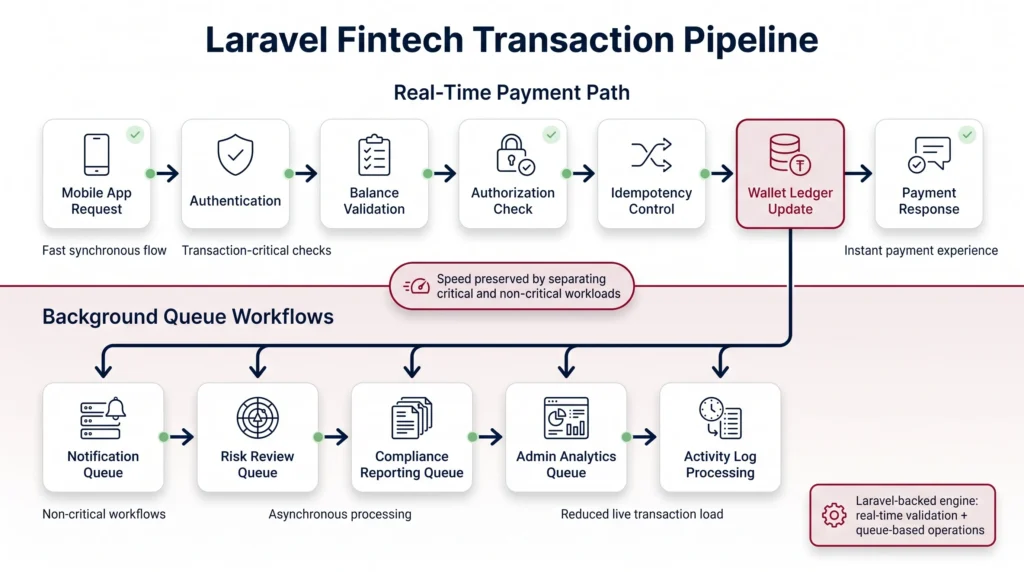
Laravel is often misunderstood in fintech discussions. Some teams assume a Laravel backend is only suitable for simple apps. In practice, Laravel can support serious fintech workflows when the system is engineered with clean service boundaries, queue discipline, secure API design, and database-level care.
The performance issue is not the framework alone. The real issue is architecture.
A Laravel-backed fintech clone should be structured around:
1. Transaction Service Layer
The transaction service should handle wallet transfers, payment requests, remittance actions, balance validation, ledger updates, and transaction status changes. This layer should not be mixed directly with controller logic or front-end assumptions.
2. Encryption and Decryption Boundaries
Sensitive payloads should be encrypted and decrypted only where needed. Over-decrypting data for every screen increases latency and exposure. The platform should define which fields require encryption, which can be tokenized, which can be masked, and which should never be logged.
3. Idempotency Controls
Fintech APIs must avoid duplicate transfers caused by retries, poor network conditions, or repeated client requests. Idempotency keys help prevent the same payment action from being processed multiple times.
4. Queue-Based Non-Critical Workflows
Notifications, reports, compliance exports, email alerts, and some risk-scoring workflows should not delay the core transaction response unless they are required for approval.
5. API Authorization at Object Level
Every wallet, beneficiary, card, transaction, and KYC object should be checked against the authenticated user and role context. This helps reduce object-level authorization risk, where attackers may try to access or modify resources that do not belong to them.
6. Audit-First Admin Actions
Admin actions should leave structured records. A compliance officer should be able to review who accessed a user profile, who changed a transaction status, who approved a KYC document, and what triggered a risk review.
This is where Miracuves’ source-code-owned fintech approach becomes important. When founders own the code foundation, they are better positioned to customize audit rules, compliance workflows, integrations, and market-specific controls without being locked into a rigid vendor environment.
Read More: How Safe Is a White-Label Revolut app? Security Guide 2026
Founder Decision Signals
Founder Decision Signals
Speed
If encryption adds less than 45ms latency cost, founders can preserve near-instant transaction UX while improving sensitive payload protection.
Security
Security should cover payloads, APIs, admin access, transaction logs, KYC workflows, AML workflow support, and integration controls.
Audit Readiness
A fintech clone becomes easier to review when every critical action is logged, permissioned, and connected to a clear transaction or identity event.
Market Fit
Founders can validate faster when the product foundation already supports wallet flows, admin control, and compliance-ready workflows.
How to Pass Neo-Banking Audits Without Rewriting Your Core Engine
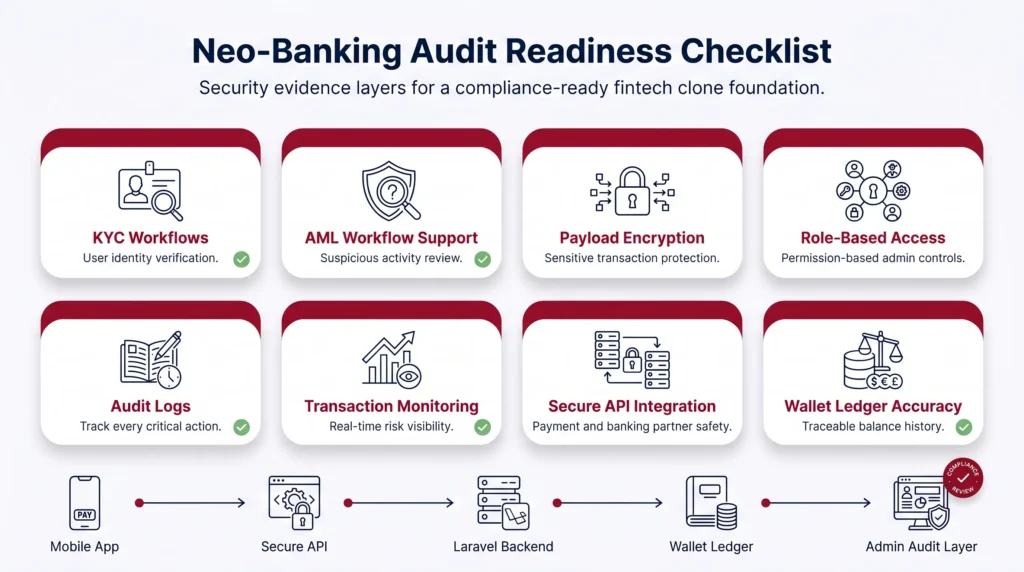
A fintech audit does not only inspect screens. It examines the control layer behind the screens.
A neobank or Revolut-style platform may need to show how user identity is verified, how payments are authorized, how sensitive data is protected, how admins access records, how suspicious behavior is reviewed, and how transaction history remains traceable.
The best way to avoid a full rewrite is to design the core engine around auditability from the beginning.
Build the Ledger as a Source of Truth
A wallet balance should not be treated as a simple number in a user table. A serious fintech platform needs a ledger-style transaction history that can explain how the balance changed over time.
This is critical for:
- failed transaction investigation
- refund handling
- dispute review
- reconciliation
- admin reporting
- compliance review
- customer support accuracy
Keep Compliance Workflows Configurable
KYC and AML workflows vary by region, partner, and business model. A founder launching a remittance app may need different checks than a founder launching a digital wallet or neobank-style product.
A strong fintech clone should allow configurable workflows for identity verification, document review, suspicious activity flags, admin approval, and reporting exports.
Separate Admin Roles Carefully
Support agents, finance operators, compliance reviewers, and platform owners should not all see the same data. Role-based access control helps ensure each team member gets only the permissions required for their function.
This protects users and gives founders better internal governance.
Prepare Evidence, Not Just Features
During technical review, it is not enough to say “we have encryption.” Teams may need to show:
- where sensitive data is encrypted
- how keys are managed
- what logs are retained
- who can access financial records
- how admin actions are recorded
- how payment failures are handled
- how suspicious activity is flagged
- how third-party APIs are secured
Payment security requirements continue to evolve as new clarifications, corrections, and updated controls are introduced over time. This is a reminder that fintech teams need maintainable architecture rather than hardcoded compliance assumptions, so security workflows can adapt without disrupting payments, audits, or platform operations.
Read More: Revolut App Features List: What Makes It a Fintech Powerhouse?
White-Label Fintech vs. Custom Build: Security Tradeoff
| Build Path | Security Strength | Speed Advantage | Risk |
|---|---|---|---|
| Basic app script | Fast to demo | High initial speed | Often weak audit logs, shallow authorization, unclear encryption scope |
| Custom fintech build | Highly customizable | Slower initial launch | Higher cost and longer validation cycle |
| White-label fintech platform | Faster launch with configurable foundation | Strong when source-code-owned and security-aware | Must be customized properly for jurisdiction, partner, and compliance scope |
| Miracuves Revolut-style clone approach | Ready-made fintech foundation with source code, admin control, and compliance-ready workflows | Supports faster validation and launch planning | Final compliance still depends on legal, operational, and integration review |
Miracuves helps founders launch white-label fintech platforms with source-code ownership, admin dashboards, wallet workflows, and customisation support. For founders comparing a Revolut clone app, a Wise clone solution, or broader fintech app development, the right decision is not only about features. It is about whether the architecture can support security, compliance workflows, transaction speed, and long-term control.
Mistakes Founders Should Avoid
Mistakes Founders Should Avoid
Treating encryption as the entire security strategy
Encryption protects sensitive data, but fintech security also needs authorization, audit logs, role-based access, KYC workflows, AML workflow support, fraud signals, secure integrations, and operational governance.
Choosing a fast script without audit visibility
A fast launch can become expensive if the platform cannot prove who accessed data, who approved actions, how payments moved, and how suspicious activity was reviewed.
Ignoring object-level API authorization
Financial APIs expose sensitive objects such as transactions, wallets, beneficiaries, and documents. Every object should be checked against the user, role, and action context.
Hardcoding compliance assumptions
Compliance needs vary by region and operating model. A fintech clone should provide configurable workflows instead of rigid rules that require core rewrites later.
Miracuves Perspective: Secure Fintech Clones Should Be Built for Review, Not Just Release
A fintech clone should not only help founders launch quickly. It should help them answer harder questions from investors, banking partners, compliance consultants, payment processors, and internal technical teams.
That means the product foundation needs:
- encrypted data transfer and storage
- secure API workflows
- KYC and AML workflow support
- wallet ledger clarity
- transaction monitoring
- admin access controls
- audit logs
- configurable roles
- source-code ownership
- scalable backend structure
Miracuves’ ready-made fintech approach gives founders a faster path to launch while preserving room for customisation. The stronger decision is not choosing speed over security. It is choosing a launch-ready foundation where speed, encryption, admin control, and audit readiness are designed together.
Final Thoughts: Security and Speed Should Not Compete in Fintech Clones
The real challenge in fintech clone development is not adding more features. It is building a product foundation that can support fast transactions, encrypted data movement, audit visibility, admin control, and future compliance workflows without forcing a rebuild later.
For neobank founders and fintech startups, the stronger decision is not choosing the fastest script or the most expensive custom build. It is choosing an architecture that balances launch speed with long-term technical control. A Revolut-style clone should protect sensitive payloads, preserve wallet ledger accuracy, support KYC/AML workflows, and give operators clear evidence through logs, dashboards, and transaction monitoring.
The benchmark matters because it changes the security conversation. If end-to-end payload encryption can be implemented on a Laravel-backed fintech engine with less than 45ms latency overhead, founders do not have to treat security as the enemy of instant payments. They can design for both trust and speed from the beginning.
Miracuves helps fintech founders start with a white-label, source-code-owned foundation that can be customised for wallet flows, remittance logic, admin controls, secure APIs, and compliance-ready workflows. Final compliance still depends on jurisdiction, legal review, integrations, and operating model, but the product foundation should make that path easier — not harder. Let’s build together.
FAQs
What is fintech clone security?
Fintech clone security refers to the controls built into a white-label or ready-made fintech platform to protect user accounts, wallet balances, transaction data, identity documents, payment flows, APIs, and admin dashboards. It includes encryption, role-based access, audit logs, KYC workflows, AML workflow support, transaction monitoring, and secure integrations.
Does payload encryption slow down fintech transactions?
Payload encryption can add latency, but it does not have to make transactions feel slow. Based on the benchmark variable provided for Miracuves’ Revolut-style clone builds, end-to-end payload encryption can be implemented on Laravel with less than 45ms latency cost when scoped and optimized correctly.
Is Laravel secure enough for fintech app development?
Laravel can support secure fintech workflows when implemented with strong architecture, encryption boundaries, secure API authorization, role-based access, queue handling, audit logs, and disciplined key management. The framework alone does not guarantee security; the implementation quality matters.
What security features should a Revolut-style clone include?
A Revolut-style clone should include encrypted data transfer, payload protection, KYC workflow support, AML workflow support, transaction monitoring, wallet ledger accuracy, role-based admin access, audit logs, secure payment gateway integration, suspicious activity flags, and configurable compliance workflows.
Can a fintech clone be fully compliant out of the box?
No fintech clone should be described as fully compliant everywhere out of the box. A platform can provide a compliance-ready foundation, but final compliance depends on the target jurisdiction, legal review, payment partners, banking integrations, data policies, operating model, and regulatory requirements.
Why do fast fintech scripts fail compliance reviews?
Fast fintech scripts often fail because they focus on visible features instead of deeper controls. Common gaps include weak authorization, missing audit logs, broad admin access, unclear encryption scope, poor ledger design, limited KYC/AML workflows, and insufficient evidence for technical review.
How does source-code ownership help fintech founders?
Source-code ownership gives founders more control over security changes, compliance workflows, integrations, audit logic, admin permissions, and future customisation. This is especially important in fintech because regulations, partner requirements, and risk controls may change over time.