Key Takeaways
- Digital banking platform features can bring accounts, cards, FX, savings, business finance, payments, transfers, security, and administrative controls into one connected financial system.
- The strongest platforms connect customer-facing features with shared balances, transaction records, identity verification, limits, notifications, risk controls, and financial data.
- Feature planning should reflect the target user, supported currencies, transaction types, card programs, business use cases, banking integrations, security requirements, and operational workflows.
Core Feature Signals
- Account features can include personal and business accounts, multi-currency balances, transaction histories, beneficiaries, deposits, transfers, spending insights, statements, and account controls.
- Card and FX modules can support virtual or physical cards, spending limits, card freezing, international payments, currency exchange, rate displays, conversion fees, and multi-currency spending.
- Savings and business finance features may include savings goals, recurring deposits, business payments, expense tracking, team permissions, payment requests, invoicing support, and financial reporting.
Operations & Admin Insights
- Admin controls should support user management, KYC review, transaction monitoring, card management, transfer limits, fee configuration, account restrictions, disputes, and operational reporting.
- Role-based access, audit logs, fraud alerts, reconciliation, approval workflows, transaction search, compliance-ready workflows, and analytics help operations teams manage financial activity securely.
- Miracuves develops customizable digital banking platforms with accounts, cards, FX, savings, business finance, payments, security controls, transaction monitoring, analytics, and admin management.
Digital banking platforms have moved far beyond simple balance checks and basic money transfers. Modern users expect one financial experience where they can open accounts, manage cards, exchange currencies, save money, track spending, pay internationally, and control financial activity from a mobile-first interface.
For founders, the feature question is not only, “What should the app include?” The stronger question is, “Which features create user trust, repeat engagement, monetization potential, and operational control?”
Revolut has become a useful reference point for digital banking product strategy because it brings multiple finance journeys into one app experience. But a founder should not simply copy another platform’s interface. The smarter approach is to understand the feature architecture behind modern digital banking and then shape it around a specific market, customer segment, compliance path, and revenue model. For founders exploring a faster fintech launch, Miracuves’ modern digital banking product strategy can help connect core finance modules with branding, admin control, and launch-ready execution.
This guide breaks down the most important digital banking platform features across accounts, cards, FX, savings, business finance, security, integrations, and admin controls.
Why Digital Banking Features Need a Product Strategy, Not Just a Checklist
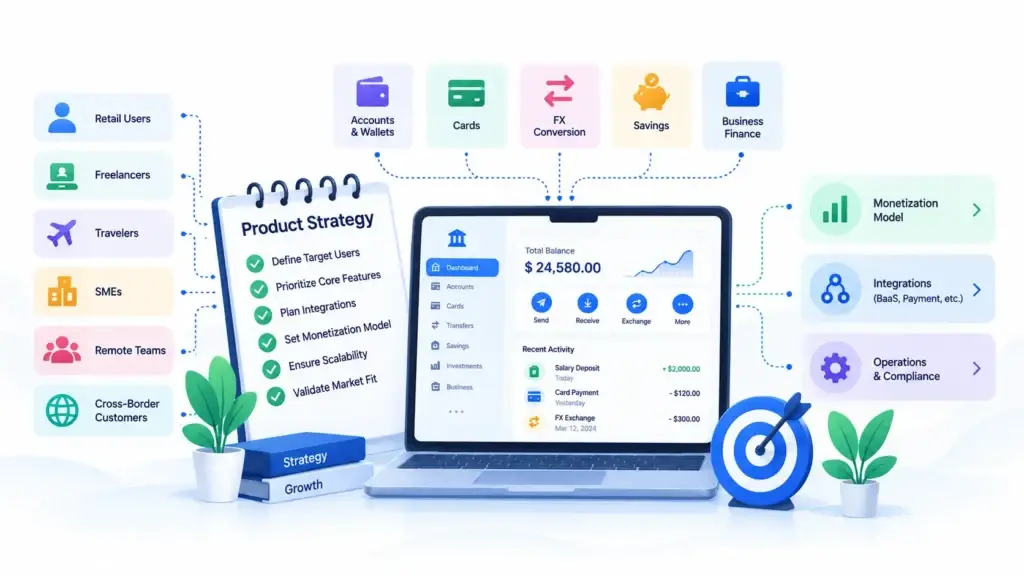
A digital banking app can look simple on the surface, but every feature depends on deeper product decisions. Account balances need ledger accuracy. Card controls need issuing partner workflows. FX conversion needs rate logic. Savings tools need balance movement rules. Business finance features need permissions, approvals, reporting, and admin visibility.
This is why founders should avoid treating digital banking features as a random list. Each module should answer a business question.
Does the platform serve retail users, freelancers, travelers, SMEs, remote teams, or cross-border customers? Will revenue come from subscriptions, FX margins, transfer fees, card usage, premium accounts, business finance tools, or partner services? Will the platform rely on Banking-as-a-Service integrations, payment gateway integrations, internal wallet flows, or licensed partners?
A clear feature strategy helps founders launch with the right foundation instead of overbuilding features that do not match the first market version.
1. Account Management and User Dashboard
Account management is the center of a digital banking platform. Users should be able to view balances, recent activity, account details, statements, linked cards, available currencies, and financial summaries without confusion.
A strong account dashboard usually includes:
- Account overview
- Available balance and pending balance
- Transaction history
- Account statements
- Currency-wise balances
- Linked cards
- Notifications and alerts
- Profile and account settings
The business value is clarity. If users cannot quickly understand where their money is, what changed, and what action they can take next, the platform will struggle with trust and retention.
For founders, the account dashboard should also be designed with future expansion in mind. A retail banking user may only need balance visibility, while a business user may need team spending, invoice activity, approval status, and financial reports. For a deeper module-level view, this complete digital banking feature breakdown can help founders understand how user, card, account, business finance, and admin workflows connect inside one platform.
2. Secure Onboarding, KYC, and Authentication
Onboarding is where user trust begins. A fintech product should make registration smooth while still supporting identity verification, security checks, and risk controls.
Important onboarding features include:
- Email or mobile registration
- Secure login
- Biometric authentication
- Multi-factor authentication
- Device verification
- KYC document collection
- Identity verification status
- Profile completion progress
- Terms and consent capture
- Risk review workflows
For users, onboarding should feel simple. For the platform operator, onboarding should create enough verification structure to support compliance workflows and reduce fraud risk.
A digital banking platform can be designed with KYC and AML workflow support, but final compliance depends on jurisdiction, licensed partners, regulatory requirements, integrations, legal review, and the operating model.
3. Payments, Transfers, and Money Requests
Payments and transfers are core engagement drivers in any digital banking platform. Users expect to send, receive, request, and track money without friction.
Common payment and transfer features include:
- Bank transfers
- Wallet-to-wallet transfers
- Peer-to-peer payments
- Beneficiary management
- Payment requests
- Recurring transfers
- Scheduled payments
- Transfer status tracking
- Payment receipts
- Failed payment notifications
The founder decision here is not only about adding transfer buttons. The product must define transfer limits, fees, approval flows, failure handling, refund logic, dispute paths, and partner integrations.
If the platform targets cross-border users, transfer workflows should also connect with multi-currency accounts, FX conversion, compliance screening, and transaction monitoring.
4. Multi-Currency Accounts and FX Conversion
Multi-currency support is one of the most important features for digital banking products serving travelers, freelancers, exporters, international students, remote teams, global businesses, and cross-border customers.
A multi-currency banking experience may include:
- Multiple currency balances
- Currency conversion
- FX quote preview
- Exchange rate display
- Currency-wise transaction history
- Account funding flows
- International payment support
- Local account details where supported
- FX markup or fee logic
- Rate refresh rules
The user value is flexibility. Users can hold, spend, convert, and move money across currencies from one app experience.
The business value is monetization. FX margins, transfer fees, premium currency plans, and international payment services can become important revenue streams when designed transparently and responsibly.
5. Card Management for Virtual and Physical Cards
Cards are a major part of digital banking engagement because they connect the app to everyday spending. A modern card module should give users control over how, where, and when money is spent.
Useful card management features include:
- Physical card ordering
- Virtual card creation
- Single-use card options where supported
- Freeze and unfreeze controls
- Spending limits
- Online payment controls
- ATM withdrawal controls
- Merchant category controls
- Card replacement requests
- PIN management
- Real-time card transaction alerts
For users, card controls create confidence. For founders, card features can support revenue through subscriptions, interchange, premium cards, card delivery fees, and business finance plans, depending on the market and partner setup.
A card issuing platform or BaaS partner may be required for real card issuance, so founders should plan this module around available infrastructure and legal requirements.
6. Savings, Vaults, and Budgeting Tools
Savings and budgeting features turn a digital banking app from a transaction tool into a daily financial companion. These features encourage users to keep balances in the app, set goals, and return more frequently.
Common savings and budgeting features include:
- Goal-based savings pockets
- Vaults or sub-accounts
- Round-up savings
- Recurring deposits
- Budget categories
- Spending limits
- Expense summaries
- Monthly insights
- Alerts for overspending
- Progress tracking
For founders, these features are valuable because they improve engagement and balance retention. A user who only sends money once may not return often. A user who tracks spending, saves toward goals, and manages cards from the same platform has more reasons to stay active.
7. Business Finance Features for SMEs and Teams
This expands the product beyond personal banking and creates stronger monetization opportunities. This is where the digital banking business model becomes important, because business users can support revenue through subscriptions, team finance tools, FX usage, premium accounts, and value-added financial services.
Business finance features may include:
- Business account dashboard
- Team member access
- Role-based permissions
- Expense tracking
- Invoice creation
- Vendor payments
- Receipt uploads
- Payroll support surfaces
- Approval workflows
- Business statements
- Cash flow summaries
- Team card controls
The key difference between personal finance and business finance is control. A business owner needs visibility over who spent money, which invoice is unpaid, which transfer needs approval, and how cash flow is moving.
This is also where admin and permission logic becomes critical. Without access control, approval flows, and reporting, business finance features can become difficult to manage at scale.
8. Admin Controls for Financial Operations
Admin controls are often underestimated because users do not see them. But for the platform operator, the admin dashboard is the control center of the entire digital banking business.
A strong banking admin dashboard may include:
- User management
- KYC review status
- Transaction monitoring
- Account activity logs
- Fee and limit management
- Currency and FX settings
- Card status controls
- Dispute management
- Refund and reversal workflows
- Suspicious activity flags
- Support ticket management
- Role-based staff access
- Reports and analytics
- Audit logs
The admin layer decides whether the platform can handle real operations. If every issue requires developer intervention, the business becomes slow and fragile. If the admin team can review users, monitor transactions, manage disputes, adjust limits, and track reports from one dashboard, the platform becomes easier to operate.
For founders, this is one of the strongest reasons to evaluate backend control before focusing only on the mobile app interface.
9. Security Features That Build User Trust
Security should be built into the product foundation, not added as an afterthought. Users are more likely to trust a digital banking platform when they can see clear account protection, card controls, notifications, and support workflows.
Important security features include:
- Encrypted data transfer
- Secure authentication
- Multi-factor authentication
- Biometric login
- Device verification
- Role-based access control
- Audit logs
- Transaction alerts
- Suspicious activity flags
- Card freeze controls
- Admin access controls
- Fraud monitoring workflows
- Activity history
- Secure API integration
Security also affects internal operations. Admin users should not all have the same access. Finance teams, support teams, compliance reviewers, and business operators may need different permissions. Founders should also review fintech security and compliance workflows before finalizing KYC, AML support, transaction monitoring, audit logs, fraud review, and admin access rules.
A secure platform should support visibility, traceability, and controlled intervention across user accounts, transactions, cards, and support actions.
10. BaaS, Payment Gateway, and API Integrations
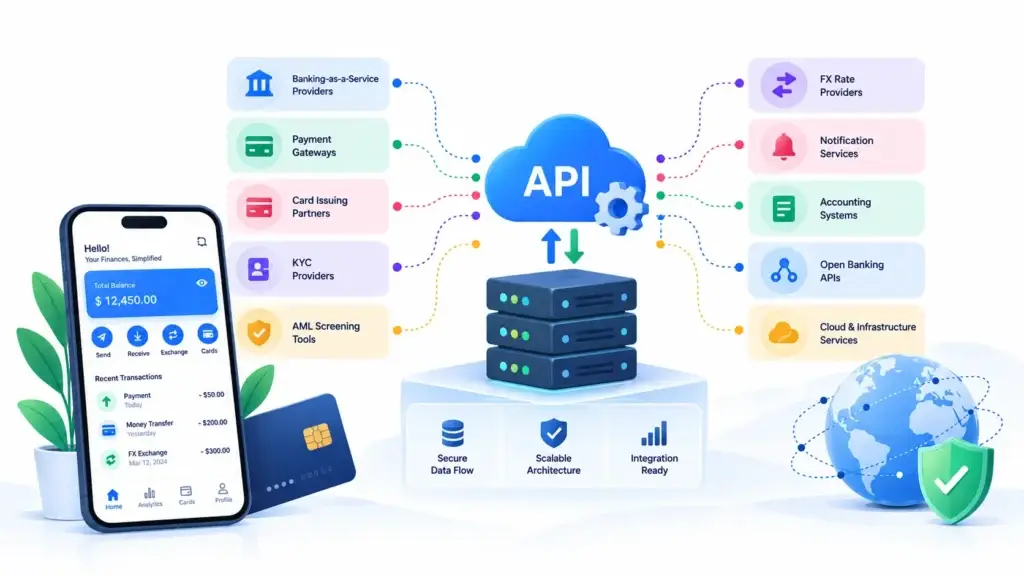
Banking-as-a-Service and payment integrations help connect a digital banking platform to real financial infrastructure. Depending on the business model, founders may need providers for account issuance, card issuing, payments, remittance, currency exchange, identity verification, and compliance screening.
Important integration areas include:
- Banking-as-a-Service providers
- Payment gateways
- Card issuing partners
- KYC providers
- AML screening tools
- FX rate providers
- Notification services
- Accounting systems
- Open banking APIs where supported
- Cloud and infrastructure services
The product should be integration-ready from the beginning. If the architecture is not built for APIs, adding financial partners later can become expensive and slow. Founders who want to understand the technical planning behind accounts, payments, cards, APIs, and backend workflows can explore this guide on how to build a finance app with the right technical foundation.
This is where a launch-ready fintech foundation can help founders move faster because the core structure for accounts, transactions, cards, FX, business finance, and admin workflows is already planned.
Digital Banking Platform Feature Map
| Feature Area | User Value | Business Value | Admin Control Needed |
|---|---|---|---|
| Account dashboard | Clear balance and activity visibility | Better daily engagement | User status, account logs, statements |
| Onboarding and KYC | Faster registration with trust | Safer user acquisition | Verification review, approval status, risk flags |
| Payments and transfers | Easy money movement | Transfer fees and repeat usage | Limits, failed payments, dispute handling |
| Multi-currency and FX | Currency flexibility | FX margins and international usage | Rate settings, currency controls, transaction review |
| Card management | Safer everyday spending | Card revenue and premium plan potential | Card status, limits, freeze controls |
| Savings and budgeting | Better money habits | Balance retention and app stickiness | Vault activity, rules, notifications |
| Business finance | Team and SME money control | Business plans and higher-value users | Roles, approvals, reporting, invoices |
| Security workflows | User confidence | Lower fraud and operational risk | RBAC, audit logs, suspicious activity review |
Founder Decision Signals
Speed
If the goal is faster market validation, founders should begin with the most important account, payment, card, FX, and admin workflows instead of building every finance module from zero.
Control
The admin dashboard should allow the platform operator to manage users, transactions, disputes, fees, limits, verification, and reports without depending on developers for every change.
Security
Authentication, encryption, audit logs, role-based access, and transaction monitoring help protect user trust and support responsible operations.
Monetization
Digital banking platforms can support revenue through subscriptions, FX margins, transfer fees, card-related revenue, business accounts, and partner-led services.
What Founders Should Prioritize First
A new digital banking platform does not need to launch with every possible finance feature. The first version should focus on the features that match the target audience and business model.
For example, a travel finance product may prioritize multi-currency accounts, FX, cards, and spending alerts. A freelancer finance product may need international payments, invoices, savings pockets, and tax-friendly reporting surfaces. A business finance product may need team permissions, expense workflows, vendor payments, approvals, and admin reporting.
The right priority depends on five questions:
- Who is the first user segment?
- What financial problem does the platform solve first?
- Which features create trust and repeat usage?
- Which integrations are required before launch?
- Which admin controls are needed to operate safely?
This approach helps founders avoid overbuilding and keeps the product focused on practical market validation.
Common Mistakes Founders Should Avoid
Building Only the User App
A polished mobile interface is not enough. Digital banking platforms need backend workflows for user verification, transaction monitoring, admin actions, fee controls, support, reporting, and risk review. Many early fintech products fail because they overbuild user-facing features while ignoring operational risk, which is why reviewing mistakes to avoid when building a digital banking product can help founders plan with more clarity.
Adding Too Many Finance Modules Too Early
Cards, FX, savings, investments, business finance, and payment features all add complexity. Founders should launch with the right feature set for the first market instead of trying to build every possible module at once.
Ignoring Compliance Workflow Planning
Software can support KYC, AML, audit logs, transaction monitoring, and reporting workflows, but legal and regulatory obligations depend on the target market, licensed partners, and business structure.
Underestimating Admin Dashboard Depth
The admin dashboard is where the platform operator manages real financial operations. Weak admin controls can create delays, support issues, manual work, and operational risk.
Treating Security as a Final Step
Security should be considered from the start. Authentication, access control, audit logs, encrypted communication, transaction alerts, and fraud monitoring workflows should be part of the foundation.
How Miracuves Helps Founders Launch Faster
Miracuves helps founders build white-label digital banking products with ready-made fintech foundations that can be customized around brand, market, integrations, compliance direction, and revenue model.
For founders who want to avoid building every module from scratch, a white-label digital banking foundation from Miracuves can provide a faster path to launch with account workflows, card management, multi-currency journeys, business finance modules, admin controls, source-code ownership, and rebranding support.
Where relevant, Miracuves can support a 6-day solution delivery approach for ready-made deployments. Deeper customization, provider integrations, or compliance-heavy requirements may need additional planning based on scope. Before finalizing scope, founders can compare digital banking development cost factors such as integrations, platforms, branding, compliance workflows, feature depth, and admin control.
The value is not only speed. The stronger value is starting with a fintech product foundation that already considers user experience, admin visibility, monetization, security workflows, and long-term customization.
For founders comparing implementation options, it also helps to know how to choose the right fintech development partner based on source-code ownership, customization flexibility, deployment support, admin visibility, and long-term product control.
Final Thoughts
Digital banking platform features should work together as a financial ecosystem. Accounts give users visibility. Transfers create money movement. Cards connect the platform to daily spending. FX enables international usage. Savings tools improve engagement. Business finance expands the customer base. Security builds trust. Admin controls make the platform operationally manageable.
For founders, the real opportunity is not to copy another fintech product feature by feature. It is to understand which modules matter, how they connect, and how they support a specific business model.
A strong digital banking platform should be user-friendly on the front end and deeply controlled on the back end. That balance is what turns a finance app from a simple wallet into a scalable fintech product.
FAQs
What are the most important digital banking platform features?
The most important digital banking platform features include account dashboards, secure onboarding, KYC workflow support, payments, transfers, multi-currency accounts, FX conversion, card management, savings tools, business finance modules, notifications, security features, and admin controls.
Why are admin controls important in a digital banking platform?
Admin controls help the platform operator manage users, verification status, transactions, disputes, fees, limits, card activity, reports, and suspicious activity. Without a strong admin dashboard, the app may look good but become difficult to operate as usage grows.
Do digital banking platforms need multi-currency support?
Multi-currency support is important if the platform targets travelers, freelancers, international students, remote workers, exporters, SMEs, or cross-border users. It allows users to hold, convert, send, and manage funds in different currencies.
What card features should a modern fintech app include?
A modern fintech app may include virtual cards, physical card ordering, freeze and unfreeze controls, spending limits, online payment controls, ATM controls, transaction alerts, PIN management, and card replacement requests, depending on the issuing partner and market.
What is the role of BaaS in digital banking platforms?
Banking-as-a-Service can help digital banking platforms connect with infrastructure for account issuance, card issuing, payments, identity workflows, and other regulated financial services. The exact setup depends on the provider, region, license model, and business requirements.
Can a digital banking platform support business finance?
Yes. A digital banking platform can support business finance through team accounts, role-based access, expense tracking, invoice flows, vendor payments, approval workflows, payroll support surfaces, business statements, and reporting tools.
How can a digital banking platform generate revenue?
Revenue can come from subscription plans, FX margins, transfer fees, card-related revenue, business accounts, premium features, partner services, payment flows, and value-added financial tools. The right model depends on the target audience and operating market.
How fast can Miracuves help launch a digital banking platform?
For ready-made white-label fintech deployments, Miracuves can support a 6-day solution delivery path where relevant. Final timelines depend on branding, feature scope, integrations, compliance requirements, provider setup, and customization needs.
Miracuves is an independent software development company. We are not affiliated with, connected to, sponsored by, or endorsed by any company or product named in this article.
Terms such as “X Clone” are used descriptively. It is how the software industry refers to building a platform with functionality comparable to a known service, and how clients search for it.
The entire design and codebase of our products is built by our own team. Our products contain no code, design, graphics, or content originating from any third-party website or applications.
All third-party names and marks referenced in this article are the property of their respective owners, referenced solely to identify the services discussed.