


Key Takeaways
What You’ll Learn
- Forex speed depends on infrastructure not only the trading interface.
- The execution stack was placed in NY4 near financial connectivity infrastructure.
- Direct fiber reduced network uncertainty by avoiding unnecessary public-internet routes.
- The measured segment recorded 0.30ms under defined production test conditions.
- The main lesson is to make execution claims measurable and auditable.
Stats That Matter
- 0.30ms covered a defined execution segment, not the complete click-to-fill journey.
- NY4 colocation shortened the physical path between trading services and liquidity connectivity.
- FIX connectivity handled order transmission, sessions, heartbeats, recovery, and acknowledgements.
- In-memory data reduced database calls inside the order-critical process.
- Useful metrics include median, p95, p99, jitter, rejects, slippage, and failover latency.
Real Insights
- Average speed alone is misleading because slower tail events can still affect execution quality.
- Public internet adds more variables through congestion, carrier routing, and network hops.
- Clock synchronization is essential for measuring each stage of an order accurately.
- Latency-sensitive workloads should be isolated from dashboards, reports, and back-office services.
- For founders, build an institutional Forex clone around colocation, direct FIX connectivity, risk controls, observability, and verified execution benchmarks.
In institutional foreign-exchange trading, the visible platform is only the outer layer.
The mobile terminal, web interface, trading charts, account dashboard, and administrative controls may shape the user experience, but brokerage economics are determined deeper in the stack. The decisive layer is the execution path between the trader’s order, the brokerage engine, the liquidity-routing logic, and the selected liquidity provider.
An institutional Forex clone can appear fast to the trader while still introducing avoidable delay after an order reaches the brokerage infrastructure. Each unnecessary network hop, shared virtual resource, congested route, or public-internet dependency increases uncertainty between the requested price and the price available when the order reaches the market.
That uncertainty creates the millisecond tax.
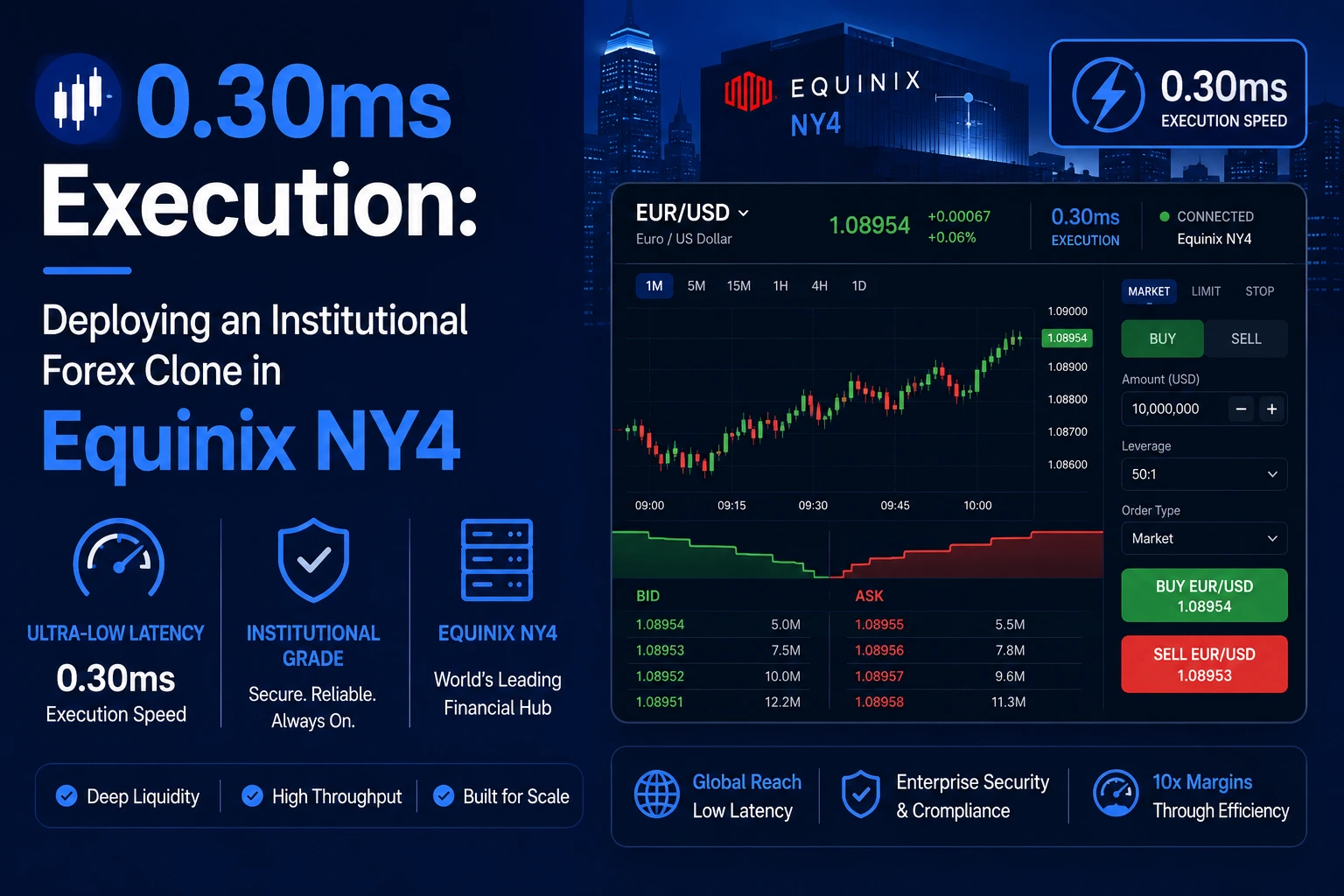
In this technical FinTech platform development deployment, Miracuves configured a white-label institutional Forex platform around a colocated execution architecture in Equinix NY4. The matching and routing stack was positioned close to the financial-services connectivity ecosystem, while direct fiber cross-connects were used for the relevant liquidity path.
The supplied production benchmark recorded 0.30 milliseconds for the defined execution segment. This figure should be published with its precise measurement methodology—such as whether it represents internal engine processing, gateway-to-liquidity-provider transmission, or an acknowledgement round trip—rather than being presented as an undefined universal speed claim.
Equinix identifies NY4 in Secaucus, New Jersey, as a facility serving major financial and enterprise companies. The site lists Cross Connects, Campus Cross Connects, Fiber Connect, Precision Time, and other interconnection services among its available capabilities.
The Millisecond Tax: Why Lagging Servers Destroy Broker Profitability
Latency is often discussed as though it were only a trader-experience metric. For a brokerage, it is also a risk and revenue variable.
When a market order reaches a broker, the system must validate it, apply account and risk checks, select a route, encode or transform the order into the required protocol, transmit it to the chosen counterparty, receive a response, update internal state, and return the execution result.
A delay at any point can increase the difference between the client-visible quote and the executable market price.
For a low-volume retail platform, that difference may initially appear insignificant. Under higher volume, volatile markets, or latency-sensitive flow, the cumulative effect can alter:
- Slippage distribution
- Fill quality
- Reject frequency
- Exposure duration
- Hedging accuracy
- Liquidity-provider relationships
- Dealing-desk risk
- Client complaints
- Brokerage margin
Why average latency is not enough
A vendor may advertise a low average while concealing unstable performance at the 95th, 99th, or 99.9th percentile.
Institutional evaluation must therefore distinguish among:
- Median latency: Typical processing time
- Tail latency: Performance during slower events
- Jitter: Variation between otherwise similar messages
- Internal processing time: Time inside the trading engine
- Wire time: Time spent traversing the network
- Round-trip time: Request-to-acknowledgement duration
- Order-to-fill time: Full commercial execution outcome
- Failover latency: Performance after a primary path becomes unavailable
A brokerage can tolerate neither misleading benchmarks nor undefined measurement boundaries. “Sub-millisecond” has little decision value unless the vendor explains exactly where timestamps were taken.
How latency arbitrage changes the risk equation
Latency arbitrage occurs when a participant identifies and exploits a timing difference between a brokerage’s price, its execution infrastructure, and the underlying market.
The arbitrageur does not need the entire platform to be slow. A repeatable delay in quote updates, order handling, or liquidity routing may be enough to create a statistical advantage.
A low-cost server build is particularly vulnerable when it combines:
- Remote hosting far from the liquidity endpoint
- Oversubscribed virtual machines
- Shared network interfaces
- Multiple public-internet carriers
- Inconsistent routing
- Uncontrolled operating-system workloads
- Slow market-data normalization
- Sequential risk checks
- Poor clock synchronization
- No latency anomaly monitoring
The result is not simply a slower application. It is a brokerage operating with an information and execution disadvantage.
The Deployment Objective: Control the Entire Order Path
The client required a white-label Forex platform capable of supporting institutional execution expectations without surrendering branding, administrative control, or source-code ownership.
The technical objective was therefore broader than reducing one benchmark number.
Miracuves structured the deployment around five control principles:
- Minimize physical distance to relevant counterparties.
- Remove avoidable public-internet hops from the execution path.
- Separate latency-sensitive services from non-critical workloads.
- Instrument every stage of the order lifecycle.
- Preserve redundant paths without allowing failover complexity to undermine normal execution.
Core platform layers
| Architecture layer | Operational responsibility | Latency relevance |
|---|---|---|
| Trader gateway | Authenticates sessions and receives orders | Must avoid blocking calls and overloaded connections |
| Pre-trade risk engine | Checks limits, margin, symbols, and account status | Must make deterministic decisions without unnecessary database round trips |
| Order-management system | Maintains order state and lifecycle | Requires in-memory processing with durable event persistence |
| Smart order router | Selects liquidity route based on configured logic | Route selection must remain predictable under peak load |
| FIX gateway | Maintains sessions with external counterparties | Session health, sequencing, encoding, and retransmission directly affect execution |
| Market-data handler | Receives and normalizes prices | Stale data creates execution and pricing risk |
| Liquidity aggregator | Consolidates executable pricing | Slow normalization can erase network-level gains |
| Audit and telemetry layer | Records timestamps and execution outcomes | Required to prove rather than merely claim performance |
| Broker administration | Controls users, risk, symbols, spreads, and routing | Must operate outside the critical execution thread |
The platform design avoided placing reporting, CRM, analytics, and administrative processes inside the synchronous order path. Those services remained available to the brokerage team but could not interrupt order processing.
Why Equinix NY4 Was Chosen for the Execution Layer
The deployment used Equinix NY4 as the relevant New York colocation environment for the execution stack.
NY4 is located in Secaucus, New Jersey, and Equinix positions it as an interconnection facility serving major financial, media, and enterprise companies. Its listed capabilities include physical cross-connect services, Fiber Connect, Metro Connect, Campus Cross Connects, and Precision Time.
For a Forex brokerage, the practical value of colocation is not the data-center brand alone. The value comes from what physical proximity and the surrounding connectivity ecosystem make possible.
Colocation reduces variables
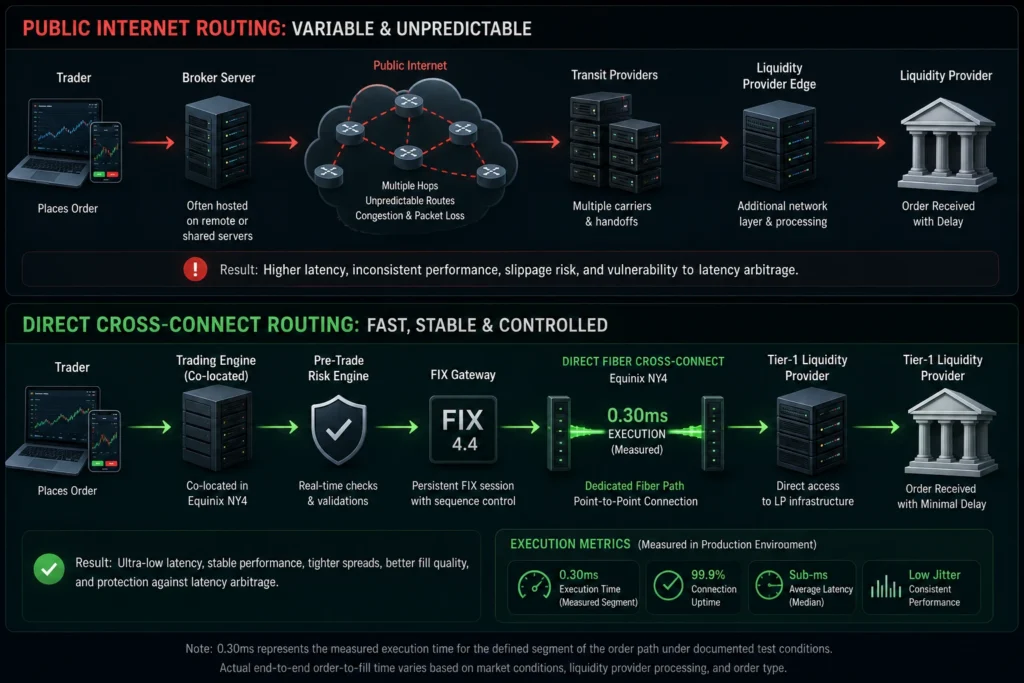
A public-cloud or commodity-hosting deployment may introduce several layers between the trading engine and its liquidity destination:
Trading Engine
   ↓
Virtual Network
   ↓
Cloud Edge
   ↓
Transit Provider
   ↓
Public Internet
   ↓
Intermediate Carrier
   ↓
Liquidity Provider Edge
   ↓
FIX Gateway
The exact route can change because of congestion, peering policy, failover behavior, or carrier decisions outside the broker’s control.
A colocated cross-connect path is structurally different:
Colocated Trading Engine
   ↓
Network Interface
   ↓
Data-Center Meet-Me Infrastructure
   ↓
Dedicated Fiber Cross-Connect
   ↓
Liquidity Provider Infrastructure
This does not make every order instantaneous, nor does it eliminate application-level processing. It reduces the number of uncontrolled network variables between the parties.
Equinix defines a cross-connect as a dedicated point-to-point cable connection used to provide high-performance, secure, low-latency access between businesses and service providers inside a data-center ecosystem.
Bypassing the Public Internet: Engineering Direct FIX API Cross-Connects
FIX connectivity is sometimes treated as a checkbox: the platform either “supports FIX” or it does not.
At an institutional level, that framing is inadequate. A production FIX connection is a stateful operational system with sequence management, session recovery, authentication, heartbeats, message validation, routing rules, retransmission behavior, and business-level rejection handling.
The direct-connect execution path
In the case-study architecture, the platform’s FIX gateway was connected through a controlled fiber path to the selected Tier-1 liquidity environment.
The execution sequence followed this structure:
- The trader submitted an order through an authenticated client session.
- The gateway normalized the request into the platform’s internal order schema.
- The pre-trade risk service checked balance, margin, exposure, symbol permissions, and configured limits.
- The order-management service created the authoritative order state.
- The routing engine selected an eligible liquidity destination.
- The FIX gateway encoded and transmitted the order over the direct connection.
- The external acknowledgement or execution report was validated against the session sequence.
- The order state was updated and propagated to the trader, broker dashboard, risk services, and audit stream.
What direct fiber changes
Direct fiber does not accelerate inefficient application code. It removes unnecessary network indirection after the platform has already been engineered correctly.
Its primary advantages are:
- Fewer routing hops
- Lower path variability
- Reduced exposure to public-network congestion
- More predictable latency
- Improved troubleshooting
- Clearer responsibility boundaries
- Better capacity planning
- Stronger separation from general web traffic
Equinix has separately documented financial-services deployments where geographic proximity and interconnected infrastructure were used to reduce FX-processing latency. It notes that market participants can use proximity to financial networks to improve trading performance, although that evidence does not validate the specific 0.30ms figure in this Miracuves deployment.
FIX session controls implemented around the connection
A low-latency connection still requires disciplined protocol handling. The design therefore accounted for:
- Persistent sessions
- Sequence-number validation
- Resend-request handling
- Duplicate-message detection
- Heartbeat and test-request monitoring
- Counterparty-specific message dictionaries
- Business-reject classification
- Session-level and application-level timestamps
- Controlled reconnect logic
- Kill-switch and routing-disable controls
- Independent primary and recovery paths
The objective was deterministic behavior. A gateway that performs quickly under ideal conditions but enters an uncontrolled recovery loop during packet loss is not institutional-grade infrastructure.
Engineering the Matching Engine for Deterministic Processing
The execution engine was designed to minimize unnecessary work inside the order-critical thread.
In-memory decision state
Frequently accessed risk and routing data was held in memory rather than fetched synchronously from a remote relational database for every order.
This included appropriate subsets of:
- Account trading permissions
- Instrument status
- Exposure limits
- Routing preferences
- Liquidity-session status
- Symbol configuration
- Markup and spread rules
- Order-type permissions
Durability remained important, but persistence was structured around an event and audit stream rather than placing slow storage operations directly in front of every outbound order.
Workload isolation
The deployment separated execution-sensitive services from:
- Reporting
- Historical analytics
- Email and notification delivery
- CRM synchronization
- Administrative exports
- User-behaviour analytics
- Document processing
- Batch reconciliation
These workloads could scale independently and could not consume the same execution-thread resources during volatility.
Connection reuse and preallocation
The platform avoided repeated connection setup during order submission. FIX sessions, internal service channels, memory buffers, and other critical resources were prepared before peak trading activity.
This reduced avoidable runtime allocation, connection negotiation, and garbage-collection pressure.
Clock discipline
Latency evidence is meaningless when clocks disagree.
The measurement layer therefore required synchronized timestamps across:
- Trader gateway
- Risk engine
- Order manager
- FIX gateway
- Network interfaces
- Observability pipeline
The architecture used high-precision time synchronization appropriate to the deployment environment, allowing engineers to reconstruct where delay entered the order lifecycle.
The 0.30ms Benchmark: Stopping Latency Arbitrage at the Hardware Level
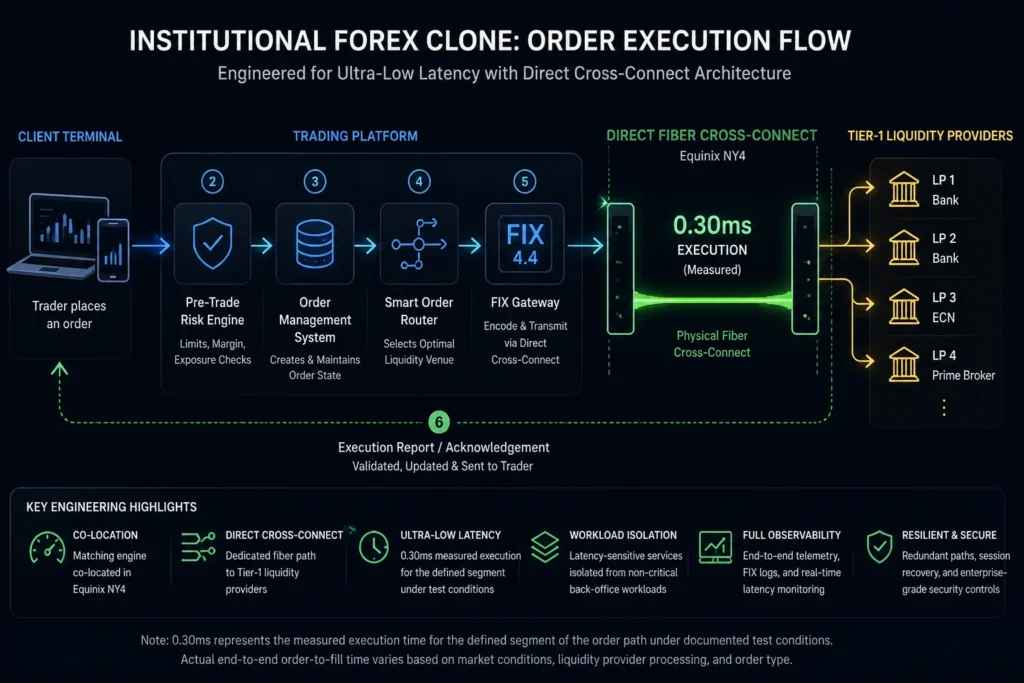
The supplied benchmark for the defined execution segment was 0.30 milliseconds.
That result should not be published as a broad “every trade executes in 0.30ms” promise. Execution outcomes vary according to message type, liquidity-provider processing, market conditions, instrument, order size, rejection behaviour, network state, and the selected measurement boundary.
The defensible case-study claim is:
During the documented production test window, the configured colocated execution path recorded 0.30ms for the specified measured segment under the stated test conditions.
Benchmark methodology required for publication
The final case study should accompany the number with the following evidence:
| Benchmark field | Required disclosure |
|---|---|
| Start timestamp | Exact component and event where measurement begins |
| End timestamp | Exact acknowledgement or processing event where it ends |
| Measurement type | One-way, round-trip, internal, or order-to-fill |
| Test sample | Number of messages included |
| Percentile | Median, p95, p99, and worst observed result |
| Message type | New order, cancel, replace, market data, or execution report |
| Order profile | Instrument, order type, and size |
| Market state | Normal, volatile, or controlled test period |
| Network path | Cross-connect and endpoint description |
| Exclusions | Liquidity processing or external components not included |
| Clock source | Time-synchronization method |
| Test date | Date and duration of benchmark window |
Without these fields, 0.30ms is marketing. With them, it becomes architecture evidence.
Why hardware proximity matters
Software optimization cannot overcome the speed-of-light cost of unnecessary physical distance. Nor can efficient code control the route selected by the public internet.
The deployment reduced that exposure by positioning the execution layer near the required connectivity and using a direct physical path for the relevant counterparty connection.
The practical goal was not to make arbitrage physically impossible in every form. That would be too absolute. The goal was to remove a major category of infrastructure delay that latency-sensitive flow could exploit.
Public-Internet Hosting Versus Colocated Cross-Connect Architecture
Execution Infrastructure Comparison
| Decision Factor | Commodity Public-Internet Build | Colocated Cross-Connect Build |
|---|---|---|
| Network path | May traverse several carriers and changing routes | Controlled physical connection to the relevant counterparty environment |
| Latency consistency | Higher exposure to congestion and route variability | More predictable under equivalent application conditions |
| Physical distance | Potentially remote from liquidity infrastructure | Execution services positioned near the connectivity ecosystem |
| Troubleshooting | Multiple external transit parties may complicate diagnosis | Clearer physical and network boundaries |
| Workload isolation | Often shared with web, analytics, and back-office services | Latency-sensitive workloads can be isolated |
| Tail latency | More difficult to stabilize | Can be controlled through proximity, tuning, and dedicated capacity |
| Cost profile | Lower initial infrastructure cost | Higher infrastructure commitment justified by execution-sensitive volume |
| Best suited for | Early validation or non-latency-sensitive operations | Brokerages where execution quality materially affects risk and margin |
Latency Was Not the Only Production Requirement
Execution speed alone does not create a viable Forex brokerage platform.
The deployed foundation also required operational controls covering users, risk, counterparties, payments, instruments, permissions, and auditability.
Broker administration
The administrative environment enabled authorized brokerage teams to manage:
- Trader accounts
- Account verification status
- Instruments and trading sessions
- Spread and markup configurations
- Exposure thresholds
- Leverage policies
- Order-routing rules
- Liquidity connections
- Deposit and withdrawal states
- Suspicious activity flags
- User and administrator permissions
- Disputes and support cases
- System and execution logs
Role-based access
Not every employee should be able to alter routing, risk, withdrawals, or platform-wide settings.
Permission-based dashboards separated responsibilities across operations, compliance, dealing, finance, support, and technical administration. Sensitive actions were designed to generate audit records.
Security and compliance workflows
The system was structured to support:
- Encrypted data transfer
- Encrypted storage for appropriate data
- Role-based access control
- Administrator activity logs
- Trader verification workflows
- Transaction monitoring
- Withdrawal controls
- Suspicious activity review
- Secure API integration
- Audit and execution records
These controls provide a compliance-ready product foundation, not automatic regulatory approval. Final obligations depend on the brokerage model, target jurisdiction, licensing status, legal review, custody arrangements, and chosen payment and liquidity partners. Miracuves’ security-language standards specifically prohibit claims of universal or guaranteed compliance.
Business Outcome: Infrastructure Became a Brokerage-Control Layer
The value of the deployment was not confined to a lower latency figure.
The brokerage gained greater control over:
- Where orders were processed
- How liquidity destinations were selected
- Which network path carried execution traffic
- How latency was measured
- How rejects and disconnects were classified
- How operational teams inspected execution quality
- How risk settings could be changed without modifying the core engine
- How new counterparties could be added within the routing model
For founders, this distinction matters.
A generic trading script gives the broker screens and workflows. An institutional platform must also give the broker control over the execution lifecycle.
Founder Decision Signals
Execution Sensitivity
If client flow is latency-sensitive or volatility materially changes fill quality, infrastructure placement becomes a commercial decision rather than a hosting detail.
Measurement Quality
Reject any speed claim that does not define start point, end point, sample size, percentile, and external processing exclusions.
Liquidity Proximity
Choose deployment locations according to the actual liquidity and market-data ecosystem, not according to generic cloud-region familiarity.
Operational Control
Ensure the brokerage can inspect routing, slippage, rejects, session health, and latency without depending on the development vendor for every investigation.
Mistakes That Turn a “Fast” Forex Platform Into an Execution Liability
Mistakes Brokerage Founders Should Avoid
Publishing an Undefined Latency Number
A single figure is not credible unless the measurement boundary, test volume, percentiles, message type, and market conditions are documented.
Optimizing the Interface While Ignoring the Execution Path
A responsive trading screen cannot compensate for slow risk checks, inefficient order routing, or an unstable liquidity connection.
Using Public-Internet Hosting for Latency-Sensitive Flow
Public routing may be adequate for many applications, but it introduces variables that become commercially significant when execution timing affects brokerage risk.
Measuring Averages Instead of Tail Latency
A platform that performs well most of the time but stalls during volatile periods can expose the brokerage precisely when risk is highest.
Ignoring Failover Performance
A secondary path that restores connectivity but multiplies latency may preserve uptime while degrading execution quality. Both availability and performance must be tested.
Allowing Back-Office Workloads Into the Critical Path
Reports, notifications, exports, and analytics should not compete with order processing for the same execution resources.
Why a White-Label Foundation Still Requires Infrastructure Engineering
White-label development is sometimes associated with surface-level customization. That interpretation is too narrow for a trading platform.
A serious white-label Forex product should provide a reusable product foundation while leaving room to configure:
- Brokerage branding
- Account structures
- Supported instruments
- Risk logic
- Spreads and markups
- Liquidity relationships
- Routing rules
- Payment integrations
- Verification workflows
- Reporting
- Administrative permissions
- Hosting and connectivity topology
The value is not that every brokerage receives an identical deployment. The value is that proven modules do not need to be rebuilt while execution-critical components can be adapted to the brokerage’s market, liquidity model, licensing structure, and performance requirements.
Miracuves’ broader solution positioning emphasizes ready-made, white-label, source-code-owned foundations with custom branding, administrative control, scalable backend architecture, and product customization.
Conclusion
The most important result of this deployment was not a visually complete Forex application.
It was a controlled execution architecture.
By colocating the relevant trading services in Equinix NY4, separating the order path from non-critical workloads, engineering persistent FIX connectivity, and using a direct fiber cross-connect for the relevant liquidity route, the platform reduced avoidable infrastructure uncertainty.
The supplied benchmark recorded 0.30ms for the defined measured segment. Its publication value depends on attaching the technical context that makes the number auditable.
For brokerage founders and FinTech CTOs, that is the real decision standard.
Do not ask whether a vendor offers a “fast Forex clone.” Ask:
- Where does the engine run?
- Where is the liquidity endpoint?
- What network path connects them?
- What exactly does the benchmark measure?
- What happens at the 99th percentile?
- How does the system behave during failover?
- Can the brokerage inspect the evidence independently?
A platform becomes institutional not when it uses the language of institutional trading, but when its white-label clone app development foundation, architecture, observability, controls, and performance evidence can survive institutional scrutiny.
Ready to engineer a faster, more controlled Forex trading infrastructure? Contact us to discuss your execution architecture, FIX connectivity, liquidity routing, and deployment requirements.
FAQs
What does 0.30ms Forex execution mean?
It means the defined section of the order-processing path completed in 0.30 milliseconds during the documented test conditions. The claim should specify whether the measurement covers internal processing, gateway transmission, a liquidity-provider acknowledgement, or another boundary. It should not automatically be interpreted as the complete trader-click-to-fill time.
Why does Equinix NY4 matter for Forex infrastructure?
Equinix NY4 is part of the Secaucus financial-services connectivity ecosystem and provides colocation and interconnection services, including physical cross-connects and fiber connectivity. For a brokerage connected to counterparties available in or near that ecosystem, colocation can reduce physical distance and uncontrolled network routing.
How does a direct fiber cross-connect reduce Forex latency?
A cross-connect creates a dedicated point-to-point physical connection between infrastructure inside a data-center environment. It can reduce public-internet hops, route variability, and congestion exposure. Application processing, liquidity-provider response time, and hardware configuration still affect total execution latency.
Can low latency completely prevent latency arbitrage?
No responsible architecture provider should make that absolute guarantee. Low and predictable latency can remove important timing weaknesses, but arbitrage exposure also depends on pricing logic, market-data speed, liquidity relationships, risk controls, markups, last-look policies, and trader behaviour.
What metrics should a brokerage monitor besides average execution speed?
A brokerage should monitor median, p95, p99, and maximum latency; jitter; rejects; requotes; disconnects; slippage by symbol and liquidity provider; FIX-session health; retransmissions; fill ratios; and failover-path performance.
Is a white-label Forex platform suitable for institutional deployment?
It can be, provided the underlying architecture supports configurable risk controls, FIX connectivity, liquidity routing, observability, workload isolation, security controls, and appropriate deployment topology. White-label branding alone is not evidence of institutional capability.
Does colocation guarantee better execution?
No. Colocation reduces distance and can improve path predictability, but poor application design, overloaded hardware, inefficient risk checks, weak market-data handling, or slow counterparties can still produce poor execution.
Is regulatory approval included with a Forex trading platform?
No. A platform can support verification, monitoring, audit, and risk-management workflows, but licensing and compliance depend on the jurisdiction, brokerage model, legal review, operating entity, counterparties, and regulatory requirements.