Key Takeaways
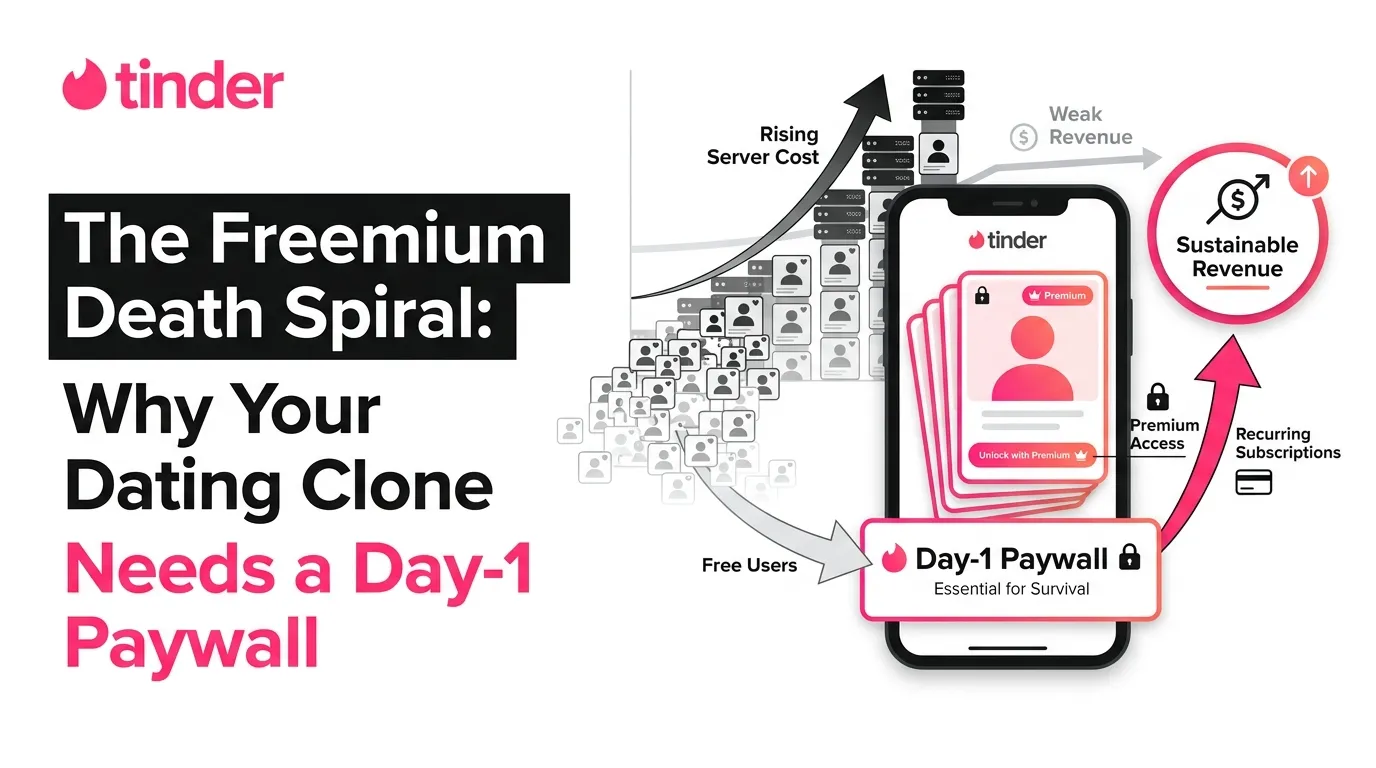
- A Day-1 paywall filters out low-intent users before they weaken a niche dating community.
- Smaller paid communities can create stronger engagement, trust, and match quality than large free user bases.
- Membership plans, secure payments, verification, cancellation controls, and access rules are core features.
- Success depends on local match availability, clear value, transparent pricing, and strong safety controls.
- A mandatory paywall can improve monetization while reducing dormant profiles and moderation costs.
Monetization Signals
- Users need clear membership benefits, visible pricing, secure checkout, renewal details, and simple cancellation.
- Founders need subscription controls, free-trial rules, pricing experiments, retention data, and revenue reporting.
- Admins need control over plans, payments, refunds, account access, verification, disputes, and analytics.
- Verification, reporting, moderation, and community standards must support the payment filter.
- Notifications keep members updated on billing, renewals, matches, messages, and account activity.
Real Insights
- Freemium can damage a niche dating app when free access attracts casual users who reduce ecosystem quality.
- Payment signals intent, but it should not replace identity verification, moderation, or safety workflows.
- A paywall works best after founders secure enough relevant matches within each launch location.
- Transparent renewal, refund, and cancellation terms protect user trust and reduce billing disputes.
- Miracuves builds dating platform apps with Day-1 paywalls, subscriptions, verification, matching, and admin workflows.
Most dating app founders are given the same advice:
Make registration free. Remove friction. Grow the user base. Build network effects. Monetize later.
That advice sounds logical because it describes how large consumer platforms often operate. Tinder, Hinge, Bumble, and other major products typically let people enter for free before selling subscriptions, visibility upgrades, advanced filters, and other premium features.
But a bootstrapped niche dating business is not a mass-market platform. Dating app platforms built for specific communities must prioritise member quality, trust, and engagement over registration volume.
You do not have unlimited acquisition capital. You cannot tolerate thousands of dormant profiles simply because they improve a registration chart. You cannot afford an ecosystem where serious members repeatedly encounter people who joined casually, swipe indiscriminately, send low-effort messages, or disappear after one session.
After nine years of building software businesses, one monetization lesson stands above most others:
The wrong free users can cost more than an empty app.
The Illusion of Scaling a Dating User Base With Free Access
Founders frequently treat registration growth as proof that their product is working.
It is not.
A registration proves that someone was willing to enter an email address, connect a social account, or download an application. It does not prove that the person values the community, intends to date, will complete a profile, or will contribute to a useful marketplace.
This distinction matters because a dating platform is not a conventional content product. Its inventory consists largely of people.
Every new member affects the experience offered to every other member. A poorly completed profile, spam account, unserious browser, inactive user, or aggressive messenger is not simply a weak conversion. That account becomes part of the product another member is paying—or being asked to pay—to access.
Free users can create false liquidity
A dating clone can display 10,000 registered accounts and still feel empty.
That happens when:
- Most profiles are incomplete.
- Members have not logged in recently.
- Messages receive no reply.
- Users are outside the active launch geography.
- People joined from curiosity rather than intent.
- The gender or interest distribution is badly imbalanced.
- Free users consume matches without investing in conversations.
- Fake, promotional, or fraudulent profiles remain visible.
The founder sees scale. The member experiences rejection, silence, and uncertainty.
Research into swipe-based dating systems also shows how platform design can concentrate attention among a smaller group of profiles, leaving others with little engagement. Adding more free accounts does not automatically distribute attention more fairly or create better outcomes.
In marketplace terms, this is false liquidity. Supply appears to exist, but it cannot produce reliable interactions.
Free acquisition can conceal a weak proposition
A founder who attracts 5,000 free users may feel successful while still knowing nothing about willingness to pay.
A founder who asks for payment on Day 1 receives harsher but more useful information:
- Is the niche painful or important enough?
- Does the positioning feel specific?
- Do members trust the brand?
- Is the community promise differentiated?
- Does the membership benefit justify the price?
- Can the founder acquire a paying user profitably?
A paywall converts vague attention into a commercial signal.
That signal may be small. It may even be uncomfortable. But it is closer to business validation than a large database of free accounts.
Read More: What is Tinder App and How Does It Work?
Why Non-Paying Users Can Destroy Ecosystem Quality
“Non-paying” does not automatically mean “bad user.” Paid users can also behave badly, and many free members genuinely want meaningful connections.
The strategic issue is incentive alignment.
When joining costs nothing and demands little effort, the platform attracts a wider range of motivations. Some people want relationships. Others want entertainment, social validation, follower growth, casual browsing, scams, promotional leads, or something to do for ten minutes.
A mass-market app may absorb that diversity. A niche community usually cannot.
Low effort becomes the visible culture
Users learn what kind of community they have joined by observing other members.
If profiles contain one blurry photograph and no meaningful details, new users lower their effort. If thoughtful messages rarely receive replies, serious members stop writing them. If everyone swipes rapidly, matching becomes a game rather than an intentional decision.
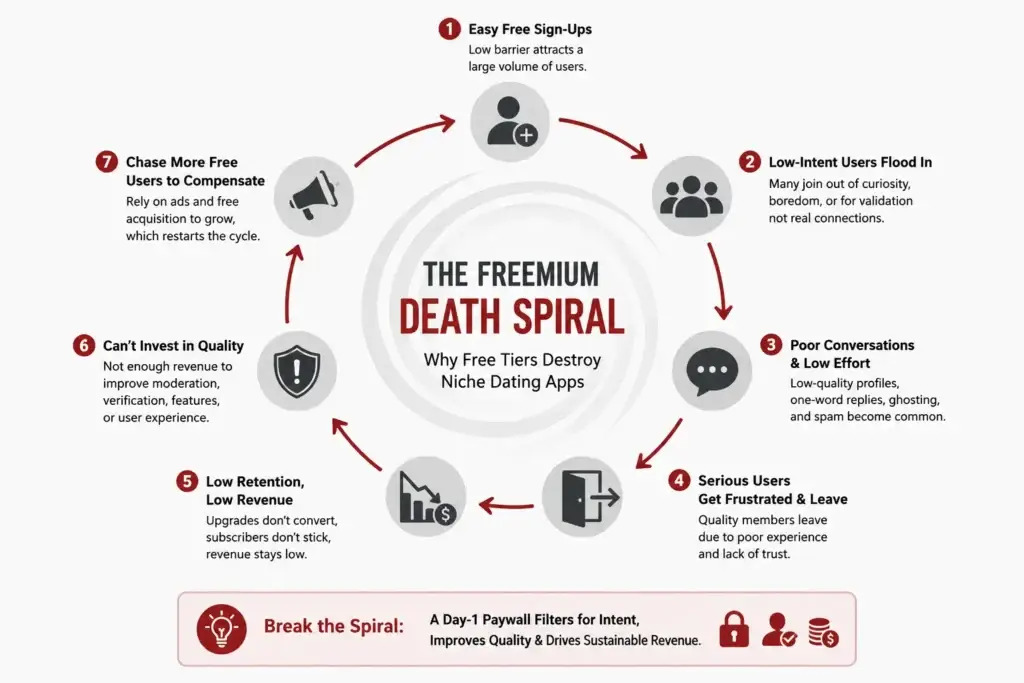
This creates the freemium death spiral:
- Free access attracts a high volume of mixed-intent users.
- Mixed-intent users lower profile and conversation quality.
- Serious users receive weaker matches and fewer meaningful replies.
- Serious users leave or refuse to upgrade.
- Revenue remains too low to support verification and moderation.
- Community quality declines further.
- The founder responds by chasing even more free registrations.
The app becomes busier on paper and less valuable in practice.
Serious members bear the cost
Imagine a dating platform for divorced professionals, single parents, faith-based relationships, people over 50, or members of a tightly defined cultural community.
The target user is not merely purchasing swipe functionality. They are purchasing access to a credible pool of people who share an intention or qualification.
When low-effort accounts flood that pool, serious members absorb the cost through:
- Time wasted reviewing irrelevant profiles.
- Emotional fatigue from unanswered conversations.
- Lower confidence that members are genuine.
- Greater exposure to spam or inappropriate behaviour.
- Reduced willingness to recommend the platform.
- Reduced willingness to renew.
The platform may not charge those users financially, but it charges them in attention and trust.
Moderation costs rise before revenue does
Free communities still require:
- Profile review.
- Identity or face-verification workflows.
- Abuse reporting.
- Image and message moderation.
- Spam detection.
- Account suspension controls.
- Block and report tools.
- Dispute handling.
- Customer support.
- Payment and refund support for premium members.
Dating fraud is not a theoretical product risk. Academic research has documented fraudulent dating applications using fake accounts and automated conversations to push users toward paid services. That history makes transparent monetization and authentic profiles especially important for any new dating brand.
A founder who postpones monetization does not postpone these obligations. The founder merely accepts the costs without establishing a reliable way to fund them.
Read More: Tinder App Marketing Strategy
The Economics of the Mandatory Day-1 Paywall
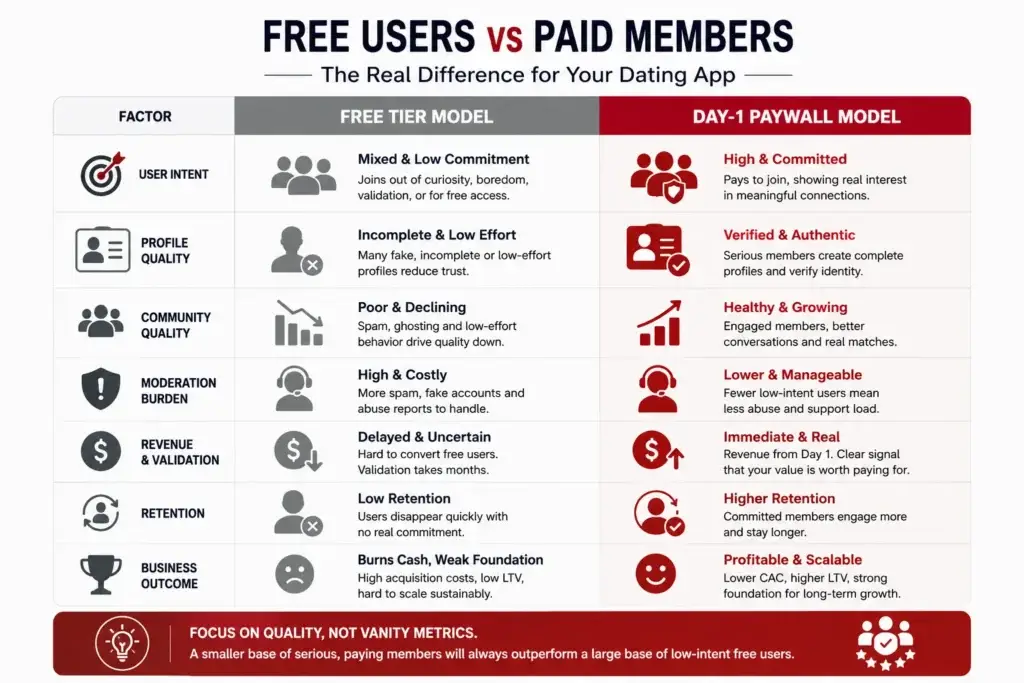
A mandatory paywall changes the central business question.
Freemium asks:
How many people can we bring inside?
A Day-1 subscription asks:
How many qualified people value this community enough to join?
That second question produces a smaller top-of-funnel number. It can also produce a stronger operating foundation.
Payment is a commitment signal
An upfront fee creates friction. In many consumer products, friction is treated as an enemy.
In a niche dating community, carefully chosen friction can be a filter.
Someone willing to pay is more likely—though never guaranteed—to:
- Complete a detailed profile.
- Return to the platform.
- Read the community rules.
- Invest effort in messages.
- Evaluate matches intentionally.
- Expect accountability from other members.
- Report bad behaviour rather than silently abandon the app.
The payment should not be treated as a substitute for verification or moderation. It should be one part of a trust system.
Revenue appears before infrastructure costs accelerate
Consider two simplified launch models.
| Metric | Free-First Model | Day-1 Paywall Model |
|---|---|---|
| Registered users | 5,000 | 400 |
| Paying users | 150 | 400 |
| Example monthly membership | $20 | $20 |
| Monthly subscription revenue | $3,000 | $8,000 |
| Paying-user share | 3% | 100% |
| Community size | Larger | Smaller |
| Intent signal | Mixed | Stronger |
| Moderation burden | Potentially high | More contained |
| Commercial validation | Delayed | Immediate |
These figures are illustrative, not forecasts. Actual conversion, churn, acquisition cost, taxes, payment fees, refunds, and engagement will vary by market.
The point is that a smaller paid community can create more operating room than a much larger free audience.
The founder can calculate acquisition economics earlier
With a mandatory subscription, the founder can track:
- Cost per paying member.
- Trial-to-paid conversion, when a trial exists.
- Monthly recurring revenue.
- Refund rate.
- First-month churn.
- Cohort retention.
- Profile completion.
- Matches per active member.
- Conversations per match.
- Report rate.
- Renewal by acquisition channel.
This replaces vanity growth with business-model clarity.
A free model can also track many of these metrics, but its acquisition dashboard is easily dominated by registrations, downloads, and daily active users that may not correlate with revenue or match quality.
Read More: Tinder App Features Explained
A Paywall Does Not Give You Permission to Hide the Product
A hard paywall implemented badly feels like a demand for blind trust.
The user reaches the app, sees a subscription screen, and is asked to pay before understanding who the community serves, whether active members exist nearby, or what makes the experience different.
That is not premium positioning. It is an information deficit.
Before payment, prospective members should understand:
- The target community.
- Eligibility or membership criteria.
- Supported locations.
- The moderation standard.
- What verification is required.
- What membership includes.
- Whether messaging, matching, events, or concierge support are included.
- Billing frequency.
- Cancellation and refund terms.
- How personal data and profile visibility are handled.
The goal is not to trick the user past a paywall. It is to make the value proposition clear enough that the right user chooses it deliberately.
Consumer criticism of increasingly aggressive dating-app paywalls shows the risk of gating ordinary functionality, creating artificial scarcity, or selling repeated visibility upgrades without adequate transparency.
A founder should therefore distinguish between two models:
Commitment paywall: One transparent membership buys access to a curated community and its core experience.
Extraction paywall: Users pay repeatedly to undo intentionally frustrating product restrictions.
The first can build trust. The second may generate purchases while damaging the brand.
Read More: How the World’s Top Dating App Makes Money
When a Day-1 Paywall Is the Stronger Choice
A mandatory subscription is most defensible when the platform has a clear reason to exist beyond “another place to swipe.”
Strong use cases include:
- Profession-specific dating.
- Faith or values-based communities.
- Mature dating communities.
- Invitation-only or application-based memberships.
- High-touch matchmaking.
- Dating combined with curated offline events.
- Privacy-sensitive professional communities.
- Regionally constrained communities with strong offline identity.
- Platforms that include identity checks or manual profile review.
A selective platform such as Raya demonstrates that some users will accept paid, restricted access when exclusivity and community identity are central to the proposition. Its model is not directly transferable to every founder, but it illustrates that maximum accessibility is not the only route to dating-product demand.
When freemium may still be appropriate
A free entry model may remain stronger when:
- Rapid local density is essential.
- The audience has low willingness to pay.
- The platform is broad rather than niche.
- Advertising is a credible long-term revenue source.
- The founder has significant capital to subsidize growth.
- Users need to experience matching before perceiving value.
- A two-sided launch imbalance requires one segment to enter free.
- The product has a strong premium upgrade path that does not degrade free members’ experience.
The mistake is not choosing freemium.
The mistake is choosing it automatically.
Founder Decision Signals
Niche Strength
A paywall becomes more credible when members share a specific identity, intention, qualification, or relationship goal.
Liquidity
Confirm that enough suitable members can be recruited within the same geography or matching pool before restricting access.
Trust Cost
Calculate what verification, moderation, customer support, and abuse management will cost before assuming free growth is inexpensive.
Value Clarity
Do not ask for payment until the membership promise, inclusions, billing terms, and community standards are unmistakably clear.
How to Test a Mandatory Paywall Without Guessing
The paywall should be validated as carefully as the matching experience.
1. Interview the narrowest viable audience
Do not ask, “Would you use a better dating app?”
Ask:
- What frustrates you about existing platforms?
- Have you previously paid for a dating service?
- What would make a community worth paying for?
- Which members should not be admitted?
- Would verification make you more willing to join?
- What price would feel suspiciously low?
- What outcome would cause you to cancel?
2. Pre-sell founding memberships
Create a clear landing page describing:
- Who the platform serves.
- How members are screened.
- Where it will launch.
- What founding members receive.
- The initial membership price.
- The expected launch process.
- Refund conditions if minimum membership density is not reached.
Pre-selling tests more than interest. It tests willingness to trust the proposition with money.
3. Launch one controlled market
A dating marketplace needs local or segment-specific density. Launching across 20 cities with a few members in each can make the entire platform feel inactive.
A stronger approach is to concentrate:
- One city.
- One profession.
- One faith community.
- One age band.
- One relationship objective.
- One event-led community.
4. Track quality-adjusted growth
Do not stop at paid registrations.
Track:
| Metric | What It Reveals |
|---|---|
| Verified profile rate | Whether members accept the trust requirements |
| Profile completion rate | Whether payment translates into effort |
| Active matches per member | Whether the pool creates realistic opportunities |
| Conversation response rate | Whether matches produce engagement |
| Report and block rate | Whether community quality is holding |
| First renewal rate | Whether members perceive continuing value |
| Refund rate | Whether acquisition promises match the experience |
| Geographic match availability | Whether the network is sufficiently dense |
5. Preserve pricing flexibility in the admin layer
A founder should be able to configure:
- Monthly and annual plans.
- Introductory offers.
- Founding-member pricing.
- Trials or paid application fees.
- Coupons.
- Referral credits.
- Location-specific pricing.
- Feature access by plan.
- Cancellation rules.
- Grace periods.
- Revenue and renewal reports.
Hardcoding a paid business model does not mean hardcoding one permanent price.
Read More: Business Model of Tinder
What Miracuves Means by “Hardcoding the Paywall”
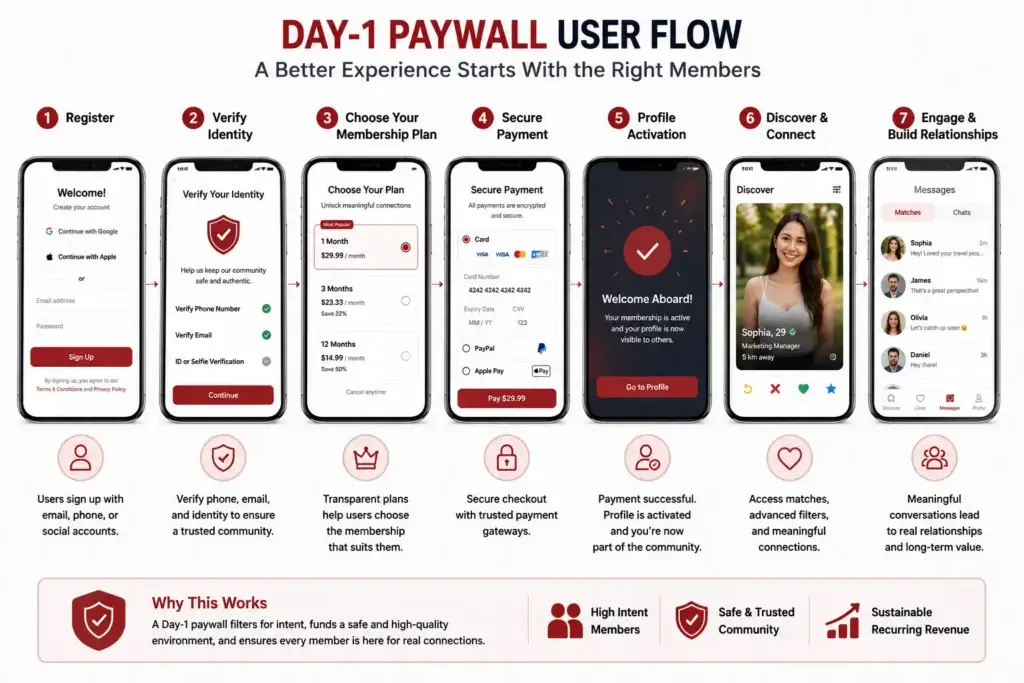
The recommendation is not to make the payment screen impossible to change.
It is to make paid membership part of the product architecture from the beginning rather than an afterthought added once the community has learned to expect everything for free.
Within a white-label Tinder clone app, the paid journey can be designed around:
- Registration.
- Eligibility or profile application.
- Email, phone, or identity verification.
- Community standards acceptance.
- Plan selection.
- Secure payment.
- Profile activation.
- Matching and messaging access.
- Renewal, cancellation, and account controls.
The admin dashboard should then connect membership status with profile visibility, matching access, moderation actions, refund history, and cohort analytics.
Miracuves’ dating solution already supports premium memberships, subscriptions, in-app purchases, administrative revenue controls, profile management, content moderation, and source-code delivery. The product page currently positions the ready-made solution with a six-day deployment route, subject to the selected scope and customization.
For founders who need a broader custom engagement model, Miracuves also provides clone app development services and a dedicated dating app development capability.
Mistakes Dating App Founders Should Avoid
Charging Before Creating Local Match Availability
A premium promise collapses when paying members see no realistic matches. Recruit a credible initial cohort within the same geography, community, or matching pool before opening broad acquisition.
Using Payment as the Only Safety Filter
Bad actors can still pay. Combine membership fees with identity verification, abuse reporting, moderation workflows, role-based access controls, and clearly visible community standards.
Copying Mass-Market Subscription Features
A niche user may not value unlimited swipes or profile boosts. They may care more about verified members, curated introductions, compatibility insights, privacy controls, or community-led events.
Hiding Renewal and Cancellation Terms
Unexpected billing damages trust quickly. Display the membership price, billing frequency, renewal terms, cancellation process, and refund rules before the user completes payment.
Optimizing Only for Revenue
A paid dating community still fails when members cannot find credible matches. Analyse subscription revenue alongside retention, profile completion, conversation quality, safety signals, renewal rates, and member outcomes.
Final Thoughts: Build a Valuable Community, Not a Large Database
Freemium is not inherently broken. It is simply dangerous when a niche founder adopts it without considering what free access does to incentives, trust, moderation costs, and community composition.
The hard truth is that a dating app with 500 committed members may be a stronger business than one with 50,000 indifferent registrations. This is especially true for Tinder-like dating platforms, where rapid sign-ups can create the appearance of growth without producing meaningful conversations, genuine connections, or sustainable revenue.
A Day-1 paywall forces the founder to confront the most important questions early:
Is the niche specific enough? Is the promise credible? Are the members serious? Is the experience worth paying for? Can the business fund the safeguards required to protect the community?
That is why the paywall is more than a payment mechanism.
For the right dating clone, it is the first layer of product positioning, community design, and market validation. Let’s Grow Together
FAQs
Should a new dating app have a free tier?
Not automatically. A free tier can help a broad platform build density, but it may attract mixed-intent users and delay revenue validation. Niche founders should compare the value of faster registration growth against moderation costs, community quality, and willingness to pay.
What is a Day-1 paywall in a dating app?
A Day-1 paywall requires a member to purchase a subscription or membership before accessing core matching and communication features. The user should still receive clear information about the community, pricing, benefits, billing, cancellation, and privacy before paying.
Will charging users improve dating-app quality?
Payment can increase commitment, but it does not guarantee good behaviour or successful matches. A paid platform still needs profile standards, identity checks where appropriate, moderation, reporting, balanced member acquisition, and sufficient local liquidity.
Can a niche dating app be profitable with fewer members?
Potentially. A smaller group of paying, retained members may produce stronger unit economics than a large free audience. Profitability still depends on acquisition cost, churn, payment fees, infrastructure, support, refunds, moderation, and operating expenses.
What should a paid dating membership include?
The core membership might include profile activation, matching, messaging, advanced preferences, privacy controls, verification, community events, or curated introductions. The benefits should reflect the niche rather than copying generic swipe-app upgrades.
How should founders price a paid dating app?
Pricing should be tested against audience income, urgency, geographic market, level of curation, verification costs, and membership benefits. Founding-member plans and controlled pricing experiments can reveal willingness to pay without permanently committing to one price.
Is a mandatory subscription better than in-app purchases?
A subscription creates recurring revenue and a clear membership relationship. In-app purchases can supplement revenue through boosts, gifts, or events, but they can also make the product feel transactional. The right model depends on the community promise and member expectations.
Can Miracuves build the paywall into a Tinder clone?
Miracuves can configure subscription access, premium membership flows, payment integrations, administrative revenue controls, and related dating-platform functionality according to the final scope. The exact implementation should be confirmed during product planning.
Miracuves is an independent software development company. We are not affiliated with, connected to, sponsored by, or endorsed by any company or product named in this article.
Terms such as “X Clone” are used descriptively. It is how the software industry refers to building a platform with functionality comparable to a known service, and how clients search for it.
The entire design and codebase of our products is built by our own team. Our products contain no code, design, graphics, or content originating from any third-party website or applications.
All third-party names and marks referenced in this article are the property of their respective owners, referenced solely to identify the services discussed.