


Key Takeaways
- A compliance-first alcohol delivery app must verify customer age before completing restricted orders.
- The deployment processed 10,000 alcohol orders while maintaining a 94% checkout completion rate.
- Biometric checks, document verification, consent capture, and audit records are core compliance layers.
- Age verification must balance legal protection with a fast and simple checkout experience.
- A structured verification gateway can reduce compliance risk without creating excessive customer drop-off.
Compliance Signals
- Customers need clear consent, guided document capture, biometric verification, and fast approval feedback.
- Delivery partners need verified handoff steps, recipient confirmation, and restricted-order instructions.
- Admins need control over failed checks, manual reviews, compliance records, disputes, and verification reports.
- Verification providers must support secure data handling, liveness checks, retry logic, and accurate age decisions.
- Real-time alerts help identify failed verification, identity mismatches, repeated attempts, and risky orders.
Real Insights
- Age verification should be measured at each checkout stage instead of relying on one overall abandonment rate.
- Poor capture instructions or slow verification responses can reduce legitimate customer completion.
- Consent logs, verification outcomes, timestamps, and delivery records create stronger compliance evidence.
- The case study reported zero underage-sale incidents during the measured deployment period.
- Miracuves builds alcohol delivery apps with biometric age verification, secure checkout, delivery controls, and admin workflows.
Alcohol delivery looks simple from the outside.
A customer opens an app, browses wine, beer, or spirits, selects a store, pays online, and waits for delivery. To a generic software vendor, this may look almost identical to food delivery. Replace restaurants with liquor stores, add age verification, change the product catalogue, and the app appears ready.
That is exactly where the risk begins.
Alcohol delivery is not standard hyperlocal delivery. It is restricted commerce. The transaction is controlled not only by inventory, driver availability, and store hours, but also by local alcohol sales laws, delivery permissions, age verification, municipal boundaries, and license-specific operating conditions.
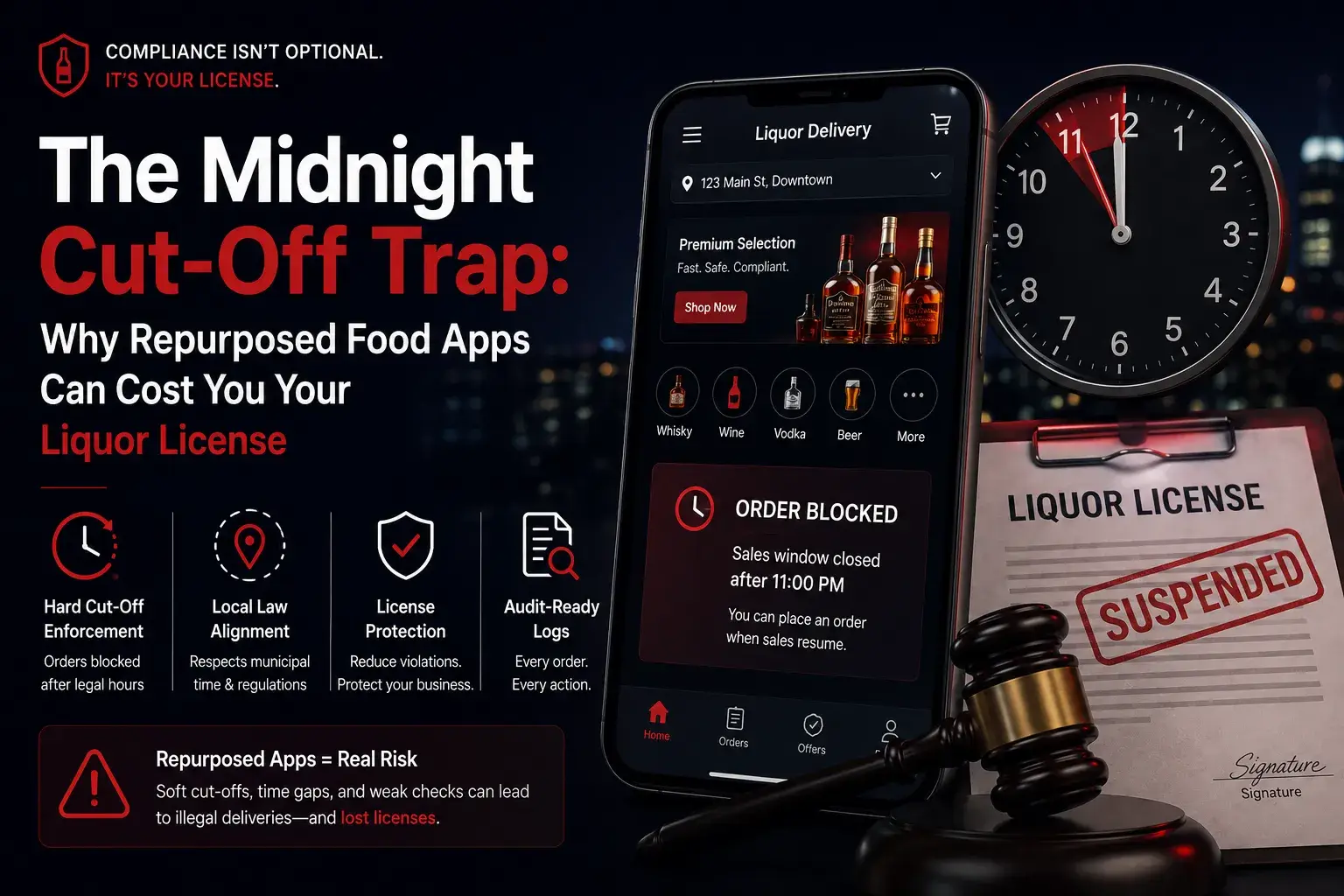
The most dangerous failure is often invisible during demos. It appears at the edge of the legal sales window.
A customer places an order at 11:59 PM. The app accepts payment. The store receives the order. The driver is assigned at 12:01 AM. The order may look normal in the dashboard, but legally it can become a serious after-hours alcohol dispatch problem depending on the location and license rules.
That is the midnight cut-off trap.
For founders, retail aggregators, and investors, the question is no longer, “Can we launch an alcohol delivery app quickly?” The better question is, “Can our platform stop illegal restricted transactions before they enter the order pipeline?”
Miracuves approaches alcohol delivery app development with this compliance-first mindset. A liquor delivery platform must be built around hard transaction controls, not soft store-closing logic.
The Soft-Close Danger in Generic Delivery Scripts
Most generic delivery scripts were built for food, grocery, parcels, or local convenience commerce. In those categories, store availability usually works as a business rule. A restaurant closes at 11:00 PM, so the app hides the restaurant or stops showing menu items.
That logic is acceptable when the consequence is a delayed burger.
It is not acceptable when the product is alcohol.
A food delivery script often treats closing time as a soft availability setting. The store owner can extend hours, the admin can override availability, the customer may still have products in the cart, and the payment gateway may process the transaction before the backend fully validates the legal window.
In restricted commerce, that is not enough.
An alcohol delivery app must answer harder questions:
- Was the order placed during legally allowed alcohol sales hours?
- Was payment captured before or after the cut-off?
- Was the store legally allowed to accept the order at that exact time?
- Was dispatch initiated inside or outside the allowed delivery window?
- Which local time zone and municipal rule applied?
- Was the decision recorded in an audit log?
A generic app may only check whether the store is open. A compliance-ready liquor delivery app checks whether the transaction is legally allowed at the server level.
That distinction matters because alcohol sales hours are not universal. In New York City, for example, NYC311 states that off-premises liquor and wine sales are prohibited between midnight and 8 AM, with different Sunday restrictions. New York State also notes that many counties further restrict alcohol sales hours beyond state-level rules. California’s Department of Alcoholic Beverage Control says retail alcohol sales are lawful from 6 AM to 2 AM, and unlawful between 2 AM and 6 AM.
A single “store close time” field cannot safely handle that complexity.
Read More: What Is Nestor Liquor App and How Does It Work?
The Legal Reality of After-Hours Alcohol Dispatch
Alcohol regulation does not treat time casually.
In many markets, the legal issue is not only whether the customer clicked “place order.” It can also involve whether the alcohol was sold, delivered, given, or dispatched during restricted hours.
California’s ABC guidance is a clear example. The California retail hours rule states that licensees, agents, or employees who sell, give, or deliver alcoholic beverages during prohibited hours can be guilty of a misdemeanor.
That language is important for app founders because it shows why the order lifecycle matters.
A platform cannot only validate the cart at browsing time. It needs controls across the full restricted-commerce chain:
- Product visibility
- Cart validation
- Checkout validation
- Payment authorization
- Store acceptance
- Driver assignment
- Dispatch release
- Delivery completion
- Audit logging
The midnight cut-off trap usually happens when these steps are not treated as one controlled transaction.
A customer may add a bottle to the cart at 11:45 PM. The cart still exists at 11:59 PM. Payment begins before midnight but confirms after midnight. Store acceptance happens at 12:01 AM. Dispatch happens at 12:04 AM.
A standard food delivery app may consider that a successful order.
A restricted-commerce app should treat it as a blocked transaction if the configured local rule says the sale or delivery cannot continue after the cut-off.
This is where founders need to understand the difference between business convenience and legal defensibility. A liquor delivery platform must be able to prove why an order was accepted, rejected, delayed, or blocked at a specific time.
Read More: Business Model of Nestor Liquor : Complete Strategy Breakdown 2026
The Midnight Cut-Off Liability Variable
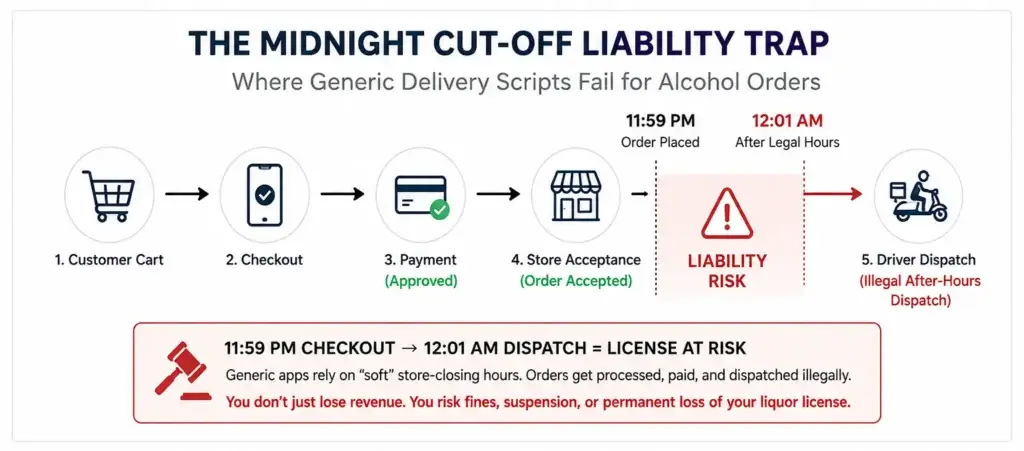
The “Midnight Cut-Off Liability” variable is the hidden risk created when a delivery system uses flexible store-hour logic for legally restricted goods.
It appears when four conditions overlap:
First, the app allows customers to browse or checkout close to the legal cut-off.
Second, the platform relies on front-end availability, store status, or admin settings instead of server-side legal validation.
Third, the transaction pipeline continues asynchronously after the customer taps “order.”
Fourth, payment, store acceptance, or dispatch occurs outside the allowed alcohol sales window.
This is not a theoretical edge case. It is exactly the kind of operational gap that appears under real marketplace pressure: weekend spikes, late-night demand, delayed payment confirmation, driver shortage, store staff delays, daylight saving time changes, and multi-city expansion.
The issue becomes worse when founders launch across multiple cities. One city may allow sales until midnight. Another may allow sales until 2 AM. A county may have stricter Sunday rules. A licensee may have its own operating conditions.
A generic script usually asks: “Is the store open?”
A restricted-commerce platform must ask: “Is this exact alcohol transaction legally allowed for this store, this product, this customer location, this local time, this delivery method, and this license rule?”
That is the standard investors should expect before backing a liquor delivery marketplace.
Read More: Best Nestor Liquor Clone Scripts 2026: Launch Your Online Liquor Store Fast
Why Front-End Blocking Is Not Enough
Some vendors solve alcohol availability by hiding products from the customer app after closing time.
That helps user experience, but it is not real protection.
Front-end controls can fail for several reasons:
- The customer already has alcohol products in the cart.
- The mobile app cache still shows available inventory.
- The user begins checkout before the cut-off and completes payment after it.
- The store manually accepts an order from an older dashboard session.
- The payment gateway webhook confirms after the legal window closes.
- The driver assignment service runs asynchronously after cut-off.
- A timezone mismatch causes the system to use server time instead of municipal time.
A regulated alcohol delivery app should not trust the front end as the final authority.
The backend must be the enforcement layer.
That means the server must re-check the legal time window before every critical state change. Browsing may be allowed in some business models, but checkout, payment capture, store acceptance, dispatch, and delivery release should be controlled according to configured rules.
In practical terms, the app should not simply say:
“The store closes at midnight.”
It should enforce:
“No alcohol order from this store can move from cart to paid order after the configured legal cut-off for this jurisdiction and license condition.”
That is a very different engineering standard.
Read More: How Nestor Liquor Makes Money in 2026
Hardcoding Atomic Time-Locks: The Miracuves Standard for Restricted Commerce
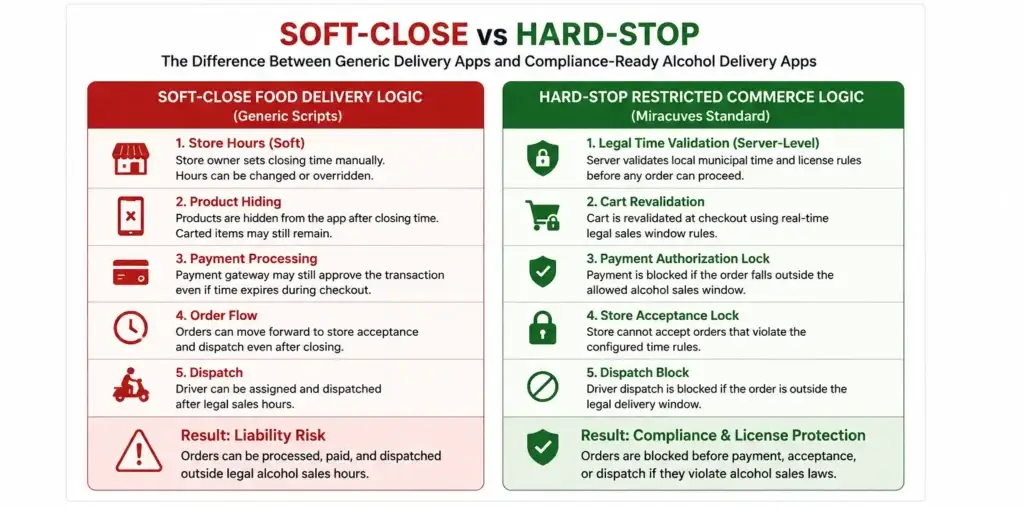
For restricted commerce, Miracuves recommends server-level atomic transaction locks.
An atomic transaction lock means the system treats a restricted order decision as one controlled backend event. The app does not allow one service to approve payment while another service later discovers the order is illegal. The legal-window validation happens at the transaction boundary before the order proceeds.
In simple terms:
The system checks the local rule.
The system checks the store license configuration.
The system checks the current municipal time.
The system checks the product category.
The system checks the delivery location.
Only then does the order move forward.
If the order fails the rule, the system blocks it before payment capture, dispatch release, or store acceptance.
This is the difference between “soft-close” and “hard-stop.”
Soft-close logic
Soft-close logic is common in food delivery scripts. It usually depends on a store availability field, product visibility, or admin toggle.
It is flexible, but flexibility can become liability in restricted commerce.
Hard-stop logic
Hard-stop logic is enforced on the backend. It does not depend only on the customer app, store dashboard, or driver app. It blocks restricted transaction movement at the source.
For alcohol delivery, hard-stop logic should include:
- Server-side alcohol sales window validation
- Local time zone and municipal rule mapping
- Store-license operating-hour configuration
- Category-level restriction rules
- Payment authorization blocking
- Store acceptance blocking
- Dispatch release blocking
- Admin override restrictions
- Audit logs for accepted and blocked orders
- Alerting for attempted after-hours transactions
Miracuves uses this standard because alcohol delivery platforms need more than speed. They need a product foundation that supports operational control.
Read More: Launch Your Online Liquor Store Fast
Where Repurposed Food Delivery Code Usually Breaks
Repurposed food delivery apps tend to fail because they were not designed for restricted products.
Here is the practical breakdown.
| Failure Area | Food Delivery Logic | Alcohol Delivery Requirement |
|---|---|---|
| Store hours | Store owner sets open/close time | Server validates legal sales window by jurisdiction |
| Product availability | Menu items hidden after closing | Restricted goods blocked at transaction level |
| Cart | Cart can persist across sessions | Cart must be revalidated before checkout |
| Payment | Payment can process if item is available | Payment must be blocked if legal window expires |
| Dispatch | Driver assignment follows order acceptance | Dispatch must respect alcohol delivery rules |
| Admin override | Admin can reopen store manually | Admin override should not bypass configured legal rules |
| Logs | Standard order history | Audit trail for blocked and approved restricted orders |
A normal delivery platform is built to maximize order completion.
An alcohol delivery platform must balance conversion with legal boundaries.
For founders, this is the central product decision. Do you want a checkout engine that pushes every order forward, or a restricted-commerce engine that knows when to stop?
Founder Decision Signals
Founder Decision Signals
Speed
A ready-made liquor delivery foundation can support faster launch, but only if restricted-commerce controls are already part of the backend logic.
Risk
If the platform accepts alcohol orders outside configured legal windows, the risk is not just technical failure. It can become licensing, investor, and retail partner risk.
Scalability
Multi-city expansion requires local rule mapping. One generic store-hours module cannot safely scale across municipalities with different alcohol sales windows.
Trust
Retail partners and investors need confidence that the platform can block restricted orders before payment, acceptance, or dispatch.
What a Compliance-Ready Alcohol Delivery App Should Include
A serious alcohol delivery app should be designed around restricted-commerce workflows from day one.
The core modules should include:
Customer app
The customer app should support browsing, product discovery, cart, checkout, delivery tracking, order history, and identity verification prompts. But for alcohol, the customer experience must also include clear availability messaging when orders are blocked by time, zone, or eligibility rules.
Retailer or store dashboard
Retailers should manage inventory, product categories, pricing, operating hours, and order acceptance. However, they should not be able to override legally configured cut-off rules casually. Store-level flexibility must sit below compliance-level enforcement.
Driver app
The driver app should support pickup, route tracking, delivery proof, age-check prompts, failed delivery reporting, and restricted-order instructions. For alcohol, the delivery workflow should also support recipient verification, refusal handling, and return workflows where legally required.
Admin dashboard
The admin panel is the control center. It should manage users, stores, drivers, products, commissions, delivery zones, restricted categories, time-window rules, blocked orders, disputes, and reporting.
For a liquor delivery marketplace, admin control is not just convenience. It is risk management.
Compliance rule engine
This is the layer many generic scripts miss.
The compliance rule engine should support:
- Local alcohol sales hours
- Store license conditions
- Restricted delivery zones
- Product category restrictions
- Age verification workflows
- Time-zone handling
- Dispatch eligibility
- Blocked order logs
- Manual review queues
- Admin permission controls
Miracuves helps founders build alcohol delivery platforms with these restricted-commerce layers instead of simply repurposing food delivery logic.
Read More: White-Label Nestor Liquor App Security: Risks, Compliance & Safety in 2026
Why Municipal Time Matters More Than Server Time
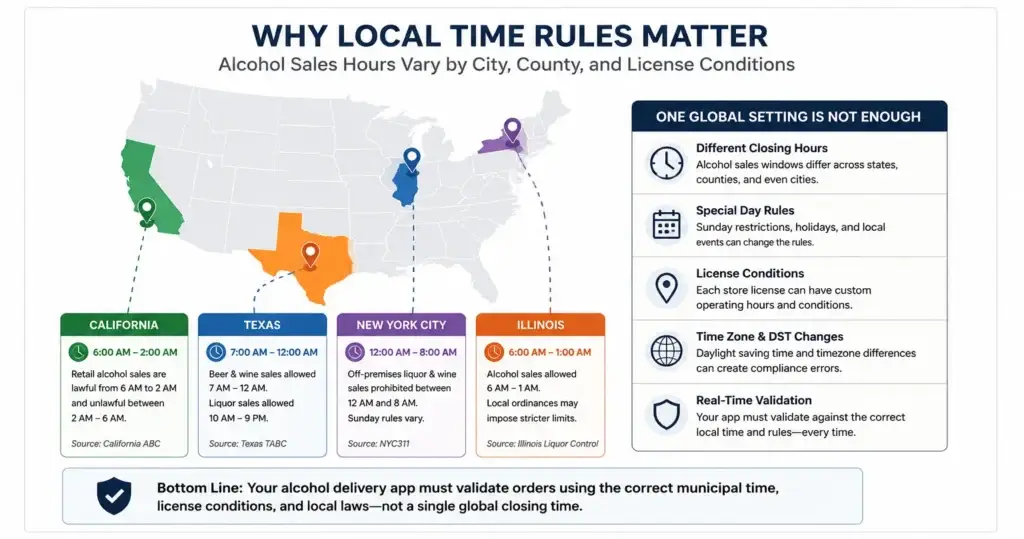
One of the most overlooked technical issues in alcohol delivery app development is time authority.
Many low-cost scripts use server time. That may work when every store operates in one region. It becomes risky when the business expands across cities, counties, states, or countries.
Alcohol sales rules are local. The system should evaluate the transaction based on the relevant municipal or licensed-store time, not only the cloud server’s default timezone.
This matters in cases such as:
- Stores operating across multiple cities
- Customers ordering from border areas
- Daylight saving time transitions
- Different Sunday sales rules
- Marketplace expansion across states
- Admin teams operating from another timezone
- Payment gateways returning delayed confirmations
California’s ABC even gives specific treatment to time-change days in its retail hours statute, showing why time logic cannot be treated casually in alcohol transactions.
A compliance-ready alcohol delivery app should therefore separate:
- server infrastructure time
- store local time
- customer delivery-zone time
- municipal rule time
- payment confirmation time
- dispatch event time
When these are not clearly handled, a founder can end up with order records that look technically valid but legally questionable.
The Investor View: Why This Risk Affects Valuation
Angel investors and early-stage funds do not only evaluate product screens. They evaluate risk.
A liquor delivery app built on generic food delivery code may look attractive during a demo. It may have product listings, cart, delivery tracking, admin management, and payment integration. But if the backend cannot prove restricted-order control, the company carries hidden operational debt.
That risk can affect:
- Retailer onboarding
- License-holder confidence
- Insurance conversations
- Due diligence
- State or municipal expansion
- Payment processor reviews
- Brand partnerships
- Acquisition readiness
The alcohol delivery category has already shown how complex the market can be. Uber acquired Drizly for $1.1 billion in 2021 and later shut it down as a standalone app to focus on alcohol within Uber Eats. That does not mean the category lacks opportunity. It means alcohol delivery infrastructure must be treated as a serious operating system, not a casual add-on.
For investors, the strongest question is simple:
“Show us how the system blocks an illegal alcohol order before payment, store acceptance, and dispatch.”
If the founder cannot answer that clearly, the product is not ready for regulated commerce.
Mistakes Founders Should Avoid
Mistakes Founders Should Avoid
Using food delivery store hours as alcohol compliance logic
Food delivery hours are usually business preferences. Alcohol sales windows can be legal boundaries. Treating both the same creates unnecessary risk.
Allowing payment before final restricted-order validation
If payment succeeds before the server confirms the legal sales window, the platform may create refund, dispute, and compliance problems.
Relying only on front-end product hiding
Front-end controls improve user experience, but backend enforcement must decide whether the order can legally proceed.
Ignoring local time-zone and municipal rule mapping
Alcohol rules vary by location. A single global cut-off setting is not enough for multi-city or multi-state operations.
The Miracuves Perspective: Build Restricted Commerce First
The wrong way to build an alcohol delivery app is to start with a food delivery script and patch compliance later.
The better approach is to start with restricted-commerce assumptions:
- Some products cannot always be sold.
- Some customers cannot receive orders.
- Some locations cannot be served.
- Some hours cannot be overridden.
- Some failed deliveries must be logged.
- Some actions need proof and audit trails.
- Some admin controls must be permission-based.
That changes the architecture.
Miracuves builds liquor delivery app solutions around admin control, source-code ownership, white-label branding, and compliance-ready workflows. For founders who want a faster path, a ready-made foundation can reduce launch time because core ordering, delivery, retailer, driver, and admin modules do not need to be built from zero.
But the real value is not speed alone.
The real value is having a product foundation that understands the difference between normal delivery and restricted alcohol commerce.
Founders planning a liquor marketplace can also review Miracuves’ dedicated ready-made liquor delivery app page, alcohol delivery app guides, and Drizly-style app resources to connect this risk-focused article with broader launch planning. Miracuves has a liquor delivery app category page and Drizly-style alcohol delivery resources available on its site.
Final Thoughts: Alcohol Delivery Is a Compliance Product Before It Is a Convenience Product
Food delivery optimizes for speed, convenience, and order completion. Alcohol delivery app development must also optimize for restricted sales windows, local rules, recipient eligibility, store-license conditions, delivery controls, and auditability.
The midnight cut-off trap exposes the weakness of cheap, repurposed delivery scripts. If the system accepts an order at 11:59 PM and dispatches it after the legal window, the platform has not solved alcohol delivery. It has created a liability pipeline.
The stronger founder decision is to build with restricted-commerce logic from the beginning.
Miracuves Solutions help founders launch faster with ready-made, white-label, source-code-owned app solutions built for branding, admin control, monetization, and compliance-ready operational workflows. For alcohol delivery, that foundation matters because the backend must know not only how to process an order, but when to stop one.
FAQs
What is the midnight cut-off trap in alcohol delivery apps?
The midnight cut-off trap happens when an alcohol delivery app accepts, processes, or dispatches an order around the legal closing window without server-level validation. For example, an order placed at 11:59 PM may move into payment or dispatch after midnight, creating possible after-hours sales risk depending on local laws.
Why can’t I use a food delivery script for alcohol delivery?
A food delivery script usually relies on store hours, menu availability, payment, and dispatch workflows. Alcohol delivery needs restricted-commerce controls such as age verification, local sales-hour validation, geofencing, license-based rules, dispatch blocking, and audit logs.
Is front-end product hiding enough for liquor delivery compliance?
No. Hiding products after closing time helps the user experience, but it should not be the final compliance layer. The server must validate the legal sales window before checkout, payment, store acceptance, and dispatch.
What are server-level atomic transaction locks?
Server-level atomic transaction locks are backend controls that stop a restricted order from moving forward unless all required rules pass at the same transaction point. For alcohol delivery, this can include local time, store license conditions, product type, delivery zone, and customer eligibility.
What features should an alcohol delivery app include?
A liquor delivery app should include customer ordering, retailer dashboard, driver app, admin panel, payment integration, real-time tracking, age verification, restricted-zone controls, time-window validation, failed-delivery workflows, audit logs, and reporting.
Does Miracuves guarantee legal compliance for alcohol delivery apps?
No technology vendor should guarantee legal compliance across every jurisdiction. Miracuves can build compliance-ready workflows and server-level controls based on configured rules, but final compliance depends on local laws, legal review, license conditions, integrations, and the operating model.
How fast can Miracuves launch a ready-made liquor delivery app?
For ready-made Miracuves solutions, a 6-day launch may be possible when the selected scope, branding, modules, and integrations are aligned. Custom requirements, legal workflows, and advanced integrations can affect the final timeline.
Why is source-code ownership important for alcohol delivery platforms?
Source-code ownership gives founders more control over compliance changes, custom rules, integrations, scaling, and long-term product decisions. In regulated categories such as alcohol delivery, flexibility matters because rules and operational needs can change by market.