Key Takeaways
- Native collaboration tools reduce marketplace revenue leakage.
- Built-in chat, meetings, and file sharing keep users on-platform.
- Integrated workspaces improve freelancer and client engagement.
- On-platform communication strengthens admin visibility.
- Collaboration features increase repeat marketplace transactions.
Collaboration Signals
- Offer secure messaging and project discussions.
- Provide file sharing with version history.
- Support milestone tracking and task updates.
- Enable video meetings without external apps.
- Maintain complete project activity logs.
Real Insights
- External tools reduce commission opportunities.
- Native collaboration improves marketplace retention.
- Centralized project data strengthens dispute resolution.
- Integrated workflows scale better than disconnected tools.
- Miracuves builds Upwork Clone platforms with native collaboration workspaces.
Most founders building an Upwork clone Native Collaboration Tools worry about the obvious things first: job posting, freelancer profiles, bidding, escrow, reviews, messaging, and admin dashboards.
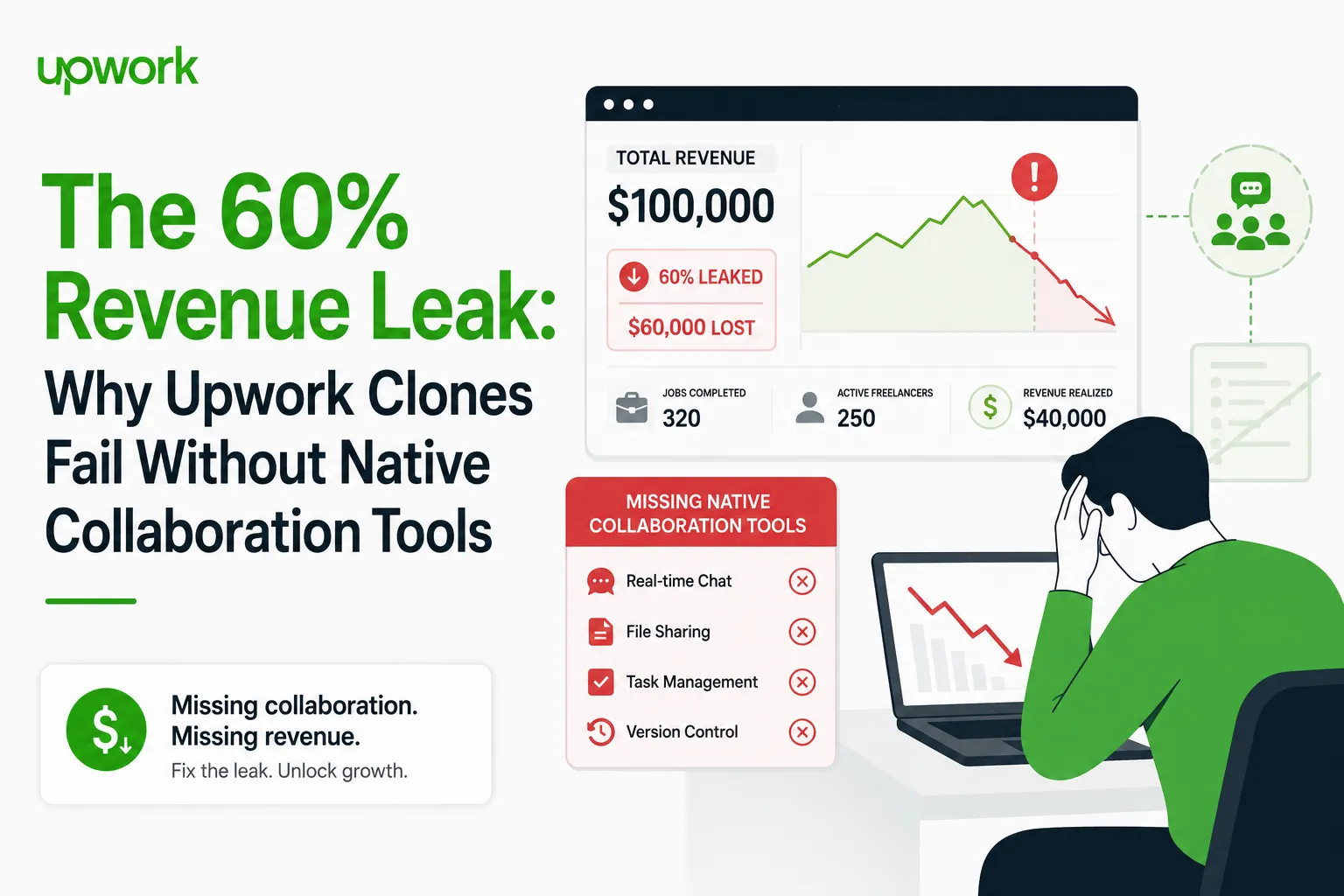
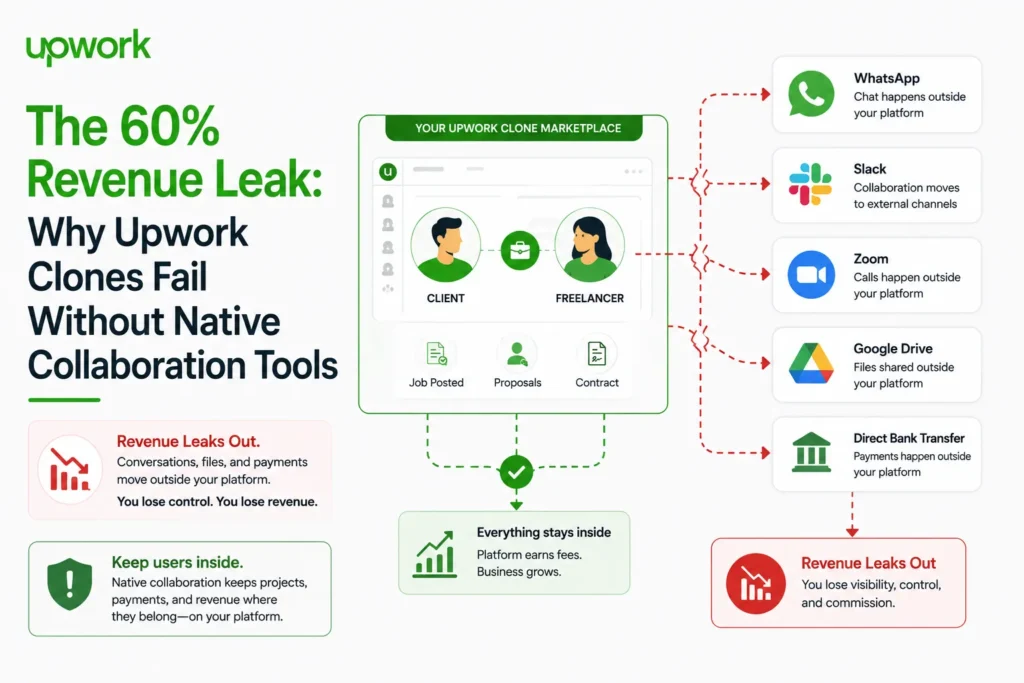
Those features matter. But they are not the biggest threat to marketplace profitability. The real threat appears after your platform starts working. A client finds a good freelancer. The freelancer completes one project successfully. Trust is established. Then both parties quietly move to WhatsApp, Slack, Google Drive, Zoom, email, or direct bank transfer to avoid platform commission.
That is platform leakage. And for freelance marketplaces, it can quietly destroy the business model.
In our marketplace engineering experience, platform operators often underestimate how much revenue disappears when users take work off-platform. The problem is not only payment avoidance. It is the loss of repeat projects, milestone fees, premium subscriptions, dispute visibility, file history, data, and long-term marketplace control.
An Upwork clone does not become profitable simply because users register. It becomes profitable when users keep working, communicating, paying, and collaborating inside the platform.
That is why Miracuves approaches freelance marketplace development differently. Instead of treating collaboration as a basic chat module, Miracuves helps founders build native Virtual Collaboration Spaces that make the platform too useful to abandon.
The Disintermediation Threat: When Users Steal Your Network
A freelance marketplace creates value by helping two sides find each other.
Clients come for access to talent. Freelancers come for access to paid work. The platform earns by facilitating discovery, communication, contracts, milestones, payments, reviews, and trust.
But once both parties trust each other, the platform faces a dangerous question:
Why should they keep paying the platform?
If the answer is only “because our policy says so,” the marketplace is exposed.
Disintermediation happens when clients and freelancers use your app for discovery, then move the relationship outside your ecosystem. They may continue on WhatsApp for chat, Zoom for calls, Google Drive for files, Slack for daily coordination, and direct transfers for payments.
At that point, your platform has paid the acquisition cost but lost the monetization cycle.
This hurts in several ways:
| Leakage Point | What the Platform Loses | Business Impact |
|---|---|---|
| Off-platform communication | Message history, project context, moderation visibility | Harder dispute resolution and weaker trust controls |
| Direct payment | Commission, service fee, payment processing margin | Immediate revenue loss |
| External file sharing | Version history, proof of work, delivery records | More disputes and less accountability |
| External meetings | Client-freelancer engagement data | Lower visibility into project health |
| Repeat work outside the app | Lifetime value from successful relationships | Marketplace growth becomes expensive and unstable |
For an Upwork clone founder, this is more dangerous than low registration numbers. Low registrations are visible. Leakage is invisible until revenue projections fail.
A marketplace can look active while monetization is quietly escaping.
Read more : Best Upwork Clone Script in 2026: Features & Pricing Compared
Why Banning Email Addresses in Chat Does Not Actually Work
Many marketplace founders try to solve leakage with restrictions.
They block email addresses. They mask phone numbers. They detect words like “WhatsApp,” “Telegram,” “Slack,” or “PayPal.” They warn users not to share contact details.
These controls can help, but they do not solve the core problem.
Users who want to move off-platform will always find new ways to communicate. They may write phone numbers with spaces, send screenshots, share usernames indirectly, use code words, or wait until after one completed transaction before moving the relationship outside.
The deeper issue is not detection.
The deeper issue is value.
If your platform only offers basic chat, basic milestones, and basic payments, users compare it against the tools they already know. WhatsApp feels faster. Zoom feels easier. Google Drive feels familiar. Slack feels better for ongoing work. Direct payment feels cheaper.
So the founder’s job is not only to punish leakage.
The founder’s job is to make staying on-platform operationally better.
That requires moving from a “marketplace with chat” to a “marketplace with collaboration infrastructure.”
Read more : Upwork Clone Revenue Model: How Upwork Makes Money in 2026
The Miracuves Cure: Building Virtual Collaboration Spaces Too Good to Leave
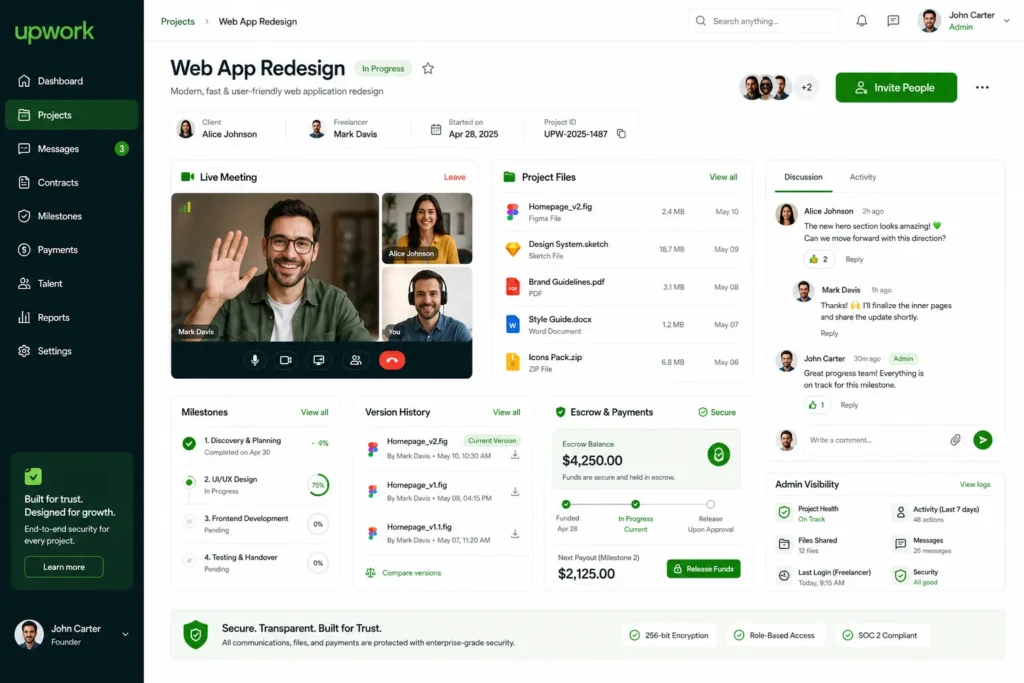
A Virtual Collaboration Space is a native project workspace inside the freelance marketplace.
Instead of forcing clients and freelancers to use separate tools for meetings, files, comments, approvals, milestones, version history, and payments, the platform brings those workflows into one secure project room.
This is where an Upwork clone becomes harder to bypass.
When the workspace contains the full history of the project, users have a practical reason to stay. The platform becomes more than a lead-generation channel. It becomes the operating system for the working relationship.
A strong Virtual Collaboration Space can include:
| Collaboration Module | What It Does | Why It Reduces Leakage |
|---|---|---|
| Integrated video meetings | Lets clients and freelancers schedule or join project calls inside the platform | Reduces the need to move to Zoom or Google Meet |
| Secure file sharing | Keeps briefs, assets, drafts, and final deliveries inside the project room | Prevents scattered Google Drive links and missing proof |
| Threaded project discussions | Organizes communication by task, milestone, or deliverable | Makes the platform more useful than generic chat |
| Version control for files | Tracks revisions, approvals, and changes | Helps resolve disputes and prevents confusion |
| Milestone-linked deliverables | Connects payment releases to approved work stages | Keeps payment logic tied to project progress |
| Work diary or time tracking | Records hourly work, screenshots, or activity summaries where relevant | Builds trust and payment confidence |
| Internal approval flow | Lets clients approve, request changes, or reject deliverables in context | Keeps decision-making inside the platform |
| Dispute evidence trail | Stores messages, files, approvals, and payment records | Gives admin teams better control when conflicts arise |
The key is not to overload users with features. The key is to make every collaboration feature protect trust, reduce friction, and support revenue retention.
Miracuves’ white-label Upwork clone approach can support this kind of marketplace foundation with source-code ownership, admin control, secure payment workflows, and custom collaboration modules based on the founder’s business model.
Founder Decision Signals
Speed
If you want to launch quickly, start with a ready-made Upwork clone foundation instead of building every marketplace workflow from zero.
Revenue Control
If commission is your main revenue model, collaboration tools should be designed to keep repeat work and payments inside your platform.
Trust
If clients and freelancers handle files, approvals, and discussions outside your app, your admin team loses visibility during disputes.
Market Fit
If users prefer external tools, your platform may need better native workflows before scaling paid acquisition.
Why Native Collaboration Protects More Than Commission Revenue
Commission leakage is the obvious loss.
But the hidden losses are often more damaging.
When users leave your freelance marketplace after the first successful connection, your platform loses the data needed to improve matching, pricing, dispute handling, and retention.
You no longer know which project categories have repeat demand. You cannot see which freelancers build long-term relationships. You cannot track why some projects succeed while others fail. You cannot identify which clients are high-value. You cannot build accurate recommendation logic because the most important collaboration signals happen somewhere else.
Native collaboration keeps these signals inside the product.
That matters for:
- better freelancer recommendations;
- more accurate client quality scoring;
- stronger dispute resolution;
- improved milestone templates;
- better category-level pricing insights;
- higher repeat transaction visibility;
- more valuable admin analytics;
- stronger subscription and premium feature planning.
For platform owners, this is not just a technical feature decision. It is a monetization architecture decision.
A freelance marketplace with weak collaboration tools may acquire users but fail to capture value. A marketplace with strong collaboration infrastructure has a better chance of becoming part of the user’s daily workflow.
read more : White-Label Upwork App Security: Risks, Compliance & Best Practices
What a Collaboration-First Upwork Clone Should Include
A standard Upwork clone may include user registration, job posting, bidding, profiles, chat, payments, reviews, and admin management.
A collaboration-first Upwork clone goes deeper.
It thinks about what happens after the client chooses the freelancer.
That post-hiring layer is where revenue retention is won or lost.
Collaboration-First Upwork Clone Feature Framework
| Feature | Business Value | Founder Impact |
|---|---|---|
| Project Workspaces | Creates one central place for briefs, files, messages, milestones, and approvals. | Reduces dependency on WhatsApp, Slack, and email. |
| Integrated Video Calls | Lets users discuss work without leaving the platform. | Keeps high-value client-freelancer interactions visible. |
| Secure File Sharing | Stores project assets, drafts, and final deliverables inside the marketplace. | Improves dispute evidence and delivery accountability. |
| Threaded Discussions | Organizes communication by topic, task, or milestone. | Makes the platform more useful than basic one-to-one chat. |
| Version History | Tracks file revisions and client approvals. | Prevents confusion over what was delivered and approved. |
| Milestone-Based Escrow | Connects payments to defined project stages. | Protects commission revenue and builds trust. |
| Admin Dispute Console | Gives admins access to project records, messages, files, and payment history. | Helps resolve conflicts faster and more fairly. |
The Wrong Way to Fight Platform Leakage
Many founders respond to leakage with control-heavy tactics.
They add stricter chat filters. They threaten account bans. They hide profile information. They block file attachments. They limit communication before payment.
Some of these rules may be necessary, especially for early-stage trust and safety. But used alone, they can damage user experience.
A client hiring a freelancer wants speed. A freelancer wants clarity. Both want fewer obstacles. If the platform feels restrictive but does not add enough value, users become even more motivated to escape.
The stronger approach is a combination of:
- Policy controls that define what users can and cannot do.
- Trust systems such as escrow, reviews, verification, and dispute support.
- Native collaboration tools that make work easier inside the marketplace.
- Admin visibility so the operator can detect risk and support users.
- Pricing logic that makes the commission feel fair compared to the value provided.
The best marketplaces do not rely only on walls. They create reasons to stay.
How Virtual Collaboration Spaces Improve Marketplace Monetization
A collaboration-first freelance platform can support multiple revenue streams beyond basic commission.
Once users rely on the platform to manage work, the founder can introduce premium value layers.
| Revenue Stream | How Collaboration Tools Support It |
|---|---|
| Commission fees | Users stay on-platform because payments are tied to milestones and delivery records. |
| Subscription plans | Power users may pay for advanced workspaces, storage, reporting, or team collaboration. |
| Featured profiles | Better project data can improve freelancer ranking and premium visibility logic. |
| Sponsored job posts | Clients who see strong collaboration tools may trust the platform for higher-value projects. |
| File storage upgrades | Agencies and recurring clients may need more storage, version history, and workspace capacity. |
| Verification packages | Verified professionals can be positioned more strongly in high-trust categories. |
| Dispute support fees | Advanced mediation or protected contract tiers can become premium trust layers. |
This is where a freelance marketplace becomes more than a listing site.
It becomes a revenue system.
Security and Trust Controls Founders Should Not Ignore
Collaboration tools also increase responsibility. When files, messages, meetings, payments, and client data live inside the platform, security must be part of the foundation.
A freelance marketplace should consider:
- encrypted data transfer;
- secure file storage;
- role-based access control;
- admin activity logs;
- secure payment gateway integration;
- escrow and milestone tracking;
- dispute management workflows;
- user verification;
- access permissions for project workspaces;
- abuse reporting and moderation;
- audit-ready project records.
The goal is not to claim universal compliance. Final compliance depends on jurisdiction, integrations, legal review, and the platform’s operating model.
The practical goal is to build a compliance-ready foundation that gives founders better operational control as the marketplace grows.
Mistakes Founders Should Avoid
Treating Chat as the Collaboration Layer
Basic chat is not enough for serious freelance work. Clients and freelancers need files, approvals, calls, revisions, milestones, and records. If your app does not provide these, external tools will.
Relying Only on Contact-Info Blocking
Blocking emails and phone numbers may slow leakage, but it does not remove the incentive to leave. The platform must provide enough value to justify staying.
Ignoring Repeat Work
The first project may happen on-platform, but repeat work is where major lifetime value appears. If repeat work moves outside the app, your acquisition economics weaken.
Launching Without Admin Visibility
Admins need visibility into disputes, milestones, project history, payment status, and user behavior. Without this control layer, growth becomes harder to manage.
Why Source-Code Ownership Matters for Collaboration-Heavy Marketplaces
A basic freelance marketplace can often launch with standard modules.
But a collaboration-heavy marketplace needs flexibility.
As founders learn how users behave, they may need to adjust workspace permissions, add new meeting integrations, improve file workflows, create niche-specific milestone templates, build AI-assisted project summaries, or customize admin analytics.
This is where source-code ownership matters.
A source-code-owned Upwork clone gives the founder more control over long-term product evolution. Instead of being locked into a fixed SaaS template, the platform can adapt as the business model matures.
For example:
- a legal freelance marketplace may need secure document review flows;
- a design marketplace may need visual feedback and version comparison;
- a software talent marketplace may need repository links and sprint boards;
- a content marketplace may need editorial approvals and plagiarism checks;
- an agency marketplace may need multi-member workspaces and client reporting.
The collaboration layer should match the niche. A one-size-fits-all marketplace script may launch quickly, but it may not protect revenue if the working experience is too shallow.
Miracuves helps founders start with a ready-made, white-label freelance marketplace foundation and customize the collaboration layer around the actual business model.
Ready-Made Upwork Clone vs Custom Marketplace Build
| Build Option | Best For | Strength | Limitation |
|---|---|---|---|
| Basic script marketplace | Testing simple job posting and bidding flows | Faster initial setup | May lack deeper collaboration, admin, and retention logic |
| Fully custom build | Large teams with unique product requirements | Maximum flexibility | Higher cost, longer development cycle, more upfront risk |
| Miracuves white-label Upwork clone | Founders who want faster launch with customization control | Ready-made foundation, source code, admin dashboard, collaboration customization | Final scope depends on required modules and integrations |
A ready-made foundation is not about copying Upwork blindly. It is about starting with proven marketplace workflows and then building the right differentiation layer.
For this topic, that differentiation layer is native collaboration.
How Miracuves Helps Build Leakage-Resistant Freelance Marketplaces
Miracuves helps founders launch white-label, source-code-owned freelance marketplace platforms with the core workflows needed to connect clients and freelancers.
For an Upwork-style marketplace, that can include:
- client and freelancer registration;
- profile management;
- job posting;
- proposal and bidding workflows;
- project contracts;
- milestone tracking;
- escrow and payment workflows;
- messaging;
- reviews and ratings;
- admin dashboard;
- user, job, payment, and dispute management;
- collaboration module customization;
- deployment support.
For founders concerned about platform leakage, Miracuves can help design the collaboration layer as part of the business strategy, not just as an add-on.
That means thinking through how users will communicate, share work, approve deliverables, release payments, resolve disputes, and return for future projects.
The platform should not merely connect users.
It should become the safest and most convenient place for them to keep working together.
Final Thoughts: The Real Upwork Clone Risk Is Not Launching. It Is Losing the Relationship.
Most Upwork clone discussions focus on launch.
But the stronger founder question is what happens after the match.
If clients and freelancers find each other through your platform but collaborate and pay elsewhere, your marketplace becomes an acquisition engine for private relationships. That is not a scalable business model.
The cure is not only stricter chat filtering. It is stronger product value.
Native Virtual Collaboration Spaces give users a reason to keep work inside the ecosystem. Meetings, files, threads, milestones, approvals, payments, and dispute records become part of the platform’s value. When the platform becomes operationally useful, commission feels more justified.
That is the difference between an Upwork clone that lists freelancers and a freelance marketplace that protects long-term revenue.
Miracuves helps founders build the second kind.
FAQs
1. What is platform leakage in an Upwork clone?
Platform leakage happens when clients and freelancers meet through your freelance marketplace but continue communication, collaboration, or payments outside the platform. This reduces commission revenue, weakens admin visibility, and lowers long-term marketplace value.
2. Why do freelancers and clients move off-platform?
They usually move off-platform to avoid commission fees, communicate faster, use familiar tools, or continue repeat work directly. If your platform does not provide enough collaboration value, users have little reason to stay after trust is established.
3. Can blocking emails and phone numbers stop marketplace leakage?
Blocking contact details can reduce obvious leakage attempts, but it cannot fully stop users from finding workarounds. A stronger solution is to make the platform’s collaboration tools valuable enough that users prefer staying inside the marketplace.
4. What are Virtual Collaboration Spaces in a freelance marketplace?
Virtual Collaboration Spaces are project workspaces inside the marketplace where clients and freelancers can manage files, meetings, messages, milestones, approvals, and payments. They help keep project activity inside the platform.
5. What collaboration tools should an Upwork clone include?
A strong Upwork clone should include secure messaging, integrated video meetings, file sharing, milestone tracking, version history, project approvals, escrow workflows, dispute records, and admin visibility.
6. How do native collaboration tools improve marketplace revenue?
They reduce off-platform movement, keep repeat projects visible, support commission collection, create premium feature opportunities, and help the platform capture more lifetime value from successful client-freelancer relationships.
7. Is a ready-made Upwork clone enough to build a profitable marketplace?
A ready-made Upwork clone can provide the foundation, but profitability depends on positioning, niche selection, trust systems, monetization logic, collaboration workflows, and retention strategy. Founders should customize the platform around their target users.
8. Can Miracuves customize an Upwork clone with advanced collaboration features?
Yes. Miracuves can help founders build a white-label Upwork clone with source code, admin control, marketplace workflows, and custom collaboration modules based on the business model and launch scope.
Miracuves is an independent software development company. We are not affiliated with, connected to, sponsored by, or endorsed by any company or product named in this article.
Terms such as “X Clone” are used descriptively. It is how the software industry refers to building a platform with functionality comparable to a known service, and how clients search for it.
The entire design and codebase of our products is built by our own team. Our products contain no code, design, graphics, or content originating from any third-party website or applications.
All third-party names and marks referenced in this article are the property of their respective owners, referenced solely to identify the services discussed.