


Key Takeaways
What You’ll Learn
- Non-technical founders do not need to become developers before launching an app.
- Your job is to own the business logic, not every line of code.
- Technical literacy helps you manage better without becoming the weakest engineer on your team.
- Admin control is essential because it lets you run users, payments, disputes, content, and reports.
- The main lesson is to build with speed, control, revenue clarity, and market validation.
Stats That Matter
- The article says founders should focus less on syntax and more on launch-ready product strategy.
- Founder work includes validation, product model, capital, distribution, revenue, and scalable operations.
- Revenue options can include subscriptions, commissions, fees, ads, listings, transactions, and premium accounts.
- Key ownership areas include product logic, revenue model, admin control, source code, and growth system.
- Development paths include no-code, custom development, white-label apps, and ready-made foundations.
Real Insights
- Learning code can become a distraction when the market is moving faster than your tutorials.
- Clear workflows prevent bad builds because developers should not guess your business model.
- Source-code ownership improves flexibility for customization, hosting, integrations, and future teams.
- Growth is where founder leverage compounds through sales, partnerships, onboarding, retention, and acquisition.
- For founders, build an app development strategy around product clarity, admin control, monetization, ownership, and faster launch execution.
Most advice for non-technical founders starts in the wrong place.
It tells you to learn programming basics, understand frameworks, take a coding course, study databases, and become “technical enough” before building your app. That sounds responsible on the surface. In reality, it can become a dangerous distraction.
If you are a founder, your job is not to spend six months trying to understand syntax while your market moves, your competitors launch, and your customer acquisition window gets more expensive. Your job is to turn a market opportunity into a functioning business. That is why app development for non technical founders should focus less on learning code and more on building a launch-ready product strategy.
That means validating demand, defining the product model, raising or allocating capital, building distribution, engineering revenue, and making sure the technology foundation gives you enough control to scale.
This is where app development for non technical founders needs a sharper conversation. The question is not, “How much code should I learn?” The real question is, “How much operational control do I need to launch, monetize, and scale without becoming trapped by the wrong technical decisions?”
Miracuves helps founders approach this problem differently through ready-made, white-label, and source-code-owned app solutions that allow entrepreneurs to start from a production-grade foundation instead of building every module from zero.
The Illusion of the Coding CEO: Why Syntax Is a Management Failure
There is a popular myth in startup culture: if you are building a software company, you must learn how to code.
That idea sounds empowering, but it often creates a false sense of progress. A non-technical founder spends weeks watching tutorials, learning terminology, experimenting with small scripts, and trying to understand frontend and backend development. They feel productive because they are “learning technology.”
But the business may not be moving.
No customers are being interviewed. No acquisition channel is being tested. No pricing model is being validated. No investor narrative is being sharpened. No partnership pipeline is being built. No pre-launch community is forming.
That is the real cost.
A founder who spends months trying to become a junior developer may be ignoring the work that only a founder can do. Developers can write code. Designers can create interfaces. Technical teams can configure infrastructure. But the founder must decide why the product exists, who will pay for it, how the market will be entered, and what operational advantage the company will build.
Syntax is not strategy.
A non-technical founder should understand enough about software to ask intelligent questions, identify risks, review workflows, and avoid being misled. But there is a major difference between technical literacy and technical substitution.
Technical literacy helps you manage the build.
Technical substitution tricks you into becoming the weakest developer on your own team.
The CEO-to-Code Ratio: Where Non-Technical Founders Should Actually Spend Their Time
The CEO-to-Code Ratio is a simple but aggressive operating principle:
The more time a founder spends trying to personally decode software syntax, the less time they may be spending on the activities that increase enterprise value.
A software founder’s highest-value work usually sits in five areas:
- Capitalization: securing capital, managing budget, and allocating resources toward speed and validation.
- Customer acquisition: building demand before and after launch.
- Market positioning: choosing a niche, wedge, geography, or underserved audience.
- Revenue engineering: defining pricing, commissions, subscriptions, ads, transaction fees, or marketplace monetization.
- Operational control: ensuring the app has the dashboards, workflows, permissions, analytics, and ownership structure needed to run the business.
Code supports these goals. It does not replace them.
For example, a founder launching a food delivery platform should spend more energy solving merchant onboarding, delivery partner supply, commission design, service zones, customer offers, and retention loops than learning how a backend endpoint is structured.
A founder launching a short video app should care more about creator acquisition, content moderation, feed engagement, monetization, and infrastructure scalability than memorizing a programming framework.
A founder launching a fintech app should focus on user trust, verification workflows, transaction logic, compliance preparation, partner integrations, and risk controls instead of trying to become a developer overnight.
The founder’s job is to command the system, not manually assemble every component of the system.
Read More: Why Time to Market Matters More Than Ever in App Development
Flipping the Focus: Prioritizing Market Capitalization Over Code Compilation
App development becomes dangerous when founders treat the product as the business.
The app is not the business.
The app is the operating layer through which the business delivers value.
A technically beautiful app with no acquisition strategy is a stranded asset. A fully custom build with no monetization clarity is a cash drain. A feature-heavy platform with no operational playbook is just expensive software.
Non-technical founders should flip their focus from code compilation to market capitalization.
That means asking sharper questions before development begins:
| Founder Question | Why It Matters |
|---|---|
| Who is the first narrow user group we can win? | Prevents the app from becoming too broad and unfocused. |
| What painful workflow are we replacing? | Creates a stronger reason for users to switch. |
| Which supply-side or demand-side problem must be solved first? | Critical for marketplaces, delivery apps, service platforms, and creator ecosystems. |
| What monetization model fits user behavior? | Prevents revenue from being added as an afterthought. |
| What must the admin dashboard control from day one? | Determines whether operations can run without constant developer dependency. |
| What needs to be customizable after launch? | Protects future iteration and market-specific adaptation. |
| Do we need custom development or a ready-made foundation? | Helps balance speed, cost, control, and uniqueness. |
This is real founder work.
A non-technical founder does not need to understand every line of code to answer these questions. But they must answer them before anyone starts building.
What Non-Technical Founders Must Own Instead of Code
Not owning code knowledge does not mean giving up ownership.
In fact, the smartest non-technical founders are often highly disciplined about what they must control.
They may outsource development, but they do not outsource business judgment.
Here is what a founder should own.
1. The Product Logic
You should be able to explain the app in plain business language.
Who uses it? What do they do first? What action creates value? What action creates revenue? What happens when something fails? What does the admin need to control?
If you cannot explain the workflow, the development team will fill the gaps for you. That is risky because developers may make technically convenient decisions that do not match your business model.
2. The Revenue Model
Your monetization strategy should not be vague.
Depending on the app category, revenue may come from:
- subscriptions
- commissions
- delivery fees
- booking fees
- service charges
- featured listings
- advertising
- creator commissions
- transaction fees
- premium accounts
- reseller licensing
A non-technical founder should know which revenue streams matter now and which can be added later.
3. The Admin Control Layer
The admin panel is where the software becomes a business machine.
This is where the platform operator manages users, vendors, partners, creators, payments, commissions, content, disputes, approvals, refunds, reports, and system settings.
For non-technical founders, admin control is especially important because it reduces dependency on developers for everyday business changes.
A strong admin dashboard lets you adjust operations. A weak admin dashboard forces you to request development help for basic decisions.
4. The Ownership Structure
You need clarity on what you own after launch.
Do you own the source code? Do you control the database? Can you access the server? Can another technical team work on the product later? Are third-party integrations documented? Is the app locked inside a vendor-controlled environment?
A branded app without ownership can still become a dependency trap.
A source-code-owned app foundation gives the business more long-term flexibility.
5. The Growth System
The app will not sell itself.
Your launch plan should include channel strategy, offer design, onboarding flow, retention triggers, referral logic, content plan, local partnerships, paid acquisition assumptions, and founder-led sales activity.
If you are non-technical, growth is where your leverage should compound.
The more technical execution is handled by a capable infrastructure partner, the more energy you can put into market capture.
Build, Buy, License, or Customize: Choosing the Right App Development Path
Non-technical founders usually have four practical routes.
| Development Path | Best For | Founder Risk | Speed | Control |
| Learn to code yourself | Personal experiments, very small prototypes | High opportunity cost | Slow for production apps | High only if you become competent |
| No-code or AI builders | Early prototypes, internal tools, simple validation | Scalability and ownership limits | Fast | Medium to low depending on platform |
| Custom development | Unique workflows, proprietary products, complex systems | Higher cost and longer timelines | Slower | High if contracts and ownership are clear |
| White-label or ready-made infrastructure | Proven app models, faster launch, marketplace and clone app concepts | Vendor selection risk | Fast | High when source code and admin control are included |
The right decision depends on your business stage.
If you are testing a small internal workflow, no-code may be enough.
If your app depends on a unique technical invention, custom development may be necessary.
If you are launching a known model such as ride-hailing, food delivery, grocery delivery, rental marketplace, freelance marketplace, creator platform, fintech wallet, job portal, or ecommerce marketplace, building every common module from zero may not be the smartest use of capital.
In those cases, a ready-made or white-label app foundation can help you start with tested product patterns and focus your customization budget on what makes the business different.
Licensing Battle-Tested Blueprints to Command a Software Business
A white-label app is not about pretending someone else’s product is innovation.
Used correctly, it is about licensing a proven software blueprint and adapting it into a market-specific business.
The strongest founders do not ask, “Can I copy an app?”
They ask:
- What proven behavior already exists in the market?
- What user expectation should we preserve?
- What operational workflow can we improve?
- What niche can we serve better?
- What branding, pricing, geography, or supply-side strategy gives us an edge?
- What modules should be customized for our market?
- What should we avoid building from zero?
This is how a non-technical founder can command a software business without becoming trapped in manual development.
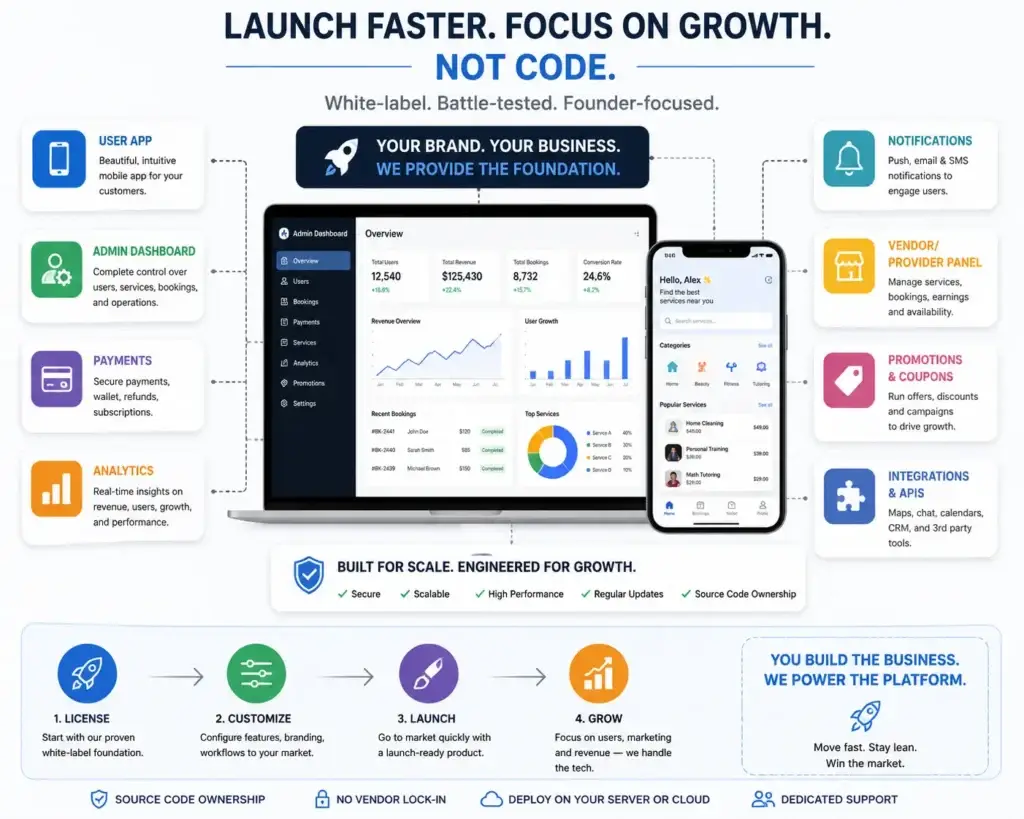
A ready-made app foundation can include core user flows, backend logic, mobile apps, web panels, admin controls, and essential modules. The founder can then focus on branding, market adaptation, monetization, and launch execution.
Miracuves supports this approach through white-label and ready-made app solutions across multiple categories, helping founders start from a launch-ready foundation while retaining control over branding, admin workflows, customization direction, and source-code ownership where applicable.
Founder Decision Signals: When White-Label Infrastructure Makes Sense
If you are a non-technical founder, the right app development decision is not about learning every line of code. It is about choosing the path that gives you speed, control, scalability, and market validation.
Speed
If market timing matters, a ready-made app foundation helps you launch faster instead of spending months building common modules from zero.
Cost
Your capital should support customer acquisition, partnerships, and operations—not unnecessary development delays on already-proven workflows.
Scalability
Choose a solution with admin control, source-code access, flexible integrations, and backend workflows that can support future growth.
Market Fit
If users already understand the app model, your advantage comes from niche focus, branding, pricing, service quality, and execution.
White-label infrastructure makes sense when the business model is not technically mysterious.
A taxi app needs rider, driver, booking, tracking, payment, rating, and admin workflows.
A delivery app needs customer, merchant, delivery partner, order, dispatch, payment, and admin workflows.
A marketplace needs listings, search, booking, payments, reviews, vendor dashboards, and dispute handling.
A creator platform needs profiles, content upload, feeds, monetization, moderation, reporting, and payout workflows.
These are not unknown patterns.
The founder’s job is not to rediscover them line by line. The founder’s job is to decide how the business will win using those patterns.
Read More: Clone App Development: The Fastest Way to Validate a Market Without Starting From Zero
Mistakes Non-Technical Founders Make While Starting App Development
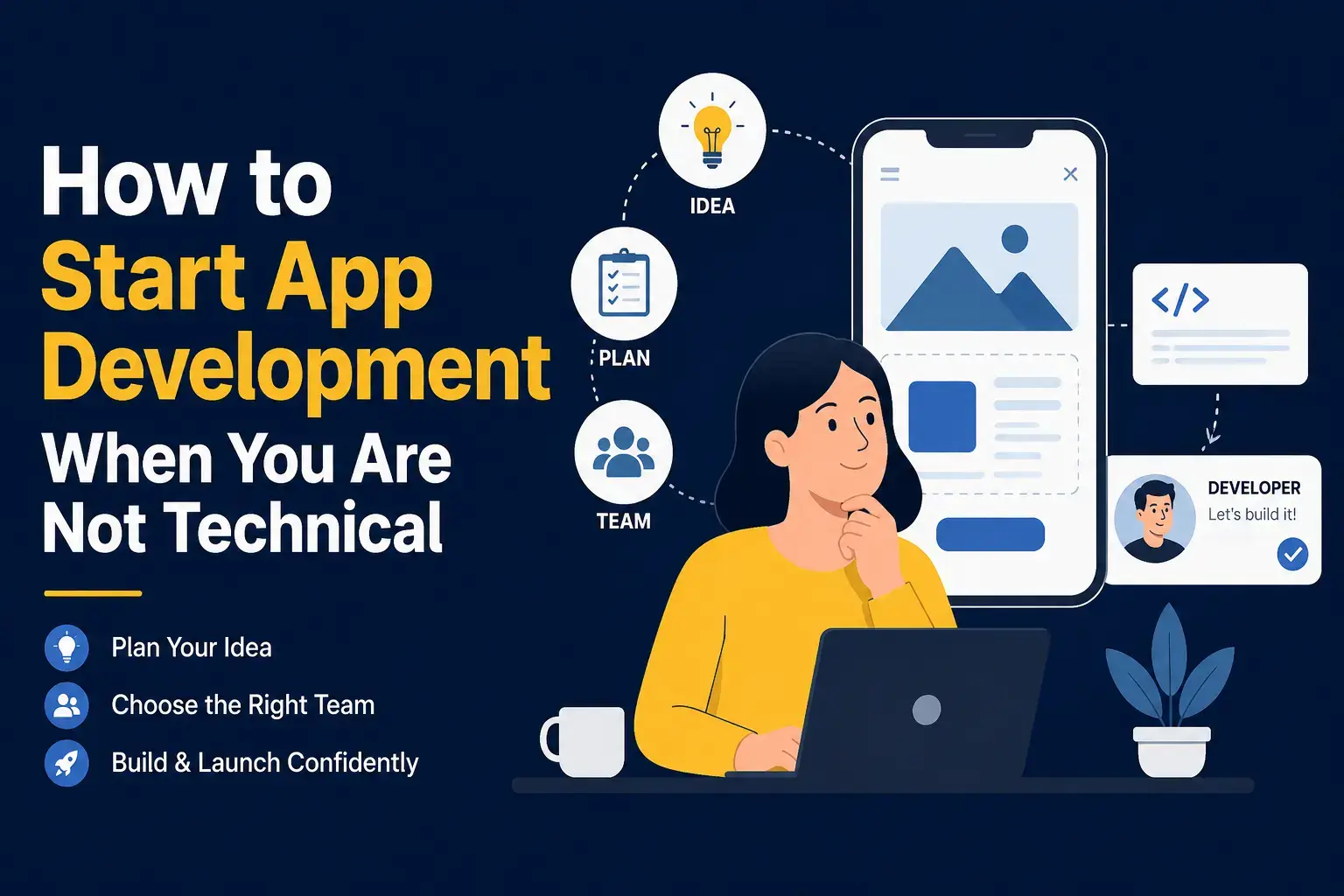
Trying to Become a Developer Instead of a Better Operator
Technical literacy is useful, but becoming the weakest engineer on your own project is not leverage. Spend your best energy on customers, capital, positioning, and revenue.
Building Before Defining the Business Model
An app without clear monetization, user roles, operations, and acquisition logic becomes expensive experimentation.
Ignoring Source-Code Ownership
A branded app can still create dependency if the founder does not understand source code rights, hosting access, database control, and customization limits.
Choosing the Cheapest Vendor Without Checking Control
Low upfront pricing can become expensive if the app lacks admin depth, documentation, scalability, testing, support, or ownership clarity.
How Miracuves Helps Non-Technical Founders Launch With Control
Miracuves helps founders, startups, agencies, and venture operators move from idea to launch using ready-made, white-label, and source-code-owned app solutions.
For non-technical founders, this matters because the goal is not only to “get an app developed.” The goal is to launch with enough operational control to run the business.
A Miracuves-style app foundation can help founders think through:
- customer, vendor, provider, driver, creator, or merchant workflows
- admin dashboard requirements
- monetization logic
- branding and customization
- source-code ownership
- integration needs
- launch scope
- post-launch iteration
- market validation priorities
Founders exploring proven app models can start with the Miracuves solutions to review ready-made and white-label app foundations across categories.
If the founder is still deciding between a pre-built foundation and a custom build, the guide on white-label solutions vs custom development is a useful next read.
For founders concerned about long-term control, source code ownership in app development explains why ownership can affect customization, scalability, and vendor flexibility.
Final Thoughts: Your Job Is Not to Become the Developer
Non-technical founders do not fail because they cannot code.
They fail when they misunderstand what they are supposed to own.
You do not need to own every syntax decision. You need to own the market thesis, customer acquisition strategy, monetization model, operating workflows, brand positioning, and product control layer.
Code is a business component.
Infrastructure is leverage.
A founder who spends months trying to become a beginner developer may lose the very advantage that made them valuable: market insight, sales ability, capital access, industry experience, or operational aggression.
The smarter move is not to avoid technology. The smarter move is to command it.
For founders planning to launch faster, Miracuves offers ready-made and white-label app foundations that help turn software from a development burden into a business asset.
Ready to launch your app without building everything from zero? Contact us to discuss your white-label app development plan.
FAQs
How can a non-technical founder start app development?
A non-technical founder should start by defining the target user, business model, core workflows, monetization strategy, admin control needs, and launch scope. After that, they can choose between no-code, custom development, or a white-label app foundation.
Should non-technical founders learn to code before building an app?
They should learn enough technical vocabulary to manage decisions, but they do not need to become developers. For most founders, time is better spent on customer acquisition, market validation, fundraising, partnerships, and business operations.
What is the best app development option for non-technical founders?
The best option depends on the product. No-code works for simple prototypes, custom development works for unique technical products, and white-label app development works well when the business model is already proven and speed matters.
Can I build an app without coding?
Yes. A founder can build an app without personally coding by using no-code tools, hiring developers, working with an app development company, or licensing a ready-made white-label app solution.
Why is source-code ownership important for non-technical founders?
Source-code ownership gives founders more control over customization, hosting, integrations, maintenance, future development, and vendor flexibility. Without source-code access, the business may remain dependent on the original provider.
Is white-label app development better than custom development?
White-label app development can be better when founders need faster launch, lower development uncertainty, and a proven app foundation. Custom development is better when the product requires highly unique workflows, proprietary technology, or deep technical innovation.
What should non-technical founders ask before hiring an app development company?
They should ask about source code ownership, admin dashboard features, database access, hosting control, documentation, post-launch support, customization limits, third-party integrations, testing process, and total launch scope.
How does Miracuves help non-technical founders?
Miracuves helps non-technical founders launch ready-made and white-label app solutions with branding, admin control, source-code ownership where applicable, customization support, and faster deployment.