



Key Takeaways
- A pre-launch compliance checklist helps founders prepare their app before enterprise security reviews begin.
- Founders, CTOs, compliance teams, enterprise buyers, and admins need clear security controls before launch.
- Encryption, audit logs, access control, tokenized payments, data retention, and secure APIs are core compliance layers.
- Compliance risk depends on user data type, payment handling, role permissions, logging, hosting, and third-party integrations.
- A strong security baseline helps founders build buyer trust and reduce delays during institutional audits.
Compliance Signals
- Enterprise buyers need proof of secure data handling, permission controls, logging, backups, and incident readiness.
- Admins need control over user roles, access levels, audit trails, data exports, account changes, and security settings.
- Payment workflows should avoid storing raw card data and use secure gateway handling, tokenization, and transaction logs.
- Healthcare, fintech, marketplace, and SaaS apps need stronger controls when they process sensitive or regulated data.
- Security reviews should cover authentication, authorization, encryption, API protection, monitoring, backups, and vendor dependencies.
Real Insights
- Compliance is easier to prove when security controls are built into the product before enterprise sales conversations.
- Weak access control, missing audit logs, and unclear payment storage can slow down B2B contract approvals.
- Founders should prepare security evidence before pitching hospitals, banks, enterprises, universities, or government buyers.
- A compliance checklist helps convert security from a launch blocker into a stronger sales advantage.
- Miracuves builds enterprise-ready apps with encryption, audit logs, access controls, secure payment workflows, role management, and admin control.
Founders often think enterprise sales are blocked by pricing, features, or slow procurement. In regulated industries, the real blocker is usually trust.
A hospital will not adopt a healthcare app without asking how patient data is stored. A fintech partner will not approve a payment product unless cardholder data is protected. A corporate buyer will not onboard a marketplace, SaaS platform, or white-label app unless the vendor can answer basic security questions with evidence.
That is why compliance should not begin after launch. It should shape the product before launch.
A strong pre-launch compliance checklist helps founders prepare for HIPAA, GDPR, PCI-DSS, SOC 2-style questionnaires, institutional vendor reviews, and enterprise security audits. It does not replace legal advice or certification. Instead, it gives your app the technical foundation needed to move through security review with fewer surprises.
For founders building in healthcare, fintech, marketplaces, delivery, creator platforms, ecommerce, or enterprise SaaS, this is where a ready-made and white-label app foundation from Miracuves can help. The goal is not to “skip compliance.” The goal is to start with security, admin control, source-code ownership, and audit-ready architecture from day one.
Winning B2B Contracts: Why Compliance Is Your App’s True Moat
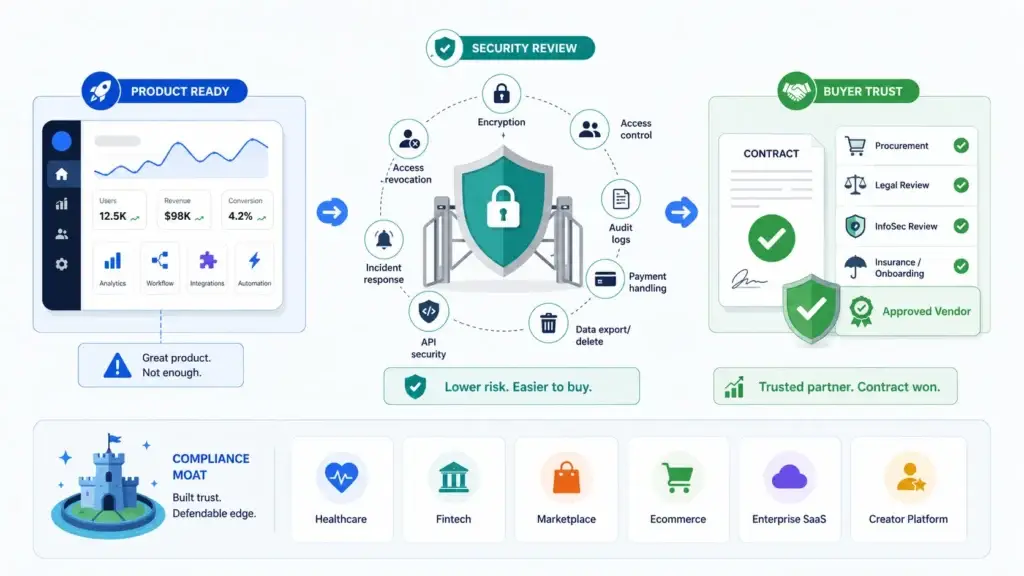
In early-stage product building, speed matters. But in regulated markets, speed without security creates sales friction.
A founder can build a strong product, win demos, and impress prospects, only to lose the contract during vendor security review. This happens when the buyer asks for documentation the startup cannot provide:
- How is sensitive data encrypted?
- Who can access admin records?
- Are logs tamper-resistant?
- Is payment data stored directly?
- Can users request deletion or export?
- Are APIs protected against abuse?
- Is there a documented incident response process?
- Can access be revoked immediately when an employee leaves?
These questions are not theoretical. They are often part of procurement, legal review, information security assessment, insurance review, and institutional onboarding.
The FTC advises app developers to consider security at every development stage and to understand what data the app collects and retains. That founder-level ownership matters because enterprise buyers do not simply audit code. They audit responsibility.
For founders, compliance becomes a moat because it signals operational maturity. A competitor may have similar features, but if your product can show cleaner access controls, stronger logging, documented data flows, and secure payment handling, you reduce the buyer’s perceived risk.
That is especially important in verticals such as:
- Healthcare apps handling patient data
- Fintech apps handling identity, wallet, or payment data
- Marketplaces handling user, provider, and transaction records
- Ecommerce apps handling orders and payment flows
- Enterprise SaaS platforms handling business-critical workflows
- Creator platforms handling user-generated content, payouts, and identity verification
Compliance is not only about avoiding penalties. It is about becoming easier to buy.
The Institutional Compliance Baseline: What Enterprise Buyers Expect Before Launch
The Institutional Compliance Baseline is a practical security layer every regulated app should prepare before its first serious B2B sales conversation.
It includes four core areas:
- Data protection
- Secure identity and access
- Auditability and logging
- Payment and transaction security
A founder does not need to become a lawyer to understand this baseline. But the founder does need to know what the product must prove.
1. Data Encryption at Rest and in Transit
Encryption at rest protects stored data inside databases, backups, file storage, and cloud volumes. Encryption in transit protects data while it moves between mobile apps, web apps, APIs, servers, payment gateways, and third-party integrations.
For HIPAA-relevant apps, electronic protected health information must be protected through appropriate safeguards. For GDPR-facing apps, Article 32 specifically points to encryption and pseudonymisation as possible measures for securing personal data. For PCI-DSS environments, strong cryptography is central to protecting cardholder data during transmission over open networks.
A pre-launch app should verify:
- Database encryption is enabled
- Backups are encrypted
- File storage uses secure access permissions
- API traffic uses HTTPS/TLS
- Secrets are not hardcoded in the source code
- Environment variables are separated by staging and production
- Sensitive exports are limited and logged
- Mobile apps do not store sensitive data unnecessarily on device
The founder question is simple: if a buyer asks where sensitive data lives and how it is protected, can you answer with an architecture diagram and configuration proof?
2. Secure Logging and Audit Trails
Enterprise buyers care about what happened, when it happened, who did it, and whether the record can be reviewed.
HIPAA audit controls require mechanisms that record and examine activity in systems containing or using electronic protected health information. That means a healthcare product should not treat logs as generic debugging output. Logs are evidence.
A secure app should log:
- Admin logins
- Failed login attempts
- Password resets
- Permission changes
- User record access
- Payment actions
- Profile changes
- Data exports
- Deletion requests
- Provider, vendor, or staff approval actions
- Suspicious activity flags
Good logging also avoids a common mistake: storing sensitive data inside logs. Logs should help investigations without exposing passwords, full card numbers, health records, private messages, or identity documents.
The pre-launch question is: can your platform reconstruct a security event without leaking more sensitive data during the investigation?
3. Tokenized Payment Storage and PCI-DSS Scope Reduction
Founders should avoid storing raw card data unless they have a clear business reason, a qualified security team, and the correct PCI-DSS assessment path.
For most startups, the smarter approach is to use secure payment gateway integration and tokenized payments. Tokenization allows the platform to reference a payment method without storing the actual card number inside the app database.
This matters because PCI-DSS applies to organizations that store, process, or transmit cardholder data. PCI SSC’s v4.0.1 standard is the current limited revision to PCI-DSS and clarifies requirements without adding or deleting requirements from v4.0.
A pre-launch app should verify:
- No raw card data is stored in the app database
- Payment tokens are used instead of card numbers
- Payment gateway webhooks are verified
- Refunds and disputes are logged
- Admin users cannot view full payment credentials
- Payment errors do not expose sensitive transaction details
- Access to transaction records is permission-based
- Payment-related API endpoints are rate-limited and monitored
The founder goal is not only “accept payments.” The goal is to accept payments without expanding risk unnecessarily.
4. Role-Based Access Control and Least Privilege
Role-based access control decides who can do what inside the product.
This is where many early apps fail. They build an admin panel quickly, give broad access to internal users, and later realize that every support agent, vendor manager, or operations lead can see too much.
HIPAA expects access to electronic protected health information to be appropriate to the user’s role. GDPR also expects personal data to be processed securely and only by authorized people acting under proper instructions.
A regulated app should define roles before launch:
- Super admin
- Operations admin
- Support manager
- Provider or vendor
- Finance user
- Compliance reviewer
- Content moderator
- Customer or patient user
- Read-only auditor
Each role should have clear permissions. For example, a support agent may need to view order status but not full payment details. A clinic admin may need appointment records but not platform-wide user exports. A marketplace vendor may need sales data but not another vendor’s customer list.
The pre-launch question is: can you show an enterprise buyer that access is limited by business need?
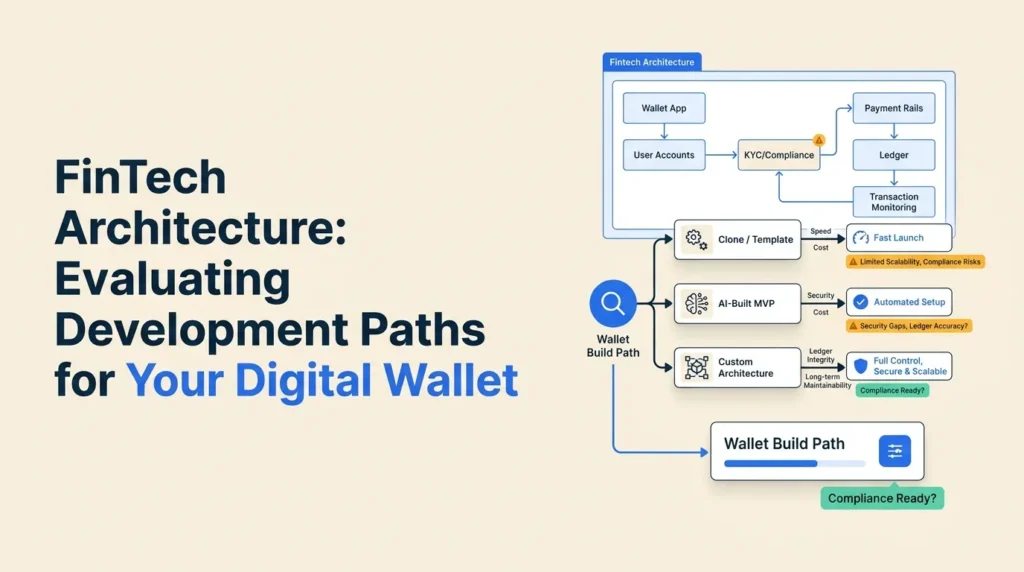
Read More: FinTech Architecture: Evaluating Development Paths for Your Digital Wallet
Founder Decision Signals
Speed
If compliance is added after launch, founders often lose time rebuilding data flows, permissions, and audit logs. Build the baseline before procurement review begins.
Risk
Regulated buyers do not only evaluate features. They evaluate whether your app can protect sensitive data, prove access discipline, and support incident response.
Sales
A stronger compliance baseline helps founders answer security questionnaires faster and reduces friction during enterprise vendor onboarding.
Control
Source-code ownership, admin permissions, documentation, and deployment control matter because compliance depends on how the app is operated after handoff.
The Pre-Launch Audit Checklist: Encryption, Logs, and Access Control
Use this checklist before launching a healthcare app, fintech app, marketplace, ecommerce platform, delivery app, creator platform, or enterprise SaaS product.
| Compliance Area | What to Check Before Launch | Why It Matters |
|---|---|---|
| Data inventory | Identify what personal, health, payment, identity, and business data the app collects | You cannot protect data if you cannot map it |
| Data classification | Separate public, internal, confidential, restricted, PHI, payment, and identity data | Different data types require different controls |
| Encryption at rest | Confirm databases, backups, files, and storage volumes are encrypted | Protects stored sensitive records |
| Encryption in transit | Enforce HTTPS/TLS for app, web, API, and third-party traffic | Protects data moving across networks |
| Key management | Store keys securely and restrict access | Encryption fails if keys are exposed |
| Secure logging | Log access, changes, exports, admin activity, failed logins, and security events | Creates audit evidence |
| Log protection | Avoid passwords, full card numbers, PHI, and secrets in logs | Prevents logs from becoming a data leak |
| Role-based access | Define permissions by role and business need | Limits unnecessary access |
| MFA | Add multi-factor authentication for admins and high-risk roles | Reduces account takeover risk |
| Session control | Use timeout, token expiry, and device/session management | Prevents long-lived unauthorized sessions |
| API security | Use authentication, rate limits, validation, and abuse monitoring | Protects backend workflows |
| Payment tokenization | Use gateway tokens instead of storing raw card data | Reduces PCI-DSS exposure |
| Vulnerability scanning | Scan dependencies, code, APIs, and infrastructure | Finds issues before buyers do |
| Backup and recovery | Test encrypted backups and restoration procedures | Supports business continuity |
| Data deletion | Define deletion and retention workflows | Supports privacy and contract requirements |
| Incident response | Prepare escalation, investigation, notification, and containment steps | Required for serious enterprise trust |
| Documentation | Prepare architecture diagrams, access policies, security runbooks, and handoff docs | Helps pass procurement and audit review |
This checklist does not make an app automatically HIPAA-compliant, GDPR-compliant, or PCI-DSS compliant. It creates the baseline that makes formal review more practical.
How HIPAA, GDPR, and PCI-DSS Translate Into Product Architecture
Founders do not need to memorize every regulatory clause before building. But they do need to translate compliance expectations into app decisions.
HIPAA: Protect Electronic Health Information
HIPAA applies to covered entities and business associates in the U.S. healthcare ecosystem. If your app creates, receives, maintains, or transmits electronic protected health information, your architecture must support administrative, physical, and technical safeguards.
For product teams, this usually means:
- Access controls for patient, doctor, provider, and admin roles
- Audit logs for PHI access and changes
- Encrypted storage and transmission
- Authentication controls
- Incident response workflows
- Backup and recovery planning
- Vendor and hosting review
- Policy documentation
The safest wording for founders is “HIPAA-ready foundation” or “can be configured to support HIPAA workflows,” not “automatically HIPAA compliant.”
GDPR: Protect Personal Data and User Rights
GDPR applies when personal data of EU/EEA individuals is processed, regardless of whether the company itself is based in Europe in many scenarios.
For app architecture, GDPR readiness often means:
- Data minimisation
- Consent and lawful basis mapping
- Data export workflows
- Deletion or erasure workflows
- Privacy-conscious analytics
- Pseudonymisation or encryption where appropriate
- Records of processing support
- Data transfer review
- Breach notification workflows
- Vendor and processor documentation
GDPR is not only about cookie banners. It is about how personal data moves through the system.
PCI-DSS: Protect Cardholder Data
PCI-DSS matters when your product stores, processes, or transmits cardholder data. Many founders reduce their exposure by using trusted payment processors, hosted payment pages, tokenization, and limited storage of payment information.
For app architecture, PCI-DSS readiness often means:
- No raw card storage
- Tokenized payment references
- Secure payment gateway integration
- Webhook validation
- Transaction logging
- Restricted access to payment records
- Secure API design
- Vulnerability scanning
- Payment error handling that does not expose sensitive details
The stronger your payment architecture, the easier it becomes to answer enterprise payment security questions.
Read More: White-Label Practo App Security: Is It Really Safe in 2026?
Launching Secured White-Label Assets From Day 1
A white-label app can help founders move faster, but speed only creates business value when the product foundation is built with security, control, and audit readiness from the beginning.
The wrong white-label product can create serious risk. It may limit source code access, lack proper documentation, depend on weak admin controls, skip dependency scanning, or leave sensitive workflows unclear. For founders selling into healthcare, fintech, marketplaces, ecommerce, or other regulated sectors, those gaps can create friction during enterprise security reviews.
The right white-label foundation gives founders a stronger starting point with branded user apps, admin dashboards, source code access, role-based workflows, secure payment integration options, configurable hosting, API structure, testing support, QA processes, documentation handoff, and a post-launch support path.
This is where working with a security-conscious software development company becomes important. Miracuves helps founders launch ready-made and white-label app solutions with source-code ownership, admin control, branded workflows, and faster deployment. For regulated verticals, that matters because compliance depends not only on frontend screens, but also on backend architecture, logs, deployment discipline, permissions, and operational evidence.
A pre-engineered app foundation does not remove the need for legal review, audit preparation, or compliance-specific configuration. It does reduce the amount of product infrastructure a founder has to build from zero.
That is the real value: a faster launch path without treating security as an afterthought.
Read More: How Miracuves Delivers Enterprise-Grade Apps in Just 6 Days Without Cutting Corners
What Founders Should Ask Before Choosing a White-Label App Provider
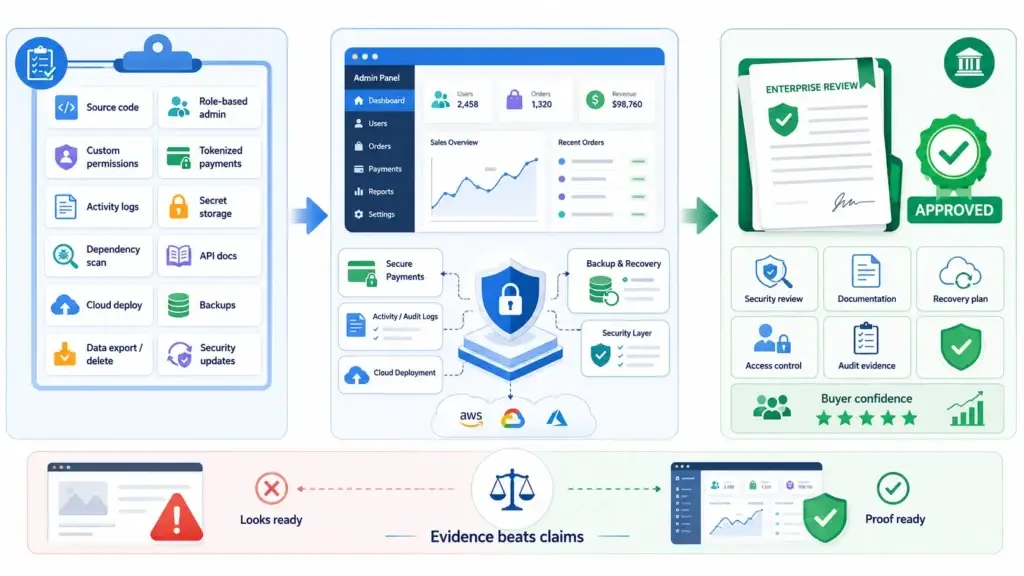
Before licensing any white-label engine, founders should ask direct security questions.
Can we access and own the source code?
Is the admin panel role-based?
Can permissions be customized?
Are payment integrations tokenized?
Are logs available for admin and user activity?
Are secrets stored outside the codebase?
Is there dependency scanning?
Is there API documentation?
Can we deploy to our preferred cloud environment?
Are backups and recovery workflows documented?
Can the platform support data deletion and export workflows?
Is there a post-launch security update path?
These questions protect the founder from buying a surface-level app that looks ready but fails institutional review.
A serious enterprise buyer will not accept “our app is secure” as proof. They will ask for evidence.
Read More: How Safe is a White-Label WooCommerce App? Security Guide 2026
Common Pre-Launch Compliance Mistakes Founders Should Avoid
Treating Compliance as a Post-Launch Task
This is the most expensive mistake. If encryption, logging, permissions, and data mapping are ignored during development, they usually require backend redesign later.
Giving Admin Users Too Much Access
Early teams often create one powerful admin role. That may work for testing, but it creates audit risk. Enterprise apps need permission separation.
Storing Sensitive Data Without a Clear Reason
Do not store card details, identity documents, health records, or private messages unless the business truly requires it. Less stored data usually means lower operational risk.
Forgetting Logs Until Something Goes Wrong
Logs are not only for debugging. They are proof during investigations, audits, and security reviews.
Assuming a Payment Gateway Makes Everything PCI-DSS Ready
A gateway helps, but your own app still needs secure integration, webhook validation, restricted access, and safe transaction handling.
Making Compliance Claims Without Evidence
Do not claim HIPAA, GDPR, or PCI-DSS compliance unless your legal, technical, and operational controls can support that claim. Use careful language such as “compliance-ready foundation” until formal validation is complete.
Miracuves Perspective: Build Faster, But Build With Audit Readiness
The founder’s challenge is clear: move fast enough to test the market, but build securely enough to survive enterprise review.
A custom build can be powerful, but it often takes longer because every module starts from zero. A generic low-cost script can be fast, but it may create hidden security, documentation, and ownership risks.
Miracuves’ white-label approach sits between those extremes. Founders can begin with a launch-ready product foundation, customize workflows, apply brand identity, configure admin controls, and retain source-code ownership. For regulated industries, this helps the team focus earlier on configuration, evidence, deployment choices, policies, and compliance-specific review.
That is how founders should think about compliance: not as a certificate pasted onto the website, but as a baseline that makes the product easier to trust, easier to review, and easier to sell.
Final Thoughts: Compliance Is a Sales Asset Before It Is an Audit Requirement
The strongest founders do not wait for a hospital, bank, insurer, enterprise client, or payment partner to ask security questions. They prepare answers before the sales conversation reaches procurement.
A pre-launch compliance checklist helps your team build with discipline. It pushes you to understand your data, restrict access, encrypt sensitive records, protect payment flows, document operations, and prepare evidence.
That does not guarantee HIPAA, GDPR, or PCI-DSS approval. But it does create a stronger product foundation.
For founders entering regulated markets, compliance is not only about avoiding risk. It is about becoming credible enough for serious buyers to trust.
FAQs
What is a pre-launch compliance checklist?
A pre-launch compliance checklist is a security and documentation review completed before an app goes live. It helps founders verify encryption, access controls, audit logs, payment security, data retention, backups, API protection, and incident response readiness.
Does this checklist make my app HIPAA compliant?
No. A checklist alone does not guarantee HIPAA compliance. HIPAA compliance depends on the app’s role, data flows, hosting, policies, contracts, access controls, documentation, and legal review. The checklist helps prepare a compliance-ready technical foundation.
What security controls matter most for GDPR-ready apps?
GDPR-ready apps should focus on data minimisation, encryption or pseudonymisation where appropriate, user rights workflows, secure access controls, breach response, vendor documentation, and clear records of how personal data is processed.
Does PCI-DSS apply if I use Stripe, PayPal, or another payment gateway?
Using a payment gateway can reduce PCI-DSS scope, especially when tokenization or hosted payment flows are used. However, your app still needs secure integration, webhook validation, restricted access, and safe transaction logging.
Why do enterprise buyers ask for audit logs?
Audit logs help prove who accessed data, what changed, when the event happened, and whether suspicious activity occurred. They are essential for investigations, compliance review, and vendor security questionnaires.
Is a white-label app safe for regulated industries?
A white-label app can be safe if it includes secure architecture, source-code ownership, role-based access, documentation, secure deployment options, and compliance-ready workflows. The founder must still configure, host, operate, and audit the app responsibly.
What should founders prepare before a B2B security review?
Founders should prepare architecture diagrams, data flow maps, access control policies, encryption details, vulnerability scan results, API documentation, incident response plans, backup procedures, and admin permission records.