Key Takeaways
- An InDrive clone app helps founders launch a ride-hailing platform with flexible fare negotiation, driver matching, real-time tracking, and scalable mobility infrastructure.
- Unlike traditional taxi apps, InDrive-style platforms allow riders and drivers to negotiate ride prices directly before trip confirmation.
- A scalable ride-hailing platform requires rider apps, driver apps, admin dashboards, dispatch systems, payment integrations, and live GPS tracking.
- Founders should focus on local market operations, driver onboarding, pricing strategy, and ride availability before expanding globally.
- Long-term platform growth depends on real-time infrastructure, low-latency dispatching, fraud prevention, route optimization, and scalable cloud architecture.
Ride-Hailing Platform Signals
- Rider apps should support live booking, fare negotiation, route tracking, ride history, digital payments, ratings, and trip notifications.
- Driver apps should include trip requests, earnings dashboards, navigation tools, ride acceptance, wallet systems, and availability controls.
- Admin panels should manage drivers, riders, commissions, disputes, pricing rules, analytics, promotions, and regional operations.
- The backend architecture must support real-time GPS tracking, socket communication, trip matching, payment workflows, and scalable APIs.
- Performance optimization depends on cloud deployment, caching, geolocation indexing, queue systems, and reliable notification infrastructure.
Real Insights
- An InDrive clone app is not just a taxi booking solution; it is a dynamic mobility marketplace built around flexible pricing and driver-rider interaction.
- Many ride-hailing startups fail because they underestimate operational challenges such as driver retention, surge balancing, fraud prevention, and regional compliance.
- Launching in underserved cities or niche transport segments often creates better traction than competing directly in highly saturated metro markets.
- Revenue can come from ride commissions, subscription plans, surge pricing, ads, corporate transport partnerships, and premium ride categories.
- Miracuves provides scalable InDrive Clone solutions with rider apps, driver apps, admin dashboards, payment systems, and customizable ride-hailing infrastructure.
The ride-hailing market is no longer defined only by Uber-style fixed pricing. In many emerging markets, riders want affordability, drivers want more control, and platform operators need a business model that can scale city by city without forcing every ride into the same algorithmic pricing structure.
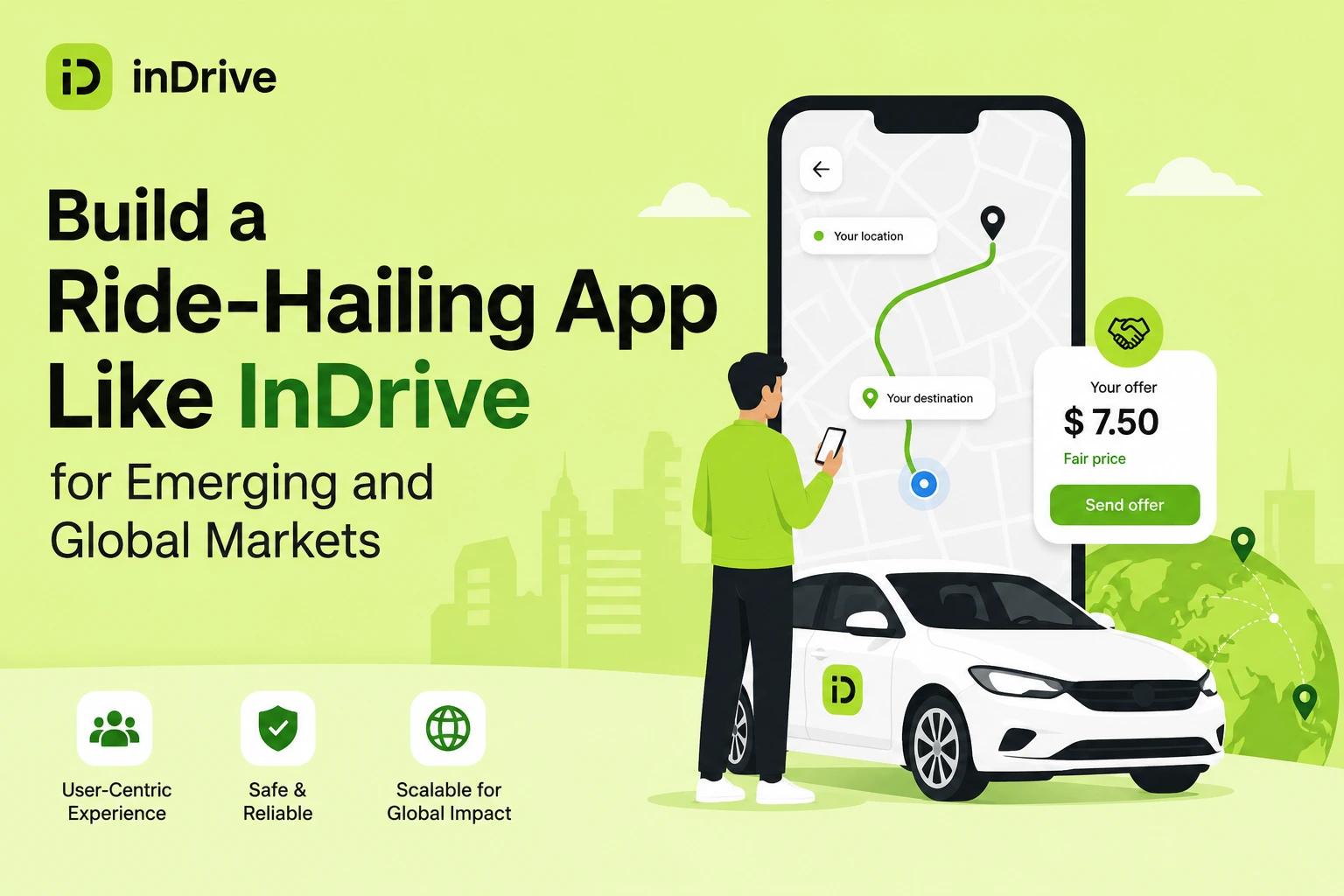
That is why founders are increasingly exploring how to build a Ride-Hailing App Like InDrive.
The inDrive model stands out because it gives riders and drivers room to negotiate fares instead of depending entirely on automated surge pricing. inDrive own app positioning highlights city rides, intercity rides, courier delivery, and the idea that a fair price is agreed between both sides, not simply imposed by the platform.
For founders, this creates a different kind of opportunity. A ride-hailing app like InDrive clone is not just a taxi booking product. It is a marketplace where pricing flexibility, driver freedom, trust, local affordability, and operational control become the foundation of growth.
Miracuves helps founders build ready-made, white-label, source-code-owned ride-hailing platforms that can be customized for local markets, driver workflows, fare negotiation, admin control, and faster launch. The stronger opportunity is not copying inDrive feature by feature. It is understanding why the model works and adapting it for your own market.
Why the InDrive Model Is Growing in Emerging Markets
The core reason the inDrive-style model works is simple: it gives both sides of the marketplace more pricing control.
In traditional ride-hailing apps, the platform usually calculates the fare based on distance, time, demand, traffic, and pricing rules. That can work well in mature markets, but it can create friction in cities where customers are price-sensitive and drivers are selective about which rides they accept.
A fare negotiation taxi app changes this flow. The rider proposes a fare, nearby drivers can accept it or make a counteroffer, and the rider can choose based on price, driver rating, vehicle, distance, and arrival time.
inDrive has positioned this model around control, fairness, and affordability. Reuters reported in March 2026 that inDrive differentiates itself from Uber and Grab by allowing drivers and riders to negotiate fares, with strong appeal among price-conscious users in emerging markets.
This matters for founders because emerging markets often have:
| Market Condition | Why Fare Negotiation Helps |
|---|---|
| Price-sensitive riders | Riders can suggest what they are willing to pay |
| Driver income concerns | Drivers can reject low fares or counteroffer |
| Uneven city demand | Pricing can adapt to local behavior instead of one fixed algorithm |
| Cash-heavy economies | Platforms can support flexible payment behavior |
| Trust-building needs | Riders can choose drivers based on rating, price, vehicle, and trip history |
A Ride-Hailing App Like InDrive can therefore become a stronger fit for markets where users value control over automation.
What Makes a Ride-Hailing App Like InDrive Different From Uber-Style Apps?
An Uber-style app usually depends on automatic ride assignment and platform-led pricing. A ride-hailing app like InDrive clone depends more on rider-driver choice, fare negotiation, and marketplace transparency.
| Comparison Point | Uber-Style Ride-Hailing App | InDrive-Style Ride-Hailing App |
|---|---|---|
| Pricing model | Algorithm-driven fare | Rider proposes fare, driver accepts or counters |
| Driver control | Driver accepts or rejects assigned ride | Driver can choose rides based on route, fare, and rider details |
| Rider control | Rider usually gets matched automatically | Rider can choose from available driver offers |
| Marketplace psychology | Convenience-first | Control, affordability, and fairness-first |
| Surge logic | Often demand-based dynamic pricing | Can be built as surge-free or negotiation-led pricing |
| Best-fit markets | Mature, convenience-driven cities | Emerging, price-sensitive, driver-led, or underserved markets |
| Platform challenge | Optimizing automation | Balancing negotiation speed, fairness, and liquidity |
For founders, this difference affects the entire product. The app is not just a booking interface. It needs a bidding workflow, offer management logic, real-time driver availability, fair pricing suggestions, anti-abuse controls, and a strong admin dashboard.
Core Features Every Modern Ride-Hailing App Like InDrive Needs
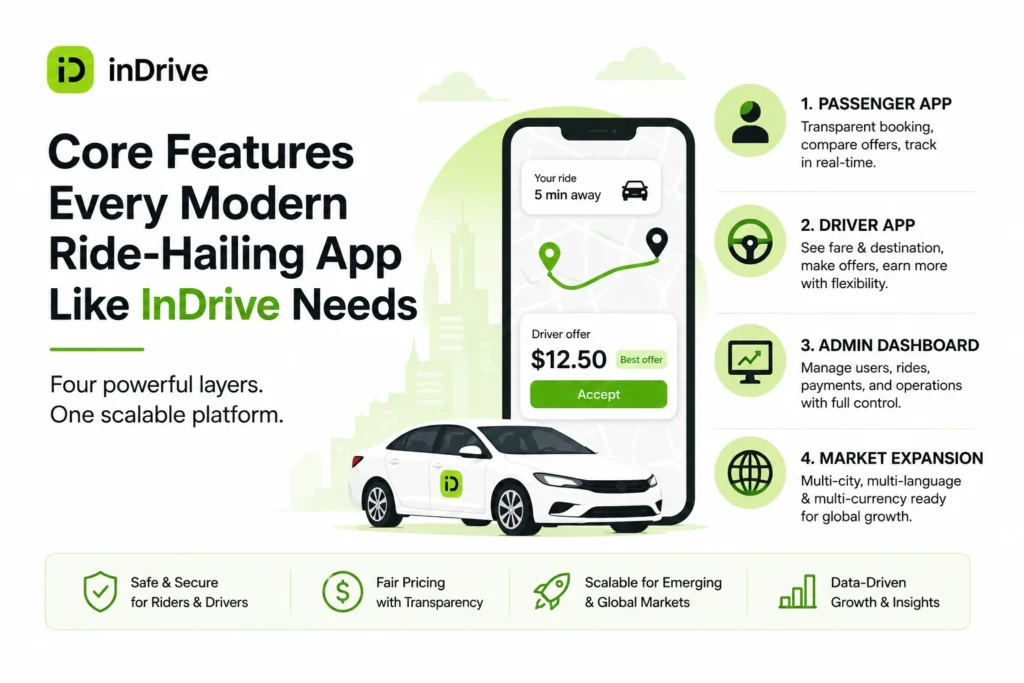
A scalable ride-hailing platform should be built around four product layers: passenger experience, driver control, admin operations, and market expansion.
Passenger App Features
Passengers need speed, transparency, and confidence before confirming a ride.
Important passenger-side features include:
- User registration and profile management
- Pickup and drop-off selection
- Fare suggestion and custom fare entry
- Driver offer comparison
- Driver profile, rating, vehicle details, and completed trip count
- Real-time GPS tracking
- In-app chat and masked calling
- Multiple payment options
- Trip history and invoices
- SOS and ride-sharing safety options
- Ratings, reviews, and complaints
- Promo codes and referral rewards
The rider experience should make fare negotiation feel simple, not confusing. A strong app should guide users with suggested fare ranges, estimated pickup time, and clear driver comparisons.
Driver App Features
Drivers are the supply engine of a ride-hailing marketplace. If they feel controlled, underpaid, or penalized unfairly, liquidity becomes difficult.
Driver-side features should include:
- Driver registration and document verification
- Vehicle profile management
- Ride request feed
- Accept, reject, or counteroffer workflow
- Pickup and destination visibility
- Live navigation
- Earnings dashboard
- Wallet and payout history
- Driver ratings and feedback
- Availability toggle
- In-app support
- Emergency tools
- Cancellation reason tracking
inDrive’s app store description highlights that drivers can see the rider’s drop-off location and fare before accepting, and can offer their own fare or skip rides. That is a key product insight for any founder building a ride bidding app.
Admin Dashboard Features
The admin panel is where the platform operator controls the business.
A strong admin dashboard should include:
- User, driver, and fleet management
- Ride monitoring
- Commission settings
- Fare rules and suggested fare logic
- City-wise pricing controls
- Driver document approval
- Payment and payout management
- Dispute management
- Promo code and referral management
- Cancellation monitoring
- Fraud alerts
- Support ticket management
- Analytics and reporting
- Multi-language and multi-currency configuration
For a multi-country taxi app, the admin layer is not optional. It decides whether the founder can adjust operations city by city without depending on developers for every small change.
Fleet Management Features
Many ride-hailing startups eventually work with fleet owners, rental car operators, taxi associations, corporate transport vendors, and logistics partners.
Fleet features can include:
| Fleet Feature | Business Value |
|---|---|
| Fleet owner dashboard | Allows partners to manage vehicles and drivers |
| Vehicle document tracking | Helps maintain operational compliance |
| Driver assignment | Supports organized fleet operations |
| Earnings reports | Gives fleet owners revenue visibility |
| Commission rules | Enables different partner agreements |
| Performance analytics | Helps identify high-performing drivers and routes |
This creates a stronger B2B layer for founders who want to expand beyond individual drivers.
How Fare Negotiation Engines Work in Ride-Hailing Apps
The fare negotiation engine is the heart of a Ride-Hailing App Like InDrive.
A basic ride request flow looks like this:
- The passenger enters pickup and drop-off locations.
- The app suggests a reference fare based on distance, estimated time, city rules, and demand.
- The passenger enters or accepts a fare.
- Nearby eligible drivers receive the request.
- Drivers can accept, reject, or counteroffer.
- The passenger compares available driver offers.
- The passenger selects a driver.
- The ride is confirmed and tracked in real time.
The real challenge is not the screen. It is the logic behind it.
A strong fare negotiation engine should consider:
| Logic Layer | What It Does |
|---|---|
| Fare suggestion | Helps riders avoid unrealistic offers |
| Driver counteroffer | Allows drivers to protect earnings |
| Offer expiration | Prevents stale offers from blocking ride flow |
| Geo-radius matching | Sends requests to relevant nearby drivers |
| Ride acceptance scoring | Prioritizes reliable drivers and relevant offers |
| Abuse prevention | Detects repeated fake rides, fare manipulation, or suspicious cancellations |
| Admin fare guidance | Lets platform operators set city-level floor suggestions |
The goal is to create flexibility without chaos. Riders should feel they are saving money, drivers should feel they have choice, and the platform should still protect service quality.
Ride Matching Architecture Behind Scalable Taxi Platforms
Most competitor pages mention GPS tracking. Very few explain what actually makes a scalable taxi dispatch system work.
A ride-hailing app like InDrive needs a real-time architecture that can handle location updates, driver availability, fare offers, ride confirmations, cancellations, payments, and safety events without slowing down.
Core Architecture Layers
| Layer | Role in the Platform |
|---|---|
| Mobile apps | Passenger and driver interfaces |
| API gateway | Handles app requests securely |
| Real-time communication | WebSockets or similar infrastructure for ride offers, location, and status updates |
| Geo-dispatch engine | Finds drivers based on distance, availability, vehicle type, and city rules |
| Ride management service | Controls ride lifecycle from request to completion |
| Fare negotiation service | Manages offers, counteroffers, expiry, and confirmations |
| Payment service | Handles cards, wallets, cash, payouts, refunds, and invoices |
| Notification service | Sends push alerts, SMS, email, and in-app updates |
| Admin dashboard | Controls operations, pricing, users, disputes, and analytics |
| Analytics engine | Tracks demand, driver density, cancellations, revenue, and city performance |
Why Real-Time Driver State Matters
Driver state synchronization is one of the most important backend challenges.
A driver can be:
- Offline
- Online but idle
- Reviewing a request
- Negotiating a fare
- En route to pickup
- On trip
- Temporarily unavailable
- Suspended or under review
If the backend does not track this correctly, the platform may send requests to unavailable drivers, create duplicate offers, delay dispatch, or frustrate riders.
Why Event Queues Matter
At scale, ride-hailing platforms generate constant events:
- Driver location updates
- Ride requests
- Fare offers
- Counteroffers
- Cancellations
- Payment status updates
- SOS triggers
- Support tickets
- Rating submissions
Event queues help process these activities reliably without overloading the system. This is especially important for cities with peak-hour spikes.
Founder Decision Signals
Speed
Choose a ready-made foundation if your priority is launching quickly, testing market demand, and avoiding a long build cycle from zero.
Cost
Focus on the modules you truly need first: rider app, driver app, admin dashboard, fare negotiation, payments, tracking, and safety workflows.
Scalability
Check whether the platform can handle real-time driver location, city-wise pricing, payment localization, and marketplace expansion.
Market Fit
A bidding-based ride model is strongest when riders value affordability and drivers want more freedom over fare acceptance.
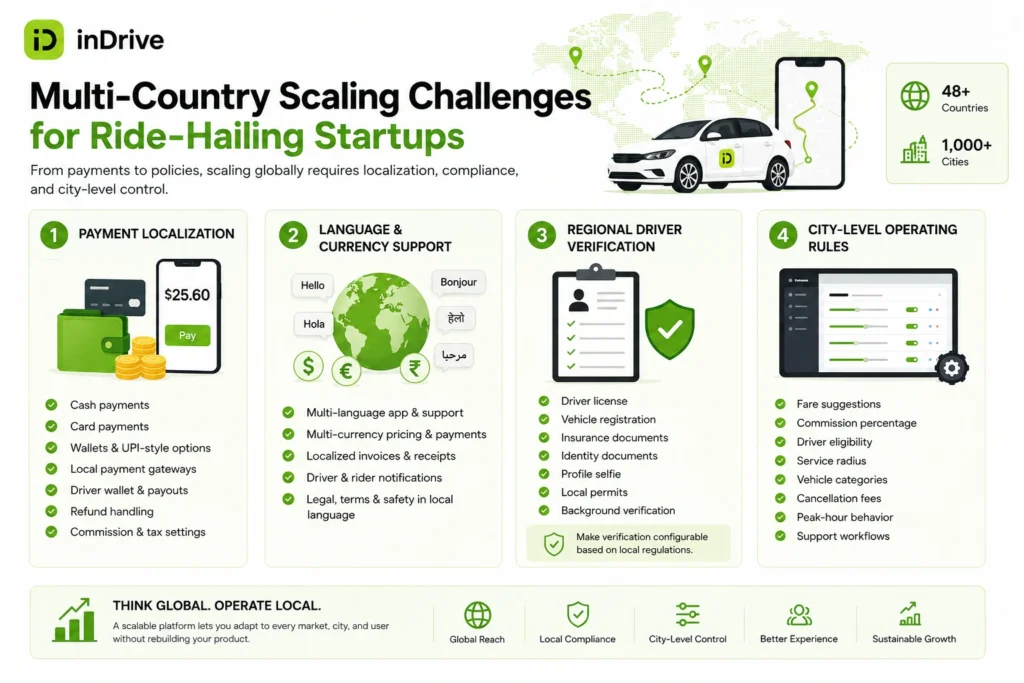
Multi-Country Scaling Challenges for Ride-Hailing Startups
Building for one city is different from building for global markets.
inDrive’s own public profiles describe its presence across more than 1,000 cities and 48 countries, showing how deeply localization matters in this category.
A founder planning a global or emerging-market ride-hailing app must think through several expansion layers.
1. Payment Localization
Different markets use different payment behaviors.
Some cities may depend heavily on cash. Others may prefer cards, wallets, UPI-style transfers, bank transfers, mobile money, or local payment gateways.
A scalable ride-hailing platform should support:
- Cash payments
- Card payments
- Wallets
- Local payment gateways
- Driver wallet and payout workflows
- Refund handling
- Commission deductions
- Regional tax or invoice settings
2. Language and Currency Support
Multi-language and multi-currency support should not be treated as cosmetic. It affects onboarding, trust, support, invoices, driver instructions, dispute flows, and legal notices.
3. Regional Driver Verification
Driver onboarding varies by market. A platform may need to collect:
- Driver license
- Vehicle registration
- Insurance documents
- Identity documents
- Profile selfie
- Local permits
- Background verification documents
Final compliance depends on jurisdiction, legal review, integrations, and operating model, so founders should treat verification as a configurable workflow rather than a one-time feature.
4. City-Level Operating Rules
Each city may need different rules for:
- Fare suggestions
- Commission percentage
- Driver eligibility
- Service radius
- Vehicle categories
- Cancellation fees
- Peak-hour behavior
- Support workflows
A scalable admin dashboard should let operators manage these differences without rebuilding the platform.
How to Solve the Driver-Passenger Cold Start Problem
The hardest part of launching a ride-hailing marketplace is not building the app. It is creating marketplace liquidity.
Marketplace liquidity means riders can find drivers quickly, and drivers can find enough ride requests to stay active.
A new city usually faces three cold-start risks:
| Cold-Start Risk | What Happens |
|---|---|
| Too few drivers | Riders wait too long and leave |
| Too few riders | Drivers stop opening the app |
| Poor geographic density | Supply and demand exist, but not in the same zones |
Practical City Launch Strategy
Founders should avoid launching everywhere at once. A better strategy is to focus on high-density zones first.
Useful launch zones include:
- Airport routes
- Business districts
- University areas
- Tourist zones
- Residential-to-office corridors
- Transit hubs
- Event venues
The first goal is not full city coverage. The first goal is repeatable ride density.
Driver Incentives That Actually Help
For an inDrive-style platform, driver acquisition should focus on freedom and earnings visibility.
Useful incentives include:
- Lower early-stage commission
- Driver referral rewards
- Faster payout cycles
- Route visibility before acceptance
- Counteroffer flexibility
- Fleet owner partnerships
- Local taxi association onboarding
The platform should make drivers feel that the app helps them earn, not just follow commands.
Monetization Models Beyond Ride Commissions
Most ride-hailing blogs stop at commissions. That is too narrow.
A Ride-Hailing App Like InDrive can support multiple monetization streams.
| Monetization Model | How It Works | Founder Value |
|---|---|---|
| Ride commission | Platform takes a percentage or fixed fee per ride | Core revenue model |
| Driver subscription | Drivers pay a monthly fee for access or premium tools | Predictable recurring revenue |
| Fleet SaaS | Fleet owners pay for dashboards, reports, and management tools | B2B expansion |
| Featured driver placement | Drivers pay for better visibility where legally and ethically allowed | Additional marketplace revenue |
| Corporate transport | Companies book rides for employees | Higher-value contracts |
| Courier delivery | Use driver network for parcels | Expands utility beyond rides |
| Intercity rides | Longer-distance ride marketplace | Higher transaction value |
| Ads and local promotions | Promote local businesses inside the app | Local monetization |
| Insurance partnerships | Offer driver or rider protection products through partners | Ecosystem revenue |
| API partnerships | Provide mobility access to hotels, travel apps, or corporate tools | Platform expansion |
Reuters reported that inDrive is looking to expand delivery offerings in developing countries and has made acquisitions in grocery delivery in Pakistan and Kazakhstan. This supports the broader point: ride-hailing platforms can evolve into larger mobility and urban service ecosystems.
AI Features Modern Ride-Hailing Apps Are Adding
AI should not be added as a buzzword. It should solve operational problems.
Useful AI-driven features include:
| AI Feature | Practical Use |
|---|---|
| ETA prediction | Improves rider expectations and driver planning |
| Demand forecasting | Helps operators identify high-demand zones |
| Fraud detection | Flags fake GPS, suspicious cancellations, or abnormal ride behavior |
| Route optimization | Helps drivers reduce wasted time |
| Fare suggestion intelligence | Recommends fair offer ranges based on distance, time, and market behavior |
| Driver risk scoring | Helps identify repeated safety or service issues |
| Support automation | Speeds up common dispute and refund workflows |
| Churn prediction | Identifies drivers or riders likely to stop using the app |
For founders, AI should support marketplace efficiency, safety, and retention. It should not replace the basic need for clean workflows and reliable dispatch.
Read more : Build a Ride-Hailing App Like InDrive for Emerging and Global Markets
Security and Compliance for Global Ride-Hailing Apps
Security is not a marketing add-on. It is part of the product foundation.
inDrive’s official passenger safety page highlights verified drivers, privacy protection, ride sharing, emergency calling, emergency contacts, and 24/7 support. Its driver safety page also highlights passenger verification, safe feed monitoring, anonymous communication, emergency tools, and support.
A modern ride-hailing app should include:
- Driver and passenger verification
- Role-based access control
- Encrypted data transfer
- Secure payment gateway integration
- Masked calls and in-app chat
- SOS button
- Emergency contact alerts
- Ride sharing with trusted contacts
- Trip history and audit logs
- Fake GPS detection
- Device risk monitoring
- Fraud and cancellation monitoring
- Dispute management
- Admin activity logs
For global markets, founders should also prepare for privacy, payment, transport, insurance, and local mobility rules. The platform can support compliance workflows, but final compliance depends on the target country, legal review, integrations, and operating model. This careful wording follows Miracuves’ security and compliance language rules.
Cost to Build a Ride-Hailing App Like InDrive
The cost to build a Ride-Hailing App Like InDrive depends on the selected modules, design depth, tech stack, customization, integrations, launch region, and scale requirements.
Founders should avoid treating cost as a single number. A bidding-based taxi app has more complexity than a basic taxi booking app because it needs fare negotiation, offer expiry, counteroffers, driver selection, real-time state management, and stronger admin controls.
Main Cost Drivers
| Cost Factor | Why It Matters |
|---|---|
| Passenger and driver apps | Core booking, negotiation, tracking, payments, and communication |
| Admin dashboard | Controls users, drivers, commissions, disputes, pricing, and reports |
| Fare negotiation engine | Adds offer, counteroffer, expiry, and acceptance logic |
| Real-time dispatch | Requires GPS streaming, driver state, and low-latency matching |
| Payment integrations | Varies by country, payment gateway, wallet, payout, and tax needs |
| Safety features | SOS, verification, masked calls, trip sharing, fraud alerts |
| Localization | Multi-language, multi-currency, regional settings |
| Fleet management | Adds B2B partner workflows |
| AI and analytics | Adds demand forecasting, fraud detection, and performance insights |
| Custom branding | UI, brand identity, app store assets, and user experience refinement |
Miracuves’ ready-made approach can reduce development time because the foundation already includes core app flows, admin control, and essential modules. Final pricing should be confirmed based on selected features, integrations, branding, and customization scope, which aligns with Miracuves’ pricing rules.
Why White-Label Ride-Hailing Platforms Reduce Time-to-Market
Building every ride-hailing module from zero can slow down validation. For founders entering competitive mobility markets, delay has a cost.
A white-label ride-hailing platform gives you a launch-ready foundation that can be customized around:
- Brand identity
- City-specific pricing
- Fare negotiation rules
- Driver onboarding
- Payment methods
- Commission logic
- Safety workflows
- Language and currency
- Admin reporting
- Future expansion modules
Miracuves’ white-label app approach is useful for founders who want source-code ownership, admin control, custom branding, and faster market validation without starting from a blank development cycle. Miracuves’ solution ecosystem is built around ready-made, white-label, source-code-owned app solutions for founders, startups, agencies, and businesses.
The smarter question is not “Can we copy inDrive?” The smarter question is “Can we build a flexible ride-hailing platform that fits our target market better than a fixed-price taxi app?”
Super-App Expansion Opportunities for InDrive-Style Platforms
A ride-hailing platform can become more valuable when it expands into adjacent services.
Potential expansion modules include:
| Expansion Module | Why It Works |
|---|---|
| Parcel delivery | Uses driver network during ride demand gaps |
| Intercity rides | Extends value beyond city trips |
| Bike taxi | Useful in dense urban markets |
| EV rides | Supports sustainability-focused positioning |
| Women-only rides | Builds trust in safety-sensitive markets |
| Corporate transport | Creates recurring B2B demand |
| Airport transfers | High-frequency, high-intent travel use case |
| B2B logistics | Uses mobility infrastructure for business deliveries |
| Fleet partner dashboard | Helps onboard professional transport operators |
The key is sequencing. Founders should not launch every module at once. Start with the strongest local mobility use case, build liquidity, then expand into adjacent services.
Mistakes Founders Should Avoid
Mistakes Founders Should Avoid
Building Only a Feature List
A ride-hailing app is a live marketplace. Passenger app, driver app, and admin panel are only the surface. The real value comes from dispatch logic, pricing control, driver supply, safety workflows, and city-level operations.
Ignoring Driver Economics
If drivers do not see enough value, they will leave. Fare negotiation, payout visibility, route transparency, and fair commission logic matter as much as rider acquisition.
Launching Too Many Cities Too Early
Thin supply across many regions creates bad rider experience. It is better to build strong liquidity in selected zones before expanding.
Treating Safety as a Later Feature
Verification, SOS, trip sharing, masked communication, fraud detection, and support workflows should be part of the foundation, not a post-launch patch.
Final Thoughts: Build for Local Control, Driver Trust, and Scalable Growth
A Ride-Hailing App Like InDrive is not successful because of fare negotiation alone. It works because the model gives riders affordability, drivers more choice, and operators a flexible way to adapt pricing across different markets.
For founders, the opportunity is strongest in cities where users are price-sensitive, taxi supply is fragmented, driver earnings matter, and fixed-price ride-hailing models feel too rigid.
The right product should combine a bidding engine, real-time dispatch, driver density strategy, localized payments, safety controls, admin intelligence, and future expansion into delivery, intercity, corporate transport, or fleet services.
Miracuves helps founders launch faster with ready-made and white-label ride-hailing app solutions that can be customized for fare negotiation, driver workflows, admin control, source-code ownership, and market-specific growth.
FAQs
What is a Ride-Hailing App Like InDrive?
A Ride-Hailing App Like InDrive is a taxi booking platform where riders can propose a fare and drivers can accept, reject, or counteroffer. Unlike fixed-price ride-hailing apps, the inDrive-style model gives both riders and drivers more control over pricing.
How is an inDrive-style app different from an Uber clone?
An Uber-style app usually uses algorithmic pricing and automated matching, while an inDrive-style app focuses on fare negotiation, driver choice, rider selection, and marketplace transparency. This makes it more suitable for price-sensitive and emerging markets.
What are the must-have features of a ride-hailing app like InDrive?
The core features include passenger app, driver app, admin dashboard, fare negotiation engine, real-time GPS tracking, driver offer comparison, payments, masked communication, ratings, SOS, document verification, and dispute management.
How much does it cost to build a Ride-Hailing App Like InDrive?
The cost depends on features, integrations, tech stack, customization, payment gateways, safety workflows, admin modules, and launch scope. A ready-made white-label solution can reduce development time because the core foundation is already available.
Why is driver liquidity important in ride-hailing apps?
Driver liquidity ensures riders can find nearby drivers quickly. Without enough active drivers in the right zones, wait times increase and users leave. Founders should focus on city-level density before expanding too widely.
Does Miracuves provide a white-label ride-hailing app solution?
Yes. Miracuves helps founders build ready-made and white-label ride-hailing platforms with branding, admin control, source-code ownership, driver workflows, and faster launch support.