


Key Takeaways
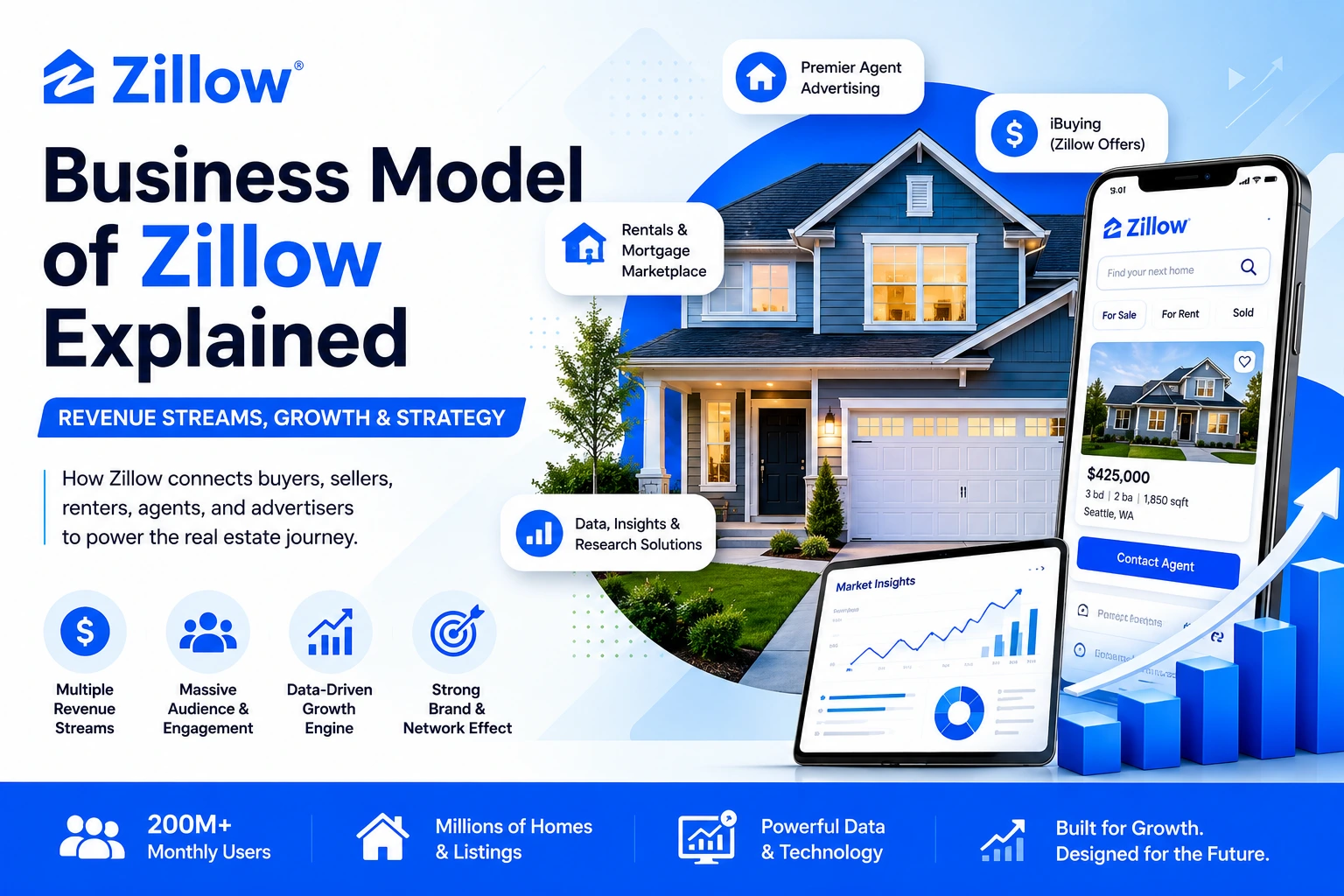
- Zillow’s business model is built around real estate listings, lead generation, agent advertising, mortgage services, rentals, and property data monetization.
- Its largest revenue driver comes from connecting homebuyers and sellers with real estate agents through paid lead and advertising programs.
- Zillow combines marketplace traffic, property search tools, Zestimate valuation technology, and real estate analytics to keep users engaged throughout the home-buying journey.
- The platform monetizes multiple user groups including agents, landlords, lenders, advertisers, renters, and property professionals.
- Long-term success depends on user trust, property data accuracy, marketplace liquidity, lead quality, and scalable real estate infrastructure.
Revenue Model Signals
- Premier Agent advertising allows real estate professionals to pay for visibility and buyer leads within targeted property listings.
- Rental marketplace revenue comes from landlords, property managers, and rental professionals promoting listings and collecting tenant leads.
- Mortgage-related monetization includes lender partnerships, referral fees, mortgage lead generation, and financing integrations.
- Zillow’s massive property database and Zestimate feature help increase user engagement, repeat visits, and marketplace trust.
- Operational complexity changes based on MLS integrations, property data pipelines, mapping systems, lead routing, advertising infrastructure, and compliance requirements.
Real Insights
- Zillow is not only a property listing website; it is a real estate marketplace ecosystem driven by data, discovery, advertising, and transaction intent.
- The strongest part of Zillow’s strategy is user retention because buyers, renters, homeowners, and agents repeatedly return throughout different stages of the real estate cycle.
- Founders can learn from Zillow by building trust-first marketplaces with transparent pricing, searchable inventory, neighborhood insights, and lead-driven monetization.
- Real estate marketplaces become more valuable when they combine property discovery, financing support, analytics, and localized search experiences together.
- The future of Zillow-style platforms will depend on AI recommendations, predictive analytics, personalized search, integrated financing, and scalable real estate technology systems.
Zillow did not become one of the most recognized real estate platforms by simply putting property listings online. Its real strength is that it transformed fragmented housing discovery into a digital marketplace where buyers, sellers, renters, agents, landlords, lenders, and property managers interact around high-intent real estate decisions.
That is why the Business Model of Zillow is more than an advertising model. It is a real estate marketplace model built around traffic, trust, data, leads, financing, software, and transaction support.
Zillow describes itself as a housing super app that connects search, touring, financing, rental applications, agent workflows, and more into one ecosystem for renters, buyers, sellers, and real estate professionals.
For founders, this is the real lesson: Zillow won because it controlled demand before it expanded monetization. It attracted millions of users with free property search and home-value data, then converted that attention into revenue through agents, rentals, mortgages, software tools, and marketplace services.
Miracuves helps founders study these proven marketplace patterns and turn them into launch-ready, white-label app platforms with custom branding, admin dashboards, monetization workflows, and source-code ownership.
What Is Zillow? How Zillow Works
Zillow is a U.S.-based real estate technology marketplace that helps people search homes for sale, rental properties, agents, mortgages, and housing-related services. The platform became popular because it made property discovery easier, more visual, and more data-driven.
At the center of Zillow’s early growth was a simple but powerful idea: give consumers access to housing information that was previously hard to find. Zillow’s own company overview says the Zestimate opened access to home-value data and changed how people approach buying, selling, and renting.
From a business model perspective, Zillow operates across several layers:
- Consumer property search
- Real estate agent lead generation
- Rental listing marketplace
- Mortgage marketplace and Zillow Home Loans
- Real estate software tools
- Property data and valuation intelligence
- Rich media listing experiences
- Home transaction support
This makes Zillow a proptech ecosystem rather than a simple classified listings website.
For founders, Zillow is useful to study because it shows how a marketplace can begin with information access, scale through free user adoption, and monetize through professionals who need visibility, leads, and transaction support.
Zillow clone works by connecting high-intent consumers with real estate professionals and housing services. A buyer may search homes, save listings, check estimated values, request a tour, contact an agent, calculate affordability, or explore financing. A renter may search apartments, apply for rentals, or connect with property managers. Agents, landlords, builders, and lenders use Zillow to reach these users at the exact moment they are exploring housing decisions.
Zillow explains its marketplace as two-sided: one side includes consumers looking to buy, sell, rent, or finance a home; the other includes agents, landlords, property managers, builders, and mortgage lenders.
The platform flow looks like this:
- Consumers search for homes or rentals.
- Zillow captures demand through listings, maps, filters, Zestimate data, and saved searches.
- Consumers show intent by clicking, saving, requesting tours, applying, or asking for financing.
- Agents, property managers, lenders, or housing professionals pay to access or serve that demand.
- Zillow expands revenue by adding software, mortgage, rentals, and transaction-support layers.
This is why Zillow’s business model is powerful. It monetizes intent rather than only traffic.
A casual visitor may not generate revenue immediately. But a user who requests a tour, applies for a rental, contacts an agent, or starts mortgage pre-approval is commercially valuable because they are close to a transaction.
Read more : What Is Zillow Rentals and How Does It Work?
Zillow Business Model Explained
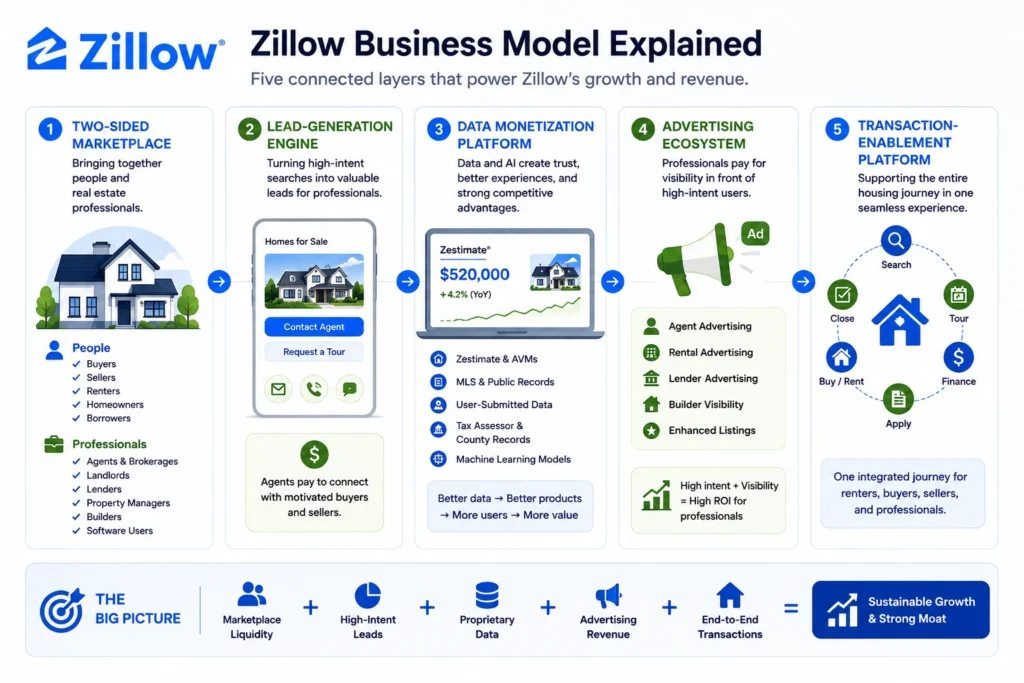
The Business Model of Zillow can be understood through five connected layers: marketplace, lead generation, data, advertising, and transaction enablement.
1. Zillow as a Two-Sided Real Estate Marketplace
Zillow brings together people who need housing decisions and professionals who need qualified customers.
On one side:
- Buyers
- Sellers
- Renters
- Homeowners
- Borrowers
On the other side:
- Real estate agents
- Brokerages
- Landlords
- Property managers
- Builders
- Mortgage lenders
- Software users
The more buyers and renters Zillow attracts, the more valuable it becomes for agents, landlords, and lenders. The more professionals participate, the more useful the platform becomes for consumers. This creates marketplace liquidity.
For founders, this is the first major lesson: a marketplace does not scale because it has features alone. It scales when both sides have a reason to keep returning.
2. Zillow as a Lead-Generation Engine
Zillow’s monetization is heavily connected to lead generation. When users search properties and request contact with agents or lenders, Zillow can convert that intent into agent advertising, referral-style models, mortgage opportunities, or professional services revenue.
Zillow says agents pay to advertise and connect with potential buyers and sellers, including users who click buttons such as “Contact Agent” or “Request a Tour.”
This model works because real estate transactions are high-value. Even a small number of qualified leads can justify advertising spend for agents or brokerages if those leads convert into transactions.
3. Zillow as a Data Monetization Platform
Zillow’s data does not only power user experience. It strengthens the platform’s competitive moat.
The Zestimate is a strong example. Zillow says the Zestimate uses public records, MLS data, user-submitted home details, county and tax assessor records, direct MLS feeds, and machine learning models to estimate home values.
This matters because data creates four business advantages:
- Users return to check home values.
- Homeowners update property facts, improving data quality.
- Buyers and sellers trust the platform as a research layer.
- Zillow can improve search, recommendations, pricing signals, and transaction tools.
The lesson for founders is clear: data should not be treated as a backend detail. In a marketplace, data can become acquisition, retention, trust, and monetization infrastructure.
4. Zillow as an Advertising Ecosystem
Zillow monetizes professionals who want visibility in front of real estate consumers. This includes agent advertising, rental advertising, lender advertising, builder visibility, and enhanced listing products.
Advertising works especially well when the platform owns high-intent traffic. A visitor browsing casually on social media is different from a user looking at a specific home, neighborhood, mortgage calculator, or rental application. Zillow’s advertising value comes from this intent.
5. Zillow as a Transaction-Enablement Platform
Zillow’s newer strategy is not only to show listings. It wants to support the full moving journey: search, tour, agent connection, financing, rental applications, selling, and closing-related workflows.
Zillow states that its strategy is to make moving easier by connecting the entire housing journey into one integrated end-to-end experience for renters, buyers, sellers, and professionals.
That is the core of its housing super app strategy.
Zillow Revenue Streams
Zillow makes money by connecting consumers with professionals and services while keeping property search largely free for users. Zillow’s official explanation lists agent advertising, rental advertising, mortgages, lender advertising, and software/tools as key revenue areas.
Zillow Revenue Streams Breakdown
| Revenue Stream | How It Works | Why It Matters |
|---|---|---|
| Premier Agent / Agent Advertising | Agents pay to reach buyers and sellers searching on Zillow. | Turns high-intent property traffic into agent leads. |
| Residential Revenue | Includes agent-related products, new construction marketplace, software tools, and listing experiences. | Core monetization layer for for-sale real estate. |
| Rentals Revenue | Property managers and landlords pay to advertise rental listings and reach renters. | Gives Zillow recurring marketplace revenue beyond home buying. |
| Mortgage Revenue | Zillow Home Loans and lender marketplace products generate revenue from financing activity. | Expands Zillow from discovery into transaction support. |
| Advertising and Media | Builders, lenders, agents, and property businesses pay for visibility. | Monetizes attention and buyer/renter intent. |
| Software and SaaS Tools | Tools such as agent software and showing/touring workflows support professionals. | Builds deeper professional dependency. |
| Enhanced Listings / Showcase | Rich listing experiences help agents and sellers present properties better. | Increases listing quality and professional monetization. |
| Closing and Transaction Services | Zillow’s broader strategy supports the end-to-end moving journey. | Strengthens the housing super app model. |
In Q1 2026, Zillow reported total revenue of $708 million, up 18% year over year. For Sale revenue grew 12% to $514 million, Residential revenue grew 8% to $450 million, Mortgages revenue grew 56% to $64 million, and Rentals revenue grew 42% to $183 million.
This shows that Zillow’s business model is no longer dependent on one simple advertising line. Rentals and mortgages are becoming important growth layers.
How Zillow Makes Money From Premier Agent and Residential Revenue
Premier Agent and related residential products have historically been central to Zillow’s monetization model.
The logic is simple: Zillow attracts home shoppers; agents need qualified buyers and sellers; Zillow sells access, visibility, and lead opportunities.
But the deeper strategy is more powerful. Zillow is not just selling impressions. It is selling proximity to transaction intent.
A user who searches “homes for sale in Austin under $600,000,” saves a home, checks a Zestimate, and requests a tour is much more valuable than a generic website visitor. Zillow can package that intent into agent advertising and partner workflows.
For founders building real estate marketplaces, this is the most important monetization lesson: do not monetize too early with generic ads. Build intent signals first. Then monetize the professionals who benefit from that intent.
Why Zillow Grew So Fast
Zillow’s growth was not accidental. It came from a strong combination of free tools, organic search, data utility, marketplace demand, and brand memory.
1. Zillow Made Real Estate Search Free and Easy
Before platforms like Zillow became mainstream, real estate information was less accessible to everyday consumers. Zillow changed that by making property browsing simple, visual, and open.
Free search built consumer trust before monetization expanded.
2. Zestimate Became a Viral Retention Tool
Zestimate gave homeowners and buyers a reason to visit Zillow even when they were not ready to transact.
Someone may not be buying today, but they may still check their home value, compare neighborhood prices, or monitor market trends. That creates repeat behavior.
3. SEO Became a Distribution Engine
Real estate is highly searchable. Users search by city, neighborhood, property type, price, school district, and mortgage terms.
Zillow’s listing pages, neighborhood pages, home-value pages, and market content created massive search visibility. This reduced dependence on paid acquisition and turned organic discovery into a growth engine.
4. Listings Created a Content Flywheel
Every listing is content. Every property page can attract traffic. Every search result page can help users narrow intent. Every saved search generates a signal.
This is why marketplace content is different from blog content. The product itself becomes SEO infrastructure.
5. Data Improved Trust
The more data Zillow collected and displayed, the more useful it became. Users could compare homes, prices, history, estimates, neighborhoods, photos, and financing options in one place.
6. Mobile Search Strengthened Habit Formation
Real estate discovery is emotional and visual. Mobile browsing made it easy for users to check listings repeatedly, save homes, share properties, and request tours.
Zillow’s company overview says Zillow Group apps have more than twice as many daily active users as the next company in the category, and more than 80% of its traffic comes directly to the platform.
That direct traffic matters because it signals brand strength and lower reliance on third-party discovery channels.
Zillow’s Competitive Advantage
Zillow’s competitive advantage comes from several connected moats.
Data Moat
Zillow has years of property, search, pricing, listing, and user behavior data. Zestimate alone uses large-scale public, MLS, and user-submitted data.
This data supports valuations, recommendations, search relevance, pricing confidence, and product improvement.
Brand Moat
Zillow became almost synonymous with online real estate search in the U.S. When users think about browsing homes, Zillow is often one of the first platforms they remember.
Brand recall lowers acquisition costs and increases direct traffic.
Marketplace Liquidity
Zillow has buyers, renters, sellers, agents, landlords, property managers, and lenders. This makes it difficult for smaller competitors to match the same level of supply and demand.
Product Ecosystem
Zillow connects listings, tours, agent workflows, rentals, mortgage tools, applications, and professional software. The more services it connects, the harder it becomes to compete with only a listings product.
AI and Rich Media Advantage
Zillow’s Q1 2026 shareholder letter says its AI strategy is supported by content, context, and integration, including rich media such as Zillow 3D Home tours, interactive floor plans, virtual staging, and SkyTour.
For founders, the lesson is that competitive advantage rarely comes from one feature. It comes from connected systems: data, distribution, trust, workflows, and monetization.
Zillow’s Failed iBuying Strategy: What Founders Should Learn
Zillow Offers was Zillow’s attempt to enter iBuying, where Zillow would buy homes directly, make improvements, and resell them.
At first glance, this looked like a natural expansion. Zillow had traffic, home-value data, and consumer trust. But iBuying created a completely different risk profile.
A listings marketplace is asset-light. Zillow does not need to own every property listed on the platform.
An iBuying business is asset-heavy. It requires pricing accuracy, capital, renovation operations, local market timing, inventory management, and resale execution.
The failure of Zillow Offers shows that data advantage does not automatically remove operational risk. Even strong algorithms can struggle when market conditions shift, renovation costs change, local demand fluctuates, and inventory sits longer than expected.
Startup Lessons From Zillow Offers
| Lesson | Why It Matters |
|---|---|
| Do not confuse marketplace visibility with operational control. | Having demand does not mean you can profitably manage physical inventory. |
| Asset-light models scale differently from asset-heavy models. | Marketplaces can grow faster because they do not carry the same balance-sheet risk. |
| Algorithms need operational reality checks. | Pricing models must account for local conditions, liquidity, repairs, and timing. |
| Expansion should match core strengths. | Zillow’s strength was demand, data, and lead flow; iBuying required logistics and inventory execution. |
| Test risk before scaling aggressively. | High-capital models need tighter validation loops. |
For founders, this is one of the most valuable parts of Zillow’s story. The right lesson is not “avoid innovation.” The right lesson is to understand the difference between software scale and operational scale.
Zillow’s Housing Super App Strategy
Zillow’s modern strategy is to become a housing super app. That means the platform wants to support more of the moving journey in one connected experience.
A housing super app may include:
- Home search
- Rental search
- Property valuation
- Agent connection
- Tour scheduling
- Mortgage pre-approval
- Loan origination
- Rental applications
- Listing media
- Seller tools
- Closing support
- Professional software
Zillow’s company overview says the platform connects search, touring, financing, rental applications, agent workflows, and more to reduce friction in housing decisions.
This strategy matters because real estate transactions are fragmented. Buyers often use one tool for search, another for mortgage, another for agent communication, another for documents, and another for closing. Zillow’s opportunity is to unify more of that journey.
For founders, the super app lesson is not to launch every feature on day one. The better approach is to start with one high-frequency marketplace use case, build trust, then expand into adjacent workflows.
Zillow Growth Strategy in 2026
Zillow’s 2026 growth strategy appears focused on integrated housing experiences, rentals expansion, mortgage growth, AI-enabled product improvements, and margin discipline.
In Q1 2026, Zillow reported 18% year-over-year revenue growth, 42% rentals growth, 56% mortgage growth, and $46 million of net income. It also stated that its Q2 outlook expected revenue of $750 million to $765 million and rentals revenue growth of approximately 30%.
Key 2026 Growth Priorities
| Growth Area | Strategic Meaning |
|---|---|
| Rentals expansion | Builds recurring marketplace activity beyond home purchases. |
| Mortgage growth | Moves Zillow closer to transaction monetization. |
| AI integration | Improves search, media, personalization, valuation, and user experience. |
| Rich media listings | Makes listings more immersive and useful for buyers. |
| Agent software tools | Deepens professional dependency on Zillow. |
| Housing super app | Connects fragmented steps into one ecosystem. |
| Cost discipline | Supports profitability while expanding products. |
The founder takeaway is that Zillow is moving from search marketplace to transaction infrastructure. That is a stronger business model because it captures more value from the same user journey.
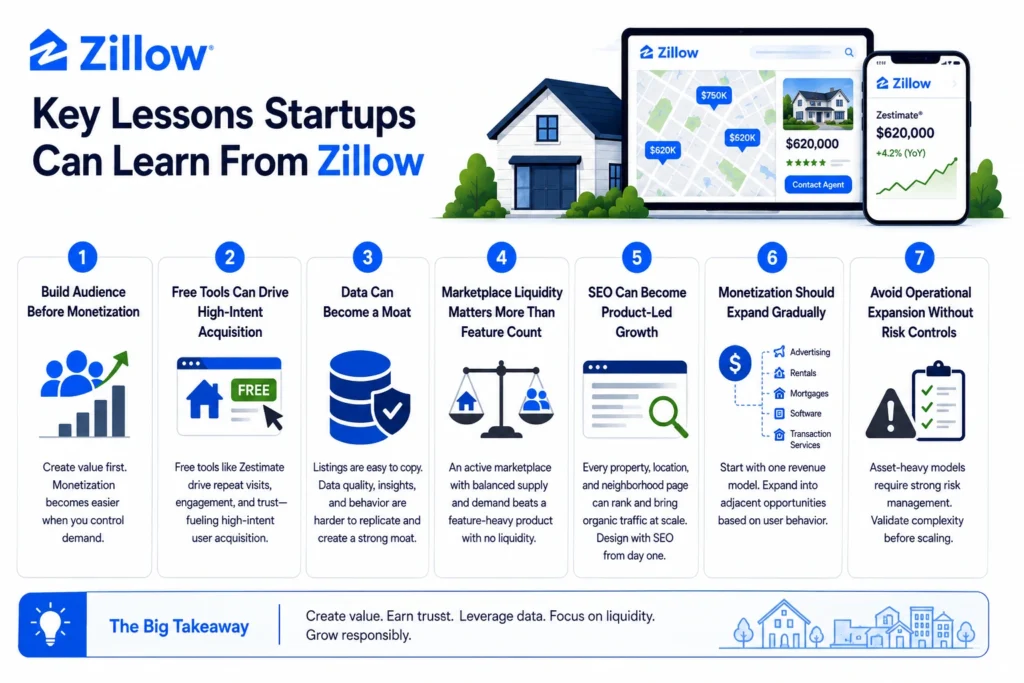
Key Lessons Startups Can Learn From Zillow
1. Build Audience Before Monetization
Zillow first created value for users by making real estate information accessible. Monetization became easier after the platform controlled demand.
Founders should avoid forcing monetization before users trust the product.
2. Free Tools Can Drive High-Intent Acquisition
Zestimate is a free tool, but it creates repeat visits, property engagement, and trust. A startup can apply the same logic with free calculators, valuation tools, comparison tools, eligibility checks, or market insights.
3. Data Can Become a Moat
Listings alone can be copied. Data quality, pricing intelligence, user behavior, and transaction history are harder to replicate.
4. Marketplace Liquidity Matters More Than Feature Count
A real estate marketplace with fewer but active buyers, agents, and listings is stronger than a feature-heavy app with no supply-demand balance.
5. SEO Can Become Product-Led Growth
Every property page, location page, and neighborhood page can become a search entry point. Founders should design marketplace architecture with SEO from the beginning.
6. Monetization Should Expand Gradually
Zillow expanded from advertising into rentals, mortgages, software, and transaction services. Startups can follow a similar path: start with one clear revenue model, then expand based on user behavior.
7. Avoid Operational Expansion Without Risk Controls
Zillow Offers showed that expanding into asset-heavy operations requires a different level of risk management. Founders should validate operational complexity before scaling capital-intensive models
How Startups Can Build a Zillow-Like Platform
A Zillow-like real estate marketplace should not begin as a copy of Zillow’s full ecosystem. It should begin with the strongest product foundation for the target market.
For example, a founder may start with:
- Residential property listings
- Rental listings
- Agent profiles
- Property search and filters
- Map-based discovery
- Saved searches
- Lead forms
- Tour requests
- Admin listing approval
- Agent dashboard
- Property owner dashboard
- Subscription or advertising plans
- Reviews and verification
- Push notifications
- Analytics dashboard
As the platform matures, it can expand into:
- AI property valuation
- Mortgage integrations
- Rental applications
- Document workflows
- CRM tools for agents
- Listing promotion products
- Rich media tours
- New construction marketplace
- Property management tools
Miracuves helps founders create white-label marketplace apps with source code, admin dashboards, monetization-ready workflows, and scalable product architecture. For real estate and rental businesses, a ready-made foundation can help validate the market faster without building every module from zero.
Core Features of a Zillow-Like Real Estate Marketplace
Core Features for a Zillow-Like Marketplace
| Feature | Business Value | Founder Impact |
|---|---|---|
| Property Listings | Creates marketplace supply for buyers and renters. | Helps founders build inventory depth in target cities or niches. |
| Map Search | Improves location-based discovery. | Supports neighborhood, commute, school, and price-based browsing. |
| Agent Dashboard | Allows agents to manage profiles, leads, listings, and subscriptions. | Turns professionals into paying marketplace participants. |
| Lead Routing | Connects user inquiries to the right agent, owner, or property manager. | Protects monetization quality and response speed. |
| AI Valuation | Gives users property-value estimates and pricing confidence. | Creates repeat visits and data-driven engagement. |
| Rental Applications | Supports renter-to-property-manager workflows. | Expands revenue beyond home buying. |
| Admin Dashboard | Controls listings, users, payments, plans, content, and disputes. | Gives the platform operator operational control without developer dependency for every change. |
| Monetization Plans | Supports ads, subscriptions, featured listings, lead fees, and SaaS tools. | Allows the founder to test multiple revenue streams gradually. |
Zillow-Like Monetization Models for Startups
Founders do not need to copy Zillow’s monetization exactly. The right model depends on the target geography, supply side, professional willingness to pay, and transaction value.
Practical Revenue Options
| Monetization Model | Best For | Example |
|---|---|---|
| Agent Subscription | Agent-heavy marketplaces | Monthly paid plans for lead access and profile visibility |
| Featured Listings | Rental and sale platforms | Agents or owners pay to promote listings |
| Lead Fees | High-intent buyer inquiries | Pay-per-lead or success-based lead pricing |
| Rental Application Fees | Rental marketplaces | Renters pay for application processing or screening |
| Mortgage Referral Revenue | Finance-enabled platforms | Lender partnerships or mortgage lead marketplace |
| SaaS Tools | Professional users | CRM, showing management, listing analytics |
| Advertising | High-traffic platforms | Builder, lender, moving, insurance, or home-service ads |
| Commission Model | Transaction-supported platforms | Closing support, booking fees, or service commissions |
The safest approach is to start with simple monetization and add complexity later. For example, a real estate marketplace may begin with agent subscriptions and featured listings before adding mortgage integrations or AI valuation products.
Final Thoughts: Zillow’s Real Business Model Is Marketplace Infrastructure
The Business Model of Zillow is not just about advertising or property listings. Zillow built a real estate marketplace infrastructure layer around search, data, agent leads, rentals, mortgages, software, and transaction support.
Its growth shows that the strongest marketplaces do three things well:
They aggregate demand.
They create trust through data and usability.
They monetize the professionals who benefit from that demand.
For founders, Zillow’s story offers a practical roadmap. Start with a focused marketplace use case. Build search and listing quality. Add dashboards and lead flows. Use data to improve trust. Monetize gradually. Avoid asset-heavy risks until the operating model is validated.
Miracuves helps founders build real estate, rental, travel, and marketplace platforms with white-label branding, admin control, monetization workflows, and source-code ownership. If you want to launch a Zillow-like marketplace faster, the smarter move is not to copy Zillow blindly. It is to build a focused, scalable version aligned with your market, users, and revenue model.
FAQs
What is the Business Model of Zillow?
The Business Model of Zillow is based on a real estate marketplace that connects buyers, sellers, renters, agents, landlords, property managers, builders, and mortgage providers. Zillow earns revenue from agent advertising, rentals, mortgages, software tools, enhanced listings, and marketplace services.
What is Zillow’s biggest revenue stream?
Zillow’s largest revenue area is its For Sale segment, which includes residential and mortgage-related revenue. In Q1 2026, Zillow reported For Sale revenue of $514 million, including $450 million in Residential revenue and $64 million in Mortgages revenue.
Why did Zillow become successful?
Zillow became successful because it made real estate information easy to access, built trust through Zestimate and property data, captured organic search demand, created a strong mobile experience, and monetized professionals through high-intent leads.
What is Zillow’s competitive advantage?
Zillow’s competitive advantage comes from brand trust, property data, marketplace liquidity, direct traffic, Zestimate, agent relationships, rental inventory, mortgage workflows, and its broader housing super app strategy.
Can startups build a Zillow-like platform?
Yes, startups can build a Zillow-like platform by starting with focused property listings, map search, agent dashboards, lead routing, rental workflows, admin controls, and monetization plans. The key is to localize the model instead of copying Zillow’s full ecosystem immediately.
What features are needed for a Zillow-like app?
A Zillow-like app usually needs property listings, map search, filters, photos, saved searches, agent profiles, inquiry forms, tour requests, admin dashboard, listing approval, subscription plans, payment integration, notifications, and analytics. Advanced versions can add AI valuation, mortgage integrations, rental applications, and rich media tours.