


Key Takeaways
- Building an app like Amazon requires more than an online store because it combines marketplace logic, seller systems, fulfillment workflows, payments, and scalable infrastructure.
- A complete Amazon-like platform usually includes buyer apps, seller dashboards, admin panels, inventory systems, search engines, recommendation logic, and logistics management.
- Core features include product listings, multi-vendor support, order management, reviews, payments, delivery tracking, notifications, and advanced search capabilities.
- Scalable architecture becomes critical because ecommerce marketplaces handle large product catalogs, real-time transactions, high traffic, and multiple operational workflows.
- Long-term marketplace success depends on seller adoption, customer retention, operational automation, fast search, secure payments, and fulfillment efficiency.
Marketplace Infrastructure Signals
- Multi-vendor architecture allows sellers to manage products, inventory, pricing, orders, payouts, and fulfillment from their own dashboards.
- Search and recommendation systems are critical because buyers depend heavily on product discovery, filters, AI suggestions, and personalized shopping experiences.
- Order and logistics systems must support shipping workflows, warehouse operations, tracking updates, returns, refunds, and delivery management.
- Payment infrastructure should support secure checkout, wallets, split payments, subscriptions, taxes, invoices, and multi-currency transactions.
- Development complexity changes based on catalog size, mobile apps, recommendation engines, seller workflows, payment integrations, fulfillment automation, and scaling requirements.
Real Insights
- An Amazon-like app is not only an ecommerce frontend; it is a full marketplace ecosystem connecting buyers, sellers, payments, inventory, and logistics together.
- The biggest technical challenge is scaling operations smoothly while maintaining fast product search, stable checkout, and reliable order processing.
- Founders should avoid building every advanced feature before launch because marketplace growth depends first on seller onboarding, liquidity, and customer activity.
- Operational automation becomes essential as the platform grows because manual order handling, inventory updates, and support workflows quickly become difficult to manage.
- The strongest Amazon-like platforms combine scalable architecture, intelligent search, secure transactions, seller management, logistics workflows, and data-driven personalization.
Building an App Like Amazon is not the same as building a normal ecommerce app.
A basic ecommerce app sells products from one business to many customers. An Amazon-style platform connects buyers, sellers, product catalogs, payments, warehouses, logistics partners, recommendations, reviews, refunds, and admin teams inside one marketplace ecosystem.
That difference matters.
Many founders start by asking, “What features do I need to build an app like Amazon?” A better question is: What marketplace systems must work together so buyers find products, sellers manage inventory, orders move correctly, and the platform operator stays in control?
Amazon’s model is powerful because it is not only a shopping interface. It is a commerce infrastructure layer. Independent sellers contribute more than 60% of sales in Amazon’s store, which shows how important seller onboarding, catalog management, fulfillment workflows, and marketplace operations are to the overall business model.
This guide explains how to build an Amazon-like ecommerce marketplace from a developer and founder perspective: features, architecture, tech stack, search, recommendations, inventory, payments, logistics, scaling, cost factors, and mistakes to avoid.
Why Founders Still Want to Build an App Like Amazon
Amazon already dominates broad ecommerce. So why do founders still want to build an Amazon-like platform?
Because the opportunity is no longer about becoming another global everything store. The stronger opportunity is to build a focused marketplace for a specific category, geography, buyer segment, or operational niche.
Examples include:
- A B2B marketplace for industrial supplies
- A regional marketplace for local sellers
- A grocery and household essentials marketplace
- A fashion marketplace with verified boutique sellers
- A marketplace for refurbished electronics
- A pharmacy and wellness ecommerce platform
- A marketplace for eco-friendly products
- A marketplace for creator-led merchandise
The Amazon model is attractive because it proves the power of marketplace economics: more sellers increase catalog depth, better catalog depth attracts more buyers, more buyers attract more sellers, and the marketplace can monetize through commissions, ads, logistics, subscriptions, and seller services.
For founders, the goal is not to copy Amazon blindly. The goal is to use the Amazon-style marketplace pattern as a launch-ready foundation and customize it around a sharper business model.
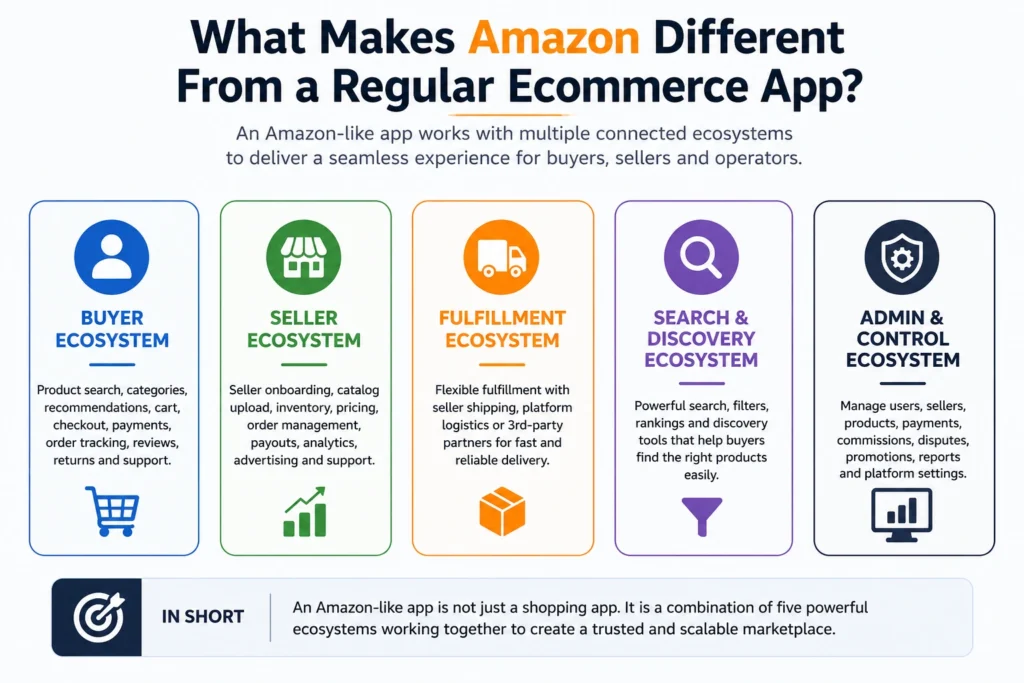
What Makes Amazon Different From a Regular Ecommerce App?
Most ecommerce apps have a simple structure: one business uploads products, customers buy, and the business ships orders.
An Amazon-like app is more complex because it has multiple operating layers.
Buyer Ecosystem
The buyer side includes product discovery, search, category browsing, personalized recommendations, cart, checkout, payment, order tracking, reviews, refunds, wishlist, and customer support.
The buyer experience must feel simple even when the backend is complex.
Seller Ecosystem
The seller side includes onboarding, verification, catalog upload, inventory management, pricing, order acceptance, fulfillment status, returns, payouts, analytics, advertising, and support.
Without a strong seller system, the marketplace cannot scale beyond the platform owner’s own catalog.
Fulfillment Ecosystem
Amazon-like platforms need clear fulfillment logic. Sellers may ship directly, the platform may handle logistics, or third-party logistics partners may be integrated.
This affects delivery speed, return handling, customer experience, and operational cost.
Search and Discovery Ecosystem
Search is one of the most important systems in any ecommerce marketplace. Buyers rarely browse every category manually. They search, filter, compare, and trust rankings.
A weak search system creates poor conversion even if the product catalog is large.
Recommendation Ecosystem
An Amazon-like app should eventually use behavior-based recommendations: similar products, frequently bought together, recently viewed, personalized home feed, cart-based suggestions, and post-purchase recommendations.
Admin and Control Ecosystem
The admin panel is where the platform operator manages users, sellers, products, payments, disputes, refunds, fraud signals, logistics, commissions, promotions, and reporting.
For a founder, this control layer is as important as the mobile app itself.
Core Features Required in an Amazon-Like App
An App Like Amazon usually needs four major interfaces: buyer app, seller panel, admin dashboard, and logistics workflow.
Buyer App Features
Buyer features should reduce friction from discovery to repeat purchase.
| Buyer Feature | Business Value | Founder Impact |
|---|---|---|
| User registration and profile | Enables personalization and order history | Helps build repeat purchase behavior |
| Product search and filters | Improves product discovery | Increases conversion from high-intent users |
| Product detail pages | Shows images, specs, pricing, reviews, delivery estimate | Helps buyers make confident decisions |
| Cart and wishlist | Supports purchase planning | Improves retention and remarketing opportunities |
| Multiple payment options | Reduces checkout abandonment | Supports wider buyer segments |
| Order tracking | Builds post-purchase trust | Reduces support pressure |
| Ratings and reviews | Improves trust and product ranking | Helps marketplace quality control |
| Returns and refunds | Builds confidence | Requires strong operational workflows |
Seller Panel Features
The seller panel determines whether vendors can operate without constant manual support.
| Seller Feature | Business Value | Founder Impact |
|---|---|---|
| Seller registration and verification | Controls marketplace quality | Prevents low-quality or fraudulent seller entry |
| Product listing management | Enables catalog growth | Helps marketplace scale beyond internal inventory |
| Inventory management | Prevents overselling | Protects buyer experience |
| Pricing and discount tools | Gives sellers commercial flexibility | Helps marketplace compete on offers |
| Order management | Lets sellers process orders efficiently | Reduces fulfillment delays |
| Payout dashboard | Creates transparency | Builds seller trust |
| Sales analytics | Helps sellers improve performance | Increases seller retention |
| Support and dispute tools | Resolves operational issues | Reduces admin workload |
Admin Dashboard Features
The admin panel should give the platform operator complete visibility.
| Admin Feature | Business Value | Founder Impact |
|---|---|---|
| User management | Controls buyer accounts and activity | Helps manage abuse and support |
| Seller approval | Maintains marketplace quality | Reduces fraud and poor seller experience |
| Product moderation | Ensures catalog quality | Protects buyer trust |
| Commission management | Controls revenue model | Allows category-wise monetization |
| Payment and payout control | Manages marketplace cash flow | Reduces financial disputes |
| Refund and return management | Handles post-order issues | Improves buyer trust |
| Promotion management | Supports campaigns and seller ads | Creates additional revenue channels |
| Reports and analytics | Tracks marketplace health | Improves business decisions |
Delivery and Logistics Features
Logistics can be simple at launch or advanced at scale.
Early-stage marketplaces may start with seller-managed shipping. More advanced platforms can integrate delivery partners, warehouse systems, route assignment, real-time tracking, and return pickup workflows.
Marketplace Architecture Behind an App Like Amazon
The architecture of an Amazon-like platform should be planned around services, data flow, scalability, and operational reliability.
A practical architecture includes:
- Frontend layer for buyer app, seller dashboard, admin panel, and web storefront
- API gateway for routing requests securely to backend services
- Authentication service for buyers, sellers, admins, and logistics users
- Catalog service for products, categories, attributes, media, and variants
- Search service for indexing and ranking products
- Inventory service for stock levels, reservations, and warehouse sync
- Cart service for active shopping sessions
- Order service for order lifecycle management
- Payment service for checkout, refunds, payouts, and reconciliation
- Notification service for email, SMS, push, and WhatsApp updates
- Recommendation service for personalization
- Logistics service for shipping, tracking, returns, and delivery partner integration
- Admin service for moderation, disputes, commissions, reports, and controls
For smaller launches, these can begin inside a modular monolith. As traffic, catalog volume, and seller activity grow, high-pressure services such as search, payments, inventory, notifications, and recommendations can be separated.
AWS defines event-driven architecture as a pattern where decoupled services publish, consume, or route events. For ecommerce marketplaces, this is useful because actions such as “order placed,” “payment confirmed,” “stock reserved,” “shipment created,” and “refund initiated” often need several systems to react without tightly coupling everything together.
Choosing the Right Tech Stack for an Amazon-Like App
There is no single perfect tech stack for every ecommerce marketplace. The right choice depends on launch scope, team capability, budget, scalability expectations, and integration needs.
Frontend Tech Stack
For mobile apps:
- Flutter
- React Native
- Swift for iOS
- Kotlin for Android
For web:
- React.js
- Next.js
- Vue.js
- Angular
Flutter or React Native can be practical for faster cross-platform development. Native apps may be better when performance, device-specific behavior, and long-term mobile control are major priorities.
Backend Tech Stack
Common backend options include:
- Node.js
- Java Spring Boot
- Laravel
- Python Django
- Go
- .NET
For marketplace platforms, Node.js, Java, and Go are often preferred for scalable backend systems. Laravel can work well for cost-efficient and faster launches when the architecture is planned carefully.
Database Layer
A marketplace may need multiple data stores:
| Data Need | Suggested Technology |
|---|---|
| Users, orders, payments | PostgreSQL or MySQL |
| Product catalog flexibility | PostgreSQL JSONB, MongoDB, or hybrid model |
| Search index | Elasticsearch or OpenSearch |
| Cache and sessions | Redis |
| Event logs and streams | Kafka, RabbitMQ, or cloud queue services |
| Analytics | BigQuery, ClickHouse, Redshift, or Snowflake |
| Media storage | S3-compatible object storage |
Cloud Infrastructure
Cloud infrastructure should support scaling, deployment, backups, monitoring, and security.
Common options include:
- AWS
- Google Cloud
- Microsoft Azure
- DigitalOcean for smaller launches
- Cloudflare for CDN, caching, and edge security
For an Amazon-style marketplace, cloud planning should include autoscaling, load balancing, containerization, object storage, CDN, observability, and disaster recovery.
How Product Search Works in an Amazon-Like Marketplace
Search is one of the biggest conversion drivers in ecommerce.
A basic search system matches keywords. A better marketplace search system understands product title, category, brand, attributes, price, rating, availability, delivery speed, seller score, and user intent.
A scalable ecommerce search system includes:
- Product indexing
- Category and attribute mapping
- Synonym handling
- Typo tolerance
- Faceted filters
- Sorting by relevance, price, rating, delivery speed, and popularity
- Ranking rules for sponsored products
- Availability-aware results
- Personalized ranking signals
For example, when a buyer searches “wireless headphones,” the system should not only match the phrase. It should understand related attributes such as Bluetooth, noise cancellation, battery life, brand, price range, and delivery availability.
Search Indexing Workflow
A practical search workflow may look like this:
- Seller creates or updates a product
- Catalog service validates the product data
- Product update event is published
- Search index worker consumes the event
- Elasticsearch/OpenSearch updates the product index
- Cache layer refreshes high-traffic queries
- Buyer search results show updated product data
This avoids forcing the search system to query the main product database for every request.
Building Recommendation Engines Like Amazon
Recommendations make ecommerce feel personalized.
At launch, recommendations can be rule-based. As traffic grows, the platform can move toward behavior-based and AI-powered recommendations.
Basic Recommendation Types
- Recently viewed products
- Similar products
- Products from the same category
- Frequently bought together
- Popular products in a category
- Seller-specific recommendations
- Cart-based upsells
- Post-purchase cross-sells
Advanced Recommendation Signals
A more mature recommendation engine can use:
- Click history
- Search history
- Cart additions
- Wishlist activity
- Purchase history
- Product similarity
- User segment
- Location
- Price sensitivity
- Seasonal demand
- Seller performance
The key is to start simple. A founder does not need an advanced AI recommendation system on day one. The first version should capture clean user behavior data so the recommendation system can improve over time.
Multi-Vendor Seller Management System
Seller management is where many Amazon-like apps fail.
It is easy to build a product upload form. It is harder to build a seller operating system that supports onboarding, catalog quality, order performance, payouts, returns, disputes, and seller trust.
A strong seller system should include:
- Seller registration
- Business verification
- Tax or document upload where relevant
- Store profile
- Product listing approval
- Bulk product upload
- Inventory update tools
- Order processing dashboard
- Return and refund workflow
- Seller ratings
- Payout reports
- Commission visibility
- Policy violation alerts
- Seller support tickets
For founders, seller management is not only a feature group. It is the supply-side engine of the marketplace.
If sellers do not trust the dashboard, payout logic, catalog approval process, or dispute workflow, they will not stay active.
Payment Gateway and Escrow Architecture
Payments in an Amazon-like marketplace are more complex than single-vendor ecommerce payments.
A marketplace payment flow may include:
- Buyer pays for the order
- Platform confirms payment
- Order is created
- Seller is notified
- Platform holds funds until fulfillment condition is met
- Commission is deducted
- Seller payout is processed
- Refund or dispute logic applies if needed
Depending on the target region and business model, founders may need payment gateway integration, wallet logic, split payments, escrow-style holding, payout automation, refund workflows, tax handling, and reconciliation reports.
Security should be treated as a foundation, not an add-on. Payment systems should use secure payment gateway integration, encrypted data transfer, role-based access control, audit logs, fraud monitoring, and admin approval workflows.
Inventory Management and Warehouse Synchronization
Inventory is one of the hardest parts of marketplace development.
A product may be available from multiple sellers, multiple warehouses, or multiple delivery zones. Stock can change from purchases, returns, cancellations, damaged items, seller updates, warehouse updates, and offline sales.
A practical inventory system should support:
- Real-time stock updates
- Reserved stock during checkout
- Low-stock alerts
- Multi-warehouse availability
- Seller-managed inventory
- Admin stock correction
- Inventory import/export
- Product variants
- Return-to-stock logic
- Overselling prevention
Cart Reservation Logic
Without cart reservation logic, two buyers may try to buy the same last unit at the same time.
A simplified reservation flow:
- Buyer adds product to cart
- Stock is not permanently reduced yet
- Buyer starts checkout
- System reserves stock for a limited time
- Payment succeeds
- Stock is reduced permanently
- If payment fails or timeout occurs, stock is released
This kind of logic prevents overselling and improves buyer trust.
Order Lifecycle and Fulfillment Flow
Every Amazon-like marketplace needs a clear order state machine.
A basic order lifecycle may include:
| Order State | Meaning |
|---|---|
| Cart created | Buyer has selected products |
| Checkout started | Buyer is entering address and payment |
| Payment pending | Payment is being processed |
| Payment confirmed | Funds are authorized or captured |
| Order placed | Order is officially created |
| Seller accepted | Seller confirms order |
| Packed | Product is ready for shipment |
| Shipped | Logistics process has started |
| Out for delivery | Delivery partner is near buyer |
| Delivered | Buyer received the order |
| Return requested | Buyer wants to return |
| Refund initiated | Refund workflow has started |
| Closed | Order cycle is complete |
The system should avoid vague statuses because unclear order states create support pressure.
For scalable operations, order events should trigger notifications, inventory updates, seller dashboards, logistics calls, invoice generation, and analytics updates.
Microservices vs Monolithic Architecture for Ecommerce Marketplaces
Founders often assume they need microservices from day one. That is not always true.
Modular Monolith
A modular monolith keeps the application in one deployable backend but separates internal modules clearly.
Best for:
- Early-stage marketplace launches
- Faster development
- Smaller engineering teams
- Lower DevOps complexity
- Clear first market version
Microservices
Microservices split major business capabilities into independently deployable services.
Best for:
- Large catalog size
- High traffic
- Multiple engineering teams
- Complex logistics
- Heavy personalization
- High order volume
- Advanced seller operations
| Architecture | Best For | Risk |
|---|---|---|
| Modular monolith | Faster launch and controlled complexity | Can become hard to scale if poorly structured |
| Microservices | High-scale marketplace operations | Higher DevOps, monitoring, and deployment complexity |
| Hybrid approach | Start simple, separate high-pressure services later | Requires good architecture planning |
A smart approach is to start with a modular architecture that can evolve. Search, notifications, payments, recommendations, and analytics can be separated as traffic grows.
Scaling Challenges in an App Like Amazon
An Amazon-like platform does not scale only by adding more servers. It scales by removing bottlenecks.
Common scaling challenges include:
- Slow product search
- Large product image loading delays
- Database overload during sale events
- Cart and checkout concurrency issues
- Inventory mismatch
- Delayed seller updates
- Payment failure handling
- Refund and return backlog
- Notification delays
- Logistics tracking failures
- Admin reporting slowdown
A scalable ecommerce platform should use:
- CDN for product images and static assets
- Redis caching for high-traffic data
- Read replicas for database scaling
- Search index instead of direct database search
- Queue systems for background jobs
- Event-driven workflows for order updates
- Load balancers and autoscaling
- Monitoring for API latency, error rates, payment failures, and queue delays
AWS notes that event-driven systems can support fanout and parallel processing, where multiple systems respond to the same event for different purposes. That pattern fits ecommerce workflows where an order event may trigger payment confirmation, seller notification, warehouse update, invoice generation, and analytics in parallel.
AI Features Modern Ecommerce Apps Need
AI is not mandatory for the first launch, but it can become a strong growth layer.
Useful AI features include:
- Personalized product recommendations
- Smart search suggestions
- Product description generation for sellers
- Image-based product search
- Fraud detection signals
- Dynamic pricing suggestions
- Customer support chatbot
- Review sentiment analysis
- Product category auto-tagging
- Demand forecasting
- Inventory restock prediction
The best approach is to introduce AI where it improves business outcomes. AI should not be added only because it sounds modern.
For example, AI-based product tagging can reduce seller catalog errors. AI recommendations can increase average order value. Fraud signals can reduce marketplace abuse. Support automation can reduce operational load.
Cost to Build an App Like Amazon
The cost to build an Amazon-like app depends on features, platforms, integrations, tech stack, UI complexity, seller workflows, logistics requirements, search complexity, and scalability needs.
Do not evaluate cost only by screen count. Marketplace cost is driven by business logic.
Key cost factors include:
- Buyer app complexity
- Seller dashboard depth
- Admin panel controls
- Product catalog structure
- Search and filter logic
- Payment gateway and payout flow
- Refund and return management
- Logistics integration
- Inventory synchronization
- Recommendation engine
- Analytics dashboard
- Security requirements
- Third-party integrations
- Web + Android + iOS platform scope
- Custom design and branding
- Post-launch support
Many market articles publish broad cost ranges, but those ranges are often too generic to guide a real build. For example, Nevina Infotech lists a broad estimate for an Amazon-like app based on robustness and feature scope. For Miracuves-style planning, the better approach is to define modules first, then estimate based on launch scope.
Cost Planning Table
| Cost Driver | Basic Marketplace | Scalable Marketplace |
|---|---|---|
| Buyer app | Product browsing, cart, checkout | Personalization, advanced filters, loyalty, returns |
| Seller panel | Product upload, orders | Bulk upload, analytics, ads, payout reports |
| Admin panel | User/product/order control | Fraud, disputes, commissions, moderation, reports |
| Search | Keyword search | Indexed search, ranking, filters, typo tolerance |
| Inventory | Basic stock update | Multi-warehouse sync, reservations, concurrency control |
| Payments | Gateway checkout | Split payments, payouts, refunds, reconciliation |
| Logistics | Manual tracking | Delivery partner APIs, shipment lifecycle, return pickup |
| AI | Not required initially | Recommendations, fraud signals, smart search |
Final pricing should be confirmed based on selected modules, integrations, branding, and customization requirements.
Founder Decision Signals
Founder Decision Signals
Speed
If your goal is to validate a niche marketplace quickly, start with buyer, seller, admin, catalog, payment, and order workflows before building advanced Amazon-scale systems.
Cost
Cost rises when sellers, inventory, payouts, refunds, logistics, and search become deeply customized. Define the first market version before estimating.
Scalability
Plan for scalable search, caching, queue systems, and modular services early, even if you do not launch with full microservices from day one.
Market Fit
A focused category marketplace usually validates faster than a broad Amazon-style everything store because seller acquisition and buyer messaging are clearer.
Mistakes Founders Make When Building Marketplace Apps
Mistakes Founders Should Avoid
Trying to Build the Full Amazon Experience From Day One
Amazon is a mature commerce ecosystem. A new founder should not start with every feature, warehouse workflow, AI system, and ad engine immediately. Start with the core marketplace loop: sellers list, buyers purchase, orders are fulfilled, payments are handled, and admins control quality.
Ignoring Seller Operations
Many founders focus only on the buyer app. But an Amazon-like marketplace needs active sellers, accurate inventory, reliable fulfillment, transparent payouts, and seller trust. Weak seller operations limit marketplace liquidity.
Underbuilding Search
Large catalogs become useless if buyers cannot find relevant products. Search architecture should be planned early with indexing, filters, ranking logic, and availability-aware results.
Skipping Admin Controls
The admin dashboard must manage products, sellers, orders, refunds, disputes, commissions, logistics, and reports. Without strong admin control, the platform becomes difficult to operate as volume grows.
First Market Version Strategy for Amazon-Like Startups
A first market version should not try to compete with Amazon feature-for-feature.
Instead, focus on one category, one region, one buyer segment, or one seller community.
What to Build First
- Buyer app or responsive ecommerce web app
- Seller onboarding
- Product catalog
- Search and filters
- Cart and checkout
- Payment gateway
- Order management
- Seller order dashboard
- Admin panel
- Basic delivery workflow
- Ratings and reviews
- Refund and return flow
What Can Wait
- Advanced AI recommendations
- Multi-warehouse automation
- Seller ad marketplace
- Dynamic pricing engine
- Complex loyalty system
- Full logistics fleet management
- Enterprise analytics warehouse
- Multi-region deployment
The first goal is not to look as large as Amazon. The first goal is to prove that buyers and sellers will transact repeatedly in your chosen niche.
How Miracuves Helps Build an App Like Amazon Faster
Miracuves helps founders build ready-made and white-label marketplace app solutions with source code, custom branding, admin control, and monetization-ready workflows.
For an Amazon-like marketplace, Miracuves can support the core foundation:
- Buyer app
- Seller panel
- Admin dashboard
- Product catalog
- Cart and checkout
- Payment gateway integration
- Order management
- Commission setup
- Reviews and ratings
- Delivery workflow
- Branding customization
- Source-code ownership
- Faster launch planning
Final Thoughts: Build a Marketplace System, Not Just a Shopping App
The real challenge in building an App Like Amazon is not the product listing page, cart, or checkout screen. Those are important, but they are only the visible layer.
The deeper challenge is marketplace infrastructure.
You need seller onboarding, catalog quality, inventory accuracy, product discovery, order orchestration, secure payments, refunds, logistics, recommendations, admin control, and scalable backend workflows.
For founders, the best path is not to copy Amazon feature by feature. It is to identify a focused marketplace opportunity, launch with the right core systems, validate buyer-seller demand, and scale technical complexity only when the business model proves traction.
Miracuves helps founders take that practical path with white-label, source-code-owned, launch-ready marketplace solutions that can be customized for ecommerce, rental, delivery, travel, local commerce, and multi-vendor business models.
FAQs
What is an App Like Amazon?
An App Like Amazon is a multi-vendor ecommerce marketplace where multiple sellers list products, buyers search and purchase items, and the platform operator manages payments, commissions, orders, logistics, refunds, and seller operations through an admin dashboard.
How do I build an app like Amazon?
To build an app like Amazon, start with marketplace planning, define buyer and seller workflows, design the product catalog, choose a tech stack, build buyer and seller interfaces, integrate payments, create admin controls, implement search, manage inventory, test order flows, and launch with a focused category or region.
What features are required in an Amazon-like app?
Core features include buyer registration, product search, filters, product pages, cart, checkout, payments, order tracking, reviews, seller onboarding, product listing, inventory management, seller dashboard, admin panel, commission management, refunds, and logistics workflows.
How much does it cost to build an app like Amazon?
The cost depends on features, platforms, tech stack, integrations, catalog complexity, seller workflows, payment logic, logistics, search, AI recommendations, and customization scope. Final pricing should be estimated after defining the required modules and launch scope.
Should I build a custom Amazon clone or use a ready-made solution?
A custom build gives more flexibility but usually takes more time and planning. A ready-made or white-label solution can help founders launch faster because core marketplace modules are already available. The right choice depends on budget, timeline, customization needs, and long-term product strategy.
Can Miracuves help build an Amazon-like ecommerce marketplace?
Yes. Miracuves helps founders build white-label and ready-made ecommerce marketplace solutions with buyer, seller, admin, payment, product, order, and monetization workflows. The solution can be customized based on business model, branding, integrations, and launch scope.