


Key Takeaways
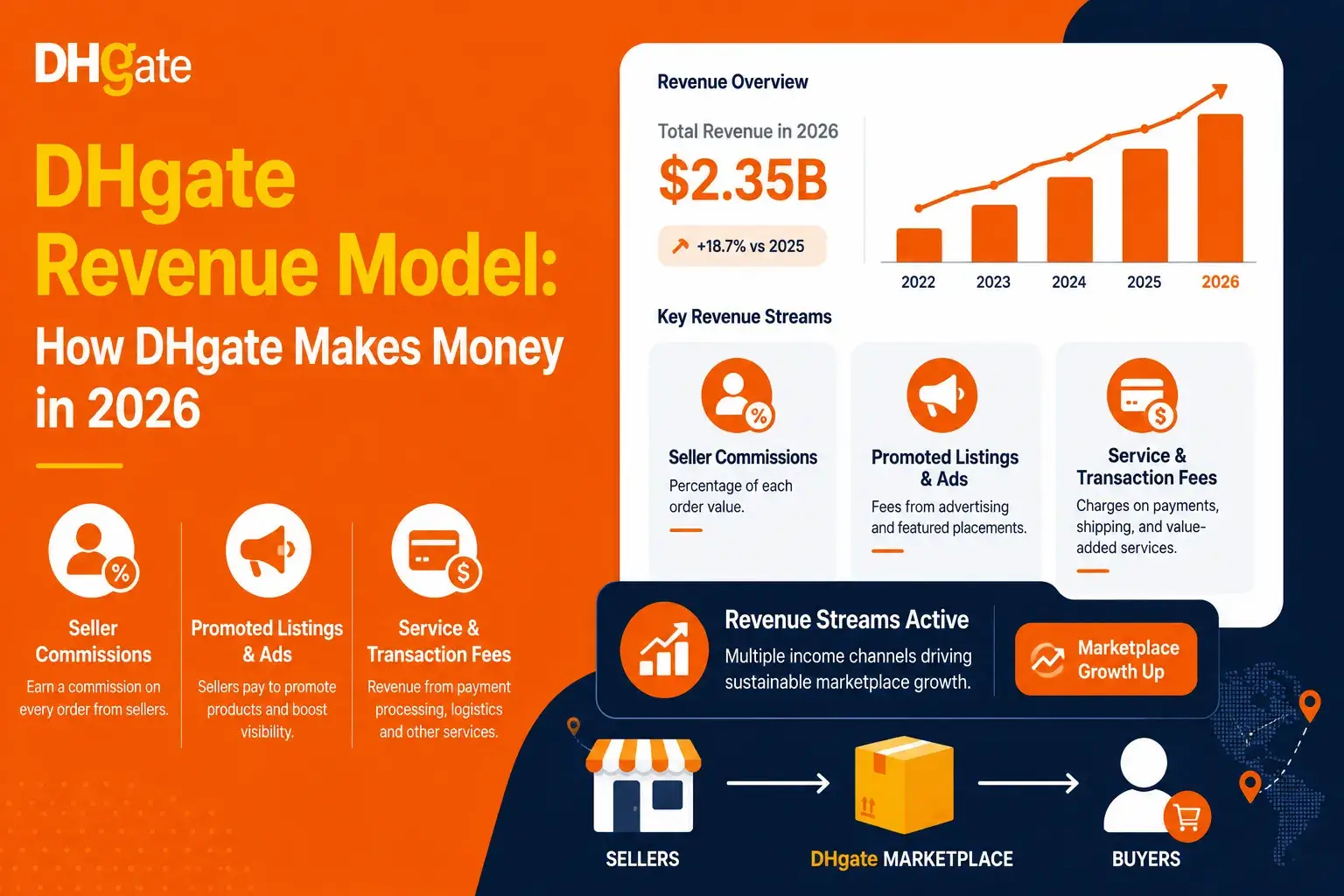
- DHgate’s revenue model is built around cross-border B2B eCommerce, seller commissions, transaction fees, advertising, logistics support, and value-added services.
- Its biggest revenue stream comes from connecting global buyers with manufacturers, wholesalers, and suppliers across multiple product categories.
- The platform earns by supporting transactions, product discovery, seller visibility, buyer protection, payment processing, and international trade workflows.
- DHgate shows how marketplace platforms can grow by combining supplier access, bulk pricing, global shipping, buyer trust, and seller monetization tools.
- For founders, the main lesson is clear: a wholesale marketplace becomes stronger when it solves trust, payments, logistics, product discovery, and repeat sourcing together.
Revenue Signals
- Commission income can come from completed orders when sellers use the platform to reach international buyers and process wholesale transactions.
- Seller advertising creates revenue through promoted listings, sponsored products, keyword visibility, category placement, and marketplace traffic boosts.
- Transaction and payment-related income can grow through secure payment processing, buyer protection systems, currency handling, and order management.
- Logistics and fulfillment support can add revenue by helping buyers and sellers manage shipping, tracking, customs, and cross-border delivery complexity.
- Value-added services such as seller tools, data insights, verification, premium placement, and trade support can improve retention and platform profitability.
Real Insights
- DHgate is not just an online marketplace; it is a cross-border sourcing platform that connects demand, supply, payments, logistics, and trade trust.
- The strongest part of the model is supplier discovery because buyers need reliable access to affordable products, verified sellers, and bulk purchase options.
- Trust features like escrow-style payments, reviews, dispute handling, seller verification, and order tracking are critical for international marketplace growth.
- Founders can learn from DHgate by building marketplace platforms around buyer confidence, seller visibility, logistics support, and repeat B2B purchasing behavior.
- The future of DHgate-style revenue will depend on AI product discovery, supplier verification, faster logistics, trade financing, personalized sourcing, and stronger buyer protection.
DHgate is one of the world’s largest B2B cross-border eCommerce marketplaces, connecting Chinese manufacturers directly with global wholesale buyers across categories such as electronics, apparel, accessories, and industrial goods. By removing traditional intermediaries and enabling smaller order quantities, DHgate made international sourcing accessible to SMEs, resellers, and dropshippers worldwide.
In 2026, DHgate operates as a mature trade platform focused on repeat buyers, tighter logistics control, and value-added merchant services that go beyond simple transactions. The platform emphasizes escrow-based payments, reliable cross-border shipping, supplier verification, and data-driven matchmaking to increase trust, efficiency, and long-term engagement on both sides of the marketplace.
For founders, DHgate offers a strong blueprint for building high-volume, commission-driven B2B marketplaces with predictable margins and recurring revenue. Its model shows how combining transaction fees with logistics, advertising, and premium seller services can create a scalable, defensible business with clearer unit economics than most B2C platforms.
DHgate Revenue Overview – The Big Picture
- 2026 Revenue: ~$1.8 billion
- Valuation (private estimate): ~$6–7 billion
- YoY Growth (2024–2026): ~15%
- Primary Markets: US, Europe, Middle East, LATAM
- Average Gross Margin: 42–48%
- Competition Benchmark: Alibaba.com, Global Sources, Made-in-China
DHgate’s advantage lies in servicing SME buyers who order frequently but in smaller wholesale volumes.
Read More: What is DHgate and How Does It Work?
Primary Revenue Streams Deep Dive
Revenue Stream #1: Transaction Commissions
DHgate earns a commission on every completed wholesale transaction.
- How it works: Percentage fee per order
- Commission range: 3%–10%
- Revenue share: ~50%
- 2026 contribution: ~$900M
Revenue Stream #2: Cross-Border Logistics Services
DHgate provides shipping, customs, and tracking via partner carriers.
- Pricing: Per-kg and per-order logistics fees
- Revenue share: ~25%
- 2026 contribution: ~$450M
Revenue Stream #3: Seller Advertising & Promotions
Suppliers pay to boost product visibility and search ranking.
- Pricing model: CPC + placement packages
- Revenue share: ~15%
- 2026 contribution: ~$270M
Revenue Stream #4: Value-Added Seller Services
Includes storefront upgrades, analytics, certifications, and faster payouts.
- Revenue share: ~7%
- 2026 contribution: ~$126M
Revenue Stream #5: Payment & FX Margins
Margins from currency conversion and escrow-based payments.
- Revenue share: ~3%
- 2026 contribution: ~$54M
Revenue Streams Breakdown Table
| Revenue Stream | % Share | 2026 Revenue |
|---|---|---|
| Transaction Commissions | 50% | $900M |
| Logistics Services | 25% | $450M |
| Advertising | 15% | $270M |
| Seller Services | 7% | $126M |
| Payments & FX | 3% | $54M |
The Fee Structure Explained
DHgate monetizes primarily from suppliers, while keeping buyer entry friction extremely low.
User-Side Fees (Buyers)
- No signup fees
- Shipping & customs charges
- Optional inspection and insurance fees
Provider-Side Fees (Suppliers)
- Sales commissions
- Advertising spend
- Logistics service charges
Hidden Revenue Layers
- Shipping consolidation margins
- Priority escrow release
- Data-driven ad pricing
Regional Pricing Variation
- Higher logistics margins in North America
- Discounted commissions for high-volume sellers
Fee Structure Table
| User Type | Fee Category | Typical Range |
|---|---|---|
| Buyer | Shipping & customs | $20–$200+ |
| Supplier | Transaction commission | 3%–10% |
| Supplier | Logistics | Variable by weight |
| Supplier | Advertising | CPC-based |
| Supplier | Premium tools | Subscription-based |
How DHgate Maximizes Revenue Per User
DHgate focuses on long-term buyer-seller relationships.
- Segmentation: SME buyers, resellers, dropshippers
- Upselling: Faster shipping, quality inspections
- Cross-selling: Packaging, labeling, compliance services
- Dynamic pricing: Volume-based discounts
- Retention monetization: Repeat wholesale contracts
- LTV optimization: Subscription seller tools
- Psychological pricing: Tiered supplier plans
On average, active buyers place 8–12 bulk orders per year, creating stable recurring revenue.
Cost Structure & Profit Margins
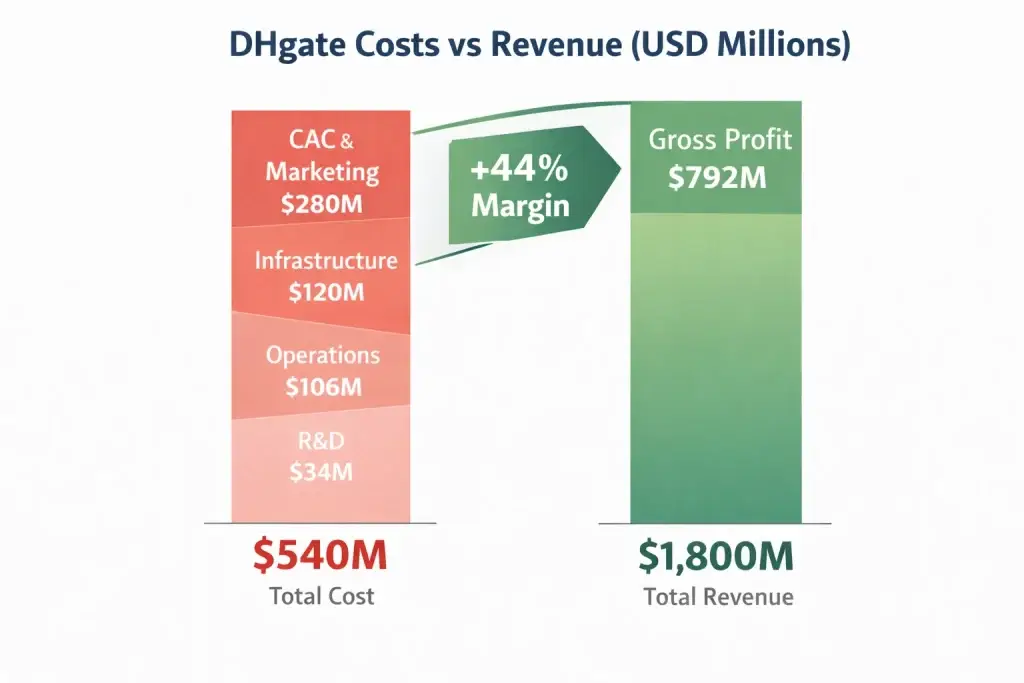
Major Cost Buckets
- Infrastructure: Platform, payments, data security
- CAC & Marketing: Global buyer acquisition
- Operations: Dispute resolution, logistics coordination
- R&D: Search, fraud prevention, AI matching
Unit Economics
- Avg order value: $420
- Avg platform revenue per order: $32–38
- Contribution margin: ~45%
DHgate maintains profitability through scale, repeat usage, and logistics density.
Read More: Best DHgate Clone Scripts 2025 | Global B2B Wholesale Marketplace
Global Cost of Development for a DHgate-Like Marketplace App
DHgate-Like B2B E-commerce Marketplace Development — Market Price by Tech Stack
The tech stack affects the speed, scalability, seller management, product listings, and order handling of a DHgate-like marketplace. PHP/Laravel works well for cost-effective marketplace launches, Node.js/React.js supports real-time inventory, search, and buyer-seller interactions, while Go microservices suit large B2B platforms with high traffic, multi-vendor operations, and cross-border commerce needs.
PHP/Laravel is often the most practical choice for launching a DHgate-like marketplace quickly and affordably. Node.js/Python fits better when heavier marketplace activity and data-rich workflows become more important, while Go microservices are better suited for enterprise-scale B2B ecommerce platforms with higher concurrency and more complex infrastructure needs.
These values reflect global development cost estimates. Final pricing varies based on vendor onboarding, product catalogs, bulk orders, payment gateways, commission setup, shipping flow, dispute management, admin controls, and platform complexity.
Miracuves DHgate-Like Platform Solution Cost and Tech Stack
Miracuves Pricing for a DHgate-Like B2B/B2C Marketplace Platform developed in JavaScript architecture for $12,999 USD One-Time Price in just 6 days
Get a fully developed, deployment-ready wholesale marketplace platform modeled after DHgate. Built on a modern JavaScript foundation, this complete package includes everything you need to launch and scale:
- Core Workflows: Seller onboarding, product listing, wholesale ordering, buyer registration, cart checkout, order management, shipment tracking, and customer notifications.
- Built-in Revenue Logic: Seller commissions, product listing fees, promoted listings, subscription plans, transaction fees, service charges, bulk order pricing, and marketplace advertising.
- Management Hub: Centralized admin dashboard, seller management, buyer management, product approval, order tracking, payment records, refund handling, dispute management, and marketplace analytics.
- Launch-Ready: Fully prepared for your custom branding, configuration, payment gateway setup, seller onboarding, product category setup, and immediate market entry.
Why Is DHgate-Like Marketplace Development More Affordable?
Most large marketplace platforms become expensive when businesses choose fully custom development from scratch. Building seller panels, buyer apps, product systems, payment workflows, order management, shipping logic, and admin controls separately can increase cost, timeline, and technical complexity.
We took a smarter, more practical approach:
- You Aren’t Paying for Ground-Up Development: Our marketplace engine is already developed, tested, and ready to deploy. You skip the inflated cost and long waiting period usually required for building a wholesale marketplace from scratch.
- The Power of JavaScript: We built this solution on a modern JavaScript architecture that supports scalable marketplace workflows, fast frontend performance, API-driven integrations, and smooth admin operations.
You get a launch-ready DHgate-like marketplace platform with practical wholesale commerce features, source code access, and faster deployment without the high custom development price tag.
Note: This cost is for the solution, re-branding, deployment, and source code only.
Future Revenue Opportunities & Innovations
New Revenue Streams
- Supplier financing & credit
- AI-driven demand forecasting
- Subscription-based buyer sourcing
AI/ML Monetization
- Smart supplier matching
- Fraud detection & dispute reduction
- Predictive inventory demand
Market Expansion
- Africa & Southeast Asia
- Regional fulfillment hubs
Predicted Trends (2025–2027)
- B2B marketplaces becoming SaaS-like
- Embedded finance growth
- Fewer suppliers, higher trust
Risks & Threats
- Alibaba pricing pressure
- Trade regulations and tariffs
Opportunities for New Founders
- Vertical-specific B2B marketplaces
- Region-focused wholesale platforms
Lessons for Entrepreneurs & Your Opportunity
What Works
- Commission-led monetization
- Logistics as a profit center
What to Replicate
- Escrow-based trust systems
- Seller subscription layering
Market Gaps
- Faster delivery for SMEs
- Transparent supplier verification
Founder Improvements
- Better buyer analytics
- Simplified onboarding
Final Thought
DHgate proves that B2B marketplaces can be more predictable and profitable than B2C by relying on higher order values, repeat purchasing cycles, and long-term buyer–supplier relationships. Unlike consumer platforms driven by impulse demand, B2B trade benefits from planned procurement, stable volumes, and clearer unit economics.
Its strong focus on repeat buyers and supplier services creates durable, recurring revenue streams that are less sensitive to seasonality and marketing spend. By monetizing logistics, escrow payments, analytics, and premium seller tools, DHgate turns operational infrastructure into consistent profit centers.
For founders, the real opportunity lies in building specialized, trust-driven wholesale platforms that serve specific industries, regions, or buyer segments. Marketplaces that emphasize verification, transparency, and value-added services can achieve faster profitability, stronger retention, and long-term defensibility.
FAQs
1. What is the DHgate revenue model?
The DHgate revenue model is based on multiple income streams, including seller commissions, logistics services, advertising fees, premium seller tools, payment processing, and value-added marketplace services. Instead of depending on only one revenue source, DHgate earns from different stages of the B2B buying and selling journey.
2. How does DHgate make money?
DHgate makes money by charging sellers commissions on completed transactions, offering paid advertising options, supporting logistics services, and providing premium tools for sellers who want better visibility and higher sales. The platform may also earn through payment-related services, currency conversion margins, and buyer protection features.
3. What is DHgate’s main revenue source?
Transaction commission is one of the main revenue sources for DHgate. Every time a buyer purchases products from a seller through the platform, DHgate can earn a percentage of the sale. This makes commissions a core part of the DHgate business model.
4. Does DHgate charge sellers?
Yes, DHgate can charge sellers through commissions, promotional listings, advertising campaigns, premium seller services, and platform tools. Sellers may pay for better product visibility, improved store features, and access to marketplace growth options.
5. How much does it cost to build a DHgate-like marketplace app?
The cost depends on the technology stack, features, platform complexity, number of user roles, logistics integrations, payment gateways, admin dashboard, scalability needs, and customization level. A basic marketplace can cost less, while a large-scale B2B wholesale platform with advanced automation and enterprise features can require a higher budget.