


Key Takeaways
What You’ll Learn
- WooCommerce’s business model is built around open-source eCommerce infrastructure enabling businesses to create customizable online stores using WordPress-based commerce tools.
- The platform monetizes through ecosystem-driven revenue streams including plugins, themes, payment integrations, hosting partnerships, extensions, and premium commerce services.
- Flexibility is WooCommerce’s biggest competitive advantage because merchants can customize store functionality, integrations, and workflows without relying on closed ecosystems.
- Developer and plugin ecosystems improve scalability by allowing third-party tools, extensions, and integrations to continuously expand platform capabilities.
- The biggest takeaway for founders is that open-source commerce platforms scale successfully when flexibility, ecosystem participation, developer support, and recurring digital services work together.
Stats That Matter
- The article positions WooCommerce as a major open-source eCommerce ecosystem supporting online stores, D2C brands, digital merchants, and customizable commerce operations.
- Core revenue comes from premium plugins and commerce extensions including payment gateways, subscriptions, shipping tools, analytics systems, and store management integrations.
- Additional monetization comes from ecosystem partnerships involving hosting providers, payment processors, developers, and third-party software vendors.
- The platform benefits from WordPress’s global adoption because millions of websites already use WordPress infrastructure for content and digital business management.
- WooCommerce’s ecosystem strategy improves long-term scalability through community-driven development, plugin expansion, and customizable commerce workflows.
Real Insights
- WooCommerce succeeds because it gives merchants full ownership and flexibility allowing businesses to customize stores without depending entirely on closed SaaS ecosystems.
- The strongest growth driver is ecosystem participation because developers, plugin creators, hosting providers, and service partners continuously expand platform functionality.
- Customization improves merchant retention since businesses increasingly require unique storefront experiences, integrations, and operational workflows.
- Open-source infrastructure reduces entry barriers because merchants can launch online stores with lower upfront costs and scalable customization opportunities.
- For entrepreneurs, the biggest lesson is to build a WooCommerce-style eCommerce platform around open-source flexibility, plugin ecosystems, scalable commerce infrastructure, developer communities, and recurring digital monetization.
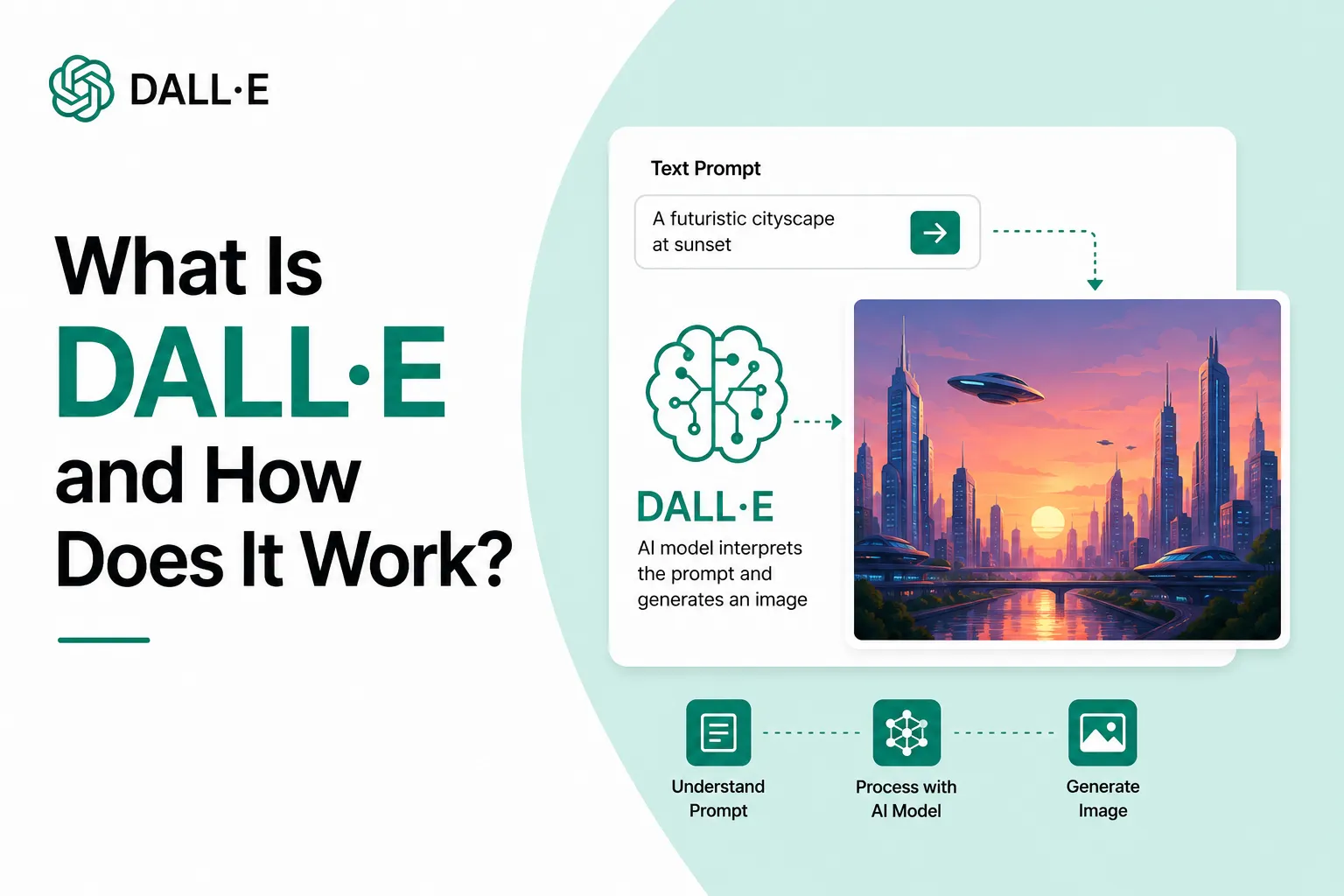
Imagine describing an image in plain English—“a cozy reading room inside a tree, warm lighting, digital art style”—and instantly getting a visual that matches your imagination. No design tools, no sketching, no photo editing. Just words turning into images. That’s the problem DALL·E solves.
DALL·E is an AI image generation system created by OpenAI that converts text descriptions into original images. It allows users to generate illustrations, concept art, realistic scenes, and creative visuals simply by describing what they want to see.
What makes DALL·E especially powerful is its ability to understand both language and visual concepts at the same time. It doesn’t just create random images—it interprets context, style, composition, and relationships between objects in a surprisingly human-like way.
By the end of this guide, you’ll understand what DALL·E is, how it works step by step, its business model, key features, the technology behind it, and why many entrepreneurs aim to build DALL·E-like image generation platforms—and how Miracuves can help make that possible.
What Is DALL·E? The Simple Explanation
DALL·E is an AI image generation system that creates images from text descriptions. In simple terms, you type what you want to see, and DALL·E generates a brand-new image that matches your description—whether it’s realistic, artistic, or completely imaginative.
The Core Problem DALL·E Solves
Creating visuals usually requires design skills, time, and specialized software. DALL·E removes those barriers by:
- Turning ideas into images instantly
- Eliminating the need for drawing or photo editing skills
- Making visual creation accessible to non-designers
- Speeding up creative experimentation
It lets people focus on ideas and storytelling, not tools.
Target Users and Use Cases
DALL·E is commonly used by:
• Designers and creative teams for concept exploration
• Marketers creating campaign visuals
• Writers visualizing scenes and characters
• Educators creating illustrative content
• Product teams prototyping ideas quickly
• Individuals experimenting with AI art
Current Market Position
DALL·E is positioned as a mainstream, easy-to-use AI image generator. It’s known for strong language understanding, reliable outputs, and tight integration into broader AI workflows, making it accessible to beginners while still useful for professionals.
Why It Became Successful
DALL·E became popular because it made AI image generation simple and intuitive. Users didn’t need to learn complex parameters—clear natural language was enough to get impressive results.
How DALL·E Works — Step-by-Step Breakdown
For Users (Creators, Marketers, Designers)
Getting started
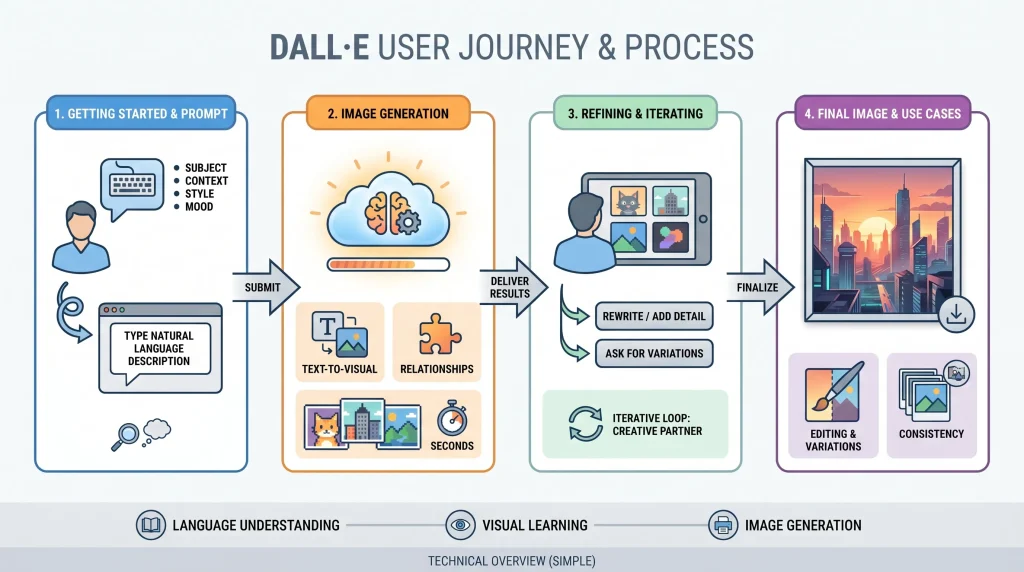
Users interact with DALL·E through a simple interface where they type a text description of the image they want. There’s no need to adjust technical settings—natural language is enough to begin.
Writing a prompt
A prompt usually includes:
- Subject (what should appear in the image)
- Context (environment, action, relationships)
- Style (photorealistic, illustration, watercolor, 3D, etc.)
- Mood or details (lighting, colors, perspective)
Clear prompts lead to more accurate and visually appealing results.
Image generation
Once the prompt is submitted, DALL·E:
- Interprets the text and visual intent
- Understands how objects relate to each other
- Generates one or more original images from scratch
- Delivers results within seconds
Each image is newly created, not copied from existing pictures.
Refining and iterating
Users can improve results by:
- Rewriting or adding detail to the prompt
- Asking for variations of an image
- Adjusting style or composition through language
- Regenerating until the desired outcome is achieved
This iterative loop makes DALL·E feel like a creative partner.
Typical user journey
User writes prompt → AI generates images → user reviews results → refines prompt → final image is produced.
For Advanced Use Cases
Image editing and variations
DALL·E supports modifying existing images by changing or replacing specific parts using text instructions, helping users refine visuals without starting over.
Consistency across outputs
With careful prompting, users can guide DALL·E toward consistent styles or themes across multiple images—useful for branding or storytelling.
Technical Overview (Simple)
DALL·E combines:
- Language understanding (to read prompts)
- Visual concept learning (to understand objects and scenes)
- Image generation models (to create pixels from ideas)
This allows it to translate words into coherent visuals with strong alignment to user intent.
Read More :- How to Develop an AI Chatbot Platform
Key Features That Make DALL·E Successful
Natural language understanding
DALL·E is especially good at understanding plain English descriptions. Users don’t need technical commands—simple, descriptive language is enough to guide image creation accurately.
Strong alignment between text and visuals
The system understands relationships between objects, actions, and environments. This means prompts like “a cat sitting on a stack of books in a quiet library” produce images where elements make sense together, not random combinations.
Wide range of visual styles
DALL·E can generate images in many styles, including:
- Photorealistic scenes
- Digital illustrations
- Hand-drawn or painted looks
- Minimalist or abstract visuals
- Cartoon and stylized art
This versatility makes it useful across many creative needs.
Image variation and iteration
Users can generate multiple variations from a single idea. This supports creative exploration and helps users refine concepts without starting over.
Image editing with text instructions
DALL·E allows users to modify parts of an image using text guidance—such as changing an object, adjusting style, or altering details—while keeping the rest of the image intact.
Beginner-friendly experience
One of DALL·E’s strengths is accessibility. New users can get strong results without learning complex parameters, which lowers the barrier to entry.
Reliable and consistent outputs
Compared to early image generators, DALL·E tends to produce more consistent, usable images, making it practical for real-world creative workflows.
Broad creative use cases
DALL·E is used for:
- Marketing visuals and ads
- Concept art and mood boards
- Educational illustrations
- Product mockups
- Social media content
- Story and character visualization
Integration into AI workflows
DALL·E fits naturally into broader AI workflows, often combined with text generation, brainstorming, and editing—making it part of a larger creative pipeline.
Focus on safety and responsible use
Built-in safeguards help reduce harmful or misleading outputs, which is important for businesses and public-facing content.
The Technology Behind DALL·E
Tech stack overview (simplified)
DALL·E is built on generative AI for images, which means it can create brand-new visuals from scratch based on what you describe in words. At a high level, it combines:
- A language understanding layer (to interpret your prompt)
- An image generation model (to produce the picture)
- Optional tools for edits and variations (to refine existing images)
- Safety systems that block or reduce harmful requests
OpenAI has iterated across versions (DALL·E, DALL·E 2, DALL·E 3) to improve image quality, prompt understanding, and safety controls.
How text becomes an image
In simple terms, DALL·E learns patterns connecting words to visual concepts (like “golden hour lighting,” “wide-angle street photo,” or “watercolor illustration”). When you submit a prompt, it uses those learned patterns to generate an image that matches the description, including objects, style, and composition.
The original DALL·E approach is described as a transformer that processes text and image information together as tokens, enabling the model to connect language to visual structure.
Generations, edits, and variations
DALL·E is often used through an “image generation” workflow with three common capabilities:
- Generations: Create an image from a text prompt
- Edits: Modify an existing image using a new prompt (change part of it or restyle it)
- Variations: Produce alternate versions of an existing image (not always available for every model/version)
This is why DALL·E feels practical for real projects: you don’t just generate once—you iterate.
Why DALL·E 3 feels more “prompt-smart”
DALL·E 3 is designed to understand more nuance and detail in prompts than earlier versions, which helps it follow complex instructions more accurately.
Also, when using the DALL·E 3 API, prompts may be automatically expanded into more detailed instructions to improve results (similar to how prompt enhancement works in ChatGPT-style experiences).
Safety, moderation, and bias controls
Because image generation can be misused, DALL·E includes safeguards. For example, OpenAI describes mitigations for DALL·E 3 that can decline certain requests (like public figures by name) and broader safety work across risk areas.
Why this tech matters for business
DALL·E’s real business value is speed and iteration: teams can go from idea → visual → refinement in minutes. That makes it useful for:
- Campaign concepts and ad creatives
- Product mockups and brand exploration
- Storyboarding and concept art
- Educational and editorial visuals
DALL·E’s Impact & Market Opportunity
Industry impact
DALL·E helped bring text-to-image generation into the mainstream. By making image creation as simple as writing a sentence, it changed how non-designers, marketers, educators, and product teams approach visuals. What once required design software and skills now starts with language.
It also shifted creative workflows. Instead of spending days on early concepts, teams can generate dozens of visual directions in minutes, then refine the strongest ideas. This made AI imagery a front-end ideation tool, not just a novelty.
Market demand and growth drivers
Demand for DALL·E-style image generation is driven by:
- Explosion of visual content across social, ads, and web
- Faster content cycles in marketing and media
- Rising costs and time constraints in traditional design
- Growth of no-code and low-code creative tools
- Increasing comfort with AI-assisted creativity
As visuals become central to communication, text-to-image tools move from optional to essential.
User segments and behavior
DALL·E is widely used by:
- Marketing teams creating campaign visuals
- Product teams prototyping ideas
- Educators and publishers generating illustrations
- Creators and influencers producing content
- Individuals exploring AI-assisted art
A common behavior pattern is rapid iteration. Users generate, tweak, regenerate, and refine multiple times before settling on a final image.
Business and enterprise adoption
Businesses value DALL·E because it:
- Reduces dependency on external design for early stages
- Speeds up brainstorming and concept validation
- Lowers cost of experimentation
- Integrates well into broader AI workflows
It’s often used alongside writing and planning tools as part of a single creative pipeline.
Future direction
Text-to-image platforms like DALL·E are evolving toward:
- Better consistency across multiple images
- Stronger style and brand control
- Higher reliability for commercial use
- Deeper integration into design and marketing tools
- Multimodal workflows combining text, image, and layout
Opportunities for entrepreneurs
There are strong opportunities to build DALL·E-inspired platforms for:
- Brand-safe image generation for businesses
- Industry-specific visual tools (real estate, e-commerce, education)
- Marketing and ad creative automation
- Product mockup and visualization tools
- Embedded image generation inside SaaS products
This massive success is why many entrepreneurs explore building image-generation platforms—language-driven creativity has unlocked an entirely new market layer.
Building Your Own DALL·E-Like Platform
Why businesses want DALL·E-style image platforms
DALL·E shows that language-driven creativity scales extremely well. Businesses are drawn to this model because:
- Visual content is required everywhere (marketing, ads, product, social)
- Text input lowers the learning curve for users
- Faster ideation leads to quicker decision-making
- AI reduces early-stage design costs
- Usage-based models scale naturally with demand
Instead of replacing designers, these platforms accelerate creative workflows.
Key considerations before development
If you plan to build a DALL·E-like platform, you should define:
- Target users (creators, marketers, SMBs, enterprises)
- Image style focus (realistic, artistic, branded, niche-specific)
- Prompt simplicity vs advanced controls
- Image editing and variation capabilities
- Safety, moderation, and content rules
- Licensing and commercial usage policies
- API vs end-user application strategy
Clear positioning avoids competing purely on “generic image generation.”
Read Also :- How to Market an AI Chatbot Platform Successfully After Launch
Miracuves DALL·E-Like AI Image Generation Platform Solution Cost and Tech Stack
Miracuves Pricing for a DALL·E-Like AI Image Generation Platform developed using JavaScript architecture is available on request. Final pricing depends on AI image generation workflows, rendering infrastructure, generative AI integrations, media processing systems, scalability requirements, storage infrastructure, and deployment scope. Estimated delivery timeline: 30 to 90 days. For custom architecture planning, enterprise AI workflows, and feature-specific pricing — Contact us.
Get a fully developed, custom AI-powered creative platform modeled around DALL·E-style image generation and generative AI capabilities. Built on a modern JavaScript foundation, this solution can be customized for AI startups, creative agencies, content creators, SaaS businesses, marketing teams, design platforms, educational tools, and enterprise media solutions.
- Core Workflows: AI image generation, text-to-image creation, AI-powered editing, image enhancement, prompt-based creative workflows, asset generation, workspace collaboration, media management, export systems, and AI-assisted design automation.
- Built-in Revenue Logic: Subscription plans, AI generation credits, premium rendering access, enterprise licensing, API monetization, creator memberships, team collaboration packages, and white-label SaaS monetization.
- Management Hub: Admin dashboard, user management, rendering analytics, AI usage tracking, project monitoring, subscription management, moderation controls, API monitoring, storage management, and reporting systems.
- AI-Ready Architecture: Prepared for generative AI models, scalable rendering systems, cloud-based media processing, AI workflow orchestration, secure content management, real-time generation pipelines, and enterprise-grade scalability.
Why Does a DALL·E-Like Platform Require JavaScript Architecture?
A modern AI creative platform requires more than a standard image editor. It handles AI prompts, rendering systems, media processing, user workspaces, generative AI workflows, subscription management, collaboration systems, AI request handling, and scalable creative operations. A modern JavaScript architecture helps manage these highly interactive AI and media workflows smoothly across creators, teams, admins, and AI systems.
We recommend JavaScript architecture for this type of platform because:
- Built for Interactive AI Creative Workflows: JavaScript supports live rendering updates, real-time media previews, AI-powered generation systems, project collaboration, and smooth user interactions.
- Advanced Frontend Experience: React.js or similar JavaScript frameworks can power modern AI creative dashboards, asset libraries, prompt interfaces, editing panels, rendering systems, and admin controls.
- Scalable Backend Logic: JavaScript-based backend systems can efficiently manage AI rendering queues, media storage, user sessions, subscription limits, project history, API requests, and high-volume AI processing.
- Flexible Integration Layer: The platform can connect with generative AI APIs, cloud rendering providers, storage systems, analytics tools, payment gateways, authentication systems, editing frameworks, and third-party creative services.
You get a scalable AI-powered creative platform designed for intelligent content production, creative automation, recurring revenue generation, and long-term AI product growth.
Tech Stack
We preferably will be using JavaScript for building the entire solution (Node.js/Nest.js/Next.js for the web backend + frontend) and Flutter / React Native for mobile apps, considering rendering performance, scalability, AI workflow efficiency, and the benefit of one codebase serving multiple platforms.
Note: Final pricing depends on selected AI models, rendering infrastructure, media storage requirements, scalability goals, usage limits, security layers, and custom feature development.
Essential features to include
A strong DALL·E-style MVP should include:
- Text-to-image prompt interface
- Multiple image outputs per prompt
- Image variations and regeneration
- Edit-by-prompt functionality
- Image history and reuse
- Usage limits and billing logic
- Fast, simple creative workflow
High-impact additions later:
- Brand-style consistency controls
- Team collaboration and asset libraries
- Commercial licensing management
- API access for product integrations
- Expansion into video or layout generation
Read More :- AI Chat Assistant Development Costs: What Startups Need to Know
Conclusion
DALL·E made one thing very clear: creativity doesn’t need complex tools anymore—it needs clear ideas. By turning everyday language into visuals, it changed how people brainstorm, design, and communicate. The simplicity of typing a prompt and getting usable images is what turned AI image generation from a research concept into a practical creative tool.
For founders and product teams, DALL·E proves that platforms sitting at the intersection of language and visuals unlock massive value. When creativity becomes faster, cheaper, and more accessible, entirely new products, workflows, and businesses emerge around it.
FAQs :-
What is DALL·E used for?
DALL·E is used to create images from text descriptions, including illustrations, concept art, marketing visuals, product mockups, educational images, and creative artwork.
How does DALL·E make money?
DALL·E is monetized through usage-based pricing and paid plans, where users or developers pay for image generations as part of broader AI access.
Is DALL·E free to use?
DALL·E typically offers limited access through paid plans or credits. Regular or large-scale usage usually requires a subscription or usage fees.
What makes DALL·E different from other AI image generators?
DALL·E is known for strong language understanding and reliable prompt alignment, making it easier for users to get images that closely match detailed descriptions.
Do I need design skills to use DALL·E?
No. DALL·E is designed so anyone can generate images using natural language, without design or illustration experience.
Can DALL·E images be used for commercial purposes?
Commercial usage depends on the terms of the plan being used. Many businesses use DALL·E-generated images for marketing, content, and product concepts.
Can DALL·E edit existing images?
Yes. DALL·E supports image editing and variations, allowing users to modify parts of an image using text instructions.
How long does it take to generate an image?
Image generation usually takes a few seconds, depending on demand and usage tier.
Is DALL·E suitable for businesses and teams?
Yes. Businesses use DALL·E for rapid visual ideation, marketing assets, and creative exploration, often alongside other AI tools.
Can I build a platform like DALL·E?
Yes. DALL·E-style platforms can be built by combining text-to-image models, prompt handling, image refinement tools, and scalable infrastructure.
How can Miracuves help build a DALL·E-like platform?
Miracuves helps founders and businesses build AI image generation platforms with text-to-image engines, prompt workflows, editing tools, billing systems, and enterprise-ready infrastructure—allowing you to launch a DALL·E-style product quickly and scale with confidence.