


Key Takeaways
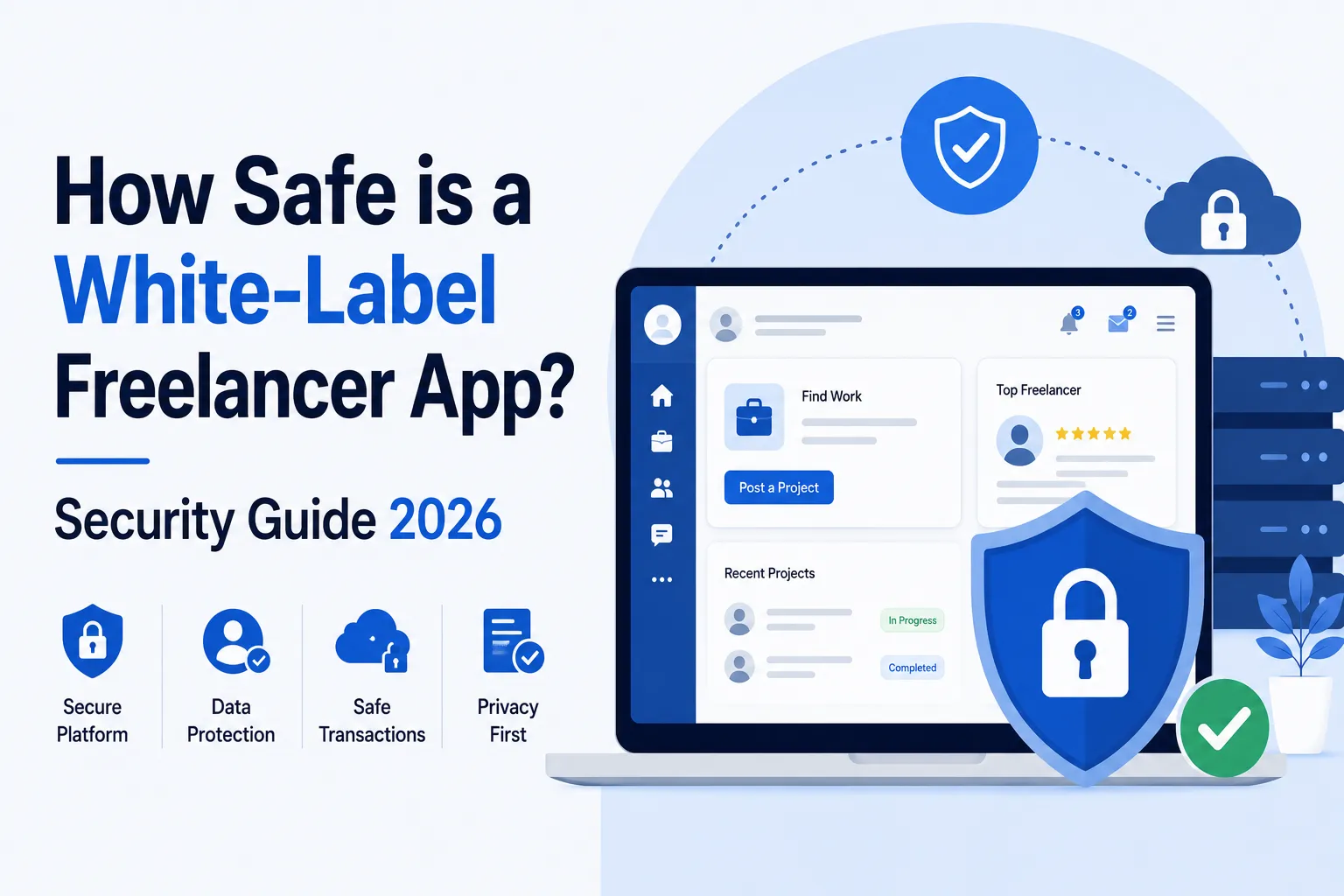
- A freelancer app must be built with strong security because it handles user profiles, payments, contracts, files, chats, payouts, and sensitive business data.
- The biggest risks usually come from weak authentication, insecure APIs, payment fraud, file vulnerabilities, poor access control, and unsafe third-party integrations.
- Important security layers include encrypted communication, secure escrow payments, KYC verification, role-based permissions, activity logs, and fraud monitoring.
- Freelancer platforms should also prepare for compliance requirements such as GDPR, data retention rules, payment security standards, and dispute documentation.
- Long-term platform trust depends on secure infrastructure, verified users, transparent transactions, admin visibility, and continuous security maintenance.
Security Infrastructure Signals
- Authentication security should include secure login flows, password hashing, session management, MFA options, and suspicious activity monitoring.
- Escrow and payment protection are critical because freelancer apps handle deposits, milestone releases, refunds, commissions, and payout workflows.
- Role-based access control helps separate permissions between freelancers, clients, admins, moderators, and support teams.
- Secure file handling is important because contracts, portfolios, attachments, invoices, and project documents may contain sensitive information.
- Development complexity changes based on payment gateways, KYC integrations, messaging systems, cloud storage, audit logs, moderation tools, and compliance requirements.
Real Insights
- A freelancer marketplace is not only a job platform; it is a trust ecosystem where users exchange money, files, intellectual work, and communication daily.
- Founders should prioritize backend security early because weak API protection or payment handling can damage platform credibility quickly.
- Dispute systems, milestone tracking, and moderation tools are important because platform trust depends on transparent workflow management.
- Security should be continuously monitored because freelancer apps evolve with new integrations, payment flows, messaging tools, and user behavior patterns.
- The safest freelancer platforms combine secure authentication, encrypted communication, escrow protection, admin visibility, fraud detection, and scalable compliance-ready infrastructure.
A White-Label Freelancer App can be safe, scalable, and launch-ready, but only when security is treated as part of the product foundation rather than an afterthought.
For founders, the real question is not simply whether a freelancer app has login, payments, chat, job posting, and reviews. The stronger question is whether the platform can protect client data, freelancer profiles, project files, payment flows, dispute records, messages, admin controls, and marketplace trust as users begin transacting inside the app.
Freelancer marketplaces carry a unique security burden because they connect strangers around paid work. A client may upload business documents. A freelancer may share portfolio assets. Both sides may exchange messages, payment information, delivery files, invoices, tax details, and reviews. If the platform fails at access control, payment security, profile verification, or dispute handling, trust can break quickly.
That is why founders evaluating a White-Label Freelancer App should look beyond design and feature lists. A safe freelancer marketplace needs role-based access control, secure payment gateway integration, encrypted data transfer, audit logs, admin approval controls, abuse reporting, dispute workflows, and privacy-conscious data handling. These are the security layers Miracuves recommends positioning as foundational for marketplace trust.
Miracuves helps founders launch ready-made, white-label, source-code-owned app solutions with admin control, custom branding, and faster deployment. For freelancer marketplace founders, the advantage is not only speed. It is starting with a structured product foundation that can be customised around business model, security expectations, and marketplace operations.
What Makes a White-Label Freelancer App Safe or Risky?
A White-Label Freelancer App is usually a ready-made freelancer marketplace foundation that can be branded and customised for a business. It may include client apps, freelancer apps, web panels, admin dashboards, job posting, gig listings, messaging, payments, reviews, and dispute workflows.
The safety of the app depends less on the word “white-label” and more on how the product is engineered.
A white-label app can be safe when it includes:
- Role-based access control for clients, freelancers, admins, and support teams
- Secure authentication and session management
- Encrypted data transfer
- Secure payment gateway integration
- Escrow-style payment handling or milestone payment workflows
- Admin approval controls
- Audit logs for sensitive actions
- Abuse reporting and dispute management
- Secure API integration
- Regular security updates
- Source-code access for future improvements
A white-label app becomes risky when it is only a visual clone with weak backend logic. For example, if a freelancer can view another freelancer’s order details, if a client can access private delivery files by changing a URL, or if a sub-admin can change payment records without approval, the platform has a serious trust problem.
OWASP lists broken access control as a major web application risk because access control failures can allow users to view, modify, delete, or perform actions outside their intended permissions. In a freelancer marketplace, this risk directly affects orders, messages, payouts, reviews, admin actions, and private files.
Why Freelancer Marketplace Security Matters More in 2026
Freelance marketplace security is becoming more important because work platforms now handle more than simple job listings. They manage identity, payments, communication, contracts, ratings, business files, and sometimes sensitive project data.
Security threats also affect freelancers directly. A 2026 ITPro report described campaigns where attackers used fake recruitment and freelance-platform-style workflows to target software developers with malicious packages and fake interview processes. While that article discusses external threat activity, it reinforces a broader marketplace reality: platforms that connect work opportunities with remote workers must think seriously about identity, trust, communication safety, and abuse prevention.
Academic research has also identified security responsibility as a challenge in online freelance software development, arguing that security in freelance environments should be treated as a distributed responsibility across platforms, clients, and developers rather than blamed on one party alone. For founders, this means a freelancer marketplace should guide safe behaviour through product design, not only through terms and conditions.
A marketplace is only as trusted as its weakest workflow. Even if the front-end looks professional, users may leave if they experience fake profiles, payment confusion, project file leaks, spam messages, manipulated reviews, or unresolved disputes.
Core Security Layers Every White-Label Freelancer App Should Include
A secure White-Label Freelancer App should protect four major areas: identity, access, money, and marketplace behaviour.
Essential Security Features for a White-Label Freelancer App
| Security Layer | What It Protects | Founder Impact |
|---|---|---|
| Role-Based Access Control | Client, freelancer, admin, and sub-admin permissions | Prevents users from accessing data or functions outside their role. |
| Secure Authentication | Login, sessions, password resets, account access | Reduces account takeover risk and improves user trust. |
| Secure Payment Gateway Integration | Payments, payouts, refunds, invoices, transaction records | Protects revenue flows and reduces payment disputes. |
| Escrow or Milestone Workflow | Client deposits, freelancer delivery, order release | Creates confidence for both sides of the marketplace. |
| Encrypted Data Transfer | Messages, files, profile data, transaction activity | Helps protect sensitive data moving between users and systems. |
| Audit Logs | Admin edits, payout changes, dispute updates, account actions | Gives the platform operator visibility when something goes wrong. |
| Moderation and Abuse Reporting | Fake gigs, spam, harassment, suspicious offers, policy violations | Protects marketplace quality and user experience. |
| API Authorization | Mobile app and backend communication | Prevents users from manipulating API requests to access restricted data. |
Security Risks Founders Should Check Before Buying a Freelancer App
A freelancer marketplace may look complete during a product demo, but security weaknesses often appear in edge cases. Founders should test how the system behaves when users try to access data they should not see, change order status incorrectly, manipulate payment states, upload risky files, or abuse messaging.
1. Weak role separation
A freelancer marketplace has multiple user types. Clients should not access freelancer payout settings. Freelancers should not access client billing records. Support agents should not change financial records unless their permission level allows it.
This matters because broken access control is not just a technical bug. It is a business risk. OWASP explains that access control failures can lead to unauthorised information disclosure, modification, destruction, or users performing actions outside their limits.
2. Insecure APIs
White-label freelancer apps often include web, Android, iOS, and admin panels connected to backend APIs. If APIs are not properly protected, users may manipulate object IDs, order IDs, gig IDs, wallet IDs, or message IDs.
OWASP’s API Security guidance explains that broken object-level authorization can happen when attackers manipulate object IDs sent through requests. For a freelancer app, that could mean trying to access another user’s order, invoice, file, conversation, or dispute record.
3. Poor payment and payout controls
Payment workflows are one of the most sensitive areas in a freelancer marketplace. A secure platform should clearly separate payment initiation, payment confirmation, platform commission, freelancer payout, refund, cancellation, and dispute states.
Founders should check whether the app supports secure payment gateway integration, transaction logs, payout approval workflows, refund rules, and admin-level transaction visibility.
4. Fake profiles and fake gigs
Freelance platforms can attract spam, duplicate accounts, fake portfolios, fake reviews, and low-quality gigs. User verification, profile approval, gig moderation, review monitoring, and abuse reporting help protect marketplace trust.
5. Weak dispute handling
A dispute workflow is not only a support feature. It is a security and trust feature. It protects both the client and freelancer when delivery quality, payment release, cancellation, refund, or scope disagreement becomes sensitive.
A safe freelancer app should allow admins to review evidence, order history, messages, milestones, files, and transaction status before making a decision.
6. No post-launch security process
Even a well-built app needs ongoing maintenance. The FTC advises businesses to keep security current and build processes for addressing new vulnerabilities quickly. Founders should ask whether the white-label vendor provides update support, security patching guidance, dependency review, and source-code access.
Mistakes Founders Should Avoid
Choosing a freelancer app only by UI screens
A polished interface does not prove that payment flows, APIs, admin roles, and user permissions are secure. Founders should test the backend control layer before launch.
Ignoring admin permissions
If every admin can access every module, the platform becomes harder to control as the team grows. Role-based admin access protects operations.
Launching without dispute workflows
Freelancer marketplaces need clear complaint, refund, cancellation, and order review flows because trust breaks quickly when money and work delivery are unclear.
Buying a closed system without source-code access
Without source-code ownership or access, founders may struggle to audit, customise, or improve security as the marketplace scales.
White-Label vs Custom Freelancer App Security
A white-label freelancer app is not automatically less secure than custom development. The safer option depends on code quality, architecture, vendor process, security testing, source-code access, and ongoing maintenance.
| Build Option | Security Advantage | Security Risk | Best For |
|---|---|---|---|
| White-label freelancer app | Faster launch with existing marketplace workflows | Risky if the code is outdated, closed, or poorly maintained | Founders who want faster validation with customisation |
| Custom freelancer app | Security can be designed around exact requirements | Longer build cycles and more implementation risk if the team lacks marketplace experience | Funded teams with complex custom workflows |
| No-code marketplace | Fastest experimentation | Limited control over backend security, custom flows, and scalability | Early concept testing with low transaction risk |
| Open-source script | Code visibility and flexibility | Requires strong technical team for hardening and maintenance | Technical founders with in-house engineering |
For many founders, the strongest path is a source-code-owned white-label solution that combines launch speed with long-term control. Miracuves’ core positioning includes ready-made clone app solutions, white-label app development, source-code ownership, admin dashboards, custom branding, and scalable backend foundations.
Admin Panel Security: The Control Layer Founders Often Underestimate
The admin panel is where the platform operator controls users, freelancers, clients, categories, gigs, jobs, payments, disputes, reviews, content, commissions, reports, and platform settings.
That makes the admin panel one of the most sensitive parts of a White-Label Freelancer App.
A secure admin panel should include:
- Role-based admin permissions
- Sub-admin access controls
- Activity logs
- Payout approval workflows
- Dispute review history
- User suspension and verification controls
- Gig approval and rejection controls
- Commission and fee setting restrictions
- Content moderation queues
- Report export controls
A weak admin panel can create internal risk. For example, a support user should not necessarily have permission to change commission settings or approve payouts. A content moderator should not automatically access full payment records. A finance admin may need transaction visibility but not user password controls.
This is where founders should ask practical demo questions:
- Can I create different admin roles?
- Can I restrict who can approve payouts?
- Can I see who changed a dispute status?
- Can I block suspicious freelancers or clients?
- Can I review gig updates before publishing?
- Can I export reports safely?
- Can I disable inactive or suspicious accounts?
The more money and user activity the marketplace handles, the more important admin control becomes.
Payment, Escrow, and Dispute Security in Freelancer Marketplaces
Freelancer marketplaces need payment trust from both sides. Clients want confidence that funds are not released before work is delivered. Freelancers want confidence that clients cannot disappear after receiving work.
A safe white-label freelancer app should support payment logic such as:
- Secure payment gateway integration
- Wallet or transaction history
- Platform commission tracking
- Freelancer payout records
- Refund and cancellation status
- Milestone or escrow-style workflows where relevant
- Admin review for disputed transactions
- Invoice or receipt generation
- Payment status logs
The app should also avoid unclear payment states. For example, an order should not show as “completed” for the freelancer and “pending” for the client without a clear system reason. Payment status conflicts create support load, refund risk, and trust issues.
Security does not end at the payment gateway. The marketplace also needs internal logic that tracks who paid, who delivered, who approved, who disputed, who refunded, and who changed the status.
User Verification, Review Safety, and Abuse Prevention
A freelance marketplace depends on reputation. But reputation can be manipulated if user verification and review systems are weak.
Common abuse risks include:
- Fake freelancer accounts
- Fake client accounts
- Fake job postings
- Fake reviews
- Review exchanges
- Spam messages
- Phishing links
- Portfolio theft
- Duplicate accounts
- Off-platform payment attempts
- Abusive communication
- Misleading gig descriptions
Older research on micro-task marketplaces found that malicious users can misuse freelance-style marketplaces for manipulated tasks and crowdsourced abuse. While marketplace models have evolved since then, the founder lesson remains relevant: open marketplaces need moderation, reporting, and policy enforcement built into the product.
A safer White-Label Freelancer App should support:
- Email and phone verification
- Optional document verification for high-risk categories
- Freelancer profile approval
- Gig approval queues
- Abuse reporting
- Review moderation
- Message reporting
- Account suspension
- Admin notes
- Dispute escalation
For niche freelance marketplaces, verification can also be tailored by category. A marketplace for designers may need portfolio checks. A marketplace for developers may need GitHub or skill validation. A marketplace for local professionals may need identity or license checks depending on the target market.
API, Backend, and Data Security Checklist
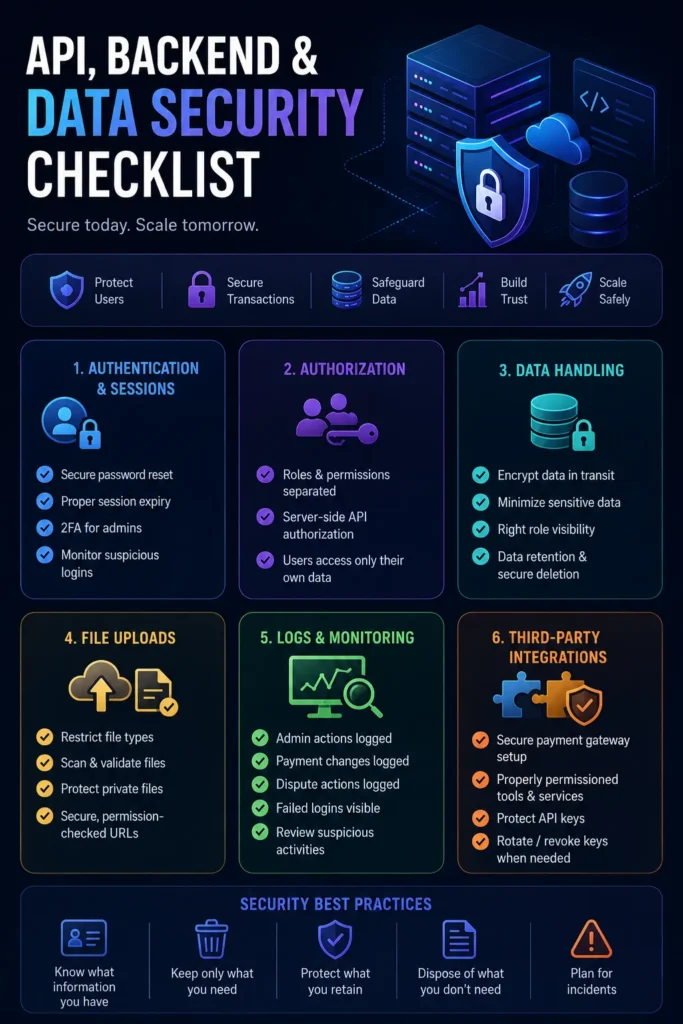
Most users never see the backend, but backend security determines whether the app can safely scale.
OWASP’s 2021 Top 10 includes risks such as broken access control, cryptographic failures, injection, insecure design, security misconfiguration, vulnerable and outdated components, identification and authentication failures, software and data integrity failures, logging and monitoring failures, and server-side request forgery. These categories matter for freelancer marketplace apps because the platform handles user data, transactions, messages, files, and role-based actions.
Founders should ask vendors about:
Authentication and sessions
- Are password reset flows secure?
- Are sessions expired properly?
- Is two-factor authentication available or configurable for admins?
- Can suspicious login activity be monitored?
Authorization
- Are client, freelancer, admin, and sub-admin permissions separated?
- Are API endpoints checked on the server side?
- Can users access objects only when they own them or have permission?
Data handling
- Is sensitive data encrypted in transit?
- Is sensitive data minimised where possible?
- Is private information visible only to the right role?
- Can old or unnecessary data be removed based on policy?
The FTC’s business guidance recommends knowing what personal information a business has, keeping only what is needed, protecting retained information, disposing of unnecessary information properly, and planning for incidents. This maps well to freelancer marketplaces because they collect profile, contact, communication, transaction, and work-delivery data.
File uploads
- Are file types restricted?
- Are files scanned or validated before access?
- Are private delivery files protected?
- Are file URLs hard to guess and permission-checked?
Logs and monitoring
- Are admin actions logged?
- Are payment state changes logged?
- Are dispute actions logged?
- Are failed login attempts visible?
- Are suspicious activities reviewable?
Third-party integrations
- Are payment gateways configured securely?
- Are email, SMS, storage, analytics, and notification tools properly permissioned?
- Are API keys protected?
- Can integrations be rotated or revoked if compromised?
Founder Decision Signals Before Launch
Founder Decision Signals
Speed
A white-label freelancer app is useful when you want to launch faster, but speed should not remove security review. Test core workflows before going live.
Cost
Security problems become expensive after launch. A slightly stronger foundation is usually more cost-efficient than repairing trust after payment or data issues.
Scalability
As users grow, admin roles, moderation queues, payment logs, API limits, and dispute controls become more important than the first UI design.
Market Fit
If your niche involves high-value projects, sensitive files, regulated work, or local professional services, verification and dispute workflows should be stronger from day one.
Security Questions to Ask Before Buying a White-Label Freelancer App
Before choosing a white-label freelancer marketplace solution, founders should ask the vendor practical questions instead of accepting broad claims.
Product security questions
- Do we get source code?
- Can the code be audited?
- Which user roles are included?
- Can admin roles be customised?
- Does the platform support secure payment gateways?
- Is there a transaction history module?
- Are order, gig, job, and dispute workflows permission-protected?
- Are API endpoints protected against unauthorised access?
- Does the app support secure file upload and file access control?
- Are logs available for admin actions and payment changes?
Marketplace trust questions
- Can freelancers be verified before publishing services?
- Can clients be blocked or reviewed for suspicious activity?
- Can users report messages, gigs, jobs, or reviews?
- Can admins moderate reviews?
- Can admins pause suspicious accounts?
- Is there a dispute management workflow?
Post-launch questions
- Who handles updates?
- How are security patches managed?
- Can the app be customised after launch?
- Can the platform support more categories, languages, currencies, or payment gateways later?
- What support is available after deployment?
These questions help founders separate a simple clone script from a serious marketplace foundation.
How Miracuves Helps Founders Launch Safer Freelancer Marketplace Apps
Miracuves helps founders build ready-made and white-label app solutions with custom branding, source-code ownership, admin dashboards, and faster deployment. For a freelancer marketplace, this approach helps founders avoid building every workflow from zero while still keeping control over the product foundation, security logic, and future customisation.
A freelancer marketplace needs more than client and freelancer profiles. It needs a controlled system where job posting, gig management, messaging, payments, ratings, disputes, and admin actions work together safely. This is where a Miracuves-style freelancer marketplace foundation gives founders a practical starting point with the core marketplace workflows already structured.
The platform can be positioned around the most important business and security layers, including:
- Client, freelancer, and admin workflows for smooth marketplace operations
- Secure payment gateway integration with order and milestone tracking
- Ratings, reviews, messaging, and dispute management workflows
- Admin control over users, categories, commissions, reports, and platform activity
- Source-code ownership and white-label branding for long-term customisation
For founders planning to launch a freelancer marketplace, the goal is not to copy Fiverr or Upwork blindly. The stronger strategy is to use a proven marketplace pattern, customise it for a niche, secure the trust layers, and launch with enough operational control to improve after real user behaviour appears.
Explore Miracuves’ ready-made app solutions or review broader white-label app development options if you want a launch-ready product foundation with room for customisation.
Final Thoughts: A White-Label Freelancer App Is Safe When Control Is Built In
A White-Label Freelancer App can be a safe and practical launch path for founders, but only when the platform includes the right security, payment, admin, and trust controls.
The decision should not be based only on launch speed or design quality. Founders should inspect role permissions, API protection, payment workflows, dispute handling, user verification, file access, admin logs, and post-launch maintenance.
The real value of a white-label freelancer marketplace is not copying another platform. It is using a proven product foundation to launch faster, customise smarter, and reduce avoidable development risk. With a source-code-owned and admin-controlled approach, founders can move faster without giving up long-term security control.
Miracuves helps founders build white-label, launch-ready app solutions designed for branding, monetization, admin control, and faster market validation.
FAQs
Is a White-Label Freelancer App safe to launch?
Yes, a White-Label Freelancer App can be safe to launch when it includes role-based access control, secure authentication, encrypted data transfer, secure payment gateway integration, admin controls, dispute management, audit logs, and ongoing security updates. Founders should verify these layers before going live.
What is the biggest security risk in a freelancer marketplace app?
The biggest risk is weak access control. If clients, freelancers, admins, and support users are not properly separated, users may access private data or perform actions outside their role. OWASP identifies broken access control as a major web application security risk.
Should a freelancer marketplace app include escrow?
Escrow-style or milestone payment workflows are useful for freelancer marketplaces because they help protect both clients and freelancers. Clients gain confidence that funds are tied to delivery, while freelancers gain confidence that the client has committed funds before work begins.
Is a white-label freelancer app safer than custom development?
It depends on the vendor, source code quality, security testing, and maintenance process. A strong white-label freelancer app can be safer than a rushed custom build if it has proven workflows, secure payment logic, admin controls, and source-code access. A poor white-label script can be risky if it is outdated or closed.
What should founders check before buying a freelancer app?
Founders should check source-code access, admin role permissions, payment gateway configuration, API authorization, file upload security, dispute workflows, user verification, audit logs, post-launch support, and whether the platform can be customised as the business grows.
How does admin panel security affect freelancer marketplace safety?
The admin panel controls users, gigs, jobs, disputes, payments, commissions, reviews, and reports. If admin permissions are too broad, internal users may access or change sensitive data without proper control. Role-based admin access and activity logs reduce this risk.