


Key Takeaways
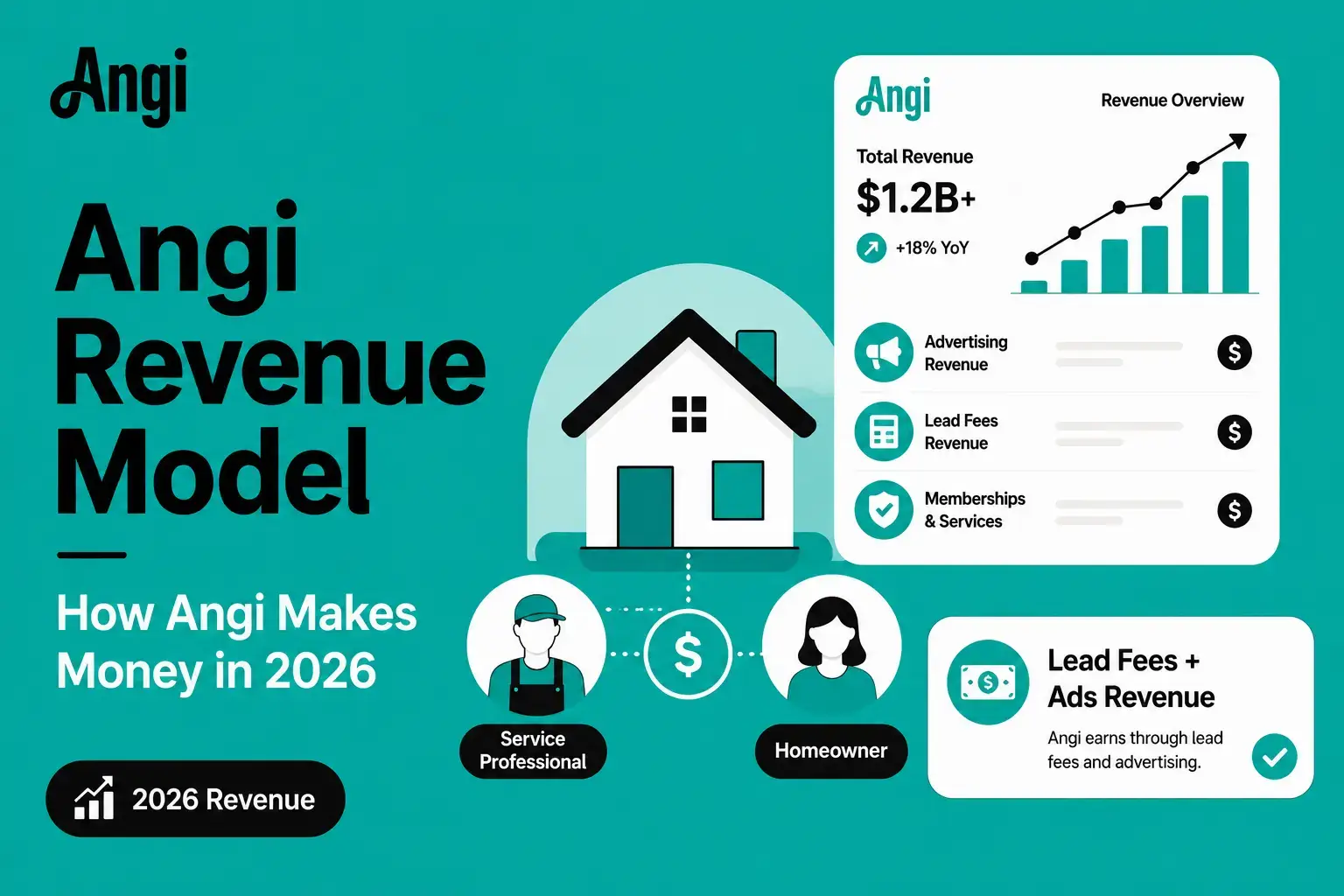
- Angi earns through a home services marketplace connecting customers with local professionals.
- Lead generation is a major revenue source from service provider connections.
- Advertising and promotions help professionals get more visibility.
- Service bookings support platform activity and customer demand.
- The model depends on trust, local supply, reviews, and repeat service needs.
What You’ll Learn
- How Angi makes money in the home services market.
- Paid leads help contractors reach interested customers.
- Subscription and ad options increase visibility for service providers.
- Customer reviews help build trust before booking.
- Revenue growth depends on providers, customer demand, pricing, and service quality.
Real Insights
- Angi grows when homeowners trust its provider network.
- Local service demand creates steady marketplace opportunities.
- Verified professionals improve customer confidence and bookings.
- Reviews and ratings matter for conversion and retention.
- The best insight is that Angi earns by turning home service demand into paid provider opportunities.
Angi generated approximately $1.4 billion in revenue in 2026, maintaining its position as one of the largest home services marketplaces in North America.
What makes Angi fascinating isn’t just its revenue size, but how it balances marketplace commissions, lead generation, advertising, and subscription models in a highly competitive industry.
Beyond monetization, Angi has successfully evolved from a simple directory listing platform into a full-stack transaction marketplace. It now controls not just lead flow, but booking, payments, visibility ranking, and even contractor SaaS tools — giving it multiple levers to influence revenue growth.
Another critical strength lies in its dual-sided optimization. Angi constantly adjusts pricing, contractor exposure, and customer acquisition strategies using marketplace data. This improves match quality, increases job completion rates, and boosts revenue per transaction.
For founders building service marketplaces, understanding Angi’s revenue engine is like studying a blueprint for scalable platform monetization. It demonstrates how layering revenue streams, optimizing take rates, and building recurring contractor relationships can transform a simple marketplace into a durable, high-margin business model.
Angi Revenue Overview – The Big Picture
2025 Revenue: ~$1.4 billion
Valuation (Market Cap 2025): ~$1.2–1.5 billion (public company under IAC umbrella structure historically)
YoY Growth: Moderate growth (~3–6% stabilization phase after prior restructuring years)
Revenue by Region:
• United States: ~95%
• Canada & Other: ~5%
Profit Margins:
• Gross margin: ~85% (asset-light marketplace)
• Adjusted EBITDA margin: ~12–18%
• Net profitability: Narrow margins due to marketing spend and restructuring
Competition Benchmark :
• Thumbtack – Private, strong VC backing
• HomeAdvisor (merged brand legacy)
• TaskRabbit (IKEA-owned)
• Yelp Services marketplace
• Houzz Pro
Read More: What Is Angi? Home Services Marketplace Explained
Angi has shifted from a pure lead-selling model toward a hybrid marketplace + transaction model, improving monetization efficiency and recurring revenue predictability.
Primary Revenue Streams Deep Dive
Revenue Stream #1: Service Provider Leads (Core Revenue – ~45%)
Angi sells verified customer leads to contractors. Providers pay per lead, whether or not they close the job.
• Lead cost: $15–$85 depending on service category
• High-value services (roofing, remodeling) cost more
• Generates consistent recurring revenue
Revenue Stream #2: Transaction Commissions (~25%)
Under its marketplace model, Angi processes bookings and takes a percentage.
• Commission: ~15–20% per completed job
• Higher-margin stream than leads
• Encourages in-platform transactions
Revenue Stream #3: Advertising & Sponsored Listings (~15%)
Service providers pay for boosted visibility.
• Monthly subscription advertising packages
• Pay-per-click visibility placements
• Category-based exclusivity pricing
Revenue Stream #4: Membership Subscriptions (~8%)
Consumers subscribe for perks such as discounts and project guarantees.
• Annual fee structure
• Added trust layer improves retention
Revenue Stream #5: SaaS Tools for Contractors (~7%)
CRM tools, payment systems, and operational dashboards.
• Monthly SaaS fees
• Increases lifetime value of contractors
Table: Revenue Streams Percentage Breakdown
| Revenue Stream | Estimated Share | Pricing Model |
|---|---|---|
| Lead Sales | 45% | Pay per lead ($15–$85) |
| Marketplace Commission | 25% | 15–20% per job |
| Advertising/Sponsored Listings | 15% | Monthly subscription + PPC |
| Consumer Membership | 8% | Annual subscription |
| SaaS Tools | 7% | Monthly SaaS fees |
The Fee Structure Explained
User-Side Fees
• Most homeowners browse free
• Membership optional annual fee
• No direct booking fee in most cases
Provider-Side Fees
• Pay-per-lead charges
• Commission on booked jobs
• Advertising subscription packages
Hidden Revenue Layers
• Payment processing margins
• Premium placement bidding
• Category-based surge pricing
Regional Pricing Variation
• Urban markets: Higher lead cost
• Rural markets: Lower lead pricing
• High-demand categories: Premium bidding rates
Table: Complete Fee Structure by User Type
| User Type | Fee Type | Amount Range |
|---|---|---|
| Homeowner | Membership (optional) | ~$29–$99 annually |
| Contractor | Lead Purchase | $15–$85 per lead |
| Contractor | Commission | 15–20% per job |
| Contractor | Advertising Subscription | $200–$2,000/month |
| Contractor | SaaS Tools | $50–$300/month |
How Angi Maximizes Revenue Per User
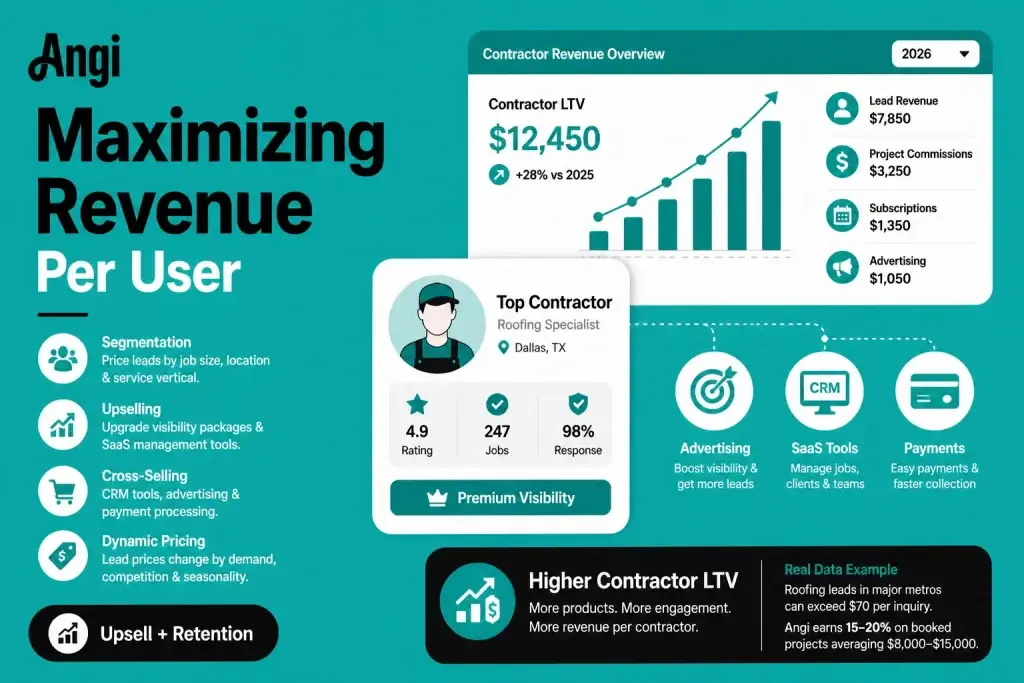
Segmentation
Angi categorizes providers by job size, location, and service vertical to price leads dynamically.
Upselling
Contractors are encouraged to upgrade visibility packages and subscribe to SaaS management tools.
Cross-Selling
CRM tools + advertising + payment processing are bundled.
Dynamic Pricing
Lead pricing changes based on demand, competition, and seasonality.
Retention Monetization
Recurring subscriptions reduce churn.
LTV Optimization
Contractor lifetime value increases when they adopt multiple revenue products.
Psychological Pricing
Tiered advertising packages create anchoring effects.
Real Data Example
Roofing leads in major metro areas can exceed $70 per inquiry, while Angi earns 15–20% on booked projects averaging $8,000–$15,000.
Cost Structure & Profit Margins
Infrastructure Cost
• Cloud hosting
• Platform development
• AI-driven matching systems
CAC & Marketing
• Google Ads
• SEO
• Brand campaigns
Marketing remains one of Angi’s largest expenses.
Operations
• Customer support
• Verification teams
• Sales staff
R&D
• Marketplace improvements
• Automation systems
• Fraud prevention
Unit Economics
• High gross margin
• Marketing-heavy acquisition model
• Improving repeat usage lowers CAC
Margin Optimization
Shift toward transaction-based commission model improves take rate efficiency.
Profitability Path
Marketplace automation + contractor SaaS monetization strengthens EBITDA margins.
Future Revenue Opportunities & Innovations
New Streams
• Financing for home projects
• Embedded insurance products
AI/ML-Based Monetization
• Predictive job matching
• Smart pricing optimization
• Automated upsell triggers
Market Expansions
• International service verticals
• Commercial property services
Predicted Trends 2025–2027
• Shift toward transaction-led revenue
• Decline in pure lead dependency
• Subscription bundling growth
Risks & Threats
• Rising CAC
• Competition from local platforms
• Regulatory oversight on gig/service pricing
Opportunities for New Founders
• Hyper-local niche service platforms
• Vertical-specific marketplaces (solar, EV installation)
• Subscription-based contractor SaaS hybrid models
Lessons for Entrepreneurs & Your Opportunity
What Works
• Multi-layer monetization
• Dual-sided revenue model
• Recurring subscription bundling
What to Replicate
• Lead + commission hybrid
• Contractor SaaS upsell
• Dynamic pricing based on demand
Market Gaps
• Transparent pricing models
• Better contractor retention tools
• Faster payout cycles
Read more: What Is Angi and How Does It Work?
Final Thought
Angi proves that service marketplaces scale better when monetization is layered and diversified. Instead of depending on only one revenue stream, its hybrid model combines leads, subscriptions, advertising, service fees, and provider visibility tools to create more stable revenue.
For founders, the lesson is clear: build a marketplace that connects users and service providers, but monetize it like a SaaS company. A diversified revenue model creates stronger margins, better retention, and more predictable long-term growth.
FAQs
1. How much does Angi make per transaction?
Angi typically earns 15–20% commission on completed marketplace bookings.
2. What’s Angi’s most profitable revenue stream?
Marketplace commissions tend to have higher margins than pay-per-lead sales.
3. How does Angi’s pricing compare to competitors?
Angi’s lead pricing is similar to Thumbtack but often higher in competitive metro areas.
4. What percentage does Angi take from providers?
Approximately 15–20% on marketplace jobs.
5. How has Angi’s revenue model evolved?
It shifted from pure lead generation toward a hybrid transaction-based marketplace.
6. Can small platforms use similar models?
Yes, especially in niche or hyper-local categories.
7. What’s the minimum scale for profitability?
Profitability depends on marketing efficiency and contractor retention, but strong local density is key.
8. How to implement similar revenue models?
Combine lead sales, commissions, subscriptions, and SaaS upsells in one ecosystem.
9. What are alternatives to Angi’s model?
Flat subscription marketplaces, reverse-auction bidding models, or freemium SaaS-only models.