


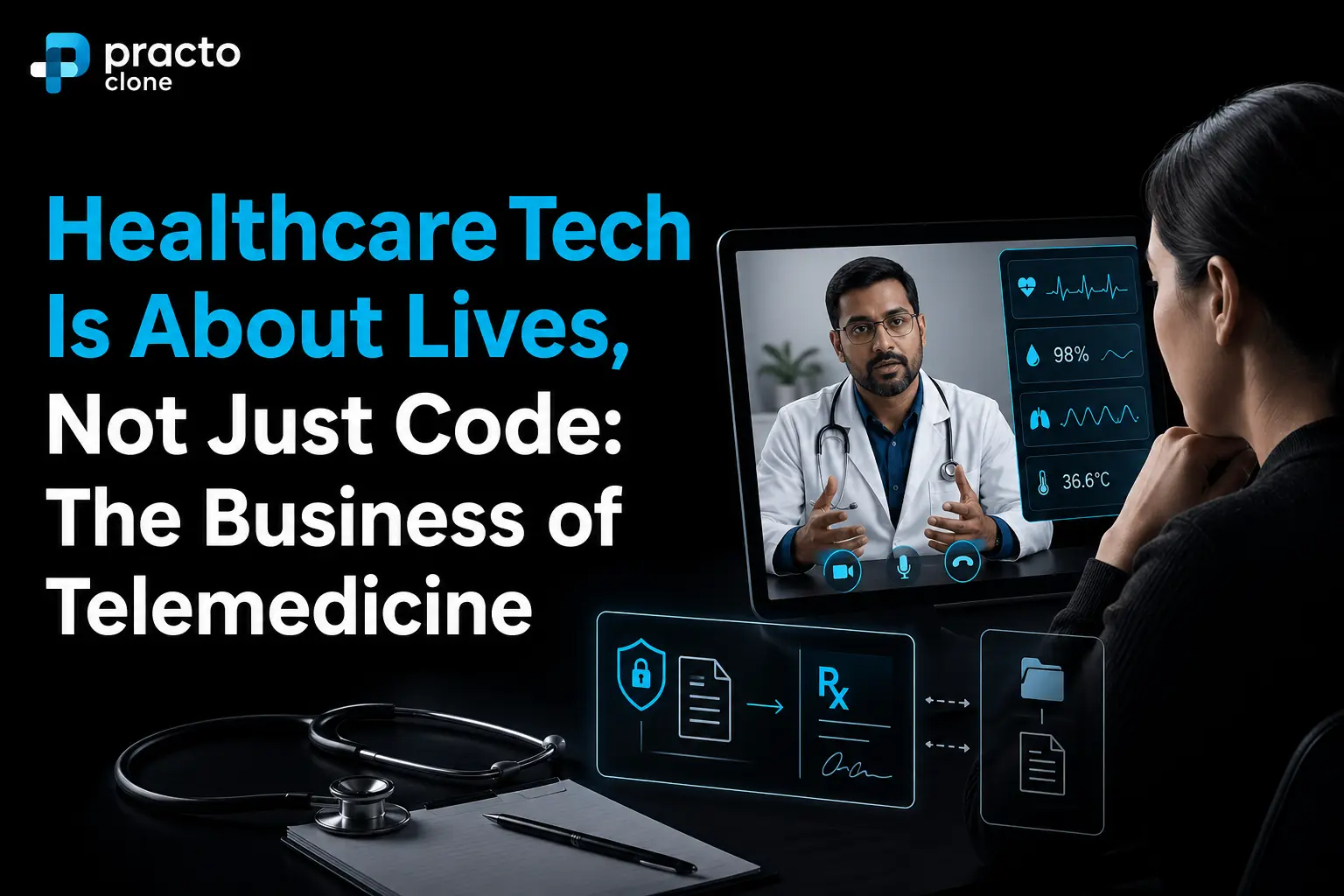
Key Takeaways
What You’ll Learn
- A Practo clone should be built like healthcare infrastructure, not just a booking app.
- Video consultations, EHR flow, and pharmacy sync are core product layers.
- Compliance and patient trust matter early in any telemedicine platform.
- Admin visibility improves platform control across doctors, patients, and services.
- Long-term success depends on reliability, privacy, and connected healthcare workflows.
Stats That Matter
- Compliance, consultation technology, EHR integration, pharmacy sync, and monetization are treated as the main healthcare platform layers.
- HIPAA and GDPR readiness are positioned as core requirements for serious telemedicine products.
- Consultation systems should support stable video, patient interaction, and clinical reliability.
- EHR infrastructure and pharmacy sync connect appointments, prescriptions, and long-term patient management.
- Admin controls are needed for providers, services, consultations, and transaction oversight.
Real Insights
- Healthcare trust is harder to earn than app engagement because patient data and care quality are involved.
- Disconnected systems reduce care quality even when the front-end looks polished.
- Security and compliance should be built from day one, not added after launch.
- Integrated healthcare workflows improve retention because patients return to platforms that feel dependable.
- The strongest telemedicine platforms are built for care continuity, not just consultation booking.
Most on-demand platforms compete on speed, pricing, or convenience. A food delivery app loses a customer if the meal arrives cold. A ride-hailing platform loses a rider if the wait time is too long. The stakes are real, but they are recoverable.
Healthcare is a different category entirely.
When a patient books a consultation, shares medical history, or receives a digital prescription, the margin for error is not a refund or a discount — it is their health, their privacy, and their trust. This changes everything about how a telemedicine platform must be designed, built, and operated.
A Practo Clone is not simply a booking interface layered over doctor profiles. It is a clinical-grade digital product that must handle sensitive data with legal precision, deliver consultation quality that reflects real medical standards, integrate with health records and pharmacy systems, and generate revenue in a way that never compromises the patient relationship.
For founders entering the digital health space, this distinction is the starting point. The most successful telemedicine platforms do not win on features alone. They win because patients feel safe, doctors trust the system, and every part of the platform — from login to post-consultation follow-up — is built with accountability.
This blog breaks down the five product and business pillars that separate a serious healthcare platform from a generic booking app.
Why HIPAA and GDPR Compliance Is the Foundation, Not a Feature
In most product categories, compliance is something that gets added after the core product is built. In healthcare, that approach is not just risky — it is commercially dangerous and in many jurisdictions, legally indefensible.
HIPAA governs the handling of patient health information in the United States. GDPR sets data protection standards across Europe. For any Practo Clone targeting these markets — or any market with equivalent national health data legislation — compliance must be a design decision made before a single line of code is written.
At the product level, this means building the following into the system from the start:
- End-to-end encryption for all patient data in transit and at rest, ensuring that no health information is exposed at any point in the transaction chain
- Role-based access controls that strictly define who within the platform can view, edit, or export health records — and log every instance of access
- Consent management flows that give patients clear, informed control over how their data is collected, stored, and shared
- Audit trails that create a verifiable record of every data interaction, which is essential both for regulatory reporting and for internal accountability
- Data residency configurations that ensure patient information remains within legally permitted geographic boundaries depending on the user’s location
What Non-Compliance Actually Costs a Healthcare Platform
The consequences of launching without a compliance foundation are not abstract or distant. HIPAA violations carry civil penalties ranging from one hundred dollars per violation for unintentional breaches to fifty thousand dollars per violation for willful neglect — with annual caps reaching into the millions. GDPR penalties can reach four percent of a company’s total global annual revenue.
Beyond financial penalties, a single data breach in healthcare is enough to destroy user trust permanently. Patients do not forgive a platform that exposes their medical history. Doctors do not build their practice on a system they cannot trust. Investors do not back a healthcare business carrying unresolved regulatory liability. The platform does not just lose revenue — it loses its reason to exist.
How Compliance Becomes a Competitive Advantage
When compliance is engineered into the platform from day one, it transitions from a cost center into a market differentiator. Platforms with verifiable data security certifications, transparent consent frameworks, and documented handling of protected health information carry a measurably stronger pitch to hospital networks, enterprise clients, insurance partners, and government health programs.
In a category where trust is the primary purchase driver, compliance is not a legal requirement sitting at the edge of the product. It is the trust layer that makes every other part of the platform credible.
How Video Consultation Technology Defines the Quality of Care Delivery
The consultation itself is the core product in a telemedicine platform. Everything else — the booking flow, the doctor profiles, the payment gateway — exists to deliver that one moment when a patient connects with a doctor. If that moment is unreliable, the platform has failed at its primary function, regardless of how polished the surrounding experience looks.
Video consultation infrastructure in a serious Practo Clone cannot be treated as a commodity integration. It must be built around clinical reliability, session security, and workflow efficiency. Getting this layer right is what separates a healthcare platform from a video calling app with a booking screen.
The following table outlines what strong video consultation infrastructure looks like from both the patient side and the doctor side — because both experiences must be designed with equal care:
| Consultation Layer | Patient-Side Requirements | Doctor-Side Requirements |
|---|---|---|
| Video Quality | Stable, low-latency connection across varied network conditions | Consistent performance even during high-volume consultation hours |
| Session Security | End-to-end encrypted session data, no third-party exposure | Secure access to patient records during the call without switching systems |
| In-Call Tools | Ability to share documents, describe symptoms, and view prescriptions | In-call prescription generation, clinical note-taking, and diagnostic referral |
| Queue Management | Real-time waiting room status and estimated wait time visibility | Live schedule view, patient queue control, and delay notification tools |
| Post-Consultation | Automatic summary, prescription copy, and follow-up instructions | Record auto-update, pharmacy trigger, and next appointment scheduling |
The Doctor-Side Experience Matters as Much as the Patient Side
Most telemedicine platforms over-invest in the patient-facing interface and underinvest in the doctor-side workflow. This is a strategic mistake. A doctor using a Practo Clone needs to see the patient’s full consultation history, active prescriptions, known conditions, and past diagnostic results before and during the call — without navigating away from the session.
When the doctor experience is well-designed, platform adoption among medical professionals increases organically. High-quality, experienced doctors attract more patients through reputation and word-of-mouth. More consultations generate richer clinical data over time, which improves platform intelligence and deepens the product’s long-term value. This is a compounding growth loop that begins with one decision: investing in the right consultation technology.
Why EHR Integration Turns Appointments Into a Continuous Health Journey
A standalone appointment is a transaction. A connected health record transforms that appointment into part of an ongoing care relationship. This is the fundamental difference that Electronic Health Record integration makes in a Practo Clone — and it is one of the most commercially underappreciated investments a healthcare platform can make.
EHR integration means that every consultation, prescription, diagnostic result, and clinical note is stored in a structured, accessible, and interconnected patient profile. When a patient returns for a follow-up, their doctor does not start from scratch. When a specialist is brought in, they have full clinical context from the first moment. When the patient reviews their own health profile, they see a coherent and organized health timeline rather than a disconnected list of appointment records.
The table below shows the key types of data that EHR integration captures and what each contributes to both clinical quality and platform value:
| EHR Data Type | Clinical Value | Platform Business Value |
|---|---|---|
| Consultation history | Continuity of care across doctors and specialties | Increases patient return rate and time-on-platform |
| Prescription records | Avoids drug interactions, supports accurate dosing | Enables pharmacy sync and repeat prescription revenue |
| Diagnostic results | Contextualizes symptoms and tracks health trends | Supports lab partnership integrations and referral commissions |
| Specialist referrals | Connects primary and specialist care within one system | Expands provider network monetization opportunities |
| Follow-up schedules | Ensures patients do not fall through care gaps | Drives re-engagement through automated appointment reminders |
What Structured Health Data Does for Platform Growth
Beyond clinical quality, a well-structured EHR system creates tangible business advantages that compound over time. Platforms with organized patient health histories can deliver smarter appointment recommendations based on past patterns, trigger preventive care alerts that bring patients back to the platform before a health issue escalates, and offer longitudinal health reports that increase perceived platform value significantly.
For founders, EHR is not simply a compliance requirement or a clinical tool. It is a retention and monetization infrastructure. Patients who experience genuine continuity of care on a platform are far less likely to switch to a competitor. This makes EHR one of the highest-return investments in the entire Practo Clone product architecture.
How Pharmacy Sync Closes the Loop Between Diagnosis and Treatment
A telemedicine consultation that ends with a prescription but provides no path to fulfillment is an incomplete product experience. The patient leaves the platform, searches for a pharmacy, presents the prescription, and manages the rest of the process entirely on their own. Every step outside the platform is a step toward disengagement — and a missed revenue opportunity.
Pharmacy sync solves this by connecting the prescription output of a consultation directly to a fulfillment pathway, whether through partner pharmacy networks, an in-app pharmacy marketplace, or delivery logistics tied to verified dispensing providers.
In a well-built Practo Clone, pharmacy sync supports:
- Digital prescription transmission directly to a connected pharmacy immediately upon consultation completion, removing any manual step from the patient’s side
- Real-time medication inventory visibility so patients can confirm availability and choose a fulfillment option before placing an order
- Prescription verification workflows that ensure regulatory and clinical accuracy before dispensing, protecting both the patient and the platform from liability
- Fulfillment tracking that keeps the patient within the platform’s experience from initial booking all the way through to medicine delivery
- Chronic care and repeat prescription management for patients on long-term medications, which creates a recurring engagement loop that benefits both the patient and the platform’s revenue model
Pharmacy Integration as Both a UX Win and a Revenue Layer
From a user experience perspective, pharmacy sync removes friction at the most critical moment in the patient journey — when they need to act on their diagnosis. A patient who books, consults, receives a prescription, and completes a pharmacy order without leaving the platform has a materially better experience than one who must manage each step in isolation. That end-to-end journey builds loyalty in a way that a good booking flow alone never can.
From a revenue perspective, pharmacy partnerships introduce a meaningful and scalable additional stream. Commission on fulfilled prescriptions, preferred placement agreements with pharmacy chains, and subscription-based medication delivery plans all contribute to platform revenue without requiring additional patient acquisition spend. The same consultation that generates a doctor service fee also generates a pharmacy transaction. This is how a single patient visit creates multiple, compounding revenue events.
Monetization Models That Build Revenue Without Eroding Patient Trust
Healthcare monetization requires a higher level of discipline and transparency than almost any other digital product category. Aggressive or opaque revenue models that succeed in e-commerce or entertainment generate backlash in healthcare, where patients are in a position of genuine vulnerability and have limited tolerance for platforms that appear to prioritize billing over care.
The platforms that build sustainable revenue in this space do so by designing their financial model around the same principles as their product: trust, value delivery, and alignment with the interests of patients and providers.
Revenue Streams Worth Building Into a Practo Clone
| Revenue Model | How It Works | Why It Builds Trust |
|---|---|---|
| Clinic and doctor subscriptions | Monthly or annual plans giving providers access to scheduling, EHR, consultation tools, and analytics | Providers pay for tools that genuinely improve their practice — no hidden charges |
| Per-consultation commission | A percentage-based platform fee on each completed consultation | Revenue scales with actual usage and value delivered |
| Pharmacy revenue share | Commission on prescriptions fulfilled through integrated pharmacy partners | Earns revenue by completing the care journey, not interrupting it |
| Diagnostic lab partnerships | Revenue from lab test referrals and result integrations within patient records | Adds clinical value while generating revenue from expanded care pathways |
| Premium patient plans | Subscription tiers offering priority booking, unlimited consultations, or health monitoring | Patients choose to upgrade because the value is visible and tangible |
| White-label licensing | Licensing the platform to hospital networks, insurers, or corporate health programs | High-value B2B revenue with strong long-term contract potential |
What makes this revenue stack defensible is that none of these streams require the platform to act against the interests of its users. Doctor subscriptions are paid for tools that demonstrably improve clinical operations. Consultation commissions are earned on completed transactions. Pharmacy and lab revenue is generated through service facilitation that genuinely benefits the patient. Premium plans are adopted voluntarily because the value is visible.
The best-performing healthcare platforms treat monetization as a value exchange. When revenue grows because patient outcomes improve and provider efficiency increases, the business becomes structurally defensible in a way that purely transactional models can never be.
Building a Practo Clone with Miracuves: From Consultation Flow to Complete Healthcare Operations
Building a Practo Clone is not just about doctor profiles, appointment booking, video calls, and payments. A real telemedicine platform must connect patients, doctors, prescriptions, health records, pharmacy workflows, payments, and admin control into one secure system.
Miracuves helps founders build a Practo Clone that is designed for real healthcare operations, not only for app launch. The platform can support:
- Patient registration and doctor booking
- Video consultation and digital prescriptions
- EHR integration for patient history
- Pharmacy sync for medicine fulfillment
- Secure payments and commission tracking
- Admin dashboard for users, doctors, services, and reports
- Compliance-ready data handling with encryption and access control
| Key Layer | Business Value |
|---|---|
| Secure consultation system | Builds patient trust and improves care delivery |
| EHR integration | Helps doctors manage patient history and follow-ups |
| Pharmacy sync | Converts prescriptions into completed medicine orders |
| Admin dashboard | Gives full control over doctors, patients, payments, and reports |
| Monetization setup | Supports commissions, subscriptions, pharmacy revenue, and lab partnerships |
With Miracuves, the Practo Clone can be customized for doctor consultation marketplaces, clinic booking platforms, hospital networks, or complete healthcare apps with pharmacy and diagnostics.
The goal is not to build an app that simply looks like Practo. The goal is to launch a secure, scalable, and compliance-ready telemedicine platform that can support real patients, verified doctors, and long-term healthcare business growth.
Conclusion
The digital health market is growing at a pace that rewards founders who build with genuine product depth and penalizes those who treat telemedicine as a simple feature set. Patients are increasingly comfortable with digital-first healthcare, but their expectations are high and their tolerance for platforms that feel insecure, clinically shallow, or operationally unreliable is very low.
A Practo like app built with compliance as its foundation, consultation quality as its core product, EHR integration as its retention engine, pharmacy sync as its fulfillment layer, and ethical monetization as its revenue model is not just competitive — it is built for the kind of long-term trust that compounds into real business value.
Trust drives repeat consultations. Trust convinces doctors to build their practice inside your platform. Trust makes a healthcare business defensible against any competitor that tries to undercut on price or outspend on marketing. In this category more than any other, the quality of what you build determines the ceiling of what you can grow.
If you are planning to build a telemedicine platform or a Practo Clone and want to approach it with the right product architecture, compliance foundation, and commercial strategy from day one, Miracuves is ready to help you build it the right way.
Get in touch with the Miracuves team to discuss your healthcare platform vision.
FAQs
What is a Practo Clone?
A Practo Clone is a telemedicine platform that allows patients to book doctors, attend video consultations, receive digital prescriptions, manage health records, make payments, and access connected healthcare services like pharmacy and lab support.
Why is compliance important in telemedicine app development?
Compliance is important because telemedicine apps handle sensitive patient data. HIPAA, GDPR, encryption, consent management, and audit trails help protect patient privacy, reduce legal risk, and build trust among patients and healthcare providers.
What are the must-have features of a Practo Clone app?
A Practo Clone app should include doctor profiles, appointment booking, video consultation, patient records, digital prescriptions, secure payments, pharmacy sync, lab integration, notifications, ratings, and an admin dashboard.
How does a Practo Clone make money?
A Practo Clone can generate revenue through doctor subscriptions, consultation commissions, pharmacy partnerships, diagnostic lab referrals, premium patient plans, sponsored listings, and white-label licensing for clinics or hospital networks.
Why choose Miracuves for Practo Clone app development?
Miracuves helps founders build scalable Practo Clone platforms with secure video consultations, EHR integration, pharmacy sync, admin controls, payment systems, and compliance-ready architecture for long-term healthcare business growth.
Related Articles: