Key Takeaways
- An OTT streaming platform feature planning should connect video playback, content discovery, subscriptions, user profiles, monetization, analytics, and platform operations within one scalable ecosystem.
- Core viewer features include adaptive streaming, search, recommendations, watchlists, continue-watching, subtitles, multiple profiles, notifications, and multi-device access.
- Founders should plan operational features alongside the viewer experience, including content management, subscription control, payments, user management, reporting, moderation, and admin permissions.
Playback & Content Signals
- Playback infrastructure should support adaptive bitrate streaming, CDN delivery, resume playback, multiple resolutions, subtitles, audio tracks, device synchronization, and reliable video startup.
- Content management features should cover movies, series, seasons, episodes, categories, metadata, thumbnails, trailers, publishing schedules, regional availability, and content access rules.
- Personalized recommendations, smart search, trending sections, related titles, watch history, curated collections, and content freshness help improve discovery and viewing depth.
Platform Operations Insights
- Operators need admin controls for users, subscriptions, payments, content catalogs, coupons, banners, notifications, refunds, roles, permissions, and customer support workflows.
- Analytics should track watch time, content completion, subscriber growth, churn, revenue, playback performance, search activity, recommendations, and content-level engagement.
- Miracuves develops customizable OTT streaming platforms with adaptive playback, content management, subscriptions, recommendations, payments, analytics, user management, security, and admin controls.
An OTT streaming platform is not just a video player with a subscription button. It is a complete viewing, content, monetization, and operations system.
For founders, feature planning matters because every module affects how viewers discover content, how smoothly they watch, how often they return, how payments are managed, and how the business operates after launch.
A weak feature plan creates friction. Viewers cannot find relevant titles. Payments become confusing. Admin teams depend on developers for small updates. Content teams struggle to manage catalogs. Retention drops because the platform does not guide users back.
A strong feature plan connects playback, discovery, content management, subscriptions, rentals, analytics, admin control, support workflows, and platform operations into one practical roadmap.
Miracuves helps founders launch OTT and video streaming platforms faster with ready-made, white-label, source-code-owned foundations that can be customized around audience strategy, content workflows, monetization, and growth operations.
Building a custom streaming product? See our OTT app development service for scope, team and delivery.
Why Feature Planning Should Start Before OTT Development
Many streaming startups begin with a basic feature list: login, video upload, video player, payment gateway, subscription plans, and admin dashboard.
That is a start, but it is not enough.
A founder should first decide what kind of streaming business the platform is meant to support. A regional entertainment platform, fitness video library, education streaming app, producer-led content marketplace, live event platform, and premium rental platform all need different feature priorities.
Before development starts, founders should clarify:
- Who will watch the content?
- Who will upload or manage the content?
- Will the platform use subscriptions, rentals, pay-per-view, ads, or mixed monetization?
- Will producers, creators, instructors, or studios need access?
- Will viewers watch on mobile, web, TV, or multiple devices?
- What discovery features are needed?
- What retention features are essential?
- What admin workflows are required after launch?
Feature planning prevents overbuilding and underbuilding at the same time. It helps founders avoid spending too much on advanced features too early while still protecting the product from operational gaps.
OTT Feature Planning Framework
| Feature Layer | What It Covers | Why It Matters |
|---|---|---|
| Playback experience | Video player, adaptive streaming, subtitles, resume playback | Improves viewing quality |
| Content discovery | Search, categories, filters, recommendations, watchlist | Helps viewers find relevant titles |
| User accounts | Signup, login, profiles, account settings, preferences | Supports personalization and access control |
| Monetization | Subscriptions, rentals, PPV, coupons, payments, invoices | Connects content value with revenue |
| Content operations | Uploads, catalog, metadata, approvals, publishing, banners | Helps teams manage the content library |
| Admin dashboard | Users, plans, content, payments, reports, support, roles | Gives operators business control |
| Analytics | Watch time, conversions, churn, revenue, content performance | Improves product and growth decisions |
| Retention | Continue Watching, alerts, reminders, recommendations | Encourages repeat viewing |
| Security and access | Secure payments, role-based access, content access rules | Protects users, revenue, and platform operations |
This framework keeps the blog focused on planning and prevents it from becoming a direct product sales page.
1. Playback Features That Shape the Viewing Experience
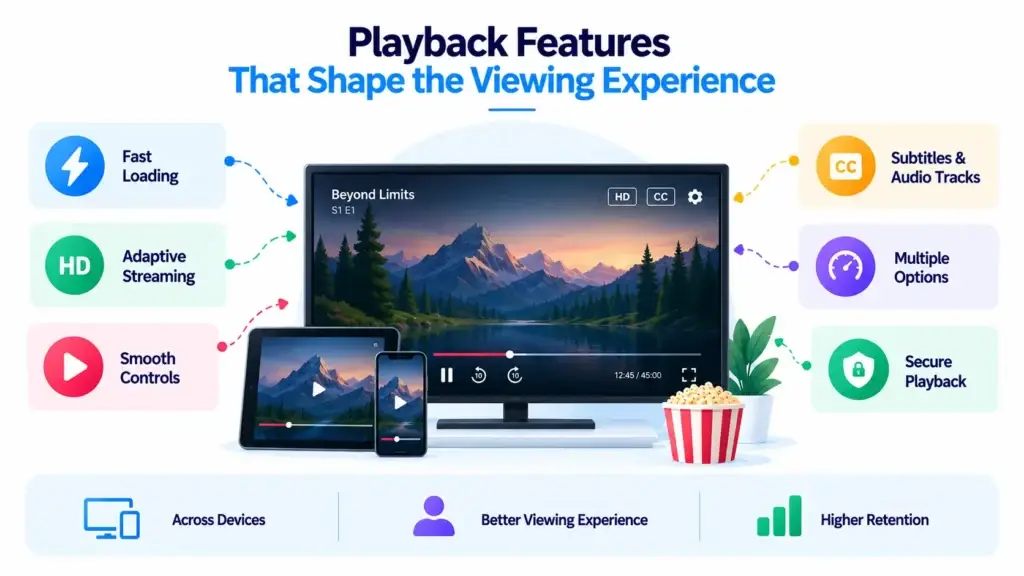
Playback is the heart of an OTT platform. If the video experience is poor, other features cannot compensate.
Important playback features include:
- Fast video loading
- Adaptive streaming
- Play, pause, rewind, and forward controls
- Full-screen viewing
- Resume playback
- Quality selection
- Subtitle support
- Multiple audio tracks where relevant
- Trailer playback
- Error handling
- Device compatibility
- Playback speed where useful
- Secure content access
Adaptive playback is especially important because viewers watch from different devices, locations, and network conditions. The platform should adjust quality based on connection strength instead of forcing a single version for every user.
Founders should treat playback as a retention feature, not only a technical feature. Smooth viewing increases session quality and reduces frustration.
2. Content Discovery Features That Help Viewers Find the Right Title
A streaming platform can have a strong catalog and still lose viewers if discovery is weak.
Content discovery features help users quickly understand what is available and what is worth watching.
Important discovery features include:
- Search
- Genre filters
- Language filters
- Category pages
- Trending rows
- New release sections
- Recently added rows
- Recommended titles
- Popular titles
- Watchlist
- Continue Watching
- Featured banners
- Title pages
- Trailer previews
- Metadata such as cast, creator, genre, language, rating, and release year
Discovery should match the business model. A regional platform may need language-first browsing. A learning platform may need topic-based categories. A premium rental platform may need featured releases, trailers, and expiry information.
For a broader view of discovery, viewing, and retention features, read this guide on features that make an OTT streaming platform competitive.
3. User Account and Profile Features
User accounts are not only for login. They support personalization, payments, viewing history, parental controls, and subscription access.
Useful account features include:
- Email or phone registration
- Social login where relevant
- Secure login
- Password reset
- Profile management
- Multiple profiles
- Kids profile
- Language preference
- Watch history
- Watchlist
- Subscription status
- Billing details
- Device/session management
- Notification preferences
- Account deletion or deactivation request
Multi-profile support is useful when families or groups share one account. Each profile can have its own watchlist, Continue Watching row, viewing history, and recommendations.
For founders, profile features help improve personalization and reduce messy recommendations across shared accounts.
4. Content Catalog and Metadata Planning
The content catalog is the foundation of the viewing experience.
A strong catalog should not simply store videos. It should organize content in a way that supports search, recommendations, promotions, monetization, and reporting.
Important catalog fields may include:
- Title
- Description
- Genre
- Language
- Content type
- Duration
- Release date
- Rating
- Cast or creator details
- Thumbnail
- Trailer
- Tags
- Series and episode structure
- Premium access status
- Rental availability
- Pay-per-view availability
- Publishing status
- Region availability where relevant
- Producer or content owner details
Metadata quality affects discovery. If titles are poorly tagged, recommendations and search become weaker.
Founders should plan catalog structure early because changing metadata logic later can create operational work.
5. Subscription, Rental, and Pay-Per-View Features
OTT monetization should be connected to the content value.
Some platforms work best with subscriptions. Some need rentals. Some monetize live events through pay-per-view. Some combine multiple models.
Important monetization features include:
- Monthly plans
- Annual plans
- Free trial logic
- Freemium access
- One-time rentals
- Pay-per-view access
- Premium content access
- Coupons
- Promo codes
- Invoices
- Payment gateway integration
- Subscription renewal
- Subscription cancellation
- Plan upgrade and downgrade
- Rental expiry logic
- Payment failure handling
- Refund workflow
- Revenue reporting
For a deeper revenue breakdown, review Miracuves’ OTT streaming platform business model guide, covering subscriptions, rentals, pay-per-view, producer revenue sharing, ads, and premium content models.
The important founder decision is not “which monetization feature is popular?” It is “which monetization model matches the content catalog and viewer intent?”
6. Content Management Features for Platform Teams
Content teams need control over the platform after launch.
A good content management system helps the team upload, edit, organize, approve, schedule, and promote content without developer dependency.
Important content management features include:
- Video upload
- Thumbnail upload
- Trailer upload
- Series and episode management
- Genre management
- Language management
- Tags and metadata
- Content status control
- Draft and publish workflow
- Scheduled publishing
- Featured banner management
- Content approval workflow
- Premium access control
- Rental settings
- Pay-per-view settings
- Bulk upload support where relevant
- Producer content review
If your platform needs structured catalog, viewer, subscription, and admin workflows, explore Miracuves’ complete OTT platform feature breakdown for a more module-level view.
7. Producer, Creator, or Content Partner Workflows
Not every OTT platform creates all content internally. Some rely on producers, studios, instructors, creators, agencies, or content partners.
If content partners are part of the business model, the platform may need:
- Producer registration
- Producer approval
- Content submission
- Content review
- Revenue share settings
- Watch-minute reporting
- Payout reports
- Content ownership details
- Agreement tracking
- Partner dashboard
- Upload limits
- Performance analytics
- Admin approval control
These workflows are important because content supply is a business operation, not just a media upload process.
A platform with producer workflows can scale content supply more easily, but it also needs governance. Founders should define who can upload, who approves content, how revenue is calculated, and how content is removed if needed.
8. Viewer Retention Features
Subscriber acquisition is expensive if viewers do not return.
Retention features help users continue watching, discover new content, and stay engaged after the first session.
Important retention features include:
- Continue Watching
- Watchlist
- Viewing history
- New release alerts
- Personalized recommendations
- Email notifications
- Push notifications
- Rental expiry reminders
- Subscription renewal reminders
- Seasonal collections
- Recently added rows
- Recommended for you rows
- Multi-profile recommendations
- Win-back campaign support
Retention should be planned before launch. If a user joins for one title and sees no clear reason to return, churn becomes likely.
For a go-to-market perspective, read this guide on OTT platform content supply, subscriber acquisition, and retention strategy.
9. Analytics Features for Better Business Decisions
Analytics help founders understand what is working.
A streaming platform should track more than total users. It should help teams understand viewing behavior, subscription performance, content quality, and revenue patterns.
Useful analytics include:
- Active users
- Trial starts
- Subscription conversions
- Rental purchases
- Pay-per-view purchases
- Watch time
- Completion rate
- Drop-off points
- Most watched titles
- Least watched titles
- Search queries
- Watchlist usage
- Continue Watching usage
- Churn rate
- Renewal rate
- Revenue by plan
- Revenue by content type
- Producer performance
- Coupon usage
- Campaign source
Analytics should guide content and marketing decisions. If viewers search for unavailable content, that may show licensing demand. If one category has high completion rates, it may deserve more promotion. If users drop off after trial, pricing or catalog value may need review.
10. Admin Dashboard and Platform Operations Features
The admin dashboard is the control room of the OTT business.
A platform operator needs to manage users, content, plans, payments, producers, campaigns, reports, and support workflows without depending on developers for every small change.
The admin dashboard should help the team manage:
- Users
- Subscriptions
- Rentals
- Pay-per-view access
- Content catalog
- Producers
- Content approvals
- Coupons
- Banners
- Notifications
- Revenue reports
- Payouts
- Watch-minute data
- Support issues
- Refund workflows
- Analytics
- Roles and permissions
Without admin control, every campaign or content update becomes slow. That hurts go-to-market execution because OTT teams need to react quickly to content performance, viewer feedback, subscription trends, and partner requests.
11. Security, Access Control, and Trust Features
OTT platforms handle user accounts, payments, subscriptions, premium content access, and sometimes producer payouts. Security should be part of the foundation.
Important trust and security features include:
- Secure login
- Encrypted data transfer
- Secure payment gateway integration
- Role-based admin access
- Admin activity logs
- Content access rules
- Payment verification
- Subscription status checks
- Device/session management
- Refund workflow
- Support workflow
- Privacy-conscious data handling
- Abuse reporting where relevant
For premium content, access control is especially important. The system must know who can watch which title, under which plan, for how long, and on which device rules.
Final compliance and policy requirements depend on the operating market, payment integrations, content rights, and legal review.
12. Notification and Communication Features
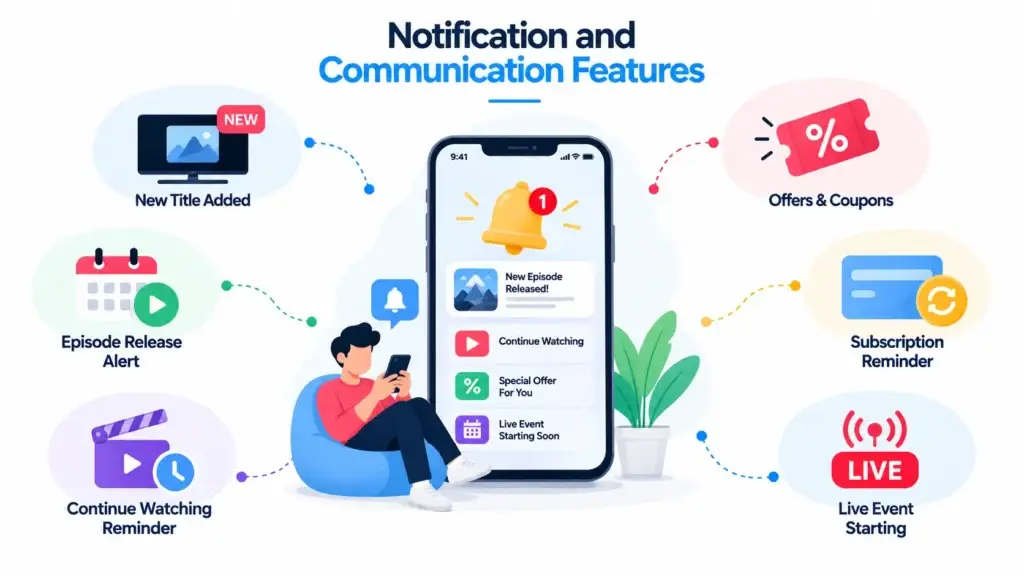
Notifications help bring users back, but they must be relevant.
Useful notification triggers include:
- New title added
- New episode released
- Watchlist title available
- Continue Watching reminder
- Rental expiring soon
- Subscription renewal reminder
- Payment failed
- Coupon or offer alert
- Live event starting
- Recommended title
- Producer or creator update where relevant
Founders should avoid generic notification blasts. The best notifications are connected to user interest, subscription status, viewing behavior, and catalog freshness.
13. Multi-Device and Expansion Planning
Not every OTT platform needs every device on day one. But the roadmap should allow expansion.
Common platform options include:
- Web app
- Android app
- iOS app
- Tablet experience
- Smart TV apps as an advanced scope
- Cross-device Continue Watching
- Shared watchlist
- Account sync
- Secure sessions
- Responsive layouts
Many founders start with web and mobile, then expand based on demand. The key is to avoid a technical foundation that blocks future platform growth.
For a technical build perspective, read this OTT streaming app developer guide to understand architecture, backend planning, platform setup, and development workflow.
Feature Priority Table: What Founders Should Build First
OTT Feature Planning Priority Matrix
| Feature Group | Launch Priority | Founder Decision |
|---|---|---|
| Playback, login, catalog, search | Must-have | Required for the basic viewing experience |
| Subscriptions, rentals, payments, access rules | Must-have if monetized | Needed to connect content access with revenue |
| Watchlist, Continue Watching, history | High priority | Improves retention and repeat viewing |
| Admin dashboard and content management | Must-have | Needed for platform operations after launch |
| Analytics and revenue reports | High priority | Helps founders improve catalog, pricing, campaigns, and retention |
| Producer workflows | Depends on content model | Essential if external content partners are part of the supply plan |
| Advanced personalization and Smart TV expansion | Scale-stage priority | Useful after viewer demand and platform behavior are clearer |
Founder Decision Signals
Playback
If viewers will watch long-form content, prioritize smooth playback, adaptive streaming, subtitles, resume logic, and device compatibility.
Monetization
If revenue starts from day one, plan subscription, rental, PPV, payment, invoice, coupon, and access-control workflows before launch.
Operations
If your team will manage a growing catalog, prioritize admin control, content approvals, metadata, banners, analytics, and support workflows.
Launch Speed
If faster validation matters, begin with a launch-ready foundation and customize around your audience, catalog, pricing, and retention roadmap.
Development Cost and Build Path Considerations
Feature scope directly affects development cost.
A simple streaming product with login, playback, catalog, subscriptions, and admin control is very different from a full platform with producer workflows, rentals, pay-per-view, advanced analytics, Smart TV apps, DRM, custom recommendation systems, and enterprise integrations.
Major cost drivers include:
- Web, Android, iOS, and TV platform scope
- Video player and playback requirements
- CDN and streaming infrastructure
- Subscription and rental workflows
- Pay-per-view access
- Producer dashboard
- Content approval logic
- Admin dashboard complexity
- Analytics depth
- Payment gateway integrations
- Security and access control
- Custom branding
- Third-party integrations
- Post-launch customization
If budget planning is part of your launch decision, this OTT platform development cost guide explains how features, streaming infrastructure, integrations, and customization affect the final investment.
Founders comparing build partners can also read this OTT platform development company guide before choosing a team for launch, customization, source-code ownership, and support.
Common OTT Feature Planning Mistakes Founders Should Avoid
1. Treating playback as the only core feature
Streaming quality matters, but a competitive platform also needs discovery, monetization, admin control, analytics, and retention workflows.
2. Building payments without clear access rules
Subscriptions, rentals, premium content, and pay-per-view require plan logic, expiry rules, payment verification, and admin controls.
3. Ignoring content operations
Without catalog management, metadata, approvals, scheduling, and promotional controls, teams struggle to keep the platform fresh after launch.
4. Adding advanced features too early
Smart TV apps, advanced personalization, complex recommendation systems, and enterprise integrations should be added when the business case is clear.
5. Underbuilding the admin dashboard
Founders need control over users, content, payments, subscriptions, reports, refunds, support, producers, banners, coupons, and roles.
How Miracuves Helps Founders Launch OTT Platforms Faster
Miracuves helps founders, media companies, agencies, and content-led startups launch OTT streaming platforms with ready-made, white-label, source-code-owned foundations.
Instead of building every module from zero, founders can start with core streaming workflows and customize the product around audience, content strategy, monetization, branding, admin control, and future growth.
A launch-ready OTT foundation can support:
- Viewer registration
- Content catalog
- Video streaming
- Subscriptions
- Rentals
- Pay-per-view access
- Watchlist
- Continue Watching
- Admin dashboard
- Content approvals
- Producer workflows
- Revenue reporting
- Coupons
- Banners
- Analytics
- Platform branding
Where the ready-made scope fits the business requirement, Miracuves can support 6-day solution delivery. Advanced customizations, integrations, Smart TV expansion, DRM, unique payment workflows, and scale-specific infrastructure can be planned based on the final roadmap.
If you are evaluating a faster launch path, explore Miracuves’ ready-made OTT streaming platform foundation. You can also explore Miracuves’ broader video content platform solutions if you are planning an OTT, creator, or video-first entertainment product.
Final Thoughts: Feature Planning Decides How Well an OTT Platform Operates
A successful OTT platform is not built by adding features randomly. It is built by connecting the right features to viewer behavior, content supply, monetization, retention, and daily operations.
Founders should prioritize the essentials first: playback, catalog, search, account management, payments, subscription or rental access, admin control, analytics, and retention workflows. More advanced features can be added once the platform has clearer viewer data, stronger content demand, and a defined growth roadmap.
The goal is not to build the biggest feature list. The goal is to build the right platform foundation for your audience, content model, and business plan.
Miracuves helps founders move faster with ready-made, white-label, source-code-owned OTT platform foundations built for customization, admin control, monetization, content workflows, and long-term growth.
FAQs
What features should an OTT streaming platform include?
An OTT streaming platform should include video playback, user registration, content catalog, search, categories, watchlist, Continue Watching, subscriptions, rentals, payments, content management, admin dashboard, analytics, notifications, and security controls.
Which OTT features are most important for launch?
The most important launch features are playback, login, catalog management, search, subscription or rental access, payment flow, admin dashboard, analytics, watchlist, Continue Watching, and support workflows.
Why is admin control important for an OTT platform?
Admin control helps platform operators manage users, content, subscriptions, rentals, payments, coupons, banners, analytics, refunds, producer workflows, and roles without relying on developers for every update.
How do OTT platforms improve viewer retention?
OTT platforms improve retention through Continue Watching, watchlists, personalized recommendations, new release alerts, viewing history, push notifications, rental reminders, and regular content updates.
What monetization features can an OTT platform support?
An OTT platform can support monthly subscriptions, annual subscriptions, rentals, pay-per-view access, premium releases, coupons, ads, producer revenue sharing, and corporate access depending on the business model.
Should founders build Smart TV apps in the first version?
Not always. Many founders begin with web and mobile apps, then expand to Smart TV apps after validating audience demand, content value, and subscription behavior.
How does feature scope affect OTT development cost?
Feature scope affects cost through platform coverage, video player complexity, streaming infrastructure, payment workflows, producer tools, admin dashboard depth, analytics, integrations, security, and customization.
Can Miracuves help launch an OTT streaming platform quickly?
Yes. Miracuves helps founders launch ready-made and white-label OTT streaming platforms with source-code ownership, branded design, admin dashboards, content workflows, monetization modules, and faster deployment. Where the ready-made scope fits, 6-day solution delivery can support faster market entry.
Miracuves is an independent software development company. We are not affiliated with, connected to, sponsored by, or endorsed by any company or product named in this article.
Terms such as “X Clone” are used descriptively. It is how the software industry refers to building a platform with functionality comparable to a known service, and how clients search for it.
The entire design and codebase of our products is built by our own team. Our products contain no code, design, graphics, or content originating from any third-party website or applications.
All third-party names and marks referenced in this article are the property of their respective owners, referenced solely to identify the services discussed.