Key Takeaways
- Building from scratch offers maximum flexibility but requires more development time, budget, technical planning, and maintenance responsibility.
- A ready-made OTT foundation can help startups launch faster and focus resources on content, audience growth, pricing, and market validation.
- The right approach depends on whether the startup’s competitive advantage comes from proprietary technology or its content and market strategy.
- An iOS viewer app must connect with a capable backend, content-management system, monetization logic, analytics, security, and admin controls.
- Source-code ownership and customization rights are critical when evaluating any ready-made streaming platform.
Build vs Buy Decision Signals
- Choose custom development when proprietary playback, personalization, rights management, or interactive technology is central to differentiation.
- Choose a ready-made foundation when launch speed, controlled costs, and early audience validation are the main priorities.
- Define subscriptions, rentals, pay-per-view, freemium access, advertising, or revenue sharing before selecting the platform architecture.
- Verify smooth iOS playback, account access, payments, App Store preparation, device testing, branding, and future multi-platform expansion.
- Review source-code terms, hosting control, dependencies, modification rights, documentation, deployment assistance, and post-launch support.
Real Insights
- Building every standard streaming module from zero can delay the most important test: whether users will watch, pay, and return.
- A polished viewer interface has limited value without operational control over content, users, plans, payments, reports, and settings.
- Content strategy and monetization rules should guide the technology decision instead of being added after development begins.
- No development provider can guarantee App Store approval because Apple retains final control over the review decision.
- Miracuves develops white-label OTT platforms with branded iOS experiences, monetization workflows, admin controls, source-code ownership, and six-day delivery where the ready-made scope applies.
Launching an iOS OTT streaming platform is not just a mobile app decision. It is a business decision that affects content control, subscription revenue, launch timing, user experience, infrastructure, and long-term ownership.
For startups, the question is rarely “Can we build this from scratch?” A capable team can build almost anything with enough time and budget. The stronger question is: should you spend your early capital building standard streaming modules, or should you start with a ready-made OTT foundation and invest more energy into content, audience, monetization, and market validation?
That is where the build-vs-buy decision becomes important.
A custom build gives you maximum technical freedom. A ready-made or white-label OTT platform gives you a faster route to launch. Neither choice is automatically right for every business. The better option depends on your content model, target audience, iOS requirements, funding stage, internal technical capability, launch urgency, and the level of differentiation your product actually needs.
This guide breaks down how startups should evaluate the build vs buy decision for an iOS OTT streaming platform without confusing platform ownership with unnecessary development complexity.
What Does Build vs Buy Mean for an iOS OTT Platform?
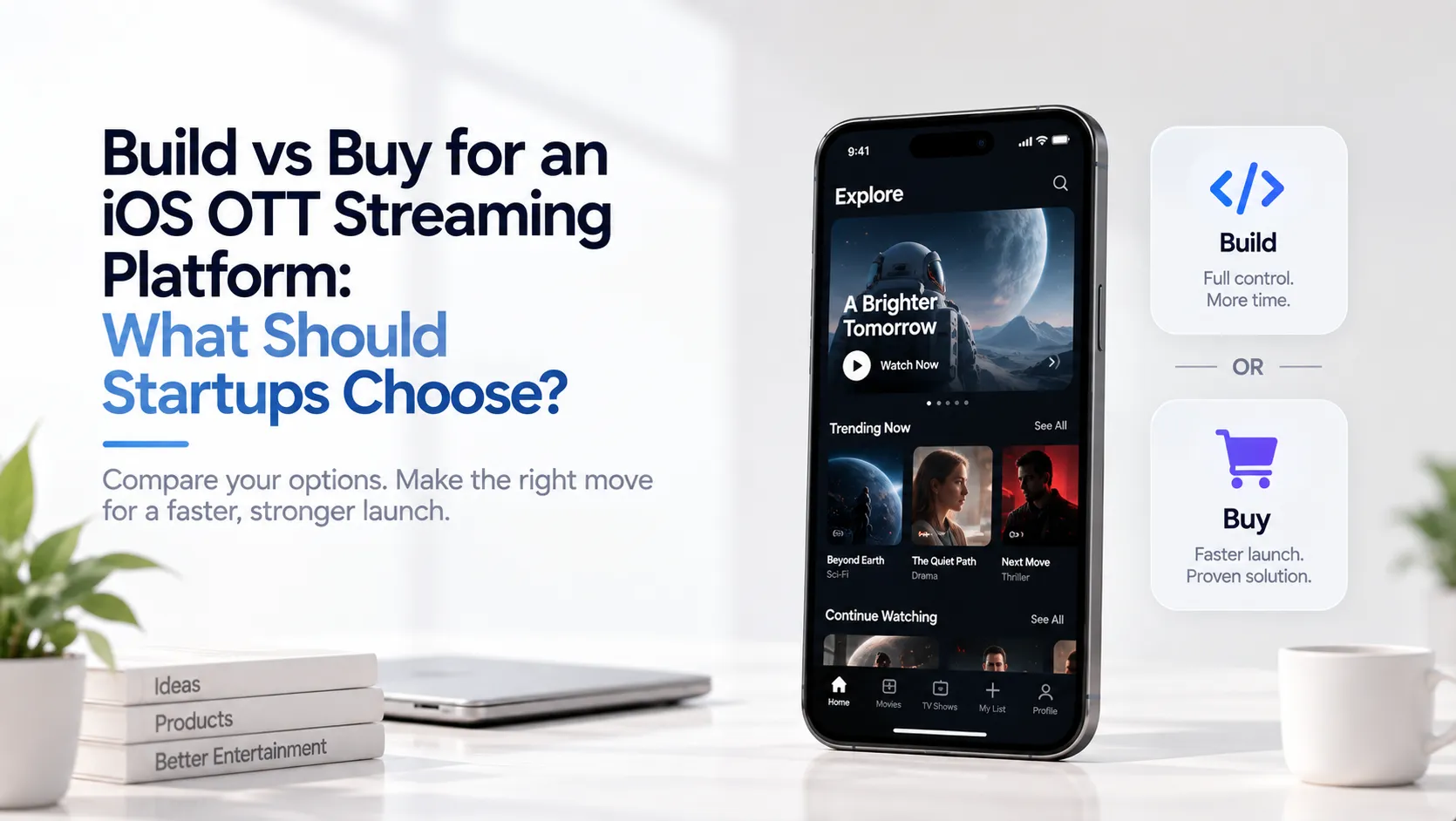
In OTT app development, “build” means creating the platform from the ground up. This usually includes the iOS viewer app, backend, video streaming workflows, content management system, subscription logic, payment integrations, analytics, security controls, admin dashboard, deployment process, and future maintenance.
“Buy” does not mean buying a finished business. It means starting with a ready-made or white-label OTT platform foundation that already includes the core streaming workflows. The startup can then customize branding, content categories, monetization rules, design elements, integrations, and selected business logic.
For an iOS streaming business, the decision matters because the app is only one visible layer. Viewers see the interface, playback, profiles, and payments. The operator also needs control over content uploads, access rules, plans, banners, transactions, user activity, reports, support workflows, and platform settings.
A startup that underestimates the backend usually ends up with a nice-looking app that is difficult to operate. A startup that overbuilds too early may spend months engineering features before proving that the audience will subscribe, rent, watch, or return.
Why Startups Struggle With the Build vs Buy Decision
Many founders start with a product vision: a premium video platform for regional films, fitness classes, children’s content, faith-based media, creator education, sports replays, independent documentaries, or professional training.
The challenge begins when that vision turns into a technical scope.
An OTT platform needs more than video playback. It needs content organization, metadata, user accounts, search, subscriptions, payment flows, access rules, device behavior, content security, analytics, and administrative control. For iOS, the founder also needs to plan around Apple device experience, testing, App Store preparation, app metadata, billing considerations, and long-term updates.
The build-vs-buy decision becomes difficult because both options sound attractive:
Building feels safer when you want complete control. Buying feels faster when you want to launch quickly. But the real decision should be based on what actually creates business value.
If your competitive advantage is a proprietary streaming technology, unusual viewer interaction, or deeply custom media workflow, building may make sense. If your advantage is content access, audience focus, regional positioning, pricing strategy, partnerships, or faster execution, a ready-made OTT foundation may be the more practical route.
When Building an iOS OTT Platform From Scratch Makes Sense
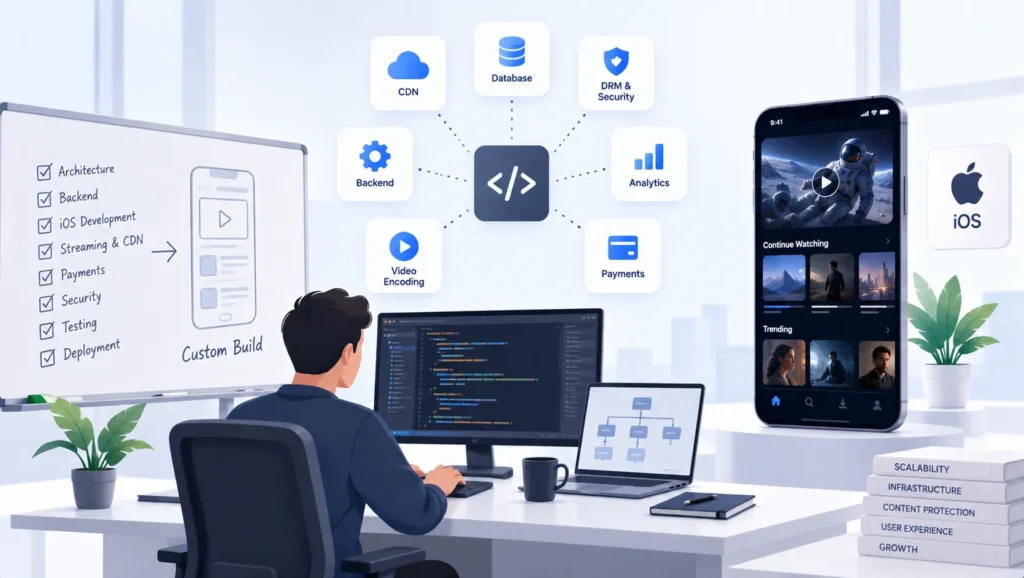
Custom development can be the right choice when the technology itself is central to the startup’s differentiation.
For example, a startup may need a completely new type of interactive storytelling experience, advanced personalization logic, unusual rights-management workflow, custom playback behavior, deep hardware integration, or a proprietary recommendation system. In those cases, a standard OTT foundation may not provide enough flexibility.
Building from scratch may also make sense when the startup has:
- A strong in-house engineering team
- Enough budget for design, backend, iOS development, QA, DevOps, security, and maintenance
- A longer validation window
- Proprietary product logic that cannot be adapted from an existing platform
- Clear documentation for every module and workflow
- A technical leadership team capable of managing streaming infrastructure decisions
The benefit is control. The tradeoff is time, responsibility, and cost exposure.
A custom OTT build usually requires the founder to manage many decisions at once: app architecture, backend framework, video encoding workflow, CDN strategy, database design, payment flows, admin permissions, content protection, analytics, deployment pipelines, monitoring, and post-launch support.
For funded teams with a deeply technical roadmap, that may be acceptable. For early-stage founders trying to validate a streaming niche, it may delay the real test: whether people will watch and pay.
What You Need to Build From Scratch
A serious iOS OTT streaming platform requires more than a viewer app. At minimum, the startup should plan for the following layers:
Core OTT Platform Layers Startups Need to Plan
| Platform Layer | Business Value | Founder Impact |
|---|---|---|
| iOS viewer app | Delivers the user-facing streaming experience on iPhone and iPad. | Requires strong UI, playback quality, profile flows, testing, and store readiness. |
| Backend and APIs | Connects users, content, plans, payments, viewing data, and access rules. | Poor backend planning can limit scale, reporting, and future customization. |
| Content management | Allows the operator to upload, organize, approve, and publish videos. | Without strong content workflows, day-to-day platform operations become slow. |
| Monetization logic | Supports subscriptions, rentals, pay-per-view, freemium, or hybrid models. | The revenue model must be planned before launch because it affects access rules and payments. |
| Admin dashboard | Gives the operator control over users, content, plans, transactions, reports, and settings. | Strong admin control reduces dependency on developers for routine changes. |
| Security and access control | Protects user data, payments, premium content, and platform operations. | Security should be part of the foundation, not something added after launch. |
| Streaming infrastructure | Supports smooth playback, content delivery, and traffic handling. | Infrastructure decisions affect user experience, operating cost, and scalability. |
When Buying a Ready-Made OTT Platform Makes Sense
Buying a ready-made OTT foundation can be a strong option when speed, cost control, and market validation matter more than building every module internally.
This route is especially practical when the startup’s viewer experience follows familiar OTT patterns: users browse content, create profiles, search videos, save watchlists, subscribe, rent, pay for premium content, continue watching, and receive recommendations or curated categories.
In this situation, the startup does not need to spend months rebuilding standard platform infrastructure before testing the business. It can start from a proven foundation, customize the product around its audience, and focus more resources on content, marketing, partnerships, pricing, and retention.
A ready-made OTT platform may be a better fit when:
- The startup wants to launch quickly
- The core streaming experience is not highly experimental
- The business has a clear content niche
- The founder wants to preserve budget for content and user acquisition
- The platform needs branded design and admin control
- Source-code ownership or customization rights are available
- The product may expand later to Android, web, or TV apps
- The founder wants to validate demand before investing in deep custom engineering
For founders evaluating a broader OTT product foundation, Miracuves’ Netflix-style OTT platform can be reviewed as a solution path after the build-vs-buy decision is clear.
Build vs Buy Comparison for iOS OTT Startups
The build-vs-buy decision becomes easier when you compare both options against business priorities instead of only technical preference.
| Decision Factor | Build From Scratch | Buy Ready-Made OTT Foundation |
|---|---|---|
| Launch speed | Slower because every module must be planned, built, tested, and deployed | Faster because core workflows already exist |
| Product control | Highest flexibility from day one | Depends on customization depth and source-code terms |
| Initial cost exposure | Higher because engineering scope is larger | More controlled because the foundation is already built |
| Differentiation | Useful when technology itself is the differentiator | Useful when content, audience, brand, pricing, or execution is the differentiator |
| Technical responsibility | Requires more internal decisions around architecture, infrastructure, security, and maintenance | Reduces initial engineering load but still requires careful provider evaluation |
| Market validation | Can be delayed by long development cycles | Faster path to test audience demand |
| Admin operations | Must be designed and built from scratch | Should already include control over users, content, plans, payments, and reports |
| Future customization | Fully flexible if architecture is well built | Strong if source-code ownership and modification rights are included |
| Startup fit | Better for funded teams with unique technical IP | Better for founders who need faster launch and practical validation |
The main lesson is simple: do not build from scratch just to feel more in control. Build from scratch when the product genuinely needs custom technology. Buy a ready-made foundation when the business can win through positioning, content strategy, pricing, distribution, and execution.
Founder Decision Signals
Speed
Choose a ready-made foundation when being first to market, testing a niche, or launching before a content window matters more than engineering every workflow from zero.
Cost
Choose carefully when budget must cover both product and growth. An OTT platform also needs content, marketing, hosting, support, and ongoing improvements.
Scalability
Check whether the platform can support video delivery, growing content libraries, user activity, analytics, and future device expansion.
Market Fit
Prioritize validation when your biggest unknown is audience demand. A faster launch can help you learn from real users earlier.
The iOS-Specific Questions Founders Should Ask
Building for iOS adds another decision layer because Apple users expect a polished experience. The app should feel fast, stable, clean, and reliable across iPhone and iPad screens.
Before choosing build or buy, founders should ask:
- Will the app support smooth video playback across common iOS devices?
- Is the interface designed for browsing, search, watchlists, profiles, and continued viewing?
- How will subscriptions, rentals, or pay-per-view access be handled?
- What App Store preparation support is included?
- Can the app be branded without damaging usability?
- How are account access, sessions, and payment-related flows handled?
- Does the backend support the iOS app properly, or is the app only a thin frontend?
- Can the product later expand to Android, web, Smart TV, or API-connected clients?
The last question is important. Many startups begin with iOS because their audience is concentrated there. But if the platform succeeds, users may expect access across more devices. A short-term iOS launch should not block long-term multi-device growth.
Why Content Strategy Matters More Than the Build Method
A streaming startup does not succeed because the app exists. It succeeds because the content has a clear audience and the product makes that content easy to access, pay for, and return to.
Before deciding whether to build or buy, define the content model.
Will the platform focus on regional films, independent creators, fitness lessons, professional courses, sports videos, kids’ content, documentaries, live events, or premium short-form shows? Will the operator own the content, license it, aggregate it, or allow producers to upload it? Will users pay monthly, rent individual titles, buy event access, or watch free content supported by ads?
These choices affect the product architecture.
A subscription-heavy platform needs plan management, recurring access rules, renewal logic, invoices, and cancellation handling. A rental platform needs purchase access, expiry rules, transaction history, and refund workflows. A producer-led platform needs content approval, partner dashboards, viewing reports, and payout logic.
This is why the build-vs-buy decision should follow the business model, not the other way around.
Monetization Models to Plan Before Launch
OTT monetization should be planned early because it shapes both the user experience and backend logic.
Common monetization models include:
| Monetization Model | How It Works | Product Requirements |
|---|---|---|
| Subscription video access | Users pay monthly or yearly for access to a content library | Plans, renewals, access rules, billing history, user account management |
| Pay-per-view | Users pay for specific videos, events, or premium releases | Purchase flow, unlock rules, invoices, access tracking |
| Rentals | Users unlock content for a limited time | Rental expiry, transaction records, reminders, payment handling |
| Freemium | Some content is free while premium content requires payment | Free/premium tagging, upgrade prompts, access restrictions |
| Advertising-supported content | Users watch free or lower-cost content supported by ads | Ad placement logic, reporting, user experience planning |
| Producer revenue sharing | Content partners earn based on agreed platform rules | Partner dashboard, viewing data, payout reports, approval workflows |
Startups should not treat monetization as a later plugin. It should be connected to content access, user roles, admin reporting, and payment workflows from the beginning.
The Admin Dashboard Is Where the Business Actually Runs
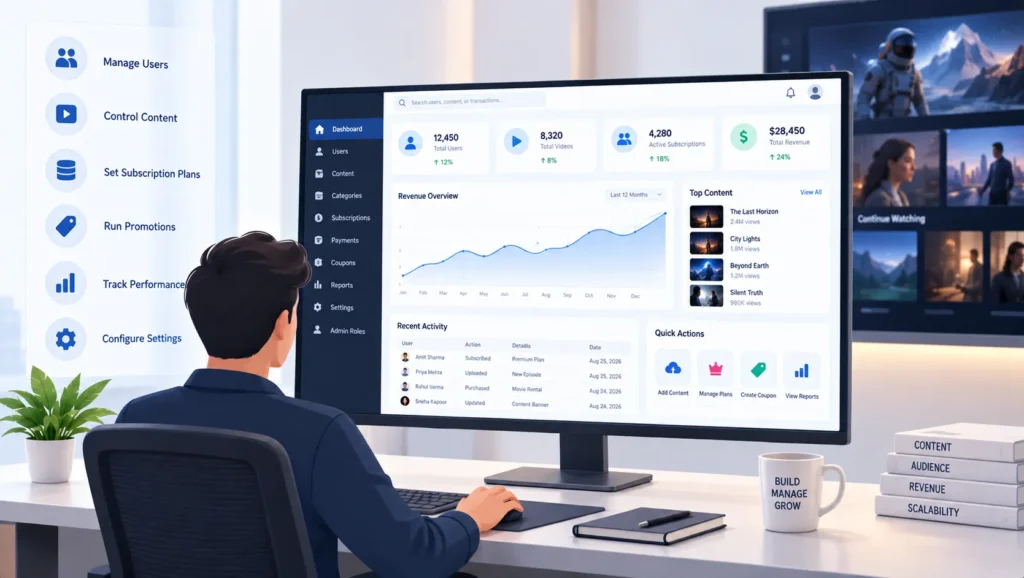
Founders often spend most of their attention on the viewer app. That is understandable because the user experience matters. But the admin dashboard decides how well the business can operate after launch.
A strong OTT admin dashboard should help the operator manage:
- Users and profiles
- Content categories
- Movies, series, episodes, and videos
- Banners and featured content
- Subscription plans
- Rental and pay-per-view access
- Coupons and promotional rules
- Payments and transaction records
- Content approvals
- Reports and analytics
- Admin roles and permissions
- Platform settings
Without this control layer, every small change becomes a development task. That slows operations and increases dependency on technical support. For a startup, the ability to change plans, publish content, review reports, and manage users without touching code is a major advantage.
Source-Code Ownership Should Be Checked Before Buying
Not every ready-made platform gives the same level of ownership. Some products are sold as licensed software. Others are hosted platforms with limited modification rights. Some providers offer full source-code ownership.
This matters because ownership affects the future of the product.
Before buying an OTT foundation, ask:
- Do we receive the source code?
- Can our team customize and extend it later?
- Are there limits on branding or modifications?
- Who controls hosting and deployment?
- Are third-party dependencies clearly documented?
- What happens if we change vendors later?
- What support is included after launch?
- Can the platform scale beyond the first version?
For startups, source-code ownership is not only a technical point. It is a business control point. It affects roadmap flexibility, investor confidence, vendor dependency, maintenance options, and long-term product value.
Security and Content Control Cannot Be an Afterthought
An OTT platform may handle personal user data, account sessions, payment activity, viewing history, premium media, content ownership details, and producer information. That means security must be planned as part of the product foundation.
Important controls include encrypted data transfer, secure API communication, role-based access control, protected admin access, activity logs, secure payment gateway integration, account protection, content approval workflows, backup processes, monitoring, and content-protection options where required.
Security needs may vary depending on target region, hosting setup, payment provider, content agreements, and operating model. The practical goal is to start with a privacy-conscious and control-ready foundation instead of adding protection only after users and content are already live.
Mistakes Founders Should Avoid
Choosing custom development without a strong reason
Building from scratch can make sense, but only when the product needs deep technical uniqueness. If the core model follows standard OTT flows, a full custom build may delay validation unnecessarily.
Buying only for the frontend
A polished iOS interface is not enough. The platform must also include backend logic, content management, monetization workflows, admin control, analytics, and security layers.
Ignoring source-code and licensing terms
Ownership terms affect future customization, vendor dependency, hosting control, and long-term product flexibility. They should be reviewed before purchase.
Planning monetization too late
Subscriptions, rentals, pay-per-view, ads, and revenue sharing all require different backend rules. The revenue model should guide the platform decision from the start.
How Miracuves Helps Startups Move Faster
Miracuves helps founders launch ready-made and white-label streaming platforms with branded design, admin control, monetization workflows, and source-code ownership. For startups that do not want to spend months rebuilding standard OTT modules, a launch-ready foundation can create a faster path to market.
The advantage is not just speed. It is focus.
Instead of spending the early stage only on engineering, founders can spend more energy on the parts of the OTT business that decide traction: content selection, pricing, launch campaigns, regional positioning, partnerships, user retention, and post-launch improvement.
Where relevant, Miracuves can support a 6-day solution delivery path for ready-made OTT launches, while advanced customization, infrastructure choices, integrations, and extended device support may require scope-based planning.
Final Thoughts: Choose the Route That Protects Speed and Control
The right choice is not simply build or buy. The right choice is the route that gives your startup enough speed, control, flexibility, and operating power to test the business properly.
Build from scratch when your OTT platform depends on proprietary technology, unusual workflows, or a deeply custom user experience. Buy a ready-made foundation when your main advantage is content, audience focus, pricing, distribution, or faster execution.
For many startups, the strongest first move is not to engineer every standard streaming workflow from zero. It is to launch with a reliable OTT foundation, validate the audience, learn from real usage, and then invest in custom features where they create measurable business value.
The goal is not only to release an iOS app. The goal is to build a streaming business that can be operated, monetized, measured, and improved after launch.
Disclaimer
Miracuves is an independent software development company. References to established streaming platforms or product categories are used only to describe common software functionality and user expectations. Miracuves does not copy third-party branding, copyrighted content, proprietary technology, or protected assets
FAQs
Is it better to build or buy an iOS OTT streaming platform?
It depends on your startup’s business model, timeline, budget, and technical requirements. Building from scratch is better when your product needs proprietary technology or highly unusual workflows. Buying a ready-made OTT foundation is often more practical when speed, cost control, and market validation are priorities.
What should startups check before buying a ready-made OTT platform?
Startups should review the iOS viewer app, backend, admin dashboard, content management system, monetization workflows, payment integrations, analytics, security controls, source-code terms, deployment support, customization options, and post-launch support.
Can a ready-made OTT platform be customized?
Yes, a ready-made OTT platform can usually be customized around branding, content categories, languages, payment gateways, subscription plans, rental rules, banners, notifications, admin roles, and selected workflows. The exact customization depth depends on the source-code and licensing terms.
Why is the admin dashboard important for an OTT startup?
The admin dashboard helps the platform operator manage users, content, categories, plans, payments, reports, roles, approvals, banners, and platform settings. Without strong admin control, routine business changes may require developer assistance.
What monetization models can an OTT platform support?
An OTT platform can support subscriptions, rentals, pay-per-view, freemium access, advertising-supported content, premium bundles, live-event access, and revenue sharing with content partners. The right model depends on the content strategy and target audience.
Does buying a ready-made streaming platform reduce ownership?
Not always. Some ready-made solutions include source-code ownership, while others follow hosted or restricted licensing models. Founders should confirm ownership, modification rights, hosting control, dependencies, support terms, and future customization options before buying.
Can an iOS OTT app expand to Android, web, or Smart TV later?
Yes, expansion is possible if the backend and platform architecture are planned properly. Startups should confirm whether the chosen foundation supports multi-device growth before launching only on iOS.
Can any provider guarantee App Store approval?
No provider can guarantee App Store approval. A development partner can help prepare the app, testing details, metadata, billing flows, and submission package, but the final review decision belongs to Apple.
Miracuves is an independent software development company. We are not affiliated with, connected to, sponsored by, or endorsed by any company or product named in this article.
Terms such as “X Clone” are used descriptively. It is how the software industry refers to building a platform with functionality comparable to a known service, and how clients search for it.
The entire design and codebase of our products is built by our own team. Our products contain no code, design, graphics, or content originating from any third-party website or applications.
All third-party names and marks referenced in this article are the property of their respective owners, referenced solely to identify the services discussed.