
Key Takeaways
- A D2C alcohol delivery app gives retailers and distilleries more control than a broad aggregator model.
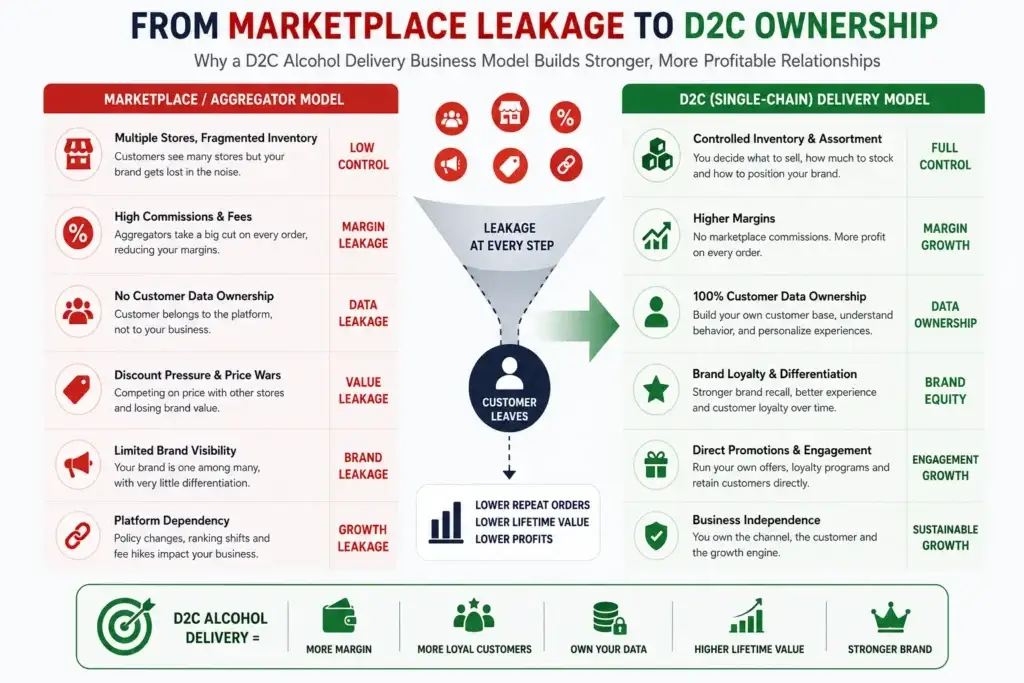
- Aggregators often face margin pressure, partner fragmentation, and weaker customer ownership.
- Brand control, direct customer data, pricing freedom, loyalty, and compliance workflows are core D2C advantages.
- Success depends on licensed operations, delivery-zone logic, age checks, payments, and repeat customer retention.
- A focused D2C alcohol delivery platform can improve margins and reduce dependency on third-party marketplaces.
Business Model Signals
- Customers need product browsing, age verification, secure checkout, delivery tracking, and repeat-order options.
- Retailers and distilleries need catalog control, pricing rules, promotions, inventory updates, and customer data access.
- Admins need control over licenses, delivery zones, drivers, payments, compliance logs, refunds, and reports.
- Loyalty programs, subscriptions, and direct promotions help D2C brands increase repeat purchases.
- Notifications keep customers, store teams, and delivery partners updated on orders, verification, and delivery status.
Real Insights
- Aggregator models can look attractive at launch but become difficult when commissions, delivery control, and partner quality vary.
- D2C works best when one brand or retail chain owns the customer relationship and delivery experience.
- Clear pricing, verified age checks, delivery boundaries, and order cut-off rules reduce operational risk.
- Customer data, retention campaigns, and direct offers give alcohol brands stronger long-term growth control.
- Miracuves builds D2C alcohol delivery apps with age verification, geofencing, catalog control, delivery workflows, and admin management.
The alcohol delivery market does not need another founder trying to build “UberEats for alcohol.”
That sentence may annoy people who still believe every fragmented market is waiting for a marketplace.
But alcohol is not food delivery with bottles.
Alcohol has tighter regulation, age checks, licensing constraints, inventory sensitivity, delivery restrictions, brand trust issues, and thinner room for operational mistakes.
Treat it like a generic aggregator opportunity, and you inherit the worst parts of marketplace economics before you earn the benefits.
Miracuves Solutions approach alcohol delivery as a restricted-commerce system first, where compliance controls, store-level rules, delivery validation, and backend safeguards are built into the operating model from the beginning.
The smarter move is not to aggregate hundreds of small liquor stores into one chaotic app. The smarter move is to build a D2C alcohol delivery like platform for one strong regional retail chain, premium beverage brand, or licensed distillery that already has demand, inventory, and customer trust.
The Aggregator Squeeze: Why Commission-Heavy Liquor Marketplaces Become a Margin Trap
The standard aggregator pitch sounds attractive at first.
Bring local liquor stores onto one app. Let customers browse nearby inventory. Add delivery tracking. Take commission on every order. Scale city by city.
That model works beautifully in pitch decks. In real operations, it is much harder.
An alcohol aggregator has to pay for customer acquisition while also convincing retailers to accept platform fees, update inventory, honor pricing, follow delivery rules, handle refunds, and compete inside the same marketplace as nearby shops. The platform gets stuck between three forces:
- Customers want fast delivery and competitive pricing.
- Retailers want to protect margins and avoid operational disruption.
- Regulators require controlled age-restricted fulfillment.
That squeeze is why the “take a cut from everyone” model is not always the strongest path. Alcohol retailers are not always sitting on excess margin that can be handed to an aggregator. Premium beverage brands also do not want their customer experience reduced to a marketplace listing beside discount products.
The closure of Drizly as a standalone app should make founders pause. Uber bought Drizly for $1.1 billion and later shut it down to consolidate alcohol ordering into Uber Eats, rather than keep Drizly operating independently.
The lesson is not that alcohol delivery has no future. The lesson is that standalone alcohol aggregation is not automatically the highest-margin path.
The Operational Chaos of Integrating Mom-and-Pop Inventory
A multi-vendor alcohol marketplace sounds scalable until inventory becomes the product.
Food menus are complex. Alcohol inventory is worse.
A local liquor store may have hundreds or thousands of SKUs across beer, wine, spirits, mixers, bundles, seasonal products, limited releases, and regional brands. Prices may shift. Stock may disappear quickly. Substitutions can frustrate customers. Promotions may be store-specific. Some items may be available in-store but not eligible for delivery depending on local rules.
Now multiply that across dozens or hundreds of small retailers.
The aggregator has to manage:
- Inconsistent inventory updates
- Store-by-store pricing differences
- Out-of-stock substitutions
- Varying delivery radius rules
- Refunds and failed deliveries
- Manual store communication
- Age-restricted handoff workflows
- Customer complaints when the marketplace does not control the shelf
This is where the aggregator loses leverage. The customer blames the app, but the app may not truly control inventory, staff behavior, packaging quality, or delivery preparation.
A single-chain D2C model changes that. The operator owns or controls the retail operation, inventory rules, pricing logic, product catalog, promotions, fulfillment process, and brand promise. That means the app is not simply a marketplace skin. It becomes a controlled digital extension of the retail business.
Read More: What is Drizly App and How Does It Work?
The Single-Chain Monopoly: Why One Strong Retail Chain Can Beat a Messy Marketplace
The best alcohol delivery opportunity is not always “many stores, one app.”
Sometimes it is “one powerful chain, one app, one operating system.”
A large regional liquor chain already has what a startup aggregator has to buy:
- Local customer trust
- Licensed retail presence
- Existing inventory
- Store teams
- Supplier relationships
- Regional brand recognition
- Repeat purchase behavior
- Physical locations for fulfillment
- Promotional power
A white-label alcohol delivery app gives that chain a direct digital channel. Instead of paying aggregator commissions or competing for visibility inside someone else’s marketplace, the chain owns the customer relationship.
That is the single-chain monopoly variable.
The chain does not need to become an open marketplace. It needs to become the default digital alcohol destination in its own region. That can be more profitable, more operationally stable, and more brand-protective than trying to aggregate every smaller shop nearby.
For premium distilleries, the same principle applies. A distillery with a loyal audience does not need to disappear inside a generic marketplace. It needs a D2C ordering, loyalty, compliance, and delivery workflow that protects brand perception and captures customer data directly.
Read More: Drizly Business model : how it generates revenue
Aggregator vs Single-Chain D2C Alcohol Delivery Model
| Decision Area | Multi-Vendor Alcohol Aggregator | Single-Chain D2C Alcohol Delivery App |
|---|---|---|
| Business focus | Aggregate many retailers into one marketplace | Digitize one licensed chain, brand, or distillery |
| Margin control | Platform margin depends on commissions and retailer acceptance | Operator keeps more control over pricing, promotions, and customer value |
| Inventory accuracy | Harder because each store manages stock differently | Stronger because inventory logic can be standardized |
| Customer ownership | Shared between app, retailers, and sometimes delivery partners | Owned directly by the retail chain or beverage brand |
| Brand experience | Mixed because each store may fulfill differently | Consistent packaging, offers, loyalty, and service standards |
| Compliance workflows | More complex across many independent stores | Easier to standardize across one controlled operation |
| Marketing efficiency | Requires marketplace-level demand generation | Can activate existing customer base, loyalty lists, and store traffic |
| Best fit | Venture-backed marketplace teams with deep operational capital | Retail chains, premium beverage brands, distilleries, franchise operators |
Why D2C Alcohol Delivery Is Really a Customer Data Strategy
The most valuable asset in alcohol delivery is not only the order.
It is the repeat customer.
A marketplace can send a bottle once. A D2C alcohol delivery app can build a customer profile around preferences, frequency, basket size, preferred categories, occasions, brand affinity, and location behavior.
That gives a retailer or distillery more room to build:
- Personalized promotions
- Loyalty rewards
- Event-based campaigns
- Membership offers
- Premium bottle drops
- Subscription-style replenishment where legally allowed
- Store pickup and delivery combinations
- Regional product launches
- High-value customer segmentation
This is where the aggregator model becomes strategically weak for premium operators. If customer demand is routed through a third-party marketplace, the operator may gain orders but lose long-term relationship depth.
A direct app reverses the power. The brand owns the audience.
Read More: How the Alcohol Delivery App Pours in Profits
The Delivery Engine Matters More Than the Marketplace Logo
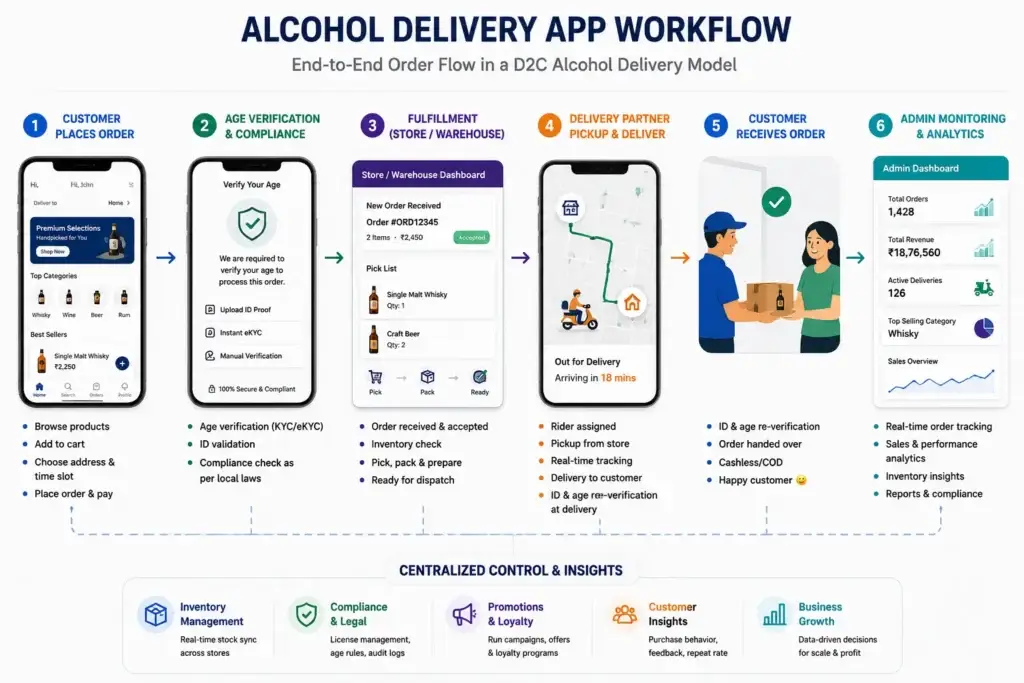
Founders often overfocus on the customer-facing app. In alcohol delivery, the backend matters more.
A serious D2C alcohol delivery platform needs operational control layers that go beyond product browsing and checkout.
Core modules a single-chain alcohol delivery app should include
| Module | Business Value | Founder or Operator Impact |
|---|---|---|
| Customer app | Product browsing, offers, cart, delivery scheduling, order status | Gives customers a direct branded buying experience |
| Store or fulfillment dashboard | Order preparation, inventory visibility, substitutions, pickup readiness | Helps teams process orders without marketplace confusion |
| Delivery partner app | Route view, delivery status, proof of handoff, failed delivery updates | Supports accountable age-restricted delivery workflows |
| Admin dashboard | Pricing, products, promotions, zones, users, refunds, reports | Gives the operator control without developer dependency |
| Age-verification workflow | DOB capture, ID workflow, delivery confirmation, restricted handoff logic | Helps reduce underage access risk and supports responsible operations |
| Analytics dashboard | Sales trends, repeat users, top SKUs, delivery performance | Helps leadership make decisions using real operating data |
| Loyalty and CRM layer | Rewards, customer segmentation, lifecycle campaigns | Increases repeat purchase potential and customer retention |
Alcohol delivery also creates real data-security exposure. The FTC took action against Drizly after security failures exposed data from 2.5 million consumers, which is a reminder that data minimization, security controls, and privacy-conscious handling are not optional in delivery platforms.
Read More: How to Build an App Like Drizly – Developer Deep Dive
Compliance Is Not a Feature. It Is the Operating System.
Alcohol delivery cannot be treated like normal ecommerce.
Every serious platform needs compliance-ready workflows designed around the target operating region. That may include age verification, license-aware delivery rules, restricted delivery locations, adult signature, order limits, permitted delivery windows, audit trails, and clear failed-delivery handling.
Direct alcohol shipping rules vary by state and product category in the U.S., and the National Conference of State Legislatures summarizes state-level direct shipment statutes with requirements such as adult signature and restrictions on shipping into areas where alcohol cannot lawfully be sold.
This matters for the product design. A D2C alcohol delivery app should not simply ask, “Can customers place an order?” It should ask:
- Is the customer eligible?
- Is the product eligible?
- Is the address eligible?
- Is the delivery time allowed?
- Is adult verification required at checkout, delivery, or both?
- Is the handoff recorded?
- Can the admin team audit exceptions?
- What happens if verification fails?
Miracuves’ delivery app development approach should be used as a configurable product foundation, not as a legal substitute. Final compliance depends on jurisdiction, licensing, legal review, third-party integrations, carrier rules, and the operator’s business model.
Read More: Drizly’s Strategy to Dominate Alcohol Delivery
Why Premium Beverage Brands Should Not Rent Their Digital Shelf Forever
A premium brand loses power when its digital presence is controlled entirely by aggregators.
Aggregators optimize for selection, convenience, and transaction volume. Premium brands optimize for story, trust, loyalty, experience, scarcity, and repeat demand. Those are not always the same game.
For a distillery, vineyard, craft beverage label, or premium retail chain, a D2C delivery platform can support a more valuable customer journey:
First, customers discover the brand through retail, events, tastings, social content, or physical stores. Then they are moved into the brand-owned app. From there, the operator can guide them toward curated bundles, limited releases, educational content, loyalty rewards, store pickup, delivery, or membership-style experiences where permitted.
That is not just delivery. That is owned commerce.
Founder Decision Signals
Founder Decision Signals
Speed
If the operator already has inventory, licensing, stores, or brand demand, a white-label delivery engine can move faster than building a marketplace from zero.
Cost
Aggregator models require heavy spending across retailer onboarding, customer acquisition, marketplace liquidity, and delivery operations. A single-chain model focuses capital on one controlled ecosystem.
Scalability
Scaling store by store inside one chain is cleaner than integrating hundreds of independent retailers with different catalogs, rules, and operating discipline.
Market Fit
If customers already trust the retail chain or beverage brand, the D2C app validates convenience and repeat demand instead of validating the entire marketplace from scratch.
Mistakes Founders Should Avoid in Alcohol Delivery App Development
Mistakes Founders Should Avoid
Building an aggregator before securing supply control
If stores do not update inventory, honor pricing, or follow fulfillment rules, the marketplace becomes responsible for a customer experience it does not control.
Treating age verification as a checkbox
Alcohol delivery requires careful age-restricted workflows, delivery confirmation, audit logs, and legal review based on the operating region.
Letting aggregators own the customer relationship
Premium retailers and distilleries should not give away customer data, loyalty behavior, and repeat demand if they have enough brand strength to run a direct channel.
How Miracuves Fits the Single-Chain D2C Alcohol Delivery Strategy
Miracuves helps founders, retail operators, and brands build ready-made and white-label app solutions with branded design, admin control, source-code ownership, and faster deployment.
For alcohol delivery, the strongest Miracuves positioning is not “launch another aggregator.” It is:
Build a branded delivery engine for a licensed operator that already has demand.
That could mean:
- A regional liquor retail chain launching its own customer app
- A premium distillery building a direct ordering and delivery workflow where legally allowed
- A beverage retailer adding delivery and pickup to existing store operations
- A franchise-style retail group standardizing delivery across locations
- A premium alcohol brand creating a controlled digital commerce channel with licensed fulfillment partners
Final Thoughts: The Future Is Not Another Alcohol Aggregator
The alcohol delivery opportunity is real, but the lazy marketplace playbook is dangerous.
Founders who try to aggregate every small liquor store inherit fragmented inventory, unpredictable fulfillment, retailer resistance, customer acquisition pressure, compliance complexity, and margin compression. That is a hard business before scale and an even harder business without operational control.
The better play is narrower and stronger: build a D2C alcohol delivery app for one powerful chain, premium beverage brand, or licensed regional operator.
That model starts with control. Control over inventory. Control over customer data. Control over pricing. Control over brand experience. Control over delivery rules. Control over loyalty.
In alcohol delivery, control is not a limitation. It is the moat.
FAQs
What is a D2C alcohol delivery app?
A D2C alcohol delivery app is a branded digital ordering and delivery platform operated by a licensed retailer, distillery, beverage brand, or retail chain. Instead of listing multiple independent liquor stores, the app connects customers directly with one controlled business ecosystem.
Why is a single-chain alcohol delivery model better than an aggregator?
A single-chain model can be stronger because the operator controls inventory, pricing, promotions, delivery standards, customer data, and brand experience. An aggregator must coordinate many independent stores, which creates operational friction and margin pressure.
Is alcohol delivery app development legally complicated?
Yes. Alcohol delivery depends on region-specific laws, licenses, age verification, delivery restrictions, adult signature rules, and operational controls. A platform can support compliance-ready workflows, but final compliance depends on legal review, jurisdiction, integrations, and the operator’s license structure.
What features should a white-label alcohol delivery app include?
A white-label alcohol delivery app should include a customer app, product catalog, cart, secure payments, delivery tracking, store dashboard, delivery partner app, admin panel, age-verification workflows, audit logs, promotions, loyalty, refunds, and analytics.
Can distilleries use a D2C alcohol delivery app?
Distilleries can use D2C ordering and delivery workflows where legally permitted and properly licensed. The exact model depends on local alcohol laws, fulfillment rules, carrier permissions, and whether direct-to-consumer sales are allowed for the product category.
Why do alcohol aggregators struggle with inventory?
Alcohol inventory changes quickly across SKUs, bottle sizes, vintages, limited releases, local brands, discounts, and store-level availability. If each small retailer updates stock differently, customers may see products that are unavailable, mispriced, or difficult to substitute.
How does Miracuves support alcohol delivery app development?
Miracuves can help operators build a white-label delivery app foundation with branded customer apps, admin control, delivery workflows, source-code ownership, and configurable modules. Compliance-specific features should be planned according to the target market and legal requirements.
Miracuves is an independent software development company. We are not affiliated with, connected to, sponsored by, or endorsed by any company or product named in this article.
Terms such as “X Clone” are used descriptively. It is how the software industry refers to building a platform with functionality comparable to a known service, and how clients search for it.
The entire design and codebase of our products is built by our own team. Our products contain no code, design, graphics, or content originating from any third-party website or applications.
All third-party names and marks referenced in this article are the property of their respective owners, referenced solely to identify the services discussed.