Key Takeaways
What You’ll Learn
- Social media apps like Facebook focus on user interaction, content sharing, and community building.
- User profiles and feeds create a personalized experience that keeps users engaged daily.
- Real-time messaging and notifications increase user retention and platform activity.
- Scalable architecture is essential to handle millions of users and real-time updates.
- Monetization strategies like ads and subscriptions drive long-term platform revenue.
Stats That Matter
- Facebook has over 3 billion monthly active users globally.
- Users spend an average of 2+ hours daily on social media platforms.
- Video content and reels are among the fastest-growing engagement formats.
- Mobile-first usage dominates social media consumption worldwide.
- Social platforms are a key driver of the multi-billion-dollar digital advertising industry.
Real Insights
- User engagement depends on content relevance and algorithm-driven feeds.
- Successful apps balance content creation, interaction, and monetization.
- Privacy and security are critical for user trust and platform growth.
- Scalability and performance directly impact user experience and retention.
- Growth comes from consistent user value, not just adding more features.
In today’s digital world, social media platforms dominate the way people connect. Building social media
like Facebook has become a lucrative venture for businesses and entrepreneurs. If you’re wondering how to create a Facebook clone this guide will walk you through the entire process—covering everything from market trends to monetization strategies. As experts in mobile app development for social networks, Miracuves offers a full-featured solution to bring your vision to life.
With billions of users worldwide, Facebook has set the gold standard for social media apps. Building a social media app like Facebook is no small task, but with the right approach and tools, it’s possible to create a platform that engages users and offers a seamless social experience. In this guide, we’ll walk through the key steps to create a social media app that can rival Facebook’s functionality and user engagement.
Why Build a Social Media App Like Facebook?
Social media apps are thriving, with users spending more time connecting, sharing, and engaging than ever before. A Facebook-like app gives businesses and developers a chance to tap into this growing market by offering features like real-time communication, content sharing, and community building. Whether you’re looking to build a niche platform or a global social network, understanding the foundations of a social media app is crucial.
Market Trends for Social Media Apps Like Facebook
| Trend | Description | Impact on App Development |
|---|---|---|
| Niche Social Platforms | Focused social networks catering to specific interests, communities, or professional groups | Opportunity for niche targeting |
| Increased Mobile Usage | Majority of users accessing social platforms via mobile devices | Mobile-first development focus |
| Short-Form & Interactive Content | Rise of video content, live streams, and interactive formats (polls, filters) | Drive user engagement |
| Privacy & Data Security | Users are increasingly concerned about how their data is handled and protected | Need for robust security features |
| AI-Powered Personalization | Using AI to personalize user experiences (e.g., custom news feeds, recommendations) | Enhanced engagement through AI |
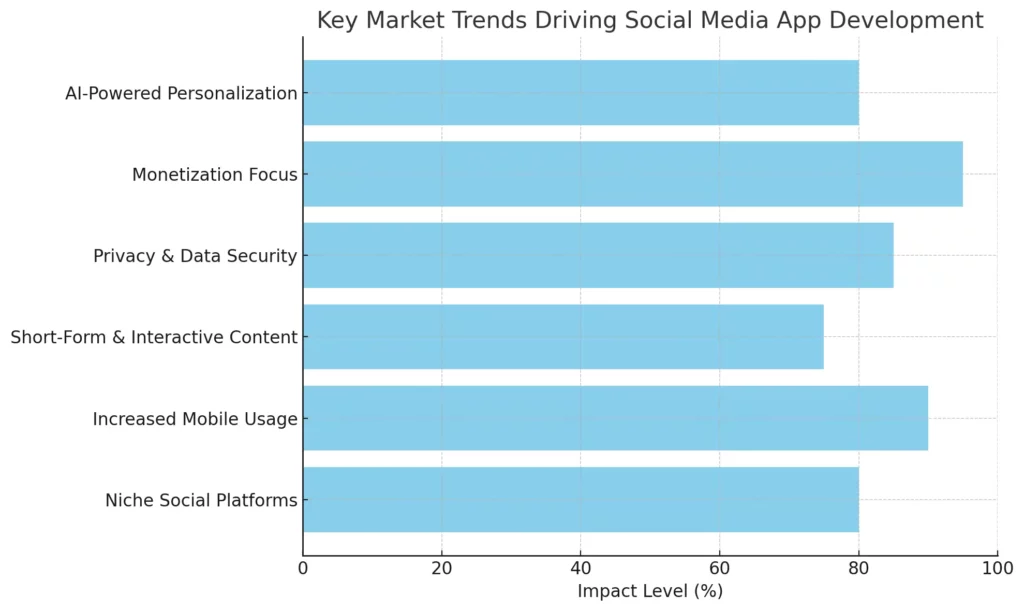
Building social media apps like Facebook has become a highly sought-after venture, as the social networking space continues to see significant growth. The rise of niche platforms, such as TikTok and Clubhouse, alongside giants like Facebook, Twitter, and Instagram, highlights that there’s still room for innovation in the market. Here are some key market trends driving social media app development:
- Niche Social Platforms:
- More users are gravitating towards platforms that cater to specific interests, industries, or demographics. For example, LinkedIn focuses on professionals, while TikTok captures short-form video enthusiasts.
- These niche platforms provide opportunities for developers to target underserved markets with custom solutions.
- Increased Mobile Usage:
- Mobile usage continues to dominate, with over 90% of social media users accessing platforms via their mobile devices. As such, mobile app development for social networks has become critical for success.
- Cross-platform development frameworks like React Native and Flutter are preferred for creating scalable social media apps.
- Short-Form and Interactive Content:
- There’s been a notable rise in the popularity of short-form content, live streams, and interactive formats. Social media apps are increasingly adopting these features to increase user engagement.
- Privacy and Data Security:
- With growing concerns over privacy and data breaches, users are becoming more conscious of how their information is handled. Developers need to focus on building secure apps with transparent data policies.
- Monetization Focus:
- Social media platforms are increasingly incorporating diverse monetization strategies to boost profitability. These strategies include in-app purchases, subscription models, and influencer-driven marketing.
- AI-Powered Personalization:
- The use of AI in social media apps to offer personalized user experiences is on the rise. Features like personalized news feeds, targeted content recommendations, and chatbot-powered customer service are becoming the norm.
Let’s visualize these trends with a chart:
Chart: Key Market Trends Driving Social Media App Development
Types of Social Media Apps
Social media apps come in various forms, each catering to different user needs and interactions. Here are the primary types of social media apps:
- Social Networking Apps
These are the most common types of social media apps, focused on building connections between people. Users can create profiles, send friend requests, and interact via messages and posts.- Examples: Facebook, LinkedIn, Twitter
- Features: News feed, friend lists, chat, and status updates.
- Media Sharing Apps
These apps are designed for users to share multimedia content such as photos, videos, and music. Media sharing apps often incorporate tools for editing and enhancing content before it is posted.- Examples: Instagram, YouTube, TikTok
- Features: Photo/video sharing, filters, live streaming, and comments.
- Microblogging Apps
Microblogging platforms allow users to post short updates, thoughts, or links. These apps are often used for real-time communication and breaking news.- Examples: Twitter, Tumblr
- Features: Short posts, hashtags, and real-time updates.
- Discussion Forums
These platforms are designed for users to have discussions, ask questions, and share knowledge on various topics.- Examples: Reddit, Quora
- Features: Threaded discussions, voting, and topic-based forums.
- Social Messaging Apps
Social messaging apps enable one-on-one or group conversations. Many social networking platforms integrate messaging into their core functionality, but standalone messaging apps also exist.- Examples: WhatsApp, Facebook Messenger, Telegram
- Features: Text, voice, and video chat, group messaging, and file sharing.
- Professional Networking Apps
These apps focus on building business connections, sharing professional experiences, and career development. They are used for job hunting, networking, and recruitment.- Examples: LinkedIn, Xing
- Features: Professional profiles, job listings, and recommendations.
- Anonymous Social Media Apps
These platforms allow users to interact and post content anonymously. They are often used for confessions, secrets, or honest feedback.- Examples: Whisper, Yik Yak
- Features: Anonymous posts, location-based feeds, and voting.
- Interest-Based Social Communities
These platforms connect users based on shared interests, hobbies, or passions. Users can join specific groups or forums and engage with like-minded people.- Examples: Goodreads (for books), Strava (for fitness), Behance (for design)
- Features: Interest-based groups, user-generated content, and recommendations.
- Social Commerce Apps
Social commerce apps blend social interaction with online shopping. Users can follow brands, shop for products, and even share their purchases with friends.- Examples: Pinterest, Instagram Shopping
- Features: Shopping tags, product recommendations, and social sharing.
- Dating Apps
Dating apps are designed to help users meet potential romantic partners based on mutual interests or preferences.- Examples: Tinder, Bumble
- Features: Swiping, matching algorithms, and private messaging.
- Review and Recommendation Apps
These platforms allow users to share reviews, rate products, and recommend services or experiences to others.- Examples: Yelp, TripAdvisor
- Features: Reviews, ratings, and user-generated recommendations.
- Live Streaming Apps
These apps focus on live broadcasting content to users, who can watch, interact via comments, and send virtual gifts.- Examples: Twitch, YouNow
- Features: Live video streaming, real-time interaction, and monetization options for creators.
Each type of social media app serves different purposes and user demographics, from casual social interaction to professional networking or content sharing. Understanding these categories can help developers decide on the features and target audience when building a new social media platform.
Learn More: Business Model of Facebook: Revenue, Strategy & Features
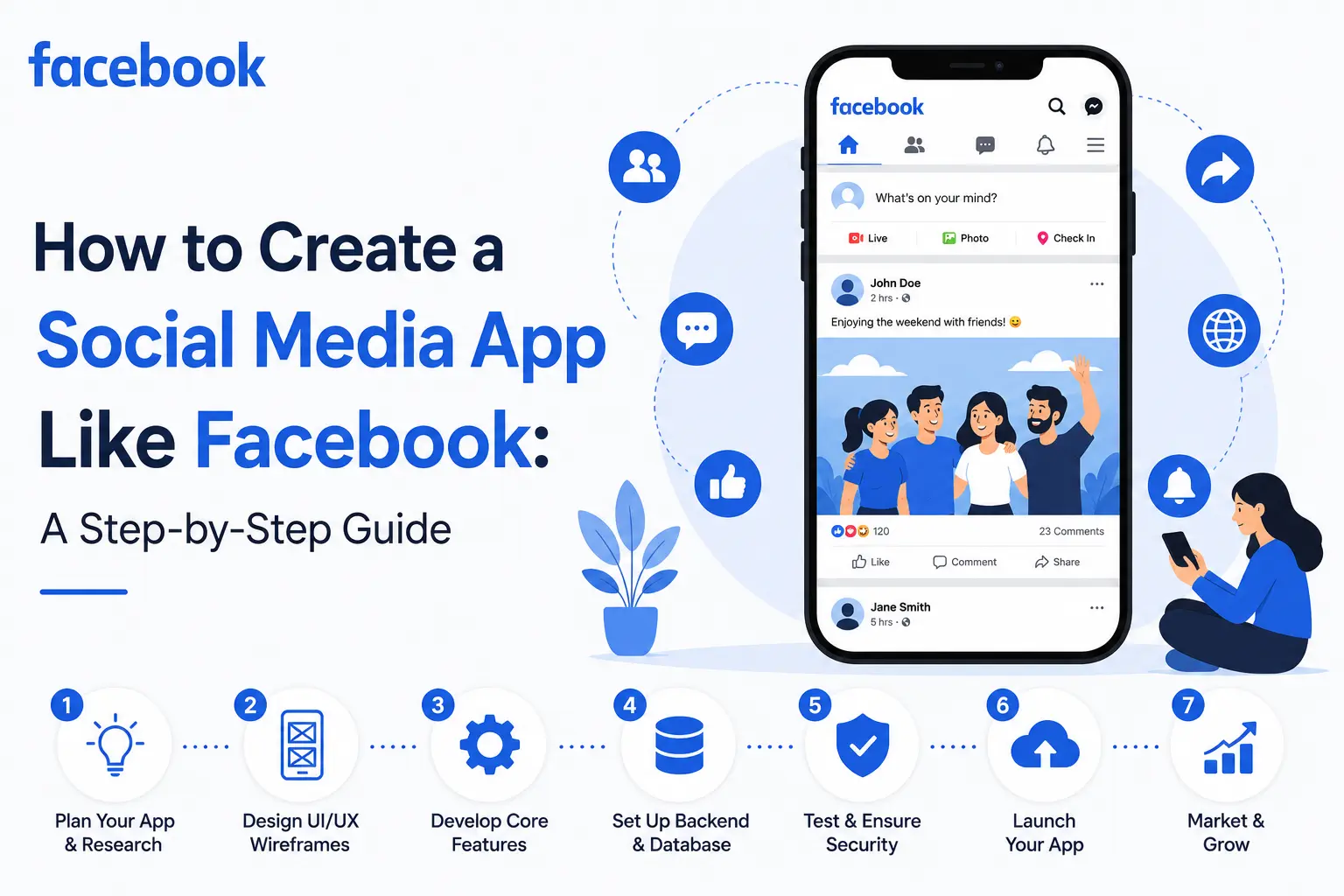
Steps to Building a Social Media App Like Facebook
Step 1: Market Research and Defining Your Niche
Before diving into development, the first and most important step is thorough market research. Facebook caters to a broad audience, but today’s successful social media apps often target specific niches (e.g., professional networking, travel enthusiasts, etc.).
Key Considerations:
- Identify your audience: Who is your app for? (e.g., Gen Z, professionals, hobbyists)
- Competitor analysis: What are other platforms offering? What gaps can you fill?
- Feature research: What are the must-have features that will drive user engagement?
Step 2: Core Features of a Social Media App Like Facebook
A successful social media app needs certain core features to engage users and keep them coming back. Here are some features to consider:
- User Profiles and Authentication
- Allow users to create personalized profiles with photos, bios, and status updates.
- Implement secure user authentication via email, phone, or social media logins.
- News Feed and Timeline
- Create a dynamic news feed where users can see updates, posts, and activities from their friends.
- Implement an algorithm to personalize the feed based on user preferences and interactions.
- Friendship & Connection Features
- Enable users to add friends, send friend requests, and manage their contact lists.
- Consider adding options for groups, events, or communities to foster deeper connections.
- Messaging and Chat Functionality
- Develop real-time messaging functionality, similar to Facebook Messenger, where users can chat one-on-one or in groups.
- Include multimedia sharing (photos, videos, and audio).
- Content Sharing (Text, Photos, Videos)
- Allow users to post status updates, share photos, videos, and links on their timeline or in groups.
- Implement privacy settings so users can control who sees their content.
- Push Notifications
- Set up push notifications to alert users about friend requests, messages, comments, likes, and more.
| Feature | Description | Importance |
|---|---|---|
| User Profiles & Authentication | Secure user login, customizable profiles, with photos, bios, and status updates | Essential |
| News Feed & Timeline | A personalized feed showing posts, updates, and activities from connections | Critical for engagement |
| Friendship & Connection Features | Friend requests, groups, events, and communities for building user networks | Core to social apps |
| Messaging & Chat | Real-time, private or group messaging with multimedia sharing | High priority |
| Content Sharing | Ability to share text, photos, and videos on the timeline or in groups | Vital for interaction |
| Push Notifications | Alerts for new messages, likes, comments, and other user activities | Enhances engagement |
Global Cost Factors & Pricing Breakdown
Facebook-Like App Development — Market Price
These amounts reflect the broader market cost of building a Facebook-style social media app based on the selected backend architecture, interaction workflow complexity, real-time engagement needs, feature depth, and long-term scalability goals.
PHP/Laravel is often the most practical choice for launching a Facebook clone quickly and affordably. Node.js/Python is better suited for real-time social interactions and dynamic feeds, while Go microservices are ideal for enterprise-scale platforms handling millions of users and complex data flows.
Miracuves Facebook-Like App Solution Cost and Tech Stack
Miracuves Pricing for a Facebook-Like Social Media App developed in PHP/Laravel with Flutter Apps for $3,699 USD (One-Time Price) in just 6 days
Get a fully developed, deployment-ready platform modeled after Facebook. Built on a rock-solid PHP/Laravel foundation, this complete package includes everything you need to launch and scale:
Core Workflows: User profiles, news feed, posts, likes, comments, messaging, and social interactions.
Built-in Engagement: Real-time notifications, content sharing logic, and user interaction systems.
Management Hub: Comprehensive user management and a centralized admin backend.
Launch-Ready: Fully prepped for your custom branding, configuration, and immediate market entry.
Why is it so affordable?
Most large-scale social media platforms like Facebook rely on complex, high-cost architectures such as Node.js or distributed systems. Building from scratch with those technologies requires highly specialized engineering teams, which significantly increases development costs and timelines.
We took a smarter, more practical approach:
You Aren’t Paying for Ground-Up Development: Our social media engine is already developed, battle-tested, and ready to deploy. You skip the inflated costs and months of waiting associated with building from scratch.
The Power of PHP / Laravel: We built this on one of the most reliable, globally adopted frameworks in the world. Not only does this keep upfront costs low, but it also ensures long-term scalability. PHP has a massive global developer ecosystem, making it easier and more cost-effective for future upgrades and customizations. You get a scalable, feature-rich social platform without the heavy enterprise price tag.
Note: This cost is for the solution, re-branding, deployment, and source code only.
Revenue Model for Social Media Apps Like Facebook
| Revenue Model | Description | Examples |
|---|---|---|
| Ad-Based Revenue | Generate income through in-feed ads, story ads, or banner ads | Facebook, Instagram |
| Subscription Model | Offer premium services or ad-free experiences for a subscription fee | LinkedIn Premium, YouTube Premium |
| In-App Purchases | Allow users to purchase virtual goods, stickers, or customizations | Snapchat Filters, Facebook Stars |
| Affiliate Marketing | Promote products or services from third parties and earn commissions | Influencer-driven product endorsements |
| Freemium Model | Offer a free version with basic features and a paid version with more advanced features | LinkedIn, Dropbox |
| User Data Monetization | Monetize anonymized user data for market research, targeted advertising, or analytics | Facebook’s targeted advertising algorithms |
Building a social media app like Facebook requires a well-defined revenue model to ensure long-term profitability. Here are some of the most common monetization strategies for social platforms:
- Ad-Based Revenue:
- The most common revenue model for social media apps, this involves generating revenue through targeted advertisements. Ads can be displayed in users’ feeds, stories, or other engagement areas. Facebook’s advertising model is highly effective due to its data-driven targeting, allowing advertisers to reach specific demographics.
- Subscription-Based Model:
- Some social media platforms offer premium features through subscription services. This may include ad-free experiences, enhanced privacy features, or access to exclusive content. This model works particularly well for niche platforms where users are willing to pay for value-added services.
- In-App Purchases:
- In-app purchases offer users the ability to buy virtual goods, stickers, or other customizations that enhance their experience. For instance, apps like Snapchat and Instagram often sell filters or effects as in-app purchases.
- Affiliate Marketing:
- Social media apps can partner with businesses to promote products and earn commissions through affiliate marketing. Influencers and content creators often play a key role in this strategy by sharing sponsored posts or links with their followers.
- Freemium Model:
- Many apps offer a free version with basic features and a paid version with advanced features. This freemium model allows users to try the app before committing to a subscription or one-time purchase.
- User Data Monetization:
- While more controversial, some platforms monetize user data by selling anonymized information to third-party companies for market research and analytics. However, data privacy laws are increasingly regulating this strategy.
By adopting a combination of these monetization strategies for social platforms, developers can build sustainable revenue streams and encourage user engagement.
Read more : Top 10 Features That Every YouTube Clone Needs to Stand Out
Competitor Analysis for Social Media Apps Like Facebook
When building a social media app like Facebook, it’s essential to understand the competitive landscape. Social media is dominated by both large, established players and emerging niche platforms. Conducting a competitor analysis will help identify opportunities, strengths, and weaknesses that can be leveraged to position your app effectively in the market.
Here’s a detailed competitor analysis of major social media platforms that are shaping the industry:
- Facebook:
- Strengths: Facebook remains the largest social media platform with billions of users, offering comprehensive features such as messaging, news feed, marketplace, and video streaming. It has a mature advertising platform with advanced targeting capabilities.
- Weaknesses: Concerns about data privacy and security have damaged Facebook’s reputation in recent years. The platform also faces saturation, with younger demographics migrating to newer platforms.
- Instagram:
- Strengths: Instagram focuses on visual content, with strong engagement features like Stories, IGTV, and Reels. It appeals to younger audiences and has successfully integrated eCommerce through features like shopping tags.
- Weaknesses: Instagram’s heavy emphasis on curated, visual content can limit its appeal to those seeking deeper connections or more text-based engagement.
- TikTok:
- Strengths: TikTok’s short-form video content and advanced algorithm for content discovery have made it extremely popular, especially among Gen Z users. Its interactive features and viral challenges drive high user engagement.
- Weaknesses: Limited long-form content and its appeal primarily to younger audiences make it less attractive for professional or older users.
- LinkedIn:
- Strengths: LinkedIn dominates the professional networking space, providing tools for career development, recruitment, and business connections. It offers a premium subscription model for added features and insights.
- Weaknesses: It lacks the entertainment and casual social interaction features found on other platforms, limiting its appeal to non-professional use.
- Twitter:
- Strengths: Twitter is known for its real-time updates and is widely used for news, public discourse, and live events. Its simplicity and open platform encourage high interaction and viral content sharing.
- Weaknesses: Twitter has faced challenges with user harassment and content moderation. Additionally, it struggles to retain new users as its growth has plateaued in recent years.
- Snapchat:
- Strengths: Snapchat pioneered the ephemeral messaging format and has a highly engaged user base for its AR filters and Stories feature. Its younger audience prefers its private, disappearing messages over more permanent posts.
- Weaknesses: Snapchat’s limited focus on messaging and stories makes it less versatile compared to more comprehensive platforms like Facebook and Instagram.
Competitor Comparison Table
| Platform | Key Features | Target Audience | Strengths | Weaknesses |
|---|---|---|---|---|
| News Feed, Messenger, Marketplace, Video, Ads | All demographics | Massive user base, versatile features, advanced ad platform | Privacy concerns, user saturation, younger user decline | |
| Stories, Reels, IGTV, Shopping Tags | Millennials, Gen Z | Visual engagement, strong eCommerce integration | Limited text-based interaction, curated content focus | |
| TikTok | Short-form video, Viral challenges, Content discovery | Gen Z, Millennials | Highly engaging short videos, viral potential | Limited long-form content, narrow age appeal |
| Professional networking, Job postings, Premium features | Professionals, Businesses | Dominates professional space, recruitment tools | Limited entertainment, casual engagement | |
| Real-time updates, News, Public discourse | Broad, News enthusiasts | Quick, open platform for live events, news | User retention, harassment and content moderation | |
| Snapchat | Ephemeral messaging, Stories, AR filters | Gen Z, Teenagers | Popular with younger users, unique AR and messaging features | Limited features outside messaging and stories |
Challenges in Building a Social Media App Like Facebook
Creating a social media app like Facebook is a rewarding but challenging task. Below are some of the most common challenges developers and entrepreneurs face during the social media app development process:
- High Competition:
- The social media space is saturated with well-established players like Facebook, Instagram, and TikTok. Gaining traction in this crowded market can be difficult, especially when competing against platforms with billions of users.
- User Retention:
- Building an app is only the first step; keeping users engaged and returning to your platform is a significant challenge. Developing user engagement strategies for social media, such as personalized feeds, frequent updates, and gamification, is key to long-term success.
- Scalability:
- As your user base grows, your infrastructure needs to handle increased traffic and data load. Ensuring that your app is scalable, with a flexible backend and optimized social media app tech stack, is crucial for future growth.
- Security and Privacy:
- Users are becoming more aware of data privacy, and with the implementation of stringent regulations (such as GDPR), ensuring data security is a challenge. You’ll need to invest heavily in security measures to safeguard user data. Ensuring compliance with data protection regulations like the GDPR is critical for protecting user data and avoiding hefty fines.
- Monetization:
- Implementing effective monetization strategies for social platforms without alienating users can be tricky. Too many ads or paywalls can drive users away, so balancing user experience and revenue generation is essential.
- User Acquisition:
- Acquiring new users for a social platform is an ongoing challenge. It requires robust marketing efforts, partnerships, and unique value propositions that differentiate your app from existing giants.
- Cross-Platform Consistency:
- Ensuring that your app provides a consistent experience across multiple platforms (iOS, Android, Web) is challenging, especially when it comes to performance, design, and features.
| Challenge | Description | Impact on Development |
|---|---|---|
| High Competition | Competing with giants like Facebook, Instagram, and TikTok | Need for unique features and positioning |
| User Retention | Keeping users engaged and ensuring they return regularly to the app | Key for long-term success |
| Scalability | Ensuring the app can handle a growing user base and traffic | Critical for performance at scale |
| Security and Privacy | Safeguarding user data and complying with regulations like GDPR | Essential for trust |
| Monetization | Implementing revenue models without disrupting user experience | Balancing user engagement and revenue |
| User Acquisition | Attracting new users in a competitive space | Important for initial growth |
| Cross-Platform Consistency | Ensuring a seamless experience across iOS, Android, and web | Vital for user satisfaction |
Conclusion
Building a social media app like Facebook is a complex process that requires a deep understanding of both the technical and business aspects. From identifying your audience and implementing core features to selecting the right tech stack, it’s essential to approach this project with expertise.
At Miracuves, we specialize in creating cutting-edge social media apps tailored to your unique needs. Whether you’re building a niche platform or a large-scale social network, we can help you bring your vision to life. Contact us today to discuss how we can develop your next big social media app
FAQ
What Features Should a Social Media App Like Facebook Have?
A strong social media app should include user profiles, personalized feeds, messaging, content sharing, and push notifications. Adding monetization features like ads or subscriptions helps sustain growth and user engagement.
How Do You Monetize a Social Media App Like Facebook?
Common monetization methods include ads, subscriptions, in-app purchases, and affiliate marketing partnerships. Balancing revenue strategies with user experience is key to long-term success.
What Are the Challenges in Building a Social Media App Like Facebook?
Major challenges include high competition, user retention, scalability, and ensuring strong privacy and security. A clear product strategy and continuous optimization are essential to overcome these hurdles.
What Are the Key Market Trends for Social Media Apps in 2026?
Trends include niche communities, mobile-first design, short-form video, and AI-driven personalization. Privacy-focused features and interactive content are shaping the future of social platforms.
Miracuves is an independent software development company. We are not affiliated with, connected to, sponsored by, or endorsed by any company or product named in this article.
Terms such as “X Clone” are used descriptively. It is how the software industry refers to building a platform with functionality comparable to a known service, and how clients search for it.
The entire design and codebase of our products is built by our own team. Our products contain no code, design, graphics, or content originating from any third-party website or applications.
All third-party names and marks referenced in this article are the property of their respective owners, referenced solely to identify the services discussed.