


Key Takeaways
- Premium vs Value OTT Streaming Platforms in India compete through content quality, pricing, language coverage, originals, sports, device access, and overall viewing convenience.
- Premium platforms often justify higher pricing through exclusive content, polished viewing experiences, strong originals, and broader device support, while value platforms focus on affordability and accessible entertainment.
- Viewer choice depends on perceived content value, subscription cost, household usage, regional preferences, advertising tolerance, and how frequently users find something worth watching.
Viewer Choice Signals
- Content libraries, exclusive movies and series, regional languages, sports rights, originals, and release frequency strongly influence which OTT service viewers consider valuable.
- Monthly pricing, mobile-only plans, ad-supported tiers, family access, bundled subscriptions, downloads, and simultaneous streams shape affordability and subscription decisions.
- Watch time, search success, recommendation relevance, content completion, subscription renewals, cancellations, and return viewing reveal whether users continue seeing value in the platform.
OTT Strategy Insights
- Operators should align pricing with content depth, target audience, regional demand, device behavior, monetization model, and the frequency with which viewers return to the platform.
- Personalized recommendations, multilingual discovery, flexible plans, reliable streaming, transparent pricing, and strong content freshness can improve both perceived value and subscriber retention.
- Miracuves develops customizable OTT streaming platforms with subscriptions, ad-supported viewing, content management, recommendations, multi-device streaming, payments, analytics, and admin controls.
India’s streaming market gives viewers more choice than simply deciding whether an OTT subscription is “expensive” or “affordable.”
A premium streaming service may cost more but offer a stronger content experience, fewer interruptions, better discovery, broader device access, or a catalogue a household watches frequently. A value-oriented platform may win for a completely different reason: lower commitment, regional relevance, bundled access, advertising-supported viewing, or a smaller catalogue that matches the viewer’s interests more closely.
That makes premium versus value OTT streaming platforms in India less about price alone and more about perceived value.
Two viewers can look at the same subscription fee and reach opposite conclusions. One sees a premium experience worth paying for. The other sees another recurring expense competing for attention.
Understanding that difference matters not only to subscribers but also to media businesses and founders planning an OTT proposition. Viewer choice reveals which parts of a streaming experience actually influence acquisition, engagement, retention, and willingness to pay.
Premium OTT and Value OTT Mean Different Things to Different Viewers
“Premium” is often treated as another word for expensive. In streaming, that definition is too narrow.
A premium OTT proposition generally asks viewers to pay more because the service believes it delivers greater perceived value through some combination of:
- distinctive or exclusive content
- stronger content discovery
- fewer advertising interruptions
- higher playback quality
- more simultaneous viewing flexibility
- broader device access
- consistent interface quality
- personalization
- regular catalogue freshness
- stronger family or household utility
A value-led OTT proposition takes a different route. It may prioritize affordability, regional programming, advertising-supported access, bundles, mobile-first consumption, niche content, or flexible commitment.
Neither position is inherently stronger.
The real question is whether the platform’s promise matches the audience paying for it.
A viewer who watches several hours every week may consider a higher subscription reasonable. Someone interested in only one show, language, genre, or sports season may judge the same fee very differently.
That is why OTT value is personal before it becomes financial.
What Actually Drives Viewer Choice in India?
OTT subscribers rarely evaluate streaming services using a formal checklist. Their decisions are usually based on a collection of smaller questions:
Does this platform have something I want to watch?
Can my family use it?
Will I actually open it regularly?
Are the ads tolerable?
Does it work on the devices I use?
Can I discover something quickly instead of endlessly scrolling?
Is the subscription still useful after I finish the show I joined for?
These questions create perceived value.
The monthly or annual fee matters, but price becomes meaningful only in relation to the experience around it.
A Simple OTT Value Equation
For viewers, subscription value can be thought of as:
Relevant content + viewing frequency + convenience + experience quality ÷ total perceived cost
“Perceived cost” includes more than money.
It can also include:
- advertising load
- time spent searching
- poor recommendations
- device restrictions
- confusing plan rules
- repeated buffering
- unnecessary subscriptions
- payment friction
- content disappearing before the viewer watches it
A low subscription price cannot always compensate for high friction.
Likewise, a premium price can remain acceptable when the platform becomes part of a household’s regular entertainment routine.
1. Content Relevance Usually Matters More Than Catalogue Size
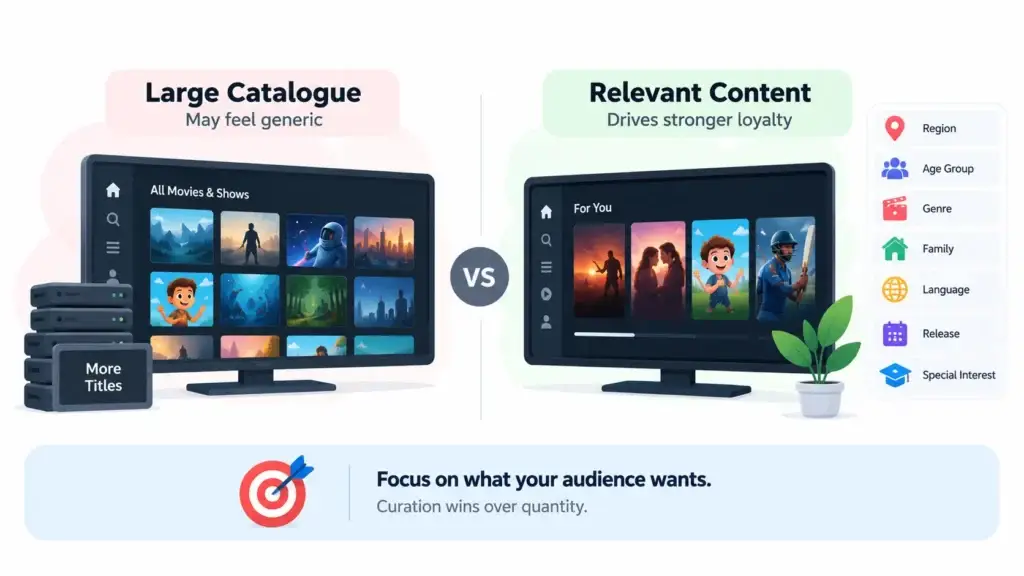
A streaming platform can advertise a huge library and still fail to feel valuable.
Viewers do not consume catalogue size. They consume individual films, series, programmes, documentaries, live events, children’s content, regional entertainment, or specialist programming that feels relevant to them.
That creates an important distinction between content volume and content fit.
A large generic catalogue may look impressive, but a smaller platform can create stronger loyalty when it understands a particular audience exceptionally well.
For Indian audiences, content fit can depend on:
- language
- region
- age group
- genre
- family preferences
- cultural context
- release frequency
- children’s programming
- live-event interest
- educational or specialist content
This is one reason value-led streaming services do not always need to imitate premium platforms.
They can win by being more relevant rather than more extensive.
Founder Insight
For an OTT business, asking “How much content do we need?” may be less useful than asking:
“How much of our catalogue will our target audience genuinely want to watch?”
That changes content strategy from accumulation to curation.
2. Viewing Frequency Changes How Expensive a Subscription Feels
The same monthly subscription can feel expensive to one subscriber and inexpensive to another.
Why?
Usage.
Consider two households paying the same amount.
One watches the service almost every evening across several profiles. The other opens it twice during the month.
The monetary price is identical, but the effective value per viewing session is completely different.
This helps explain why pricing cannot be evaluated independently from engagement.
A platform that becomes habitual gains an advantage because viewers stop thinking about each viewing session as a separate purchase.
The subscription becomes part of the household’s normal entertainment spending.
For OTT operators, this means retention depends on giving viewers reasons to return after the initial attraction has passed.
3. Regional and Language Relevance Can Beat Premium Positioning
India is not a single-content market.
Viewing preferences change dramatically by language, location, household composition, and cultural interest.
A platform offering highly relevant regional content can therefore create more perceived value for a particular audience than a larger general-entertainment service.
This creates room for:
- language-first streaming
- regional cinema libraries
- devotional programming
- local entertainment
- community-focused video
- children’s regional content
- independent filmmaking
- specialist education
- cultural archives
- niche live programming
The important business lesson is that premium value does not have to mean mass-market scale.
Different audience strategies can also require different product formats, from subscription video libraries to creator-led or short-form experiences. Miracuves’ video content platform solutions provide a broader view of the available streaming models.
A platform serving a narrower audience can still command loyalty when viewers feel that the catalogue was designed specifically for them.
4. Discovery Quality Can Determine Whether a Catalogue Feels Valuable
Owning attractive content is only part of the streaming problem.
Viewers must also be able to find it.
Poor discovery creates a strange situation: the platform may have plenty to watch, yet users conclude that “there is nothing on.”
This happens when:
- recommendations feel repetitive
- categories are too broad
- search performs poorly
- new releases are difficult to notice
- continue-watching rows become cluttered
- content presentation provides little context
- personalization fails to improve over time
Strong discovery reduces the mental work required to choose.
That matters because entertainment decisions often happen when the viewer wants convenience, not research.
Why This Matters for Value Positioning
Premium platforms must justify their price continuously.
If a viewer regularly finds something appealing within a few moments, the subscription feels useful.
If discovery becomes frustrating, even an extensive catalogue loses perceived value.
Value platforms face the same challenge. Lower pricing may acquire the subscriber, but discovery helps determine whether that subscriber stays.
5. Advertising Creates a Different Kind of Price
A streaming plan supported by advertising may have a lower monetary cost, but it asks viewers to pay partly with their attention.
For some audiences, that trade-off is perfectly acceptable.
For others, interruption-free viewing is itself a premium benefit.
This creates two different definitions of value:
Financial value: “I want to spend less.”
Experience value: “I am willing to spend more to remove friction.”
Neither preference is wrong.
The important point is that viewers do not evaluate advertising in isolation. They judge:
- frequency
- duration
- repetition
- placement
- relevance
- whether ads interrupt important moments
- whether paying more meaningfully changes the experience
An ad-supported service can therefore feel like excellent value when the exchange is transparent and reasonable.
It can also feel expensive despite a low subscription fee when the interruption cost becomes too high.
6. Device Access Matters More Than It First Appears
Streaming habits are fragmented across screens.
A viewer may discover content on a phone, continue on a television, travel with a tablet, or share the subscription across household profiles.
For this reason, device flexibility influences value.
Important considerations include:
- mobile viewing
- smart television access
- web access
- downloads
- casting
- profile separation
- simultaneous viewing
- playback continuity
A platform designed primarily around one device can still succeed when that matches its audience. But restrictions feel much more significant when subscribers expect household-wide access.
Premium pricing raises expectations further.
The higher the perceived tier, the less tolerance viewers generally have for basic usability friction.
7. Subscription Flexibility Reduces the Psychological Cost of Joining
Price is not only about the amount shown on the payment screen.
Commitment matters too.
A viewer may be comfortable paying for one month but reluctant to make a long commitment before knowing whether the catalogue fits their interests.
Flexible access can reduce this hesitation.
Depending on the audience and content strategy, value can be created through:
- monthly access
- longer-duration plans
- advertising-supported entry tiers
- limited premium access
- content bundles
- one-time access to selected programming
- seasonal access
- promotional trials or previews
The important principle is not to offer every possible model.
It is to make the buying decision feel proportionate to what the viewer is trying to watch.
Premium vs Value OTT: How Viewer Priorities Differ
| Viewer Decision Factor | Premium Positioning | Value Positioning |
|---|---|---|
| Content | Differentiated, high-interest or exclusive programming | Relevant content at an accessible price |
| Ads | Often fewer interruptions or an ad-free experience | Advertising may subsidize access |
| Discovery | Strong personalization and polished browsing | Fast access to the most relevant catalogue |
| Devices | Broad household flexibility expected | Can succeed with more focused access |
| Pricing Psychology | “Is the experience worth paying more for?” | “Am I getting enough for what I spend?” |
| Catalogue Strategy | Depth, freshness and differentiation | Relevance, specialization and efficiency |
| Retention Trigger | Habit, exclusivity and experience | Utility, affordability and audience fit |
| Main Risk | Premium fee stops feeling justified | Low price fails to create loyalty |
The strongest streaming services do not necessarily sit completely on one side.
Many blend premium and value characteristics.
What matters is whether the audience understands the proposition.
8. Subscription Fatigue Makes “Worth It” a Harder Test
Every additional digital subscription competes for part of the same household budget and attention.
This creates a behavioural shift.
Viewers increasingly evaluate not only whether they like a streaming service, but whether they use it enough to justify keeping it.
The decision becomes:
“Which subscriptions deserve a permanent place in my monthly spending?”
This raises the importance of:
- consistent content freshness
- return frequency
- recommendations
- multiple household use cases
- transparent pricing
- clear plan differentiation
A service can acquire users through one major release and still lose them soon afterward if nothing creates the next viewing occasion.
That is why subscriber acquisition and subscriber value are different problems.
9. Churn Often Begins Before a Viewer Presses Cancel
Cancellation is the final event.
The real decline often begins earlier.
Warning signs may include:
- longer gaps between viewing sessions
- less interaction with recommendations
- repeatedly searching without watching
- finishing the content that caused the initial signup
- switching most viewing to another service
- feeling that the catalogue has become repetitive
- questioning the subscription whenever the renewal appears
For streaming businesses, retention therefore depends on understanding why the viewer returns, not simply whether billing succeeded.
This is where content, discovery and product experience become connected.
A platform that improves return frequency increases the chance that its price will continue to feel justified.
10. Different Viewer Segments Define “Value” Differently
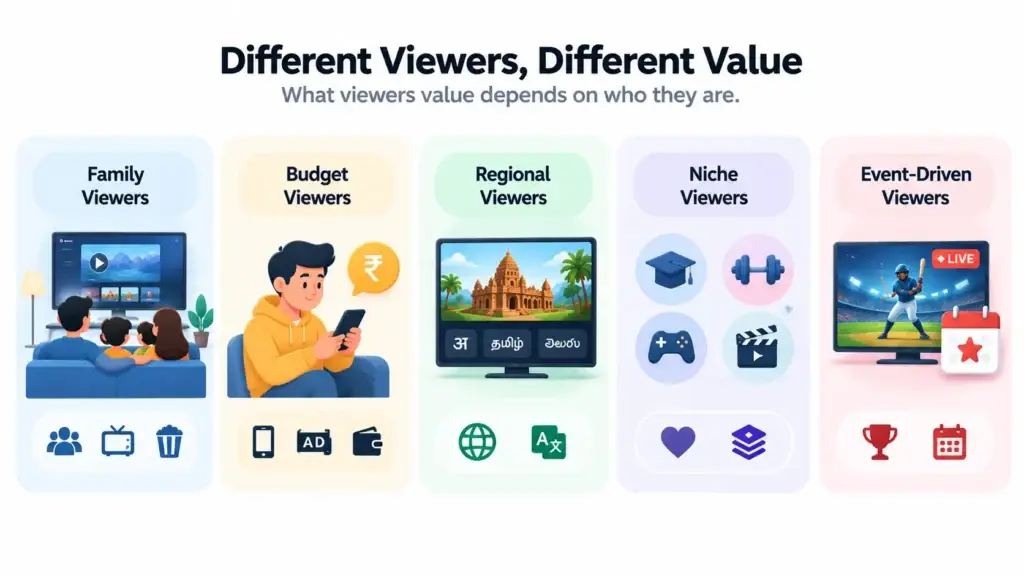
There is no universal OTT value proposition.
The Heavy Entertainment Household
This audience may value:
- several profiles
- frequent releases
- family viewing
- reliable television playback
- broad genre coverage
- minimal interruptions
A premium subscription can make sense because usage is high.
The Price-Conscious Viewer
This segment may prioritize:
- affordable plans
- advertising-supported access
- mobile viewing
- flexible commitment
- one or two highly relevant content categories
Value is primarily about avoiding unnecessary spend.
The Regional-Content Viewer
This viewer may care much more about:
- language
- cultural relevance
- local storytelling
- familiar genres
- regional stars and creators
Catalogue relevance can outweigh catalogue scale.
The Niche Enthusiast
A highly focused audience—whether interested in education, independent cinema, fitness, faith, specialist entertainment, children’s programming, or another category—may willingly pay for depth that mass-market platforms do not provide.
The Event-Driven Viewer
This subscriber joins for particular releases, seasons or live programming.
Retention requires creating reasons to remain after that event ends.
For founders, these segments show why copying another platform’s subscription strategy rarely produces a complete business strategy.
The audience should determine the offer.
11. What OTT Founders Can Learn From Premium and Value Positioning
The biggest lesson is not that founders should choose premium pricing or lower pricing.
It is that pricing must communicate a believable value proposition.
Before setting plans, an OTT business should be able to answer:
- Who is the platform specifically for?
- What content creates the first reason to subscribe?
- What creates the second, fifth and twentieth viewing session?
- Why should the viewer keep paying next month?
- Which experience improvements are audiences willing to pay more for?
- Where will viewers accept advertising or restrictions?
- Which devices matter most to the audience?
- What content is genuinely difficult to replace elsewhere?
- Does the pricing model fit expected viewing frequency?
- What would make the subscriber cancel?
These questions create stronger business-model clarity than starting with a generic monthly fee.
12. A Better Way to Think About OTT Pricing
Instead of asking:
“How much should an OTT subscription cost?”
Start with:
“What repeatable value does the viewer receive?”
Then evaluate pricing against that value.
A platform with highly specialized content may support a stronger paid proposition despite having a smaller catalogue.
A broader advertising-supported service may succeed because its audience values access more than exclusivity.
A regional service may outperform larger libraries within its target community because content relevance is considerably higher.
The pricing model should follow the audience strategy rather than define it. Founders evaluating subscriptions, rentals, advertising, pay-per-view, or mixed revenue structures can also explore Miracuves’ OTT Streaming Platform business model framework.
The pricing model should therefore follow the audience strategy—not the other way around.
Founder Decision Signals
Audience Fit
If you cannot clearly describe who watches the platform and why, pricing decisions will be based on assumptions instead of demand.
Content Pull
Identify what attracts the first subscription and what creates continued viewing after that initial content is finished.
Experience Value
Discovery, playback, device flexibility, and interruptions all affect whether the same subscription price feels premium or poor value.
Retention
A strong streaming proposition gives viewers recurring reasons to return rather than depending on occasional headline releases.
13. Viewer Choice Should Influence the Product—Not Just Marketing
Audience research is often treated as a marketing exercise.
For OTT businesses, it should shape product decisions as well.
If viewers primarily watch regional films on television, the priorities are different from a mobile-first platform built around short specialist videos.
If families drive subscriptions, profiles, parental controls and household continuity may matter more.
If the audience is highly price-sensitive, advertising or more flexible access may matter.
If the audience pays specifically for convenience, interruptions and discovery friction become more damaging.
Founders who want to explore the product layer in more detail can review these OTT Streaming Platform features and compare them against their own audience, content, and retention priorities.
This creates an important founder principle:
Do not build every feature simply because large streaming services have it. Build the experience your audience is willing to return to.
That is also where a ready-made product foundation can be useful. Instead of recreating established streaming workflows from zero, founders can focus more attention on content positioning, audience fit, branding and the parts of the experience that genuinely differentiate their service.
A more practical approach is to prioritize features around discovery, playback, retention, monetization, and audience behaviour. This OTT feature planning guide explains how founders can decide what belongs in the first version and what can be added later.
For businesses that reach that stage, Miracuves offers a Netflix clone foundation that can be customized around a specific streaming proposition rather than treating another platform’s catalogue or branding as the business strategy.
14. Why Faster Execution Can Matter Once the Audience Strategy Is Clear
Speed alone does not create product-market fit.
But once a founder understands the target audience, content proposition and revenue logic, unnecessarily rebuilding standard streaming workflows can delay real market learning.
Miracuves’ ready-made OTT approach can support a 6-day standard solution delivery where the existing product foundation fits the required scope. More extensive customisation, infrastructure, television applications or specialist integrations can require additional work.
Once the audience and product scope are defined, founders can review the factors behind OTT Streaming Platform development cost, including the platform itself, content, infrastructure, CDN usage, and other operating requirements.
The strategic advantage is therefore not “launch fast at any cost.”
It is:
Define the audience carefully, avoid rebuilding solved product layers unnecessarily, and spend more time validating the content and value proposition that viewers actually care about.
Founders who want to understand the technical layer in more depth can read this OTT streaming app developer guide covering architecture, backend planning, streaming delivery, recommendations, and scalability.
That approach connects product execution to the viewer-choice lessons discussed throughout this article.
Mistakes Founders Should Avoid
Competing Only on Lower Pricing
A lower subscription fee may attract attention, but price alone rarely creates long-term loyalty. If the catalogue, viewing experience, or discovery journey feels weak, users can still leave even when the service is inexpensive.
Building a Large Catalogue Without Audience Relevance
More content does not automatically create more value. A smaller, better-curated catalogue can perform more effectively when it closely matches the language, genre, region, or viewing habits of the intended audience.
Ignoring Content Discovery
Viewers cannot value content they struggle to find. Weak search, repetitive recommendations, poor category structure, and cluttered browsing can make even a strong catalogue feel limited.
Copying Premium Platform Features Without a Clear Reason
Adding every feature used by large streaming services can increase complexity without improving the actual viewer experience. Product decisions should follow audience behaviour, viewing habits, and business priorities rather than feature imitation.
Focusing on Sign-Ups Instead of Retention
A successful launch can create initial subscriptions, but long-term value depends on what happens after users finish the content that attracted them. Continue-watching flows, recommendations, content freshness, and repeat viewing opportunities matter for retention.
Treating All Indian Viewers as One Audience
India includes diverse language, regional, cultural, device, and pricing preferences. A broad strategy without clear audience segmentation can make content, pricing, and product decisions less relevant to the people the platform is trying to serve.
How Miracuves Helps Founders Turn OTT Strategy Into a Launch-Ready Product
Understanding what viewers value is only one part of building a successful OTT business. Founders also need a product foundation that can support content discovery, subscriptions, playback, user management, administrative control, and future customization without forcing the team to build every core workflow from zero.
Miracuves helps founders move from strategy to execution with ready-made, white-label OTT solutions that can be adapted around a specific audience, content model, branding approach, and monetization strategy.
Instead of copying another streaming platform feature for feature, the focus should be on building an experience that matches the intended viewer. That may mean prioritizing regional content, better discovery, flexible subscription options, household viewing, niche programming, or another clear market position.
Choosing the right product foundation is only part of the decision. Founders evaluating implementation partners should also understand what to verify in an OTT Streaming Platform development partner, from source-code ownership and deployment responsibilities to streaming infrastructure and post-launch control.
For suitable ready-made OTT scopes, Miracuves can support a 6-day standard delivery approach, helping founders begin market validation faster while retaining control over branding, administration, and source code.
The stronger objective is not simply to launch another streaming platform. It is to build a product foundation that supports the audience strategy, business model, and long-term direction of the OTT brand.
Final Thoughts: Viewers Pay for Relevance, Not Labels
The choice between a premium OTT platform and a value-oriented streaming service is rarely a simple contest between higher and lower prices.
Viewers are calculating value—consciously or unconsciously—through content relevance, usage frequency, language, discovery, interruptions, device access, convenience and the likelihood that they will still want the service next month.
That creates an important lesson for streaming businesses.
Premium pricing works when the experience repeatedly proves its value. Value pricing works when affordability is supported by strong content fit and enough utility to create loyalty.
Neither positioning can rescue a platform that does not understand its audience.
For founders, the strongest starting point is therefore not copying another service’s price or feature list. It is understanding who the viewer is, what makes them press play, and what gives them a reason to return.
FAQs
What is the difference between a premium and value OTT platform?
A premium OTT platform generally asks viewers to pay more in exchange for stronger content differentiation, fewer interruptions, broader device access, better discovery or a more polished overall experience. A value platform typically emphasizes affordability, accessibility, regional relevance, advertising-supported viewing or a more focused content proposition.
What makes an OTT subscription worth paying for?
Value usually comes from a combination of relevant content, viewing frequency, convenient access, reliable playback, good discovery and appropriate pricing. A subscription feels more worthwhile when viewers use it regularly and can quickly find content they want to watch.
Do Indian viewers always prefer lower-priced streaming plans?
No. Price matters, but viewers can accept higher prices when they believe the content and experience justify them. Different audiences place different value on regional content, advertising, device access, family viewing, exclusivity and convenience.
Why is regional content important for OTT platforms in India?
Regional and language-specific programming can create much stronger relevance for particular audiences. A focused catalogue that closely matches viewer preferences may generate more loyalty than a much larger but less relevant content library.
Can an ad-supported OTT platform still offer strong value?
Yes. Advertising-supported access can be attractive for price-conscious audiences when the advertising load feels proportionate to the savings. Excessive, repetitive or badly placed advertising can reduce perceived value even when monetary pricing is low.
Why does content discovery affect OTT retention?
A viewer may cancel even when a platform has a large catalogue if finding something appealing requires too much effort. Search, recommendations, categories, personalization and content presentation help turn catalogue depth into actual viewing.
What causes OTT subscription churn?
Churn can result from low viewing frequency, weak content freshness, poor recommendations, pricing concerns, excessive advertising, device limitations, or viewers finishing the specific content that originally motivated them to subscribe.
Should a new OTT business compete primarily on price?
Not necessarily. Competing only on price can be difficult to sustain. A stronger strategy is to understand a specific audience and create differentiated value through content relevance, experience, convenience, community, specialization or another benefit viewers cannot easily replace.
Miracuves is an independent software development company. We are not affiliated with, connected to, sponsored by, or endorsed by any company or product named in this article.
Terms such as “X Clone” are used descriptively. It is how the software industry refers to building a platform with functionality comparable to a known service, and how clients search for it.
The entire design and codebase of our products is built by our own team. Our products contain no code, design, graphics, or content originating from any third-party website or applications.
All third-party names and marks referenced in this article are the property of their respective owners, referenced solely to identify the services discussed.