

Key Takeaways
- AI price optimization helps vacation rental hosts set smarter nightly rates based on demand signals.
- Smart pricing uses data like seasonality, local events, occupancy, competitors, and booking windows.
- Dynamic pricing can improve revenue by raising prices during high demand and adjusting during slower periods.
- Airbnb clone platforms can use pricing intelligence to help hosts earn more and stay competitive.
- The right algorithm strategy balances occupancy, profit, guest demand, and long-term marketplace growth.
What You’ll Learn
- How AI price optimization algorithms work for vacation rental hosts.
- Machine learning models can predict pricing based on market and property data.
- Demand forecasting helps identify weekends, holidays, events, and peak travel dates.
- Competitor rate tracking helps hosts avoid underpricing or overpricing listings.
- Growth depends on accurate data, automation, booking behavior, and pricing flexibility.
Real Insights
- Manual pricing often misses demand changes that happen daily in rental markets.
- Hosts earn better when pricing adapts to real-time market conditions.
- AI pricing is not just about higher rates; it also helps fill empty nights strategically.
- Marketplace platforms gain value when hosts can price smarter and convert more bookings.
- The best strategy is to use AI pricing to improve revenue, occupancy, and host confidence together.
Vacation rental pricing is no longer about setting one nightly rate and waiting for bookings. Hosts now compete in markets where demand changes daily because of weekends, holidays, local events, weather, booking windows, competitor pricing, guest behavior, and platform visibility.
This is where AI price optimization algorithms are becoming important for vacation rental hosts.
Instead of guessing what a property should charge, AI-powered pricing systems analyze market data and recommend smarter nightly rates. The goal is simple: help hosts earn more revenue without relying only on manual pricing decisions.
For founders building an Airbnb-like rental marketplace, this pricing intelligence can also become a major product advantage. A well-built Airbnb clone script with smart pricing capabilities can help hosts price better, improve booking conversion, increase earnings, and support long-term marketplace activity. For founders planning an Airbnb like app, this pricing intelligence can become a strong platform advantage that improves host retention and booking performance.
What Is AI Price Optimization for Vacation Rentals?
AI price optimization for vacation rentals is the process of using data, machine learning, and pricing rules to recommend or automatically update nightly rates.
Instead of using the same price for every day, an AI pricing system studies real-time and historical signals such as:
Guest demand – Tracks how many users are searching, viewing, and booking properties in a specific location.
Competitor rates – Compares nearby rental prices to keep listings competitive and avoid overpricing or underpricing.
Local events – Adjusts prices during concerts, festivals, conferences, sports events, and holiday rush periods.
Seasonality – Increases or lowers prices based on peak seasons, off-seasons, weekends, and vacation periods.
Occupancy trends – Studies how often properties are booked to improve pricing based on availability and demand.
Booking lead time – Changes prices depending on how early or late guests are booking before the stay date.
Day of the week – Sets different prices for weekdays, weekends, and high-demand nights.
Weather patterns – Uses weather conditions to predict demand changes, especially for beach stays, hill stations, resorts, and outdoor travel locations.
Reviews and ratings – Considers property reputation, guest feedback, and rating strength while suggesting better pricing.
Property type and amenities – Adjusts pricing based on villa, apartment, studio, luxury stay, pool, parking, Wi-Fi, kitchen, or premium facilities.
Past booking performance – Uses historical booking data to identify what price ranges worked best earlier.
The purpose is not always to keep the property fully booked. A host can have high occupancy but still lose money if the nightly rate is too low. The better goal is revenue optimization. That means finding the right balance between occupancy and average nightly rate.
For example, a beachfront villa may not need a discount during a holiday weekend if demand is already high. But the same property may need a lower weekday rate during the off-season to avoid empty nights.
Read more: What is Airbnb App and How Does It Work?
Why Static Pricing Fails Vacation Rental Hosts
Static pricing means a host sets fixed rates and rarely updates them. It may look simple, but in vacation rentals, it often leads to missed revenue, lower occupancy, and revenue leakage.
Vacation rental demand keeps changing based on weekends, festivals, conferences, weddings, school holidays, local events, peak travel months, slow weekdays, off-season periods, and last-minute empty dates. Static pricing fails because it cannot react to these demand shifts. During high-demand periods, a host may underprice the property and get quick bookings but lose extra revenue. During low-demand periods, the same host may overprice the property and face empty nights.
Manual pricing becomes even harder when the same property is listed across Airbnb, Vrbo, Booking.com, and a direct booking website. Rates must stay updated and consistent across every channel. If guests notice pricing gaps between platforms, it can create confusion and reduce trust.
This is why AI dynamic pricing is becoming valuable for vacation rental hosts. Instead of relying on fixed rates, AI can analyze demand, competitor pricing, occupancy trends, booking lead time, seasonality, local events, and past booking performance to suggest smarter rates. For hosts, dynamic pricing is not only about increasing prices. It is about charging the right price at the right time, improving occupancy, and reducing revenue leakage across every booking channel.
How AI Price Optimization Algorithms Work
AI pricing works like a multi-layer system. Each layer handles a different part of the pricing decision.
A strong vacation rental pricing engine does not just ask, “What should the price be?” It asks:
What is happening in the market?
How much demand is expected?
How are competitors priced?
How likely is the guest to book at this rate?
What is the host’s minimum and maximum price?
Should the price change across different platforms?
Should the system recommend or automatically update the rate?
Let’s break this down.
1. Data Collection Layer
The first layer collects data from multiple sources. Without good data, an AI pricing algorithm cannot make strong pricing decisions.
Important data inputs include:
Competitor nightly rates
This shows the market price range for similar listings in the same location.
Occupancy trends
This helps the algorithm understand whether the area is filling up quickly or slowly.
Booking lead time
This shows how far in advance guests are booking. Some markets get early bookings, while others depend on last-minute travelers.
Local events
Concerts, festivals, sports events, conferences, weddings, and exhibitions can create sudden demand spikes.
Seasonality
Peak season, shoulder season, and off-season pricing behave differently.
Weather
Weather can affect beach destinations, mountain stays, resorts, and outdoor travel markets.
Day of week
Weekend pricing is often different from weekday pricing.
Reviews and ratings
A highly rated property can usually support stronger pricing than a similar property with weak reviews.
Amenities
Pools, hot tubs, parking, Wi-Fi, workspaces, pet-friendly policies, and premium interiors can affect price.
Cancellation policy
A flexible cancellation policy may improve booking conversion, while a strict policy may need pricing support.
2. Demand Forecasting Layer
After collecting data, the AI system predicts future demand.
Demand forecasting helps hosts understand which dates are likely to attract more bookings. The algorithm may study past booking patterns, market occupancy, competitor availability, search behavior, and local calendars.
For example, if many similar properties are already booked for a weekend, the system may predict higher demand and recommend a higher rate.
If future dates are not getting views or inquiries, the system may suggest a lower rate or a promotional adjustment.
Demand forecasting is especially useful for hosts who manage multiple properties because each listing may behave differently.
3. Price Elasticity Layer
Price elasticity means how guests react when prices go up or down.
In simple terms, the algorithm tries to estimate whether a higher price will reduce bookings or whether a lower price will improve occupancy enough to increase total revenue.
For example:
If demand is high and competitors are filling fast, the algorithm may increase the price.
If many guests are viewing the listing but not booking, the price may be too high.
If a property is getting booked too early every month, it may be underpriced.
If occupancy is low but competitors are also empty, the issue may be market demand, not only price.
This layer helps hosts avoid emotional pricing decisions. The system looks at booking probability and revenue potential together.
4. Rule-Based Guardrails
AI pricing should not work without control. Hosts and platform owners need guardrails.
Guardrails help the pricing system stay aligned with business rules.
Common pricing guardrails include:
Minimum price
The lowest price a host is willing to accept.
Maximum price
The highest allowed price to avoid unrealistic pricing.
Weekend premium
Higher rates for Friday, Saturday, or high-demand nights.
Event premium
Special pricing for local demand spikes.
Last-minute discount
Lower rates when a date is close and still empty.
Gap-night discount
Reduced pricing for empty nights between two bookings.
Minimum stay rule
For example, two-night minimum on weekends or three-night minimum during peak season.
Owner override
The host can manually approve, reject, or edit AI recommendations.
Channel commission adjustment
The rate may change depending on Airbnb, Vrbo, Booking.com, or direct booking margin.
This is important because AI should support the host’s revenue strategy, not fully replace business judgment.
5. Automated Price Update Layer
Once the system calculates the recommended price, the next step is distribution.
A vacation rental pricing system may update rates across:
- Airbnb
- Vrbo
- Booking.com
- Direct booking website
- Property management system
- Channel manager
- Mobile app calendar
- Host dashboard
This layer is very important because pricing is connected to availability, bookings, commissions, payouts, and calendar synchronization.
If a host changes the rate manually on one platform but forgets another channel, the listing may show inconsistent prices. That can create confusion and revenue loss.
For Airbnb-like rental marketplaces, automated price sync can become a valuable host feature.
Read more: Airbnb like App: Revolutionizing Your Travel Experience in 2026
AI Pricing vs Traditional Dynamic Pricing
Traditional dynamic pricing usually works with basic rules. AI price optimization goes deeper because it learns from multiple signals and adjusts recommendations based on market behavior.
Traditional dynamic pricing uses fixed rules like weekend premiums or seasonal prices.
AI price optimization uses predictive models, demand signals, competitor data, occupancy trends, booking pace, and property-specific performance.
Traditional dynamic pricing may update prices manually or on a fixed schedule.
AI pricing can update prices daily or continuously based on changing demand.
Traditional pricing is often general.
AI pricing can become more personalized for each property.
This is why AI pricing is becoming more useful for hosts who want better revenue control.
Key Algorithms Used in Vacation Rental Price Optimization
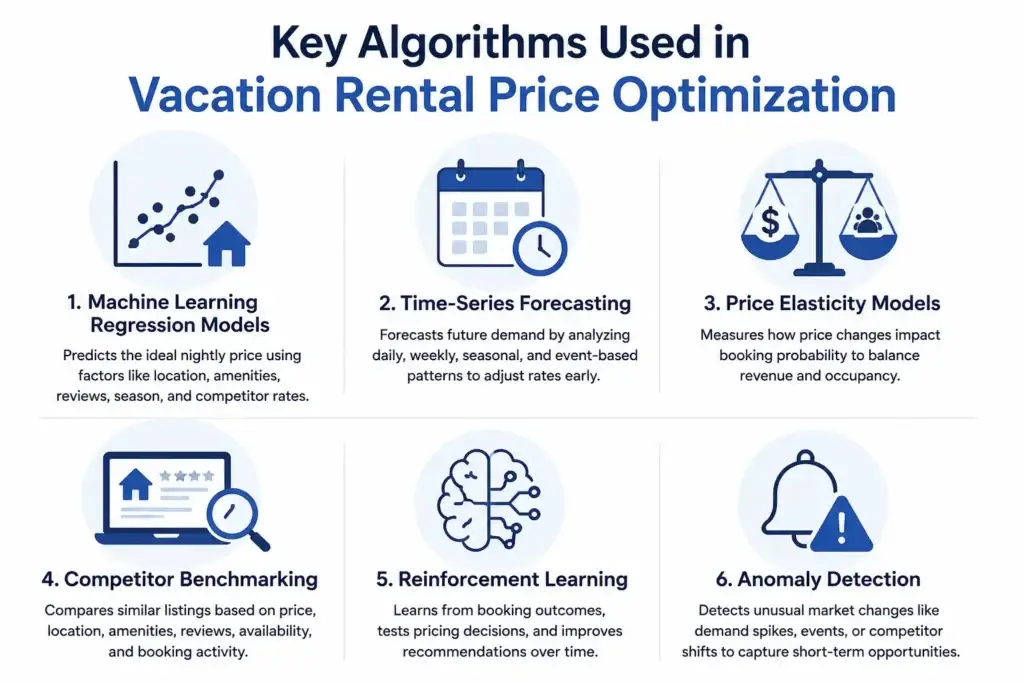
A strong AI pricing system can use different types of algorithms. Hosts do not need to understand the technical code behind each model, but knowing the logic helps them trust the recommendations.
Machine Learning Regression Models
Regression models help predict the expected nightly price of a property.
The model may consider location, bedrooms, bathrooms, amenities, property type, reviews, season, nearby demand, and competitor rates.
For example, a two-bedroom apartment near a conference center may have a different pricing pattern than a three-bedroom villa near a beach.
Regression models help estimate a fair and competitive price range.
Time-Series Forecasting
Time-series forecasting predicts future demand based on patterns over time.
It can analyze:
Daily booking activity
Weekly demand cycles
Seasonal demand
Holiday demand
Event-based demand
Year-over-year trends
For vacation rental hosts, this is useful because some dates become valuable long before they arrive.
For example, a city may receive higher demand every year during a major festival. A time-series model can help identify this pattern early and adjust rates before competitors react.
Price Elasticity Models
Price elasticity models estimate how pricing changes affect booking probability.
If a price increase does not significantly reduce booking probability, the host may earn more by raising the rate.
If a small discount improves booking probability strongly, the system may suggest a lower price to fill empty nights.
This is useful for balancing occupancy and revenue.
Competitor Benchmarking Algorithms
Competitor benchmarking algorithms compare a listing with similar properties in the same market.
The system may compare:
- Location
- Property size
- Guest capacity
- Amenities
- Review score
- Availability
- Cancellation policy
- Nightly price
- Booking activity
This helps hosts avoid pricing too far above or below the market.
However, competitor data should not be used blindly. A premium listing with better reviews and amenities may deserve a higher rate than nearby listings.
Reinforcement Learning
Reinforcement learning is used in more advanced pricing systems.
The algorithm tests pricing decisions, observes the outcome, and improves over time.
For example, if the system recommends a higher weekend price and the property still gets booked, it learns that the listing can support stronger pricing during that demand window.
If a price change reduces booking activity, the model can adjust future recommendations.
This type of system becomes more useful as it collects more booking data.
Anomaly Detection
Anomaly detection helps identify unusual market behavior.
For example:
A sudden spike in local demand
A major concert announcement
A weather-related booking surge
A conference that increases weekday bookings
A sudden drop in competitor availability
A platform trend that increases destination searches
Without anomaly detection, hosts may miss short-term revenue opportunities.
What Factors Should a Vacation Rental Pricing Algorithm Analyze?
A good vacation rental pricing algorithm should analyze both market-level and property-level factors.
Important pricing factors include:
Location demand
Beachfront homes, city-center apartments, mountain cabins, and resort stays behave differently.
Local events
Concerts, exhibitions, festivals, sports events, and conferences can increase demand.
Seasonality
Holiday seasons, school vacations, and tourist cycles influence pricing.
Competitor occupancy
If nearby listings are filling fast, demand may be rising.
Booking window
A booking made 60 days in advance has different pricing logic than a booking made 2 days before check-in.
Property type
A villa, apartment, cabin, resort room, or luxury home may need a different pricing model.
Amenities
Pools, Wi-Fi, parking, hot tubs, kitchens, workspaces, and pet-friendly options can support higher pricing.
Guest capacity
Larger homes may earn more from group bookings.
Review score
Higher ratings can increase trust and justify stronger pricing.
Channel fees
Airbnb, Vrbo, direct booking websites, and other channels may have different commission structures.
Benefits of AI Pricing for Vacation Rental Hosts
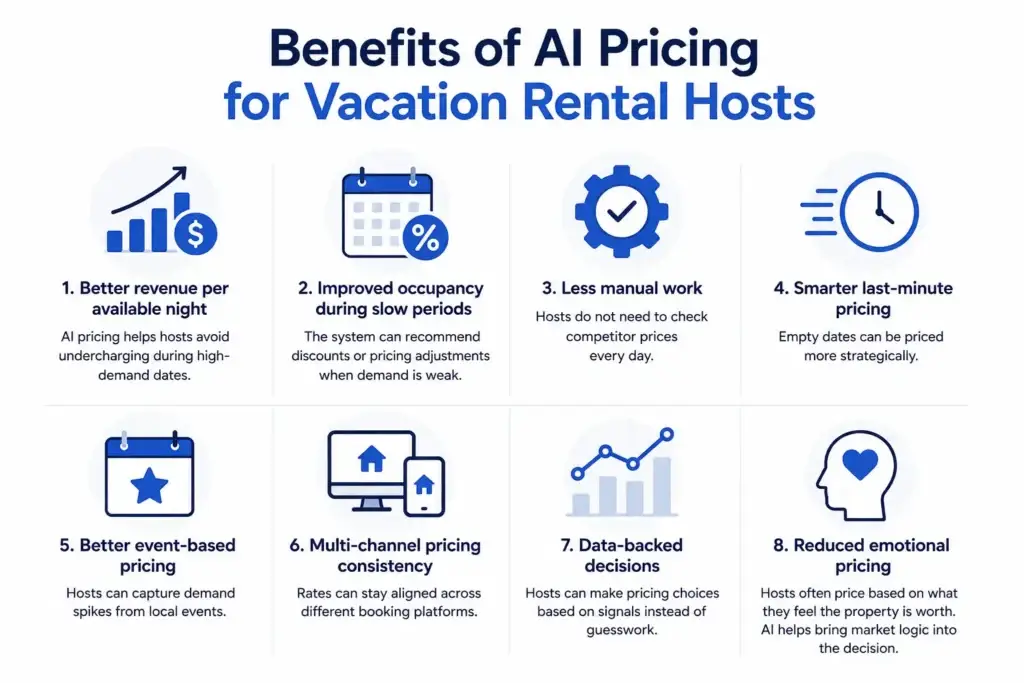
AI pricing can help vacation rental hosts make better revenue decisions.
Here are the main benefits:
Better revenue per available night
AI pricing helps hosts avoid undercharging during high-demand dates.
Improved occupancy during slow periods
The system can recommend discounts or pricing adjustments when demand is weak.
Less manual work
Hosts do not need to check competitor prices every day.
Smarter last-minute pricing
Empty dates can be priced more strategically.
Better event-based pricing
Hosts can capture demand spikes from local events.
Multi-channel pricing consistency
Rates can stay aligned across different booking platforms.
Data-backed decisions
Hosts can make pricing choices based on signals instead of guesswork.
Reduced emotional pricing
Hosts often price based on what they feel the property is worth. AI helps bring market logic into the decision.
Common Mistakes Hosts Make With AI Pricing Tools
AI pricing can improve revenue, but only if used correctly. Many hosts make mistakes that reduce its value.
One common mistake is setting the minimum price too low. If the system has permission to discount too aggressively, the host may fill the calendar but lose revenue.
Another mistake is trusting the algorithm without reviewing strategy. AI can recommend prices, but hosts still need to check business goals, guest quality, and seasonal plans.
Some hosts ignore local events. If event data is missing or incomplete, pricing may not capture demand spikes.
Many hosts optimize only for occupancy. A full calendar does not always mean maximum profit.
Some hosts apply the same pricing strategy to every property. A luxury villa and a budget apartment need different pricing rules.
Another mistake is not adjusting for platform fees. If Airbnb, Vrbo, and direct bookings have different commission structures, pricing should reflect that.
Hosts also ignore gap nights. Empty nights between bookings can quietly reduce monthly revenue.
Finally, many hosts do not track key metrics like ADR, RevPAR, occupancy rate, booking pace, and conversion rate.
Read more: Airbnb App Marketing Strategy: How to Make Your Rental App Unforgettable
AI Pricing KPIs Vacation Rental Hosts Should Track
Hosts should not judge pricing only by the number of bookings. They should track revenue performance.
Important KPIs include:
ADR
Average Daily Rate shows the average nightly rate earned from booked nights.
Occupancy Rate
This shows how many available nights are booked.
RevPAR
Revenue per Available Rental Night shows how much revenue the property earns across all available nights.
Booking Pace
This shows how quickly future dates are getting booked.
Lead Time
This shows how far in advance guests usually book.
Gap Nights
These are empty nights between two bookings.
Conversion Rate
This shows how many listing views turn into bookings.
Revenue per Listing
This shows the total earning power of each property.
These KPIs help hosts understand whether AI pricing is truly improving performance.
AI Pricing for Airbnb-Like Vacation Rental Platforms
For founders building an Airbnb-like rental marketplace, AI pricing is not just a host tool. It can become a platform advantage.
A rental marketplace can offer smart pricing features that help hosts earn better and manage listings more professionally.
An Airbnb-like platform can include:
- Suggested nightly pricing for hosts
- Event-based surge pricing
- Gap-night discount recommendations
- Direct booking margin adjustment
- Multi-channel pricing sync
- Host revenue dashboard
- Admin-controlled pricing rules
- AI-powered revenue reports
- Premium pricing tools as a paid feature
This is where an Airbnb clone script can become more powerful than a basic rental listing platform.
A simple rental marketplace allows hosts to list properties and accept bookings. A smarter marketplace helps hosts improve revenue, reduce empty nights, and make better pricing decisions.
That difference matters because hosts are more likely to stay active on a platform that helps them earn.
Why AI Pricing Matters for Airbnb Clone Script Platforms
An Airbnb clone script is not only about copying Airbnb-style features. For serious founders, it should support the business systems that make a rental marketplace profitable.
Pricing is one of those systems.
If hosts cannot price correctly, they may lose revenue. If guests see overpriced listings, conversion can drop. If prices are inconsistent across channels, trust can suffer.
A strong Airbnb-like marketplace should connect pricing with:
- Property availability
- Booking calendar
- Host dashboard
- Admin commission
- Payment gateway
- Cancellation rules
- Revenue reports
- Seasonal pricing
- Discount rules
- Multi-channel sync
This creates a more complete rental marketplace experience.
For founders, smart pricing can also become a monetization feature. The platform can offer basic listing tools for all hosts and advanced revenue tools for premium hosts or property managers.
How Miracuves Helps Build AI-Ready Vacation Rental Platforms
Miracuves helps founders build Airbnb-like vacation rental platforms with the core systems needed to launch, manage, and scale a rental marketplace.
With a ready-made Airbnb clone solution, founders can start with essential marketplace modules and add advanced pricing, automation, and revenue features based on business needs.
Miracuves can support:
AI-ready rental marketplace architecture
Miracuves helps founders build Airbnb-like platforms with booking engines, host dashboards, admin controls, property listings, reviews, payments, and scalable backend workflows.
Smart pricing module integration
The platform can support dynamic pricing rules, host price suggestions, seasonal pricing, event-based pricing, and future AI pricing engine integrations.
Multi-channel rental growth support
Founders can connect pricing logic with availability calendars, booking flows, payment commissions, host revenue dashboards, and calendar sync systems.
Faster launch with source-code ownership
Miracuves’ white-label vacation rental app solutions help founders launch faster while keeping room for custom pricing, revenue, and automation features.
Future of AI Price Optimization in Vacation Rentals
AI pricing will become more advanced as vacation rental platforms collect more data and hosts expect better revenue tools.
The future may include:
- Predictive pricing by neighborhood
- AI calendar gap detection
- Event-driven rate automation
- Personalized host recommendations
- Direct booking price optimization
- Revenue dashboards for small hosts
- AI + iCal sync + PMS integrations
- Marketplace-level pricing intelligence
- Automated pricing for multiple properties
- Better pricing suggestions for new listings
For small hosts, this can reduce manual work. For property managers, it can improve portfolio-level revenue control. For marketplace founders, it can create a stronger product experience and a new way to retain hosts.
Final Thoughts
AI price optimization algorithms are becoming a core revenue tool for vacation rental hosts. Static pricing is no longer enough in markets where demand, competition, availability, and guest behavior change every day.
Smart pricing helps hosts understand when to raise rates, when to offer discounts, how to fill gap nights, and how to improve revenue per available night.
For Airbnb-like rental platforms, AI pricing can become more than a feature. It can become a competitive advantage.
The strongest rental marketplaces will not only help users list properties. They will also help hosts earn better through pricing intelligence, demand forecasting, calendar sync, and automated revenue tools.
Want to build an Airbnb-like vacation rental platform with smart pricing, booking, host management, and revenue features? Contact Us to explore a white-label vacation rental app solution built for faster launch and long-term scalability.
FAQs
What are AI price optimization algorithms for vacation rental hosts?
AI price optimization algorithms help vacation rental hosts set smarter nightly rates by analyzing demand, competitor pricing, seasonality, local events, booking pace, occupancy, and property performance. Instead of using fixed prices, the system recommends rates that can improve both bookings and revenue.
How is AI pricing different from normal dynamic pricing?
Normal dynamic pricing usually follows basic rules like weekend pricing, seasonal pricing, or manual discounts. AI pricing goes deeper by using real-time data, predictive models, competitor activity, and booking behavior to recommend more accurate property-specific prices.
Can AI pricing help vacation rental hosts increase revenue?
Yes. AI pricing can help hosts increase revenue by raising rates during high-demand periods, reducing prices for slow dates, filling gap nights, and avoiding underpricing. However, hosts should still monitor minimum prices, local events, platform fees, and revenue KPIs.
What features should an Airbnb clone script include for smart pricing?
An Airbnb clone script should include host pricing controls, seasonal pricing, event-based pricing, discount rules, calendar sync, availability management, payment integration, admin commission settings, and host revenue dashboards. Advanced platforms can also support AI-based price suggestions and automated rate updates.
Why should founders add AI pricing features to an Airbnb-like platform?
AI pricing features can make an Airbnb-like platform more useful for hosts because they help improve earnings and reduce manual pricing work. For founders, smart pricing can become a competitive advantage, a premium host feature, and a stronger reason for property owners to stay active on the platform.
Miracuves is an independent software development company. We are not affiliated with, connected to, sponsored by, or endorsed by any company or product named in this article.
Terms such as “X Clone” are used descriptively. It is how the software industry refers to building a platform with functionality comparable to a known service, and how clients search for it.
The entire design and codebase of our products is built by our own team. Our products contain no code, design, graphics, or content originating from any third-party website or applications.
All third-party names and marks referenced in this article are the property of their respective owners, referenced solely to identify the services discussed.